
 By Muke
US Stock Market AI Insights and Market Trends: A Data-Driven Analysis Guide
In the fast-paced and often unpredictable world of the US stock market, investors have always sought ways to gain a competitive edge. Traditional stock analysis methods, relying on historical data and fundamental analysis, have been useful, but the emergence of Artificial Intelligence (AI) has opened a new frontier in market forecasting. AI tools like SimianX AI are leading the charge in transforming how investors analyze and predict stock market trends, offering powerful insights that were previously unattainable. This article delves deep into the use of AI for stock market analysis, offering an in-depth guide to understanding market trends, forecasting future movements, and making data-driven investment decisions.
Understanding the Role of AI in Stock Market Trends
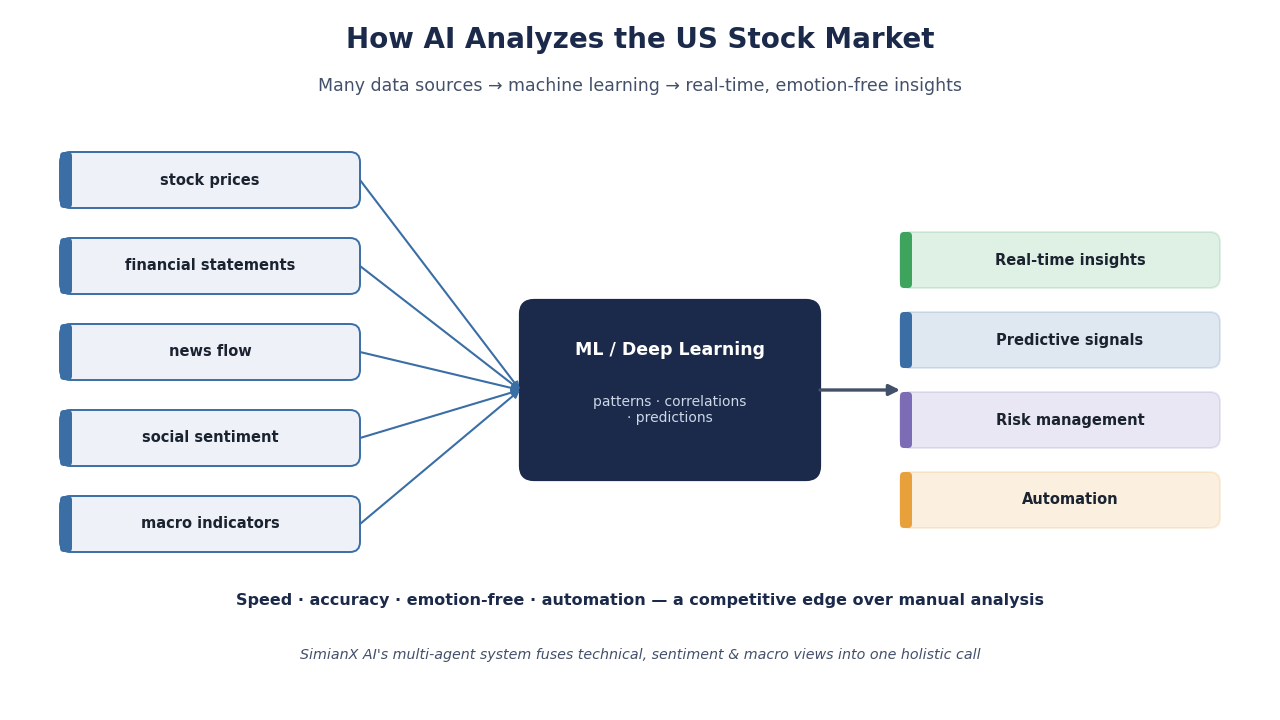
AI, specifically machine learning (ML) and deep learning (DL), has revolutionized how we approach stock market analysis. By processing vast amounts of data quickly and accurately, AI tools can detect patterns, correlations, and trends that may go unnoticed by traditional analysis. The ability of AI to analyze both structured and unstructured data—from stock prices to social media sentiment—allows it to provide real-time insights, offering investors a competitive edge.
Key Features of AI in Stock Market Analysis:
- Real-time Data Processing: AI models process massive volumes of real-time data from a variety of sources, including financial statements, stock prices, news, social media, and macroeconomic indicators. This helps investors stay ahead of market changes by providing up-to-date insights.
- Predictive Power: Machine learning algorithms are trained on historical data to identify patterns that repeat over time. These patterns are then used to predict future market movements, which can be incredibly valuable for making informed investment decisions.
- Risk Management and Optimization: AI can analyze market volatility, economic signals, and trading patterns to identify potential risks. With AI tools, investors can set up automated alerts and stop-loss levels to manage risk more effectively.
"AI-driven tools do not just help in identifying market trends, but they also enable investors to act on these insights faster and more accurately than ever before."
Benefits of Using AI for Stock Market Trends:
- Speed: AI can analyze large amounts of data much faster than a human can.
- Accuracy: With advanced algorithms, AI systems can make predictions with a higher degree of accuracy based on historical data.
- Emotion-Free Analysis: AI models don't get swayed by emotions, unlike human investors who can sometimes let sentiment influence their decisions.
- Automation: AI can automate trades and adjustments based on predetermined thresholds, reducing manual intervention.
Example of AI Predictions in Action
Let’s consider an AI model analyzing a major tech stock like Apple Inc. (AAPL). By pulling data from various sources—such as past performance, analyst ratings, earnings reports, and even social media sentiment—the AI can predict whether the stock is likely to see an upward or downward movement in the coming weeks. The AI would then deliver a recommendation for buying or selling based on this analysis.
In this example, SimianX AI, with its advanced multi-agent system, can integrate multiple perspectives—technical analysis, sentiment analysis, and even macroeconomic indicators—to offer a holistic view of the stock's future performance. This makes it easier for investors to act on the most reliable data available.
How AI Forecasts US Stock Market Movements
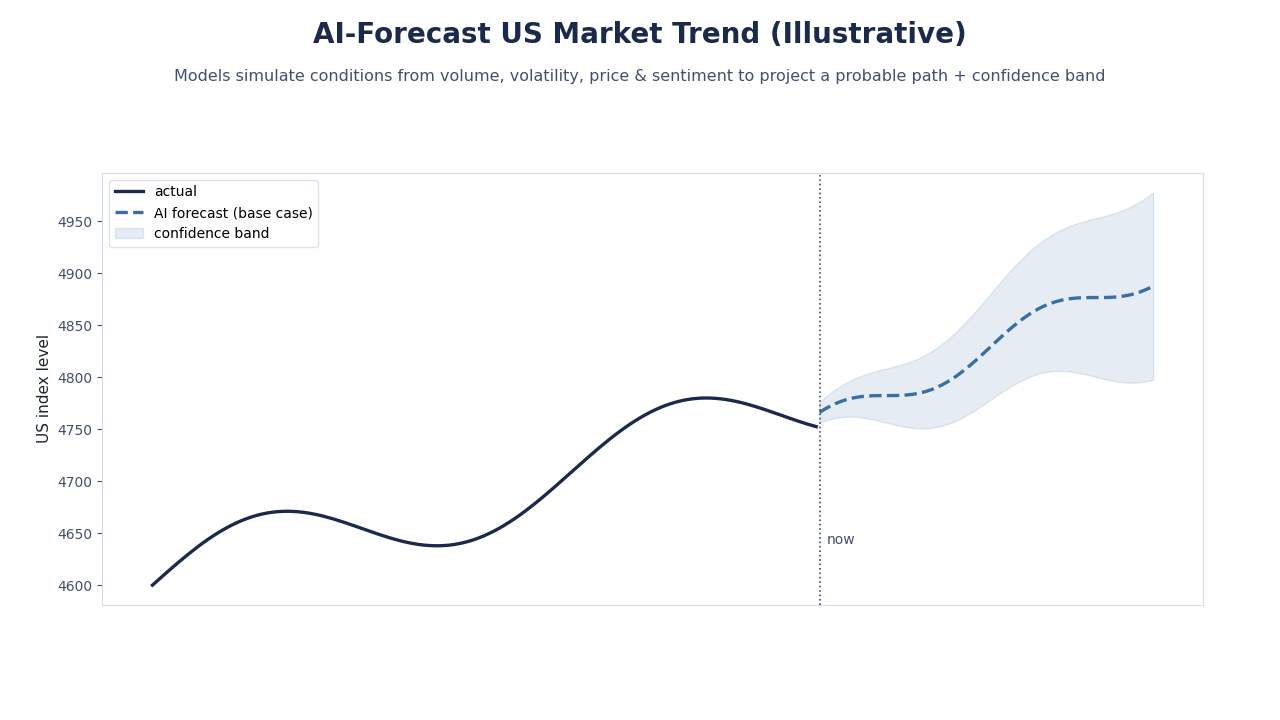
AI models work by analyzing both past and current data to forecast future market movements. They use sophisticated algorithms to analyze key metrics such as trading volumes, stock volatility, price movements, and news sentiment. With these metrics, AI can build a model that simulates market conditions and predicts future price movements with a high degree of accuracy.
Types of AI Models Used for Forecasting
- Supervised Learning: In supervised learning, AI models are trained on labeled data (e.g., past stock prices). These models learn to predict future outcomes based on patterns in the data.
- Unsupervised Learning: This type of AI doesn't rely on labeled data but instead finds hidden patterns and relationships in the data.
- Reinforcement Learning: This type of AI learns by trial and error, receiving feedback on its actions, which is useful for real-time trading scenarios.
Sentiment Analysis and Market Movements
Sentiment analysis is a crucial tool in AI-based stock market forecasting. It involves analyzing social media platforms, news sources, and financial blogs to gauge public sentiment toward a particular stock or the market as a whole. By interpreting positive, negative, or neutral sentiments, AI can predict how market psychology may influence stock movements.
For example, if there is a lot of positive sentiment surrounding a stock due to a new product launch or favorable earnings report, the AI model may predict an increase in stock prices. On the other hand, negative sentiment—such as news of a scandal or unfavorable earnings report—could suggest a downturn in the stock’s performance.
Why Risk Management is Crucial in AI-Driven Stock Market Analysis
One of the greatest benefits of AI in stock market analysis is its ability to help investors manage risk. AI tools, such as SimianX AI, provide predictive insights that go beyond just identifying trends—they can also predict when and how market volatility is likely to increase.
AI-Driven Risk Management Features
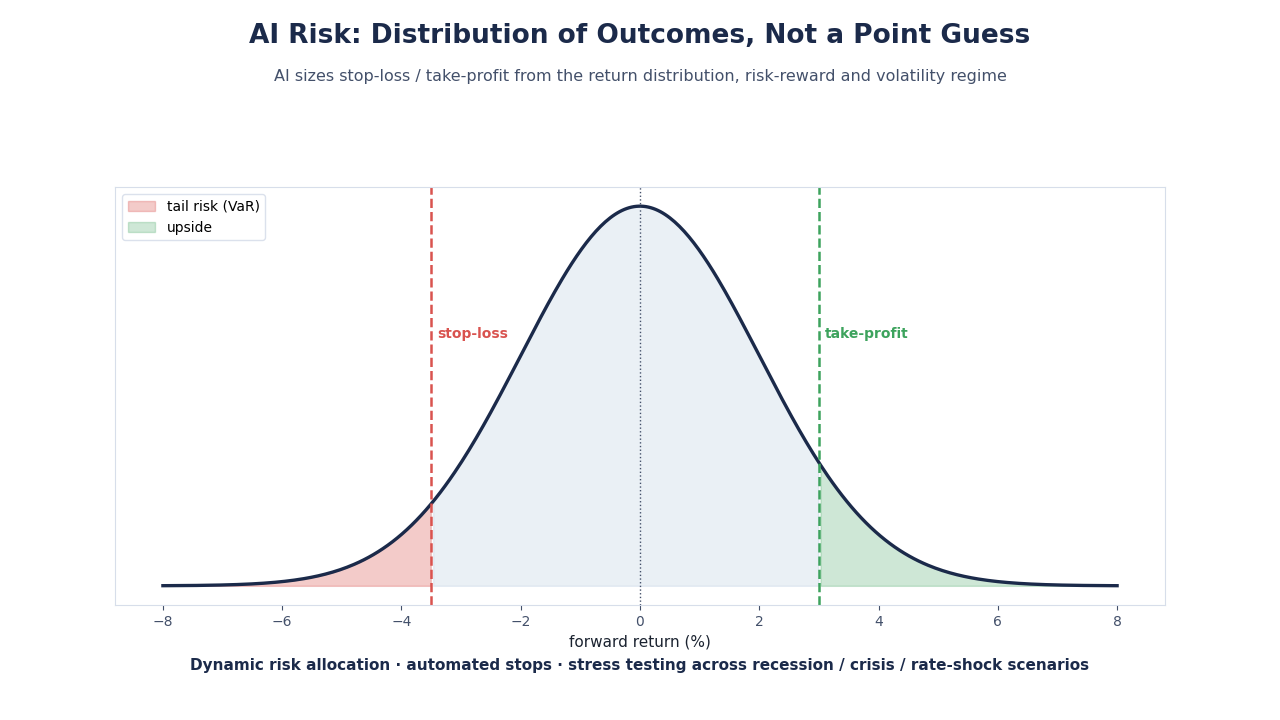
- Automated Stop-Loss and Take-Profit Levels: Based on AI predictions, investors can set automated stop-loss and take-profit levels to protect their investments. These levels are calculated based on risk-reward ratios, market conditions, and potential market volatility.
- Dynamic Risk Allocation: AI models can adjust risk levels in real-time depending on market conditions, such as during times of high volatility. This ensures that investors are never overly exposed to high-risk assets.
- Market Stress Testing: AI can simulate different market scenarios—like a recession, a financial crisis, or rapid interest rate hikes—to test how well a portfolio would perform under stress. This is particularly useful for managing long-term portfolios and adjusting positions before significant market shifts occur.
Example of AI Risk Management in Action
Imagine you’re holding a diversified portfolio consisting of technology, healthcare, and consumer goods stocks. The AI system detects increasing volatility in the tech sector due to potential regulatory changes. In real-time, the system adjusts your exposure, shifting a portion of your holdings into safer assets, such as healthcare stocks, which are less volatile. This ensures that your portfolio is better positioned to weather market uncertainty.
Integrating AI Into Your Stock Market Strategy
To leverage AI effectively, investors need to integrate AI insights into their overall stock market strategy. Here’s how you can start incorporating AI into your investment approach:
Steps for AI Integration:
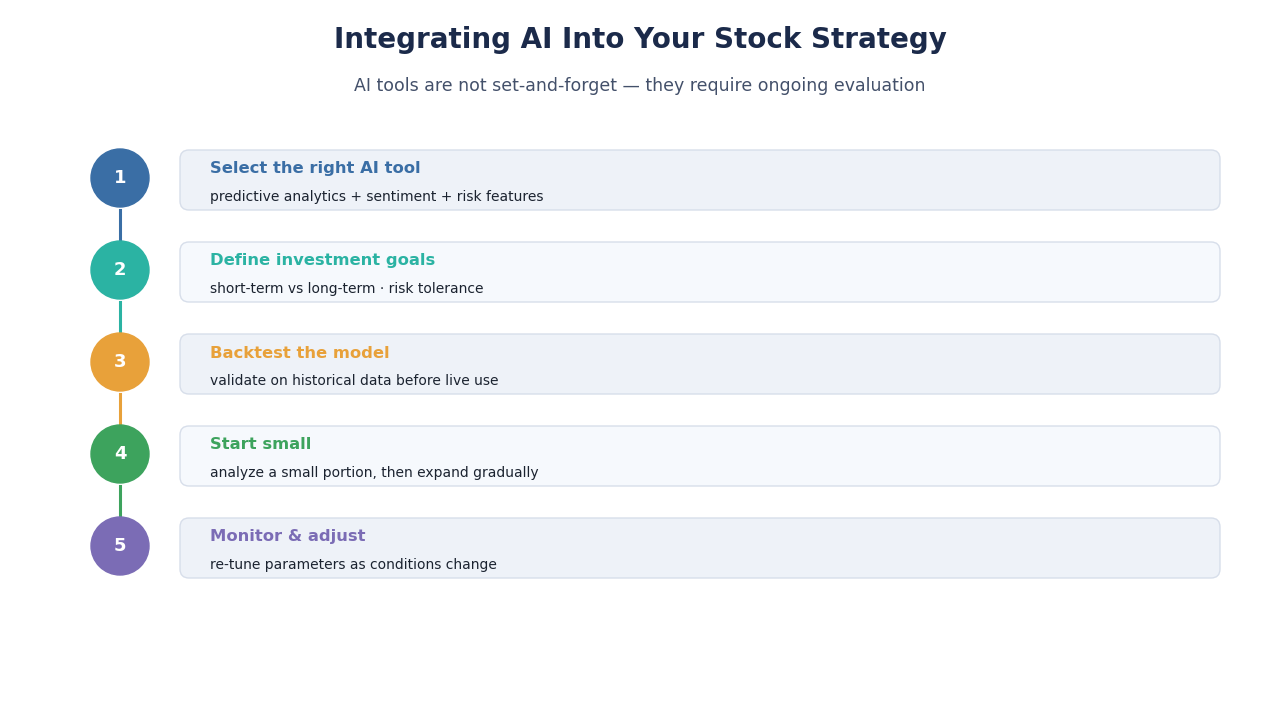
- Select the Right AI Tool: Choose an AI-powered tool like SimianX AI that provides predictive analytics, sentiment analysis, and risk management features.
- Define Your Investment Goals: Whether you’re looking for short-term gains or long-term growth, determine your investment goals and risk tolerance. This will help you set the parameters for your AI model.
- Backtest the AI Model: Before relying on AI for live trading, backtest the model using historical data. This will give you a sense of how accurate the model’s predictions are and whether it aligns with your strategy.
- Start Small: Begin by using AI to analyze a small portion of your portfolio. Gradually expand its role as you become more comfortable with the insights it provides.
- Monitor and Adjust: Regularly monitor the AI’s performance and adjust its parameters as market conditions change. AI tools are not set-and-forget solutions; they require ongoing evaluation.
| Step | Action |
|---|---|
| Step 1: Select AI Tool | Choose SimianX AI for advanced stock market analysis. |
| Step 2: Define Goals | Set investment goals and risk tolerance. |
| Step 3: Backtest | Use historical data to validate the AI's predictions. |
| Step 4: Start Small | Begin with a small portfolio to test the AI’s effectiveness. |
| Step 5: Monitor & Adjust | Evaluate and adjust AI predictions regularly. |
What Are the Best AI Tools for Stock Market Analysis?
While there are many AI tools available for stock market analysis, not all of them offer the same level of depth, accuracy, or ease of use. Some of the top tools that can help investors make more informed decisions include:
- SimianX AI: Known for its multi-agent system and data-driven decision-making, SimianX AI provides both technical and fundamental insights.
- Trade Ideas: An AI-powered stock scanner that analyzes data to identify trading opportunities.
- MetaStock: Uses AI to predict future stock prices based on historical patterns.
- Kavout: A tool that uses machine learning algorithms to rank stocks and predict their future movements.
FAQ About US Stock Market AI Insights
How does AI predict stock market trends?
AI predicts stock market trends by analyzing large datasets, including historical price movements, news sentiment, and macroeconomic indicators. Machine learning algorithms then detect patterns that help forecast future price directions.
What are the best AI tools for stock market analysis?
Some of the best AI tools for stock market analysis include SimianX AI, Trade Ideas, and MetaStock. These tools use AI to process vast amounts of data, providing valuable insights and predictions.
How can AI help with risk management in stock market investing?
AI helps with risk management by predicting market volatility and adjusting risk levels in real time. It can also set stop-loss levels, recommend diversification strategies, and identify stress points in the market.
Conclusion
The integration of AI into stock market analysis provides investors with the tools they need to gain a competitive edge. By utilizing AI-driven insights, investors can better understand market dynamics, predict trends, and manage risks more effectively. SimianX AI offers a powerful platform for making data-driven decisions in the US stock market, ensuring that investors are always ahead of the curve. To unlock the full potential of AI in stock market forecasting and risk management, explore SimianX AI and see how it can enhance your investment strategy.
Related Reading
- The S&P 500 Sector Rotation Playbook for AI Signals
- S&P 500 to 7000: Momentum, Liquidity & Valuation Signals
- US Stock Risk Dashboard: AI Signals from Breadth, Spreads
- Nasdaq 100 Liquidity Pulse: Yields, Spreads, Revisions
- S&P 500 Risk Radar: AI Signals from Breadth, Revisions
- Why US Stocks & Crypto Plummeted This Week: The Causes