
AI Rally Stress Test: Nvidia Earnings and 5% Yields
The AI rally stress test Nvidia earnings and 5% yields narrative has become one of the most important market questions for investors watching NVDA, the Nasdaq, and AI infrastructure stocks. Nvidia’s next report is not just another earnings event; it is a referendum on whether AI capital spending can keep expanding fast enough to justify premium valuations while long-duration Treasury yields pressure equity multiples. For readers using SimianX AI, this is exactly the kind of cross-asset setup where fundamentals, technicals, news sentiment, and risk management need to be analyzed together.
Why Nvidia Earnings Are the Center of the AI Rally Stress Test
Nvidia is the market’s clearest proxy for the AI infrastructure cycle. Its fiscal Q4 2026 results showed record quarterly revenue of $68.1 billion, up 73% year over year, and record Data Center revenue of $62.3 billion, up 75% year over year. Nvidia also guided for fiscal Q1 2027 revenue of $78.0 billion, plus or minus 2%, while stating that its outlook did not assume Data Center compute revenue from China.
That matters because the AI rally has become increasingly dependent on a small group of companies tied to compute, networking, memory, power infrastructure, and hyperscale data centers. When Nvidia beats expectations, the market often treats it as confirmation that AI capex remains durable. When Nvidia disappoints, investors may question whether the entire AI trade has pulled forward too much future growth.
Key takeaway: Nvidia earnings are no longer just about one company’s revenue. They are a market-wide test of AI demand, data-center spending, gross margins, and investor confidence.
Nvidia has scheduled its fiscal Q1 2027 financial results conference call for Wednesday, May 20, 2026, at 2 p.m. PT / 5 p.m. ET, covering the quarter ended April 26, 2026. The company said written CFO commentary will be posted after results are publicly announced at approximately 1:20 p.m. PT.
For investors, the most important items to watch are:
- Data Center revenue growth and whether it tracks the $78 billion revenue outlook.
- Gross margin stability, especially as Blackwell, Rubin, networking, and systems revenue mix evolves.
- China-related demand risk, because Nvidia explicitly excluded China Data Center compute revenue from guidance.
- Hyperscaler capex commentary, since Nvidia demand depends heavily on Microsoft, Amazon, Google, Meta, Oracle, and AI cloud providers.
- Inference economics, including cost per token and monetization of agentic AI workloads.
- Start with revenue versus guidance.
- Compare Data Center growth to total company growth.
- Track margin commentary and product mix.
- Read customer demand signals, not just headline EPS.
- Watch post-earnings reaction in
NVDA,QQQ, semiconductors, and software.
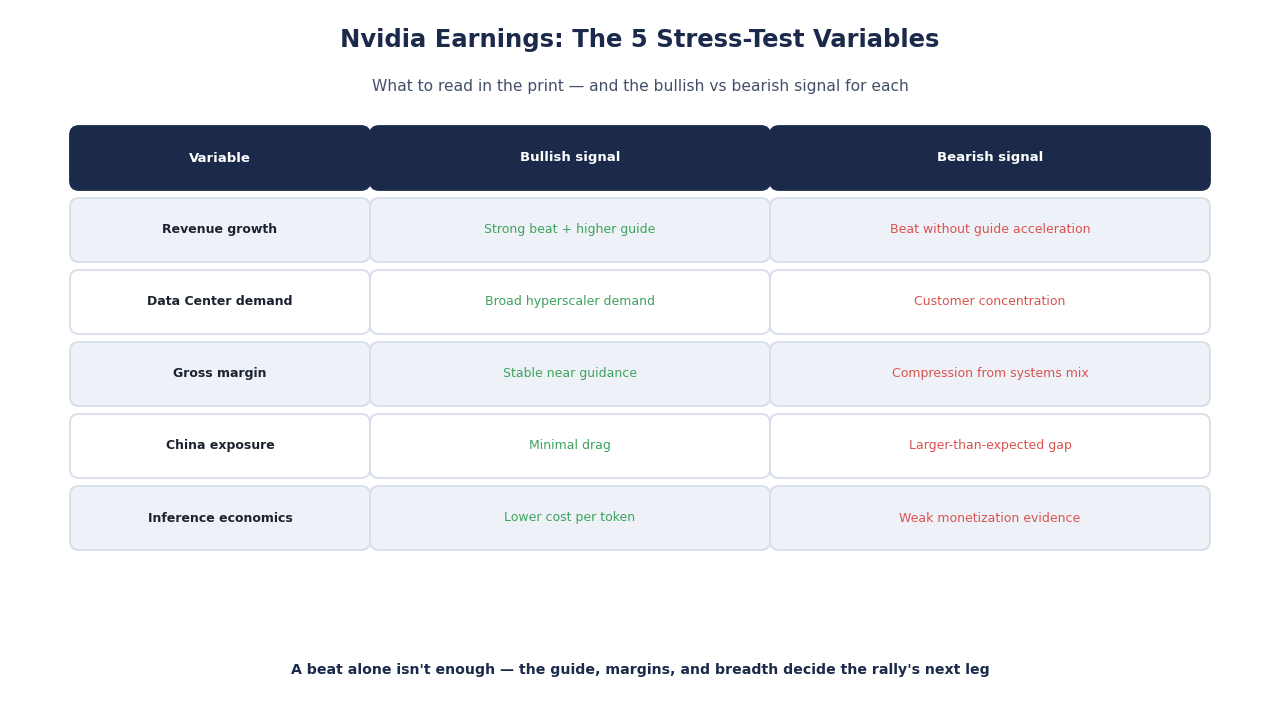
| Stress-Test Variable | Why It Matters | Bullish Signal | Bearish Signal |
|---|---|---|---|
| Revenue growth | Confirms AI capex momentum | Strong beat and higher guide | Beat without guide acceleration |
| Data Center demand | Core driver of AI rally | Broad hyperscaler demand | Customer concentration concerns |
| Gross margin | Measures pricing power | Stable near guidance | Compression from systems mix |
| China exposure | Regulatory and demand risk | Minimal drag | Larger-than-expected gap |
| Inference economics | Supports long-term AI ROI | Lower cost per token | Weak monetization evidence |
Why 5% Treasury Yields Make AI Stocks More Fragile
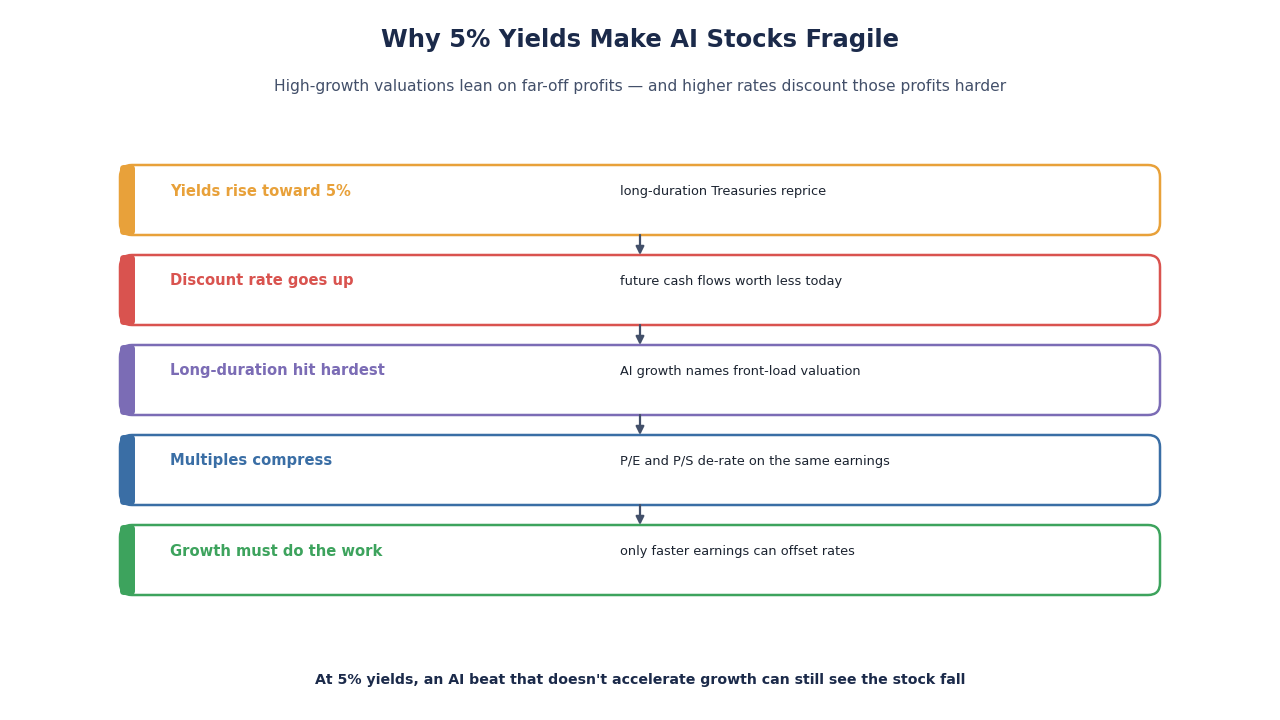
The second side of the AI rally stress test is rates. Long-duration growth stocks are especially sensitive to rising discount rates because much of their valuation depends on cash flows expected far in the future. When Treasury yields rise toward or above 5%, investors can demand a higher equity risk premium, compressing price-to-earnings multiples even for companies with excellent fundamentals.
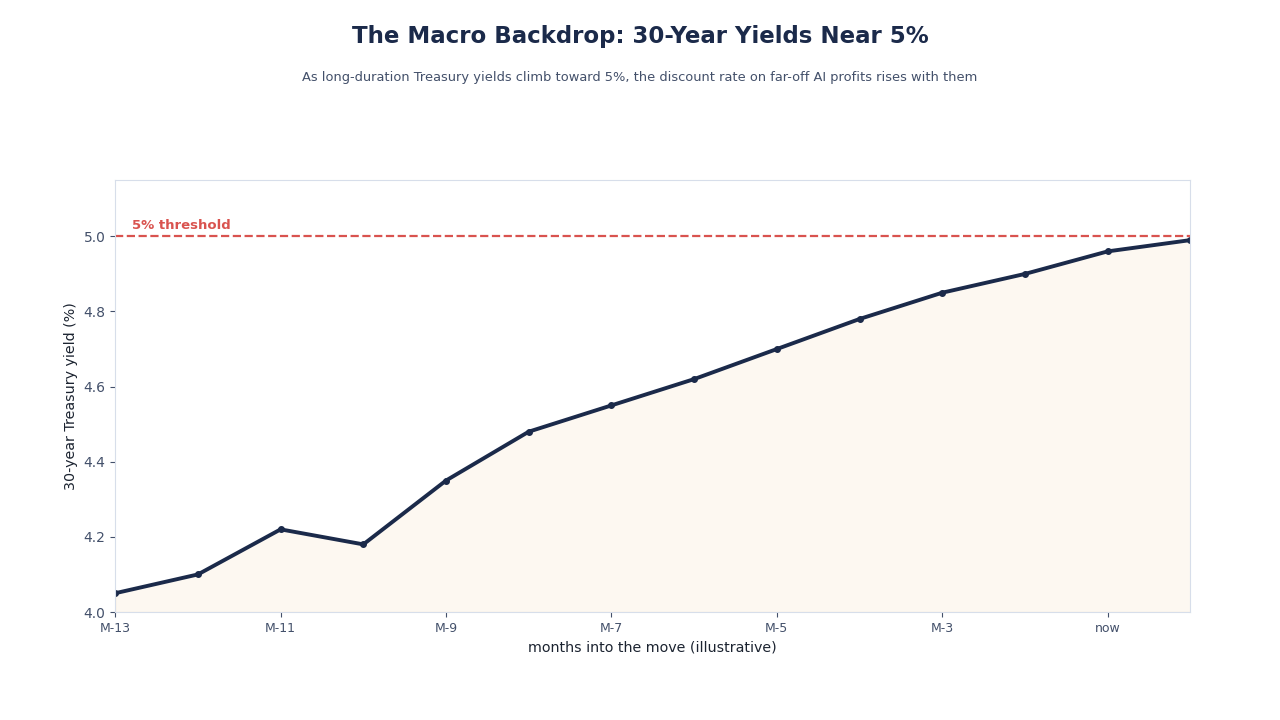
The 30-year U.S. Treasury constant maturity yield recently reached the 5% zone, creating a valuation challenge for AI leaders: even if earnings keep rising, the multiple investors are willing to pay for those earnings may fall.
This is why the phrase “Nvidia earnings and 5% yields” is so important. It captures a classic market tension:
- Nvidia earnings test the growth numerator.
- Treasury yields test the discount-rate denominator.
- Equity prices move based on how both forces interact.
If inflation remains sticky or term premiums rise, the long end of the curve can continue to pressure high-multiple AI stocks even if the Federal Reserve’s policy-rate path looks relatively stable.
What happens to AI stocks when yields rise toward 5%?
When yields rise, AI stocks can still go up—but the hurdle rate becomes much higher. Investors become less forgiving of execution risk, inventory cycles, capex slowdowns, and stretched valuations. A company like Nvidia can absorb some rate pressure if earnings revisions keep moving sharply higher, but weaker AI-linked names may suffer multiple compression.
The most vulnerable AI stocks are not always the lowest-quality companies. Often, they are the stocks where expectations are already extremely high and where valuation leaves little room for slower growth.
The Market Setup Before Nvidia Earnings
The market’s setup heading into Nvidia earnings looks like a tug-of-war between powerful AI optimism and rising macro pressure. Pre-earnings strength can be constructive, but it also raises the bar. If a stock rallies into earnings, the report must often be not merely good, but better than the market’s already elevated expectations.
For AI investors, the challenge is separating durable demand signals from sentiment-driven momentum.
A practical research framework should ask three questions:
- Is AI demand still accelerating?
Look for order visibility, cloud-provider demand, backlog commentary, networking strength, and inference workloads.
- Are margins holding up?
Strong revenue growth is less valuable if systems complexity, supply-chain costs, or competitive pricing pressure reduces profitability.
- Can valuation survive 5% yields?
A high-quality company can still be a poor short-term trade if the multiple is too rich relative to rates.
| Market Factor | Impact on AI Rally | Research Question |
|---|---|---|
| Nvidia earnings | Confirms or challenges AI demand | Are results broad-based or customer-specific? |
| 30-year Treasury near 5% | Pressures valuation multiples | Is growth strong enough to offset higher discount rates? |
| Analyst upgrades | Supports sentiment | Are estimates rising faster than price? |
| Hyperscaler capex | Drives AI infrastructure | Are cloud customers still spending aggressively? |
| Macro inflation | Limits rate-cut hopes | Are yields rising for growth or inflation risk? |
SimianX AI is useful in this type of environment because its platform is designed to combine price action, real-time news, fundamental inputs, SEC data, technical indicators, and AI-generated trading signals rather than relying on a single narrative.
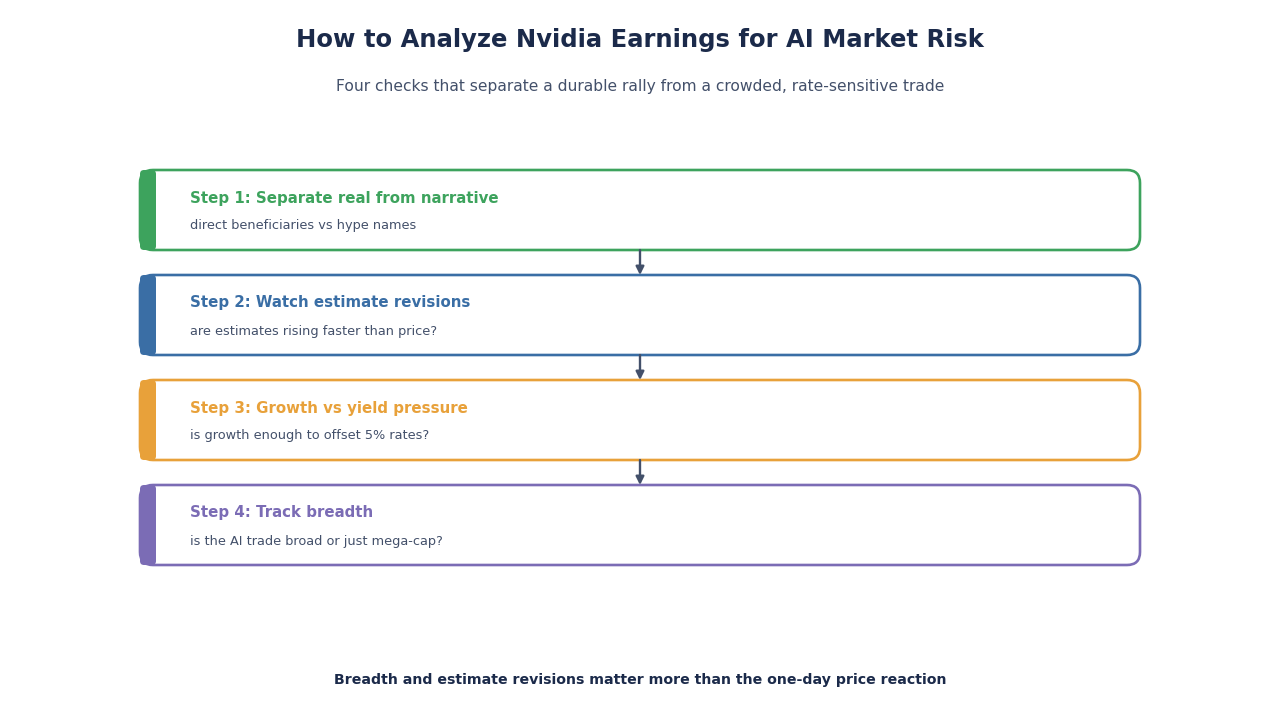
How to Analyze Nvidia Earnings for AI Stock Market Risk
A strong Nvidia report does not automatically mean every AI stock should rally. The key is to identify which companies benefit directly, which benefit indirectly, and which may already price in too much perfection.
Step 1: Separate direct beneficiaries from narrative beneficiaries
Direct beneficiaries include companies exposed to AI GPUs, networking, memory, advanced packaging, power, cooling, and data-center construction. Narrative beneficiaries include software or platform companies that mention AI but have not yet shown measurable revenue acceleration.
Direct AI infrastructure exposure usually deserves a higher-quality rating than vague “AI transformation” language.
Step 2: Watch estimate revisions, not only the stock reaction
A stock can sell off after a good report if expectations were too high. Conversely, a stock can rally after a mixed report if forward estimates move higher. The most important post-earnings signal is whether analysts increase revenue, EPS, free cash flow, and margin forecasts for the next several quarters.
Step 3: Compare AI growth against yield pressure
If the 30-year Treasury yield remains near 5%, long-duration equities need faster earnings growth to maintain the same valuation. This creates a simple but powerful rule:
The higher the yield, the more evidence investors need that AI growth is real, profitable, and durable.
Step 4: Track breadth across the AI trade
A healthy AI rally should broaden beyond Nvidia. Watch semiconductor equipment, memory, networking, cloud infrastructure, power suppliers, data-center REITs, and software companies with real AI revenue. If Nvidia rises but the broader AI ecosystem weakens, the rally may be narrowing.
How SimianX AI Can Help Investors Monitor the Stress Test
During an event-driven week, investors need more than static charts. They need a workflow that updates as news, price, volume, and earnings expectations change. SimianX AI positions itself as a multi-agent AI platform for stock and crypto analysis, including technical analysis, fundamentals, news sentiment, trading signals, and risk-management support.
For the AI rally stress test Nvidia earnings and 5% yields setup, a practical SimianX-style workflow might look like this:
- Create a watchlist with
NVDA,SMH,QQQ, hyperscalers, memory names, and AI power-infrastructure stocks. - Track technical levels such as pre-earnings highs, 20-day moving averages, gap zones, and relative strength.
- Monitor news sentiment around hyperscaler capex, export controls, supply constraints, and analyst revisions.
- Compare fundamentals across revenue growth, margins, free cash flow, and valuation.
- Use risk controls such as position sizing, stop levels, and scenario-based exposure caps.
| Investor Need | Practical Tool Use | Why It Helps |
|---|---|---|
| Earnings reaction | Real-time stock analysis | Captures price and volume shifts |
| Macro pressure | Yield-aware watchlist | Connects rates to growth valuations |
| Sentiment shifts | News and SEC monitoring | Reduces blind spots |
| Risk management | Multi-scenario planning | Avoids emotional overtrading |
| Trade timing | Technical indicators | Adds discipline to entries and exits |
This approach does not eliminate risk, but it helps investors avoid making decisions from headlines alone. When Nvidia earnings and 5% yields collide, the winning edge often comes from seeing the full picture faster and more clearly.
Bull, Base, and Bear Scenarios for the AI Rally
A research article on this topic should not make a single-point forecast. The more useful approach is scenario planning.
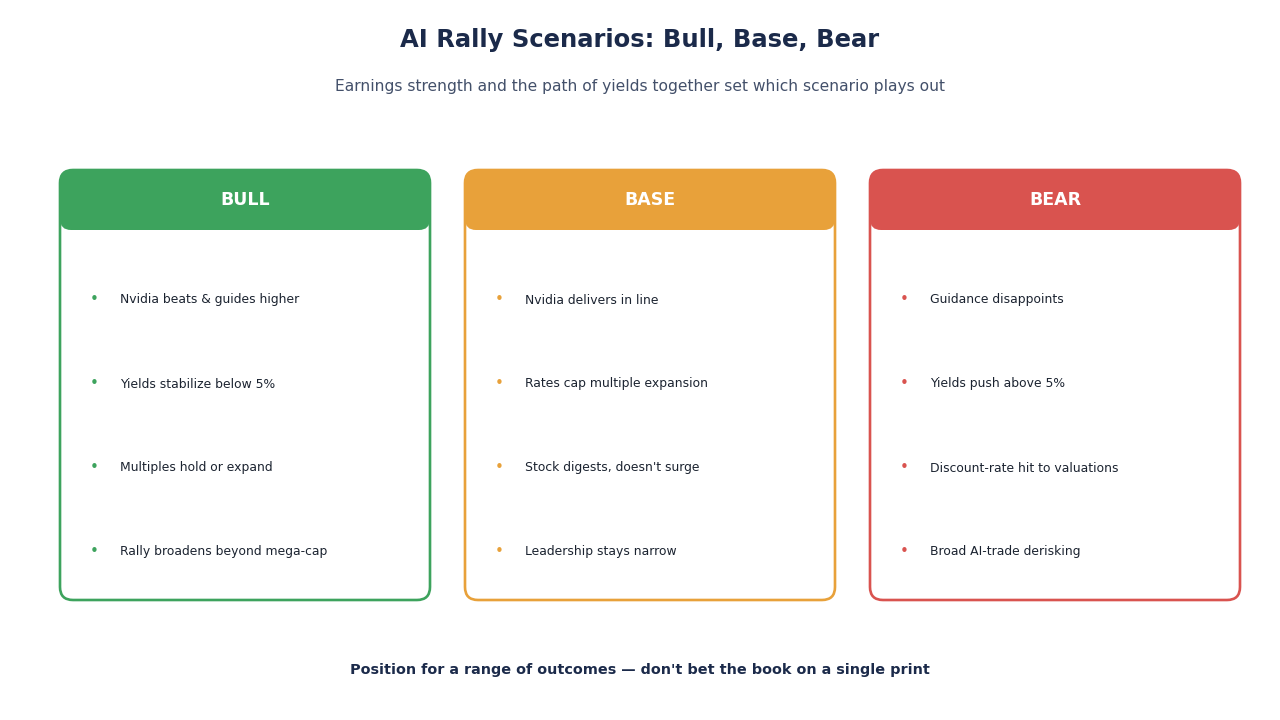
Bull Case: Nvidia Beats, Guides Higher, and Yields Stabilize
In the bull case, Nvidia exceeds expectations, raises forward guidance, confirms strong Blackwell and Rubin demand, and shows margin resilience. At the same time, Treasury yields stop rising or retreat from the 5% zone. This would support renewed appetite for AI infrastructure stocks and could broaden the rally into semiconductors, memory, cloud, and power infrastructure.
Likely market reaction: NVDA leads, SMH strengthens, QQQ outperforms, and high-quality AI infrastructure names see estimate upgrades.
Base Case: Nvidia Delivers, but Rates Limit Multiple Expansion
In the base case, Nvidia reports strong numbers, but the surprise is not large enough to reset the entire AI trade. Yields remain elevated, and investors rotate toward companies with visible cash flow, pricing power, and reasonable valuations.
Likely market reaction: winners and losers diverge sharply. Quality AI names hold up; speculative AI stocks lag.
Bear Case: Guidance Disappoints While Yields Push Higher
In the bear case, Nvidia’s guidance falls short of elevated expectations or management commentary suggests supply, margin, China, or customer-timing risk. If long-end Treasury yields stay around 5% or rise further, valuation pressure could intensify.
Likely market reaction: NVDA sells off, AI beta compresses, semiconductor ETFs weaken, and investors rotate toward defensive sectors or cash-flow compounders.
Risk Management Checklist for Trading AI Stocks Before Nvidia Earnings
The best way to trade AI stocks before Nvidia earnings is to define risk before the event. Earnings weeks are volatile because price moves reflect not just the numbers, but expectations, positioning, options activity, and macro conditions.
Use this checklist:
- Know the event time: Confirm the exact Nvidia earnings release and conference-call schedule.
- Avoid oversized positions: Event risk can create gaps that ignore stop-loss orders.
- Watch yields daily: A 5% long bond can pressure tech multiples even on good company news.
- Compare peers: If Nvidia rallies but peers fall, breadth may be weak.
- Separate investing from trading: A long-term AI thesis does not require short-term overexposure.
- Review options pricing: Elevated implied volatility can make directional bets expensive.
- Plan three outcomes: Beat-and-raise, in-line, and disappointment.
What is the best way to trade AI stocks before Nvidia earnings?
The best way is to avoid making the trade depend on one binary outcome. Investors can use smaller position sizes, staggered entries, hedges, or watchlist triggers. A disciplined approach focuses on post-earnings confirmation: whether price action, volume, and estimate revisions all support the same conclusion.
For example, a trader might wait for NVDA to reclaim a post-earnings high with strong volume before adding exposure. A longer-term investor might instead focus on whether Nvidia’s results strengthen the multi-year AI infrastructure thesis.
FAQ About AI Rally Stress Test Nvidia Earnings and 5% Yields
How will Nvidia earnings affect AI stocks in 2026?
Nvidia earnings can affect AI stocks by confirming or challenging the market’s expectations for AI infrastructure spending. Strong Data Center growth and higher guidance would likely support semiconductors, cloud infrastructure, and AI hardware suppliers, while weaker guidance could trigger a broader reset in AI valuations.
What happens to AI stocks when Treasury yields reach 5%?
When Treasury yields reach 5%, investors often demand stronger earnings growth to justify high equity valuations. This can pressure AI stocks with stretched multiples, especially companies that lack clear revenue, margin, or cash-flow evidence.
Is Nvidia still the most important AI stock to watch?
Nvidia remains one of the most important AI stocks because its GPUs, networking, and AI systems sit at the center of the data-center buildout. Its Data Center revenue remains a central indicator of AI infrastructure demand.
What should investors watch besides Nvidia earnings?
Investors should watch Treasury yields, hyperscaler capex plans, semiconductor equipment demand, memory pricing, AI power infrastructure, and market breadth. A sustainable AI rally should show strength beyond a single mega-cap stock.
How can AI tools help analyze Nvidia earnings and 5% yields?
AI tools can help by scanning fundamentals, technical indicators, news sentiment, and risk signals in real time. SimianX AI’s multi-agent approach is designed to bring multiple analytical perspectives into one workflow, helping investors make more structured decisions during volatile market events.
Conclusion
The AI rally stress test Nvidia earnings and 5% yields theme captures the market’s biggest near-term question: can AI earnings growth remain powerful enough to offset higher discount rates? Nvidia’s upcoming earnings event will test whether demand for AI compute, networking, and data-center infrastructure is still accelerating. At the same time, 30-year Treasury yields around 5% remind investors that valuation discipline matters.
The strongest takeaway is simple: AI remains a powerful structural theme, but not every AI stock deserves the same valuation or risk budget. Investors should focus on revenue durability, margin quality, estimate revisions, balance-sheet strength, and macro sensitivity.
To navigate this kind of market with more structure, explore SimianX AI and use its AI-powered market analysis workflow to monitor Nvidia, AI stocks, Treasury-yield pressure, and risk signals in one place.
Related Reading
- Alphabet Nears Nvidia in Market Value as AI Trade Broadens
- AI Chip Stocks Stay Strong: AMD, Intel Drive Data Centers
- Multi-Agent AI vs ChatGPT for NVDA Signals: 2026 Comparison
- Trump Financial Disclosure 2026: Nvidia Buy, Microsoft Sale