 By Marcus Reeve
Comparing BTC, ETH and SOL: Where to Buy This Dip
Every crypto drawdown forces the same question to the front of the queue: which coin is actually worth buying, and at what price? In the 2026 selloff that question is sharper than usual, because the three assets most investors actually hold — Bitcoin, Ethereum and Solana — are not the same kind of bet. They sit at wildly different market caps, they run on different narratives, and they fall (and recover) with very different force.
This is a side-by-side comparison of BTC, ETH and SOL built around one practical idea: the price you pay decides the return you earn. A great asset bought at a bad price is a mediocre investment; an ordinary asset bought at a great price can be a spectacular one. So instead of arguing about which coin is "best" in the abstract, we map the deep-dip accumulation zone for each — the band where prior-cycle support, capitulation history and valuation all line up — and then judge the risk and reward of buying there.
The zones we anchor to are roughly BTC $25,000–$35,000, ETH $800–$1,000, and SOL $8–$36. As of June 2026 all three trade well above those levels, so treat these as targets for a deeper correction, not predictions that prices will get there. If this dip stays shallow, you simply ladder less and accept a higher average. If it becomes a full cyclical bear like 2022, these are the shelves where disciplined buyers have historically been rewarded. (This article is market education, not personalized financial advice.)
The 2026 Selloff in Context
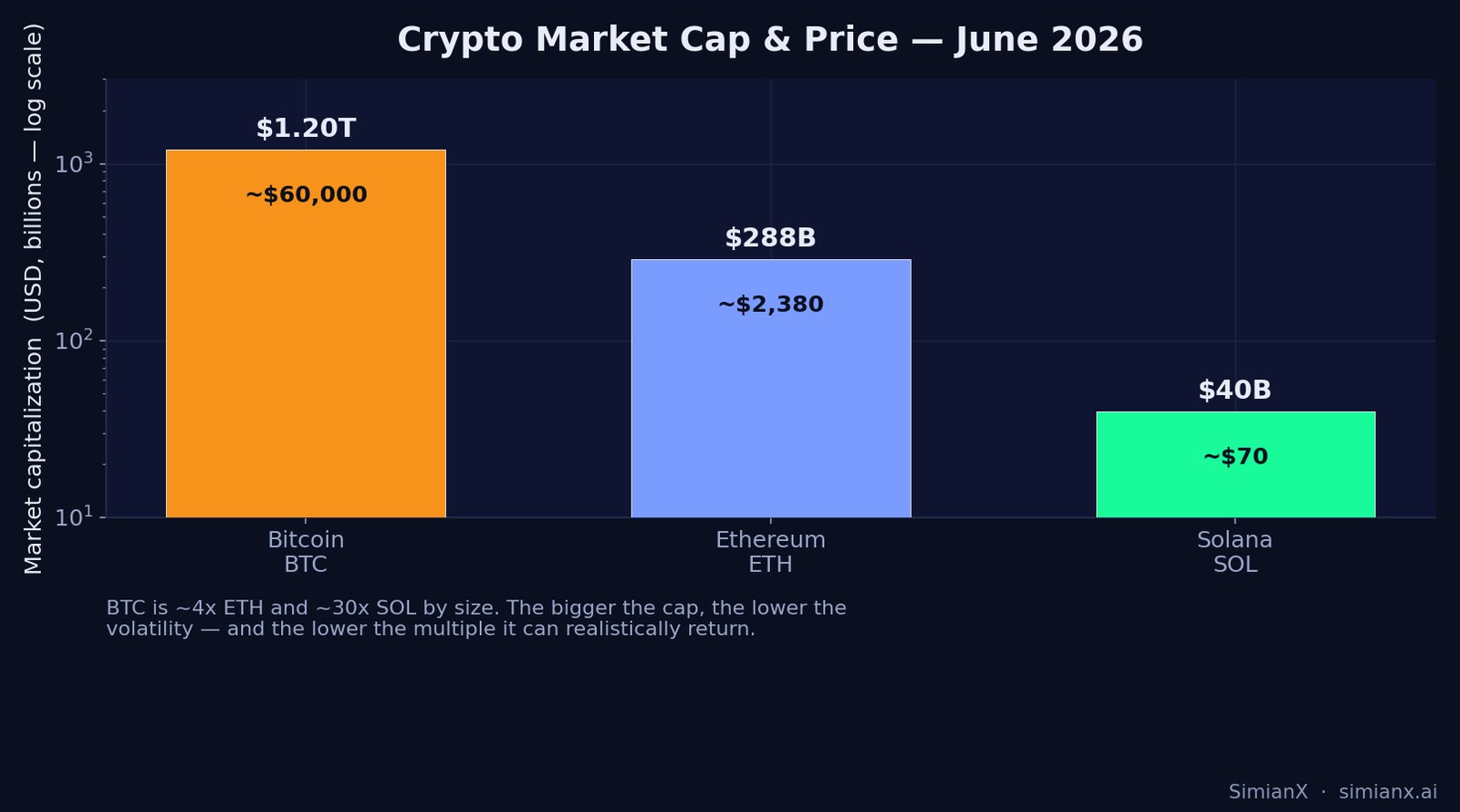
Bitcoin spent the first half of 2026 grinding down toward its lowest levels of the year, pressured by spot-ETF outflows and a broad risk-off rotation into AI equities. We covered the technical picture in Bitcoin Near 2026 Lows: BTC Support & Rebound Signals; the short version is that BTC has been trading in the low-$60,000s, ETH near $2,380, and SOL near $70.
Those are current prices. The buy zones in this article sit far below them, which is the whole point. Crypto is one of the only asset classes where, every few years, the market hands long-term buyers a 60–90% discount on the same coins they were chasing at the top. The 2018–2019 bear, the March 2020 crash, and the 2022 Terra/FTX collapse each produced a generational entry. The job of a serious accumulator is not to predict the bottom to the dollar — it is to decide in advance where to buy, and to actually buy when fear is highest.
To do that across three very different coins, you need a clear read on what each one is.
Three Coins, Three Theses
| Bitcoin (BTC) | Ethereum (ETH) | Solana (SOL) | |
|---|---|---|---|
| Core narrative | Digital gold; conviction & scarcity | RWA & the settlement layer of on-chain finance | Throughput, low fees & meme-coin liquidity |
| Market cap (Jun 2026) | ~$1.20T | ~$288B | ~$40B |
| Approx. price | ~$60,000 | ~$2,380 | ~$70 |
| Supply | Hard-capped at 21M | ~120.6M, fee-burn | ~579M, inflationary |
| What drives it | Macro liquidity, ETF flows, halving cycle | Tokenization, staking, L2 activity | App usage, TPS, retail speculation |
| Primary risk | Slow, "boring," opportunity cost | Execution vs. faster L1s | Outages, dilution, beta |
| Deep-dip buy zone | $25,000–$35,000 | $800–$1,000 | $8–$36 |
These three rows describe three completely different investments wearing the same "crypto" label. Let's take each thesis on its own terms.
Bitcoin: The Conviction Asset
Bitcoin is not a technology bet anymore — it is a monetary bet. The thesis is faith in a fixed supply: 21 million coins, no central issuer, a predictable issuance schedule that halves roughly every four years. Everything else — ETFs, corporate treasuries, nation-state reserves — is downstream of that one idea. People do not hold BTC because it is fast or cheap to use; they hold it because it cannot be debased.
That makes Bitcoin the lowest-beta, highest-certainty asset of the three. At a ~$1.2T market cap it is roughly four times the size of Ethereum and thirty times the size of Solana, and size buys stability. In a bear market BTC almost always falls least in percentage terms, holds support best, and recovers first as liquidity returns. It is the asset you can size largest without losing sleep.
The trade-off is ceiling. From a deep-dip entry, Bitcoin offers the most reliable multiple but the smallest one. Its 2022 cyclical low was about $15,479, and the $25,000–$35,000 band above it has repeatedly acted as a major demand shelf — the level long-term holders defend and institutions accumulate into. Buying BTC there is the closest thing crypto offers to a "core holding at a discount." If you only want one coin and one decision, this is the conservative answer.
Ethereum: The RWA Settlement Layer
Ethereum's 2026 narrative is no longer "world computer" hand-waving — it is real-world assets (RWA), and the numbers are finally real. Tokenized RWAs on-chain pushed past $27 billion in 2026, with Ethereum hosting the dominant share (its RWA market grew more than 300% year over year to roughly $17B). BlackRock's tokenized money-market fund, BUIDL, grew to around $2.9 billion and the firm filed for additional tokenized fund structures in May 2026. Tokenized U.S. Treasuries alone surged into the multi-billions.
Why does this matter for the ETH price? Because Ethereum is where this institutional plumbing is being built. When BlackRock, Franklin Templeton and the rest tokenize treasuries, funds and credit, they overwhelmingly settle on Ethereum and its layer-2 ecosystem. That turns ETH from a speculative token into the collateral and settlement asset of on-chain finance — fees burned, ETH staked, value accruing to the base layer as tokenized finance scales toward its much-hyped multi-trillion-dollar runway.
The risk is competition and execution: faster, cheaper layer-1s are fighting for the same activity, and Ethereum's base layer is deliberately slow. But the moat is trust and liquidity, and that is exactly what institutions optimize for. Ethereum's 2022 low was roughly $880, which makes the $800–$1,000 zone the same band that marked the last cyclical bottom. Buying ETH there is a bet that tokenization is a decade-long trend and that the chain doing most of the settling captures most of the value. It sits in the middle of our three: more upside than BTC, more certainty than SOL.
Solana: Throughput and Meme Liquidity
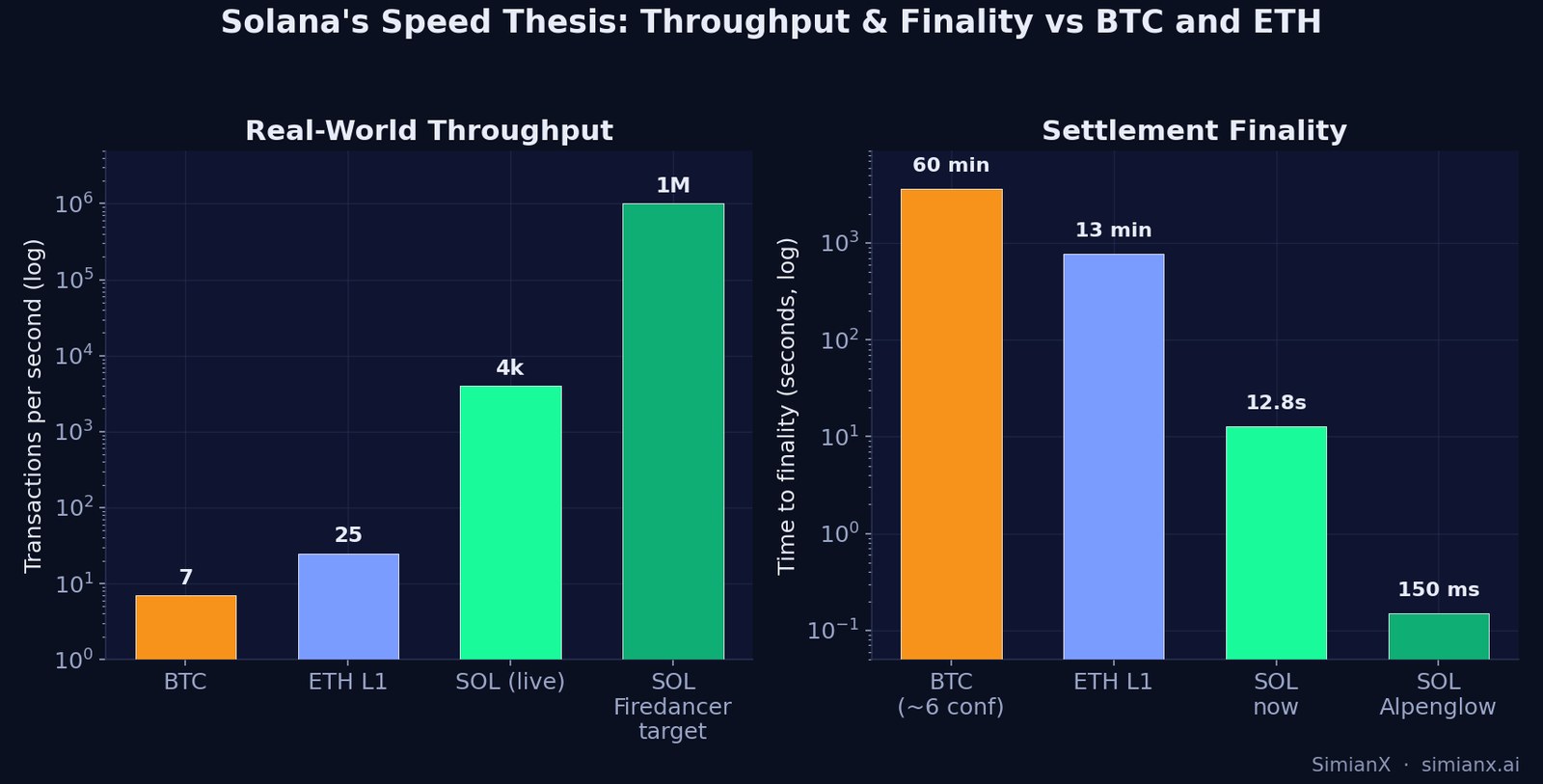
Solana is the high-beta growth bet, and its thesis is raw on-chain performance. Solana processes transactions in a single global state at a speed no other major L1 comes close to — and the team is actively upgrading the chain to widen that lead. Two upgrades define the 2026 story:
- Firedancer — an independent validator client (built by Jump Crypto) that hit mainnet and targets 1,000,000 TPS in testing. It also kills Solana's single-client fragility, the root cause of its past outages. Real-world throughput today already runs in the thousands of TPS as Firedancer adoption rolls out across validators.
- Alpenglow — a new consensus protocol that cuts transaction finality from ~12.8 seconds toward under 150 milliseconds, putting on-chain settlement within shouting distance of centralized-exchange speed. It entered validator testing in 2026 with a mainnet target later in the year.
That performance is why Solana became the home of meme coins and high-frequency retail speculation: when fees are fractions of a cent and blocks are fast, you get the launchpads, the trading bots, and the viral on-chain casinos that drive enormous (if fickle) volume. Speed is the product; meme liquidity is the demand it created.
The catch is everything that comes with high beta. Solana is ~$40B — small enough to move violently in both directions. Its 2022 collapse, accelerated by the FTX implosion, drove SOL from ~$30 to a low of $8.13, a ~97% drawdown. That history defines our $8–$36 zone: $8 is the prior capitulation extreme, and $30–$36 is the reaccumulation range that followed. SOL offers the steepest potential rebound and the deepest potential drawdown of the three. It is the satellite position, not the core.
Accumulation Zones Side by Side
Now put the three buy zones on one chart against today's price and the 2022 low. This is the single most useful picture in the article: it shows how far each coin would have to fall to reach its accumulation band, and how that band relates to the last cyclical bottom.
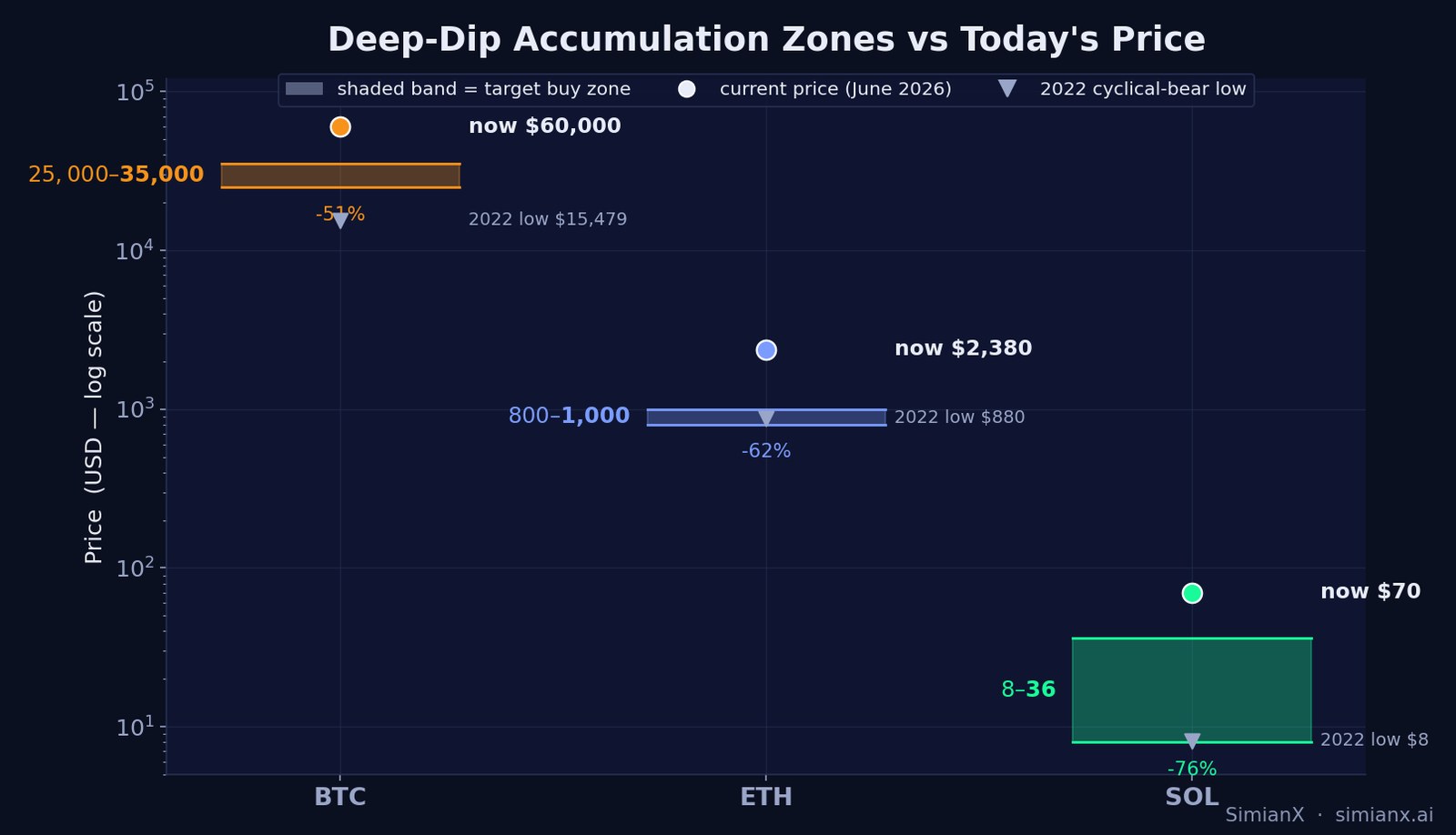
The asymmetry is the real story. Buying near a prior-cycle low caps your downside (there is far less room to fall) while preserving most of the upside to the next cycle. The chart below estimates the multiple each coin would return simply by reclaiming its prior all-time high from the middle of its buy zone.
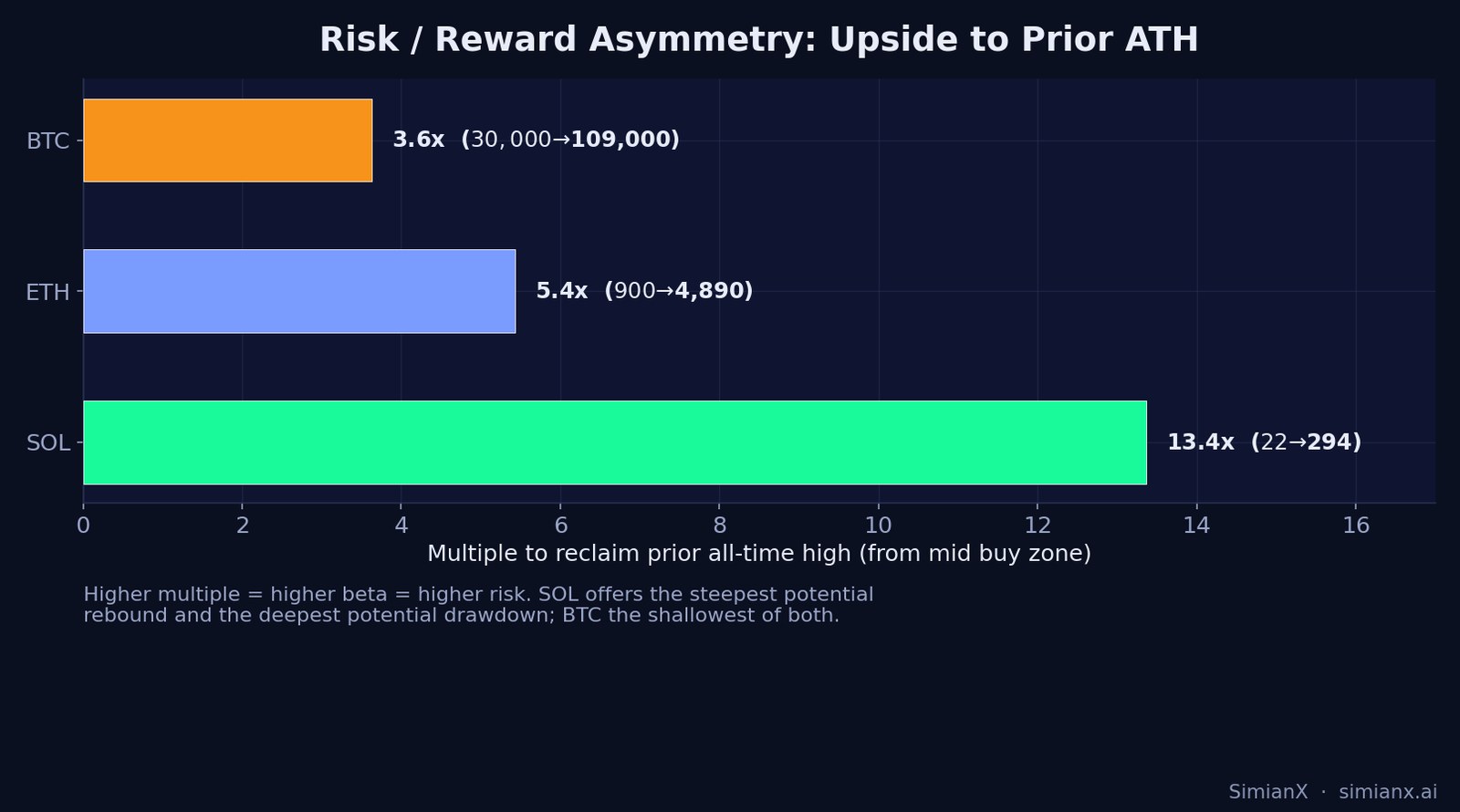
| Coin | Mid-zone entry | Prior ATH | Multiple to reclaim ATH | Risk profile |
|---|---|---|---|---|
| BTC | ~$30,000 | ~$109,000 | ~3.6x | Lowest risk, lowest multiple |
| ETH | ~$900 | ~$4,890 | ~5.4x | Balanced risk/reward |
| SOL | ~$22 | ~$294 | ~13.4x | Highest risk, highest multiple |
Read that table the right way: a 13x is not "better" than a 3.6x. It is higher beta, which means it is also the entry most likely to keep falling, take longest to recover, and test your conviction hardest. The multiple and the risk are the same coin, two sides.
How to Build a Buy Ladder, Not a Single Bet
Nobody catches the exact bottom. The professional move is to ladder — place a series of limit buys across the zone instead of one all-in order — so your average cost lands inside the band even if price never prints the absolute low.
A simple, repeatable framework:
- Decide allocation first, by risk — not by excitement. A common conservative split is roughly 60% BTC / 30% ETH / 10% SOL: the core in the safest asset, a meaningful stake in the balanced one, a satellite in the high-beta one. Tilt it to your own risk tolerance, but size SOL as the position you could see fall 60% and still hold.
- Split each coin's zone into 3–5 rungs. For BTC: orders at $35k, $32k, $29k, $26k. For ETH: $1,000, $925, $850, $800. For SOL: $36, $26, $16, $8. You are guaranteed not to buy the top of the move, and your average sits mid-zone.
- Pre-commit and automate. The entire reason laddering works is that fear peaks exactly when prices are lowest. Set the orders in advance so you don't have to find courage in the moment.
- Keep dry powder. Reserve a final rung for a true capitulation wick — the $15k-BTC / sub-$800-ETH / $8-SOL kind of event that only shows up once a cycle.
This is exactly the kind of disciplined, multi-asset plan that SimianX is built to support. Our crypto leaderboard tracks BTC, ETH, SOL and the rest of the majors in one live command room, where multiple AI models analyze the market, debate the signals, and have their calls scored transparently over time — so you can see which model is actually right about a dip before you act on it. You can browse the AI model leaderboard to compare those track records, and SimianX autopilots can monitor your accumulation zones and surface when price enters a band you care about.
Which Is the Best Buy Right Now?
There is no single answer, because "best" depends on what you are optimizing for. But the framework collapses to three honest statements:
- Want the surest store of value with the least drama? Bitcoin in the $25k–$35k zone. You sacrifice ceiling for certainty. It is the position you can hold through anything.
- Want exposure to the biggest structural trend in crypto — tokenization? Ethereum in the $800–$1,000 zone. You take more execution risk than BTC in exchange for a larger, RWA-driven upside.
- Want maximum asymmetry and can stomach maximum pain? Solana in the $8–$36 zone. The Firedancer/Alpenglow upgrade cycle gives it a genuine fundamental story to back the beta — but size it as a satellite, never the core.
For most investors the answer is not one of these — it is a weighted ladder across all three, anchored to the zones above and executed without emotion. The dip is the opportunity; the discipline is the edge.
FAQ
Are BTC $25k–$35k, ETH $800–$1k and SOL $8–$36 predictions?
No. They are scenario-based accumulation targets anchored to each coin's prior-cycle support and 2022 capitulation low. As of June 2026 all three trade above these levels. They are where a disciplined buyer would want to accumulate if the correction deepens — not a forecast that it will.
Which of the three falls the least in a bear market?
Historically Bitcoin. Its size and monetary thesis make it the lowest-beta of the three, so it typically draws down least in percentage terms and recovers first. Solana, the smallest, tends to fall the hardest and rebound the most.
Why is Ethereum's narrative "RWA"?
Because tokenized real-world assets — treasuries, money-market funds, credit — are increasingly issued and settled on Ethereum. With on-chain RWAs past $27B in 2026 and institutions like BlackRock building on it, ETH is becoming the collateral and settlement layer of on-chain finance.
What makes Solana fast, and does it matter for price?
Solana's single-state architecture, plus the Firedancer client (1M TPS target) and the Alpenglow consensus upgrade (sub-150ms finality), give it throughput no other major L1 matches. That speed is what made it the home of meme coins and high-frequency retail volume — the activity that drives SOL demand.
Should I buy all at once or ladder in?
Laddering — splitting your buy across several price rungs inside the zone — is the lower-stress, lower-regret approach, because it removes the need to time the exact bottom and keeps your average cost inside the band.
Conclusion
BTC, ETH and SOL are not three versions of the same trade — they are a conviction asset, a settlement layer, and a throughput engine, sitting at $1.2T, $288B and $40B respectively. The 2026 dip does not change what they are; it changes the price at which you can own them. Anchor each to its deep-dip zone — BTC $25k–$35k, ETH $800–$1k, SOL $8–$36 — size by risk, ladder your entries, and let the discount do the work. Track all three live, and see which AI models are calling the bottom correctly, on the SimianX crypto leaderboard.
Educational analysis only. Nothing here is financial advice; crypto is volatile and you can lose your entire investment. Do your own research and size positions to your own risk tolerance.
Related Reading
- Bitcoin Near 2026 Lows: BTC Support & Rebound Signals
- How to Run a 24/7 AI Crypto Trading Bot on Autopilot
- How to Trade a Crypto Bear Market: 2026 Survival Playbook
- Bitcoin Crash Feb 2026: $60K Bottom or More Pain Ahead?
- BTC 20/60/200-Day Moving Averages: Bull vs Bear Map
- Bitcoin Dominance Cycles: When Altseason Starts 2017-2026
- Bitcoin Halving Cycles: Complete Returns Reference 2012-2028
- AI Trading Bots vs Copy Trading: Which Wins in 2026?
- SimianX Crypto Leaderboard — live AI analysis of BTC, ETH, SOL and more
- AI Model Leaderboard — compare how each model's market calls actually perform
- SimianX Autopilots — automated monitoring for your accumulation zones
- More SimianX market stories
References
- BlackRock BUIDL & tokenized RWA growth — rwa.xyz analytics
- Solana Firedancer & Alpenglow roadmap — Solana
- Bitcoin supply & halving schedule — Investopedia: Bitcoin Halving
- tokenized funds & BUIDL — BlackRock
- Firedancer validator client — Jump Crypto
- crypto price & market-cap data — CoinGecko