
 By Muke
Iran–US War Impact on Stocks: AI Geopolitical Risk Signals
When headlines turn into hard risk, investors don’t just need opinions—they need signals. The Iran–US war impact on stocks is rarely a single “down day” story. It usually travels through a handful of market transmission channels—energy, inflation expectations, rates, risk premia, shipping, and policy uncertainty—and those channels leave measurable footprints.
This is where SimianX AI fits naturally: instead of tracking ten dashboards and guessing which headline matters, you can organize geopolitical risk signals into a repeatable workflow that converts noisy updates into decision-ready context. If you want a structured, research-style playbook for monitoring risk in real time, start with a simple premise:
Markets don’t price wars directly. They price energy constraints, uncertainty, and second-order effects—and those are observable.
Why the Iran–US war impact on stocks is not one-dimensional
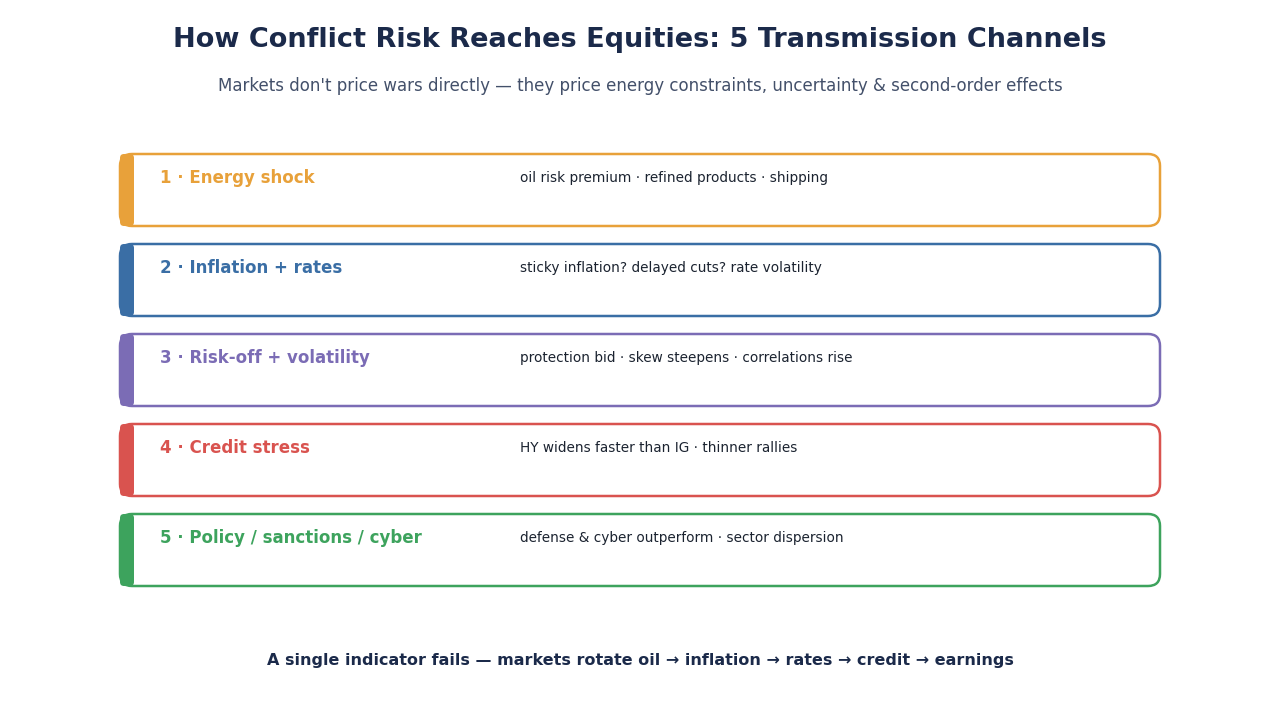
Geopolitical shocks are multidomain events. Even if the conflict narrative stays the same, markets can rotate from one dominant channel to another (oil → inflation → rates → credit → earnings). That’s why a single indicator fails.
Below are the five most common “paths” by which conflict risk shows up in equities:
1) Energy shock channel (oil, refined products, and risk premia)
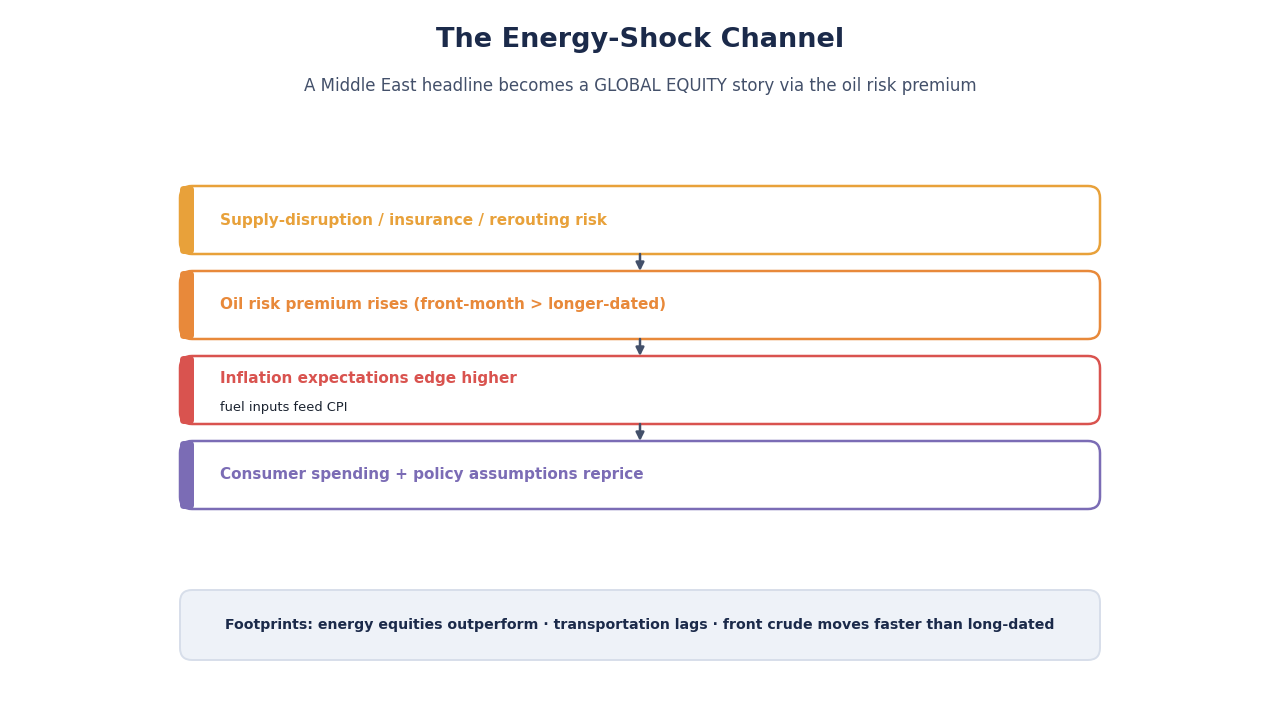
A Middle East conflict headline becomes a global equity story when investors perceive higher probability of supply disruption, higher insurance costs, or rerouting of shipments. That raises the risk premium embedded in crude and refined products, which then feeds into inflation and consumer spending assumptions.
Common market footprints
- Front-month crude moves faster than longer-dated crude (risk premium concentrated in the front end)
- Energy equities outperform, transportation often lags
- Inflation expectations edge higher as fuel inputs rise
2) Inflation + rates channel (policy reaction function)
If energy shocks persist, investors start asking: Does this keep inflation sticky? Does it delay cuts? Even if central banks look through short-term energy spikes, markets may reprice the path of policy rates.
Common market footprints
- Rate volatility rises
- Equity duration (long-duration growth) underperforms in “higher-for-longer” repricing moments
3) Risk-off + volatility channel (uncertainty is a tradeable asset)
War risk increases the value of protection. That can push volatility pricing up, widen skews, and raise correlations.
Common market footprints
- Volatility regime shift (higher realized vol)
- Downside skew steepening (crash protection gets expensive)
- Defensive factor bid (quality/low vol) vs cyclicals
4) Credit stress channel (financing conditions tighten)
If uncertainty rises meaningfully, credit markets often react earlier than equities. Spread widening is a powerful “risk budget” constraint for multi-asset allocators.
Common market footprints
- High yield spreads widen faster than investment grade
- Liquidity conditions tighten; equity rallies become “thinner”
5) Policy + sanctions + cyber channel (winners and losers change)
Geopolitical escalation can reprice defense spending expectations, sanctions risk, and cyber risk. This is where sector dispersion rises and “stock picking” matters more.
Common market footprints
- Defense/cyber segments outperform
- Cross-border sensitive industries (shipping, airlines, semis supply chains) experience higher volatility
A practical “Signal Stack” for geopolitical risk (what to monitor)
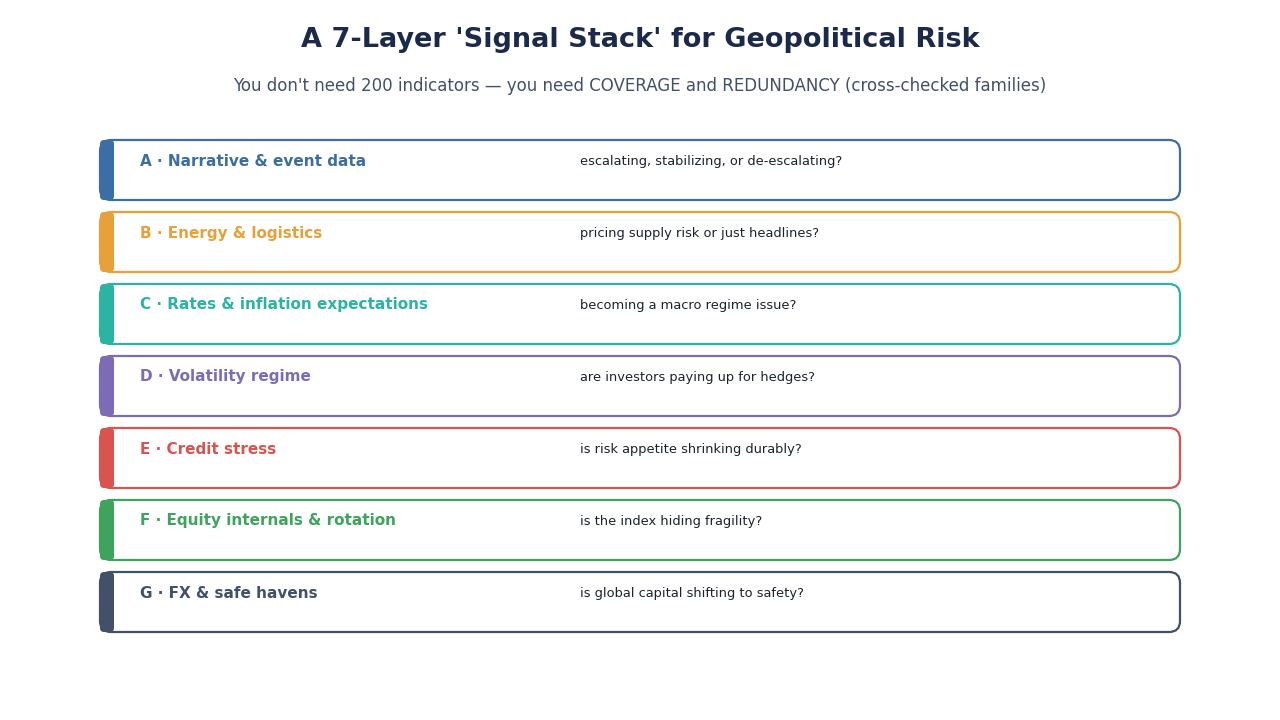
A signal stack is a layered system that cross-checks independent data families. You don’t need 200 indicators—you need coverage and redundancy.
Here’s a research-backed stack you can use to track geopolitical risk as it translates into stocks:
Layer A: Narrative & event data (what happened, and how fast the story is changing)
This layer answers: Is the situation escalating, stabilizing, or de-escalating?
Watch for:
- Rapid increases in credible headline frequency (not social noise)
- New actor involvement (wider conflict probability)
- Policy steps (sanctions, shipping restrictions, emergency measures)
AI advantage: Natural language processing can tag events by severity, geography, and affected assets—then track acceleration rather than just “sentiment.”
Layer B: Energy & logistics gauges (where geopolitics hits the real economy first)
This layer answers: Is the market pricing supply risk or just reacting to headlines?
Watch for:
- Crude and refined product moves (spot and front-month)
- Curve shape changes (front-end risk premia)
- Shipping constraints (rerouting risk, insurance costs)
Layer C: Rates & inflation expectations (are macro assumptions shifting?)
This layer answers: Is this becoming a macro regime issue?
Watch for:
- Rate volatility (uncertainty about central bank path)
- Breakevens / inflation expectations shifting alongside oil
Layer D: Volatility regime (is protection demand rising?)
This layer answers: Are investors paying up for hedges?
Watch for:
- Volatility level changes and persistence
- Skew (downside protection pricing)
Layer E: Credit stress (does the financing backdrop deteriorate?)
This layer answers: Is risk appetite shrinking in a durable way?
Watch for:
- IG vs HY spread behavior
- Signs of liquidity stress (persistent widening)
Layer F: Equity internals & sector rotation (is the market narrowing?)
This layer answers: Is the index hiding fragility under the surface?
Watch for:
- Breadth deterioration even if index level looks stable
- Leadership moving toward defensives
- Sector dispersion rising (rotation opportunities + risk)
Layer G: FX & safe havens (global risk calibration)
This layer answers: Is global capital shifting toward safety?
Watch for:
- USD strength vs risk currencies
- Traditional hedges (safe-haven FX, gold) behaving “risk-off”
How can AI track the Iran–US war impact on stocks in real time?
A human can read headlines. But humans struggle with scale, latency, and consistency—especially when the market’s interpretation changes every few hours. AI helps when it does three things well:
- Event understanding: extract who/what/where/when from headlines, then classify severity.
- Cross-asset linkage: map each event type to its most relevant market proxies (oil, rates, vol, credit, sectors).
- Decision synthesis: translate proxy moves into a ranked list of plausible narratives and portfolio implications.
A clean implementation looks like this:
- Step 1: Build an “event taxonomy” (shipping risk, sanctions, strikes, cyber incidents, diplomatic moves)
- Step 2: Assign each event type to a market impact map (energy, rates, vol, credit, sector winners/losers)
- Step 3: Create a scoring model that tracks:
- Shock size (how large is the move?)
- Persistence (does it last?)
- Breadth (how many assets confirm it?)
- Second-order effects (rates/credit confirming or not)
The goal isn’t predicting the next headline. It’s detecting when headlines become a regime shift.
The Geopolitical Risk Dashboard Blueprint (research-grade, but actionable)
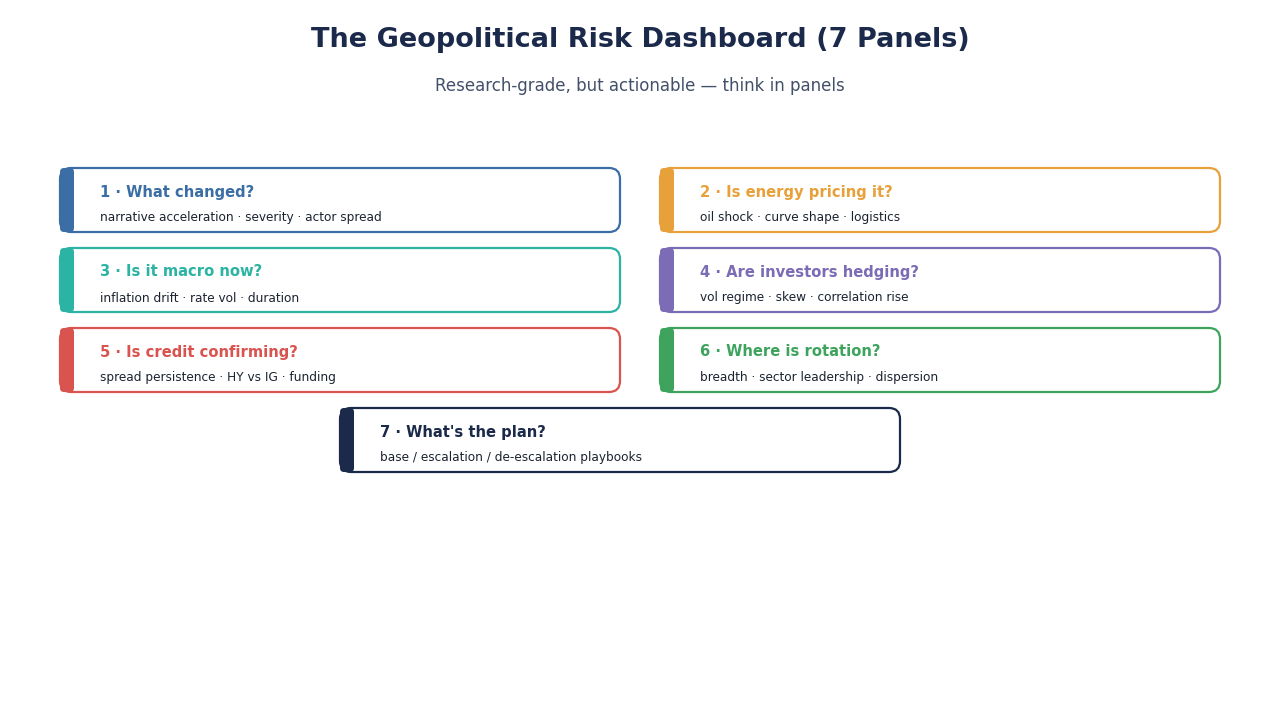
Here’s a framework you can implement inside a dashboard workflow (and adapt for your own risk style). Think in panels.
Panel 1: “What changed?” (Narrative acceleration)
- Event count (credible sources)
- Severity classification (low/medium/high)
- Actor expansion and geography spread
- Policy actions that change constraints (sanctions, shipping restrictions)
Panel 2: “Is energy pricing it?” (Energy & logistics)
- Oil shock intensity (spot/front-month emphasis)
- Curve shape change (risk premium location)
- Refining margin pressure (downstream stress)
- Logistics constraints (reroute/insurance risk proxies)
Panel 3: “Is it macro now?” (Rates & inflation)
- Inflation expectation drift
- Rate volatility signal
- Equity duration sensitivity proxy (growth vs value behavior)
Panel 4: “Are investors hedging?” (Volatility + skew)
- Volatility regime classification (low/medium/high)
- Skew steepening (tail-risk pricing)
- Correlation rise (diversification breakdown risk)
Panel 5: “Is credit confirming?” (Credit stress)
- Spread widening persistence
- HY vs IG divergence (risk appetite fracture)
- Funding conditions proxy (tightening risk)
Panel 6: “Where is the rotation?” (Equity internals & sectors)
- Breadth measures (participation)
- Sector leadership changes (energy/defense vs transport/consumer)
- Dispersion (opportunity + risk)
Panel 7: “What’s the plan?” (Scenario playbooks)
- Base case: elevated risk premium but contained macro
- Escalation: supply disruption probability rises → inflation & vol persist
- De-escalation: risk premia mean-revert → rotation unwinds
A sector-rotation lens: likely winners/losers (and why)
Geopolitical stress rarely hits “the market” evenly. It often shows up as factor and sector dispersion.
Here’s a practical table you can use as a starting hypothesis—then validate with your signal stack:
| Channel | Typical Beneficiaries | Typical Pressure | Why it happens |
|---|---|---|---|
| Energy risk premium | Energy producers, oil services | Airlines, transportation | Fuel input + supply risk repricing |
| Defense + security | Defense, cybersecurity | Rate-sensitive cyclicals | Budget repricing + risk spending |
| Inflation persistence | Value/quality cashflows | Long-duration growth | Discount rate + macro uncertainty |
| Credit tightening | High-quality balance sheets | Highly levered firms | Financing conditions become a constraint |
| Logistics disruption | Select shipping (context-dependent) | Global supply-chain exposed segments | Rerouting/insurance + delivery uncertainty |
Important: These are tendencies, not guarantees. The point of AI is to detect which channel is dominant today.
How to use SimianX AI to operationalize this workflow
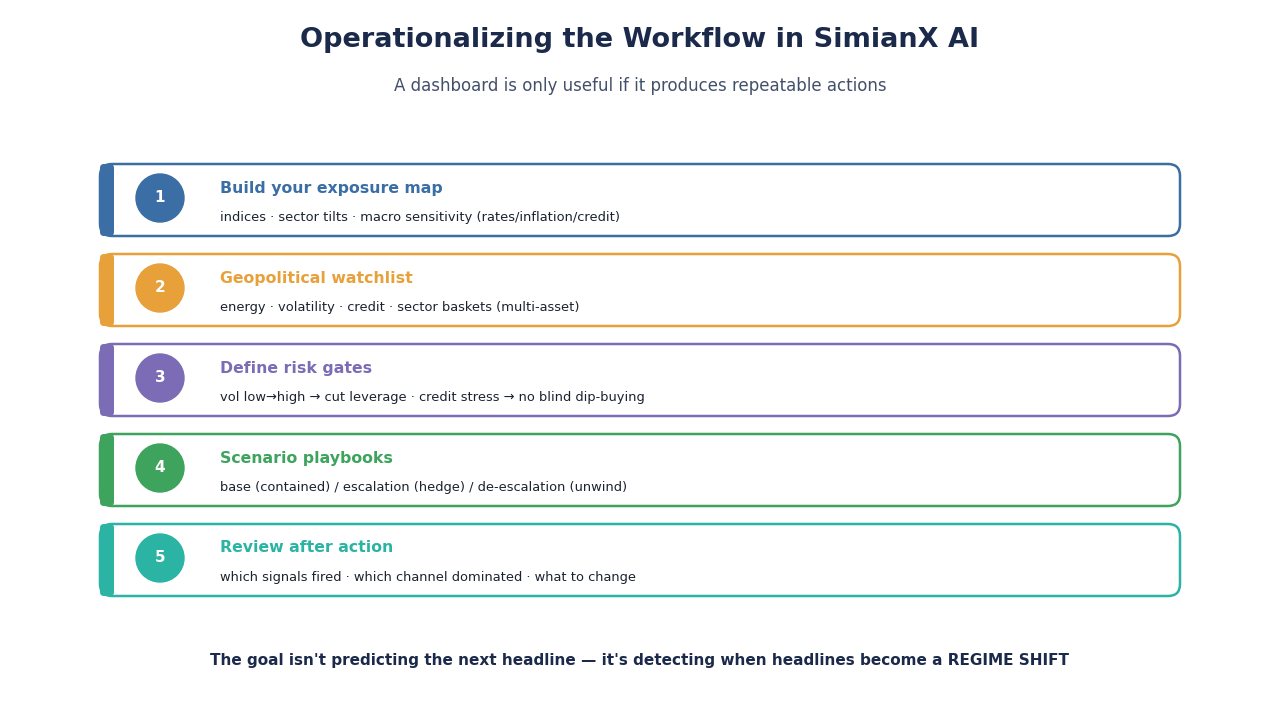
A dashboard is only useful if it produces repeatable actions. Here’s a step-by-step process you can run using SimianX AI as your “command room” layer (and link it to your own watchlists and risk rules).
Step 1) Build your exposure map (what do you actually own?)
Make a simple inventory:
- Equity indices you’re exposed to (directly or via ETFs)
- Sector tilts (energy, industrials, tech, defensives)
- Macro sensitivity (rates, inflation, credit)
Step 2) Create a geopolitical watchlist (multi-asset, not just stocks)
Include:
- Energy proxies (crude, refined products)
- Volatility gauges
- Credit stress proxies
- Sector baskets (energy, defense, airlines/transport, semis supply chain)
Step 3) Define “risk gates” (when you slow down or hedge)
Examples:
- If volatility regime flips from low → high, reduce leverage
- If credit stress persists, avoid “dip-buying” without confirmation
- If energy shock becomes persistent, review inflation/rates sensitivity
Step 4) Add scenario playbooks (pre-decide what you’ll do)
Use simple if/then rules:
- Base case (contained): prefer selective rotation, avoid over-hedging
- Escalation: add hedges, reduce cyclicals, respect vol + credit confirmation
- De-escalation: unwind protection gradually, watch for mean reversion traps
Step 5) Review after action (build your “war-risk playbook”)
Log:
- Which signals fired
- Which channel dominated
- What you did
- What you’ll change next time
A strong workflow is learnable. That’s the real edge.
To explore a dashboard-style approach, start at SimianX AI and connect it to your broader risk process. You can also cross-reference internal frameworks like the seven-radar approach in SimianX’s research library:
Common mistakes when trading geopolitics (and how to avoid them)
Even sophisticated investors fall into predictable traps:
- Headline overfitting: reacting to every update instead of tracking acceleration + confirmation.
- Single-channel thinking: assuming it’s “just oil” when rates/credit are shifting.
- Ignoring persistence: one-day spikes are different from multi-week repricing.
- Over-hedging at the wrong time: buying protection after vol is already expensive.
- No post-mortem: failing to build a repeatable playbook.
A signal stack helps because it forces you to ask:
- What channel is dominant?
- Is there cross-asset confirmation?
- Is this transient or persistent?
FAQ About Iran–US war impact on stocks
How does the Iran–US war impact on stocks usually show up first?
Often through energy pricing and volatility. If the market perceives supply or logistics risk, oil can reprice quickly, and equity volatility may rise as uncertainty gets priced into options and correlations.
What are the best AI geopolitical risk signals for stock investors?
The most useful signals are cross-confirmed: narrative acceleration + energy shock persistence + volatility regime shift + credit confirmation. Any one alone can be noisy; together they’re more decision-relevant.
How can I hedge geopolitical risk without overreacting?
Use risk gates and scenario sizing. Rather than “all-in hedges,” scale protection with confirmation (vol + credit + persistence), and plan your unwind rules in advance.
Which sectors tend to outperform during geopolitical escalation?
It depends on the dominant channel, but energy, defense, and cybersecurity often benefit when risk premia and security spending expectations rise. Validate with breadth and dispersion signals before rotating aggressively.
Can AI predict war headlines?
AI is better at classification and early detection of regime shifts than predicting specific headlines. The practical goal is faster, more consistent interpretation—so you can act with a plan, not panic.
Conclusion
The Iran–US war impact on stocks is best understood as a set of measurable transmission channels: energy, inflation and rates, volatility, credit, and sector dispersion. When you build a layered AI geopolitical risk signals stack, you stop reacting to noise and start responding to confirmed regime shifts.
If you want a command-room approach that helps you monitor these signals systematically—then turn them into alerts, risk gates, and scenario playbooks—explore SimianX AI and build a workflow your future self will trust.
Research references (optional further reading)
- Geopolitical Risk (GPR) Index overview: https://www.policyuncertainty.com/gpr.html
- GPR paper resources (Caldara & Iacoviello): https://www.matteoiacoviello.com/gpr.htm
- IMF discussion of geopolitical risks and asset pricing (GFSR chapter PDF): https://www.imf.org/-/media/files/publications/gfsr/2025/april/english/ch2.pdf
Related Reading
- Trump Iran Ultimatum: Oil $110 Spike, Stocks +2% Pivot
- Iran Tensions: Oil $100 Spike, Energy +3.9%, S&P -1%
- Oil -5% on Iran-Hormuz Talks: Brent, WTI & Sector Map 2026
- Dow Jones Risk Pulse: AI Signals Breadth, VIX, Spreads
- Wall Street Drawdown Watch: 10% Warnings, 40% Tail Risk