
 By Muke
Iraq War (2003) and the Stock Market: Why Stocks Rebounded After the Invasion
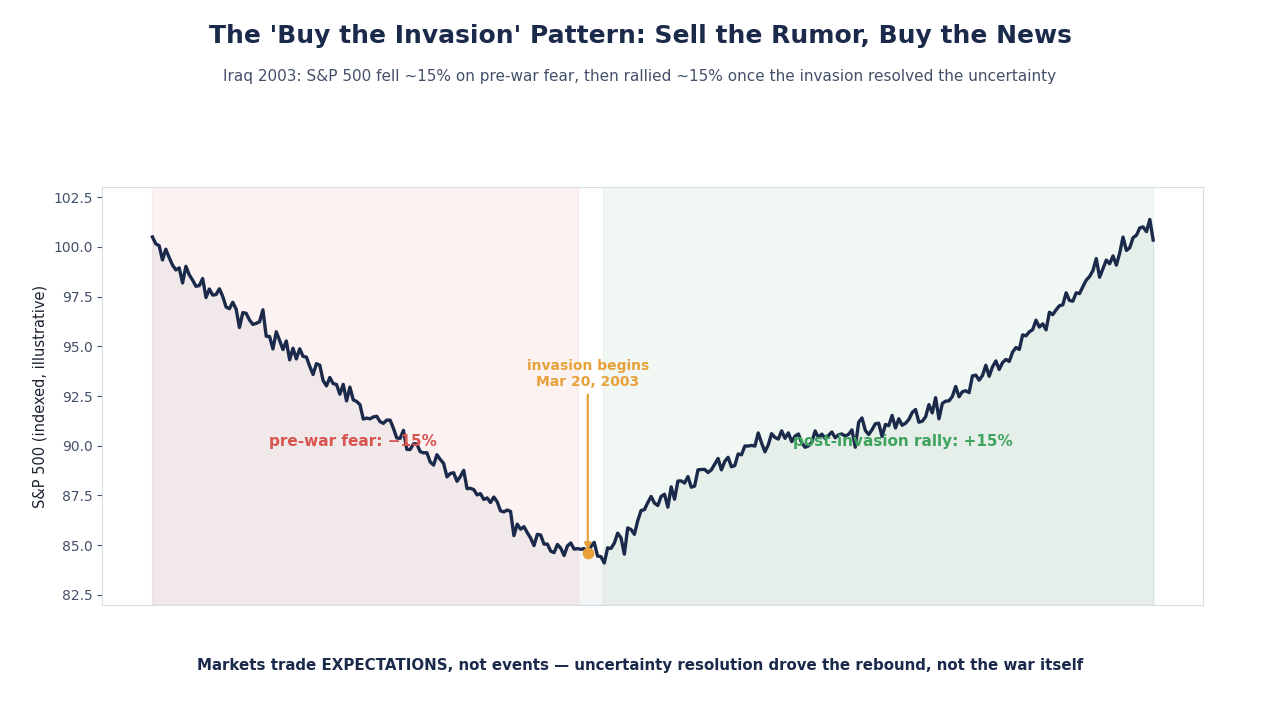
The Iraq War (2003) and the stock market rebound remains one of the most widely cited examples of how financial markets respond to geopolitical uncertainty. In the months leading up to the invasion of Iraq in March 2003, global markets were volatile and investors were uncertain about the economic consequences of war. Yet, surprisingly, once the invasion began, stocks rallied sharply.
Understanding why stocks rebounded after the Iraq War invasion provides powerful insight into how markets price uncertainty, risk premiums, and macro expectations. Today, advanced analytics platforms such as SimianX AI help investors analyze geopolitical signals, market sentiment, and macroeconomic triggers in real time.
By examining historical data, investor psychology, and macroeconomic policy responses, we can uncover why the 2003 Iraq War became a classic example of "sell the rumor, buy the news."
The Global Economic Environment Before the Iraq War
To understand why the market rallied after the invasion, we must first analyze the economic and financial environment leading up to the conflict.
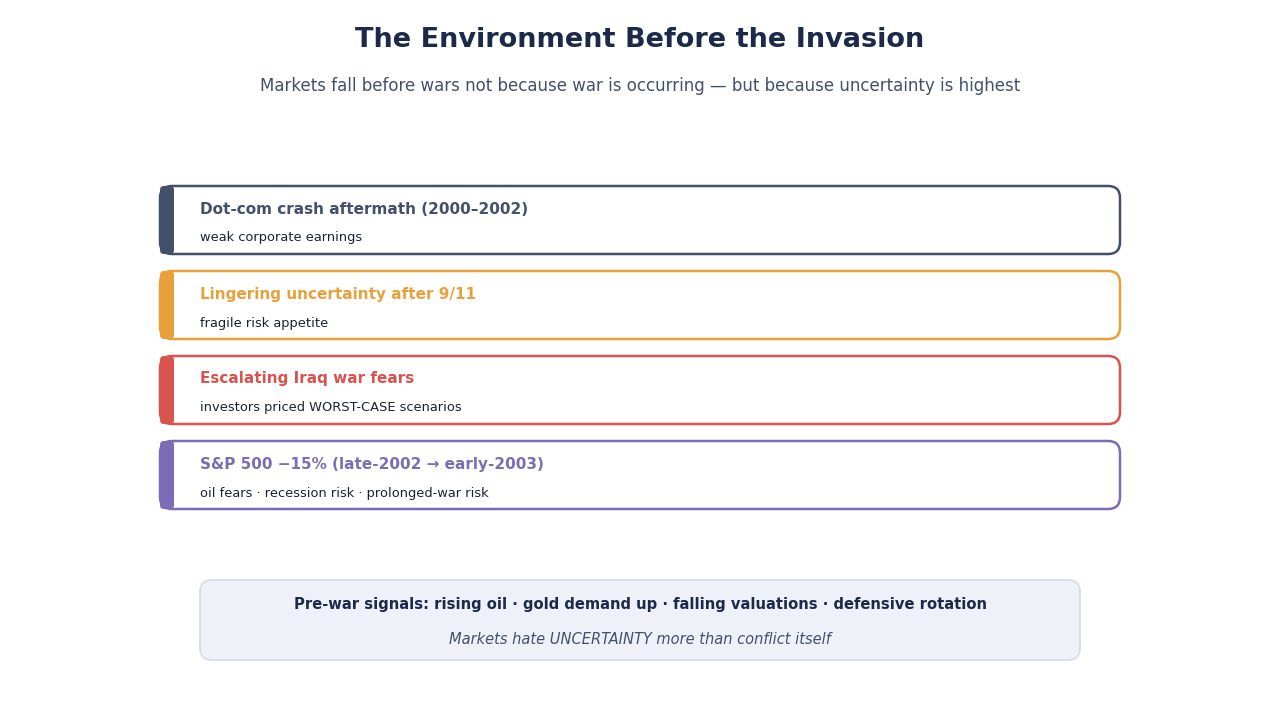
In early 2003, markets were already dealing with several major stressors:
- The aftermath of the dot-com bubble crash (2000–2002)
- Weak corporate earnings
- Lingering uncertainty after 9/11
- Concerns about a prolonged Middle East conflict
As geopolitical tension escalated, investors priced in worst-case scenarios.
Markets often fall before wars not because war is occurring, but because uncertainty is highest.
The S&P 500 declined nearly 15% between late 2002 and early 2003 as investors feared:
- oil supply disruptions
- global recession risks
- prolonged military engagement
At the same time, volatility indicators and safe-haven assets surged.
Key market signals during pre-war uncertainty included:
- rising oil prices
- increased gold demand
- falling equity valuations
- defensive sector rotation
Investor Behavior During Pre-War Periods
Financial markets hate uncertainty more than conflict itself.
Before the invasion:
- Investors lacked clarity on timing
- The potential duration of war was unknown
- There were concerns about regional instability
As a result, risk premiums expanded across global equities.
- Institutional investors reduced exposure
- Hedge funds increased volatility hedges
- Retail sentiment turned pessimistic
| Risk Factor | Market Impact |
|---|---|
| Oil supply fears | Energy prices surged |
| War duration uncertainty | Equity risk premium increased |
| Global instability concerns | Defensive assets rose |
When these risks are finally resolved—even if the outcome is not positive—markets often rally.
The "Uncertainty Resolution" Effect in Financial Markets
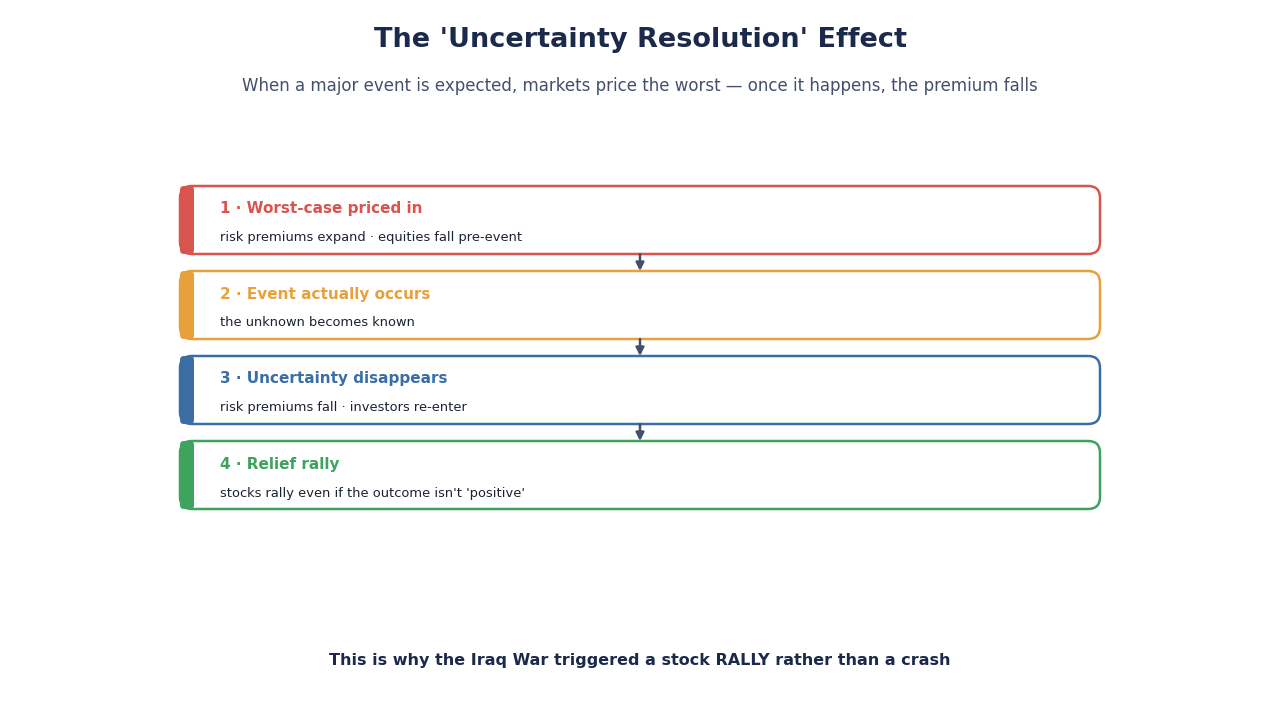
One of the most important principles in macro trading is uncertainty resolution.
When a major geopolitical event is expected, markets tend to price in the worst possible outcome.
When the event actually occurs:
- uncertainty disappears
- risk premiums fall
- investors re-enter markets
This phenomenon explains why the Iraq War triggered a stock rally rather than a crash.
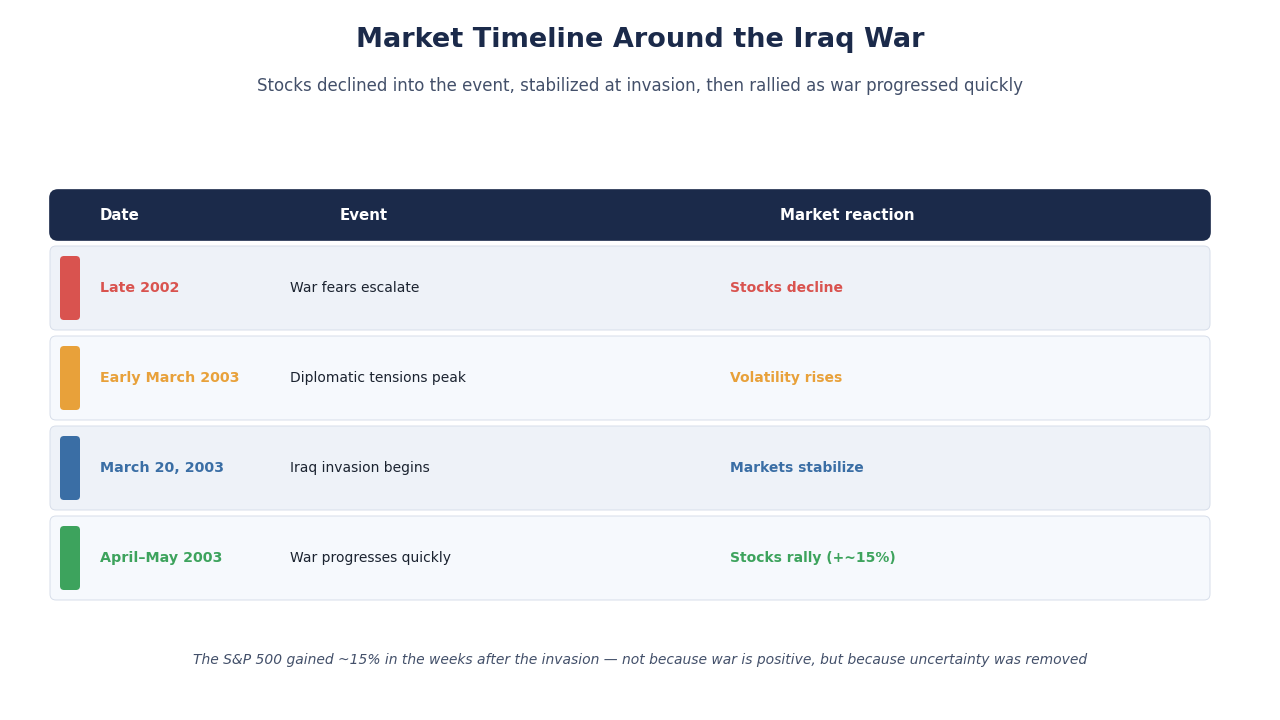
Market Timeline Around the Iraq War
| Date | Event | Market Reaction |
|---|---|---|
| Late 2002 | War fears escalate | Stocks decline |
| Early March 2003 | Diplomatic tensions peak | Volatility rises |
| March 20, 2003 | Iraq invasion begins | Markets stabilize |
| April–May 2003 | War progresses quickly | Stocks rally |
The S&P 500 gained roughly 15% in the weeks following the invasion.
This was not because war is positive for markets. Instead, it reflected the removal of uncertainty.
Markets trade expectations, not events.
Platforms like SimianX AI help traders track geopolitical signals and anticipate how markets might respond once uncertainty is resolved.
Oil Prices and the War Risk Premium
Another major factor influencing the Iraq War stock market rebound was energy markets.
Before the invasion, oil markets priced in a large geopolitical risk premium.
Key concerns included:
- destruction of oil infrastructure
- regional escalation
- supply disruptions
However, when the invasion began:
- supply fears eased
- oil prices stabilized
- inflation expectations declined
Lower energy prices are historically positive for equities.
Why oil matters for stock markets:
- energy costs affect corporate profits
- transportation costs decline
- inflation pressure decreases
- consumer spending improves
This dynamic helped fuel the post-invasion equity rally.
Monetary Policy and Liquidity Support
Another reason stocks rebounded after the Iraq War was monetary policy support.
The Federal Reserve had already begun easing policy following the early-2000s recession.
By 2003:
- interest rates were historically low
- liquidity conditions were improving
- credit markets stabilized
This created a powerful backdrop for equity markets once geopolitical risk declined.
Liquidity + Uncertainty Resolution
When two forces combine:
- falling geopolitical uncertainty
- strong liquidity conditions
markets often rally sharply.
Key macro drivers in 2003:
- accommodative Fed policy
- recovering corporate earnings
- declining bond yields
These factors allowed equities to recover quickly.
Investor Psychology: "Sell the Rumor, Buy the News"
One of the most famous trading principles is:
Sell the rumor, buy the news.
This describes how markets behave when a widely anticipated event occurs.
Before the Iraq War:
- traders feared worst-case outcomes
- capital moved to safe assets
- equity positioning became defensive
When the invasion started:
- the feared uncertainty vanished
- traders repositioned
- risk appetite returned
The Behavioral Finance Explanation
Behavioral economics suggests investors tend to:
- overestimate negative scenarios
- react strongly to uncertainty
- underestimate recovery speed
This pattern repeats across many geopolitical events.
Historical examples include:
- Gulf War (1991)
- Iraq War (2003)
- Crimea invasion (2014)
- Russia–Ukraine war (2022)
Markets often fall before conflicts and recover once clarity emerges.
How Modern AI Models Analyze War and Market Risk
Today, investors use AI-driven analytics to study how geopolitical risks influence markets.
Platforms such as SimianX AI analyze multiple data streams simultaneously:
- news sentiment
- macroeconomic indicators
- options market signals
- liquidity metrics
These tools allow traders to detect risk regime changes faster than traditional analysis.
Example AI Risk Indicators
| Indicator | What It Measures | Market Signal |
|---|---|---|
| Volatility index | Fear level in markets | Risk sentiment |
| Oil futures curve | Energy supply expectations | Inflation outlook |
| Credit spreads | Financial stress | Recession risk |
| News sentiment AI | Geopolitical tone | Event probability |
Using AI, investors can evaluate whether a geopolitical shock is already priced into markets.
This approach helps explain events like the Iraq War stock market rebound.
Why did stocks rebound after the Iraq War invasion?
The stock market rebounded after the Iraq War invasion primarily because uncertainty disappeared.
Before the invasion:
- investors feared unknown outcomes
- risk premiums expanded
- equities sold off
Once the invasion began:
- uncertainty resolved
- oil price fears declined
- liquidity remained strong
Markets responded by repricing assets higher.
Today, tools like SimianX AI help investors identify these turning points earlier by analyzing geopolitical signals, macro trends, and real-time market sentiment.
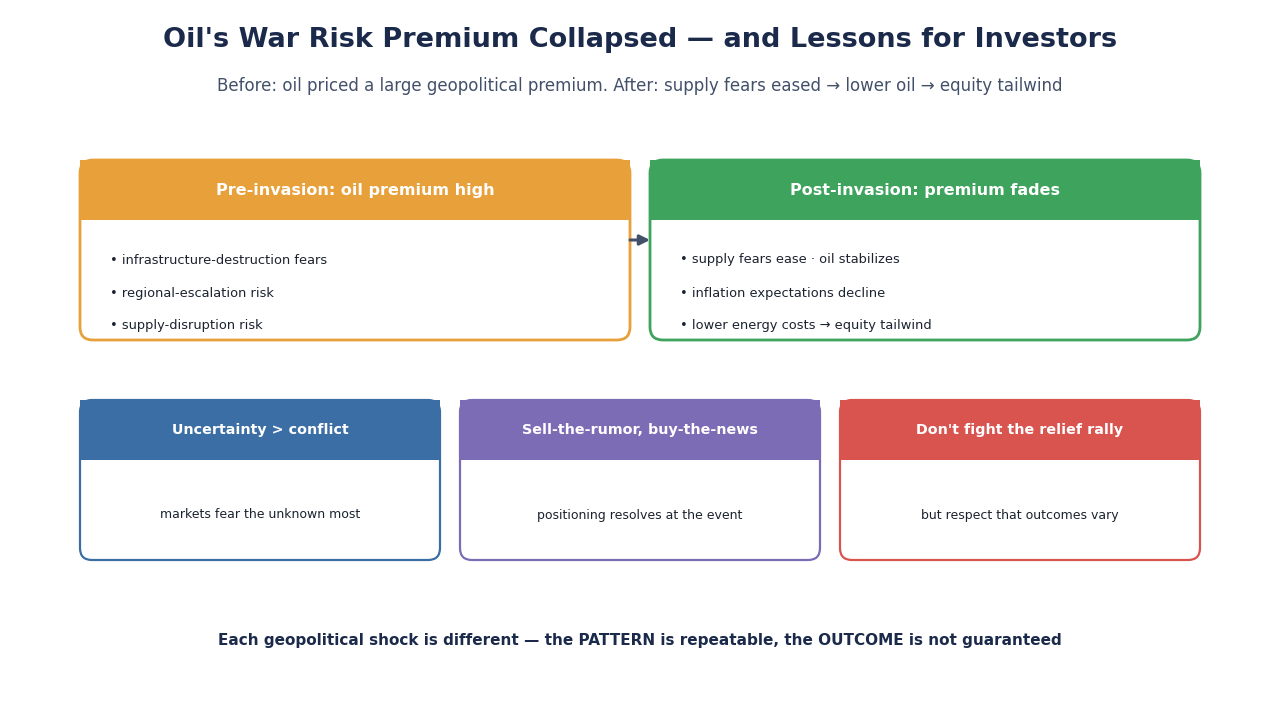
Lessons for Investors From the Iraq War Market Reaction
The Iraq War offers several important lessons for modern investors.
1. Markets Fear Uncertainty More Than Bad News
The worst declines often occur before events happen, not during them.
2. Risk Premiums Can Reverse Quickly
Once uncertainty fades, markets rapidly reprice assets.
3. Liquidity Drives Recovery
When monetary conditions are supportive, market rebounds are stronger.
4. Geopolitical Events Are Often Temporary Shocks
Markets typically focus on long-term economic fundamentals rather than short-term conflicts.
Modern AI-driven platforms such as SimianX AI allow investors to track these macro signals and understand how global events influence asset prices.
FAQ About Iraq War (2003) and the Stock Market
What happened to the stock market during the Iraq War in 2003?
The stock market initially declined before the war due to uncertainty. However, once the invasion began in March 2003, markets rallied sharply as geopolitical uncertainty declined and investors regained confidence.
Why do stock markets sometimes rise during wars?
Markets often rise during wars because uncertainty is resolved and worst-case fears are removed. Investors reposition portfolios once the event is fully priced into markets.
How did oil prices affect the Iraq War stock market reaction?
Oil prices initially surged due to supply fears. When the invasion began and supply disruption fears eased, oil prices stabilized, reducing inflation pressure and supporting equities.
Can AI predict market reactions to geopolitical events?
AI models cannot perfectly predict events but can analyze large data streams—news sentiment, volatility, macro indicators—to estimate how markets may respond. Platforms like SimianX AI help investors monitor these signals.
Conclusion
The Iraq War (2003) and the stock market rebound demonstrate how financial markets respond to geopolitical uncertainty. Rather than collapsing after the invasion, equities rallied because the risk premium embedded in prices suddenly disappeared.
Key drivers of the rebound included:
- resolution of geopolitical uncertainty
- stabilization of oil prices
- strong liquidity conditions
- investor repositioning
Understanding these dynamics helps investors interpret how markets respond to future geopolitical events.
Today, platforms such as SimianX AI enable traders and analysts to monitor real-time geopolitical signals, macro indicators, and market sentiment—helping them identify opportunities when uncertainty begins to fade.
As global markets continue to react to political and military developments, AI-driven analytics will become increasingly essential for navigating geopolitical risk and market volatility.
Related Reading
- 9/11 & Early War on Terror: S&P 500 -14%, 4-Month Recovery
- Russia-Ukraine War Stock Impact: Sectors, VIX, Risk Plan
- Iran-US War Impact on Stocks: AI Risk Signals Live
- 7 AI Risk Radars for Equities: Breadth, Revisions, Skew
- Wall Street Drawdown Watch: 10% Warnings, 40% Tail Risk
- Why US Stocks & Crypto Plummeted This Week: The Causes