
 By Muke
Nasdaq 100 Liquidity Pulse: AI Signals From Yields, Spreads, Revisions
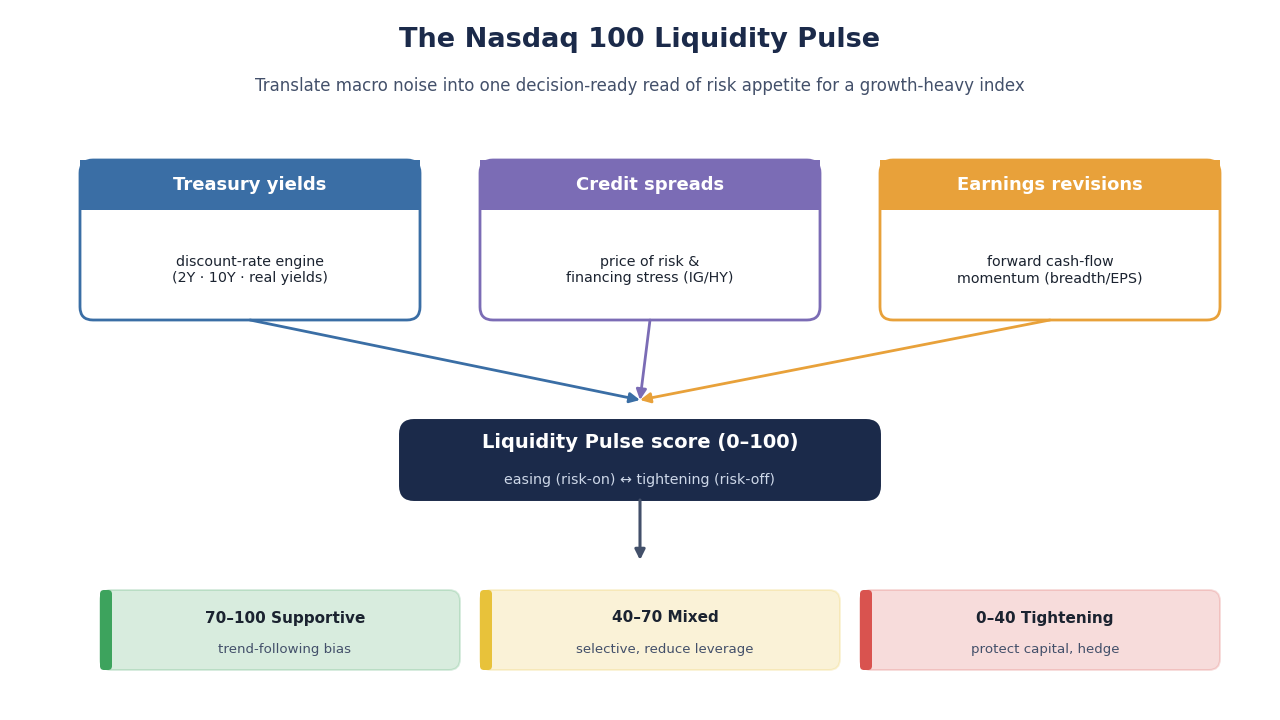
The Nasdaq 100 Liquidity Pulse is a practical way to translate “macro noise” into a repeatable, decision-ready read on risk appetite—especially for a growth-heavy index where discount rates and funding conditions matter. In this research, you’ll learn how to build a Liquidity Pulse using three measurable pillars—Treasury yields, credit spreads, and earnings expectation revisions—and how to turn them into an AI-powered workflow inside SimianX AI. If you want a framework that doesn’t rely on vibes, this is it.
Why the Nasdaq 100 is uniquely sensitive to “liquidity”
The Nasdaq 100 (often tracked via NDX or QQQ) has a structural bias toward long-duration cash flows: large-cap tech, software, semis, and communication platforms. That creates a clear mechanism:
- Treasury yields influence the discount rate used to value future cash flows.
- Credit spreads express the market’s price of risk and financing stress.
- Earnings expectation revisions measure whether the market is raising or cutting forward profit assumptions.
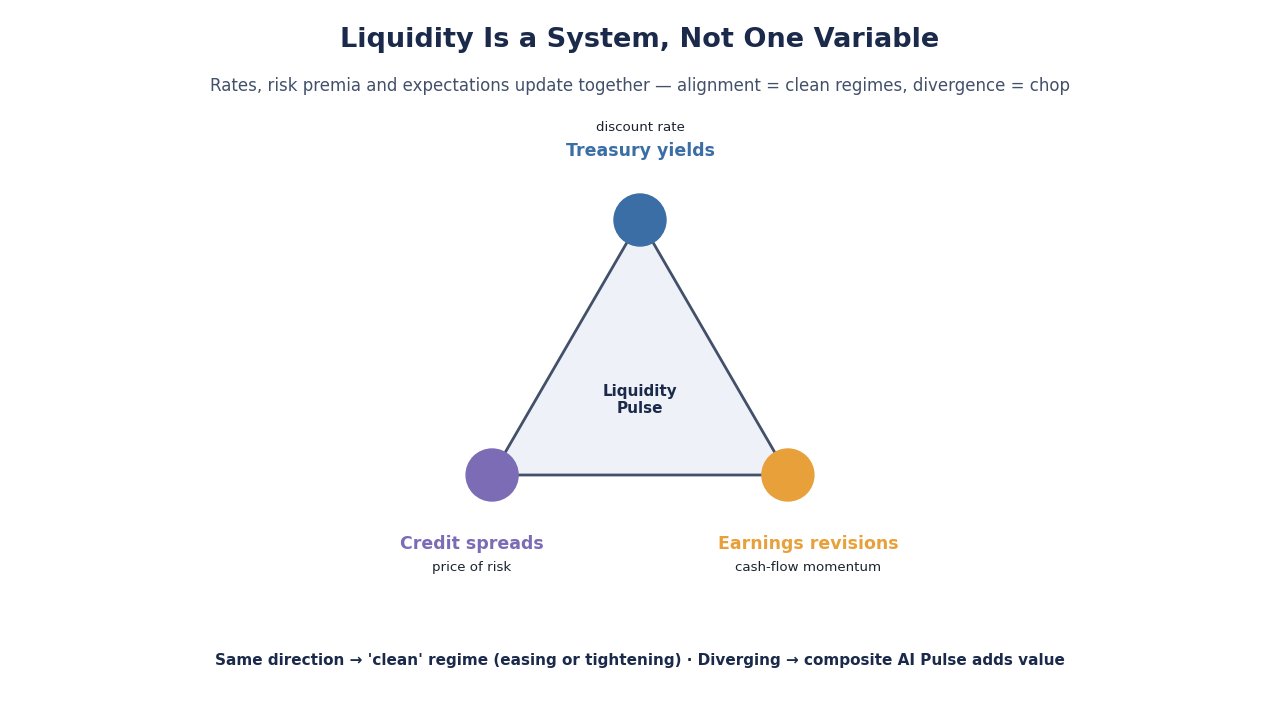
When these three move in the same direction, you often get “clean” regimes: liquidity easing (risk-on) or liquidity tightening (risk-off). When they diverge, you get chop—and that’s where a composite, AI-assisted Pulse becomes valuable.
Key idea: Liquidity is not one variable. It’s a system—rates, risk premia, and expectations updating together.
The three pillars of a Liquidity Pulse (and what each actually means)
Pillar 1 — Treasury yields: the discount-rate engine
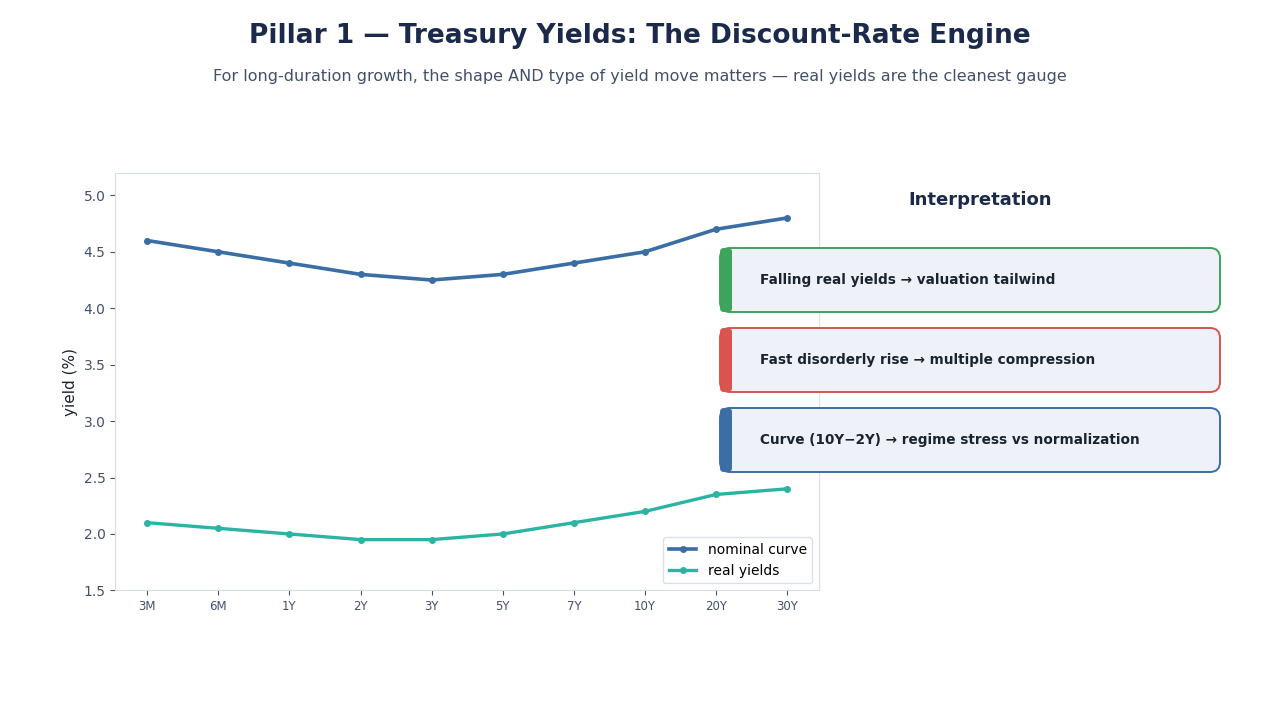
Treasury yields do more than “go up or down.” For Nasdaq 100 positioning, the shape and type of yield move matters:
2Yand5Y: policy expectations + near-term macro repricing10Y: long-duration discount rate (important for growth multiples)- Real yields (if available): often the “cleanest” duration pressure gauge
- Curve measures (e.g.,
10Y-2Y): regime stress vs normalization
Interpretation shortcut
- Falling yields (especially real yields) often = valuation tailwind
- Rising yields (fast, disorderly) often = multiple compression risk
Pillar 2 — Credit spreads: the price of risk (and hidden stress)
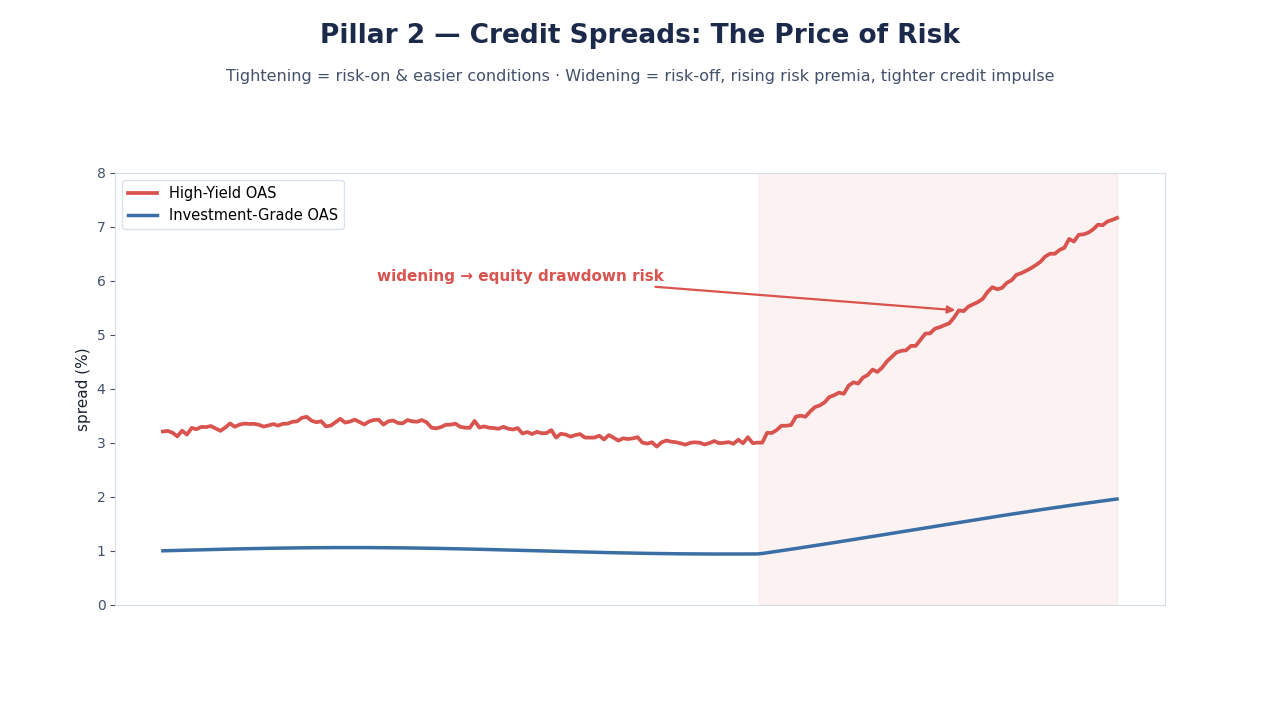
Credit spreads are the yield difference between corporate bonds and comparable-maturity Treasuries. They capture risk appetite, default fear, and funding pressure.
Two common spread buckets:
- Investment Grade (IG) spreads: early caution / macro softening
- High Yield (HY) spreads: sharper stress / equity drawdown risk
Interpretation shortcut
- Tightening spreads = risk-on and easier financial conditions
- Widening spreads = risk-off, rising risk premia, tighter credit impulse
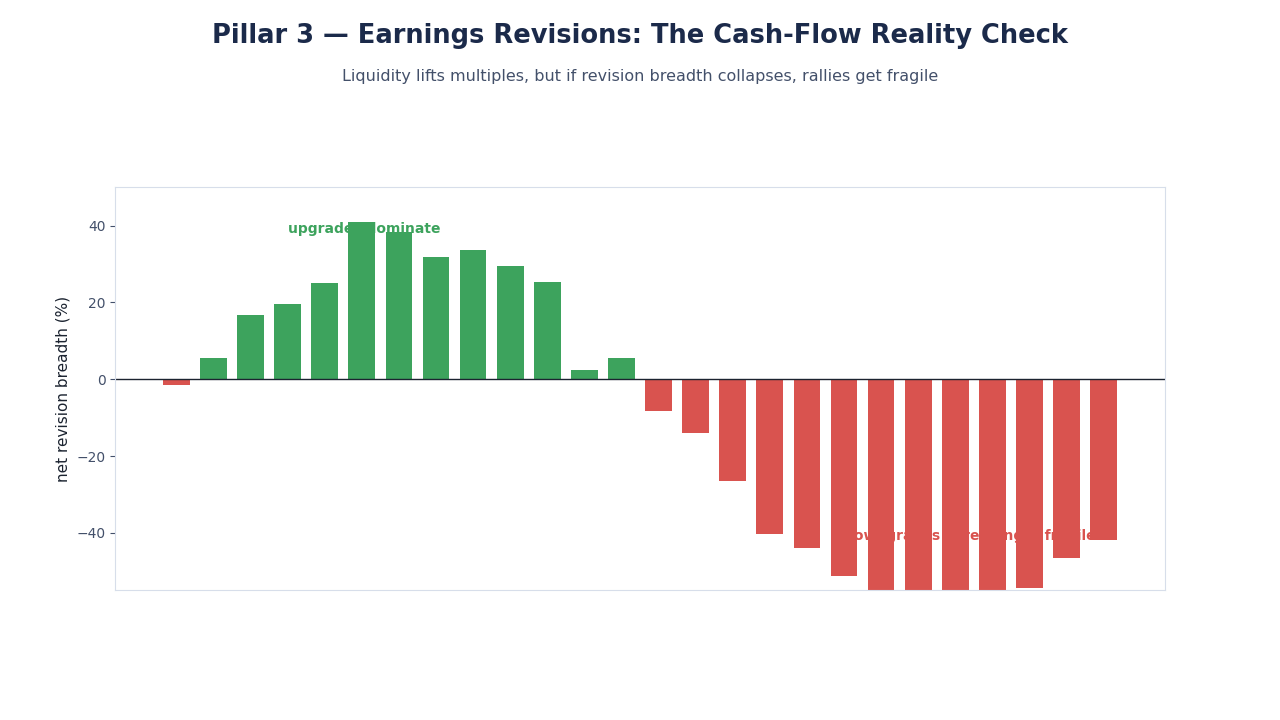
Pillar 3 — Earnings expectation revisions: the cash-flow reality check
Earnings revisions are changes to forward expectations—often captured via:
- Revision breadth (how many upgrades vs downgrades)
- Net revisions (magnitude-adjusted upgrades minus downgrades)
- Forward EPS trend (consensus EPS moving up or down)
For Nasdaq 100, revisions can act like a “fundamental momentum” filter:
- Liquidity can lift multiples, but if revisions collapse, rallies get fragile.
- Conversely, strong revisions can stabilize drawdowns even when yields rise modestly.
Turning the three pillars into a single Nasdaq 100 Liquidity Pulse
A good Pulse should be:
- Comparable across time (z-scores / percentiles)
- Robust to noise (smoothing + regime logic)
- Actionable (clear thresholds and playbooks)
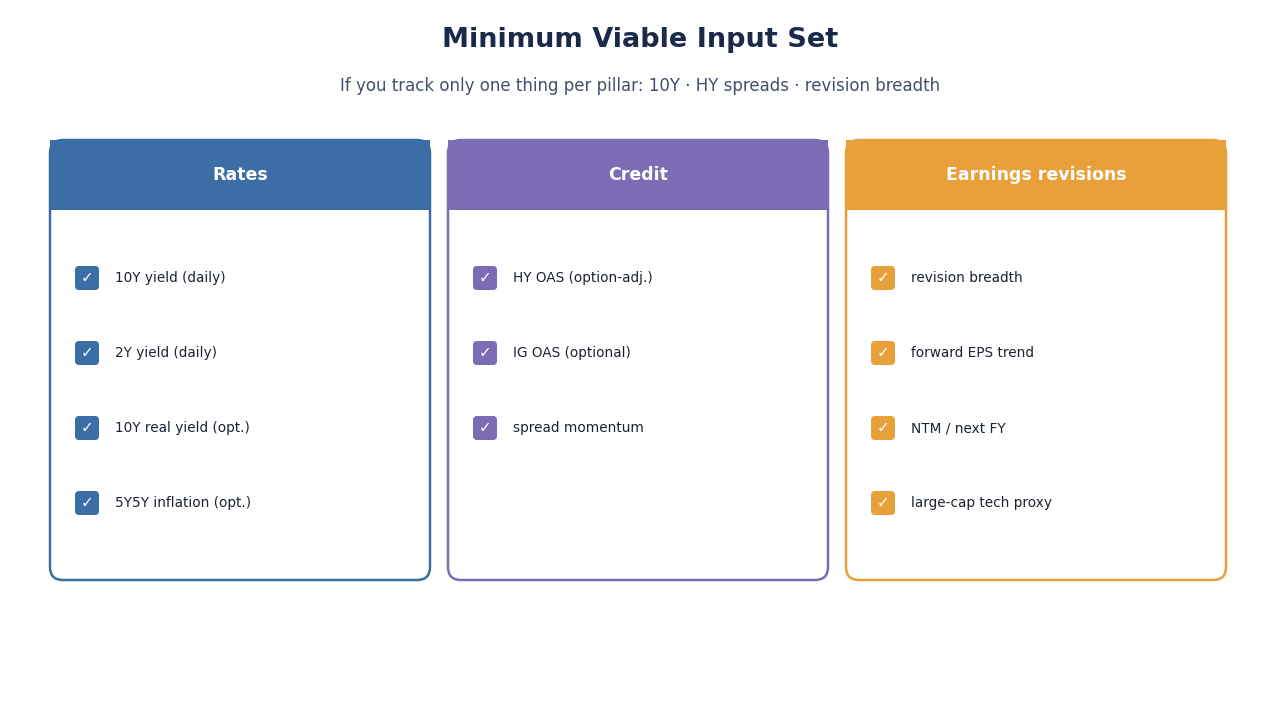
Step 1: Choose observable inputs (minimum viable set)
A simple, strong starting set:
- Rates
- 10Y yield (daily)
- 2Y yield (daily)
- optional: 10Y real yield, 5Y5Y inflation expectations
- Credit
- HY OAS (option-adjusted spread) or a HY spread proxy
- IG OAS (optional)
- Earnings revisions
- revision breadth for Nasdaq 100 constituents (or a large-cap tech proxy)
- forward EPS trend (next-12-month or next fiscal year)
If you can only track one thing per pillar: 10Y, HY spreads, revision breadth.
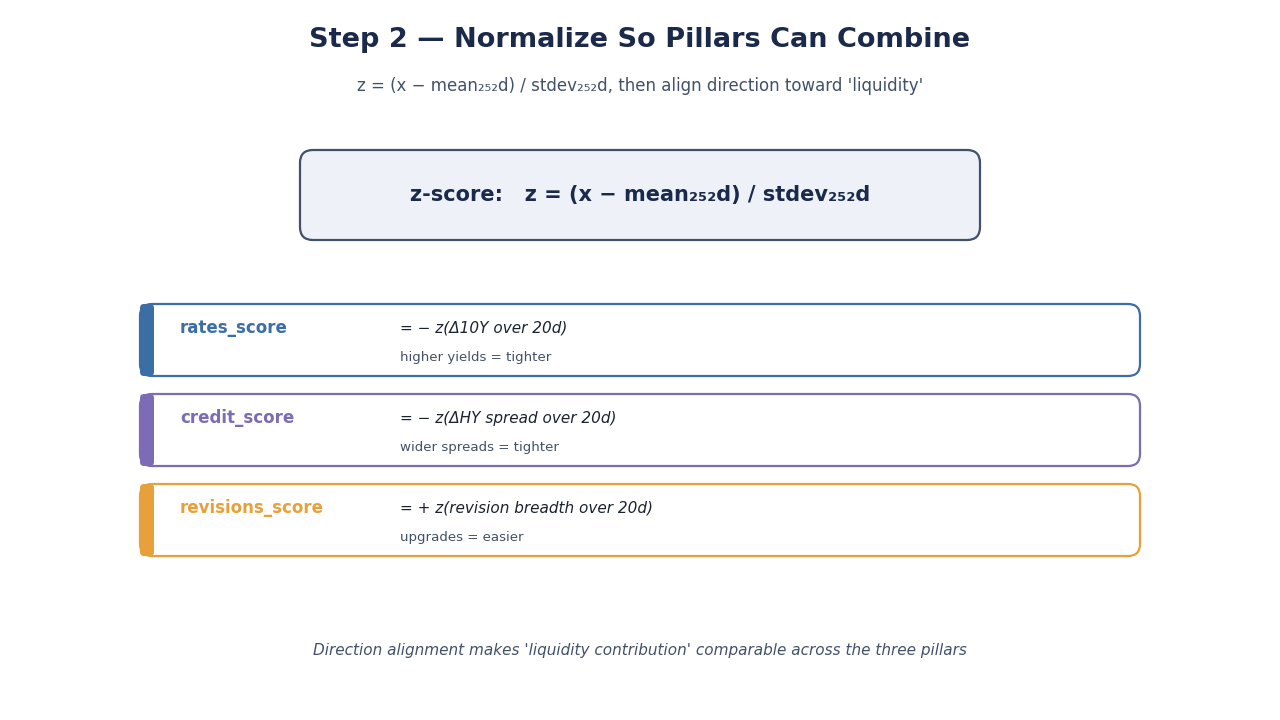
Step 2: Normalize each input (so they can be combined)
Convert raw series into a comparable scale, e.g. z-score:
z = (x - mean_252d) / stdev_252d
Then align direction:
- Higher yields = tighter (negative for liquidity)
- Wider spreads = tighter (negative for liquidity)
- Upward revisions = easier (positive for liquidity)
So you can define a “liquidity contribution” as:
rates_score = -z(10Y_change_20d)credit_score = -z(HY_spread_change_20d)revisions_score = +z(revision_breadth_20d)
Step 3: Weight the pillars (simple first, smarter later)
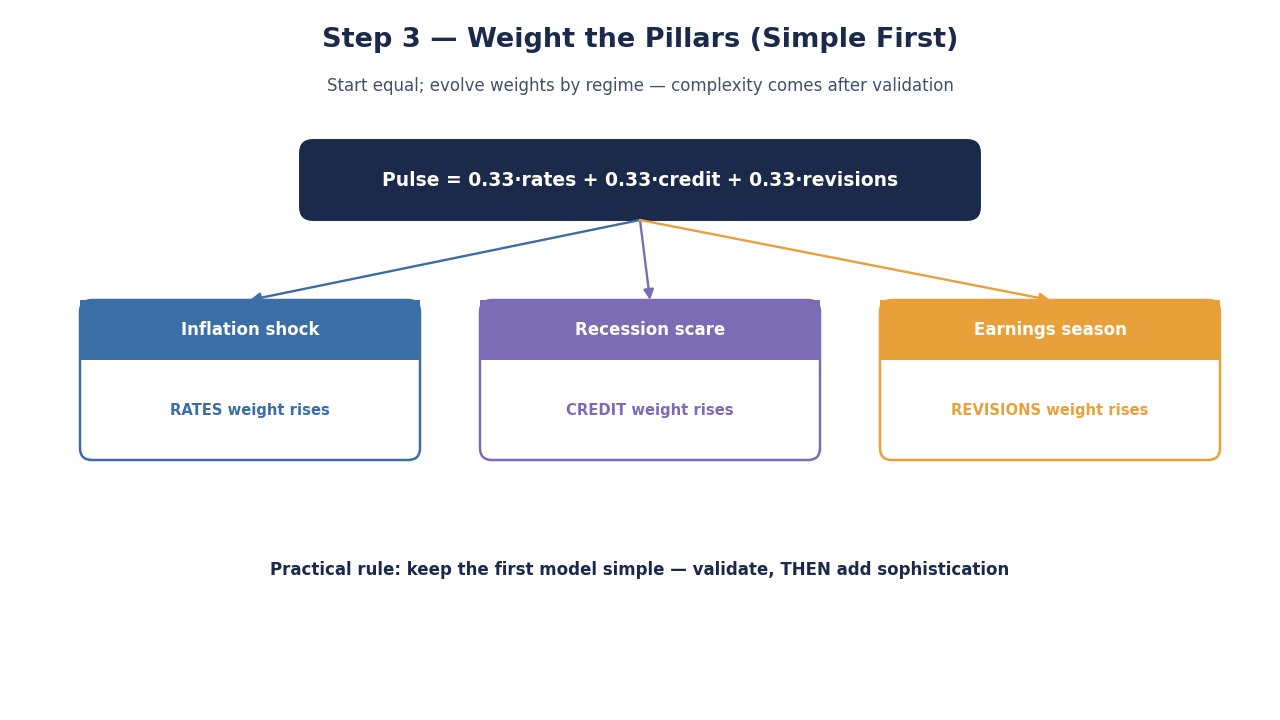
Start with equal weights:
Pulse = 0.33*rates + 0.33*credit + 0.33*revisions
Then evolve weights based on regimes:
- In inflation shocks, rates weight rises
- In recession scares, credit weight rises
- In earnings season, revisions weight rises
Bold practical rule: keep the first model simple—complexity comes after validation.
Step 4: Add a regime layer (so you don’t overtrade)
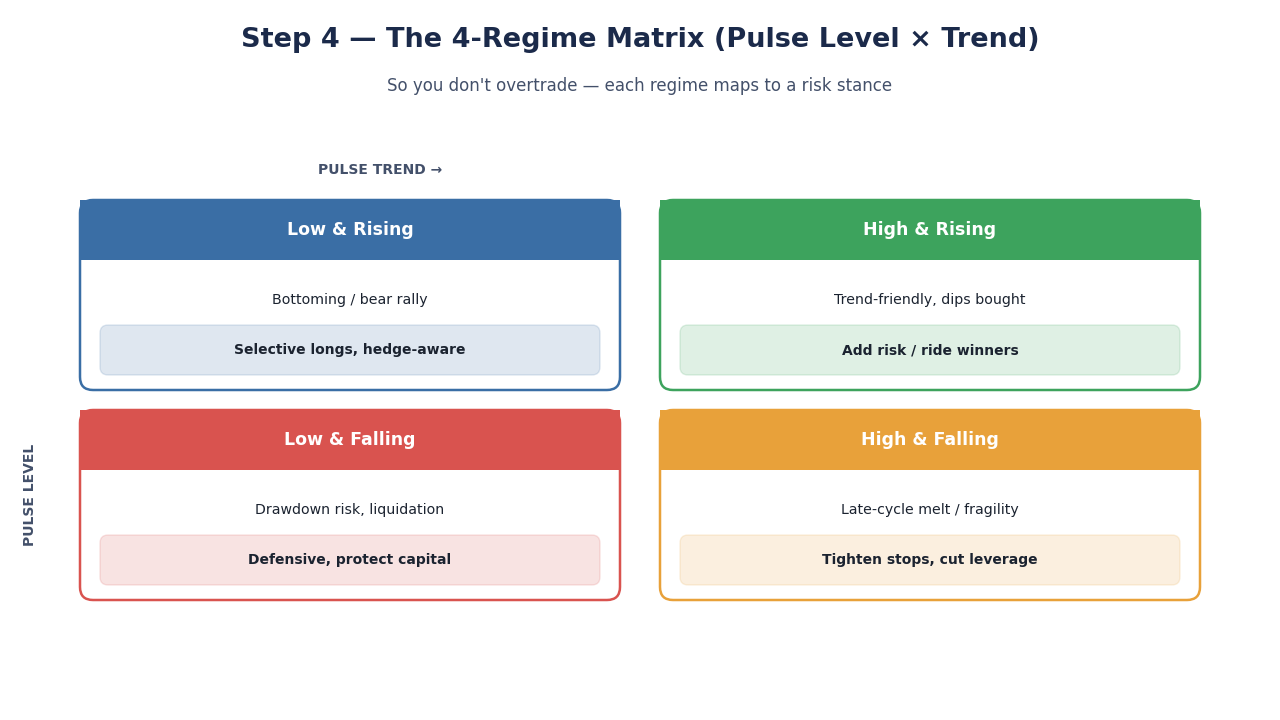
Create 4 regimes from the Pulse and its trend:
| Regime | Pulse Level | Pulse Trend | Typical Nasdaq 100 Behavior | Risk Stance |
|---|---|---|---|---|
| 1 | High | Rising | Trend-friendly, dips bought | Add risk / ride winners |
| 2 | High | Falling | Late-cycle melt / fragility | Tighten stops, reduce leverage |
| 3 | Low | Rising | Bottoming / bear rally | Selective longs, hedge-aware |
| 4 | Low | Falling | Drawdown risk, liquidation | Defensive, prioritize capital |
How does the Nasdaq 100 Liquidity Pulse signal risk-on vs risk-off?
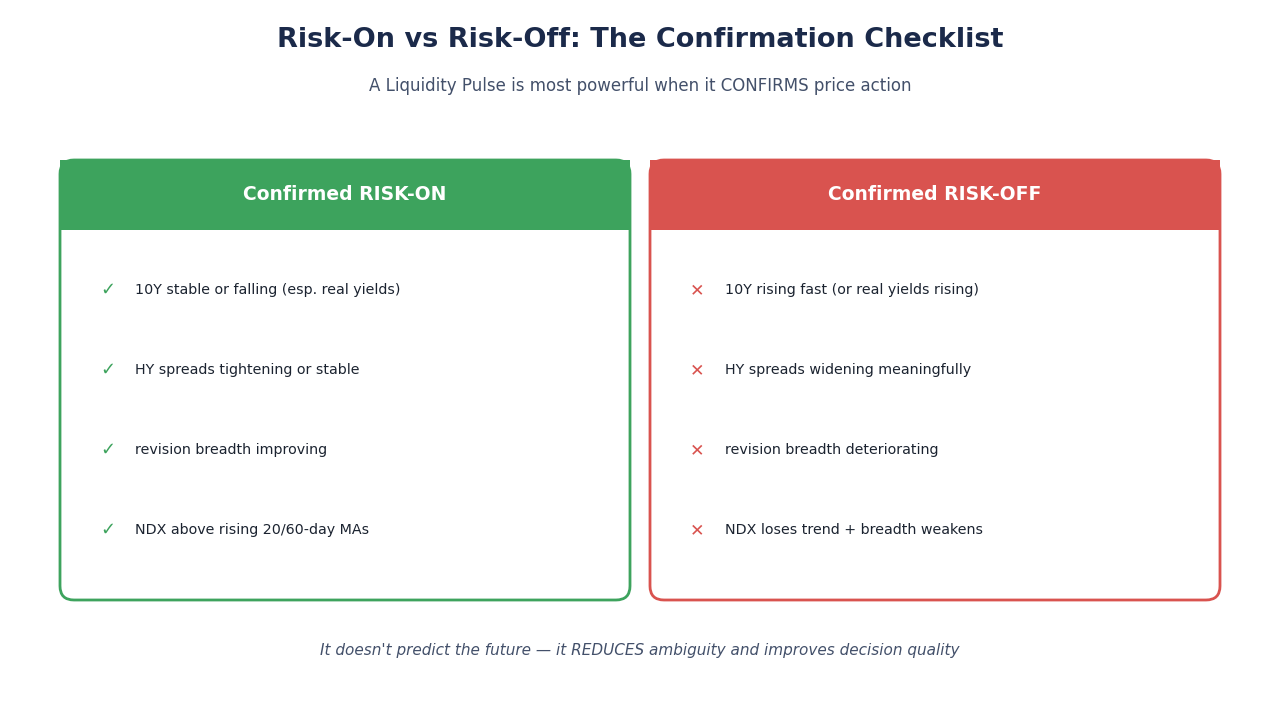
A Liquidity Pulse is most powerful when it confirms price action:
Confirmed risk-on (higher confidence)
10Ystable or falling (especially real yields)- HY spreads tightening or stable
- Revision breadth improving
- Nasdaq 100 above key trend measures (e.g., rising
20/60day MAs)
Confirmed risk-off (higher confidence)
10Yrising fast (or real yields rising)- HY spreads widening meaningfully
- Revision breadth deteriorating
- Nasdaq 100 loses trend + breadth weakens
A strong Liquidity Pulse doesn’t predict the future—it reduces ambiguity and improves decision quality.
Building an AI workflow: from signals to decisions (the SimianX way)
A common failure mode: traders track 20 dashboards and still hesitate. The advantage of AI is compression: many inputs become one interpretable stance.
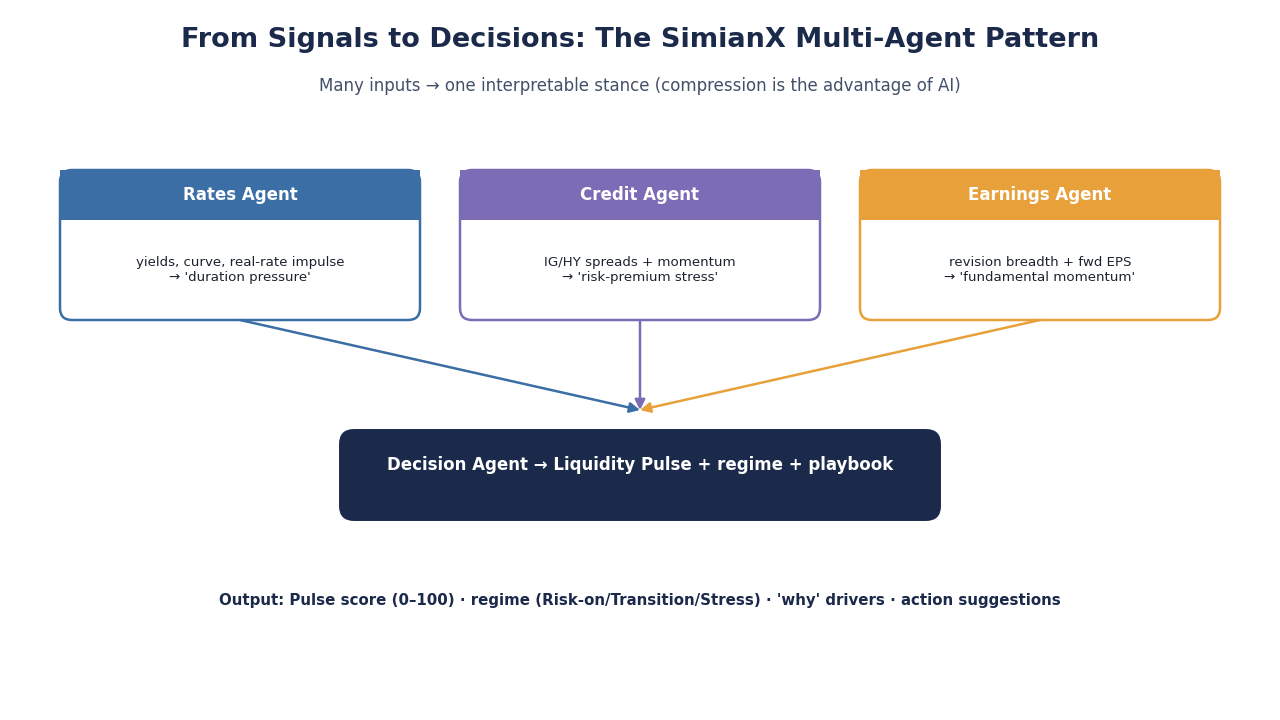
Here’s an effective multi-agent pattern you can run inside SimianX AI:
- Rates Agent: monitors yields, curve, real-rate impulse; labels “duration pressure”
- Credit Agent: tracks IG/HY spreads and spread momentum; labels “risk premium stress”
- Earnings Agent: tracks revisions breadth and forward EPS trend; labels “fundamental momentum”
- Decision Agent: fuses the three into Liquidity Pulse + regime + playbook
In practice, SimianX AI can present:
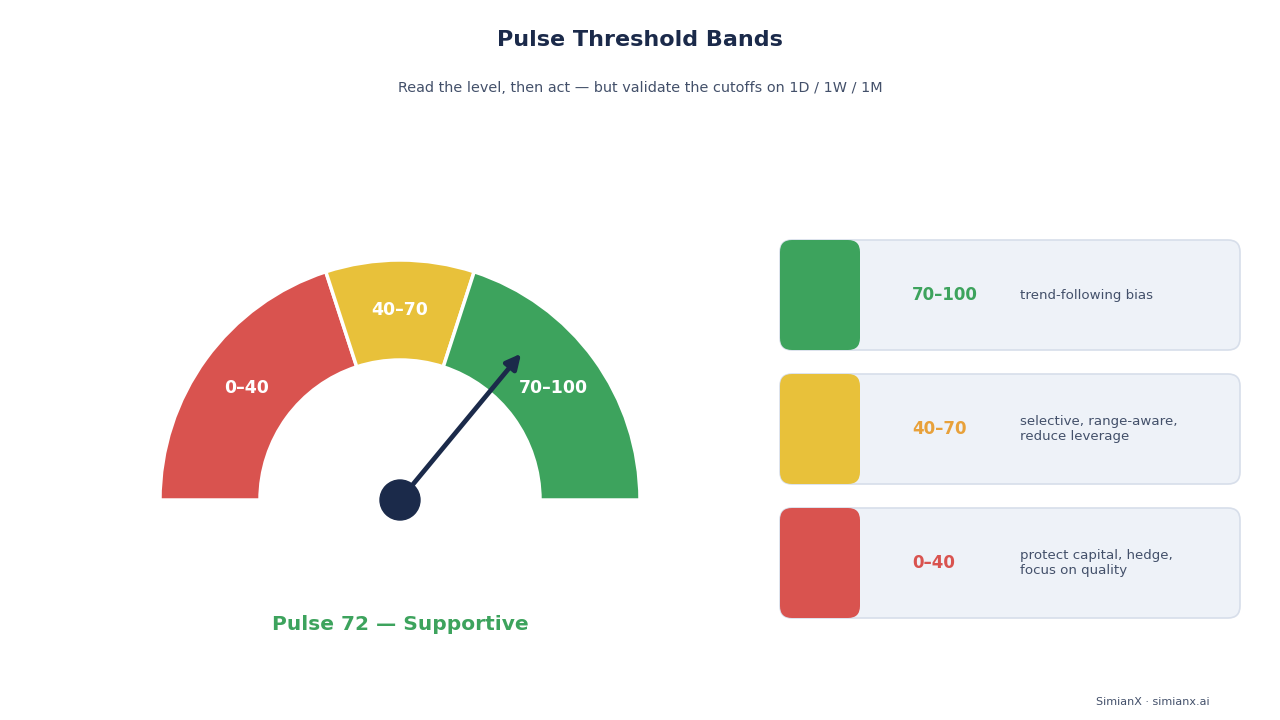
- a single Pulse score (0–100)
- regime label (Risk-on / Transition / Stress)
- “why” explanation (top drivers + what changed today)
- action suggestions (position sizing, hedges, timeframes)
Internal reference: start from the SimianX research hub at SimianX AI and explore more macro-style workflows on the Stories page.
A practical scoring model you can implement today
Below is a simple scorecard you can use even without a full quant stack.
Signal transforms (beginner-friendly)
- Rates impulse:
Δ10Y over 20 daysmapped to percentile - Credit impulse:
ΔHY spread over 20 daysmapped to percentile - Revisions impulse:
revision breadth over 20 daysmapped to percentile
Scorecard table
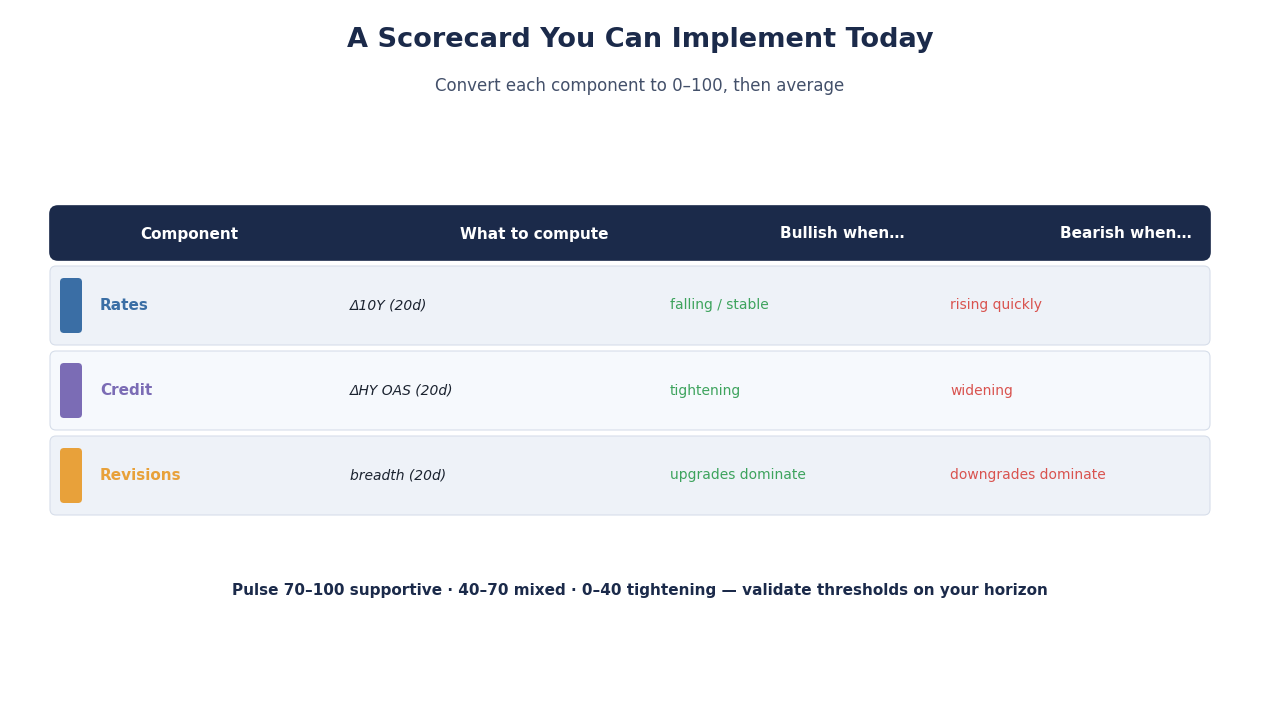
| Component | What to compute | Bullish for Nasdaq 100 when… | Bearish when… |
|---|---|---|---|
| Rates | Δ10Y (20d) | falling / stable | rising quickly |
| Credit | ΔHY OAS (20d) | tightening | widening |
| Revisions | breadth (20d) | upgrades dominate | downgrades dominate |
Convert each into a 0–100 score, then average.
Example thresholds (don’t treat as universal)
- Pulse 70–100: liquidity supportive → trend-following bias
- Pulse 40–70: mixed → selective, range-aware, reduce leverage
- Pulse 0–40: tightening → protect capital, hedge, focus on quality
Bold reminder: thresholds must be validated on your data horizon (1D, 1W, 1M).
A playbook: how to trade with the Liquidity Pulse (without overfitting)
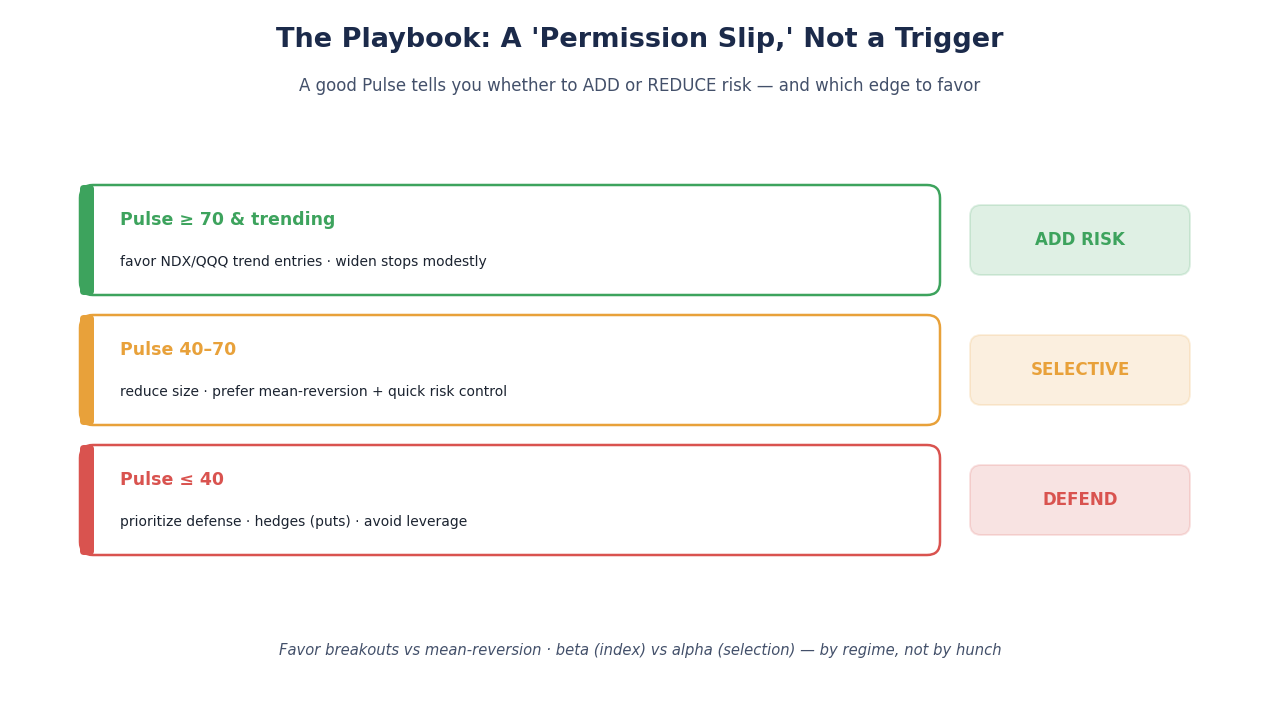
Use it as a “permission slip,” not a trigger
A good Liquidity Pulse answers:
- Should I be adding risk or reducing risk?
- Should I favor breakouts or mean reversion?
- Should I prefer beta (index exposure) or alpha (stock selection)?
A simple ruleset (illustrative)
- If Pulse ≥ 70 and price is trending:
- favor NDX/QQQ trend entries
- widen stops modestly (trend needs room)
- If Pulse 40–70:
- reduce position size
- prefer mean reversion edges + quick risk control
- If Pulse ≤ 40:
- prioritize defense
- consider hedges (e.g., protective puts) and avoid leverage
Position sizing: a safer lever than prediction
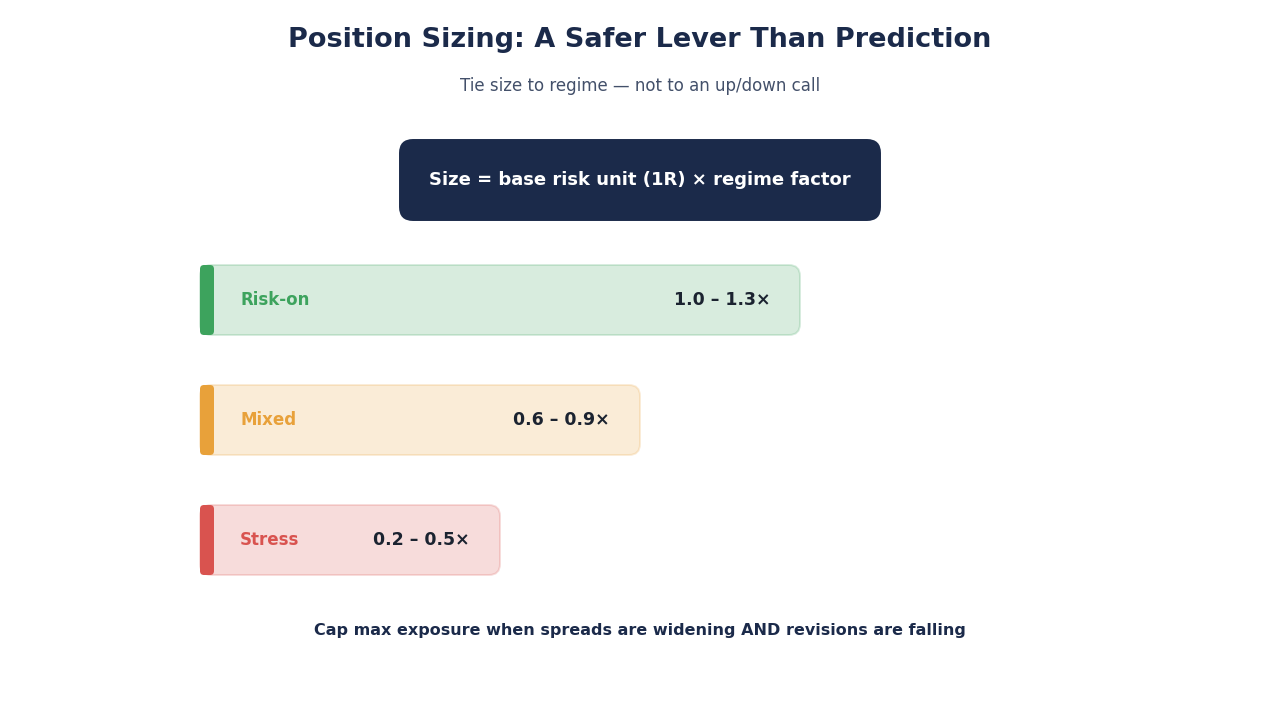
Instead of “up or down,” tie size to regime:
- Start with a base risk unit (e.g., 1R)
- Multiply by regime factor:
- Risk-on: 1.0–1.3x
- Mixed: 0.6–0.9x
- Stress: 0.2–0.5x
- Cap max exposure when spreads are widening and revisions are falling
Common pitfalls (and how to avoid them)
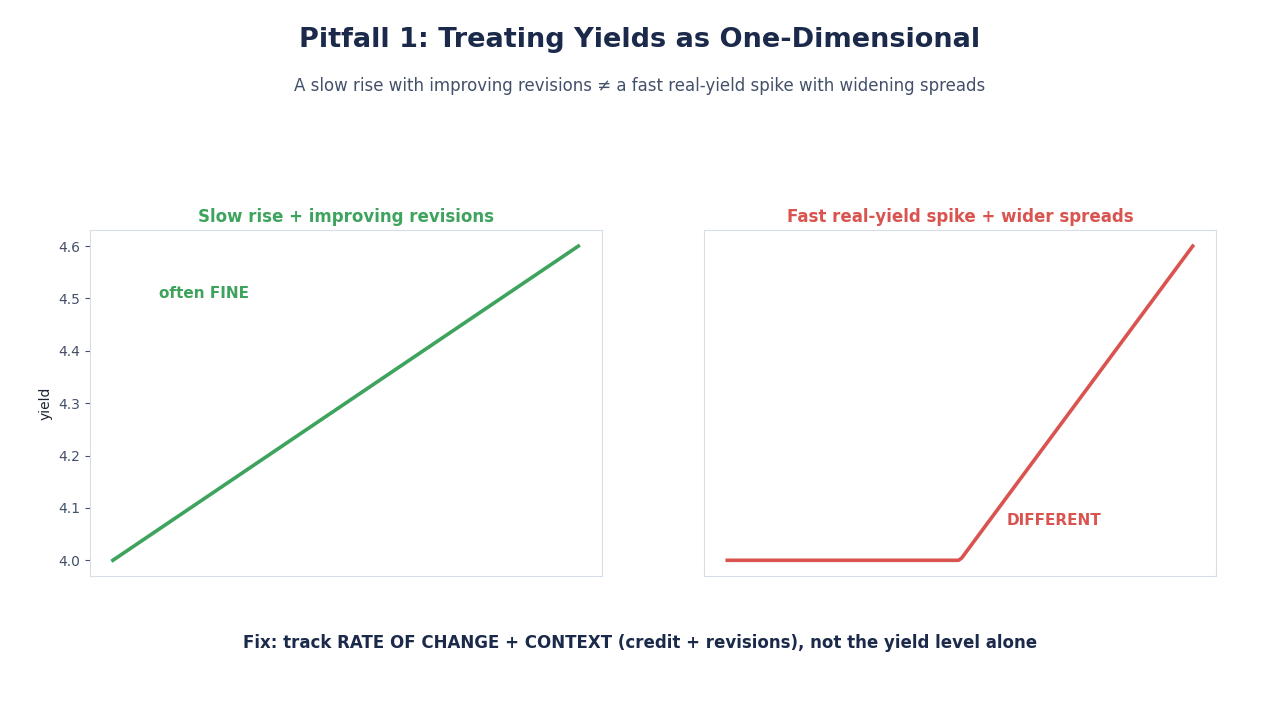
Pitfall 1: treating yields as one-dimensional
A slow rise in yields with improving revisions can be fine.
A fast spike in real yields with widening spreads is different.
Fix: track rate of change + context (credit + revisions).
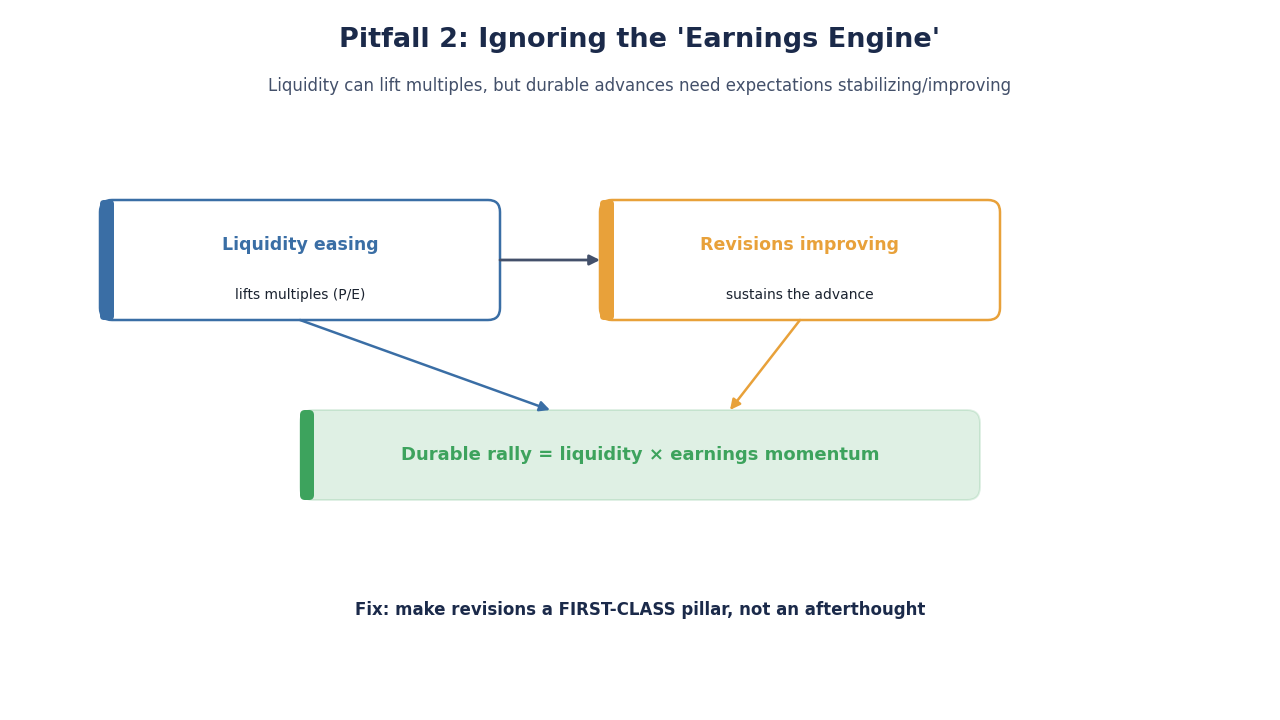
Pitfall 2: ignoring the “earnings engine”
Nasdaq 100 can rally on liquidity, but durable advances usually need expectations stabilizing or improving.
Fix: make revisions a first-class pillar, not an afterthought.
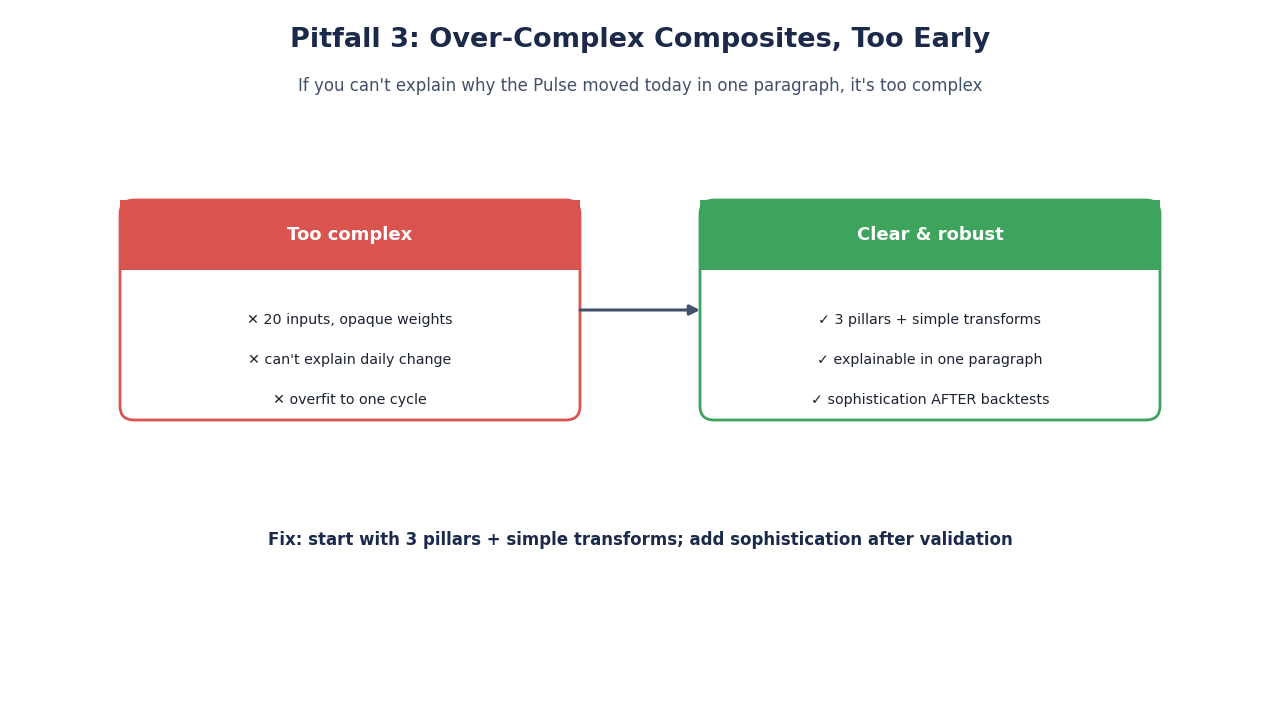
Pitfall 3: building an overly complex composite too early
If you can’t explain why the Pulse changed today in one paragraph, it’s probably too complex.
Fix: start with 3 pillars + simple transforms; add sophistication after backtests.
Backtesting the Liquidity Pulse (research blueprint)
You don’t need institutional infrastructure to run a meaningful test, but you do need discipline.
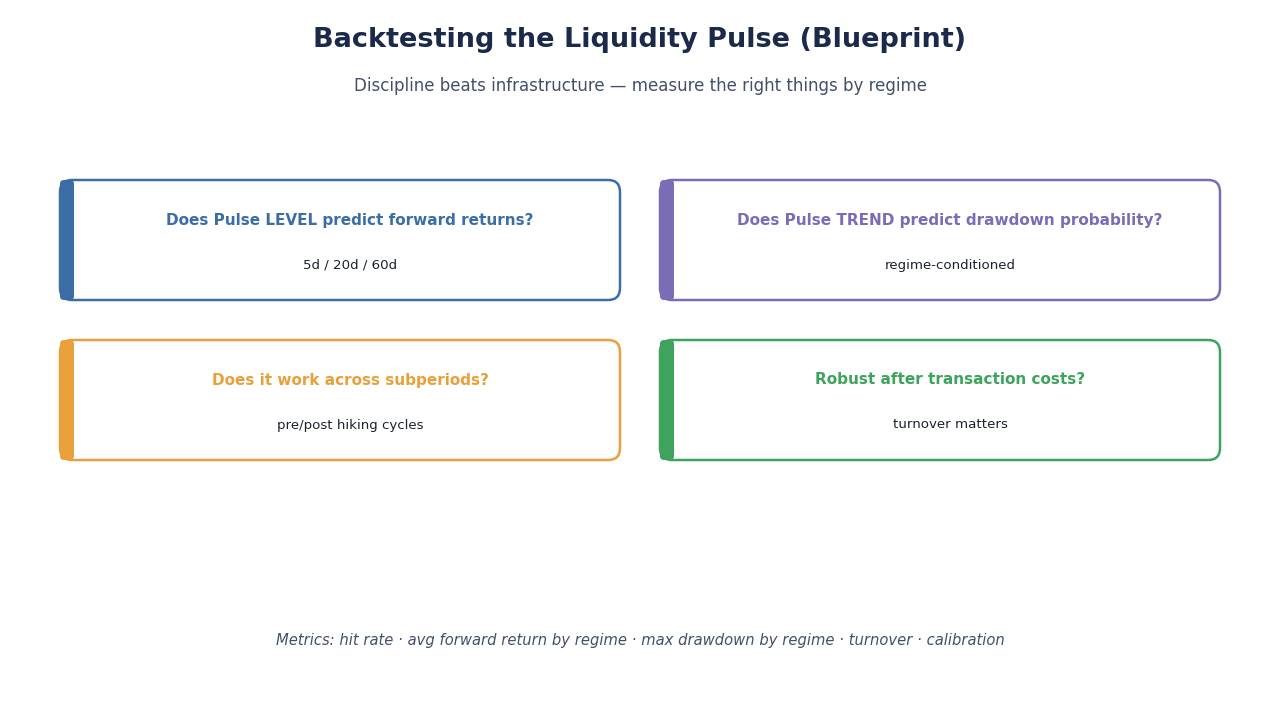
Minimum backtest questions
- Does Pulse level predict forward returns (
5d,20d,60d)? - Does Pulse trend predict drawdown probability?
- Does the model work across subperiods (pre/post hiking cycles)?
- Are results robust after transaction costs?
Suggested evaluation metrics
- hit rate (directional accuracy)
- average forward return by regime
- max drawdown by regime
- turnover (how often signals flip)
- calibration (does “stress” really mean stress?)
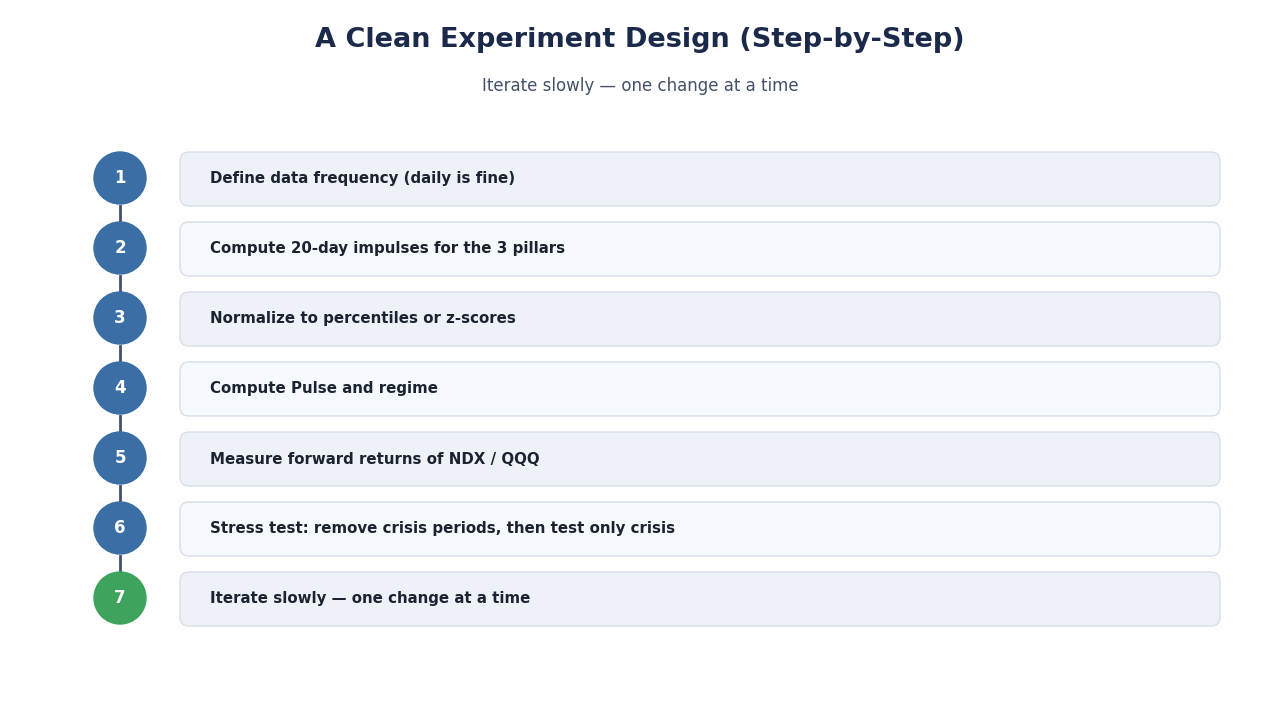
A clean experiment design (step-by-step)
- Define data frequency (daily is fine)
- Compute 20-day impulses for the three pillars
- Normalize to percentiles or z-scores
- Compute Pulse and regime
- Measure forward returns of
NDX/QQQ - Stress test by removing crisis periods (and then testing only crisis periods)
- Iterate slowly (one change at a time)
Advanced extensions (optional, but powerful)
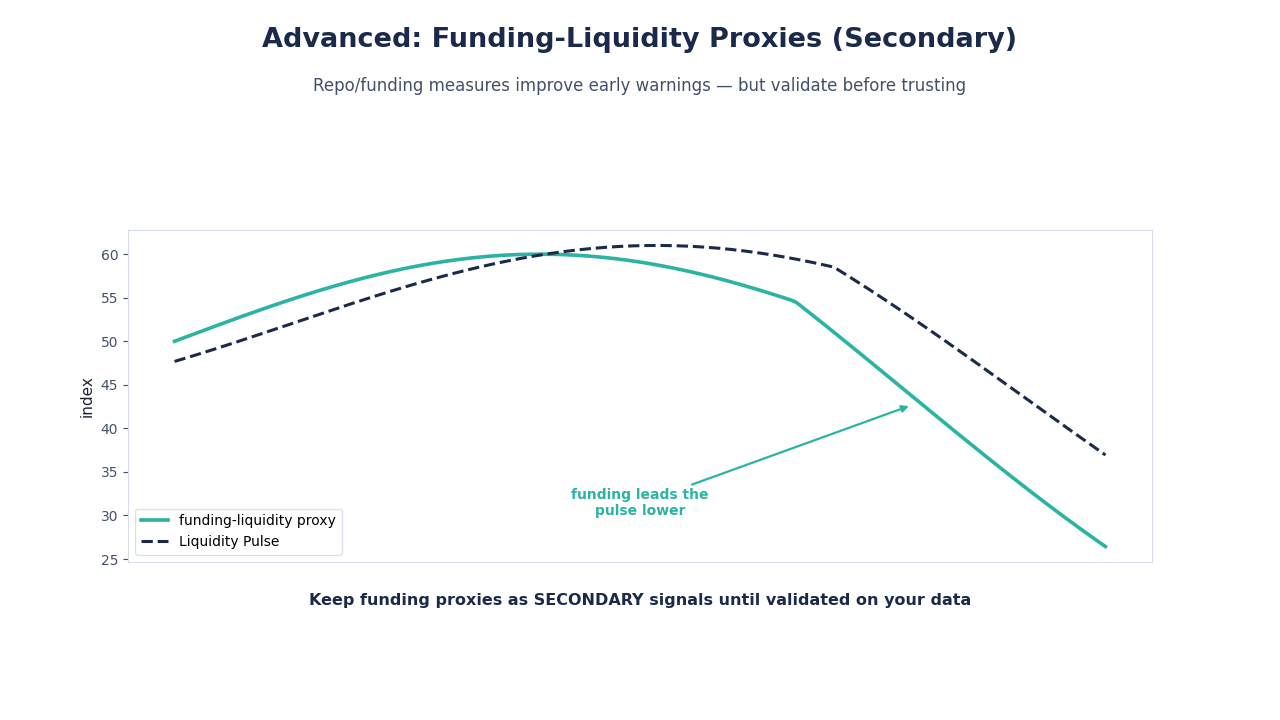
Add “funding liquidity” proxies
If you have access to repo/funding measures, they can improve early warnings. But keep them as secondary signals until validated.
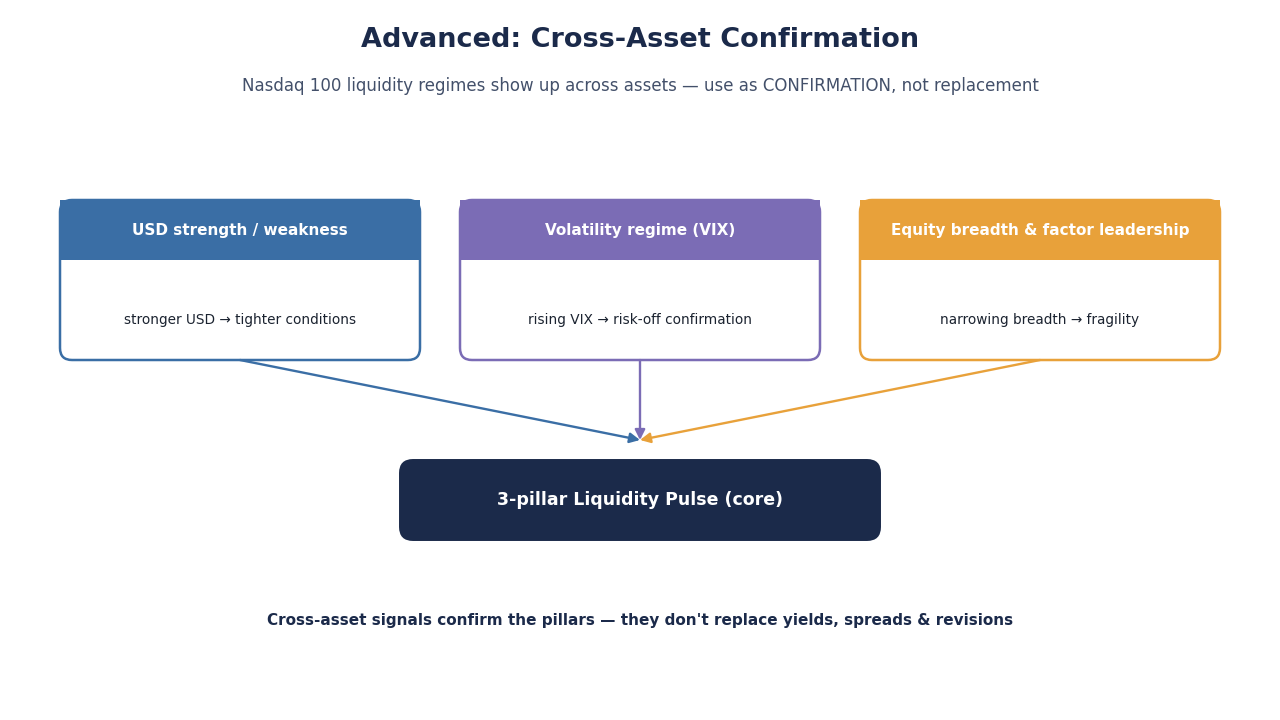
Add cross-asset confirmation
Nasdaq 100 liquidity regimes often show up in:
USDstrength/weakness- volatility regime shifts (
VIX) - equity breadth and factor leadership
Use these as confirmation, not replacements for the 3 pillars.
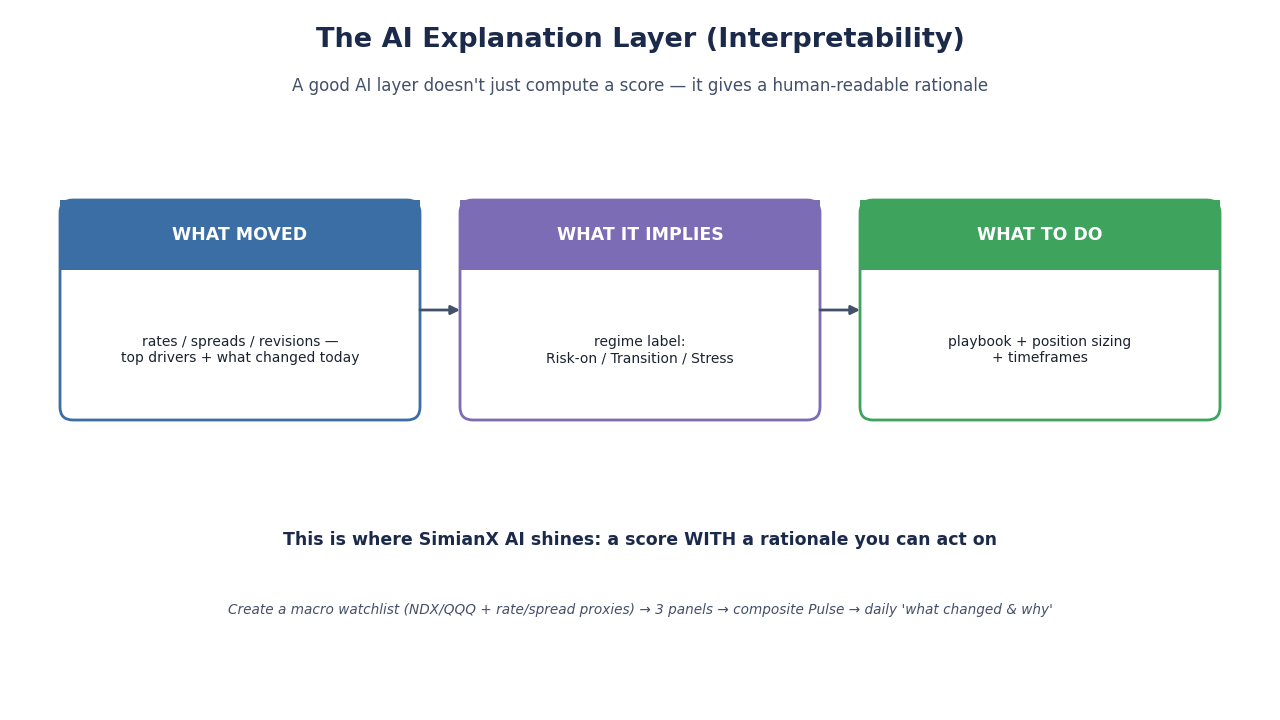
Add an AI explanation layer (interpretability)
A good AI layer should output:
- what moved (rates/spreads/revisions)
- what it implies (regime)
- what to do (playbook + sizing)
This is where SimianX AI can shine: the model doesn’t just compute a score—it gives you a human-readable rationale you can act on.
How to build a Nasdaq 100 Liquidity Pulse score in SimianX AI
To operationalize the framework:
- Create a macro watchlist around
NDX,QQQ, plus rate/spread proxies. - Configure three monitoring panels (Rates / Credit / Revisions).
- Define a composite Pulse with consistent transforms (20d impulse + normalization).
- Have SimianX summarize daily deltas: what changed and why.
- Tie your execution rules to regime (size, stops, hedges, holding period).
FAQ About Nasdaq 100 Liquidity Pulse
What is the best way to track the Nasdaq 100 Liquidity Pulse daily?
Track one variable per pillar: 10Y yield, HY spreads, and earnings revision breadth. Update a simple composite score and watch whether it’s rising or falling, not just the level.
How do Treasury yields affect Nasdaq 100 valuations?
Yields influence the discount rate used for future cash flows. Higher yields (especially real yields) can pressure long-duration growth stocks, while falling yields often support multiples.
Do credit spreads lead stock drawdowns?
They can. Widening spreads reflect rising risk premia and tighter financing conditions, which often coincide with equity stress—especially if earnings revisions are also weakening.
What is an earnings expectation revision and why does it matter?
It’s an update to analyst forecasts (often EPS). Revisions matter because they represent changing expectations, which can drive repricing even before reported earnings change.
Can SimianX AI automate this Liquidity Pulse workflow?
Yes—SimianX AI can compress rates, spreads, and revisions into an interpretable Pulse score, explain the drivers, and align a trading stance to regime shifts via a repeatable dashboard workflow.
Conclusion
The Nasdaq 100 Liquidity Pulse gives you a structured way to read the market’s “financial weather” using three pillars that consistently matter: Treasury yields (discount rates), credit spreads (risk premia), and earnings expectation revisions (cash-flow momentum). When the three align, regimes become clearer; when they diverge, the Pulse helps you size risk and avoid overconfidence. If you want to operationalize this framework with AI explanations, daily signal compression, and decision-ready dashboards, explore SimianX AI and build your own Liquidity Pulse workflow from the same pillars.
Related Reading
- US Stock Risk Dashboard: AI Signals from Breadth, Spreads
- S&P 500 Risk Radar: AI Signals from Breadth, Revisions
- Wall Street Drawdown Watch: 10% Warnings, 40% Tail Risk
- Why US Stocks & Crypto Plummeted This Week: The Causes
- S&P 500 to 7000: Momentum, Liquidity & Valuation Signals
- The S&P 500 Sector Rotation Playbook for AI Signals