
 By Muke
Russia–Ukraine War Stock Market Impact: Results and Insights
The Russia–Ukraine War stock market impact is one of the clearest modern examples of how a geopolitical shock travels through observable market channels—energy, inflation expectations, rates, volatility, credit, and sector dispersion—before it shows up in index-level returns. This research-style guide pulls those channels into a coherent set of results and practical insights so you can move from “headline reaction” to repeatable decision-making. It also shows how a workflow like SimianX AI can help you monitor these signals consistently, without getting lost in noise.
Executive summary: what the data-driven results usually show
Across academic event studies, policy reports, and market post-mortems, a pattern repeats:
- The first shock mattered most. The largest abnormal moves clustered around the invasion and the first wave of sanctions.
- Proximity and exposure drove cross-country dispersion. Europe (especially energy-dependent areas) tended to react more sharply than more insulated markets.
- Sector dispersion often dominated index direction. Energy and defense-linked themes frequently outperformed while rate-sensitive growth, transport, and some cyclicals lagged—depending on the day and macro backdrop.
- Volatility spiked, then normalized. Options repriced the uncertainty premium quickly; subsequent moves depended on whether inflation/rates channels became persistent.
- Markets adapted faster than narratives. Over time, supply chains rerouted, policy responses stabilized expectations, and risk premia partially mean-reverted—often while the war continued.
This is the key takeaway:
Markets don’t price wars directly. They price constraints, uncertainty, policy reactions, and second-order earnings effects—and those leave measurable footprints you can track.
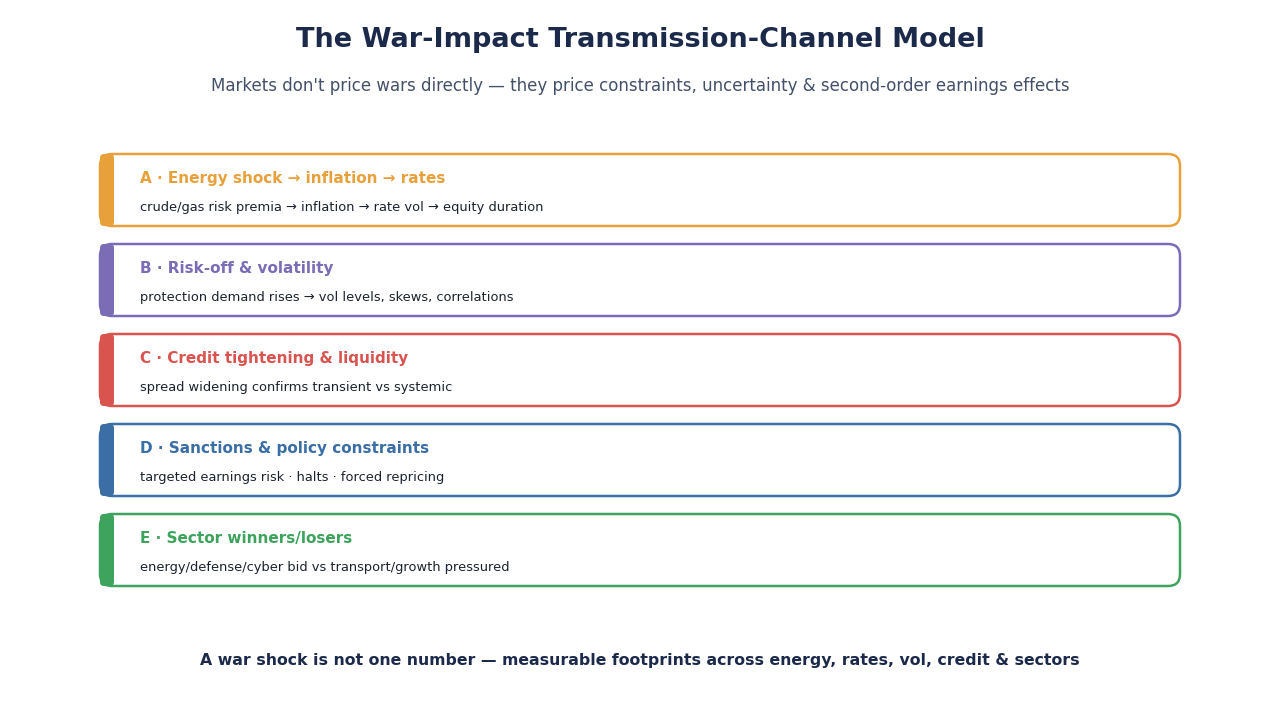
Why “war impact” is not one number: the transmission-channel model
If you want to understand market reactions to the Russia–Ukraine War, don’t start with “Did the S&P 500 go down?” Start with channels.
Channel A: Energy shock → inflation expectations → rates repricing
Energy is a fast transmission mechanism because it hits input costs, consumer inflation, and central-bank reaction functions. The war amplified a classic sequence:
1) crude and natural gas risk premia rise,
2) inflation expectations shift,
3) rates volatility increases,
4) equity duration underperforms.
Channel B: Risk-off and volatility repricing
Uncertainty is tradeable. When investors don’t know where the next constraint will appear—sanctions, cyber, shipping, gas supply—protection demand rises. You see this in volatility levels, skews, and correlations.
Channel C: Credit tightening and liquidity
Credit markets can “confirm” whether a shock is transient or systemic. Spread widening, funding stress, and liquidity deterioration constrain risk budgets and reduce dip-buying.
Channel D: Sanctions and policy constraints
Sanctions create targeted earnings risk (banks, energy, industrial linkages) and can force capital controls, trading halts, and forced repricing—especially in the directly involved market.
Channel E: Sector winners/losers (dispersion and rotation)
Even if the index recovers, the composition changes. War risk often increases dispersion: energy/defense/cyber bid vs transport/consumer discretionary/rate-sensitive growth pressured—until the dominant channel rotates.
Methodology: how researchers measure market reactions
A large share of the “results” literature uses an event study framework. In plain language, an event study asks:
- Did returns around the event differ from what would normally be expected?
- Were those differences statistically meaningful?
- Did effects differ across countries, sectors, or exposure groups?
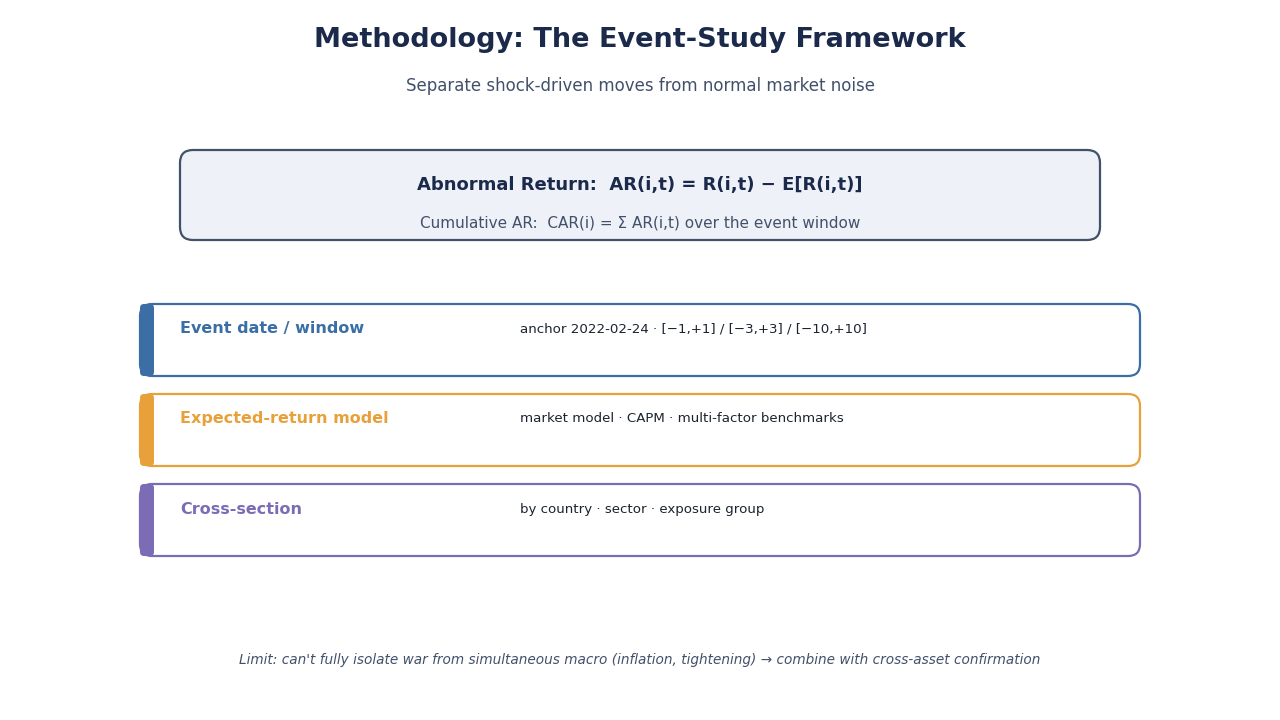
The event study building blocks
1) Event date / window
- Common event anchor: 2022-02-24 (full-scale invasion).
- Windows: [-1, +1], [-3, +3], [-10, +10], and sometimes longer.
2) Expected return model
- Market model, CAPM, or multi-factor benchmarks.
- Expected return: E[R_i,t].
3) Abnormal return (AR)
- AR_i,t = R_i,t - E[R_i,t]
4) Cumulative abnormal return (CAR)
- CAR_i = Σ AR_i,t over the chosen window.
Event studies are powerful because they separate shock-driven moves from normal market noise. But they also have limits: they can’t fully isolate war effects from simultaneous macro forces (inflation, tightening, post-pandemic supply constraints). That’s why the best interpretations combine event studies with cross-asset confirmation (energy, rates, vol, credit).
How did the Russia–Ukraine War stock market impact unfold in 2022?
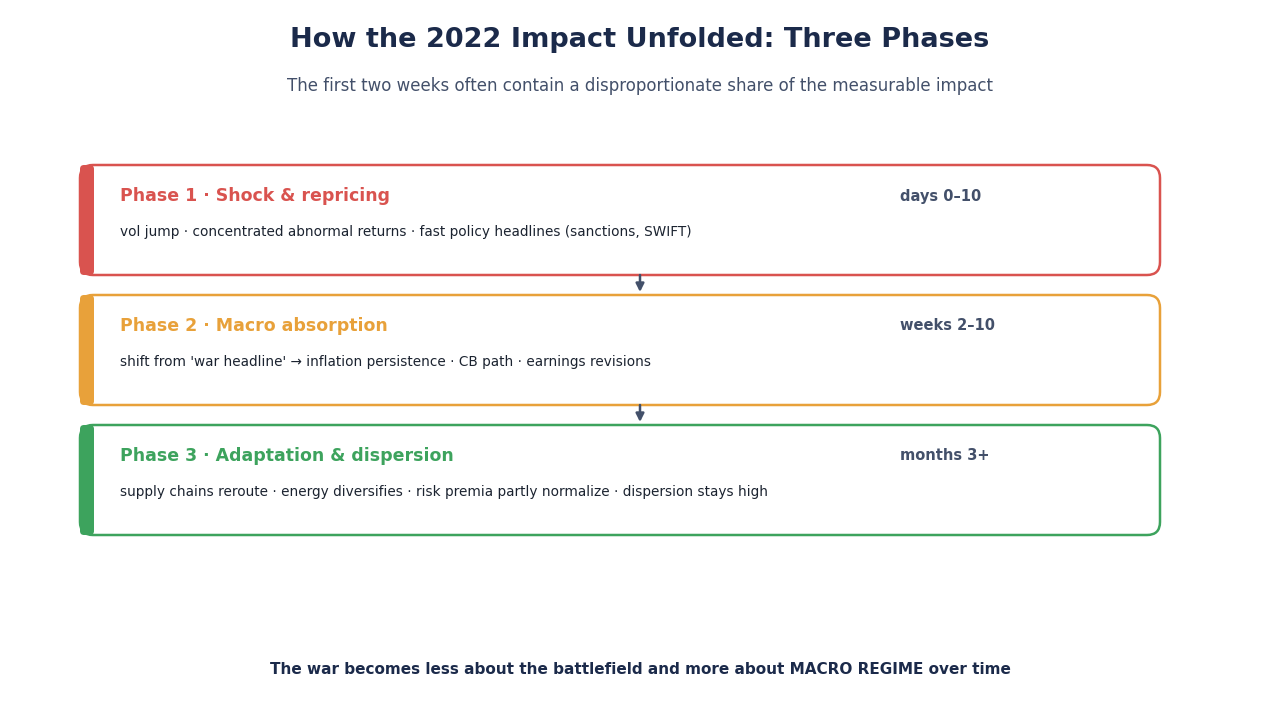
A useful way to interpret the invasion week is phase-based:
Phase 1: The “shock and repricing” burst (days 0–10)
This is where you typically see:
- volatility jump,
- sharp cross-asset repricing,
- concentrated abnormal returns in exposed geographies and sectors,
- fast-moving policy headlines (sanctions, SWIFT actions, emergency measures).
Core insight: the first two weeks often contain a disproportionate share of the measurable impact.
Phase 2: The “macro absorption” phase (weeks 2–10)
As the initial shock stabilizes, markets often shift from “war headline” to:
- inflation persistence,
- central bank path,
- energy substitution and fiscal responses,
- earnings revisions by sector.
This is where the war impact becomes less about the battlefield and more about macro regime.
Phase 3: The “adaptation and dispersion” phase (months 3+)
Over time:
- companies adjust supply chains,
- Europe diversifies energy sourcing,
- defense spending expectations reset,
- risk premia partially normalize,
- sector and factor dispersion remains elevated.
The war can still matter, but the mechanism is frequently second-order: energy costs, budget shifts, sanction constraints, investment cycles.
Key results from research: global and regional equity reactions
Across broad multi-country studies, the direction is generally consistent: negative average reaction at onset, with larger effects near the invasion and meaningful cross-country variation.
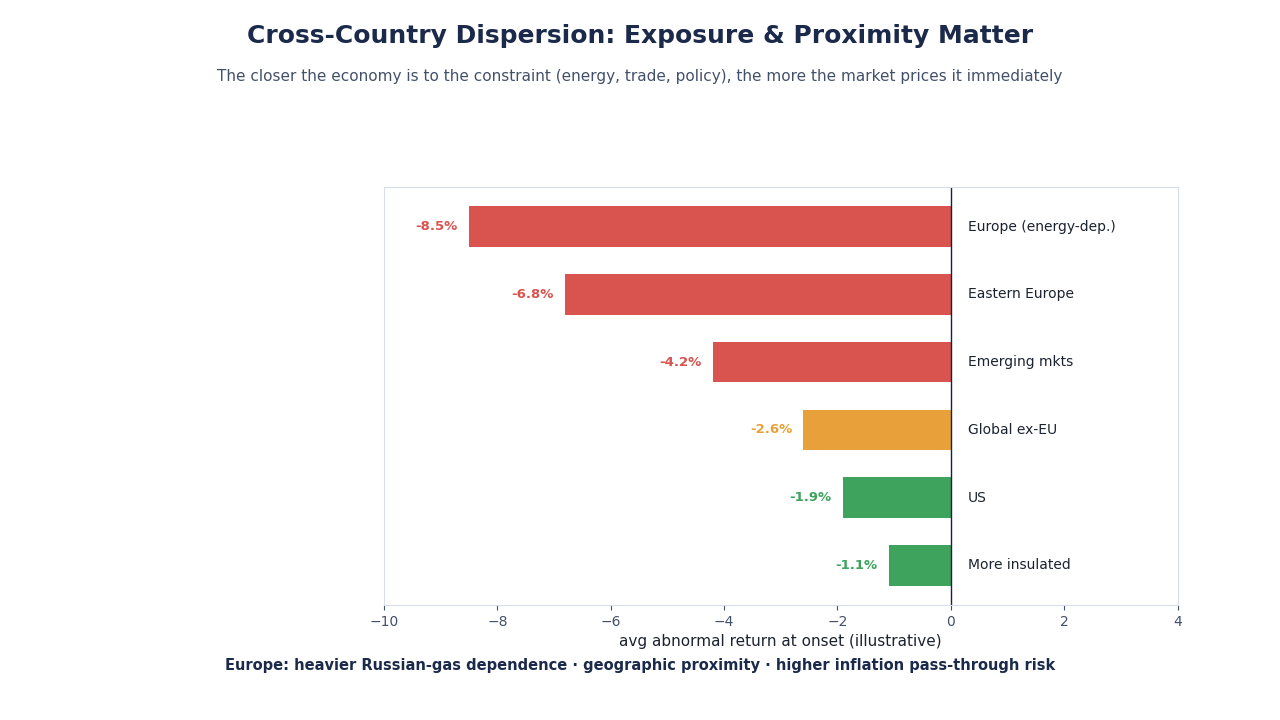
Cross-country dispersion: exposure matters
Research commonly finds that:
- markets more exposed to energy supply risk, trade links, or geographic proximity show stronger negative reactions,
- more distant markets can recover faster if global growth/liquidity offsets the shock,
- uncertainty spillovers can still hit everyone through volatility and macro repricing.
Europe vs. the rest: why proximity shows up in returns
European markets had several compounding sensitivities:
- heavier dependence on Russian energy (especially gas),
- closer geographic risk,
- higher perceived probability of supply disruption,
- stronger inflation pass-through risk.
A practical way to express this is:
The closer the economy is to the constraint (energy, trade, policy spillover), the more the market prices it immediately.
Russia and local-market mechanics: trading halts and policy defense
Russia’s financial system response (rates, market closure, capital controls) created a distinct pattern: policy-driven discontinuities rather than smooth price discovery. For global investors, this matters because it changes:
- correlation assumptions,
- recovery paths,
- counterparty and settlement risk,
- index inclusion/exclusion behavior.
Volatility: the “uncertainty premium” spike and fade
Volatility is often the cleanest real-time indicator of how uncertain investors feel.
Typical footprint during the invasion:
- VIX and equity vol spike around the invasion date,
- skews steepen (downside protection gets expensive),
- realized volatility rises as correlations increase.
Then what determines whether vol stays high?
- persistence of inflation/rates channel,
- credit confirmation (spreads),
- energy supply disruption evidence (not just headlines),
- escalation vs. de-escalation signals.
Practical interpretation
- If volatility spikes but credit stays contained and rates stabilize, equity drawdowns often prove less durable.
- If volatility spikes and credit widens persistently, the shock behaves more like a regime shift than a headline.
Energy: why oil and gas were the core macro amplifier
The Russia–Ukraine conflict mattered for equities largely because it:
- increased the probability of energy supply constraints,
- repriced commodity risk premia,
- threatened European industrial margins,
- lifted inflation uncertainty.
Even without a permanent supply collapse, markets price the distribution of outcomes—especially the tail where shortages occur.
The equity implications of an energy shock
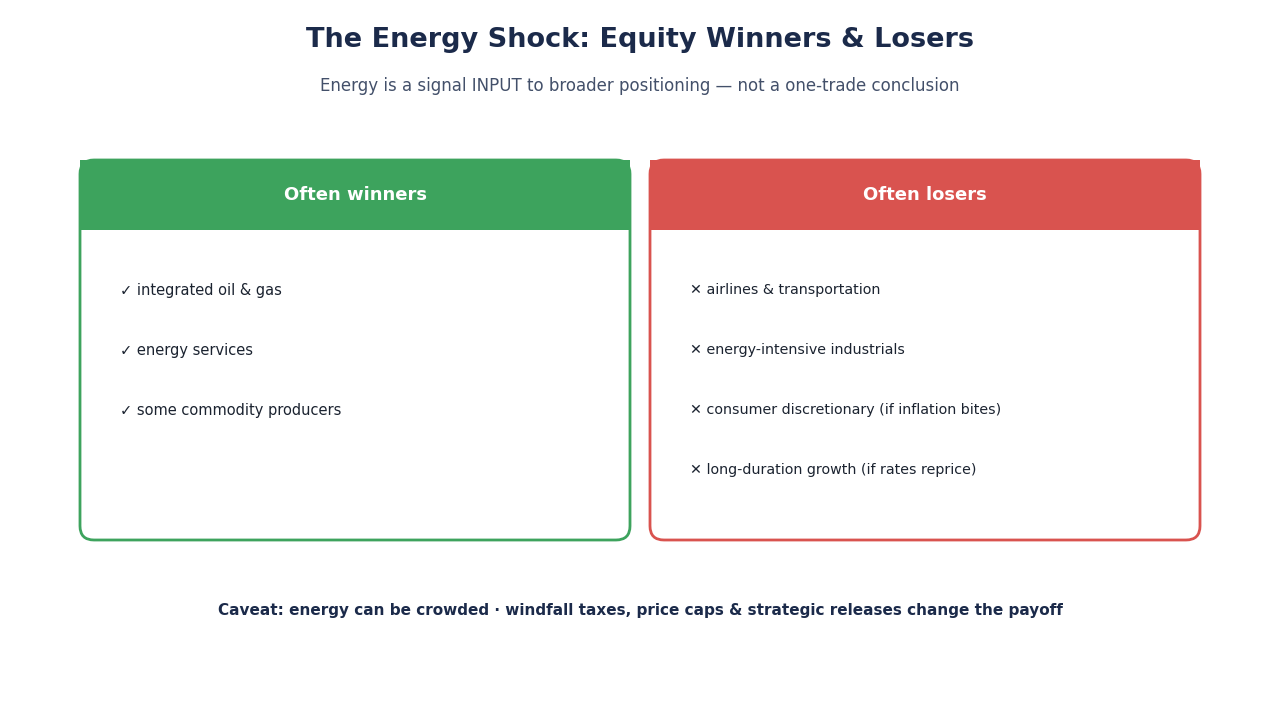
Winners (often):
- integrated oil & gas,
- energy services,
- some commodity producers.
Losers (often):
- airlines and transportation,
- energy-intensive industrials,
- consumer discretionary (if inflation bites),
- long-duration growth (if rates reprice).
Energy shock is not always “buy energy”
Energy equities can already be crowded, and political responses (windfall taxes, price caps, strategic releases) can change the payoff. The key is to treat energy as a signal input to broader positioning, not a one-trade conclusion.
Sector rotation: the war as a dispersion engine
War risk can raise dispersion more than it changes the index level. Investors who only watch the headline index can miss the real action.
A sector/industry impact map (conceptual)
| Transmission channel | Likely beneficiaries | Likely pressured | Why it happens |
|---|---|---|---|
| Energy risk premium | Energy producers, oil services | Airlines, transport, some industrials | Fuel costs + supply risk |
| Defense repricing | Defense primes, aerospace, drones | Budget-sensitive cyclicals | Spending expectations reset |
| Cyber risk | Cybersecurity, infrastructure software | Broad risk assets (if risk-off) | Attack surface expands |
| Inflation persistence | Value/quality cash flows | Long-duration growth | Discount rate rises |
| Credit tightening | High quality balance sheets | Highly levered firms | Financing constraints bind |
Important nuance: rotation changes over time
- Early phase: energy + defense leadership is common.
- Later phase: macro dominates (rates and inflation), so factors like value vs growth can matter more than “war sectors.”
- De-escalation: protection unwinds; beaten cyclicals can rebound.
Rates and inflation expectations: when geopolitics becomes macro
A war shock becomes macro when it changes:
- expected inflation path,
- central bank reaction function,
- terminal rate expectations,
- real yield trajectory.
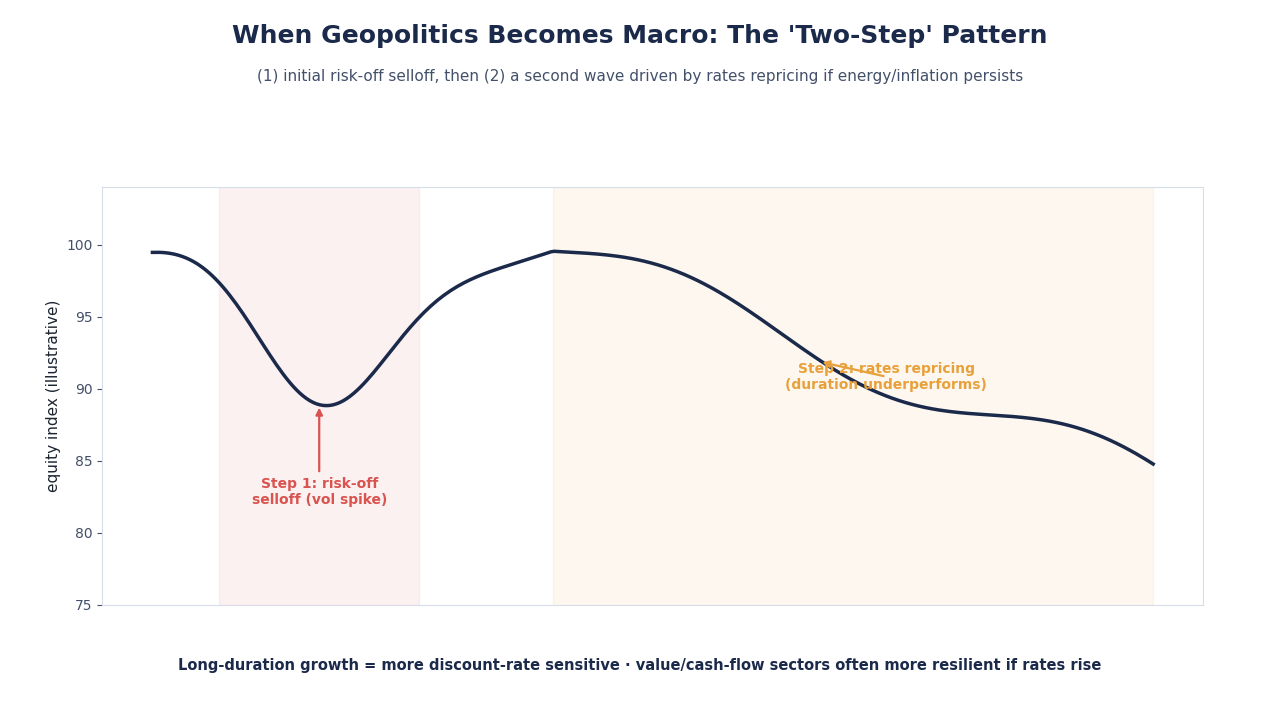
Equity duration becomes a key lens:
- Long-duration growth: more sensitive to discount rates.
- Value/cash-flow heavy sectors: often more resilient if rates rise.
This is why you often see a “two-step” pattern:
1) initial risk-off selloff,
2) then a second wave driven by rates repricing (if energy/inflation persists).
Credit and liquidity: confirming signals vs false alarms
Credit is your “truth serum” for whether the market treats the shock as:
- transient (headline-driven), or
- structural (financing conditions tightening).
A simple confirmation checklist
- HY spreads widening persistently? Risk appetite is structurally constrained.
- IG widening but HY stable? Often a macro caution signal, not panic.
- Equity rally without credit improvement? Thin rally, more fragile.
- Credit stabilizes quickly? The shock may be contained.
A research synthesis: what the academic literature tends to agree on
If you compress dozens of papers into a few durable claims, they look like this:
1) Negative abnormal returns cluster near the invasion, with the largest effect often within the first two weeks.
2) Effects differ across countries based on proximity, economic exposure, and policy vulnerability.
3) Volatility rises significantly around major conflict news and policy escalations.
4) Energy and commodity channels amplify the equity reaction through inflation and rates.
5) Sector dispersion is persistent, even when the index stabilizes.
This synthesis matters because it converts “war is bad” into testable statements:
- When did the effect concentrate?
- Where did it hit hardest?
- Which channels dominated?
Practical playbook: how to trade (and risk-manage) war-driven shocks without overreacting
This section is educational, not financial advice. The goal is a process.
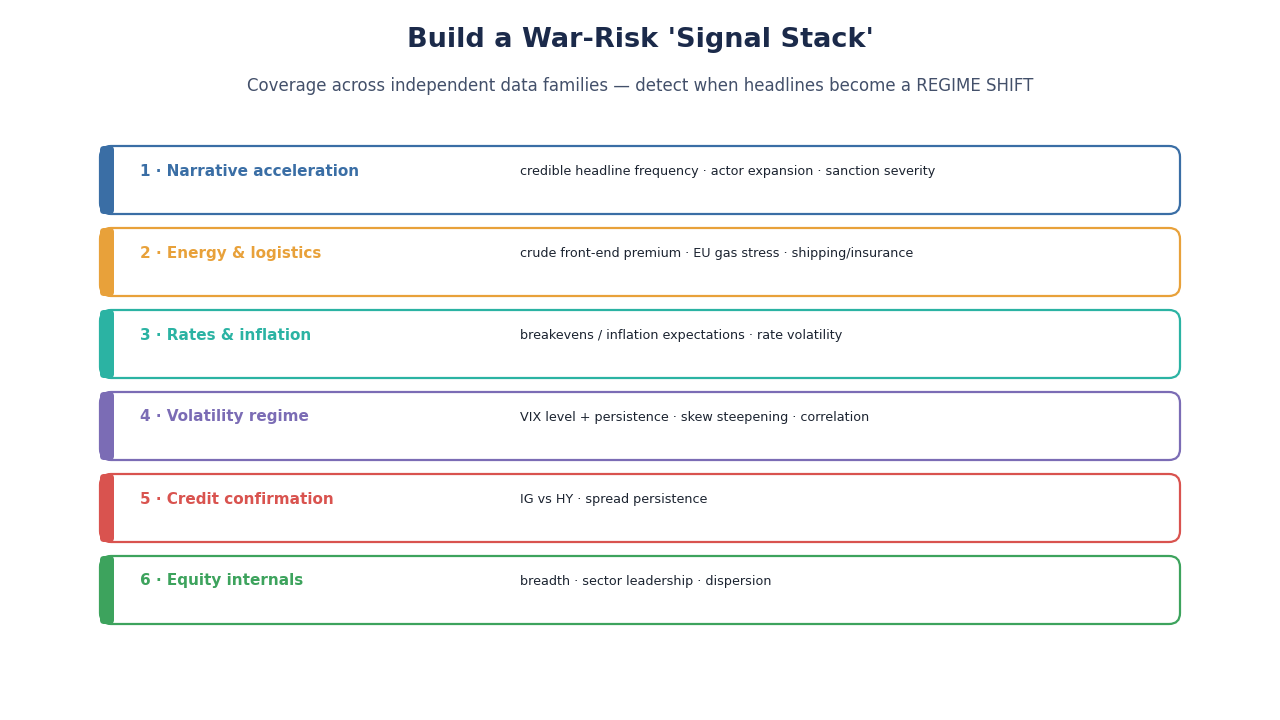
Step 1: Build a war-risk “signal stack”
You want coverage across independent data families:
- Narrative acceleration
- credible headline frequency,
- actor expansion,
- sanction severity changes.
- Energy and logistics
- crude front-end risk premium behavior,
- natural gas stress (especially Europe),
- shipping/insurance disruption proxies.
- Rates and inflation
- breakevens / inflation expectations drift,
- rate volatility.
- Volatility regime
- VIX level + persistence,
- skew steepening,
- correlation behavior.
- Credit confirmation
- IG vs HY,
- spread persistence.
- Equity internals
- breadth deterioration,
- sector leadership changes,
- dispersion.
The goal isn’t predicting the next headline. It’s detecting when headlines become a regime shift.
Step 2: Pre-define “risk gates” (your rules for slowing down)
Example risk gates you can adapt:
- If volatility regime flips from low → high: reduce leverage and position sizes.
- If credit widens for multiple sessions: avoid aggressive dip-buying without confirmation.
- If energy shock persists and inflation/rates reprice: reduce equity duration exposure.
Step 3: Choose hedges that match the channel
- If the dominant channel is volatility: consider option-based protection logic.
- If the dominant channel is energy/inflation: consider inflation/rates sensitivity reduction.
- If the dominant channel is Europe-specific energy stress: reduce regional concentration or use targeted hedges.
The principle is simple:
- Hedge what is actually moving, not what the headline says.
Step 4: Run scenario maps, not single forecasts
Use three scenarios:
- Contained: risk premium spikes, then fades; rotation trades dominate.
- Escalation: supply disruption probability rises; inflation and vol persist.
- De-escalation: risk premia mean-revert; protection unwinds; laggards rebound.
How SimianX AI can operationalize a Russia–Ukraine war market workflow
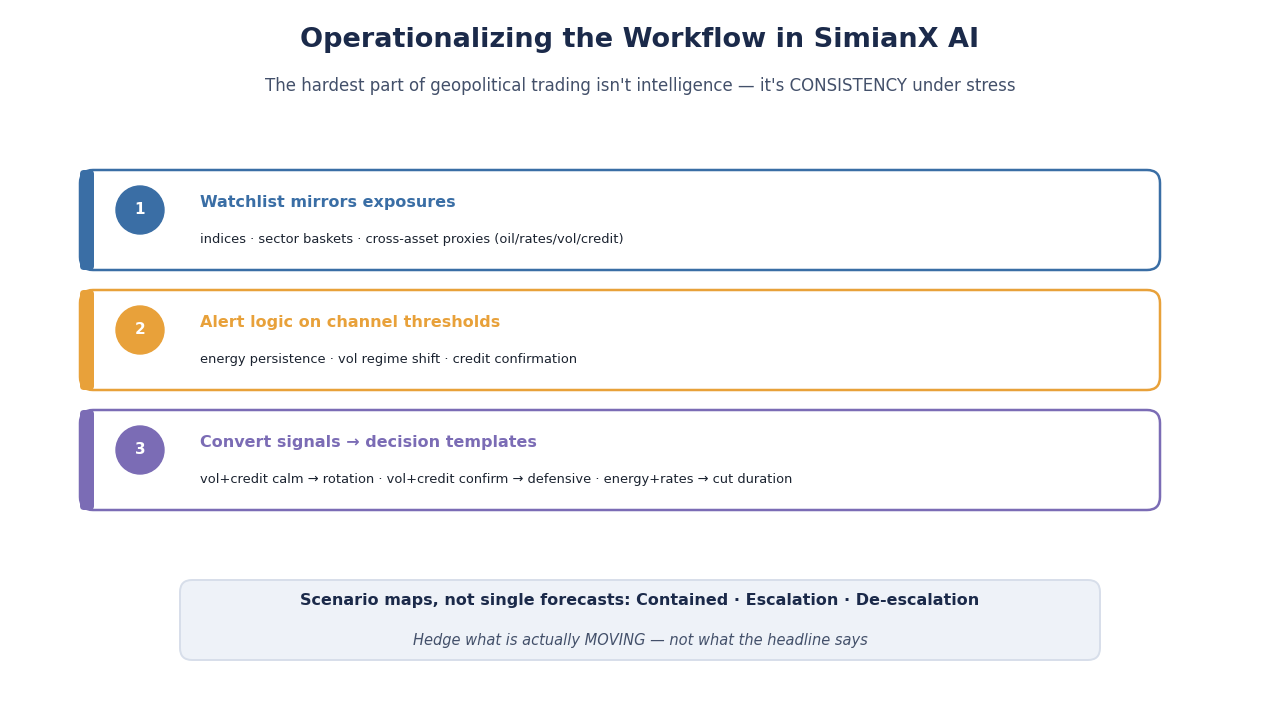
The hardest part of geopolitical trading is not intelligence—it’s consistency under stress. This is where SimianX AI fits naturally: it helps you turn a messy set of signals into a structured routine.
Here’s a practical workflow you can run:
1) Build a watchlist that mirrors your exposures
- Core equity indices (your benchmarks)
- Sector baskets (energy, defense, transport, semis supply chain)
- Cross-asset proxies (oil, rates, vol, credit)
2) Add alert logic around channel thresholds
Examples:
- “Energy shock persistence” alert: multi-day front-end strength + curve behavior.
- “Volatility regime shift” alert: level + persistence.
- “Credit confirmation” alert: HY widening persists beyond a threshold.
3) Convert signals into decision templates
- If vol spikes but credit stays calm: avoid panic hedges; prioritize rotation and sizing control.
- If vol spikes and credit confirms: move to defensive posture and respect liquidity constraints.
- If energy shock persists and rates reprice: reduce equity duration and reassess cyclicals.
To explore a command-room approach to cross-asset signals and sector rotation, visit SimianX AI.
Common mistakes investors make during war shocks
1) Headline overfitting
- reacting to every update instead of tracking acceleration and confirmation.
2) Single-channel thinking
- assuming “it’s just oil” when rates and credit are shifting.
3) Ignoring persistence
- treating multi-week repricing like a one-day scare.
4) Buying protection too late
- paying peak implied volatility for hedges.
5) No post-mortem
- failing to log signals, actions, and outcomes to improve next time.
A better approach is boring and systematic:
- identify channels,
- monitor confirmation,
- size appropriately,
- hedge with intention,
- review and iterate.
FAQ about market reactions to the Russia–Ukraine War
How did the Russia–Ukraine War affect stocks in the first weeks?
Most studies find the strongest negative impact clustered around the invasion and early sanction escalations, with effects varying by country exposure and sector sensitivity. The first 1–2 weeks often contain the largest abnormal moves.
What sectors tended to outperform during the Russia–Ukraine War?
Outperformance commonly appeared in energy-linked segments and defense/security themes, while transport and some energy-intensive industries lagged—though leadership can rotate as the macro channel (rates/inflation) becomes dominant.
What is the best way to hedge geopolitical risk in equities?
Match the hedge to the channel: volatility hedges for uncertainty spikes, duration reduction for rate repricing, and targeted regional/sector hedges when exposure is concentrated. Avoid over-hedging after implied volatility is already expensive.
Did markets recover even while the war continued?
In many cases, yes—because markets adapt through policy responses, supply-chain rerouting, and repricing of expected earnings. But recovery often comes with higher dispersion, meaning “the index” may hide big winners and losers.
Can AI predict war headlines and market moves?
AI is generally better at classification and early detection of regime shifts than predicting specific headlines. The practical edge is faster, more consistent interpretation of cross-asset confirmation signals.
Conclusion: turning Russia–Ukraine war headlines into measurable decisions
The Russia–Ukraine War stock market impact is best understood as a set of transmission channels: energy constraints, inflation and rates repricing, volatility regime shifts, credit confirmation, sanctions-driven constraints, and persistent sector dispersion. When you track those channels explicitly, you stop reacting emotionally to headlines and start responding to confirmed market states.
If you want a repeatable, dashboard-driven workflow for monitoring geopolitical risk signals—and converting them into alerts, rotation ideas, and risk gates—explore SimianX AI and build a process your future self will trust.
Related Reading
- Iran-US War Impact on Stocks: AI Risk Signals Live
- 7 AI Risk Radars for Equities: Breadth, Revisions, Skew
- Dow Jones Risk Pulse: AI Signals Breadth, VIX, Spreads
- Wall Street Drawdown Watch: 10% Warnings, 40% Tail Risk