
 By Muke
Trump Iran Ultimatum Sparks War Fears, Then Ceasefire Pivot Sends Stocks Rallying
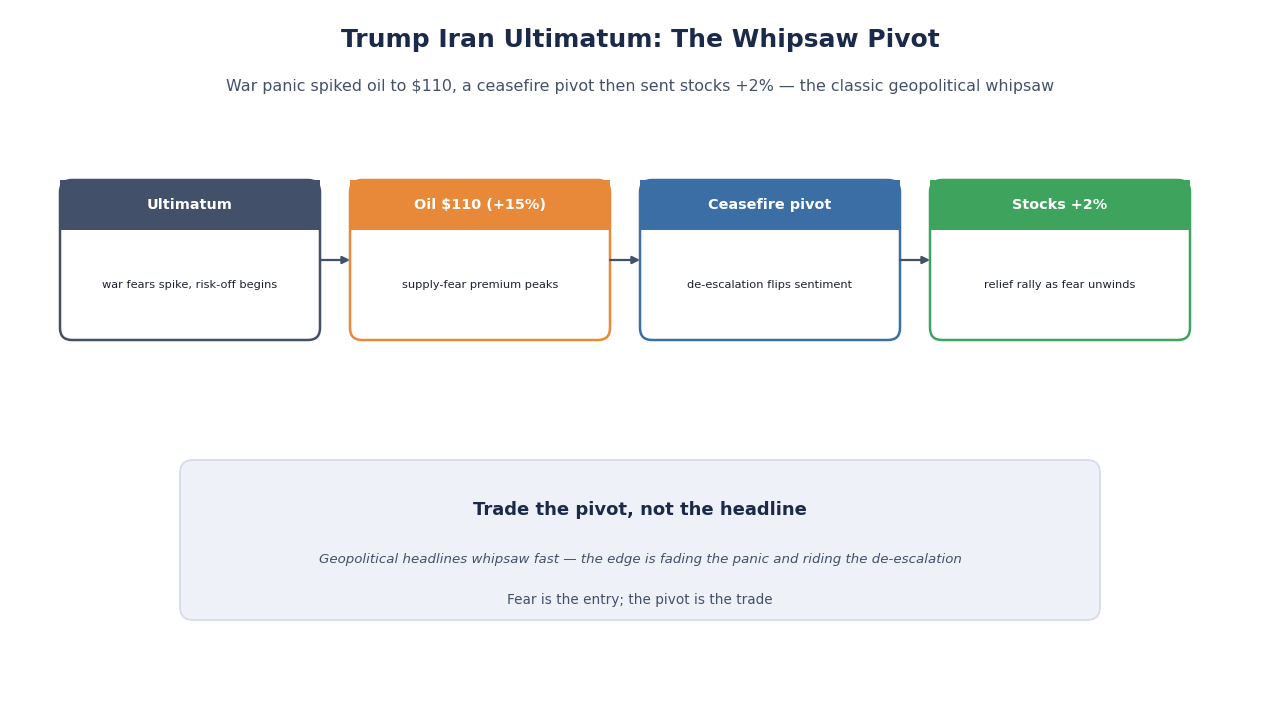
The Trump Iran ultimatum and ceasefire pivot became one of the most dramatic geopolitical market events of 2026. Just hours before an 8 PM deadline that threatened large-scale military escalation, markets were pricing in war risk. Then, in a sudden reversal, a ceasefire announcement triggered a powerful global risk-on rally.
For traders, investors, and analysts using platforms like SimianX AI, this event is a textbook example of how geopolitical shocks, narrative reversals, and liquidity flows interact in real time.
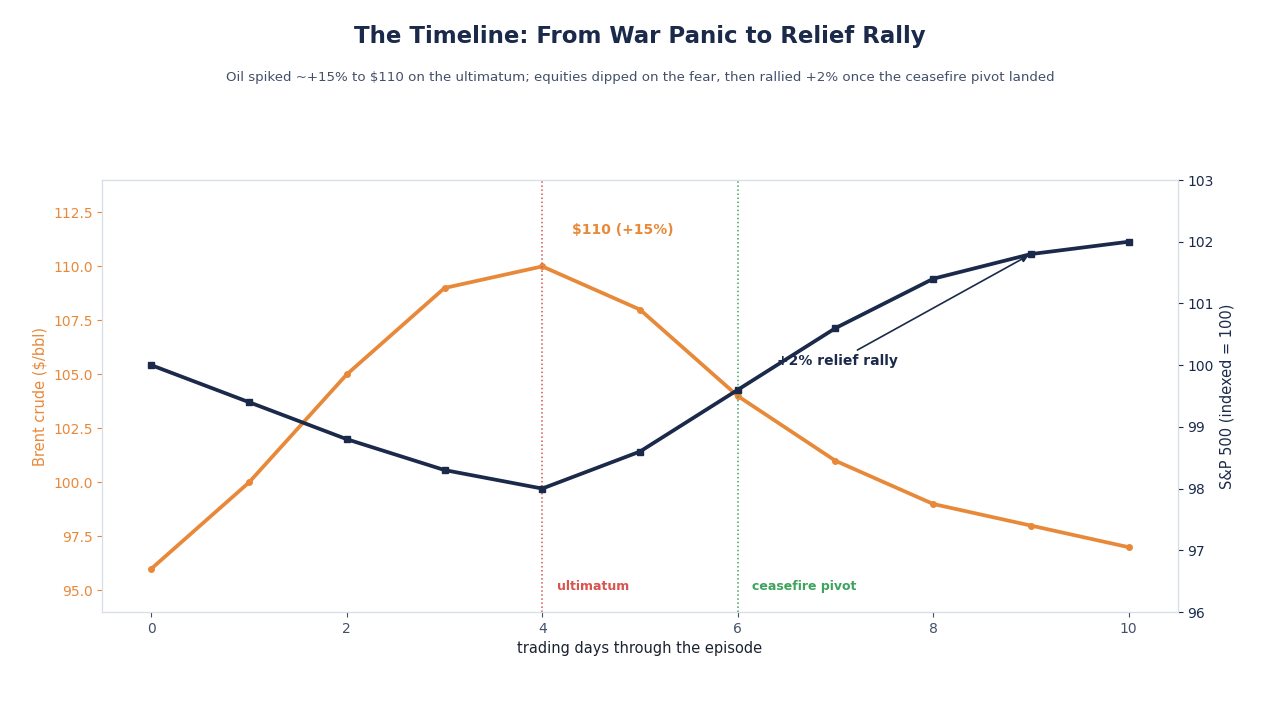
The Timeline: From War Panic to Market Relief Rally
Leading up to the deadline, tensions escalated sharply:
- Trump issued an ultimatum demanding Iran reopen the Strait of Hormuz or face devastating strikes
- Oil prices surged above $110 as supply disruption fears intensified
- Stocks fell amid rising global risk-off sentiment
- Safe-haven assets (gold, USD) gained traction
“A whole civilization will die tonight” — Trump’s rhetoric highlighted the extreme escalation risk
But the turning point came just 90 minutes before the deadline:
- A two-week ceasefire agreement was announced
- Iran agreed to reopen the Strait of Hormuz
- Military escalation was paused
Markets reacted instantly:
- S&P 500 futures jumped ~2%
- Oil prices collapsed over 15%
- Risk assets (stocks, crypto) surged
- Safe-haven demand declined
This was not just a headline shift — it was a full narrative reversal.
Why Did Stocks Rally After War Fears?
At first glance, it seems counterintuitive: how can markets swing so violently within hours?
The answer lies in expectation vs. outcome.
1. Markets Price the Worst-Case Scenario First
Before the deadline:
- Markets were pricing in:
- Full-scale regional war
- Oil supply disruption (20% of global flow via Hormuz)
- Inflation shock and Fed tightening risks
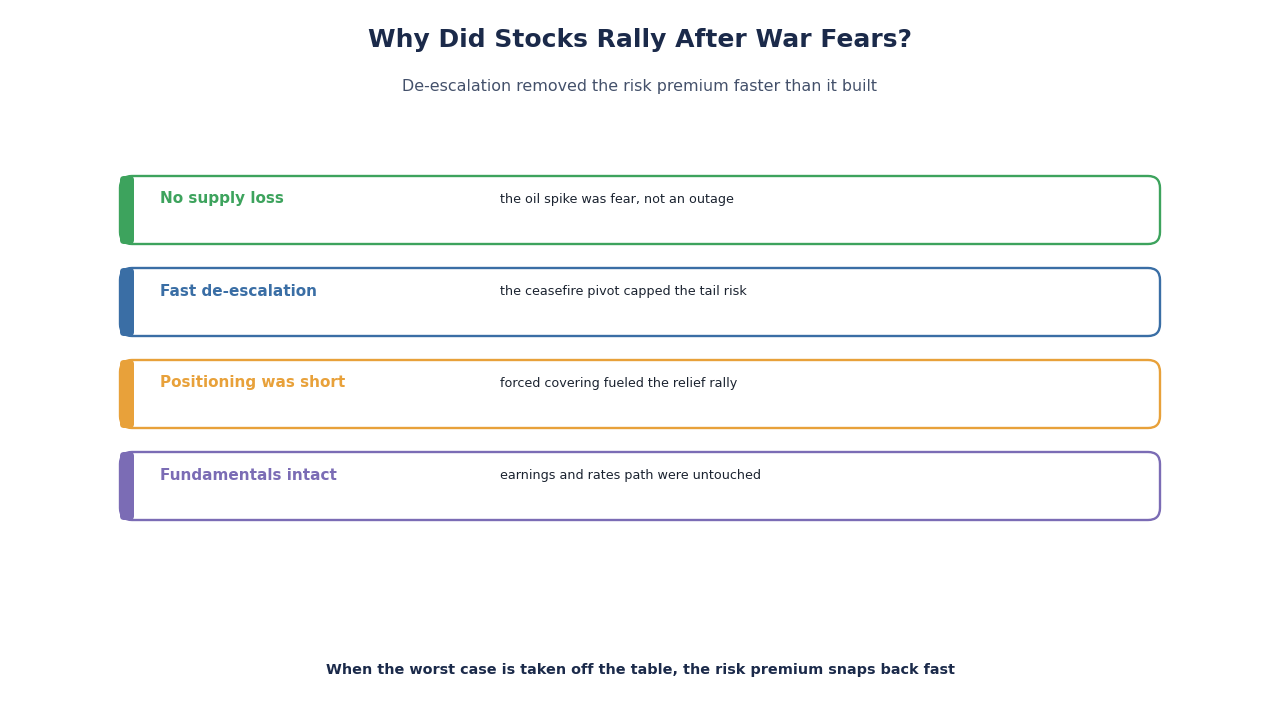
When the worst-case scenario did not materialize, assets repriced upward.
2. Oil Collapse = Immediate Relief for Equities
Oil is the key transmission channel:
| Factor | Before Ceasefire | After Ceasefire |
|---|---|---|
| Oil Price | Spike > $110 | Drop ~15–19% |
| Inflation Risk | Rising | Falling |
| Corporate Margins | Pressure | Relief |
| Equity Valuation | Compressed | Expanded |
Lower oil prices mean:
- Lower inflation expectations
- Reduced pressure on central banks
- Improved earnings outlook
3. Liquidity Flows Back Into Risk Assets
During the crisis:
- Capital moved into:
- Gold
- USD
- Bonds
After the ceasefire:
- Capital rotated into:
- Equities
- Crypto
- Emerging markets
This liquidity rotation is a key driver of sharp rallies.
4. The “TACO Trade” Effect
Markets have learned a behavioral pattern:
Aggressive rhetoric → Last-minute de-escalation
This phenomenon—sometimes referred to as the “TACO trade” (Trump Always Chickens Out)—means:
- Traders front-run de-escalation
- Markets become less reactive to initial threats
- Volatility compresses faster after shocks
How This Fits Historical Market Patterns
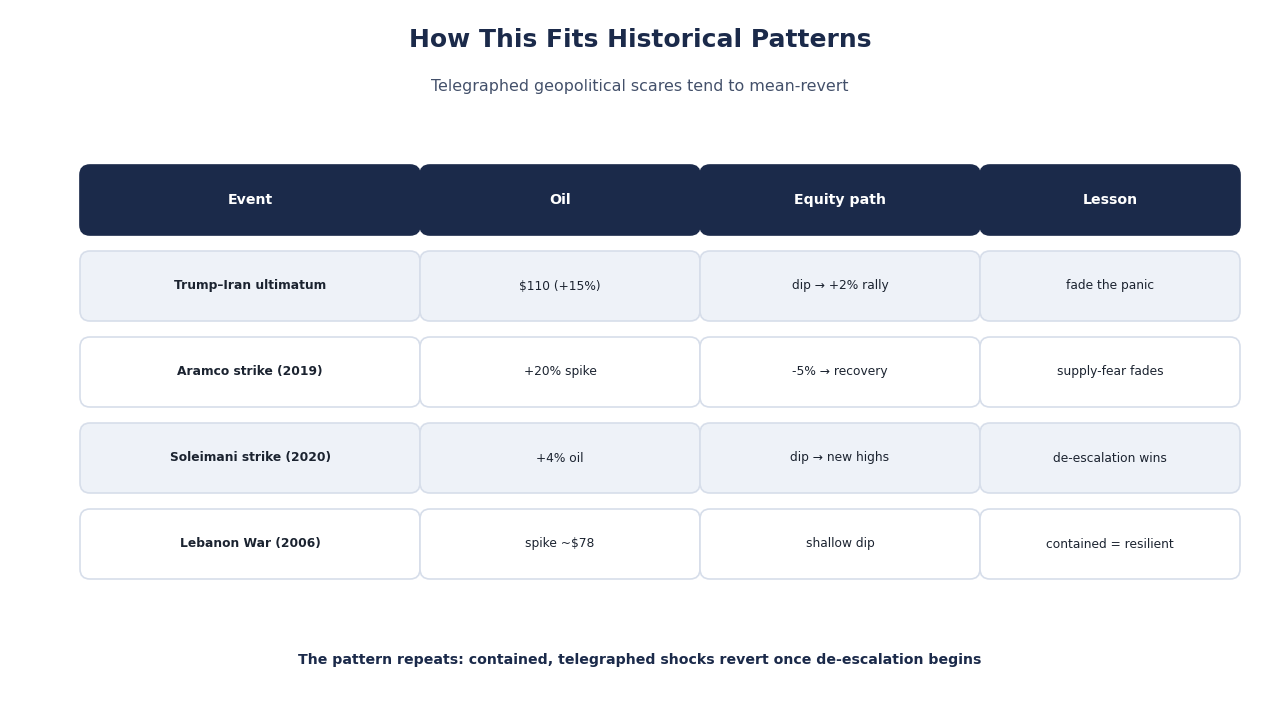
This event aligns with a broader framework of geopolitical shock responses:
| Event Type | Market Reaction | Recovery Speed |
|---|---|---|
| Full-scale war (e.g., 1990 Gulf War) | Deep drawdown | Slow |
| Short conflict (e.g., Lebanon 2006) | Moderate dip | Fast |
| Non-war escalation (EP-3 2001) | Sharp dip | Very fast |
| Ultimatum → Ceasefire (2026) | Minimal net damage | Instant rebound |
Key insight:
Markets react more to uncertainty than to actual conflict.
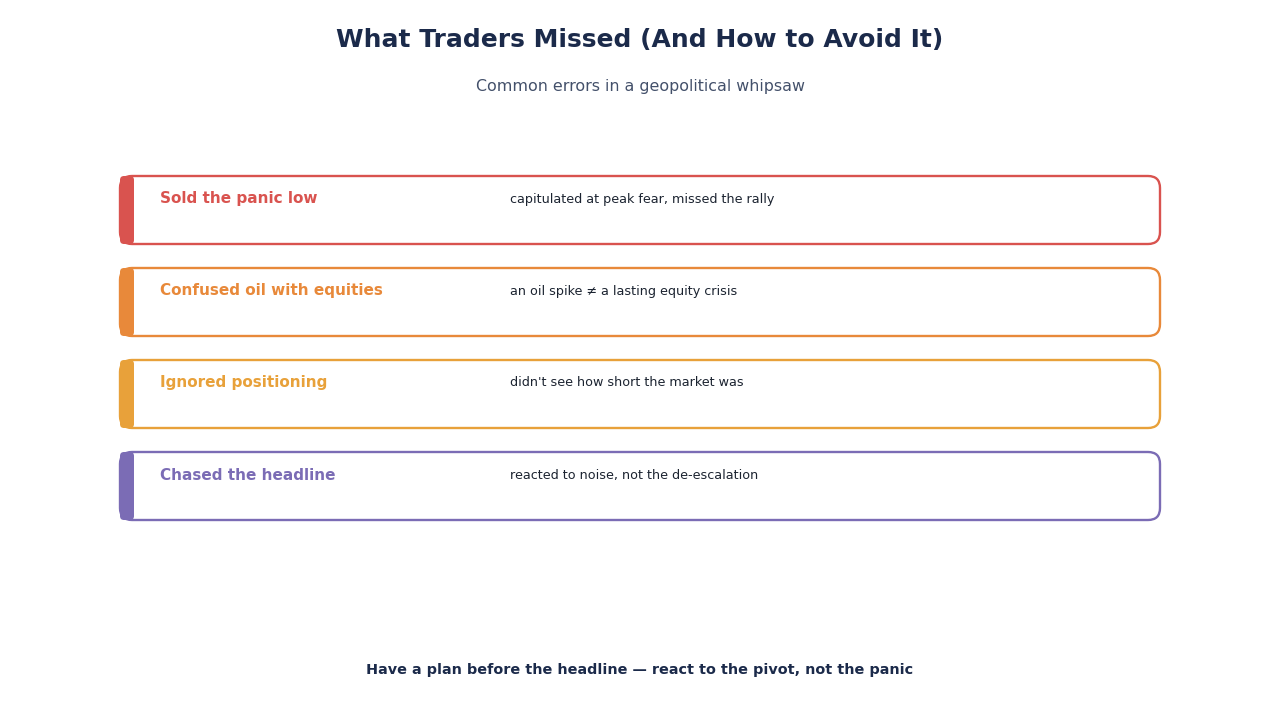
What Traders Missed (And How to Avoid It)
Many traders made two critical mistakes:
❌ Mistake 1: Overreacting to Headlines
- Selling into peak fear
- Chasing oil spikes
- Ignoring probability of negotiation
❌ Mistake 2: Ignoring Market Structure
- Liquidity positioning was already defensive
- Downside was limited
- Upside asymmetry was high
✅ Better Approach (Using AI-Assisted Analysis)
With tools like SimianX AI, traders can:
- Monitor real-time sentiment shifts
- Track multi-agent signals:
- Technical (EMA, RSI, MACD)
- News/sentiment flow
- Macro factors (oil, yields)
- Identify decision convergence points
Example workflow:
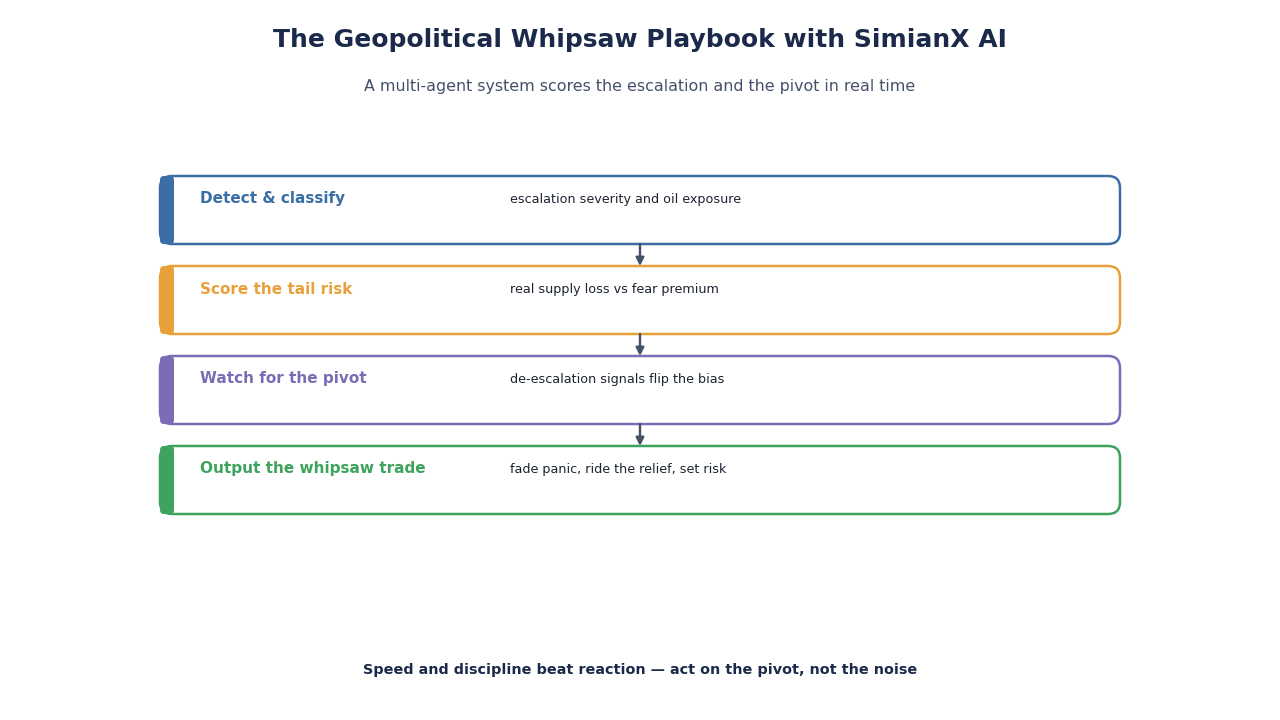
- Detect escalation via news agent
- Confirm market stress via volatility indicators
- Track divergence between price and sentiment
- Position for reversal when probability shifts
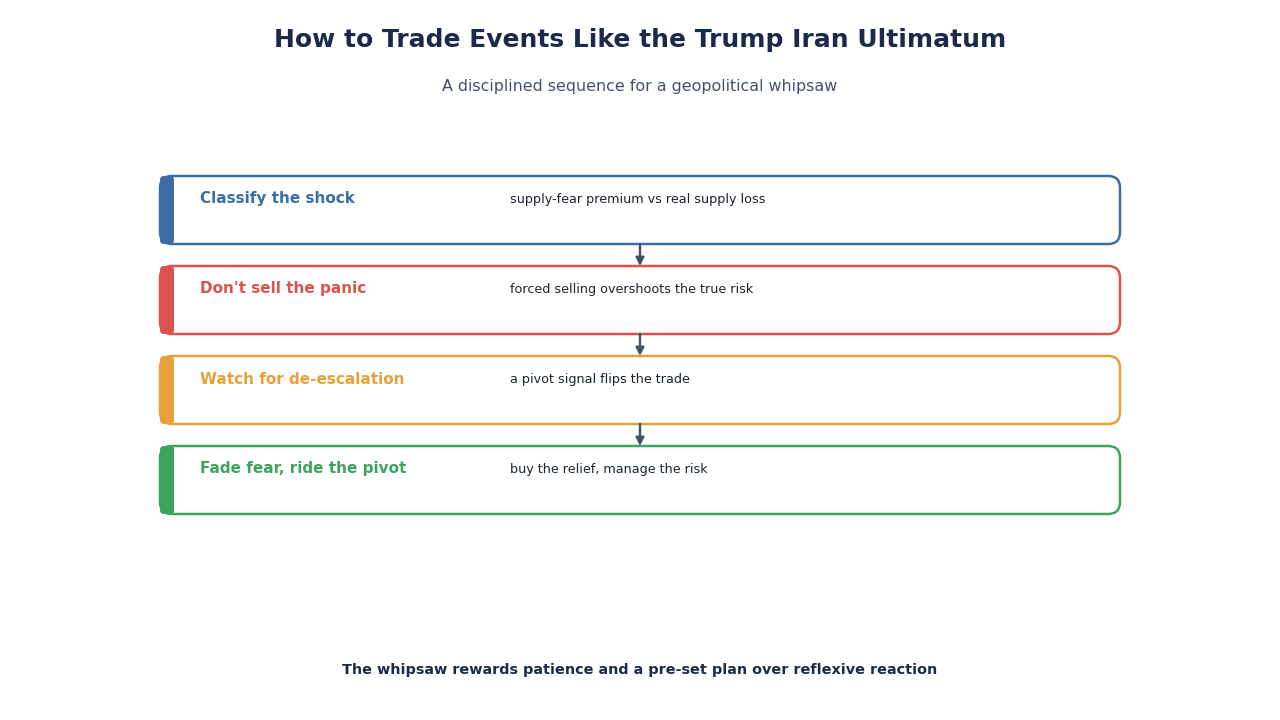
How to Trade Events Like the Trump Iran Ultimatum
Step-by-Step Framework
- Identify the catalyst
- War threat, sanctions, geopolitical escalation
- Map the key transmission channels
- Oil → inflation → equities
- Assess market positioning
- Is fear already priced in?
- Watch for narrative pivot signals
- Diplomacy, negotiations, ceasefire
- Execute on asymmetry
- Buy risk assets when downside is capped
Practical Trade Ideas
- Long equities (S&P 500, Nasdaq) after de-escalation
- Short oil after supply normalization
- Long crypto during risk-on rotation
How SimianX AI Helps in Real Time
Unlike manual analysis, SimianX AI integrates multiple signals simultaneously:
- Indicator Agent → Detects oversold/overbought conditions
- Sentiment Agent → Tracks geopolitical headlines instantly
- Fundamental Agent → Evaluates macro impact (oil, inflation)
- Decision Agent → Produces actionable bias + confidence
This creates a structured, high-probability trading framework instead of emotional decision-making.
How Does the Trump Iran Ultimatum Affect Stock Market Strategy?
The key takeaway is not the event itself, but the pattern:
Core Market Logic
- Markets overshoot on fear
- Reversal happens when:
- Worst-case scenario is avoided
- Liquidity returns
- macro risks fade
Strategic Implications
- Treat geopolitical shocks as opportunities, not just risks
- Focus on reaction speed, not prediction accuracy
- Use data-driven frameworks, not headlines
FAQ About Trump Iran Ultimatum Stocks Rally
Why did stocks rise after the Iran ceasefire?
Stocks rose because the ceasefire removed the worst-case scenario of war escalation, reducing oil prices and inflation fears while restoring investor confidence.
How do geopolitical crises impact stock markets?
They typically trigger short-term volatility, with markets dropping on uncertainty and rebounding quickly once clarity or de-escalation emerges.
What is the relationship between oil prices and stocks?
Higher oil prices increase inflation and pressure corporate margins, often hurting stocks. Falling oil prices usually support equity markets.
Can traders profit from geopolitical events?
Yes, by identifying overreactions and positioning for reversals, especially when markets price in extreme outcomes that fail to materialize.
What tools help analyze events like this?
AI-driven platforms like SimianX AI help by combining technical, sentiment, and macro data into a unified decision framework.
Conclusion
The Trump Iran ultimatum and ceasefire pivot highlights a critical truth about markets:
Markets react to uncertainty, not just events.
What looked like the start of a major war turned into a powerful rally because:
- The worst-case scenario was avoided
- Oil prices collapsed
- Liquidity returned to risk assets
For modern traders, the edge is no longer about predicting headlines — it's about interpreting probabilities and reacting faster than the crowd.
To do that effectively, tools like SimianX AI provide a structured, multi-agent approach that transforms chaotic geopolitical events into actionable trading insights.
If you want to navigate the next market shock with clarity and confidence, start integrating AI-driven decision systems into your workflow today.
Trump Iran Ultimatum Sparks War Fears, Then Ceasefire Pivot Sends Stocks Rallying
The Trump Iran ultimatum sparks war fears, then ceasefire pivot sends stocks rallying event is more than just a headline—it is a blueprint for understanding how modern markets process geopolitical risk in real time. For traders leveraging platforms like SimianX AI, this moment offers a high-resolution case study of fear pricing, narrative reversal, and liquidity-driven rallies.
The Second Layer: Understanding Market Microstructure During Crisis
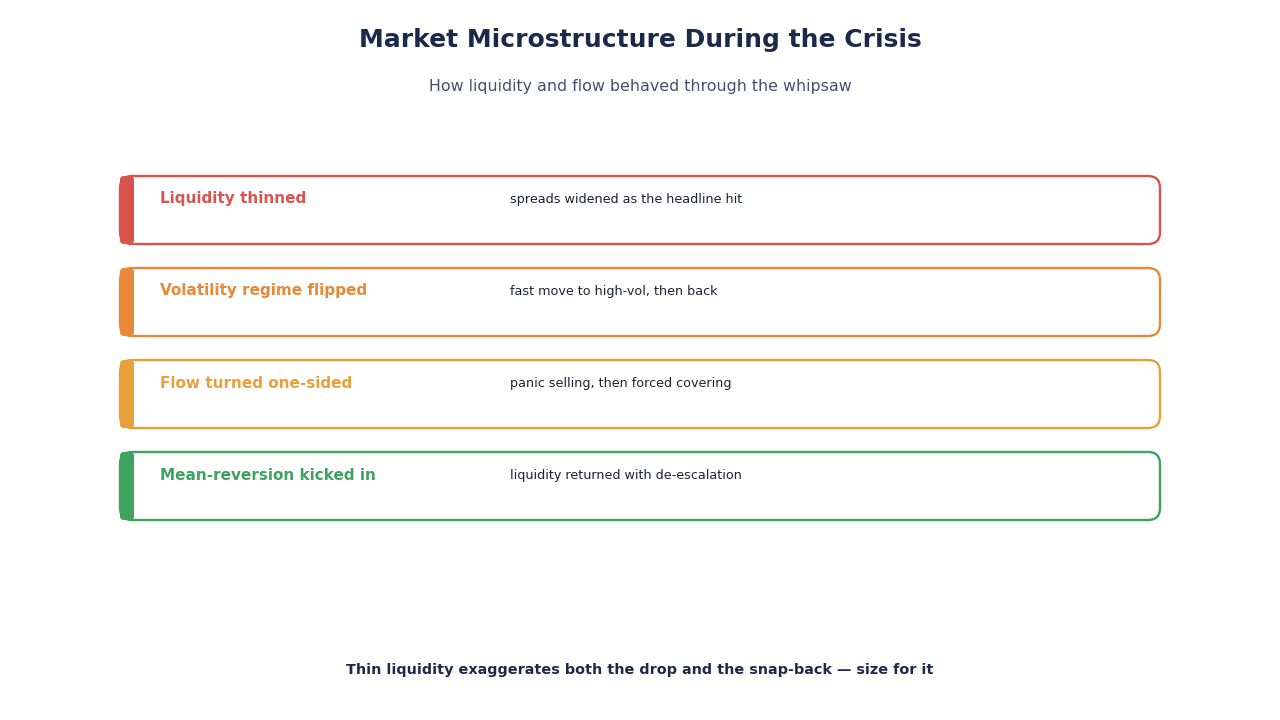
To truly understand why the market reacted so violently—and then reversed—you need to look beyond headlines into market microstructure.
Order Flow Dynamics During Escalation
When the ultimatum hit:
- Institutional players reduced exposure
- Market makers widened spreads
- Liquidity thinned across risk assets
- Volatility algorithms triggered defensive positioning
This created a fragile market structure.
“Markets don’t crash because of news—they crash because liquidity disappears.”
Liquidity Vacuum → Repricing Explosion
When the ceasefire was announced:
- Sellers disappeared instantly
- Buyers rushed back in
- Thin liquidity caused exaggerated price moves
This explains why rallies after crises often feel “too fast to chase.”
The Role of Options Markets in the Rally
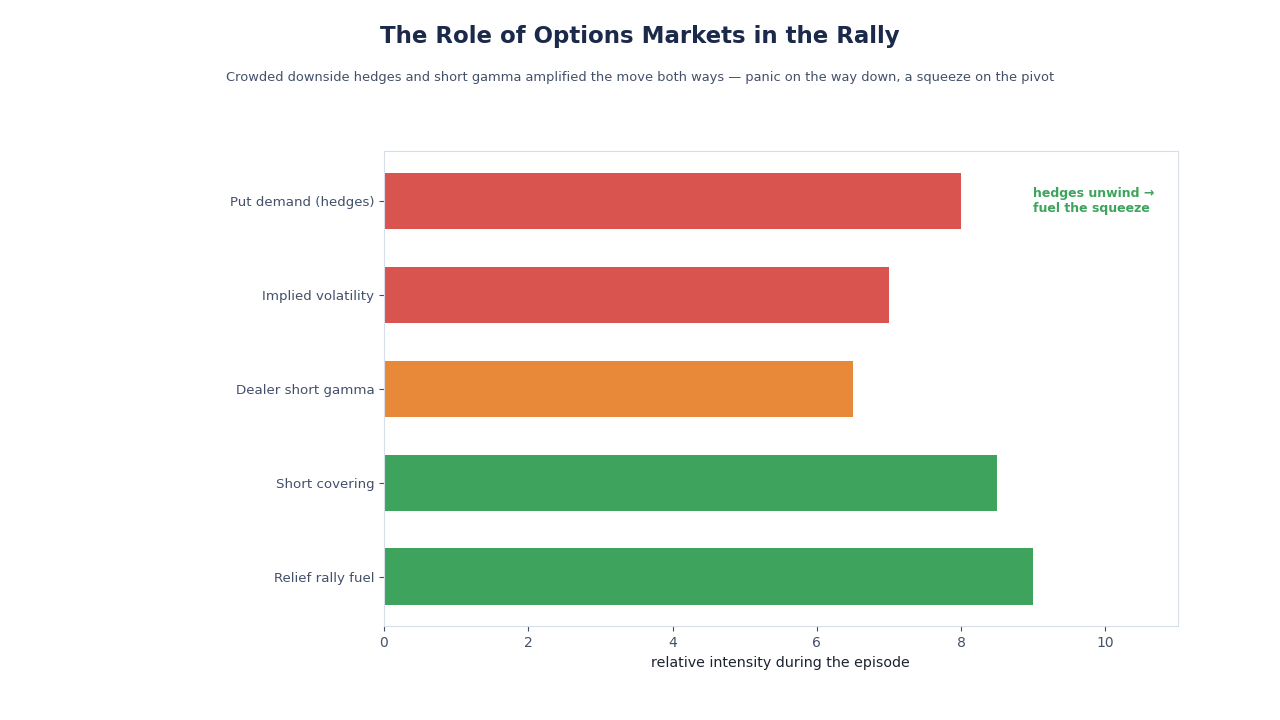
One of the most overlooked drivers of the rally was the options market.
Before the Pivot
- Heavy demand for:
- put options
- volatility hedges (VIX calls)
This created negative gamma conditions:
- Dealers were short volatility
- They hedged by selling into weakness
After the Pivot
Once the ceasefire hit:
- Puts lost value rapidly
- Dealers unwound hedges
- Forced buying accelerated the rally
This is known as a gamma squeeze.
| Phase | Dealer Positioning | Market Impact |
|---|---|---|
| Pre-event | Short gamma | Amplifies downside |
| Post-event | Gamma flip | Accelerates upside |
Macro Overlay: Why Central Banks Matter
Geopolitical shocks don’t operate in isolation—they interact with monetary policy expectations.
Pre-Ceasefire Narrative
- War → oil spike → inflation surge
- Inflation → fewer rate cuts
- Result → bearish for stocks
Post-Ceasefire Narrative
- Oil collapse → inflation easing
- Inflation easing → rate cuts back on table
- Result → bullish for stocks
Key Insight
Markets are not reacting to geopolitics directly—they are reacting to what geopolitics means for liquidity and policy.
Behavioral Finance: Why Traders Get This Wrong
Even experienced traders misinterpret events like this.
Cognitive Biases at Play
- Recency bias → assuming escalation continues
- loss aversion → panic selling near lows
- confirmation bias → seeking war escalation narratives
Crowd Positioning Trap
By the time fear peaks:
- Most traders are already positioned defensively
- There are few sellers left
- Market becomes asymmetrically bullish
How SimianX AI Identifies These Inflection Points
Traditional analysis fails because it separates data streams. SimianX AI integrates them.
Multi-Agent Framework Advantage
SimianX AI uses:
- Indicator Agent
- Detects oversold signals (e.g., RSI divergence)
- Sentiment Agent
- Tracks real-time geopolitical headlines
- Fundamental Agent
- Monitors oil, yields, inflation expectations
- Decision Agent
- Synthesizes signals into actionable bias
Real-Time Signal Example
| Signal Type | Observation | Interpretation |
|---|---|---|
| RSI | Oversold | Reversal risk |
| Oil | Spike then stall | Panic exhaustion |
| News Flow | Peak escalation | Narrative saturation |
| Volatility | Extreme | Mean reversion likely |
Advanced Strategy: Trading Narrative Reversals
The biggest edge comes from identifying when the narrative is about to flip.
Key Indicators of a Pending Reversal
- Extreme headlines (“war imminent”)
- Parabolic moves in oil or volatility
- Divergence between price and fundamentals
- Slowing downside momentum
Execution Strategy
- Wait for confirmation
- Do not anticipate blindly
- Scale into positions
- Avoid all-in entries
- Focus on high-beta assets
- Nasdaq, crypto outperform
Example Trade Setup
- Trigger: ceasefire headline
- Entry: first pullback after spike
- Target: pre-crisis levels
- Risk: invalidation below panic low
Cross-Asset Reaction Map
Understanding how different assets react gives a broader edge.
| Asset Class | Crisis Reaction | Post-Ceasefire Reaction |
|---|---|---|
| Equities | Sell-off | Rally |
| Oil | Spike | Collapse |
| Gold | Rise | Pullback |
| USD | Strength | Weakness |
| Crypto | Drop | Strong rebound |
What This Means for Future Markets
This event is not isolated—it represents a repeatable pattern.
The New Market Regime
- Faster information cycles
- AI-driven trading decisions
- Increased headline sensitivity
- Shorter recovery times
Implication for Traders
- You must react faster than ever
- Static strategies will fail
- AI-assisted frameworks become essential
How Does the Trump Iran Ultimatum Stocks Rally Shape Future Trading?
The lesson is clear:
Markets Are Now Reflexive Systems
- News → price → positioning → amplified price
Strategy Evolution
Old approach:
- Predict events
New approach:
- React to probability shifts in real time
Tactical Framework
- Monitor sentiment extremes
- Track liquidity flows
- Identify positioning imbalances
- Execute on reversals
FAQ About Trump Iran Ultimatum Stocks Rally
What caused the stock market rally after the Iran ceasefire?
The rally was driven by the removal of worst-case war scenarios, a sharp drop in oil prices, and a rapid shift of liquidity back into risk assets.
Is it common for markets to rebound after war fears?
Yes. Historically, markets often recover quickly once uncertainty declines, especially if the conflict does not escalate into prolonged war.
How can traders anticipate these reversals?
By tracking sentiment extremes, volatility spikes, and divergence signals using AI tools like SimianX AI.
What role does oil play in these events?
Oil is the primary transmission mechanism—higher oil increases inflation risk, while falling oil supports equities.
Can AI improve geopolitical trading strategies?
Absolutely. AI systems can process multiple data streams simultaneously, providing faster and more accurate decision-making frameworks.
Conclusion
The Trump Iran ultimatum sparks war fears, then ceasefire pivot sends stocks rallying event demonstrates a fundamental truth:
Markets are driven by expectations, liquidity, and narrative shifts—not just events.
The traders who won were not those who predicted war—but those who understood:
- Fear was already priced in
- Liquidity was about to return
- Narrative reversal would trigger a rally
In today’s markets, success depends on speed, structure, and signal clarity.
That’s where SimianX AI becomes essential.
By combining technical, sentiment, and macro intelligence into one unified system, SimianX AI helps you:
- Detect turning points faster
- Avoid emotional decision-making
- Execute high-probability trades
If you want to stay ahead of the next geopolitical shock, start leveraging AI-driven market intelligence today.
Related Reading
- Iran War Impact: Stocks Risk-Off, Oil $100-$120, VIX Spike
- Second Lebanon War 2006: Oil $78 Spike, Stocks Resilient
- Israel-Hamas 2023: S&P -4.5% Drawdown, 14-Day Bottom
- U.S. Strike on Iran General: Stocks Down, Oil +4% Shock
- Iran-US War Impact on Stocks: AI Risk Signals
- 2019 Saudi Aramco Drone Strike: Oil +20%, Stocks -5%