
 By Muke
UK Tokenization Roadmap 2026: The £33B Blockchain Push to Rewire Capital Markets
The UK Tokenization Roadmap 2026 is not simply another government experiment with blockchain. It is an attempt to rebuild the infrastructure beneath British capital markets—how securities are issued, how collateral moves, how transactions settle and how ownership is recorded.
The headline number is striking: tokenisation could increase annual UK economic output by up to £33 billion by 2035. But that figure is not a government spending package or a guaranteed blockchain windfall. It is an economic model based on faster transactions, lower financing costs, greater investment and more productive allocation of capital.
For investors following real-world assets, financial infrastructure and digital securities, the roadmap connects several themes already tracked by SimianX AI: tokenized funds, sovereign digital bonds, institutional blockchain networks, stable settlement assets and companies building the rails for on-chain finance.
What Is the UK Tokenization Roadmap 2026?
The phrase UK Tokenization Roadmap 2026 describes several connected initiatives rather than one law or one launch date.
The first layer is HM Treasury’s **Wholesale Financial Markets Digital Strategy**, published in July 2025. It organised the government’s capital-markets modernisation plan around three broad pillars:
- Market optimisation: removing paper processes and reducing operational friction.
- Market transformation: using technologies such as distributed ledger technology, or
DLT, to redesign financial infrastructure. - Market leadership: coordinating regulators and private institutions so the UK can influence international standards.
The second layer is the joint work of the **Financial Conduct Authority**, the **Bank of England** and the Prudential Regulation Authority. In May 2026, the authorities published a shared vision covering tokenized securities, prudential treatment, custody, collateral and central-bank-money settlement.
The third layer is an industry execution programme led by the UK’s Wholesale Digital Markets Champion, Chris Woolard. Reporting in July 2026 indicated that a task force of 54 financial institutions would concentrate on nine priority areas over an initial 12-month period.
Participants reportedly span traditional and digital finance, including major banks, asset managers, market-infrastructure firms and crypto-native companies.
The roadmap is best understood as a coordinated attempt to move tokenisation from isolated demonstrations into complete, economically useful transactions.
That distinction matters. Issuing a tokenized bond is technically possible today. The harder problem is enabling that bond to be traded, financed, posted as collateral, settled in trusted money and integrated with conventional balance sheets.
Why the £33 Billion Figure Matters—and What It Really Means
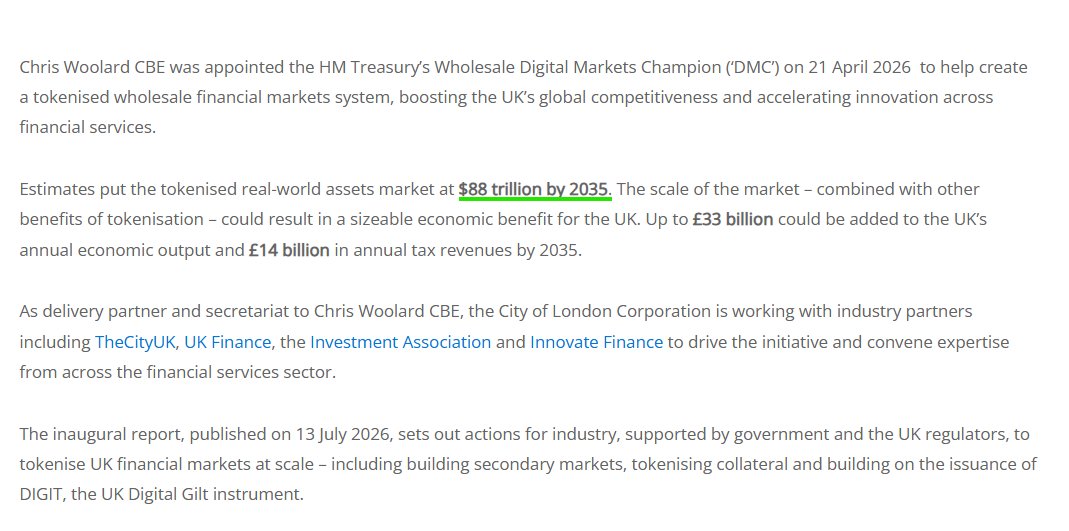
The £33 billion tokenisation opportunity comes from modelling conducted by Barclays and PwC. Their analysis suggests that widespread adoption could increase annual UK economic output by as much as £33 billion by 2035.
The estimate is broader than direct cost savings for banks.
| Source of economic value | How tokenisation could contribute |
|---|---|
| Lower transaction costs | Shared records may reduce duplicate processing, reconciliation and manual verification |
| Lower financing costs | Faster collateral movement and settlement may reduce liquidity buffers and trapped capital |
| Higher investment | Businesses may access capital more efficiently through digital issuance and distribution |
| Better capital allocation | Programmable assets and improved data could connect investors with a wider set of opportunities |
| Financial-services productivity | Automation may shorten processing times and reduce operational errors |
| Export growth | UK-based infrastructure, legal services and financial technology could serve global tokenized markets |
The model also reportedly estimates that successful implementation could generate up to £14 billion in additional tax receipts over a decade.
These figures should be treated as an upside scenario, not a forecast that will automatically materialise. The outcome depends on several assumptions:
- Global tokenized markets must expand substantially.
- The UK must capture a meaningful share of that growth.
- Institutions must move beyond pilots into production.
- Tokenized infrastructure must reduce real costs rather than merely create another technology layer.
- Legal, regulatory and settlement systems must remain internationally competitive.
The £33 billion is therefore a measure of potential economic productivity—not £33 billion allocated by the Treasury to blockchain companies.
How Will the UK Tokenization Roadmap Rewire Capital Markets?
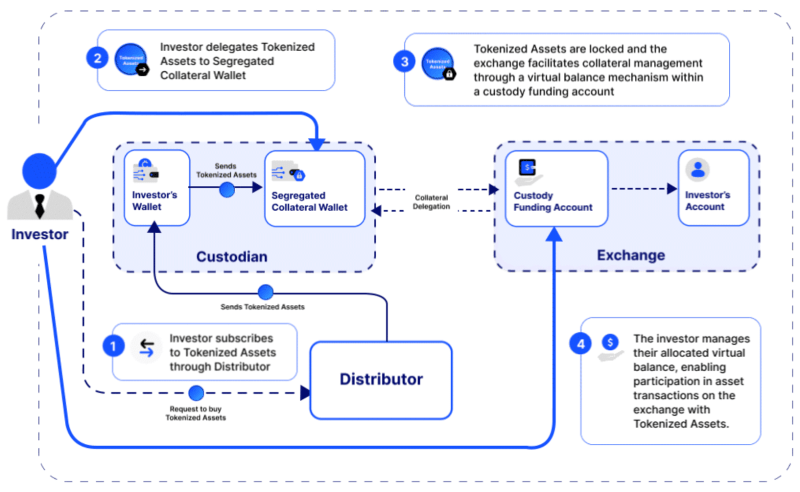
Traditional capital markets rely on a network of brokers, custodians, clearing houses, central securities depositories, transfer agents, payment systems and internal databases.
Each institution may maintain its own version of a transaction record. Those records must be compared, corrected and reconciled before ownership and payment can be considered final.
Tokenisation could replace some of those sequential processes with a shared transaction environment.
A tokenized security can contain or connect to information about:
- The identity of the asset.
- Its legal owner.
- Transfer restrictions.
- Coupon or dividend entitlements.
- Collateral status.
- Compliance conditions.
- Settlement instructions.
- Corporate actions.
Smart contracts can then automate selected actions, including coupon payments, redemptions, collateral substitutions and ownership updates.
However, blockchain does not eliminate regulation, custody or accountability. Institutional markets still need recognised issuers, enforceable property rights, resilient operators and mechanisms for correcting errors.
The UK authorities have therefore emphasised coexistence and interoperability. Tokenized infrastructure is expected to operate alongside conventional systems—potentially for many years—rather than replacing the entire market at once.
What Would an End-to-End Tokenized Transaction Look Like?
A useful example is a tokenized government or corporate bond.
- The bond is issued on an approved distributed ledger.
- Verified investors receive access through compliant digital identities.
- Trading takes place on a regulated venue or approved infrastructure.
- Cash and securities are exchanged using
delivery versus payment, orDvP. - Ownership records update automatically when settlement becomes final.
- The bond can be pledged as collateral without leaving the digital environment.
- Smart contracts distribute coupons and process redemption.
The real breakthrough is not step one. The breakthrough occurs when all seven steps can happen across interoperable, regulated systems without returning to manual reconciliation.
Why Tokenized Collateral and Repo Markets Come First
One of the most important elements of the UK roadmap is its focus on collateral and repurchase agreements.
A repo transaction allows one institution to raise short-term cash by selling a security and agreeing to repurchase it later. Repo markets are fundamental to government-bond liquidity, dealer financing and central-bank operations.
Today, collateral can become trapped by settlement windows, incompatible databases and institutional boundaries. A high-quality asset may exist, but it cannot always be moved to the right counterparty at the right time.
Tokenisation could allow eligible collateral to be:
- Identified in real time.
- Transferred outside limited processing windows.
- Programmatically locked or released.
- Reused across connected platforms where permitted.
- Valued and monitored automatically.
- Exchanged simultaneously against cash.
The industry task force reportedly plans to demonstrate an end-to-end tokenized repo transaction, with the objective of proving that tokenized assets can be used to raise cash in real institutional markets.
Tokenized collateral may create more immediate economic value than tokenized retail trading because it addresses the balance-sheet efficiency of banks, dealers and clearing institutions.
That is why the repo use case is strategically important. It tests whether blockchain can improve the movement of large pools of regulated financial assets, not merely create digital wrappers around existing securities.
The Digital Gilt Could Become the Roadmap’s Anchor Asset
A central component of the UK strategy is the proposed Digital Gilt Instrument, known as DIGIT.
A gilt is a bond issued by the UK government. A digital gilt would be issued or represented using DLT-based infrastructure while retaining the legal and economic characteristics expected of sovereign debt.
Government bonds are especially useful for testing tokenisation because they sit at the centre of financial markets. They are widely held, actively traded and frequently used as collateral.
A successful digital gilt could help the UK test:
- Primary issuance on DLT infrastructure.
- Secondary-market trading.
- On-chain ownership records.
- Settlement against central-bank money.
- Regulatory capital treatment.
- Eligibility for Bank of England liquidity operations.
- Use as collateral in repo and clearing.
- Interoperability between digital and traditional systems.
Chris Woolard has called for the first digital gilt issuance by the first quarter of 2027 and for further issuance to follow. That timing should be viewed as an industry recommendation until confirmed through a formal government timetable.
The more important issue is utility. A digital gilt that can only be purchased and held by a small group of pilot participants would have limited impact. A digital gilt that can be traded, financed and accepted as collateral could provide the foundation for a much larger market.
Why Is Bank of England Collateral Eligibility So Important?
Market participants will value a tokenized asset differently depending on what they can do with it.
If a digital gilt is legally equivalent to a conventional gilt but cannot be used in central-bank operations, clearing or repo, it may remain less useful than its traditional equivalent.
The Bank of England has indicated that tokenized and non-tokenized assets should generally receive equivalent treatment when their legal rights and underlying risks are comparable. It is also considering the eligibility of tokenized assets—including DIGIT—as collateral in its Sterling Monetary Framework.
This is one of the roadmap’s most consequential principles:
Equivalent asset, equivalent risk, equivalent treatment.
Achieving that outcome would reduce the regulatory penalty for adopting new infrastructure.
Digital Securities Sandbox: Moving From Tests to Live Markets
The UK’s **Digital Securities Sandbox**, or DSS, allows approved firms to test the issuance, trading and settlement of digital securities inside a modified regulatory environment.
As of the May 2026 joint vision, 16 firms had passed the first stage and were working toward live activity.
The sandbox matters because existing securities rules were designed for conventional market infrastructure. Some requirements assume that trading venues, settlement systems and ownership databases are operated as separate functions.
DLT can combine or redistribute those functions. The sandbox allows regulators to observe those models before creating a permanent framework.
The FCA and Bank of England have said they want firms inside the DSS to have a clear route toward permanent authorisation. They are also considering whether the sandbox should be extended, modified or used to inform broader changes to securities-settlement regulation.
A credible transition path is essential. Companies will not make long-term infrastructure investments if successful sandbox projects face a regulatory dead end.
Central Bank Money, Stablecoins and the Settlement Question
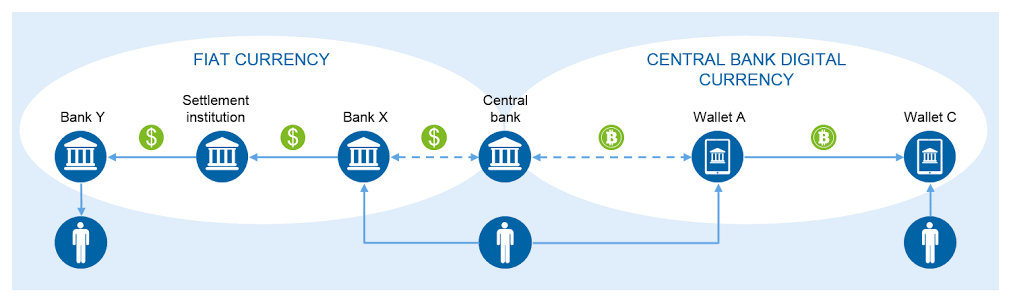
Tokenized assets need a trusted settlement asset.
A bond can move instantly on a blockchain, but the transaction is not fully modernised if the cash payment still depends on a separate system operating on limited hours.
The preferred institutional model is often atomic settlement, where the asset and payment transfer together. Either both sides complete, or neither side does.
The Bank of England is working on several possible settlement routes:
| Settlement route | Potential role | Key consideration |
|---|---|---|
| Existing central-bank money | Highest-trust settlement asset | Must connect conventional payment rails with digital ledgers |
| Synchronisation service | Coordinates asset transfers with sterling settlement through RTGS | Targeted for delivery in 2028 |
| Tokenized central-bank money | Could place central-bank settlement directly into programmable environments | Benefits and design still under assessment |
| Regulated bank deposits | Commercial-bank money represented on shared ledgers | Requires interoperability and consistent legal treatment |
| Regulated stablecoins | Potentially useful for specific market structures or extended hours | Reserve, redemption and systemic-risk rules remain critical |
The Bank has launched a Synchronisation Lab with participating institutions and is examining longer operating hours for `RTGS` and CHAPS, including movement toward near-24/7 settlement.
This matters because tokenized markets cannot operate continuously if their safest form of money is available only during traditional banking windows.
Fund Tokenisation Is Already Moving Into Implementation
Government bonds and repo markets may attract the most attention, but investment funds are another practical adoption channel.
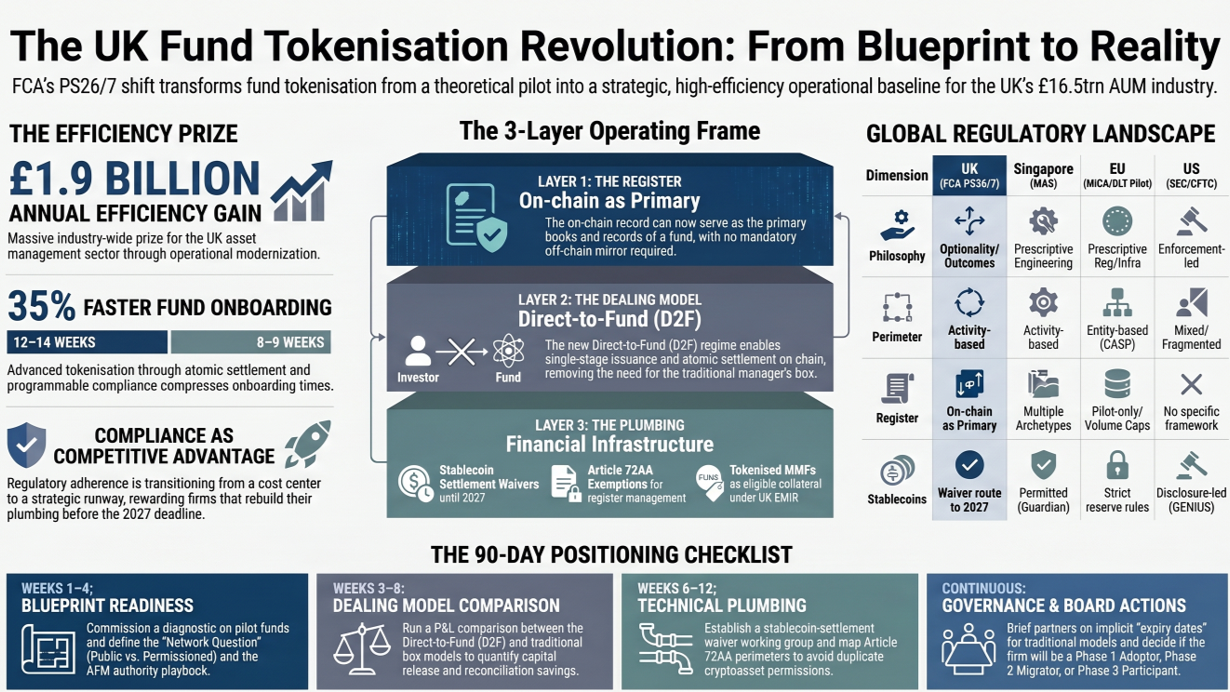
In April 2026, the FCA finalised guidance explaining how authorised fund managers can use DLT to maintain fund ownership registers. The framework allows managers to explore tokenized fund structures while remaining responsible for investor records and regulatory compliance.
The FCA has also introduced an optional Direct to Fund model that may allow investors to transact more directly with a fund rather than relying on multiple dealing intermediaries.
Potential benefits include:
- Faster subscriptions and redemptions.
- More automated ownership records.
- Reduced administrative duplication.
- Improved distribution across digital platforms.
- Programmable compliance controls.
- Greater portfolio customisation over time.
But tokenized funds are not automatically permissionless crypto products. Regulated managers must still protect investors, correct errors, process court decisions and control the official register.
This illustrates the UK’s broader approach: use blockchain infrastructure where it improves market operations while retaining identifiable legal responsibility.
Who Could Benefit From the UK Capital Markets Tokenisation Push?
The roadmap does not produce a simple list of blockchain stocks to buy. The value chain spans both public and private companies, and adoption may strengthen incumbent institutions as much as technology start-ups.
Potential beneficiaries include:
1. Market-Infrastructure Providers
Exchanges, settlement systems, clearing houses and transfer agents could build regulated digital-asset services. They also face disruption if new platforms reduce the need for conventional processes.
2. Custody and Safeguarding Companies
Institutions need secure key management, asset recovery processes, compliance controls and integration with existing custody systems.
3. Banks and Broker-Dealers
Banks may benefit from faster collateral movement, lower settlement exposure and more efficient balance-sheet management. The gains will depend on whether new infrastructure reduces total costs.
4. Asset Managers and Tokenization Platforms
Managers could distribute funds more efficiently, create programmable products and reach new investor segments. Infrastructure providers may earn issuance, administration or transaction fees.
5. Blockchain and Interoperability Networks
Public and permissioned networks may compete to support regulated assets. Institutional adoption is likely to reward networks that offer security, privacy, compliance tools and reliable interoperability—not simply high transaction speed.
6. Data, Compliance and Analytics Providers
More activity on shared ledgers could create demand for identity verification, transaction monitoring, smart-contract audits, market data and risk analytics.
SimianX users can follow this theme by separating infrastructure adoption signals from speculative crypto-market narratives. Relevant indicators include regulatory approvals, live issuance volumes, collateral eligibility, institutional partnerships and recurring revenue generated from tokenized assets.
For related research, see Securitize NYSE Debut 2026: Tokenized Stocks Hit Wall Street and the Securitize Stock 2026 Tokenized Shares Guide.
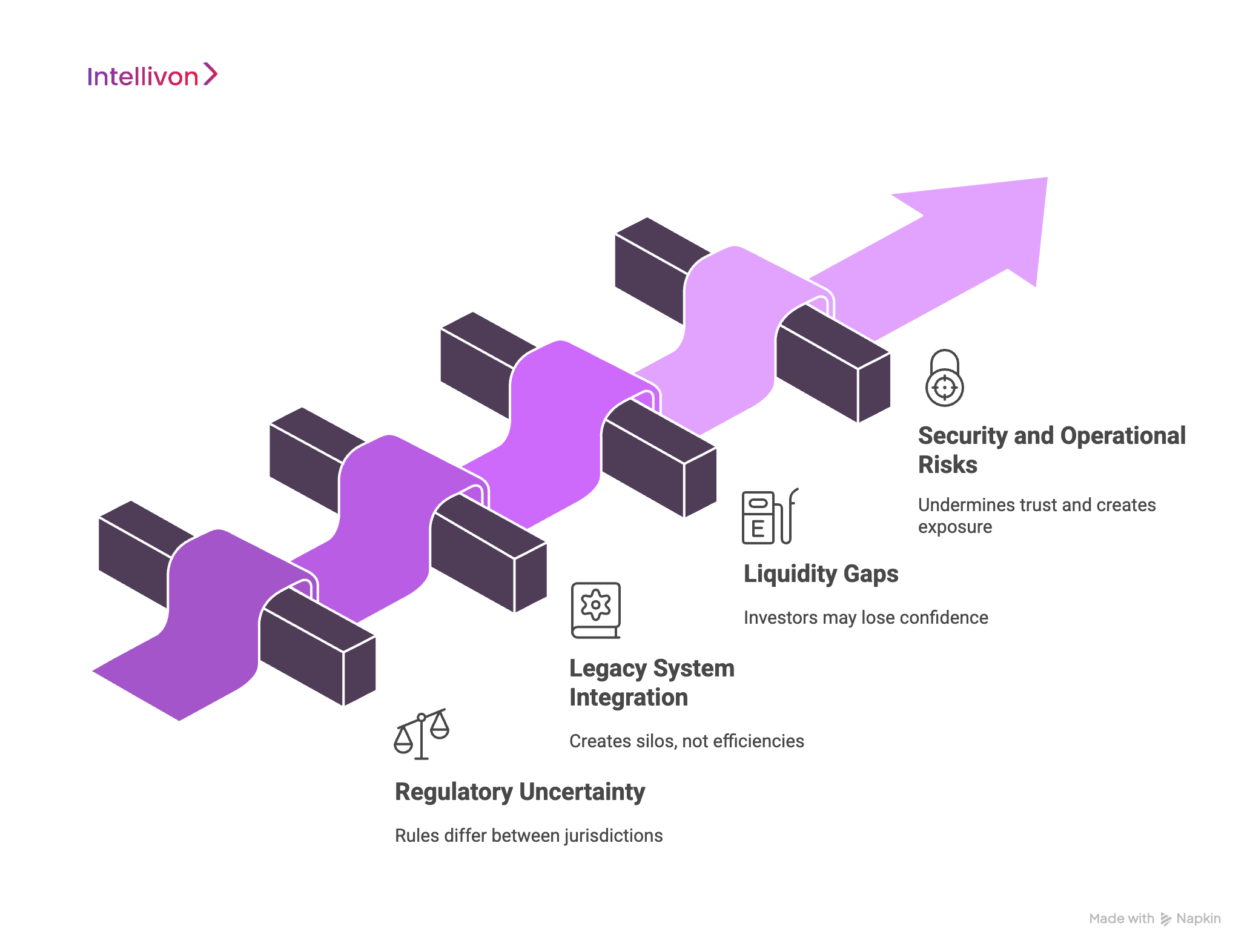
The Five Biggest Risks to the UK Tokenization Roadmap
Tokenisation does not remove financial risk. In some cases, it changes where the risk appears.
Fragmented Digital Markets
If every bank, exchange and asset manager uses a different ledger, tokenisation may create more silos rather than fewer.
What to watch: common data standards, cross-chain settlement rules and connections with legacy infrastructure.
Weak Secondary-Market Liquidity
Issuing a digital security does not guarantee that investors will trade it. Small, isolated instruments may have worse liquidity than conventional securities.
What to watch: market makers, repo eligibility, collateral use and repeat issuance.
Legal and Operational Uncertainty
Market participants must know when settlement becomes final, which record proves ownership and how assets can be recovered after cyber incidents or key loss.
What to watch: permanent authorisation rules, custody standards and court-tested legal frameworks.
Settlement-Asset Fragmentation
Different platforms may use central-bank money, tokenized deposits or stablecoins. Without interoperability, cash fragmentation could undermine asset interoperability.
What to watch: the Bank of England’s synchronisation service and its assessment of tokenized central-bank money.
Technology Without Economic Savings
Institutions could spend heavily on DLT while continuing to operate legacy systems in parallel. That would increase costs rather than reduce them.
What to watch: measurable declines in settlement failures, reconciliation expenses, liquidity buffers and transaction times.
The strongest evidence of success will not be the number of pilot announcements. It will be the volume of assets that can complete an entire regulated lifecycle on digital infrastructure.
A Practical Framework for Tracking the Roadmap
Investors and market researchers can monitor the UK tokenisation theme through five categories.
Step 1: Track Policy Milestones
Watch for:
- The full FCA and Bank of England cross-authority roadmap.
- Confirmation of the first
DIGITissuance. - Permanent rules for firms leaving the DSS.
- Final custody and safeguarding requirements.
- Prudential guidance for tokenized assets.
- Decisions on tokenized collateral eligibility.
Step 2: Track Real Transaction Volumes
Separate technical tests from economically meaningful activity.
Key measures include:
- Value of tokenized bonds issued.
- Secondary-market turnover.
- Tokenized repo volume.
- Number of repeat issuers.
- Assets under management in tokenized funds.
- Settlement-failure rates.
Step 3: Track Integration With Money and Collateral
Ask whether the asset can:
- Settle against trusted sterling.
- Be financed in repo.
- Be posted at a clearing house.
- Qualify for central-bank operations.
- Move between digital and traditional custodians.
Step 4: Track Revenue, Not Announcements
For listed companies, examine whether tokenisation produces:
- Transaction fees.
- Custody revenue.
- Issuance fees.
- Data subscriptions.
- Higher client retention.
- Lower operating costs.
Step 5: Compare the UK With Global Competitors
The UK is competing with the United States, European Union, Singapore, Hong Kong, Switzerland and the United Arab Emirates.
The winning jurisdiction may not be the one with the most permissive marketing. It may be the one that combines regulatory certainty, trusted settlement, liquid collateral and global interoperability.
Platforms such as SimianX AI can support this workflow by monitoring corporate developments, market reactions and multi-source signals around tokenization companies, financial institutions and blockchain networks.
UK Tokenization Scenarios Through 2035
| Scenario | What happens | Likely market result |
|---|---|---|
| Bull case | Digital gilts become liquid collateral, repo moves on-chain, tokenized funds scale and settlement connects to central-bank money | The UK captures a significant share of the projected £33 billion annual opportunity |
| Base case | Adoption grows in funds, bonds and selected collateral markets, but legacy systems remain dominant | Real efficiency gains emerge, although below the headline economic estimate |
| Bear case | Rules remain fragmented, digital assets lack liquidity and institutions maintain costly parallel infrastructure | Tokenisation remains a collection of pilots with limited macroeconomic impact |
The base case may be the most realistic. Financial infrastructure changes slowly because reliability matters more than novelty. Traditional and tokenized systems will probably coexist for an extended period.
That does not make the roadmap insignificant. Even partial adoption in government debt, collateral and investment funds could alter the economics of post-trade finance.
FAQ About the UK Tokenization Roadmap 2026
What is the UK Tokenization Roadmap 2026?
It is a coordinated programme involving HM Treasury, the FCA, the Bank of England, the PRA and an industry task force. Its goal is to support regulated tokenized securities, improve settlement and collateral infrastructure, and create a path from experimental projects to live markets.
Is the UK government investing £33 billion in blockchain?
No. The £33 billion figure is an estimate of the potential increase in annual UK economic output by 2035. It represents possible productivity, investment and financing benefits rather than a government spending commitment.
When will the UK issue a digital gilt?
Industry leadership has called for an initial issuance by the first quarter of 2027. The final timing, structure and follow-on programme depend on confirmation from HM Treasury and the institutions responsible for implementation.
How will tokenisation change UK capital markets?
Tokenisation could reduce reconciliation, accelerate settlement, automate corporate actions and allow collateral to move more efficiently. Its impact will depend on legal certainty, liquidity and interoperability with existing systems.
What are the best investment opportunities from UK tokenisation?
Potential exposure includes market infrastructure, custody, asset management, compliance technology and blockchain networks. Investors should focus on adoption, revenue and transaction volume rather than treating every company associated with blockchain as a direct beneficiary.
Sources and Methodology
This research draws on the HM Treasury Wholesale Financial Markets Digital Strategy, the FCA and Bank of England’s joint vision for tokenisation, FCA fund-tokenisation guidance, the Wholesale Digital Markets Champion’s mandate, and economic modelling published by Barclays and PwC.
The £33 billion estimate should be interpreted as a modelled annual economic-output opportunity by 2035. Timelines described as proposals or recommendations may change as the government and regulators publish final implementation details.
Conclusion
The UK Tokenization Roadmap 2026 represents one of Britain’s most coordinated attempts to modernise wholesale finance. Its ambition extends far beyond putting securities on a blockchain.
The roadmap aims to connect digital issuance with real trading, central-bank-money settlement, collateral mobility, regulated custody and permanent market infrastructure. Its most important tests will be the digital gilt, tokenized repo transactions, the progression of Digital Securities Sandbox firms and the creation of interoperable settlement rails.
The potential reward—up to £33 billion in additional annual UK output by 2035—is substantial. But the figure will only become credible if tokenisation lowers financing costs, releases capital and produces liquid markets at scale.
For investors, the central question is no longer whether financial assets can be tokenized. It is which institutions, technologies and jurisdictions can turn tokenization into durable economic activity.
Explore SimianX AI to monitor tokenized-asset infrastructure, institutional blockchain adoption and the market signals shaping the next generation of global capital markets.
Related Reading
- DTCC Tokenized Securities Pilot 2026: Wall Street On-Chain
- Circle OCC Approval 2026: USDC Wins as USDT Risk Rises
- Stablecoins 2026: Visa, Stripe & the USDT vs USDC Race
- Every Major Stablecoin Depeg: A Complete Reference Table
References
- HM Treasury — Wholesale Financial Markets Digital Strategy
- Bank of England — Digital Securities Sandbox
- Bank of England — RTGS Renewal Programme
- Financial Conduct Authority (FCA)
- UK Debt Management Office (DMO)
- Barclays
- PwC UK
- Investopedia — Repurchase Agreement (Repo)
- SimianX Crypto Leaderboard
SimianX provides market research and educational analysis, not investment, legal or tax advice. Digital assets and related equities can involve substantial risk.