Ranking 30 AI Models by Real Trading P&L
Ask ten traders which AI model is the best at trading and you will get ten different answers — usually whichever model the person already pays for. "Which AI is best at trading" is one of the most-searched questions in retail finance right now, and almost nobody answers it with evidence. They answer it with brand loyalty, a screenshot of one lucky week, or a percentage with no methodology attached to it.
The honest answer is that the word "best" means nothing unless every model is tested the same way, on the same markets, at the same time, with no knowledge of the future. Anything looser than that is marketing. That standard — identical conditions, forward-only, fully auditable — is the problem the SimianX crypto leaderboard was built to solve, and it is the lens this article uses to walk through how AI trading performance should actually be judged.
Why "Best AI Trader" Is Hard to Answer
Most AI-trading claims collapse under two simple questions: tested against what, and tested when.
The benchmark problem. A model that tops a reasoning or coding benchmark has demonstrated nothing about trading. Markets are adversarial, noisy, and non-stationary — the statistical relationships that held last month quietly stop holding this month, because other participants are adapting in real time. A model can be excellent at structured exams and still be a poor trader, because trading is not a knowledge-recall test; it is a decision test under irreducible uncertainty. The efficient market hypothesis is a useful reminder here: consistently extracting profit from a liquid market is hard even for full-time specialists with custom infrastructure.
The backtest problem. Backtesting is the single most abused number in trading. The recipe is simple: run a strategy over historical data, tune the parameters until the equity curve looks beautiful, then publish the curve. The strategy has effectively seen the answer key — a textbook case of overfitting. Any platform advertising a backtested "+300% annualized" return is showing you a curve fit to the past, not a forecast of the future. The remedy is well established in quantitative finance: a walk-forward test, in which every decision is made strictly on data the model has not seen, and the only result that counts is what the market actually did next.
A credible comparison of AI traders has to satisfy both conditions at once: a forward-only test, run under identical rules for every model. Miss either one and the leaderboard is just a beauty contest with extra steps.
How the SimianX Leaderboard Works
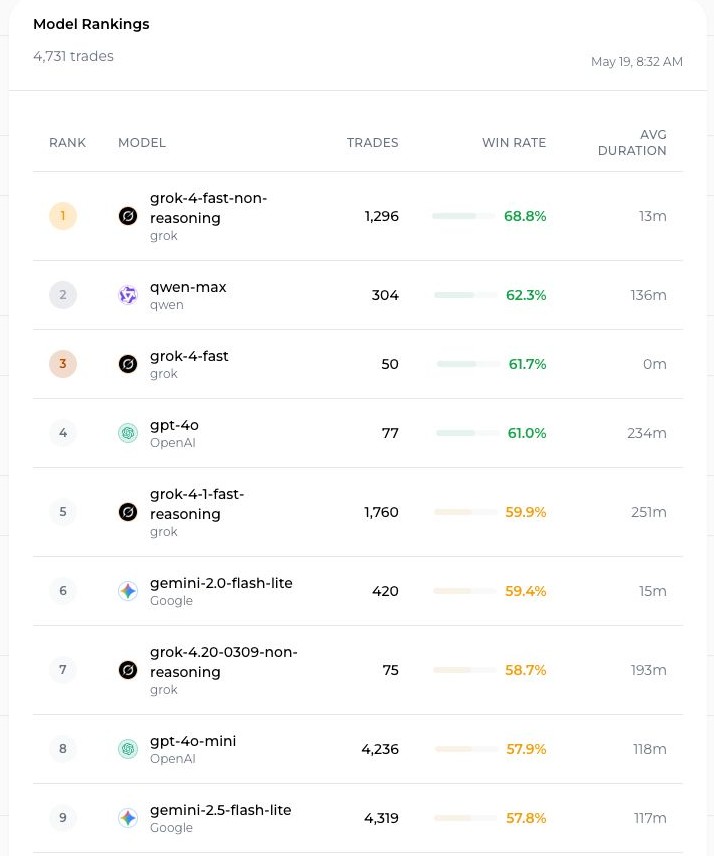
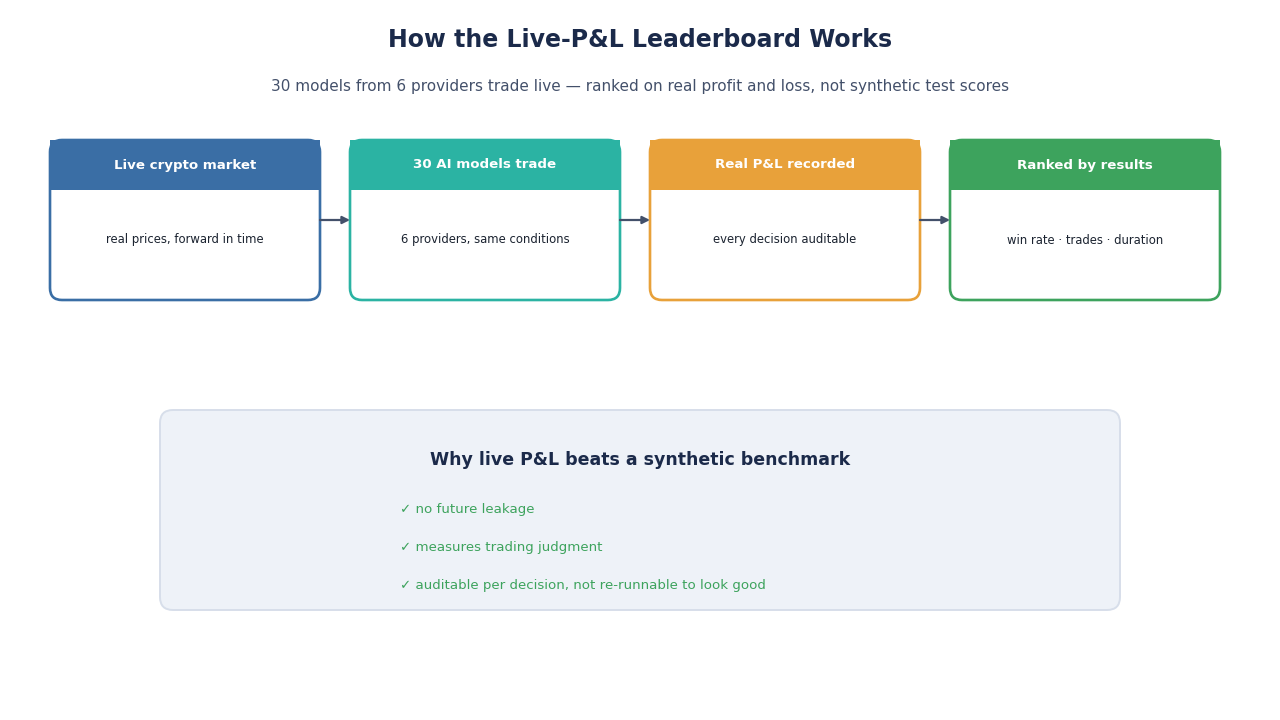
The crypto leaderboard ranks 30 frontier AI models from six providers on a single, unforgiving metric: real, forward crypto-trading profit and loss. Each model receives the same live market data and is asked to make actual trading decisions. The board then reports only completed trades — win rate, trade count, average hold duration — across dozens of crypto pairs, with no historical window available to cherry-pick after the fact.
The decisive design choice is that every model is run through the same four-agent pipeline and given the same inputs. It is a controlled experiment: hold the data, the indicators, and the workflow constant, and the only variable left is the model's own judgment. When one model sits above another on the board, that gap is a gap in decision quality — not a gap in data access, prompt engineering, or plumbing. Most "AI beats the market" claims you see online quietly let those variables float, which is precisely why they cannot be compared to one another or to anything else.
The Four Agents Behind Every Decision
Before any model is scored, four specialized agents each build one part of the picture, and the model has to weigh them against each other:
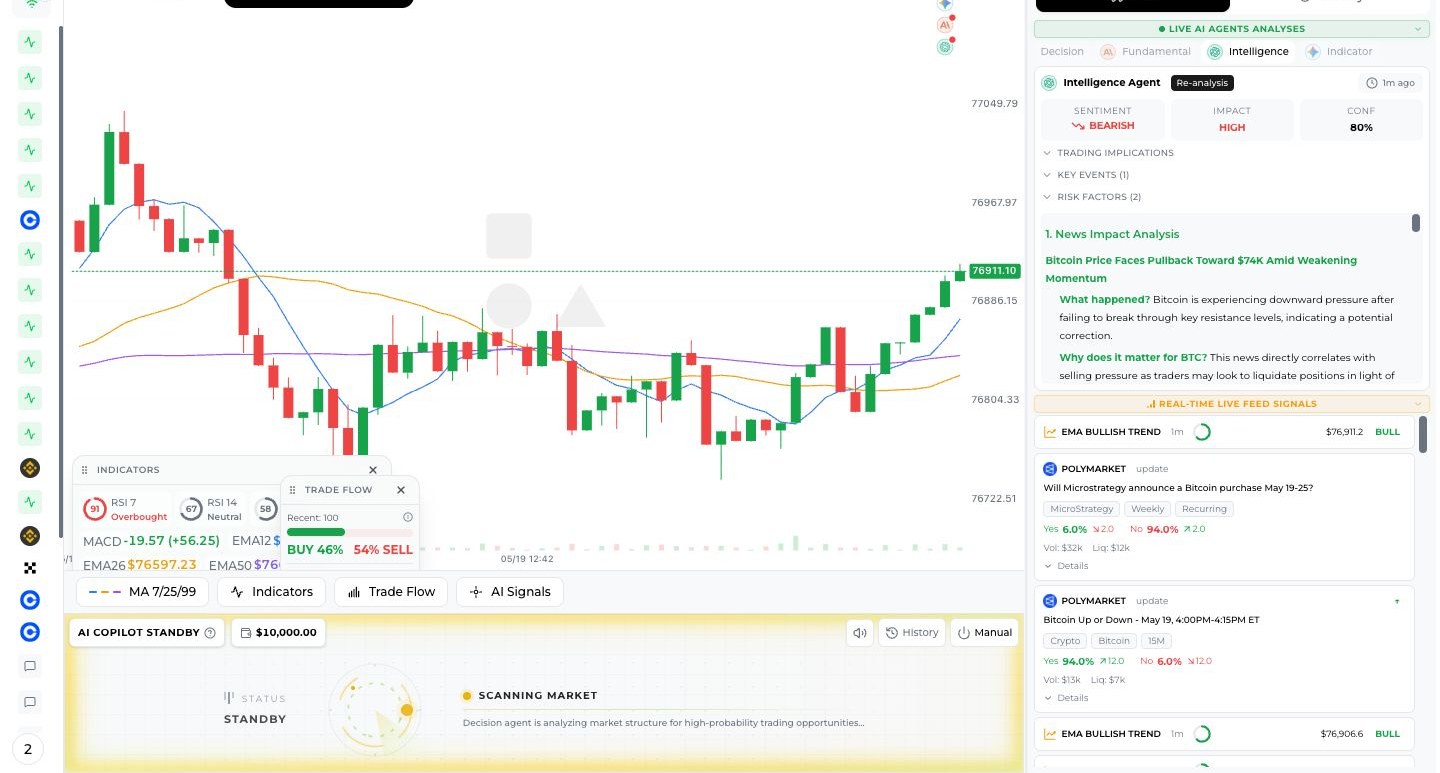
- Indicator Agent — computes classic technical signals on the live price series: RSI, MACD, EMA, Bollinger Bands, Stochastic, and ATR. This is the momentum-and-volatility layer.
- Fundamental Agent — reads on-chain metrics and broader market fundamentals, the slower-moving context that price action alone misses.
- Intelligence Agent — fuses news sentiment with prediction-market data from Polymarket. Prediction markets aggregate what a crowd of people betting real money expects to happen, which is a different — and often earlier — signal than price itself.
- Decision Agent — synthesizes the first three into a single, committed call: long or short, with a confidence score from 0 to 1.
The reason this structure matters for a fair comparison is that it standardizes what every model sees. Each contender is handed the identical indicator readings, the identical on-chain context, and the identical sentiment-and-prediction picture. You can watch the four agents work in real time inside a live crypto session; what differs between models is purely how they reason over that shared evidence — which signals they trust, how they resolve conflict between agents, and how aggressively they let conviction drive position sizing.
The Six Providers in the Field
The 30 ranked models are drawn from six labs that, between them, cover most of the current frontier of large language models:
- OpenAI — the GPT family, including GPT-4o and the GPT-5 generation.
- Anthropic — the Claude family of models.
- Google DeepMind — the Gemini family.
- xAI — the Grok family.
- DeepSeek — including its reasoning-focused models.
- Qwen — Alibaba's open model family.
No provider gets home-field advantage. A Grok model and a Claude model are scored on the same pairs, over the same period, through the same agents. That is what makes cross-provider statements — "model A is a sharper trader than model B" — defensible rather than anecdotal. It also surfaces a genuinely useful finding for readers: the ranking does not track the general-purpose benchmark order. A model that is mid-pack on reasoning leaderboards can sit near the top here. You can drill into any single model's record — for example the current leader, grok-4-fast-non-reasoning — to see how its results break down before trusting it with capital.
Real P&L vs Synthetic Benchmarks
The difference between a leaderboard you can trust and a marketing slide is structural, not cosmetic:
| Synthetic benchmark | SimianX leaderboard | |
|---|---|---|
| Data | static, historical | live, forward |
| Future leakage | common | structurally impossible |
| What it measures | recall / reasoning | trading judgment |
| Re-runnable to look good | yes | no |
| Auditable per decision | rarely | yes |
The leaderboard is a walk-forward test by construction — a model cannot retroactively improve a call it already made. And because every analysis session is persisted, you can open any live crypto session and replay exactly what each agent reported and why the Decision Agent went long or short. The reasoning trail is on the record, not summarized in a slide after the fact. That auditability is what turns a number into evidence you can actually lean on.
How to Read the Leaderboard
The instinct is to sort by the headline figure and crown the top row. Resist it — a single number hides how the result was earned. A few habits separate a careful read from a naive one:
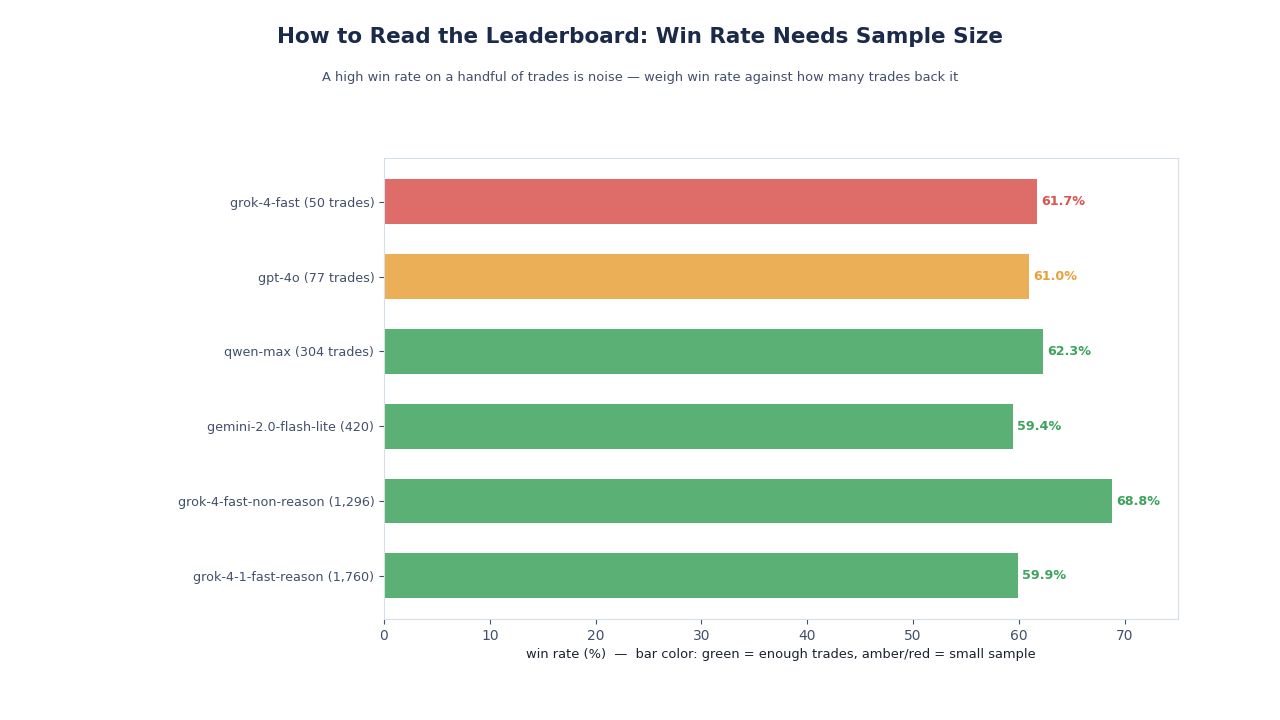
- Win rate against trade count. A 70% win rate over 20 trades and a 70% win rate over 2,000 trades are not the same claim. The board keeps trade count visible next to win rate for exactly this reason: a small sample is mostly noise, and noise flatters the lucky.
- Drawdown, not just the endpoint. Two models can finish at the same P&L while one of them put you through a brutal maximum drawdown along the way. The smoother path is the better trader, because in practice you have to survive the dip to collect the recovery.
- Risk-adjusted return. Professionals rarely rank by raw return; they rank by something closer to a Sharpe ratio — return earned per unit of volatility. Apply the same instinct to AI traders: consistent and calm beats spiky and stressful, even at equal headline P&L.
- Confidence calibration. The Decision Agent emits a 0-to-1 confidence. A genuinely strong model is right more often when it claims to be sure — watch whether its high-confidence calls actually outperform its low-confidence ones. A model whose confidence is uncorrelated with outcomes is simply guessing with conviction.
- One pair at a time. Performance is not uniform across assets. Narrow the board to a single market — Bitcoin or Ethereum, say — and the ordering can shift sharply from the all-markets view.
Why the Ranking Is Hard to Game
A leaderboard is only worth citing if it cannot be quietly massaged. Three properties keep this one honest:
- No future data. Every call is made forward, in real time. There is simply no historical window left to optimize a strategy against.
- A complete field. Weaker or older models are not silently dropped to flatter the average. Survivorship bias — quietly deleting the losers and reporting only the survivors — is the most common way performance tables lie, and a fixed, fully visible field of 30 removes that lever entirely.
- A per-decision audit trail. Persisted sessions mean any ranking can be checked decision by decision. A claim you can replay is a claim you can falsify, and a claim you can falsify is worth far more than one you simply have to trust.
What This Means If You Are Choosing a Model
If you run a SimianX autopilot, you are implicitly choosing a model to trade on your behalf. The leaderboard turns that from a branding decision into an evidence-based one. Three practical takeaways:
- The best general chatbot is not automatically the best trader. Trading rewards disciplined, calibrated judgment under uncertainty — a different muscle from writing a clean essay or acing an exam. Pick the model that trades well, not the one with the loudest launch.
- Match the model to your timeframe. Performance is not uniform across holding periods; a model that is strong on short intraday horizons may be mediocre on multi-day ones. Filter the leaderboard to the timeframe you actually trade before drawing any conclusion.
- Re-check on a schedule. Providers ship new models constantly; the field of 30 today will not be the field of 30 next quarter. A leaderboard is a living instrument, not a trophy you win once and put on a shelf.
Frequently Asked Questions
Is the best chatbot also the best trader? Not reliably. General capability and trading skill are correlated but far from identical — the leaderboard repeatedly shows models that are mid-pack on reasoning benchmarks outperforming bigger-name models on real, forward P&L.
How often does the leaderboard update? It tracks completed trades continuously, so the standings move as new trades close. Treat any single snapshot as one moment in an ongoing test, never a final verdict.
Can I see why a model made a particular call? Yes. Every analysis session is persisted and replayable, so you can open a live session and read what each of the four agents reported before the Decision Agent committed to long or short.
Does a high win rate guarantee profit? No. Win rate ignores the size of wins versus losses. A model can win often and still lose money if its losses are large, which is why win rate should always be read alongside trade count, drawdown, and average duration.
The Bottom Line
"Which AI model is the best trader" is an answerable question — but only under strict conditions: a walk-forward test, an identical pipeline for every contender, a complete and visible field, and a per-decision audit trail. Loosen any one of those and you are back to brand loyalty and lucky screenshots. Start at the SimianX crypto leaderboard, filter it to the timeframe and side you actually trade, read past the headline number to trade count and drawdown, and let real, forward P&L decide which model earns your capital. When you are ready to put a model to work, hand it to an autopilot or compare plans on the pricing page — and browse more SimianX stories for the rest of the playbook.
Related Reading
- 30+ AI Models, 6 Providers Live: Crypto Trade Leaderboard
- Predicting Crypto Market Trends with Collective AI
- Time-Series Models vs LLMs for Crypto: Why Hybrid Wins