
One Model or a Committee? How Eight AI Analysts Check Each Other
Short answer: eight AI analysts are not eight times smarter than one. What they add is structure. Each agent reads a narrower slice of the evidence, writes its view down before it sees the others, and then has to defend that view against a colleague whose job is to disagree. A final role must reconcile the reports into one decision and say what would prove it wrong. That process does not remove errors, but it makes them visible, and a visible error is one you can catch before it costs you money.
This guide explains why a single model struggles with stock and crypto analysis, what a multi-agent setup actually changes, and where it still falls short. It uses the two setups SimianX runs as worked examples: a four-agent live analysis room and an eight-seat deep research committee. Every product detail below was checked against the running system in October 2026. We do not quote accuracy or return figures for either setup, because we do not publish any that we could stand behind; the closest thing to public evidence is the crypto AI leaderboard, discussed near the end.
If you are new to agents in general, start with What Are AI Agents? How Multi-Agent AI Systems Work, which covers how a single agent plans, calls tools and hands work to another.
Why One Model Struggles With Market Analysis
Ask one large language model whether to buy a stock and you get one fluent answer. The problem is not that the answer is always wrong. The problem is that you cannot tell which parts of it deserve your trust.
Four weaknesses show up again and again:
- Everything in one pass. Chart reading, earnings analysis, news judgment and risk sizing all compete for attention in a single response. Whatever the model thinks about first tends to frame everything after it.
- No internal dissent. A single answer is written to be coherent. Inconvenient facts get smoothed over rather than argued about, because nobody in the conversation is assigned to argue.
- Numbers written, not computed. A model can state a reward-to-risk ratio or a price level with full confidence and still get the arithmetic wrong.
- No audit trail. When the call goes wrong, you have one block of prose and no way to see which input or which step failed.
None of this means a single model is useless. It means one model is doing the work of a whole research desk without any of the desk's checks.
What a Multi-Agent Setup Actually Changes
A multi-agent system splits the job into roles. In investing, the idea is borrowed from how human research teams already work: specialists write independent notes, someone argues the other side, and a decision-maker signs off. The academic work points the same way. Researchers at MIT and Google reported that letting several model instances debate improved factual accuracy and reasoning on benchmark tasks (Du et al., 2023), and the TradingAgents framework (Xiao et al., 2024) organizes trading research into analysts, bull and bear researchers and a risk team. Those are research results on benchmarks and simulations, not proof that any product makes money.
Here is what changes in practice, and what does not:
| Question | One model | A committee of agents |
|---|---|---|
| Who reads the data? | One model reads everything at once | Each role reads its own slice (chart, filings, news) |
| Are first opinions independent? | No, there is only one opinion | Yes, analysts write before seeing each other's work |
| Is disagreement surfaced? | Rarely; the answer is written to be smooth | Deliberately: a bull and a bear argue, and a chair picks the open questions |
| Who owns the final call? | The same voice that did the research | A separate role that must weigh every report |
| Can you trace a mistake? | Hard; one block of text | Easier; each report and each debate turn is kept |
| Does it fix the model's blind spots? | No | Only partly: if every seat uses the same model and the same data, errors can still line up |
| Cost and time | Low | Higher: more calls, a few minutes per run |
The idea behind the second column is the same one behind ensemble learning and the wisdom of the crowd: combining several judgments helps most when the judgments are independent. If eight agents read the same headline through the same model, you get one opinion eight times. That is why the structure matters more than the head count.
The Live Room: Four Agents on One Chart
The SimianX live analysis room puts four agents on the symbol and chart timeframe you pick. It covers more than 13,000 US stocks and ETFs and more than 4,000 crypto pairs, from 1-minute candles up (counts of live markets in our database, October 15, 2026).
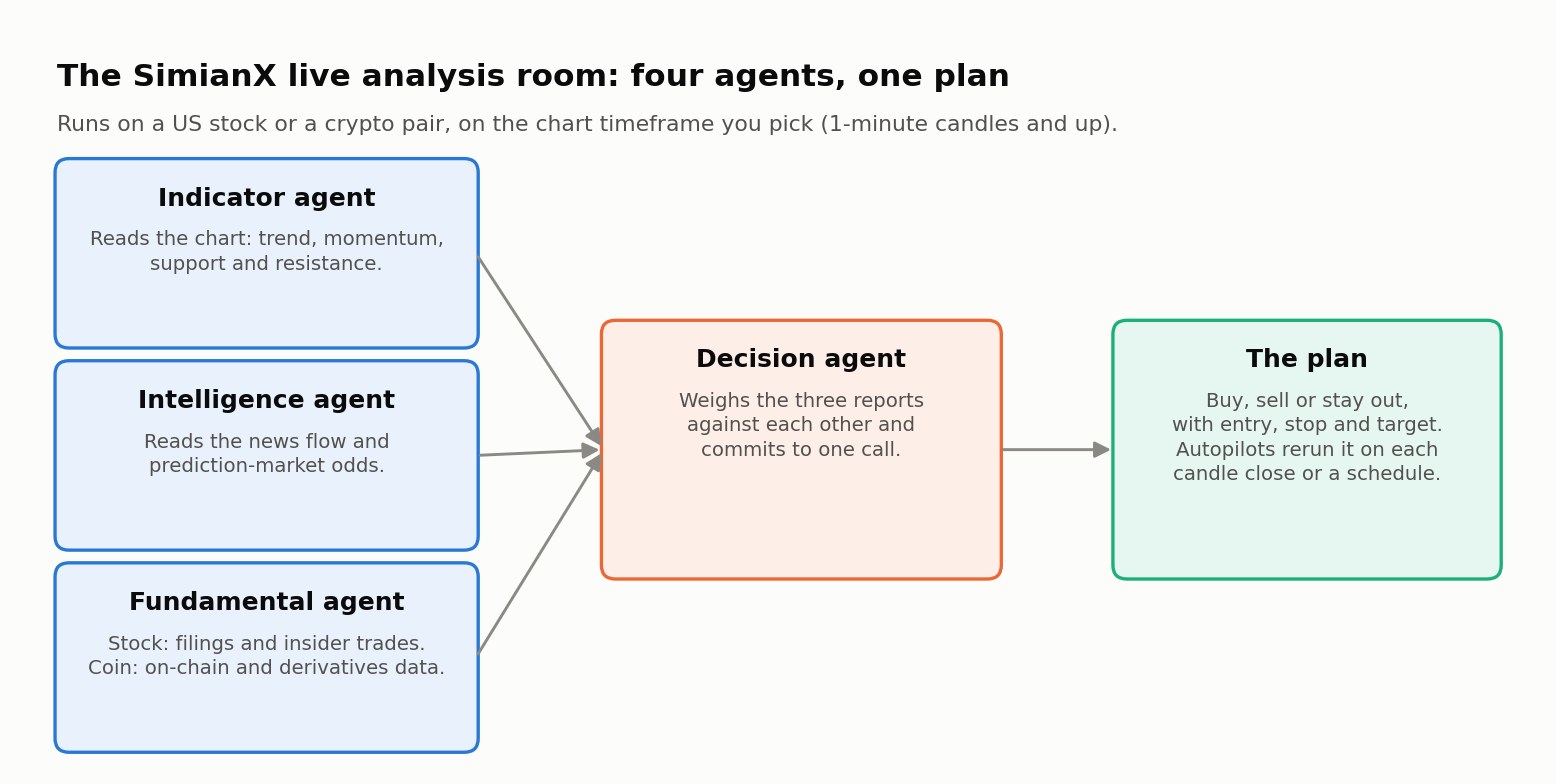
- Indicator agent. Reads the chart: trend, momentum, support and resistance, using standard measures such as RSI, MACD and ATR.
- Intelligence agent. Reads the news flow on the symbol and prediction-market odds where they exist.
- Fundamental agent. For a stock, filings and insider trades; for a coin, on-chain and derivatives data.
- Decision agent. Weighs the other three and commits: buy, sell or stay out, with an entry, a stop and a target.
You can choose the model behind each agent. That matters for the independence point above: running different models in different seats is one of the few ways to make sure the agents do not all share one model's habits. If you want the room to keep watching, an autopilot runs the same four agents on every candle close or on a schedule you set.
The live room is built for speed: one chart, one timeframe, one plan. It does not hold a debate. For that, there is the committee.
The Deep Research Committee: Eight Seats, Four Stages
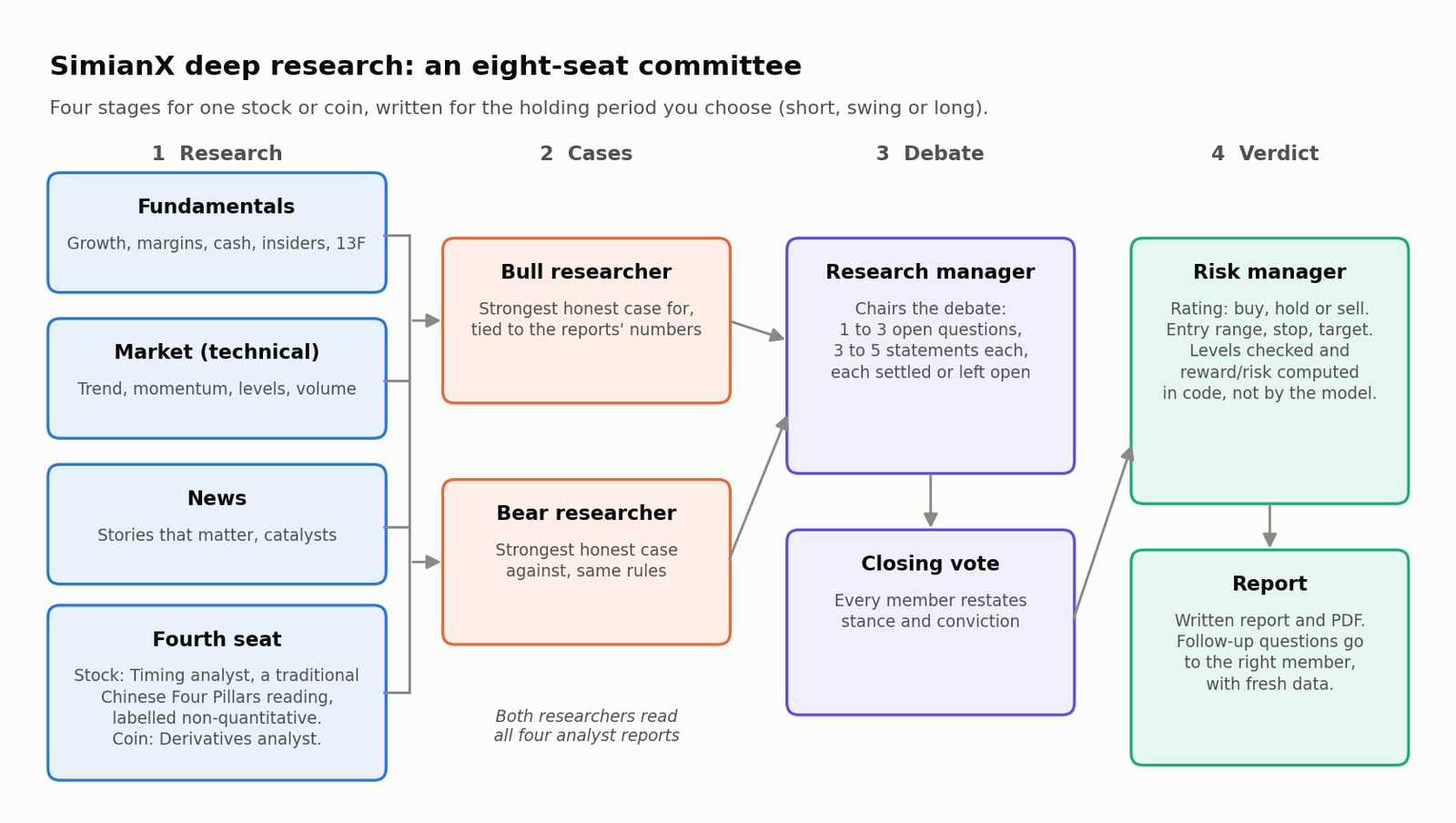
The deep research mode seats eight agents around one stock or one coin and runs them in four stages. Before it starts, you choose a holding period: short term (days to about two weeks), swing (two to eight weeks) or long term (six to twelve months or more). Every member writes for that horizon, so a long-term holder does not receive a day trader's stop.
| Seat | What it reads | What it hands on |
|---|---|---|
| Fundamentals Analyst | Revenue and margin trends, free cash flow, cash and debt, insider buying and selling, quarterly 13F institutional holdings | The one fundamental fact that matters most for the holding period |
| Market (Technical) Analyst | Trend from moving averages, RSI, MACD, recent returns, support and resistance, volume | A bias and the price that would prove it wrong, plus a setup or a reason there is none |
| News Analyst | The three to five stories that matter, each dated and sourced, and upcoming catalysts | Whether news flow is a tailwind, a headwind or neutral |
| Fourth seat (stock): Timing Analyst | The company's founding date read in the Chinese Four Pillars tradition | A timing view that the prompt requires to be labelled as traditional and non-quantitative |
| Fourth seat (coin): Derivatives Analyst | Futures and perpetual swaps, open interest, funding, long/short positioning, options flow | Where leverage sits and what would unwind it |
| Bull Researcher | All four analyst reports | The strongest honest case for, tied to numbers, with a conviction score |
| Bear Researcher | All four analyst reports | The strongest honest case against, under the same rules |
| Research Manager | Every report and the researchers' cases | Chairs the debate: picks one to three open questions and settles or leaves open each one |
| Risk Manager | Everything above, after the debate | The verdict: buy, hold or sell, with confidence, an entry range, a stop and a target |
A note on the fourth stock seat: it is a deliberate outside lens, not a hidden signal. Its own instructions tell it to say plainly that it is non-quantitative and not to invent financial facts. Read it as a different perspective, never as evidence.
Stage 1: four independent reads
The four analysts work in parallel and do not see each other's drafts. This is where independence comes from. If the fundamentals look strong and the chart looks broken, that disagreement is now written down by two separate agents instead of being blended into one paragraph.
Stage 2: the strongest case on each side
The bull and bear researchers read all four reports. Each is told to build the strongest honest case for its side, tie every argument to a figure in the reports, answer the two most dangerous points from the other side, and say what would change its mind. This is a built-in devil's advocate, the standard remedy for groupthink.
Stage 3: a chaired debate and a closing vote
The research manager does not average opinions. It picks the one to three disagreements that matter most and puts them on the agenda. Each question gets three to five statements, members can pull fresh data to back a point, and the chair settles the question or records it as unresolved. After the last question, every member restates its stance and conviction, so you can see who moved and who did not.
Stage 4: a verdict whose numbers are checked
The risk manager decides after the debate, not before. It returns a rating (buy, hold or sell), a confidence level, a headline, an entry range, a stop and a target. Two safeguards sit outside the model: the price levels are checked in code (a long needs its stop below the entry and its target above it), and the reward-to-risk ratio is calculated by code from the worst fill in the entry range rather than written by the model. Then the run writes a full report and a PDF, and you can keep asking questions; each follow-up goes to the member best placed to answer it, with fresh data.
For a screen-by-screen walk through one real run, see AI Stock Analysis Rebuilt: An 8-Agent Committee You Can Ask.
How Cross-Checking Works: An Illustration
The example below is illustrative, not a record of a real run. It shows the path a conflict takes through the committee.
- The Market Analyst sees price breaking above resistance on rising volume and leans bullish.
- The Fundamentals Analyst finds that operating margin has shrunk for three quarters in a row and that insiders have been net sellers.
- The Bear Researcher builds its case on the margin trend; the Bull Researcher argues the breakout reflects a new product cycle.
- The research manager puts one question on the agenda: is the margin decline temporary or structural? Both sides argue it with figures.
- The question stays open. In the closing vote the Market Analyst lowers its conviction.
- The risk manager rates the stock a hold with a clearly stated condition: a better entry, or a quarter that shows margins recovering.
A single model given the same data might have written "strong breakout, some margin pressure, moderately bullish". The committee writes down the conflict, names the question that decides it and tells you what to watch. That is the practical value of structure.
Live Room vs Deep Research: Which One When?
| Live analysis room | Deep research committee | |
|---|---|---|
| Agents | 4 (Indicator, Intelligence, Fundamental, Decision) | 8 (four analysts, bull, bear, research manager, risk manager) |
| Markets | US stocks and ETFs, crypto pairs | US stocks, coins |
| Time frame | The chart timeframe you pick, from 1 minute | A holding period: short, swing or long |
| Debate | None; the Decision agent weighs three reports | Chaired debate on one to three questions, then a vote |
| Output | Buy, sell or stay out, with entry, stop, target | Buy, hold or sell, with entry range, stop, target, report and PDF |
| Best for | Timing a trade on a chart you are watching | Deciding whether a position is worth taking at all |
What the Evidence Does and Does Not Show
An earlier version of this article quoted accuracy gains, customer counts and case studies that we could not verify. They have been removed. Here is what can be said honestly.
- Research supports the method, not a return figure. Multi-agent debate has improved reasoning and factuality on benchmarks in published work, and committee-style trading frameworks exist in the literature. Neither tells you how a specific product will perform in your account.
- The live agents are measured in public. Positions that live crypto sessions open and close, together with replays of the same decision moments, feed the SimianX crypto AI leaderboard, which ranks models by average R per trade. As of October 15, 2026, 39 models were ranked, with averages from +0.59R down to −0.33R. That is crypto only, and it measures models, not the eight-seat committee. How to read it is covered in Which AI Model Is the Best Trader?
- The committee has no public scoreboard yet. We do not publish a hit rate for deep research verdicts. Treat each verdict as a structured second opinion, not a forecast with a known accuracy.
Limitations to Keep in Mind
- Shared blind spots. If one model fills every seat, its habits and knowledge gaps appear in every report. Free runs use one default model for all seats; paid users can choose a model per seat.
- Shared data. Agents can only reason over the data they are given. A missing filing or a stale price affects everyone downstream.
- Debate is not truth. A well-argued case can still be wrong, and a committee can talk itself into a false consensus. The closing vote shows how opinions moved; it does not prove which side was right.
- Speed and cost. A committee run takes minutes and uses more model calls than a single answer, so it uses more of your plan's points.
- One lens is traditional. The stock committee's timing seat is explicitly non-quantitative.
- Markets change. No setup, single or multi-agent, removes the risk of loss.
Frequently Asked Questions
Are eight AI agents always better than one? No. They are better at exposing disagreement and documenting why a decision was made. If every agent uses the same model and the same data, their errors can still line up.
Do the agents use different AI models? They can. In the live room you choose the model behind each agent. In deep research, free runs use one default model for every seat, and paid users can set a model per seat.
What does the final verdict include? A rating (buy, hold or sell), a confidence level, an entry range, a stop, a target, a reward-to-risk ratio calculated in code, a written report and a PDF.
Can it trade for me? Deep research gives a recommendation, not an order. An autopilot can rerun the four live agents on a schedule and manage a paper position.
Does SimianX publish an accuracy rate? Not for deep research. Model-level trading results for the live crypto agents are public on the leaderboard.
How does this compare with asking a general chatbot? See Multi-Agent AI vs ChatGPT for NVDA Signals and GPT vs Gemini vs Claude for AI Stock Analysis.
The Bottom Line
More agents do not mean more intelligence. They mean more checks: independent first reads, a forced counter-argument, a chair who names the open questions and a final decision whose numbers are verified outside the model. That is why a committee can be more useful than a single answer, and also why it still deserves the same skepticism you would give any analyst. Try a chart in the live room, run a full deep research on a name you are weighing, or connect the four live agents to your own coding agent through Agent use.
Risk note: SimianX provides multi-agent market research and educational analysis only, not investment advice. AI output can be wrong. Past performance does not predict future results, and trading stocks or crypto can lose money.
Related Reading
- What Are AI Agents? How Multi-Agent AI Systems Work
- AI Stock Analysis Rebuilt: An 8-Agent Committee You Can Ask
- Which AI Model Is the Best Trader? Ranked by Average R
- GPT vs Gemini vs Claude for AI Stock Analysis: 2026 Guide
- Multi-Agent AI vs ChatGPT for NVDA Signals: 2026 Comparison
- Stock Live Analysis: AI Agents Cover US Stocks Real Time
- Multi-Agent AI Pipelines for Hedge Fund Deep Research
References
- Du et al. (2023) — Improving Factuality and Reasoning in Language Models through Multiagent Debate
- Xiao et al. (2024) — TradingAgents: Multi-Agents LLM Financial Trading Framework
- Wikipedia — Ensemble learning
- Wikipedia — Wisdom of the crowd
- Wikipedia — Groupthink
- Wikipedia — Form 13F
- NIST — AI Risk Management Framework