 By Muke
Yom Kippur War, the 1973 Oil Crisis & the Global Stock Market Crash
The Yom Kippur War, the 1973 Oil Crisis, and the global stock market crash together form one of the most significant geopolitical-economic shocks of the 20th century. In October 1973, a sudden war in the Middle East triggered a chain reaction that reshaped global energy markets, inflation, and equity markets for years.
For investors and economists, the event became a case study in how geopolitical conflict can trigger systemic financial shocks. Today, advanced analytics platforms such as SimianX AI help investors monitor geopolitical risks, oil price signals, and macroeconomic reactions in real time.
Understanding what happened in 1973 provides valuable insight into how wars, commodities, and financial markets interact—and how modern tools like SimianX AI can help traders interpret similar risks today.
The Geopolitical Background of the Yom Kippur War
The Yom Kippur War began on October 6, 1973, when Egypt and Syria launched a surprise attack on Israel during the Jewish holy day of Yom Kippur. The conflict was rooted in long-standing tensions following the 1967 Six-Day War, in which Israel captured territory from several Arab states.
Several geopolitical dynamics intensified the crisis:
- Cold War rivalries between the United States and the Soviet Union
- Territorial disputes in the Middle East
- Growing influence of oil-producing nations
- Rising political coordination among OPEC countries
The war itself lasted only about three weeks, but its economic consequences lasted for years.
The 1973 conflict demonstrated how regional wars can transform into global economic crises when energy markets are involved.
Within days, the conflict expanded beyond military confrontation and entered the realm of economic warfare through oil supply control.
How the War Triggered the 1973 Oil Crisis
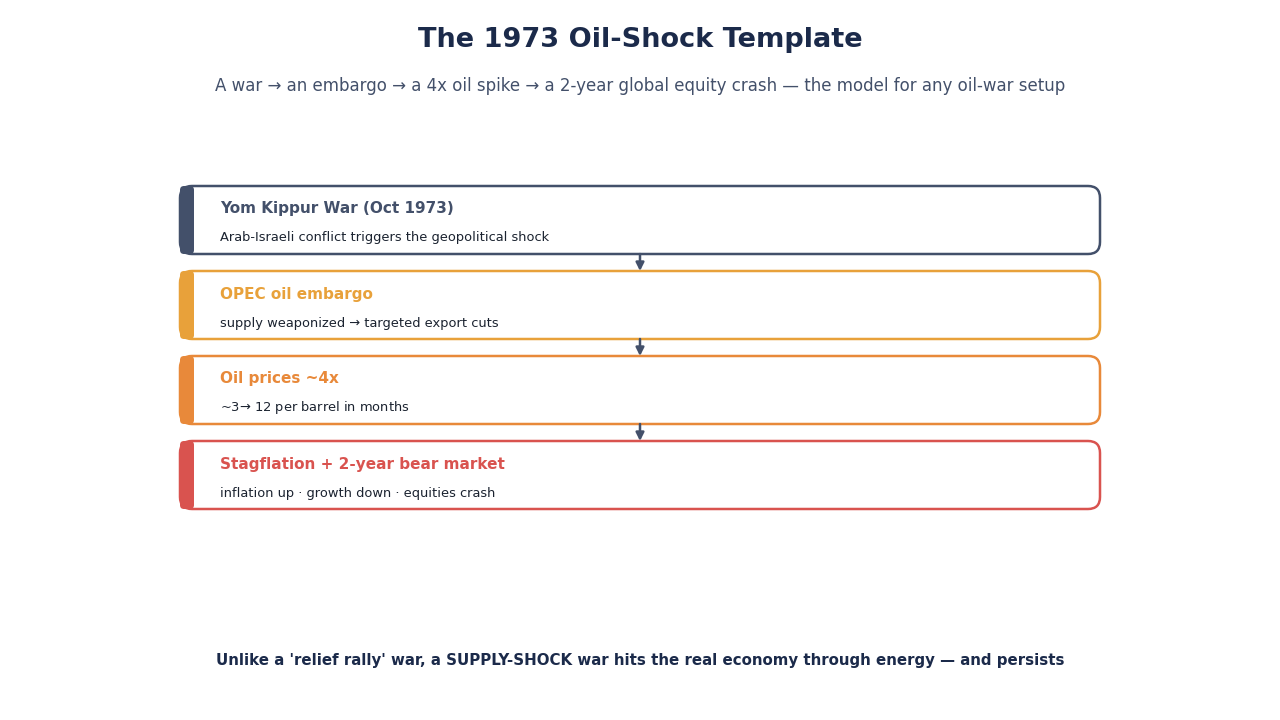
The most immediate economic impact of the Yom Kippur War was the OPEC oil embargo.
Arab members of the Organization of Petroleum Exporting Countries imposed an embargo on nations that supported Israel—primarily the United States and several Western allies.
The effects were dramatic:
| Factor | Impact |
|---|---|
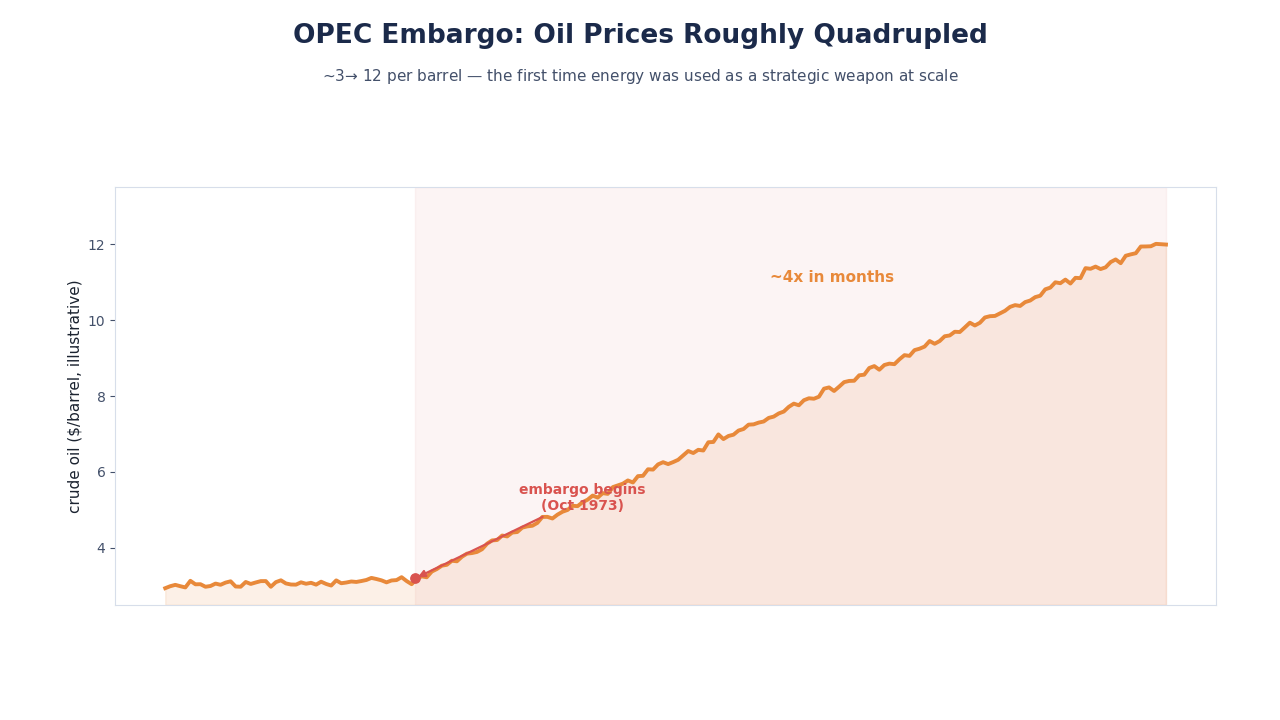
| Oil production cuts | Supply reduced by ~5% globally |
| Oil prices | Quadrupled from ~$3 to ~$12 per barrel |
| Energy shortages | Fuel rationing in many countries |
| Inflation | Sharp increase across developed economies |
Between October 1973 and early 1974, oil prices surged more than 300%, triggering one of the largest commodity shocks in modern history.
Immediate consequences included
- Gasoline shortages
- Long fuel lines in the United States
- Rising transportation costs
- Industrial production slowdowns
Energy had suddenly become a geopolitical weapon.
The Transmission Mechanism: From Oil Shock to Stock Market Crash
The global economy in the early 1970s was highly dependent on oil. When energy prices surged, the shock rippled through every sector.
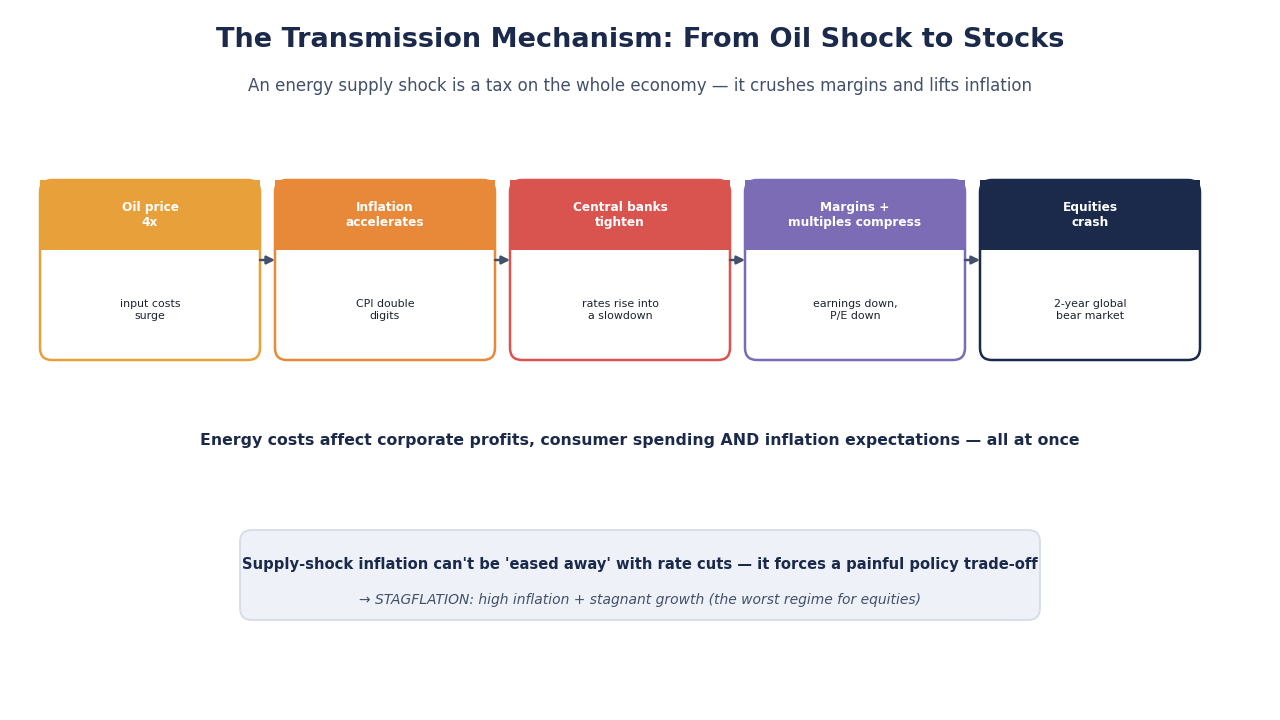
The economic transmission chain looked like this:
- War in the Middle East
- Oil embargo by OPEC
- Massive oil price surge
- Inflation spike
- Economic slowdown
- Stock market collapse
This chain reaction illustrates how commodity shocks can propagate across financial systems.
Key economic pressures included
1. Inflation Explosion
Oil is a core input for transportation, manufacturing, and energy generation. When oil prices surged, inflation surged with it.
U.S. inflation rose from about 3% in 1972 to more than 11% in 1974.
2. Stagflation
The world experienced stagflation—a rare combination of:
- high inflation
- low economic growth
- rising unemployment
Traditional economic policy tools struggled to address the situation.
3. Corporate Profit Compression
Higher energy costs reduced corporate margins across sectors:
- manufacturing
- airlines
- logistics
- consumer goods
Lower profits translated into falling equity valuations.
The 1973–1974 Global Stock Market Crash
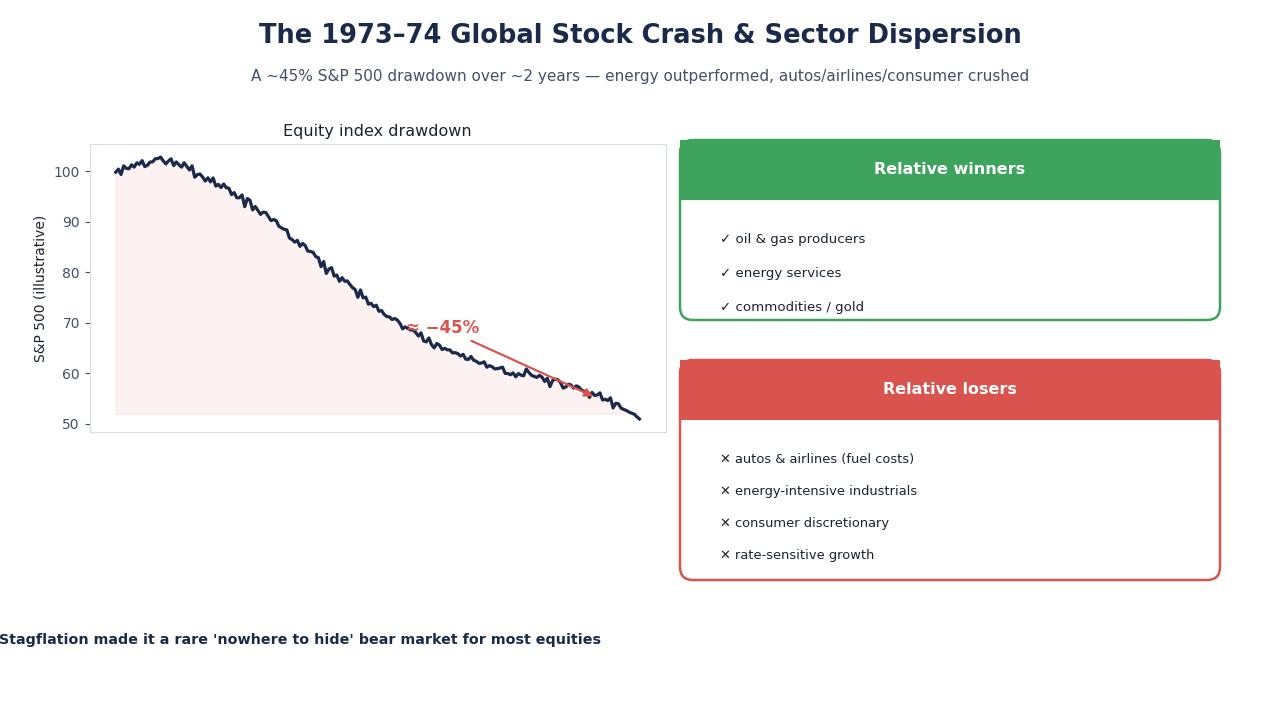
The oil crisis triggered one of the worst global equity market declines since the Great Depression.
Major market indices suffered severe losses:
| Index | Decline |
|---|---|
| S&P 500 | ~48% decline |
| Dow Jones Industrial Average | ~45% decline |
| UK FTSE | ~73% decline |
| Global equities | severe multi-year downturn |
The bear market lasted roughly 1973–1974, wiping out trillions in global equity value.
Investor sentiment collapsed
Markets reacted not only to economic damage but also to uncertainty.
Investors feared:
- prolonged war escalation
- persistent energy shortages
- central bank policy mistakes
- global recession
Sector Winners and Losers During the Oil Crisis
Not every sector suffered equally.
Some industries were destroyed, while others benefited.
Worst-performing sectors
- Airlines
- Automobile manufacturers
- Transportation companies
- Consumer discretionary businesses
These industries depended heavily on cheap fuel.
Best-performing sectors
- Oil producers
- Energy companies
- Commodities
- Precious metals
Energy companies experienced enormous profit growth.
Gold also surged as investors sought inflation hedges.
Commodity shocks often create sector rotation opportunities for investors who understand macro signals.
Monetary Policy and the Rise of Stagflation
Central banks faced an unprecedented challenge.
Normally, policymakers fight recessions by cutting interest rates. But high inflation required raising rates.
This policy dilemma created a cycle:
- Inflation rises
- Central banks tighten policy
- Economic growth slows
- Markets fall further
The 1970s became known as the era of stagflation.
The crisis eventually contributed to major shifts in economic policy, including:
- stronger central bank independence
- inflation-targeting frameworks
- energy diversification strategies
What Can Modern Investors Learn from the 1973 Crisis?
The Yom Kippur War and oil crisis offer several lessons for investors.
1. Geopolitical shocks propagate quickly
Wars can impact markets within days when critical commodities are involved.
2. Commodity markets amplify risk
Energy price shocks influence:
- inflation
- corporate earnings
- consumer spending
- monetary policy
3. Market reactions often occur before economic data
Equity markets anticipate economic damage before it appears in official statistics.
4. Sector rotation matters
During geopolitical crises:
- defensive assets outperform
- commodity producers gain
- consumer sectors suffer
These lessons remain relevant today in conflicts affecting energy supply chains.
How AI Platforms Like SimianX Analyze Geopolitical Market Risk
In 1973, investors had limited access to real-time data and geopolitical analytics.
Today, AI-driven platforms such as SimianX AI help traders detect early warning signals across markets.
SimianX integrates multiple sources of market intelligence:
- macroeconomic indicators
- commodity price signals
- geopolitical news
- derivatives market positioning
Example signals monitored by AI systems
| Signal Type | Example Indicator |
|---|---|
| Energy markets | Brent crude volatility |
| Options markets | Oil sector skew |
| Macro indicators | Inflation expectations |
| Risk sentiment | VIX volatility regimes |
Using AI-based analysis allows investors to identify potential crisis scenarios earlier.
Could a Similar Crisis Happen Today?
Modern global markets remain vulnerable to energy disruptions.
Potential triggers include:
- Middle East conflicts
- supply disruptions in major oil producers
- geopolitical sanctions
- global shipping disruptions
However, several factors differ today compared with 1973:
| 1973 Economy | Modern Economy |
|---|---|
| Heavy oil dependence | Diversified energy mix |
| Limited data access | Real-time financial data |
| Slow policy response | Central bank coordination |
Modern analytics platforms—including SimianX AI—provide real-time monitoring tools that help investors react faster than markets could in the 1970s.
How Traders Use SimianX to Monitor Geopolitical Risk
Modern investors can analyze crisis signals through platforms like SimianX AI.
Key capabilities include:
- Real-time commodity tracking
- Macro risk dashboards
- AI-driven scenario analysis
- Multi-market correlation monitoring
For example, traders can monitor relationships between:
- oil prices
- inflation expectations
- equity volatility
- bond yields
These signals can provide early warning of systemic risk events similar to the 1973 crisis.
FAQ About the Yom Kippur War Oil Crisis and Stock Market Crash
What caused the 1973 oil crisis?
The crisis was triggered when Arab members of OPEC imposed an oil embargo against countries supporting Israel during the Yom Kippur War. Oil supply cuts caused prices to quadruple, triggering global inflation and economic slowdown.
How did the oil crisis affect the stock market?
Higher energy costs reduced corporate profits and increased inflation. Combined with economic uncertainty and monetary tightening, global stock markets entered a severe bear market between 1973 and 1974.
Why did the 1973 crisis cause stagflation?
The oil shock increased production costs across the economy, raising inflation while slowing economic growth. This unusual combination created stagflation—something traditional economic policy struggled to address.
Could geopolitical wars still crash markets today?
Yes. Conflicts affecting key commodities—especially oil, natural gas, or critical supply chains—can still trigger major financial market reactions.
How can investors monitor geopolitical risk today?
Investors increasingly use AI analytics platforms like SimianX AI to track market signals, energy price volatility, macroeconomic indicators, and geopolitical news in real time.
Conclusion
The Yom Kippur War, the 1973 oil crisis, and the global stock market crash illustrate how geopolitical conflict can cascade through commodity markets and financial systems.
A regional war triggered:
- a historic energy shock
- runaway inflation
- global stagflation
- one of the worst equity bear markets of the 20th century.
For modern investors, the lesson is clear: geopolitical risk cannot be ignored.
With advanced analytics platforms such as SimianX AI, traders now have powerful tools to monitor macro signals, detect risk regimes, and respond to global events faster than ever before.
Understanding historical crises like 1973 helps investors prepare for the next market shock—and AI-driven intelligence may be the key to navigating it.
Related Reading
- Buy the Invasion Pattern: Iraq 2003 S&P 500 +15% Rally
- 9/11 & Early War on Terror: S&P 500 -14%, 4-Month Recovery
- Russia-Ukraine War Stock Impact: Sectors, VIX, Risk Plan
- Iran-US War Impact on Stocks: AI Risk Signals Live
- 7 AI Risk Radars for Equities: Breadth, Revisions, Skew
- Dow Jones Risk Pulse: AI Signals Breadth, VIX, Spreads
- Why US Stocks & Crypto Plummeted This Week: The Causes