By Muke
9/11 and the Early War on Terror: Market Shock, Risk, and Economic Aftermath
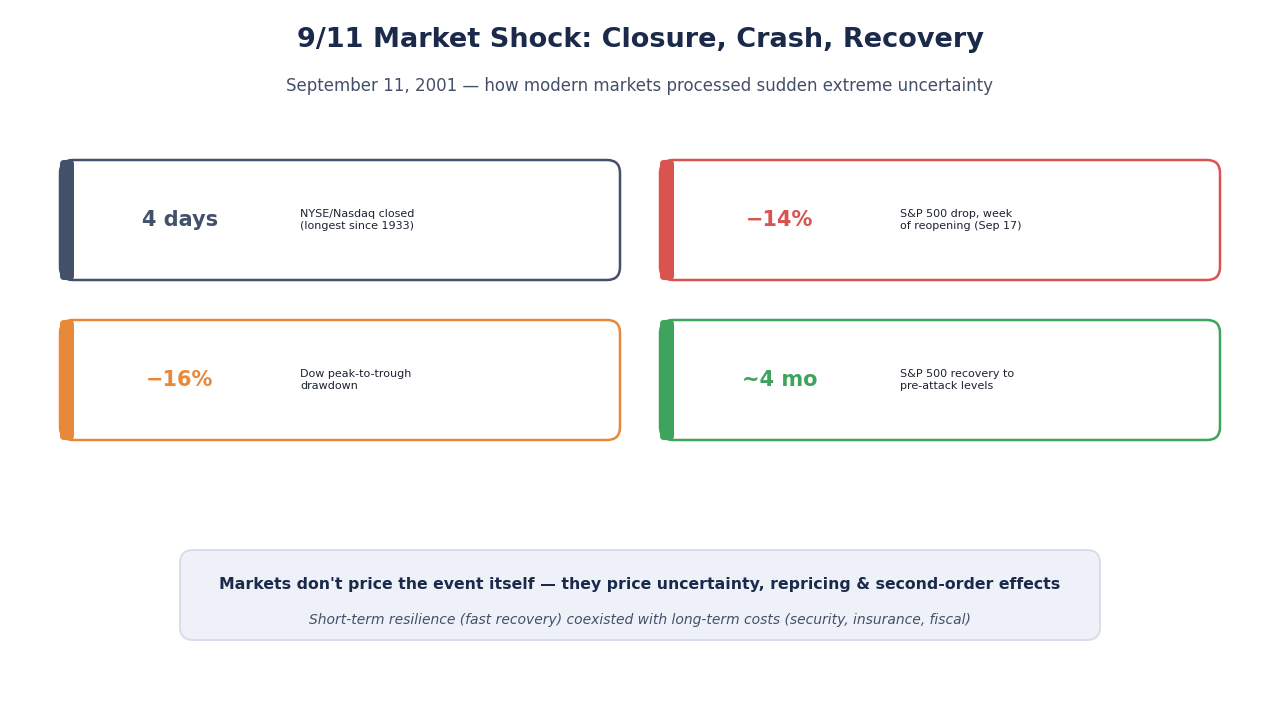
The story of 9/11 and the Early War on Terror is not only a story of national tragedy and geopolitical change. It is also a case study in how modern markets process sudden, extreme uncertainty. In a matter of hours, the United States experienced a human catastrophe, a financial-system disruption, a transportation shutdown, and the beginning of a long security-and-war cycle that reshaped risk pricing for years. For investors, policymakers, and researchers, the episode remains one of the clearest examples of how market shock, liquidity stress, sector rotation, and fiscal aftermath can unfold together. Today, platforms such as SimianX AI are relevant precisely because they help analysts organize these overlapping signals—macro, sector, volatility, and narrative—in real time rather than in hindsight. The attacks shut U.S. equity markets until September 17, 2001, disrupted payments and settlement systems, and triggered an extraordinary Federal Reserve response to preserve liquidity and confidence.
Why 9/11 still matters for market research
Many historical market events are analyzed primarily through price charts. 9/11 requires a broader lens. The attacks affected not only equities, but also market infrastructure, insurance assumptions, airline economics, office real estate, labor markets, fiscal policy, and the long arc of war-related spending. In that sense, 9/11 is one of the best examples of a cross-asset geopolitical shock—a shock that begins as a security event but quickly becomes a financial, operational, and macroeconomic event. The NYSE highlights the reopening on September 17, 2001 as a defining moment in its history, while Federal Reserve histories emphasize that the central bank had to address severe dislocations in payments, funding, and overall market functioning.
For modern readers, the value of revisiting this period is practical:
- It shows how market closures alter price discovery.
- It reveals why liquidity matters as much as valuation during a crisis.
- It clarifies how sector winners and losers can diverge sharply after a geopolitical shock.
- It shows the difference between an immediate market selloff and a multi-year economic regime shift.
- It provides a template for how tools like SimianX AI can combine news, macro data, sector behavior, and risk signals into one decision framework.
In crisis markets, the first question is rarely “What is fair value?” The first question is usually “Can the system continue to function?”
That is why 9/11 belongs in the same analytical category as other systemic shocks: it tested not just investor psychology, but the plumbing of finance itself. The attacks occurred in an economy that was already weakening in 2001, so they did not strike a fully healthy macro backdrop. Retrospective assessments from Congressional Research Service sources argued that 9/11 hit an already fragile economy and amplified an ongoing downturn rather than creating weakness from zero.
The immediate market shock: closure, uncertainty, and repricing
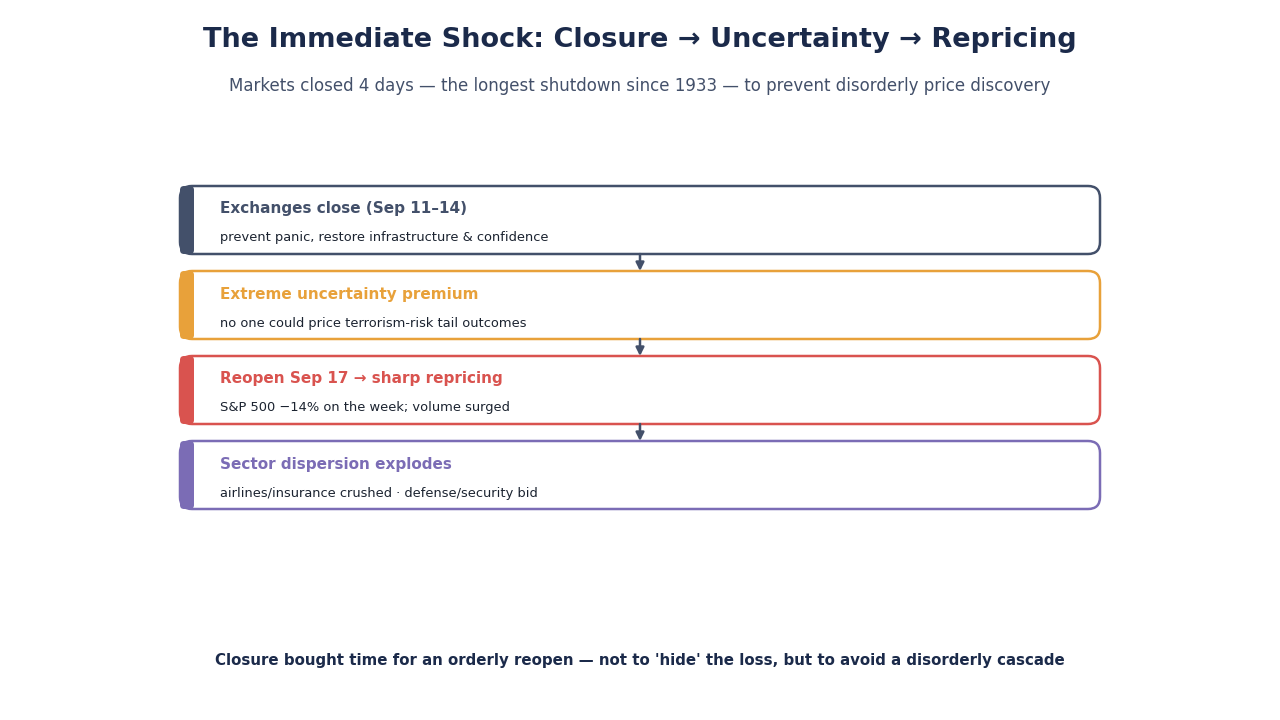
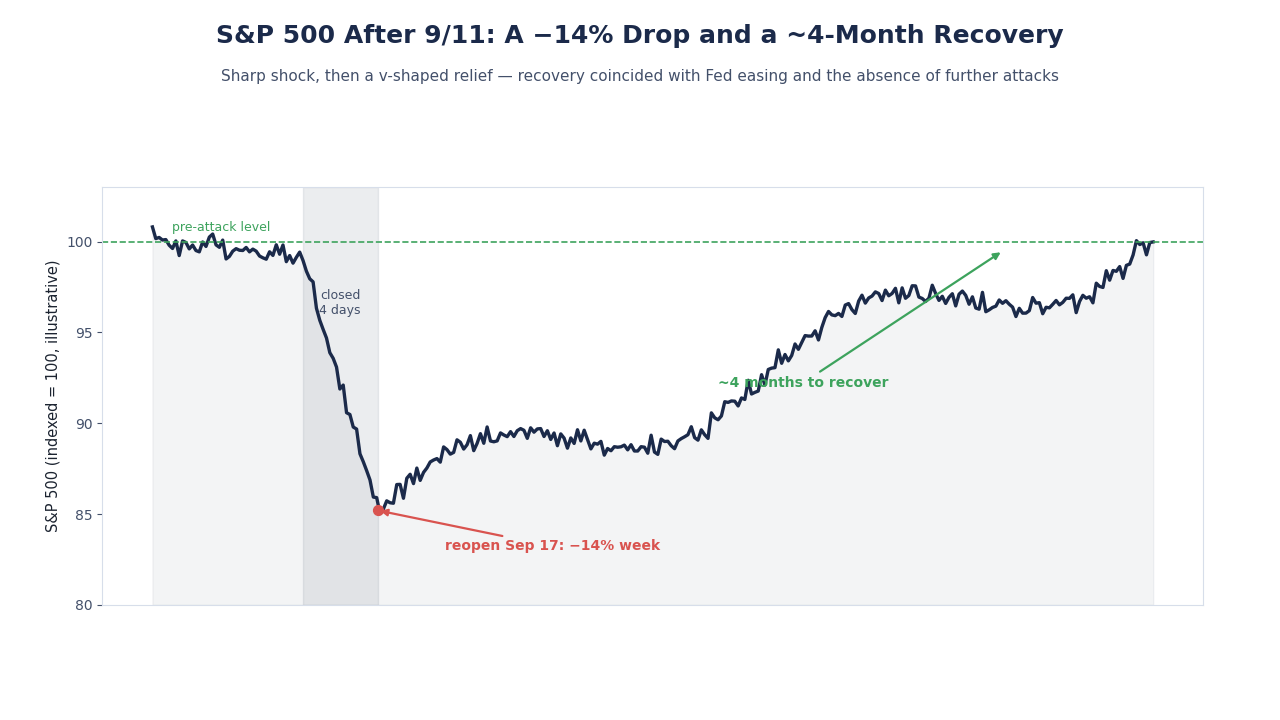
On Tuesday, September 11, 2001, U.S. markets did not complete a normal trading session. Trading was canceled, the NYSE and Nasdaq remained closed through the rest of the week, and markets reopened on Monday, September 17. That closure was historically significant because it interrupted the normal process through which risk is priced, hedged, and transferred. When markets finally reopened, investors had to absorb several days of accumulated uncertainty all at once: the scale of the attacks, the possibility of additional incidents, unknown military responses, likely disruptions to travel and commerce, and the realization that major financial firms and communications systems had been physically affected.
When trading resumed, the Dow Jones Industrial Average fell sharply, and the S&P 500 and Nasdaq also registered steep losses. Contemporary reporting and historical reviews commonly describe the reopening session as one of the largest one-day point declines for the Dow at that time, reflecting both fear and the backlog of repricing that had accumulated during the closure.
This phase of the episode is important because it reminds investors that market closures do not eliminate risk. They often compress risk into the reopening. During a closure:
- Fundamental uncertainty continues to evolve.
- Portfolio managers cannot rebalance normally.
- Hedging demand builds in private or overseas venues.
- Sentiment worsens without a visible clearing price.
- Reopening gaps can be larger than they would have been in continuous trading.
That helps explain why the first post-closure session was so violent. Investors were not reacting only to the attacks themselves; they were reacting to several days of unpriced uncertainty.
| Immediate Channel | Why It Mattered After 9/11 |
|---|---|
| Exchange closure | Delayed price discovery and concentrated reopening volatility |
| Physical disruption | Damaged telecom, office, and settlement capacity in Lower Manhattan |
| Security uncertainty | Raised fear of follow-on attacks and prolonged instability |
| Travel shutdown | Hit airlines, tourism, lodging, and consumer confidence |
| Policy uncertainty | Made future military action and fiscal costs difficult to price |
What made the 9/11 market shock different from a normal panic?
A normal market panic is usually a fast repricing inside a functioning market. The 9/11 market shock was different because the market itself was partially disabled. The issue was not merely that investors were afraid. It was that the operational environment for finance—communications, clearing, transportation, staffing, and office access—had been disrupted at the same time as the shock. Federal Reserve historical materials describe severe dislocations in U.S. financial markets and emphasize the central bank’s role in limiting broader fallout.
This distinction matters for modern crisis analysis. If a shock is only informational, markets may fall quickly but continue functioning. If a shock is also operational, then liquidity, settlement, and basic transaction capacity become central to the response. That was true after 9/11, and it is a key lesson for analysts using modern risk platforms. A system like SimianX AI is particularly useful when it can monitor not only prices, but also narratives, macro reactions, and cross-market stress signals that indicate whether a shock is turning into a broader system event.
The Federal Reserve response: liquidity before confidence
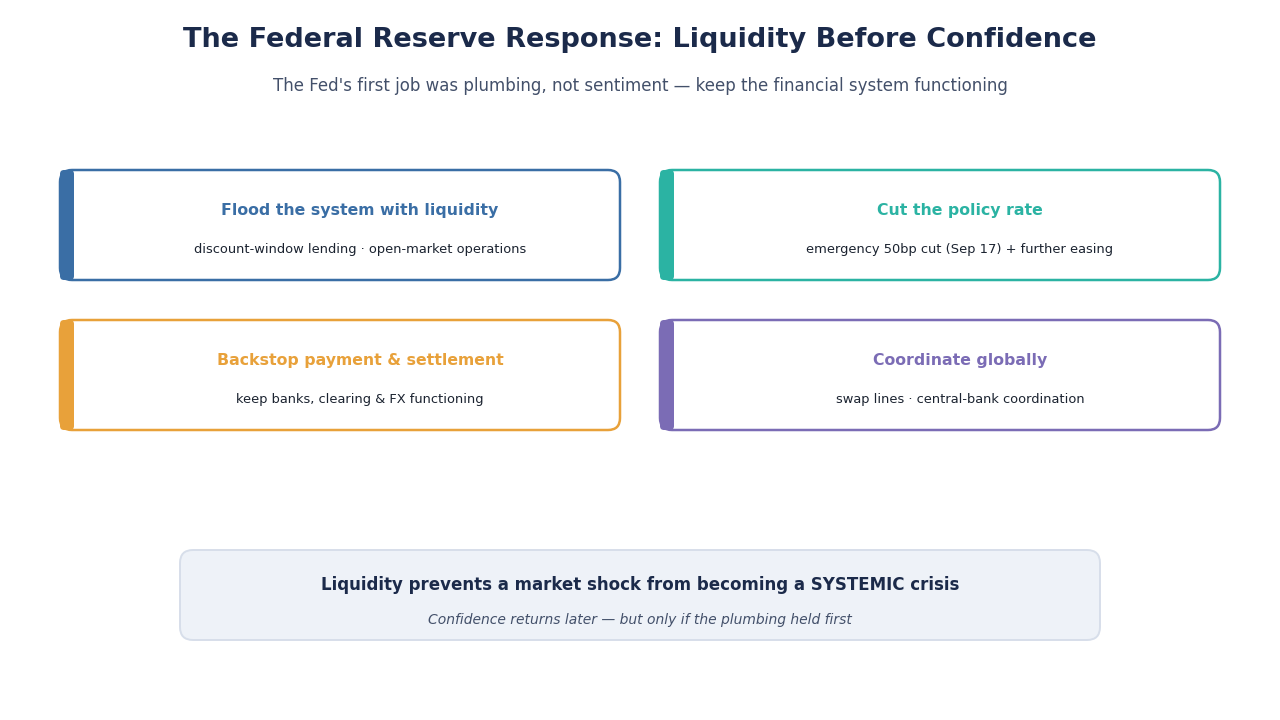
One of the most important lessons from the period is that liquidity support often comes before full confidence returns. The Federal Reserve stated on September 11 that it was open and operating and that the discount window was available to meet liquidity needs. It then supplied unusually large volumes of liquidity and cut rates by 50 basis points on September 17, 2001, while signaling that such support would continue until more normal market functioning was restored.
This policy response served several purposes at once:
- It reassured banks and dealers that funding would be available.
- It reduced the chance that payment bottlenecks would become insolvency fears.
- It signaled that policymakers understood the shock as both financial and operational.
- It aimed to limit contagion from infrastructure disruption into a wider credit crunch.
Research from the New York Fed explains that the destruction and disruption in Lower Manhattan interfered with Fedwire-related payment flows, leaving some institutions short of expected incoming payments and creating unusual liquidity needs across the banking system. In other words, the problem was not just fear; it was the timing and transmission of money itself.
This is a crucial market lesson. In many crises, prices attract the headlines, but funding and settlement conditions determine whether the selloff remains orderly. Investors often focus on valuation metrics, while central banks focus on whether the financial system can continue to transmit cash, collateral, and payments. After 9/11, that distinction was visible in real time.
Why liquidity matters more than forecasts during a shock
In the first hours and days of a geopolitical crisis, forecasts are unreliable. Nobody knows the full sequence of policy responses, corporate adaptations, or behavioral changes. What policymakers can influence, however, is whether markets remain liquid enough for private actors to adjust. That is why the Federal Reserve’s emphasis after 9/11 was not on precise economic forecasting, but on maintaining market functioning.
For investors, this produces a practical framework:
- Assess system functioning first: Are exchanges open, payments clearing, and funding markets stable?
- Assess sector sensitivity second: Which industries face direct earnings shocks?
- Assess macro spillovers third: How will employment, confidence, and policy react?
- Assess longer-cycle regime changes last: Which regulatory, fiscal, and geopolitical shifts may persist for years?
That sequence is far more useful than trying to jump straight from headlines to a long-term price target.
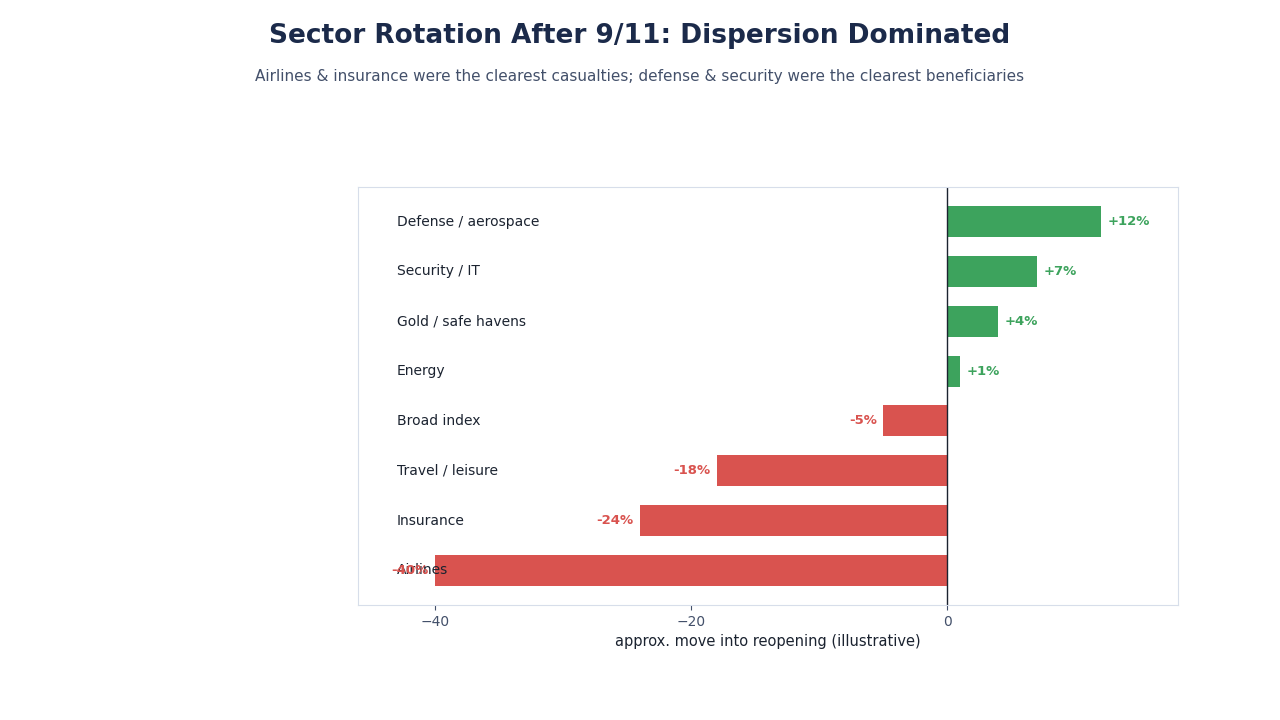
Sector rotation after 9/11: airlines down, defense up, insurance repriced
The reopening of markets after 9/11 did not produce a uniform selloff across all industries. Instead, it triggered one of the clearest examples of sector-based repricing in modern U.S. market history. Airlines, travel, hotels, leisure, and some insurers were hit especially hard, while defense-related firms and some security-oriented businesses saw relative support as investors anticipated higher government spending and a lasting increase in national-security demand. Historical summaries of the market reaction consistently describe this pattern.
The reason was straightforward:
- Airlines and travel faced immediate demand destruction and operational disruption.
- Insurers and reinsurers faced large claims and repricing of terrorism exposure.
- Defense and security were expected to benefit from expanded federal spending.
- Energy traded within a broader geopolitical risk frame, though the initial reaction was mixed by growth concerns.
- Financials had to navigate both direct infrastructure disruption and broader economic uncertainty.
The airline industry became a central example of post-9/11 economic stress. GAO materials indicate the industry’s losses from the attacks were severe, prompting rapid federal support legislation. Congress passed the Air Transportation Safety and System Stabilization Act, which provided up to $5 billion in direct compensation and up to $10 billion in loan guarantees to air carriers.
| Sector | Initial Post-9/11 Reaction | Main Driver |
|---|---|---|
| Airlines | Sharp negative | Airspace shutdown, demand collapse, fear of flying |
| Hotels & leisure | Negative | Travel contraction and confidence shock |
| Insurance | Negative / mixed | Claims burden and terrorism-risk repricing |
| Defense | Positive / relatively resilient | Expectation of higher military and security spending |
| Financials | Volatile | Infrastructure disruption plus macro uncertainty |
| Real estate | Mixed, especially NYC exposure | Office-market and location-specific risk reassessment |
The market did not ask whether all companies were “cheap.” It asked which cash flows had just become less reliable and which had become more politically supported.
This type of rotation remains highly relevant for modern geopolitical investing. Analysts using SimianX can apply the same framework to later events: identify direct losers, second-order losers, likely policy beneficiaries, and areas where investor assumptions about risk premia must be reset.
The airline industry as the clearest early casualty
No industry better captures the immediate economic impact of 9/11 than commercial aviation. Air travel was suspended, passengers became fearful, security procedures changed, and carriers faced both revenue loss and structural cost increases. GAO analysis from the period stated that airline losses from the attacks would total at least $5 billion through December 2001, and later GAO testimony noted that from 2001 through 2003 the industry reported about $23 billion in losses, with major bankruptcies following in the broader post-attack period.
This damage reflected multiple layers of stress:
- Operational losses from grounded flights
- Demand losses from fewer passengers
- Higher security costs
- Weaker corporate travel
- Credit pressure and reduced financial flexibility
The airline support package was therefore not just a bailout in the political sense; it was a recognition that aviation was a systemically important node in the broader U.S. economy. Air travel supports tourism, business travel, supply chains, and employment far beyond the carriers themselves. This is one reason 9/11 quickly moved from being a market event to a policy event.
The investment lesson from airlines
The airline case teaches an enduring lesson: sectors that appear cyclical can become quasi-infrastructure sectors during crises. Investors often value airlines based on demand trends, fuel costs, competition, and balance sheets. After 9/11, those variables were suddenly overwhelmed by national-security risk and policy intervention. That shift matters because it changed the relevant analytical toolkit. Standard earnings models were not enough; analysts had to understand legislation, emergency funding, liability, and behavioral changes in passenger demand.
This is precisely the type of analytical transition that modern multi-signal tools should support. A platform like SimianX AI is useful when it helps investors move from a narrow ticker-level view to a wider regime view: “Is this company facing a normal downturn, or is it caught inside a shock that changes rules, behavior, and public spending?”
Insurance, terrorism risk, and the birth of a new policy regime
Another major post-9/11 market lesson came from the insurance industry. The attacks generated extremely large insured losses and forced a reassessment of how terrorism risk should be priced and shared. Historical summaries often place insured losses at roughly $40 billion, making 9/11 one of the largest insured events in history. The longer-term policy consequence was the Terrorism Risk Insurance Act (TRIA), which created a federal backstop system for certain insured losses resulting from certified acts of terrorism. Treasury describes TRIA as a temporary program designed to provide a transparent system of shared public-private compensation, and GAO later found that TRIA enhanced the availability of terrorism insurance for commercial policyholders.
Why did this matter so much? Because some risks are difficult for private markets to absorb alone when they are:
- low-frequency,
- high-severity,
- difficult to diversify,
- and deeply linked to public security failures or geopolitical conflict.
After 9/11, insurers and reinsurers could not simply continue using prior assumptions. Commercial real estate, infrastructure, and large urban assets suddenly looked different. Without a viable insurance framework, financing and construction activity could also have been impaired.
| Insurance Issue | Post-9/11 Consequence |
|---|---|
| Terrorism losses | Major claims event and repricing |
| Reinsurance uncertainty | Reduced private capacity in some areas |
| Commercial property underwriting | Higher caution around terrorism exposure |
| Federal policy response | TRIA created a public-private backstop |
What investors can learn from the terrorism insurance episode
The terrorism insurance episode illustrates a broader principle: when a shock exposes a risk that private markets cannot easily carry alone, regulation and public balance sheets often step in. That does not eliminate the risk, but it changes who bears it and how it is priced. For equity investors, this means that the aftermath of crisis is often shaped not just by earnings recovery, but by institutional redesign.
That is a key reason the early War on Terror had such long-lasting economic effects. It did not merely reduce demand for certain services in late 2001. It changed insurance, security spending, building practices, transport screening, and the public-private boundary around extreme risk.
New York City: labor-market and local economic damage
While national markets are often discussed first, the local economic impact on New York City was especially severe. Bureau of Labor Statistics research found that the attacks caused significant job and wage losses beyond the weakness already associated with the 2001 recession. One BLS summary states that New York City experienced an additional loss of roughly 143,000 jobs per month over a three-month period beyond prior trend, with the impact concentrated in export-oriented sectors such as finance, professional services, information, arts and entertainment, management, and manufacturing.
This matters because Lower Manhattan was not just symbolic real estate. It was a dense economic cluster connecting:
- finance,
- business services,
- transportation,
- communications,
- legal work,
- media,
- and small business activity.
When such a cluster is damaged, the effect extends beyond headline employment counts. There are spillovers into wages, commuting patterns, office demand, municipal finance, and longer-term geography of firms.
The BLS and New York Fed research also point to deeper costs, including lifetime earnings losses associated with the workers killed in the attacks and the more localized disruption to Lower Manhattan’s business base. The New York Fed estimated aggregate lifetime earnings losses for deceased workers at roughly $7.8 billion.
Why location risk suddenly mattered more
Before 9/11, many investors and executives thought about office concentration in terms of prestige, efficiency, and access to clients. After 9/11, location risk took on a different meaning. Concentration near major symbolic or financial targets could no longer be treated as a neutral operational choice. Business continuity, backup sites, remote systems, and geographic redundancy became more important.
This was one of the subtle but lasting economic aftereffects of the attacks. A single catastrophic event changed how firms thought about concentration risk. That logic would later influence disaster recovery planning, remote-work infrastructure, and operational resilience standards across finance and other sectors.
Was 9/11 the cause of recession, or an amplifier of existing weakness?
A central research question is whether 9/11 caused the 2001 downturn or intensified a slowdown already underway. The most careful answer is that it was an amplifier. The U.S. economy was already weakening in 2001, with the technology bubble unwinding and business investment softening. Retrospective assessments from CRS and later macroeconomic research suggest that the attacks reduced growth further and worsened an already fragile labor environment rather than creating all weakness from scratch. DHS-linked macroeconomic analysis has estimated that 9/11 reduced real GDP growth in 2001 by about 0.5 percentage points and increased unemployment modestly relative to what would otherwise have happened.
This distinction is analytically important. Markets often over-attribute downturns to a single dramatic event because that event is vivid and memorable. But the correct framework usually asks:
- What was the economy doing already?
- What part of the slowdown was cyclical?
- What part was shock-specific?
- What part reflected policy response and second-order effects?
That framework prevents simplistic conclusions. The attacks clearly caused immediate disruption and additional contraction. But they landed in an economy already under pressure, which made the total damage worse.
The most dangerous shocks do not always create weakness from nothing; often they strike when a cycle is already vulnerable.
For market participants, this is a useful reminder not to analyze geopolitical crises in isolation. A shock hitting an overheated economy, a fragile credit cycle, or a weak earnings environment will propagate differently than the same shock hitting a robust expansion.
The early War on Terror and the long arc of fiscal consequences
The immediate market shock of 9/11 was measured in days and weeks. The economic aftermath of the Early War on Terror unfolded over years and decades. The U.S. response included military operations in Afghanistan and elsewhere, higher homeland-security spending, increased intelligence and security budgets, veterans’ care obligations, and interest costs associated with debt-financed war expenditures.
Brown University’s Costs of War project estimates that the total budgetary costs and future obligations of the post-9/11 wars reached roughly $8 trillion in current dollars when future veterans’ care obligations are included. Brown also notes that more than $1 trillion had already been spent on interest payments tied to debt-financed war spending, and that homeland-security and Pentagon base-budget spending increased materially over what it otherwise might have been.
These figures matter because the economic aftermath of war is not captured only by the first-year market shock. It extends through:
- federal budget allocation,
- interest costs,
- crowding out of other public spending,
- health and disability obligations for veterans,
- persistent security expenditures,
- and the political economy of defense and surveillance.
The investment relevance of long-war economics
Why should investors care about the long-run budget effects of the Early War on Terror?
Because prolonged security and military commitments can influence:
- bond issuance and fiscal expectations,
- interest-rate dynamics over time,
- defense-sector demand,
- public infrastructure trade-offs,
- energy and geopolitical risk premia,
- and the broader policy mix shaping economic growth.
This does not mean that every dollar of war-related spending has a simple one-direction market effect. It means that war can become a macro regime, not just a headline. Once that happens, analysts need to shift from event-based thinking to budget-cycle thinking.
That is another reason SimianX AI is relevant in modern markets. The challenge is no longer just detecting a breaking-news shock. It is connecting that shock to second-order fiscal, sector, and policy consequences over multiple time horizons.
Market psychology: fear, patriotism, and the limits of narrative
Another underappreciated aspect of the post-9/11 period is investor psychology. In the days after the attacks, many public voices hoped for “resilience buying” or a patriotic defense of markets. But confidence cannot simply be declared into existence. Investors may feel solidarity while still reducing risk. Historical reporting from the reopening session shows that policy support and symbolic reopening did not prevent a broad selloff.
This is a useful lesson because markets process crises through multiple psychological layers:
- Shock: immediate emotional response
- Risk reduction: portfolio deleveraging and hedging
- Narrative formation: attempts to explain the event
- Policy interpretation: judgment about government response
- Normalization: gradual shift back toward earnings and valuation
The reopening after 9/11 showed that these layers do not arrive in a neat order. Markets can honor resilience symbolically while still repricing lower in practice.
The danger of overreading first-week moves
One of the most common analytical errors after a geopolitical event is to treat first-week price action as a complete verdict. After 9/11, some sectors recovered more quickly than others; some long-term themes strengthened; some local economies took years to adapt; and the fiscal consequences stretched across decades. The initial selloff mattered, but it was only one phase of the story.
For researchers, this suggests a layered methodology:
- Day 0 to Day 5: shock, closure, reopening, and liquidity
- Week 1 to Month 3: sector rotation, policy support, confidence effects
- Month 3 to Year 2: labor, real estate, regulation, and investment changes
- Years 2+: war spending, insurance regime changes, and geopolitical repricing
This kind of time-horizon segmentation is essential for serious market research.
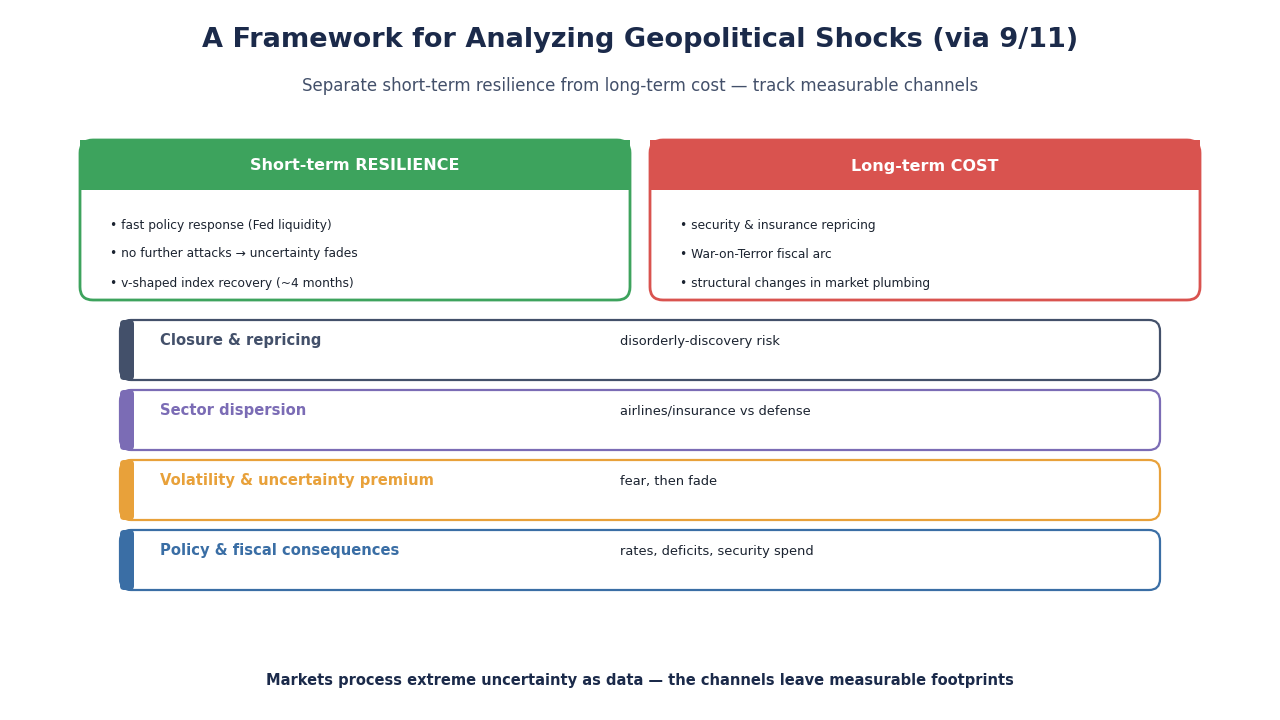
A framework for analyzing geopolitical shocks through the 9/11 lens
The episode provides a durable framework for analyzing later crises. Below is a practical model investors can use.
Step 1: Separate infrastructure risk from valuation risk
Ask whether the shock affects only sentiment and earnings, or whether it also disrupts trading, payments, transport, communications, or staffing. After 9/11, the answer was clearly both.
Step 2: Identify directly exposed sectors
Map industries into:
- direct operational losers,
- demand losers,
- policy beneficiaries,
- and second-order beneficiaries or casualties.
Step 3: Track central-bank and fiscal backstops
Liquidity tools, emergency legislation, insurance programs, and sector-specific support can alter outcomes substantially. After 9/11, the Fed and Congress both moved quickly.
Step 4: Distinguish local damage from national trend
New York City bore localized labor and business damage that was more acute than the nationwide averages.
Step 5: Extend the horizon beyond the initial shock
The Early War on Terror turned a short-term crisis into a long-term fiscal and policy regime.
| Analytical Layer | Key Question | 9/11 Example |
|---|---|---|
| Infrastructure | Is the market system functioning? | Exchange closures, payment disruptions |
| Liquidity | Can institutions fund and settle? | Fed liquidity and discount-window support |
| Sector impact | Which cash flows are hit first? | Airlines, insurers, travel |
| Policy | What support or redesign follows? | Airline aid, TRIA, rate cuts |
| Long-term regime | What persists for years? | War spending, security state, insurance changes |
How can investors use the 9/11 and Early War on Terror framework today?
They can use it to analyze any major geopolitical or terror-related shock without relying on headlines alone. The correct process is to move from system function to sector exposure to policy response to long-run regime change. That keeps analysis grounded when emotions run high.
A modern workflow might involve combining real-time news clustering, sector screens, volatility regimes, and macro alerts inside a platform such as SimianX AI, where the goal is not merely to summarize events but to translate them into structured market implications.
What 9/11 changed in financial-market structure and business continuity
Although the attacks occurred in 2001, their legacy can be seen in how markets and firms think about resilience today. The period accelerated attention to:
- electronic trading and remote capability,
- business continuity planning,
- geographic redundancy,
- data backup and communications resilience,
- and institution-level disaster recovery procedures.
The attacks highlighted the vulnerability of physical concentration in financial centers and reinforced the need for backup facilities and operational redundancy. New York Fed research on payment disruptions underscores just how vulnerable core market plumbing can become when geographic and infrastructural concentration meets a catastrophic event.
This is why 9/11 should not be remembered only as a moment of temporary market decline. It was also a catalyst for a more resilient market architecture. Ironically, one of the legacies of the shock was to push financial systems toward more distributed, technology-enabled forms of continuity.
The difference between short-term resilience and long-term cost
One of the most important conclusions from the research is that the U.S. economy and financial markets were resilient in the narrow sense that trading resumed, institutions adapted, and the system avoided collapse. But resilience in that sense should not be confused with low cost. The economic and fiscal costs remained very large.
This dual truth is essential:
- Short-term financial resilience: markets reopened, liquidity was maintained, and the system stabilized.
- Long-term economic burden: local labor losses, insurance redesign, airline distress, and vast post-9/11 war spending persisted for years.
Too often, historical narratives choose one of these truths and ignore the other. A better analysis recognizes both.
A market can be resilient in mechanics while the economy absorbs lasting structural cost.
This is the right way to understand 9/11 and the Early War on Terror. The U.S. financial system survived the shock. But the national balance sheet, policy structure, and risk environment changed in ways that lasted much longer than the initial selloff.
Practical takeaways for investors and researchers
Below is a practical checklist derived from the episode.
- Do not confuse market reopening with full normalization.
- Watch liquidity systems, not just price charts.
- Map sector exposure at multiple levels: direct, second-order, policy-linked.
- Expect insurance and regulation to change after extreme events.
- Analyze local economic damage separately from national aggregates.
- Treat prolonged military response as a fiscal regime, not a one-week story.
- Use multi-signal tools to connect narrative, macro, and sector data.
And here is a step-by-step workflow researchers can apply:
- Define the shock: terror event, war escalation, infrastructure attack, or sanction regime.
- Identify the affected market mechanisms: exchanges, payments, transport, supply chains.
- Rank sectors by direct operational exposure.
- Monitor central-bank and fiscal response.
- Estimate whether the event is transient or regime-forming.
- Reassess asset allocation once policy structure becomes clearer.
This framework is especially useful for readers of SimianX AI, because serious market research increasingly requires the synthesis of many small signals rather than dependence on one macro headline.
FAQ About 9/11 and the Early War on Terror
How did 9/11 affect the stock market?
9/11 led to the closure of U.S. equity markets until September 17, 2001, disrupting normal price discovery and concentrating uncertainty into the reopening session. When markets resumed, major indexes fell sharply and investors rotated away from airlines, travel, and some insurers while favoring defense-related names.
What happened to airlines after 9/11?
Airlines suffered one of the clearest immediate economic blows because flights were grounded, demand dropped, and security costs rose. Congress responded with the Air Transportation Safety and System Stabilization Act, providing up to $5 billion in direct compensation and $10 billion in loan guarantees to support the industry.
Did 9/11 cause a recession?
The best evidence suggests that 9/11 intensified weakness in an economy that was already slowing in 2001 rather than single-handedly causing all of it. Retrospective assessments indicate the attacks reduced growth further and added labor-market stress on top of an existing downturn.
Why was the Federal Reserve response so important after 9/11?
The Fed’s response mattered because the crisis affected not only prices but also payments, funding, and settlement systems. By supplying unusually large liquidity and cutting rates on September 17, 2001, the Fed helped limit the risk that operational disruption would become a broader financial crisis.
What is the long-term economic aftermath of the Early War on Terror?
The long-term aftermath includes higher defense and homeland-security spending, veterans’ care obligations, interest costs on debt-financed war expenditures, and broader policy changes around terrorism insurance and security. Brown University’s Costs of War project estimates total budgetary costs and future obligations of the post-9/11 wars at roughly $8 trillion in current dollars when future veterans’ care is included.
Conclusion
The history of 9/11 and the Early War on Terror is a powerful reminder that major geopolitical shocks move through markets in layers. The first layer is fear and repricing. The second is liquidity and system function. The third is sector rotation. The fourth is policy redesign. The fifth—and often the most expensive—is the long economic aftermath through budgets, regulation, and shifting risk premia. The attacks closed markets until September 17, 2001, prompted extraordinary Federal Reserve support, hit airlines and New York City especially hard, transformed terrorism insurance, and helped launch a multi-decade fiscal and geopolitical cycle whose costs extended far beyond the initial selloff.
For investors, the lesson is clear: market shock is never only about price. It is about infrastructure, policy, liquidity, and time horizon. For researchers and active market participants, that makes a disciplined framework essential. To analyze modern geopolitical risk with greater structure—from macro narratives to sector exposure and multi-timeframe signal interpretation—explore SimianX AI, a platform built to turn complex market uncertainty into clearer, more actionable insight.
Related Reading
- Iran-US War Impact on Stocks: AI Risk Signals Live
- Russia-Ukraine War Stock Impact: Sectors, VIX, Risk Plan
- 7 AI Risk Radars for Equities: Breadth, Revisions, Skew
- Dow Jones Risk Pulse: AI Signals Breadth, VIX, Spreads
- Wall Street Drawdown Watch: 10% Warnings, 40% Tail Risk