
 By Muke
Cognitive Market Predictions of Autonomous Encrypted Intelligent Systems
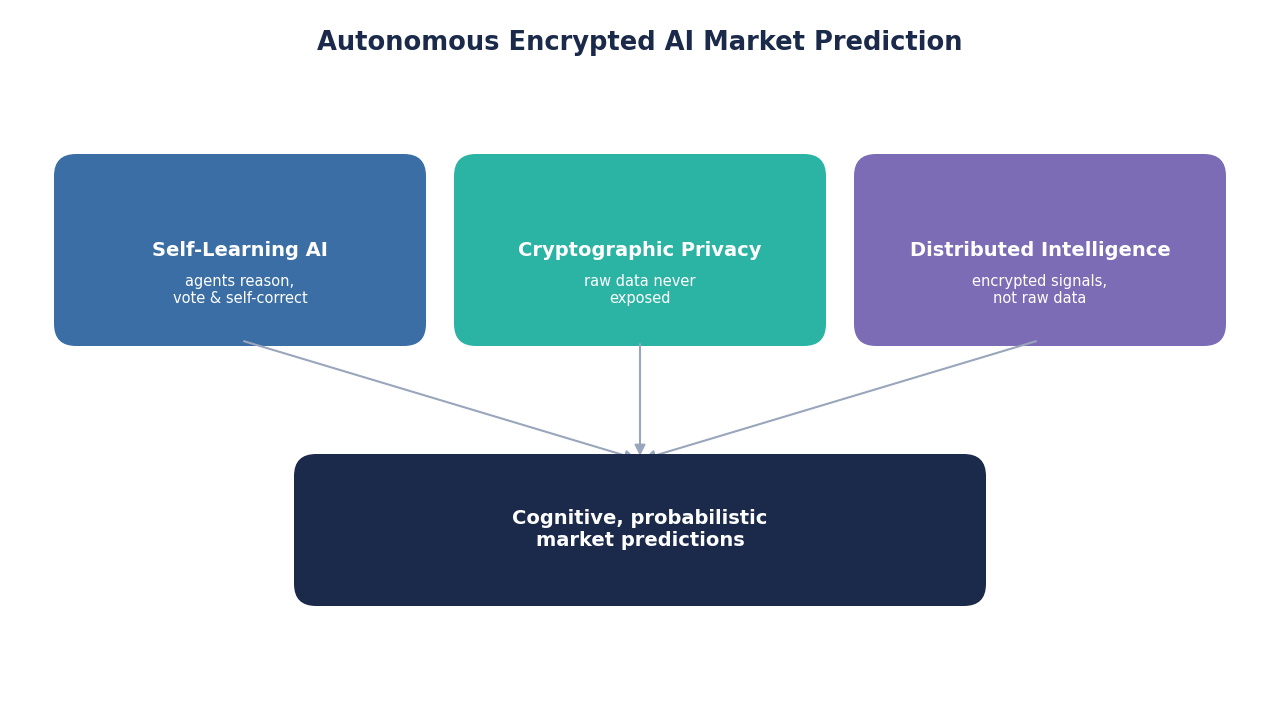
Cognitive market predictions of autonomous encrypted intelligent systems represent a new frontier in financial forecasting, combining self-learning AI, cryptographic privacy, and distributed intelligence. As markets become increasingly complex and adversarial, traditional predictive models struggle to adapt in real time. This research explores how autonomous, encrypted intelligent systems generate cognitive-level market predictions and why platforms like SimianX AI are pioneering this shift toward secure, adaptive forecasting infrastructures.
From Statistical Forecasting to Cognitive Market Intelligence
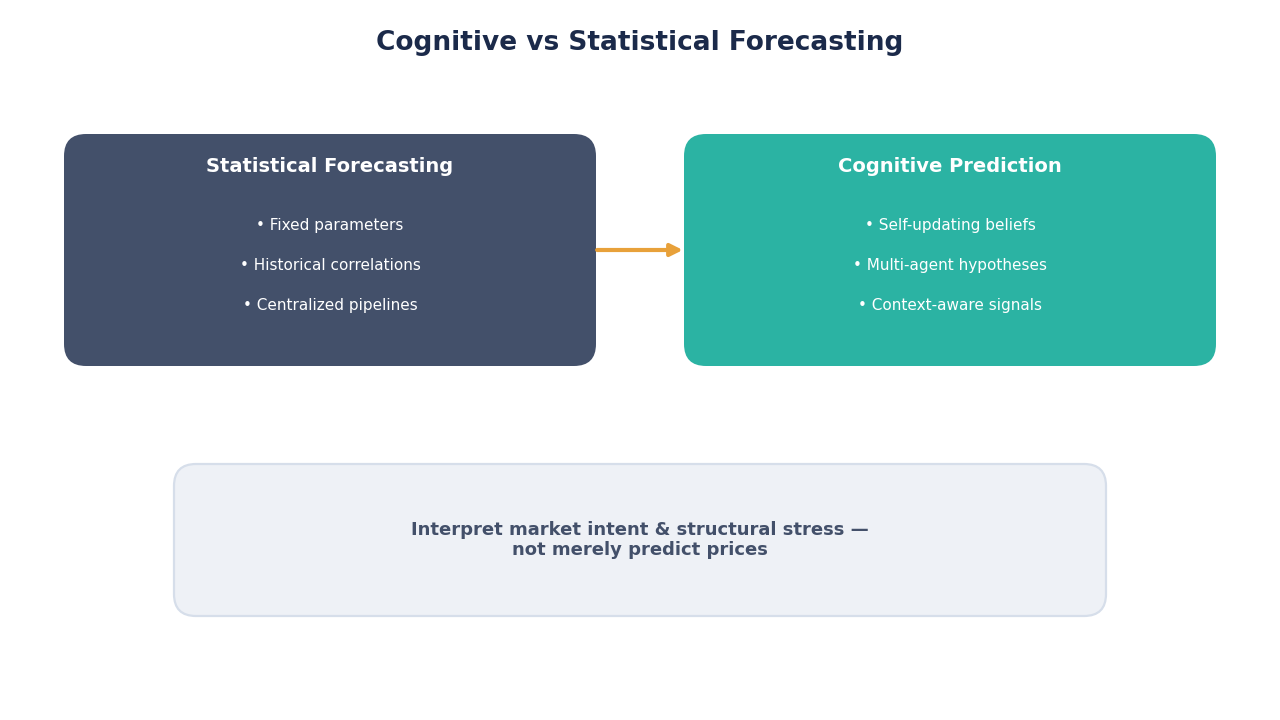
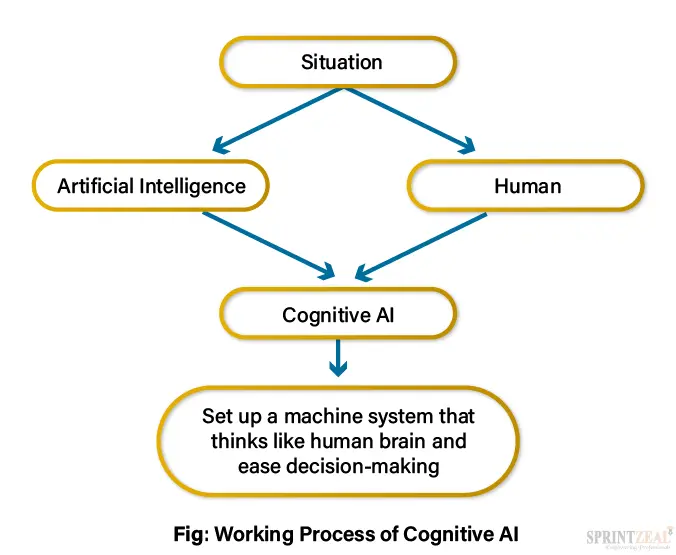
Traditional market prediction relies heavily on statistical inference, historical correlations, and centralized data pipelines. Cognitive market prediction systems differ fundamentally by reasoning about markets as adaptive, partially observable systems.
Key distinctions include:
- Continuous self-updating belief states rather than fixed parameters
- Multi-agent hypothesis generation and testing
- Context-aware interpretation of on-chain and off-chain signals
Cognitive systems do not merely predict prices—they interpret market intent and structural stress.
Cognitive market intelligence allows encrypted AI agents to model liquidity flows, sentiment shifts, and emergent coordination effects that classical time-series models fail to capture.
Architecture of Autonomous Encrypted Intelligent Systems
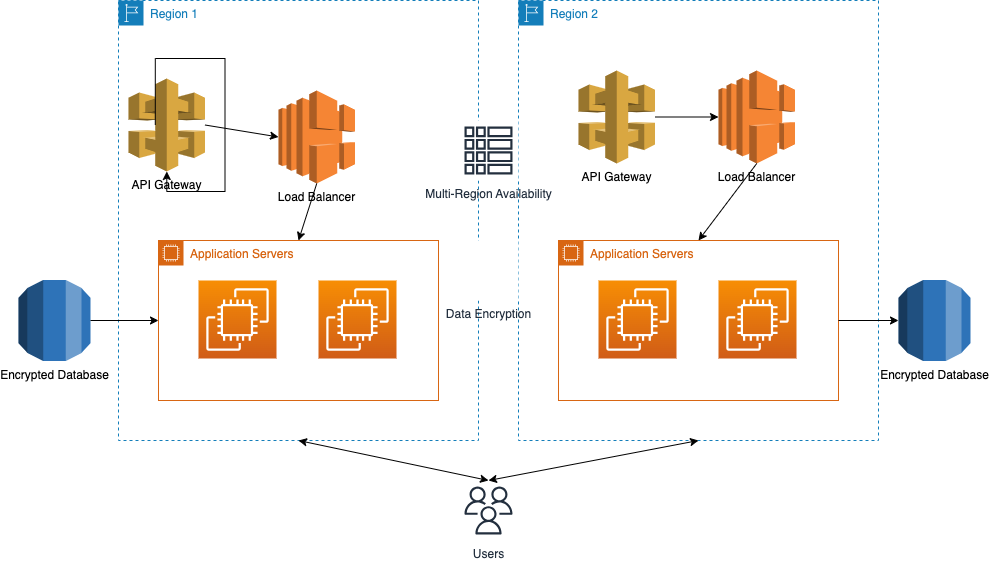
At the core of these systems lies a layered architecture designed for privacy, autonomy, and resilience.
Core Layers
- Encrypted Data Ingestion
Market data is processed through homomorphic encryption or secure enclaves, ensuring raw data is never exposed.
- Autonomous Cognitive Agents
Each agent maintains internal world models and decision policies, updating them through reinforcement and Bayesian inference.
- Collective Intelligence Layer
Agents exchange encrypted signals, not raw data, enabling coordination without information leakage.
- Prediction Synthesis Engine
Outputs probabilistic market scenarios rather than single-point forecasts.
| Layer | Function | Market Benefit |
|---|---|---|
| Encryption | Data privacy | Reduced data leakage risk |
| Autonomy | Self-directed learning | Faster regime adaptation |
| Collective cognition | Multi-agent reasoning | Lower model bias |
| Scenario synthesis | Probabilistic outputs | Better risk management |
Why Encryption Is Foundational to Cognitive Market Prediction
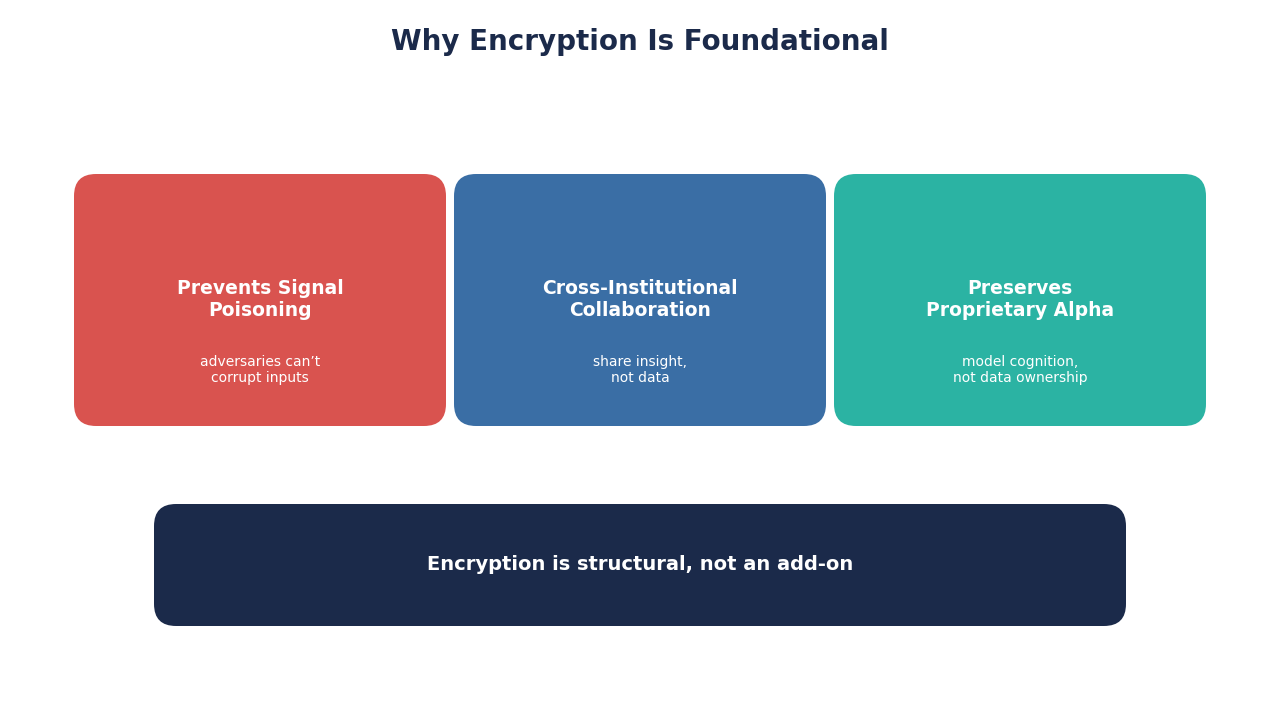
Markets are adversarial environments. Any exposed signal can be exploited. Encryption is not an add-on—it is structural.
Key advantages of encrypted cognition:
- Prevents signal poisoning by adversaries
- Enables cross-institutional collaboration without data sharing
- Preserves proprietary alpha generation
Encrypted intelligence shifts prediction from data ownership to model cognition.
This design philosophy underpins SimianX AI’s approach to privacy-first market intelligence.
How Do Autonomous Encrypted Systems Learn Market Regimes?
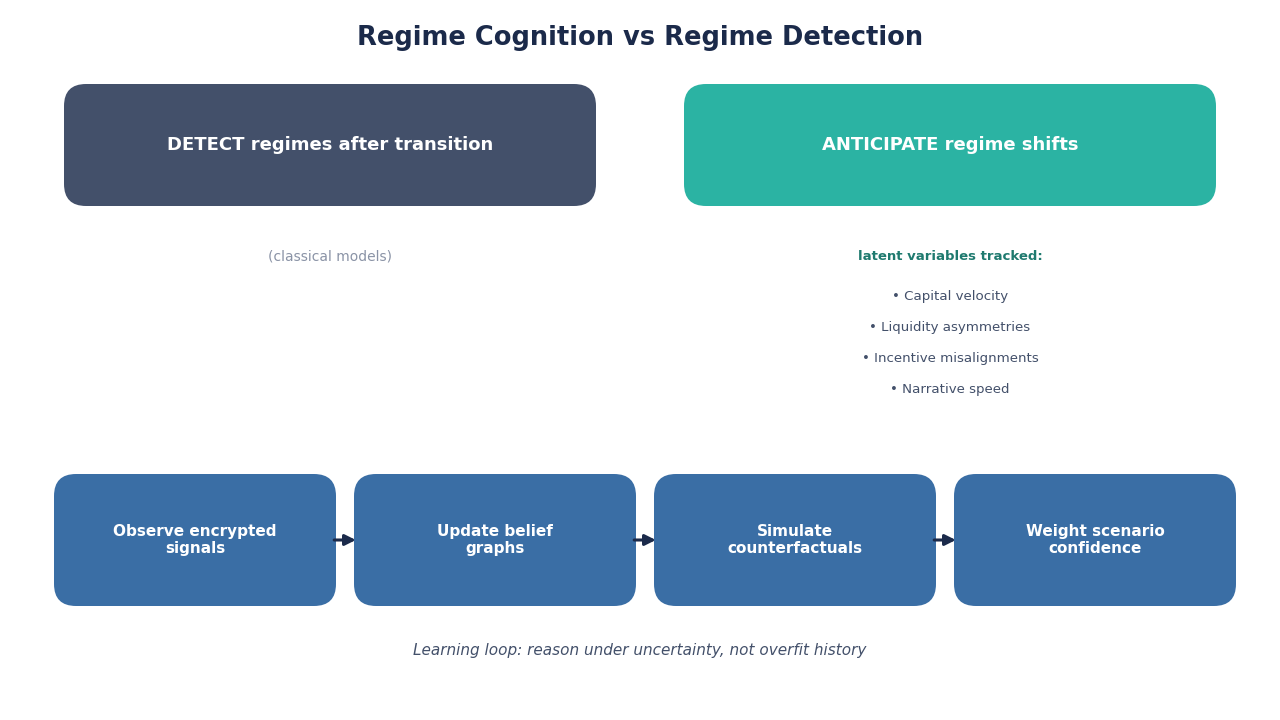
Regime Cognition vs Regime Detection
Classic models detect regimes after transitions occur. Cognitive systems anticipate regime shifts by tracking latent variables such as:
- Capital velocity changes
- Liquidity asymmetries
- Incentive misalignments
- Narrative propagation speed
Learning Loop
- Observe encrypted signals
- Update internal belief graphs
- Simulate counterfactual futures
- Allocate confidence weights to scenarios
This loop allows autonomous systems to reason under uncertainty rather than overfitting historical patterns.
Cognitive Market Predictions in Decentralized Finance (DeFi)
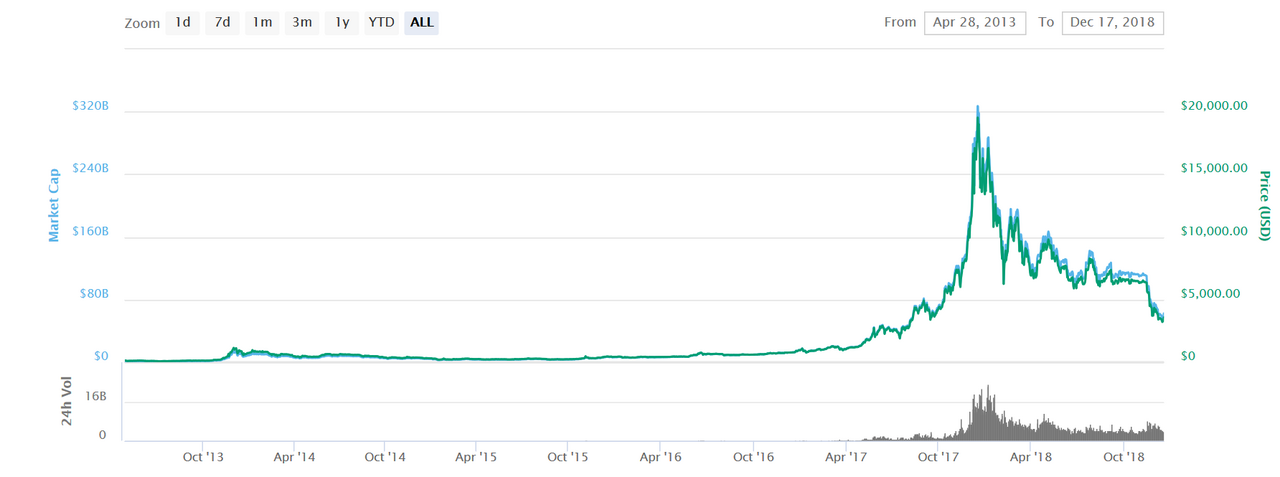
DeFi markets amplify the need for encrypted cognition due to transparency, composability, and reflexivity.
Applications include:
- Early liquidity drain detection
- Governance attack probability modeling
- Yield sustainability forecasting
- Cross-protocol contagion risk estimation
SimianX AI integrates these cognitive prediction layers to provide actionable, encrypted insights across DeFi ecosystems without compromising user or protocol privacy.
Comparison: Classical AI vs Cognitive Encrypted Systems
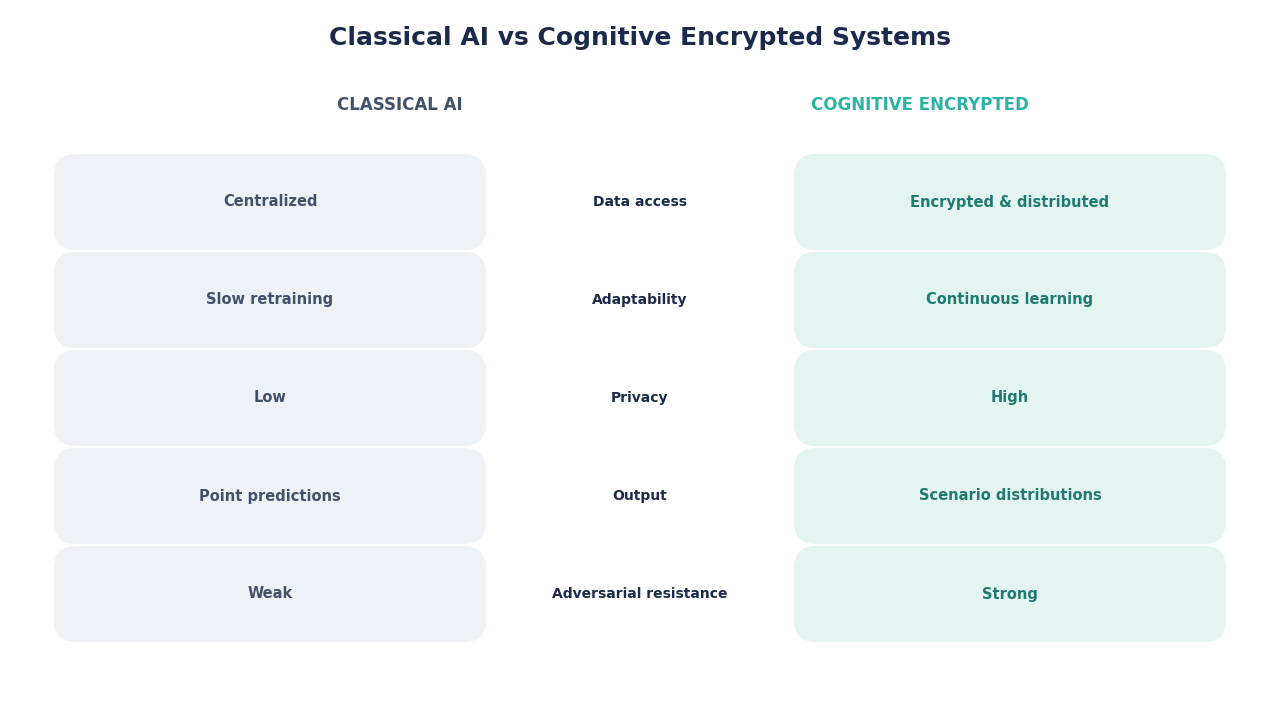
| Dimension | Classical AI Models | Cognitive Encrypted Systems |
|---|---|---|
| Data access | Centralized | Encrypted & distributed |
| Adaptability | Slow retraining | Continuous learning |
| Privacy | Low | High |
| Output | Point predictions | Scenario distributions |
| Adversarial resistance | Weak | Strong |
This shift represents a paradigm change rather than an incremental improvement.
What Makes Cognitive Market Prediction More Reliable?
What is cognitive market prediction in encrypted AI systems?
Cognitive market prediction refers to AI systems that reason, adapt, and anticipate market behavior using encrypted data flows. Unlike traditional models, they generate probabilistic scenarios based on internal world models rather than static correlations. Encryption ensures these insights remain secure and manipulation-resistant.
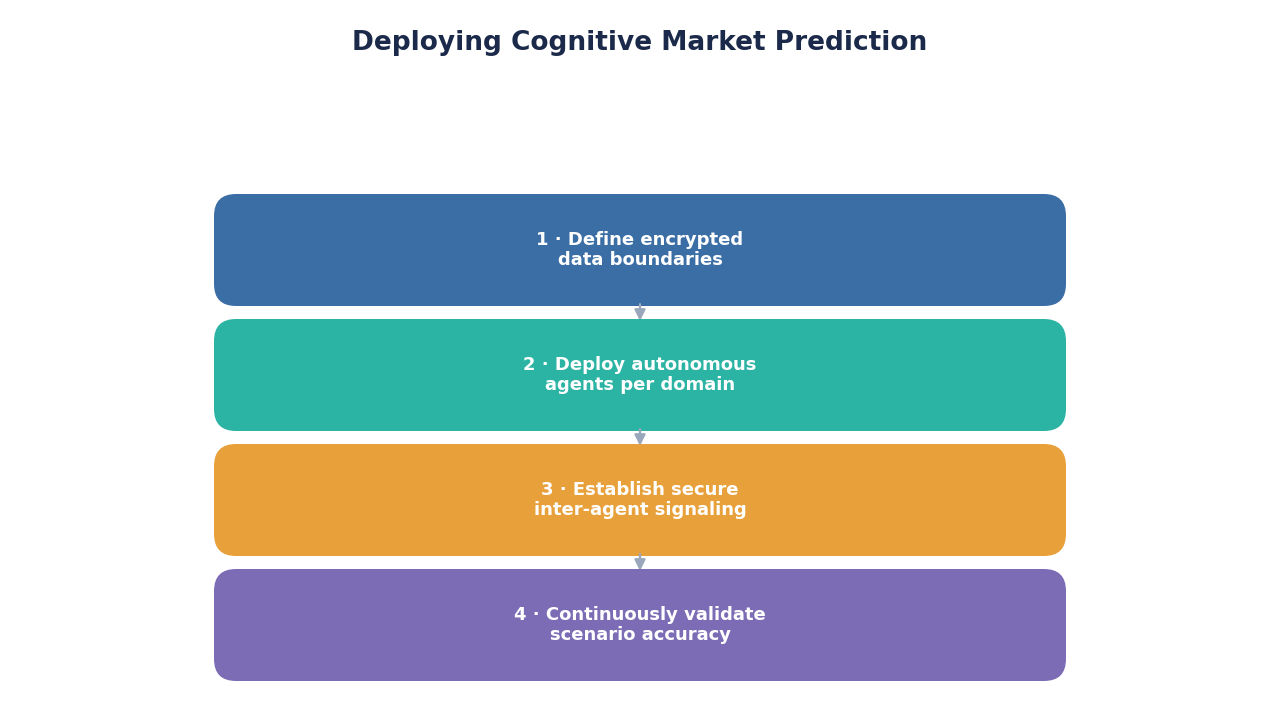
Practical Framework for Deploying Cognitive Market Prediction
A simplified deployment framework:
- Define encrypted data boundaries
- Deploy autonomous agents per market domain
- Establish secure inter-agent signaling
- Continuously validate scenario accuracy
This framework is increasingly adopted by advanced AI research teams and platforms like SimianX AI.
FAQ About Cognitive Market Predictions of Autonomous Encrypted Intelligent Systems
How do autonomous encrypted AI systems predict markets without raw data?
They operate on encrypted representations and derived signals, allowing learning and inference without exposing underlying data.
Are cognitive market predictions better than LLM-based forecasts?
They serve different roles. Cognitive systems excel at adaptive, real-time market reasoning, while LLMs are stronger in narrative and semantic analysis.
Can encrypted AI systems be audited?
Yes. While raw data remains private, model behavior, scenario outputs, and performance metrics can be externally audited.
Is this approach suitable for high-frequency trading?
It is more effective for risk-aware, regime-level decisions than ultra-low-latency execution strategies.
Conclusion
Cognitive market predictions of autonomous encrypted intelligent systems redefine how forecasting is performed in complex, adversarial markets. By uniting encryption, autonomy, and collective cognition, these systems move beyond fragile correlations toward resilient market intelligence. As this paradigm matures, platforms like SimianX AI are positioned at the forefront—enabling secure, adaptive, and actionable market predictions for the next generation of financial systems.
- Formalizing Cognitive Market Prediction Under Encryption Constraints
Once cognitive market prediction systems transition from conceptual architectures to deployed infrastructures, formalization becomes unavoidable. Without mathematical grounding, autonomy degrades into heuristic drift.
7.1 Cognitive State Spaces in Encrypted Environments
Unlike classical models that operate in observable state spaces, autonomous encrypted intelligent systems reason within latent cognitive state manifolds.
These states include:
Belief distributions over hidden liquidity conditions
Encrypted representations of incentive gradients
Temporal confidence decay functions
Internal uncertainty propagation tensors
Formally, we define a cognitive market state as:
Cₜ = {Bₜ, Iₜ, Uₜ, Θₜ}
Where:
Bₜ = belief graph over market hypotheses
Iₜ = incentive topology (agents, capital, constraints)
Uₜ = uncertainty surface under encryption
Θₜ = adaptive policy parameters
Because raw observations are inaccessible, state transitions are computed through cryptographically protected belief updates, not direct measurement.
This shifts prediction from signal fitting to belief evolution.
- Encrypted Learning Dynamics and Cognitive Drift Control
8.1 The Drift Problem in Autonomous Market Intelligence
Autonomous systems that continuously learn face cognitive drift, where internal models diverge from reality due to:
Regime misclassification
Adversarial signal injection
Over-weighting recent encrypted signals
Feedback loop amplification
In encrypted environments, drift is harder to detect because ground truth is partially hidden.
8.2 Drift Stabilization via Multi-Agent Cognitive Anchors
To counter drift, modern systems deploy cognitive anchors:
Independent encrypted agents trained on orthogonal priors
Periodic belief cross-validation under secure aggregation
Confidence-weighted disagreement scoring
Stability emerges not from correctness, but from structured disagreement.
This principle mirrors biological cognition: perception is stabilized through competing interpretations, not singular certainty.
- Market Prediction as an Adversarial Cognitive Game
9.1 Markets Are Not Stochastic — They Are Strategic
A fundamental error of classical forecasting is treating markets as stochastic processes. In reality, markets are strategic cognitive environments populated by adaptive adversaries.
Autonomous encrypted intelligent systems therefore model markets as repeated incomplete-information games, not time series.
Key elements include:
Hidden opponent strategies
Delayed information revelation
Intentional deception
Reflexive feedback
9.2 Game-Theoretic Cognitive Prediction
Cognitive prediction systems simulate opponent belief trees, estimating:
What others believe the market is
What others believe others believe
How capital will reposition based on second-order beliefs
Encryption ensures these simulations cannot be reverse-engineered by competitors observing outputs.
- Reflexivity Amplification and Containment
10.1 When Prediction Changes the Market
A critical risk emerges when cognitive systems become large enough to influence the very markets they predict.
This creates reflexivity loops:
System predicts stress
Capital reallocates
Stress materializes
Prediction appears “correct”
Without safeguards, this becomes self-fulfilling market distortion.
10.2 Reflexivity Dampening Mechanisms
Advanced systems implement:
Prediction entropy ceilings
Output smoothing across agents
Delayed confidence disclosure
Scenario-based guidance instead of binary signals
The goal is not prediction dominance, but market interpretability without destabilization.
- Cognitive Security: Defending Against Intelligence-Level Attacks
11.1 Beyond Data Attacks: Cognitive Exploits
Encrypted systems are resistant to data theft—but remain vulnerable to cognitive attacks, including:
Belief poisoning
Incentive misdirection
Time-delay manipulation
Narrative-induced regime hallucination
These attacks target how the system reasons, not what it sees.
11.2 Cognitive Firewalls
Defense mechanisms include:
Belief provenance tracking
Narrative consistency checks
Cross-temporal anomaly detection
Agent-level epistemic diversity
This establishes a new security domain: cognitive cybersecurity.
- Emergent Intelligence at System Scale
12.1 When Prediction Systems Become Cognitive Entities
As agent populations grow, encrypted intelligent systems exhibit emergent properties:
Self-organized specialization
Endogenous signal prioritization
Spontaneous abstraction layers
At sufficient scale, the system no longer behaves as a tool—but as a market-sensing organism.
12.2 Measuring Emergence
Emergence is evaluated through:
Reduction in prediction variance without loss of entropy
Increased regime anticipation lead time
Cross-market generalization without retraining
These metrics indicate true cognitive integration, not ensemble averaging.
- Ethical and Governance Implications
13.1 Who Controls Cognitive Market Intelligence?
Encrypted autonomous prediction systems challenge governance norms:
They cannot be fully inspected
They operate continuously
They adapt beyond designer intent
This raises questions of:
Accountability
Alignment
Market fairness
13.2 Toward Transparent Opacity
A paradox emerges: systems must remain opaque to protect integrity, yet transparent enough to trust.
Solutions include:
Verifiable execution proofs
Public scenario audit trails
Constraint-based alignment rather than rule-based control
- Future Research Directions
14.1 Cognitive Compression
Reducing reasoning complexity while preserving anticipatory power will be a major frontier.
14.2 Cross-Domain Cognitive Transfer
Applying market-trained cognition to:
Supply chains
Energy grids
Geopolitical risk
14.3 Human–AI Cognitive Co-Prediction
Future systems will not replace human judgment—but co-evolve with it, integrating:
Human intuition as priors
AI cognition as constraint solvers
Final Synthesis
Cognitive market predictions of autonomous encrypted intelligent systems represent a structural evolution in forecasting. They do not seek certainty, nor dominance, nor raw speed.
Instead, they embody:
Adaptive reasoning under uncertainty
Strategic awareness in adversarial markets
Privacy-preserving collective intelligence
As these systems mature, platforms like SimianX AI are not merely building tools—they are shaping the cognitive infrastructure of future markets.
The era of prediction as regression is ending.
The era of prediction as encrypted cognition has begun.
Related Reading
- Emerging Encrypted Prediction: Cooperative Multi-Agent AI
- Synthetic Prediction Engines in Decentralized Crypto
- Predicting Crypto Market Trends with Collective AI
- Crypto Market Analysis with Multi-Agent AI: Real-Time
- Market Early-Warning Intelligence from Distributed AI Swarms
- Time-Series Models vs LLMs for Crypto: Why Hybrid Wins
- Crypto Intelligence: Decentralized Cognitive Prediction
- Self-Organizing Encrypted AI Networks: Market Insights
- SimianX Crypto Leaderboard