Why DELL's 17% Breakout Matters: Inside the AI Server Catalyst
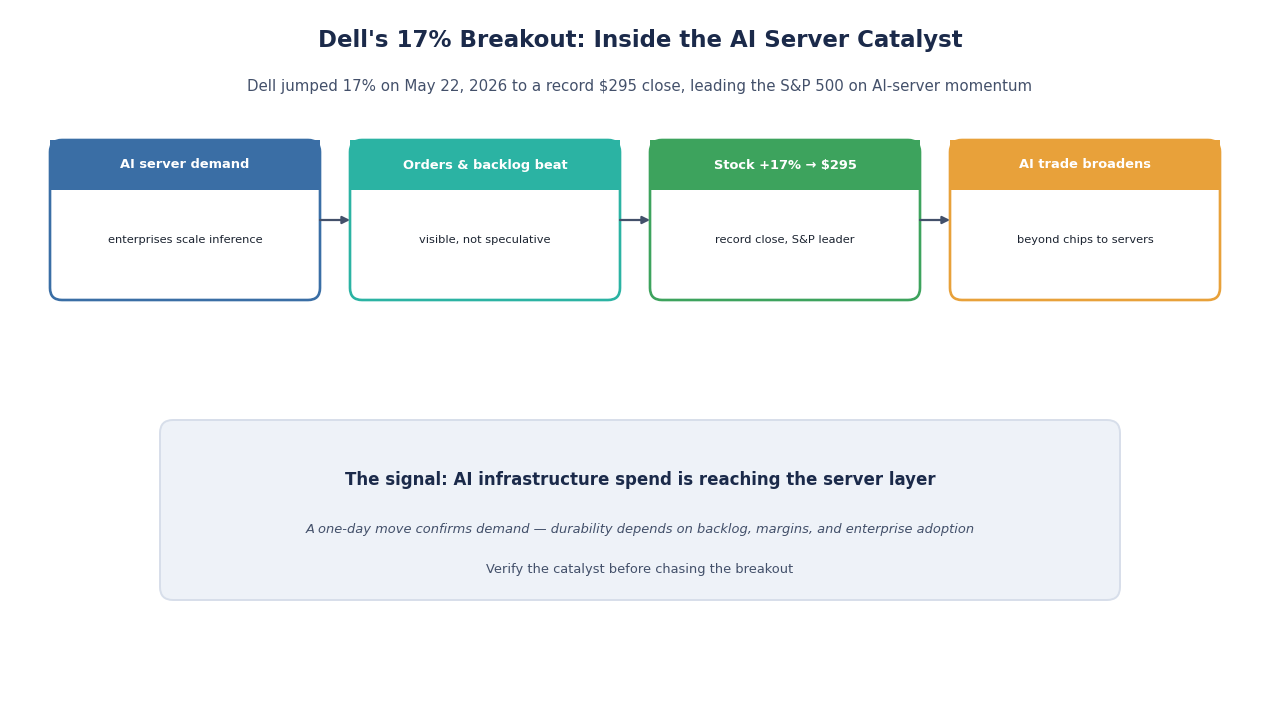
Dell's AI server breakout has become one of the most important themes for investors tracking the next phase of the AI infrastructure cycle. Dell Technologies (DELL) jumped roughly 17% to a record close of about $295 on May 22, 2026, leading the S&P 500, as investors reacted to analyst optimism around AI server demand and the company’s expanding AI infrastructure strategy.
For investors using tools like SimianX AI, the key question is not simply whether Dell had a strong trading day. The deeper question is whether the move reflects a durable shift in enterprise AI infrastructure spending—or a short-term momentum burst ahead of earnings.

Why Dell’s AI Server Chain Breakout Matters
Dell’s rally is tied to a larger market narrative: AI is moving from model experimentation into enterprise deployment. That shift creates demand for servers, storage, networking, cooling, data orchestration, and on-premises infrastructure.
Dell has positioned itself directly in that chain. At Dell Technologies World 2026, the company announced updates to Dell AI Factory with NVIDIA, covering agentic AI, data orchestration, rack-scale infrastructure, and an open ecosystem designed to help enterprises move from AI pilots to production.
The market is no longer rewarding only AI software stories. It is increasingly rewarding companies that can deliver the physical infrastructure required to run AI at scale.
This matters because AI infrastructure demand is not a single-product cycle. It includes:
- GPU-optimized servers
- Liquid-cooled racks
- Enterprise storage
- AI-ready data platforms
- Networking fabrics
- Edge and on-premises inference systems
- Security and governance layers
Dell’s investment thesis depends on whether it can convert this infrastructure demand into revenue growth, margin expansion, and sustainable backlog.
What Caused Dell Stock to Surge 17%?
Dell’s 17% move was driven by several overlapping catalysts. First, analysts raised expectations ahead of Dell’s fiscal Q1 report, with Wells Fargo increasing its price target and suggesting that AI server revenue could support a higher full-year outlook.
Second, Dell’s product announcements strengthened the narrative that the company is becoming a key supplier of enterprise AI infrastructure. Dell highlighted new AI Factory capabilities, deskside agentic AI systems, AI-ready data tools, and next-generation infrastructure for enterprises that want to run workloads on infrastructure they control.
Third, Nvidia’s messaging reinforced the broader demand cycle. Nvidia described Dell AI Factory with NVIDIA as a full-stack platform for autonomous agents, spanning deskside workstations to data center racks. Nvidia also stated that 5,000 enterprises, including Lilly, Samsung, and Honeywell, are running AI workloads on Dell AI Factories with NVIDIA.

What DELL's breakout reveals about AI server demand
This Dell's AI server breakout suggests that the breakout is less about a single trading event and more about a repricing of Dell’s role in the AI hardware stack. Investors appear to be assigning greater value to Dell’s ability to deliver AI servers, storage, and integrated infrastructure for enterprises that need private, governed, high-performance AI environments.
However, a strong price move does not automatically mean the stock is low risk. After a sharp rally, investors should separate narrative strength from valuation discipline.
| Research Area | Why It Matters for DELL |
|---|---|
| AI server demand | Determines whether revenue growth is durable |
| Backlog and orders | Shows whether demand is visible or speculative |
| Gross margin | AI servers can be high revenue but margin-sensitive |
| Supply chain access | GPU, memory, cooling, and networking constraints matter |
| Enterprise adoption | Confirms whether pilots are becoming production workloads |
| Valuation | A great business can still become expensive after a large rally |
Dell’s AI Infrastructure Strategy: More Than Servers
Dell’s AI story is not limited to selling server boxes. The company is trying to package enterprise AI infrastructure as an integrated platform.
Dell’s May 2026 announcement emphasized four major areas: agentic AI at scale, AI-ready data, next-generation infrastructure, and an open ecosystem with partners including Google, Hugging Face, OpenAI, Palantir, Reflection, ServiceNow, and others.
That matters because enterprise AI buyers often do not want to assemble every component themselves. They need infrastructure that can support:
- Secure data access
- Model deployment
- Inference at scale
- Governance and compliance
- Cost control
- Integration with existing workflows
Dell is also leaning into on-premises and hybrid AI. This is important because many enterprises cannot send sensitive data entirely to public cloud systems. Dell’s Deskside Agentic AI offering, for example, is designed to let enterprises build and run autonomous agents locally while keeping data inside their environment.
Key investment implication: Dell’s opportunity expands if enterprises shift more AI workloads from experimentation into controlled, production-grade environments.
The AI Server Supply Chain: Where Dell Fits
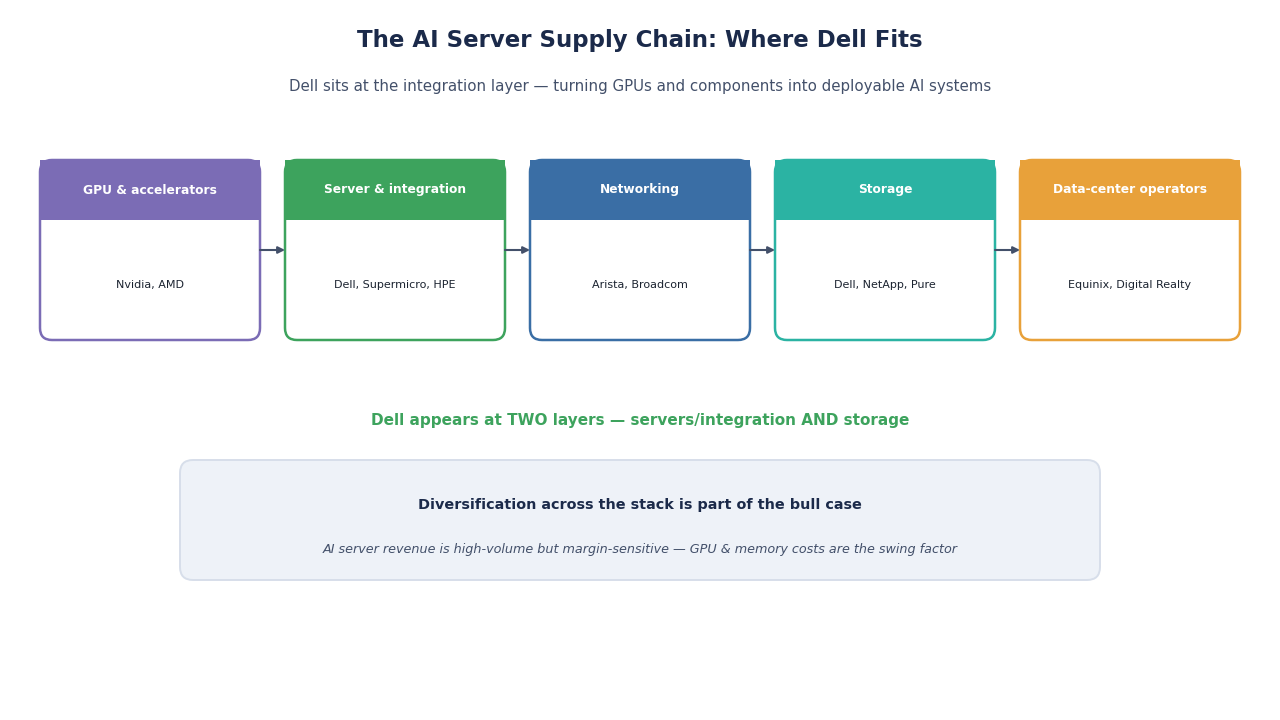
To understand Dell’s stock surge, investors need to understand the AI server supply chain. Dell sits in the infrastructure assembly and integration layer, connecting chips, storage, networking, cooling, and enterprise services into deployable systems.

A simplified AI server chain looks like this:
- Semiconductors: GPUs, CPUs, accelerators, memory
- Server platforms: GPU-optimized systems and rack-scale compute
- Thermal systems: Liquid cooling and power management
- Storage: High-performance storage for AI datasets
- Networking: InfiniBand, Ethernet, and high-throughput switching
- Software stack: Data orchestration, model deployment, monitoring
- Services: Deployment, support, security, and lifecycle management
Dell benefits when enterprises want a trusted vendor that can coordinate multiple layers of this stack. But Dell also faces execution pressure because AI infrastructure can be complex, capital-intensive, and exposed to component cost volatility.
Bull Case for DELL
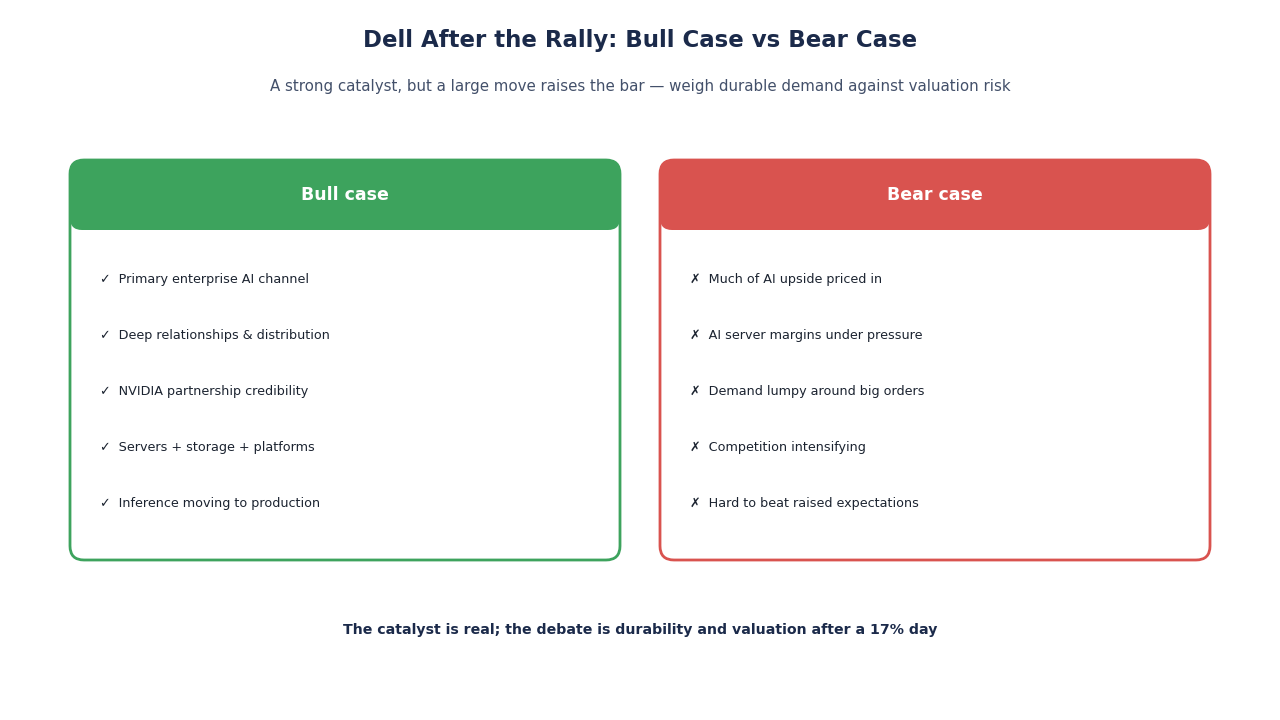
The bull case is that Dell becomes one of the primary enterprise channels for AI infrastructure. If AI workloads continue moving into production, Dell could see sustained demand for servers, storage, and integrated AI platforms.
The strongest bull-case arguments are:
- AI server demand may remain elevated as enterprises scale inference.
- Dell has deep enterprise relationships and global distribution.
- Dell’s NVIDIA partnership increases credibility in AI infrastructure.
- Hybrid and on-premises AI could expand Dell’s addressable market.
- AI Factory and related solutions may create higher-value platform sales.
Bear Case for DELL
The bear case is that Dell’s stock has already priced in a large portion of the AI upside. After a 17% daily surge and a major year-to-date rally, valuation risk becomes harder to ignore.
The main bear-case risks include:
- AI server margins may be pressured by GPU and memory costs.
- Demand could be lumpy around hyperscale or large enterprise orders.
- Competition from other server and infrastructure vendors may intensify.
- Earnings expectations may become difficult to beat after the rally.
- A broader AI trade reversal could pressure high-momentum names.
Investors should watch whether Dell converts AI demand into profitable growth—not just headline revenue.
How to Analyze Dell After the 17% AI Server Rally
A disciplined research process can help investors avoid chasing price action blindly. For a stock like Dell, the best approach is to combine fundamental analysis, technical analysis, earnings expectations, news sentiment, and risk management.
SimianX AI is relevant here because its platform uses multiple specialized AI agents to analyze stocks from different perspectives, including fundamentals, technicals, news sentiment, risk, market trends, earnings, and options-style analysis.
A practical framework:
- Start with the catalyst
Identify whether the move was caused by earnings, guidance, analyst upgrades, product announcements, or sector momentum.
- Check revenue quality
Separate AI server revenue from lower-growth segments. Look for backlog, shipment visibility, and customer concentration.
- Evaluate margins
AI infrastructure can generate large revenue numbers, but investors should monitor gross margin and operating leverage.
- Compare valuation to growth
A stock can be a leader and still become expensive if expectations move faster than fundamentals.
- Track technical confirmation
Watch volume, support levels, moving averages, and whether the breakout holds after earnings.
- Stress-test the thesis
Ask what would break the bullish case: weaker AI orders, lower margins, supply constraints, or cautious guidance.

Dell vs. Other AI Infrastructure Stocks
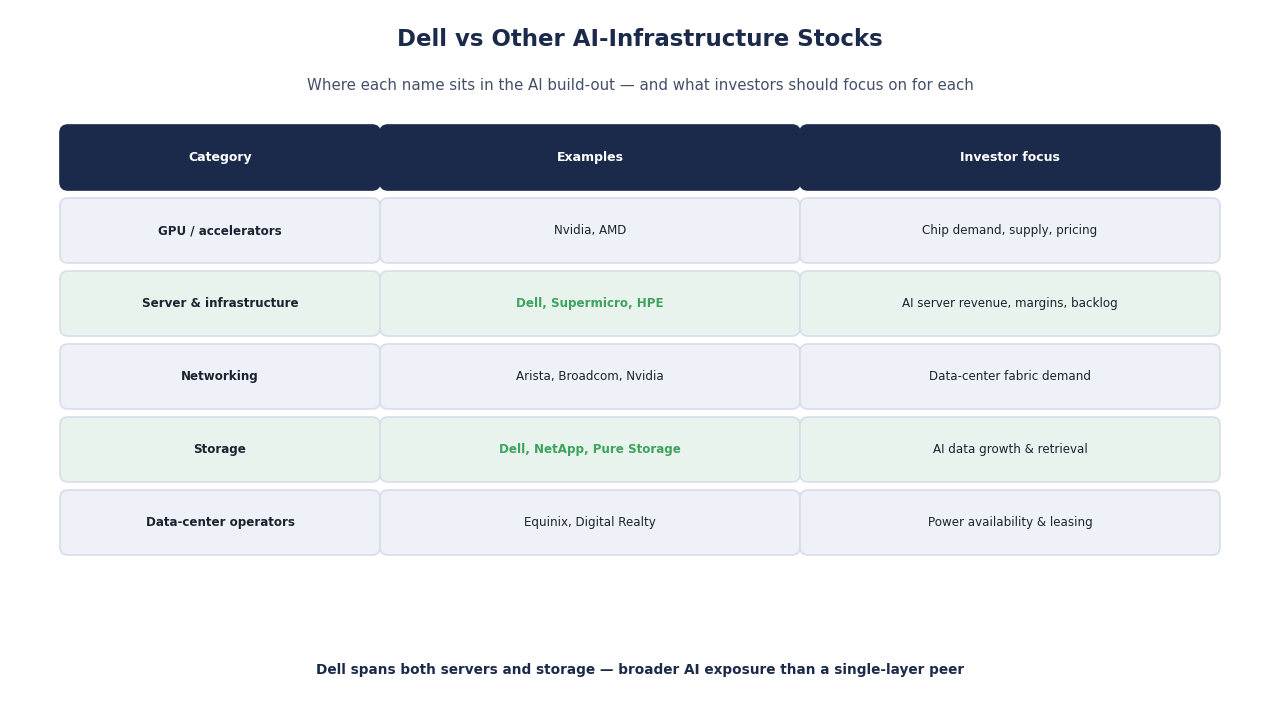
Dell should not be analyzed in isolation. Its rally fits into a broader AI infrastructure basket that includes semiconductor companies, server manufacturers, networking suppliers, data center operators, and storage vendors.
| Category | Examples | Investor Focus |
|---|---|---|
| GPU and accelerator suppliers | Nvidia, AMD | Chip demand, supply, pricing power |
| Server and infrastructure vendors | Dell, Supermicro, HPE | AI server revenue, margins, backlog |
| Networking suppliers | Arista, Broadcom, Nvidia | Data center fabric demand |
| Storage providers | Dell, NetApp, Pure Storage | AI data growth and retrieval speed |
| Data center operators | Equinix, Digital Realty | Power availability and leasing demand |
Dell’s advantage is enterprise reach and integration. Its challenge is that infrastructure vendors often compete on execution, availability, pricing, and service—not just innovation.
Key Metrics to Watch in Dell’s Earnings
For investors researching DELL after the AI server breakout, earnings commentary may matter more than the headline EPS number.
Important metrics include:
- AI server orders
- AI server backlog
- Infrastructure Solutions Group revenue
- Gross margin
- Operating margin
- Free cash flow
- Full-year guidance
- Customer concentration
- Supply availability
- Commentary on enterprise AI adoption
Dell’s prior guidance and analyst expectations have become central to the stock’s setup. Analysts were watching whether Dell could beat fiscal Q1 expectations and potentially lift its outlook because of strong AI server demand.
Is the DELL rally sustainable?
Dell’s AI server stock surge may be sustainable if three things happen: AI infrastructure demand remains strong, Dell converts demand into profitable revenue, and management raises or confirms a credible long-term growth outlook. The rally becomes more fragile if revenue growth comes with margin compression or if expectations rise faster than actual orders.
The best way to frame the stock is not “buy or avoid.” A better question is: What assumptions must be true for Dell’s current valuation to make sense?
Risk Management for Investors Watching DELL
Financial research should always include risk management. Dell’s AI infrastructure opportunity is real, but the stock’s sharp move means entry timing matters.
A practical risk checklist:
- Do not rely on a single news headline.
- Compare Dell’s valuation with peers.
- Watch post-earnings price reaction, not just reported numbers.
- Track whether analysts raise estimates after the report.
- Avoid oversized positions in high-volatility AI names.
- Use scenario analysis before making decisions.
This is where multi-agent workflows can help. SimianX AI’s stock analysis platform is designed to combine different analytical perspectives rather than relying on one narrative. Its multi-agent setup can help investors examine a stock like Dell through fundamentals, technicals, sentiment, earnings risk, and portfolio exposure.
A strong AI theme can explain a stock move, but only disciplined research can determine whether the risk-reward is still attractive.
FAQ About Dell's AI server breakout
What caused Dell stock to surge 17%?
Dell stock surged about 17% as investors reacted to analyst optimism, AI infrastructure momentum, and expectations that the company could benefit from strong AI server demand. The rally also followed Dell’s expanded AI infrastructure announcements around Dell AI Factory with NVIDIA.
Is Dell an AI server stock?
Yes. Dell is not a pure-play AI chip company, but it is a major AI infrastructure vendor. Its AI exposure comes from GPU-optimized servers, rack-scale systems, storage, data platforms, and enterprise AI deployment solutions.
How should investors analyze DELL after a major breakout?
Investors should evaluate AI server orders, backlog, margins, valuation, earnings guidance, and technical confirmation. A 17% surge can be bullish, but it also raises the bar for future results.
What is Dell AI Factory with NVIDIA?
Dell AI Factory with NVIDIA is Dell’s enterprise AI infrastructure platform built with NVIDIA technologies. It is designed to help organizations deploy AI workloads from workstations to data center racks, including agentic AI, data orchestration, and secure enterprise deployment.
Can SimianX AI help analyze Dell stock?
Yes. SimianX AI provides multi-agent stock and crypto analysis, using specialized agents to assess fundamentals, technicals, sentiment, risk, earnings, and other factors. That makes it useful for researching complex AI infrastructure stocks like Dell.
Conclusion
Dell’s 17% breakout shows how quickly investors are repricing companies tied to the AI server supply chain. The core takeaway from this Dell's AI server breakout is that Dell is increasingly viewed as a key infrastructure provider for enterprise AI, not just a traditional PC and server company.
The opportunity is significant: AI workloads need servers, storage, networking, cooling, and secure data infrastructure. Dell is well positioned in that stack through its enterprise relationships and AI Factory strategy. But the risks are also clear: valuation, margins, supply constraints, and elevated expectations could all affect future returns.
For investors, the next step is disciplined analysis—not headline chasing. Use a structured framework, compare scenarios, and evaluate both the bull and bear cases. To go deeper, explore SimianX AI and use multi-agent analysis to research Dell and other AI infrastructure stocks with a broader, more balanced perspective.
Related Reading
- AI Rally Stress Test: Nvidia Earnings vs 5% Yields 2026
- NextEra-Dominion 2026 Deal: 110 GW AI Power Bottleneck
- Small Caps Lead 2026 Chip Rebound as 10-Yr Yield Eases
- AI Chip Stocks Stay Strong: AMD, Intel Drive Data Centers