Inside the 9.99% KOSPI Plunge: Samsung, SK Hynix and the AI Memory Unwind
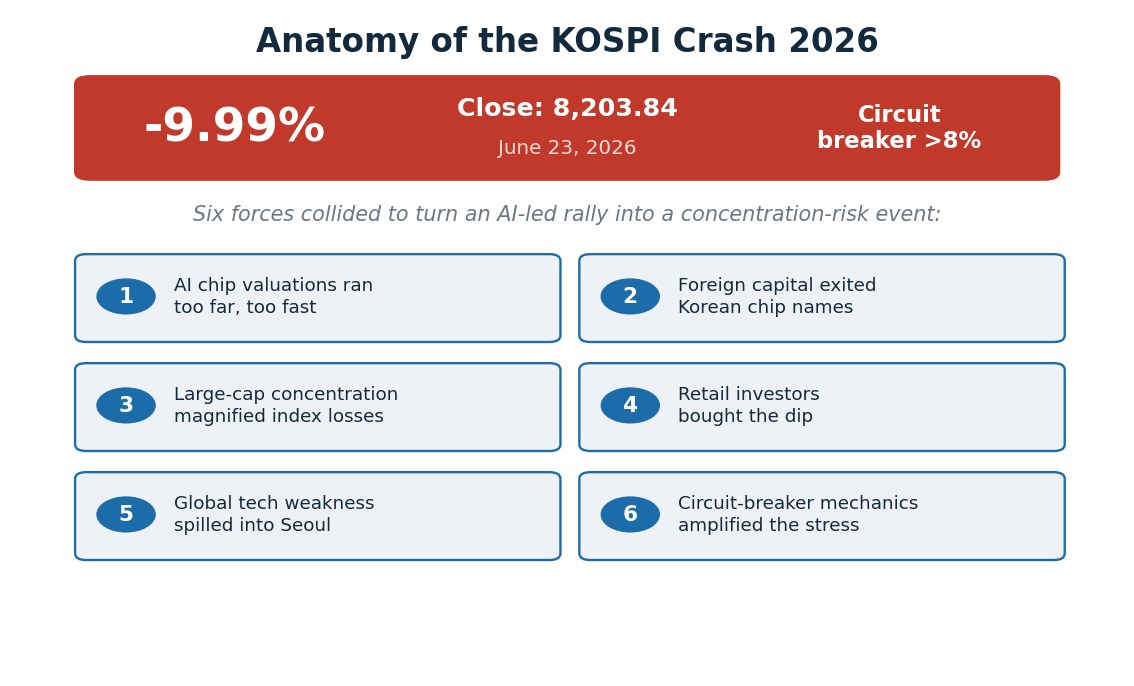
The KOSPI Crash 2026 was not just a one-day selloff in South Korean equities. It was a stress test for an entire market narrative built around artificial intelligence, high-bandwidth memory, semiconductor exports, and the belief that Korea’s biggest chipmakers could keep carrying the index higher. On June 23, 2026, the KOSPI fell 9.99% to close at 8,203.84, with the Korea Exchange triggering a 20-minute circuit breaker after the index dropped more than 8% from the prior close.
For investors, analysts, and market researchers, the deeper lesson is clear: when a national benchmark becomes heavily tied to a narrow AI infrastructure trade, stock selection, risk controls, sentiment analysis, and scenario planning become just as important as growth optimism. That is where platforms such as SimianX AI fit naturally into the workflow: SimianX positions itself around multi-agent stock analysis, real-time market intelligence, technical and fundamental review, news sentiment, and AI-assisted risk management.
What Happened During the KOSPI Crash 2026?
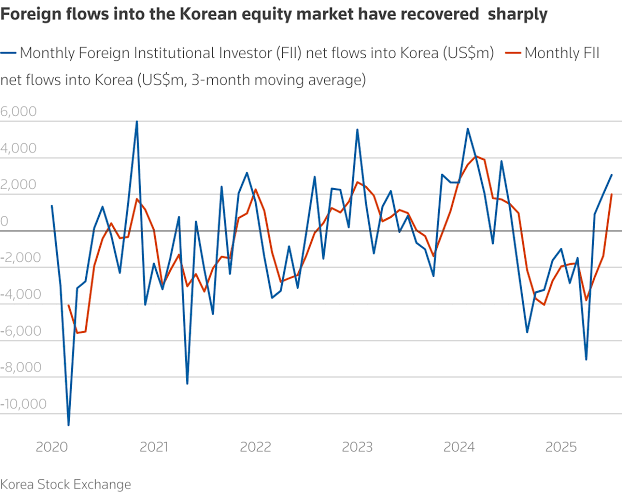
The immediate trigger was a broad technology and semiconductor selloff. Public market reports described the selloff as a sharp decline led by foreign investor selling, weakness in semiconductor shares, and profit-taking after a powerful AI-led rally.
In plain English, this was not only “panic selling.” It was a collision of several forces:
- AI chip valuations had moved too far, too fast
- Foreign capital reduced exposure to Korean semiconductor leaders
- Retail investors stepped in to buy the dip
- Large-cap concentration magnified index-level losses
- Global technology weakness spilled into Seoul
- Circuit-breaker mechanics amplified the sense of market stress
The KOSPI Crash 2026 showed how quickly an AI-led bull market can become a concentration-risk event when investors question whether semiconductor earnings can justify extreme price momentum.
The companies at the center of the shock were Samsung Electronics and SK Hynix, two giants that dominate Korea’s technology equity story. The broader market lesson is that even world-class companies can become sources of index fragility when investors crowd into the same long-tail growth theme.
| Market Factor | Why It Mattered in the KOSPI Crash 2026 |
|---|---|
| AI semiconductor enthusiasm | Drove huge gains before the selloff |
| Samsung and SK Hynix concentration | Made the index vulnerable to chip-stock weakness |
| Foreign investor selling | Added pressure to large-cap liquidity |
| Circuit breaker | Signaled disorderly market conditions |
| Retail dip-buying | Showed disagreement between institutions and individuals |
| Global tech weakness | Turned local valuation concerns into cross-market risk |
Why Samsung and SK Hynix Became the Center of Korea’s AI Chip Reckoning
The KOSPI Crash 2026 cannot be understood without looking at the rise of SK Hynix and the changing semiconductor hierarchy inside Korea’s stock market. Just before the selloff, SK Hynix had become a dominant symbol of the AI memory trade, especially because of its exposure to high-bandwidth memory, or HBM, a critical component in AI infrastructure.
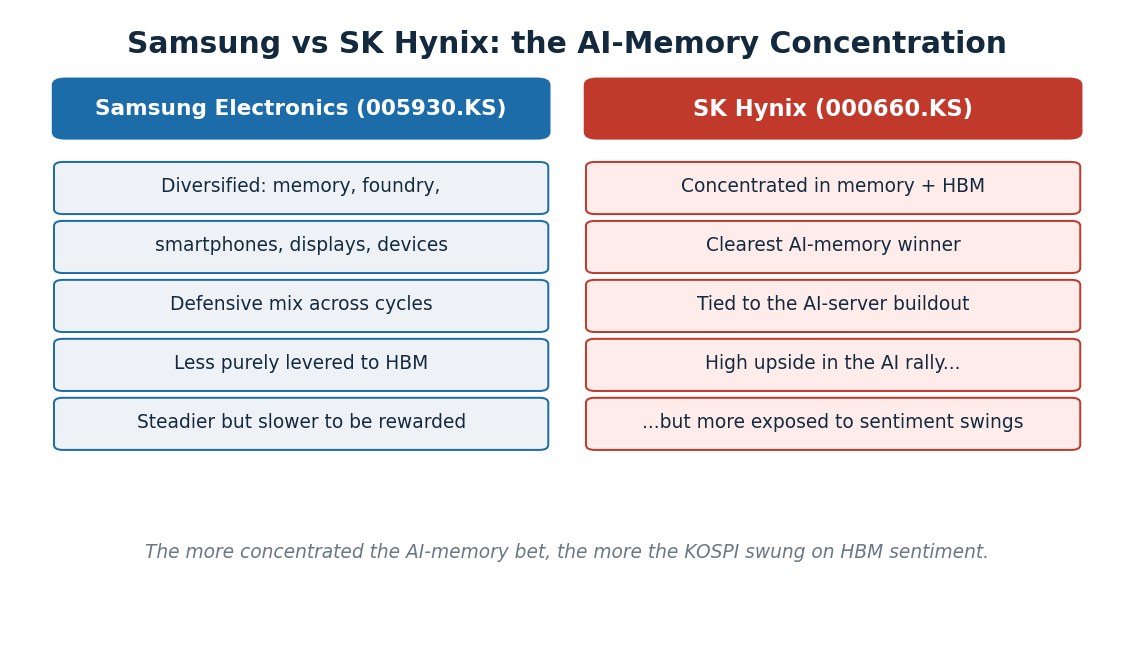
That milestone mattered because it represented more than a ranking change. It showed how strongly investors had rewarded exposure to AI memory. SK Hynix became associated with the global AI server buildout, while Samsung remained a broader technology conglomerate with exposure across memory, smartphones, foundry, displays, and consumer electronics.
Samsung’s diversification can be a strength in normal cycles, but during a narrow AI infrastructure boom, investors often reward more direct exposure more aggressively.
That created a paradox:
- SK Hynix became the market’s clearest AI memory winner.
- Samsung remained strategically important but less purely levered to HBM excitement.
- The KOSPI became increasingly sensitive to whether investors believed the AI memory cycle could keep accelerating.
What Does the KOSPI Crash 2026 Tell Us About AI Chip Risk?
The KOSPI Crash 2026 tells us that AI chip risk is not only about whether artificial intelligence adoption continues. It is also about valuation, supply-chain expectations, earnings timing, capital flows, and market positioning.
A company can be fundamentally strong while its stock becomes vulnerable. That happens when expectations rise faster than the business can prove. In semiconductor markets, investors often price in future cycles before the revenue fully appears. When the market starts to doubt the timing, magnitude, or durability of demand, a high-quality stock can fall sharply.
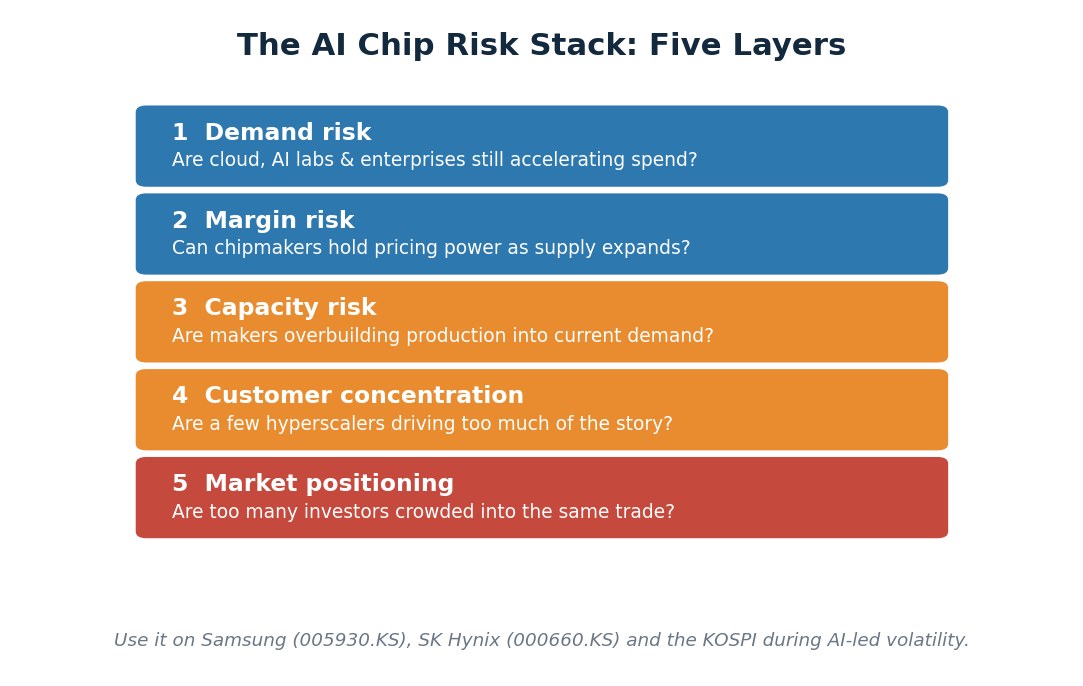
The Core AI Chip Risk Stack
Investors analyzing AI chip volatility should break the risk into five layers:
- Demand risk
Are cloud platforms, AI labs, and enterprise buyers still accelerating infrastructure spending?
- Margin risk
Can chipmakers maintain pricing power as supply expands?
- Capacity risk
Are manufacturers overbuilding production in response to current demand?
- Customer concentration risk
Are a few hyperscalers driving too much of the growth story?
- Market positioning risk
Are too many investors crowded into the same trade?
This framework is especially useful for analyzing 005930.KS Samsung Electronics, 000660.KS SK Hynix, and the broader KOSPI index during AI-led volatility.
The real question after a semiconductor selloff is not “Is AI over?” It is “How much future AI growth was already priced into the stocks?”
How Korea’s Tech-Led Market Became Vulnerable to a Sharp Selloff
Korea’s equity market has long been influenced by exporters, technology firms, and semiconductor cycles. What changed in 2026 was the intensity of the AI trade. Investors were not simply buying “Korea.” They were buying a specific idea: AI memory demand will keep compounding, and Korean chipmakers will capture a disproportionate share of the economics.
That idea may still have long-term merit. But markets do not move only on long-term merit. They also move on short-term positioning.
A useful way to understand the KOSPI Crash 2026 is to separate business fundamentals from market mechanics.
| Category | Fundamental Question | Market-Mechanics Question |
|---|---|---|
| AI demand | Are AI workloads still growing? | Has the stock already priced in perfect growth? |
| HBM supply | Can SK Hynix and Samsung meet demand profitably? | Are investors crowded into memory stocks? |
| Earnings | Are margins expanding? | Will the next earnings report beat extreme expectations? |
| Index risk | Is Korea benefiting from AI exports? | Is the KOSPI too dependent on a few chip leaders? |
| Risk control | Are companies financially resilient? | Are traders using leverage or momentum strategies? |
This distinction matters because a crash can happen even when the underlying industry remains attractive. The KOSPI Crash 2026 was less a rejection of AI and more a repricing of the speed, certainty, and concentration of the AI semiconductor story.
Practical Framework: How Investors Can Research the KOSPI Crash 2026
For a serious research workflow, investors should avoid treating the KOSPI Crash 2026 as a simple “buy the dip” or “AI bubble burst” headline. A more useful process is structured, evidence-based, and repeatable.
Step 1: Rebuild the Timeline
Start with the sequence:
- SK Hynix became a central symbol of Korea’s AI chip rally.
- The KOSPI reached an elevated level after strong technology-led momentum.
- The market then plunged sharply, triggering circuit-breaker concerns.
- Foreign and institutional investors sold aggressively, while retail investors bought the dip.
This timeline suggests the selloff was a reversal from extreme optimism, not a random isolated move.
Step 2: Separate Index Risk From Company Risk
Samsung and SK Hynix may both be semiconductor leaders, but they are not identical investments.
Samsung Electronics has a broader business mix, including memory, foundry, smartphones, displays, and consumer electronics. SK Hynix is more concentrated in memory and HBM, which made it highly attractive during the AI rally but also more exposed to sentiment swings around AI infrastructure demand.
Step 3: Compare Technical Signals With Fundamental Signals
A complete research process should combine:
- Price trend analysis
- Volume analysis
- Support and resistance levels
- Earnings revisions
- Memory pricing assumptions
- Foreign investor flows
- News sentiment
- Macro risk from U.S. technology stocks and rates
This is where SimianX AI can be integrated into a practical research workflow. SimianX describes its system as using multiple specialized AI agents for fundamental analysis, technical market analysis, news sentiment, timing, bull and bear research, and risk management. It also emphasizes professional reports and continued follow-up conversations with agents.
How to Analyze Samsung and SK Hynix After the KOSPI Crash 2026
After a selloff like this, the right question is not simply whether Samsung or SK Hynix is “cheap.” The better question is: What assumptions must be true for the stock to recover and outperform?
For SK Hynix
Key questions include:
- Can HBM demand remain strong through the next several quarters?
- Are AI customers still reserving capacity aggressively?
- Will margins stay elevated as competitors increase supply?
- Has the stock’s prior run already discounted a best-case scenario?
- Are foreign investors reducing exposure temporarily or structurally?
For Samsung Electronics
Key questions include:
- Can Samsung narrow the perceived HBM execution gap?
- Will its broader portfolio become a defensive advantage after the selloff?
- Can foundry, devices, and memory create a more balanced earnings base?
- Does its valuation now better reflect diversified exposure?
For the KOSPI
Index-level questions include:
- How concentrated is the benchmark in semiconductor leaders?
- Are foreign flows stabilizing or still exiting?
- Is retail buying absorbing institutional selling effectively?
- Are circuit-breaker events becoming more frequent?
- Is Korea’s AI export story intact despite equity volatility?
Risk Management Lessons From the KOSPI Crash 2026
The most important takeaway from the KOSPI Crash 2026 is that growth themes need risk budgets. Investors can believe in AI while still managing downside.
Here are practical rules for AI chip investors:
- Do not confuse company quality with entry-point quality.
- Watch index concentration before assuming diversification.
- Track foreign investor flows in markets dependent on external capital.
- Use stop-loss or position-sizing rules before volatility hits.
- Study both bullish and bearish scenarios.
- Avoid using one earnings cycle as proof of a multi-year thesis.
- Review leverage, ETF exposure, and correlated positions.
A simple position-sizing model can help:
| Risk Level | Portfolio Action | Example Rule |
|---|---|---|
| Low volatility | Maintain normal allocation | Position size under preset limit |
| Rising volatility | Reduce concentration | Trim oversized AI chip exposure |
| Circuit-breaker risk | Protect capital first | Pause new buying until liquidity normalizes |
| Earnings uncertainty | Scenario test | Model bull, base, and bear cases |
| Heavy foreign selling | Watch flows | Avoid averaging down blindly |
A disciplined investor does not need to abandon AI after the KOSPI Crash 2026. But they do need a clearer process for deciding how much AI exposure they can actually tolerate.
Why Multi-Agent Research Matters in AI-Led Market Crashes
Single-perspective analysis often fails during fast markets. A bullish analyst may focus on HBM demand. A bearish analyst may focus on valuation. A technical analyst may see broken momentum. A risk manager may recommend smaller position sizes. A news-sentiment analyst may identify whether the selloff is driven by facts or fear.
That is why a multi-agent research workflow is especially relevant after the KOSPI Crash 2026. SimianX AI can help investors structure research across technical, fundamental, sentiment, timing, bull-case, bear-case, and risk perspectives.
For investors researching Samsung, SK Hynix, or Korea’s tech-led market, that approach can help answer questions such as:
- Is this a short-term correction or a structural repricing?
- Are semiconductor fundamentals still improving?
- Did price action break key support levels?
- Is the market reacting to real earnings risk or crowded positioning?
- What would invalidate the bullish AI chip thesis?
The goal is not to produce a magical prediction. The goal is to reduce blind spots.
FAQ About KOSPI Crash 2026
What caused the KOSPI Crash 2026?
The KOSPI Crash 2026 was driven by a sharp technology and semiconductor selloff, profit-taking after a strong AI-led rally, and heavy foreign and institutional selling. The market move also reflected concern that AI chip valuations had become too concentrated and too aggressive.
Why did Samsung and SK Hynix fall during the Korea AI chip selloff?
Samsung and SK Hynix were central to the selloff because they are major semiconductor leaders and key components of Korea’s AI-related equity narrative. SK Hynix was especially exposed to the high-bandwidth memory trade, while Samsung remained a broader but still heavily watched technology bellwether.
Is the KOSPI Crash 2026 a warning about an AI stock bubble?
It is best understood as a warning about AI valuation concentration, not necessarily proof that AI demand is collapsing. The crash showed that when many investors crowd into the same AI chip winners, even strong companies can experience sharp drawdowns if expectations become too aggressive.
How can investors analyze Korean semiconductor stocks after the crash?
Investors should combine fundamental analysis, technical signals, foreign flow data, earnings expectations, semiconductor pricing assumptions, and scenario planning. Tools like SimianX AI can support this by bringing multiple AI analyst perspectives into one workflow, including fundamental, technical, sentiment, and risk-management views.
What is the best way to manage risk after the KOSPI Crash 2026?
The best approach is to define position size, downside limits, and thesis checkpoints before buying. Investors should avoid assuming that every AI-related dip is automatically a bargain and should instead compare valuation, earnings durability, and market liquidity.
Conclusion
The KOSPI Crash 2026 was a defining moment for Korea’s tech-led market. It exposed how quickly an AI-driven rally can reverse when valuation concerns, foreign selling, global technology weakness, and semiconductor concentration collide. Samsung and SK Hynix remain central to the global AI infrastructure story, but the crash proved that even the strongest themes need disciplined research and risk management.
For investors, the key takeaway is simple: do not analyze AI chip stocks through hype alone. Study fundamentals, price action, capital flows, sentiment, concentration, and downside scenarios together. To make that process more structured, explore SimianX AI, where multi-agent stock analysis, real-time market intelligence, technical and fundamental review, news sentiment, and risk-management workflows can help turn market shocks into clearer investment research.
Related Reading
- AI Stock Boom: Nvidia Leads the Chip Supercycle Now
- AI Chip Stocks Stay Strong: AMD, Intel Drive Data Centers
- Broadcom Earnings 2026: AI ASIC Backlog & AVGO Stock
- Alphabet Nears Nvidia in Market Value as AI Trade Broadens
- Why US Stocks & Crypto Plummeted This Week: The Causes