Real-Time AI Crypto Command Room: Coinbase, Binance, Bybit

Real-Time AI Crypto Command Room: Coinbase, Binance, Bybit

Live AI crypto command room across Coinbase, Binance, and Bybit feeds—multi-timeframe charts, multi-agent signals, and execution-ready Copilot for traders.

2026-03-02
·
20 min read
Listen to article

Real-Time AI Crypto Command Room for Coinbase, Binance & Bybit

A Real-Time AI Crypto Command Room for Coinbase, Binance & Bybit is a single, decision-focused workspace that turns fragmented exchange data into actionable, explainable trade context. Instead of juggling five tabs for charts, order books, alerts, and news, a command room unifies price, volume, market depth, volatility, and AI reasoning so you can react faster without trading blindly.

This research-style guide explains the data architecture, analytics framework, and AI workflow behind a professional command room—and how a platform like SimianX AI can operationalize the same “closed-loop” process for real traders: analyze → decide → monitor → learn. If you’re building your own command room—or choosing one—you’ll leave with a concrete blueprint.

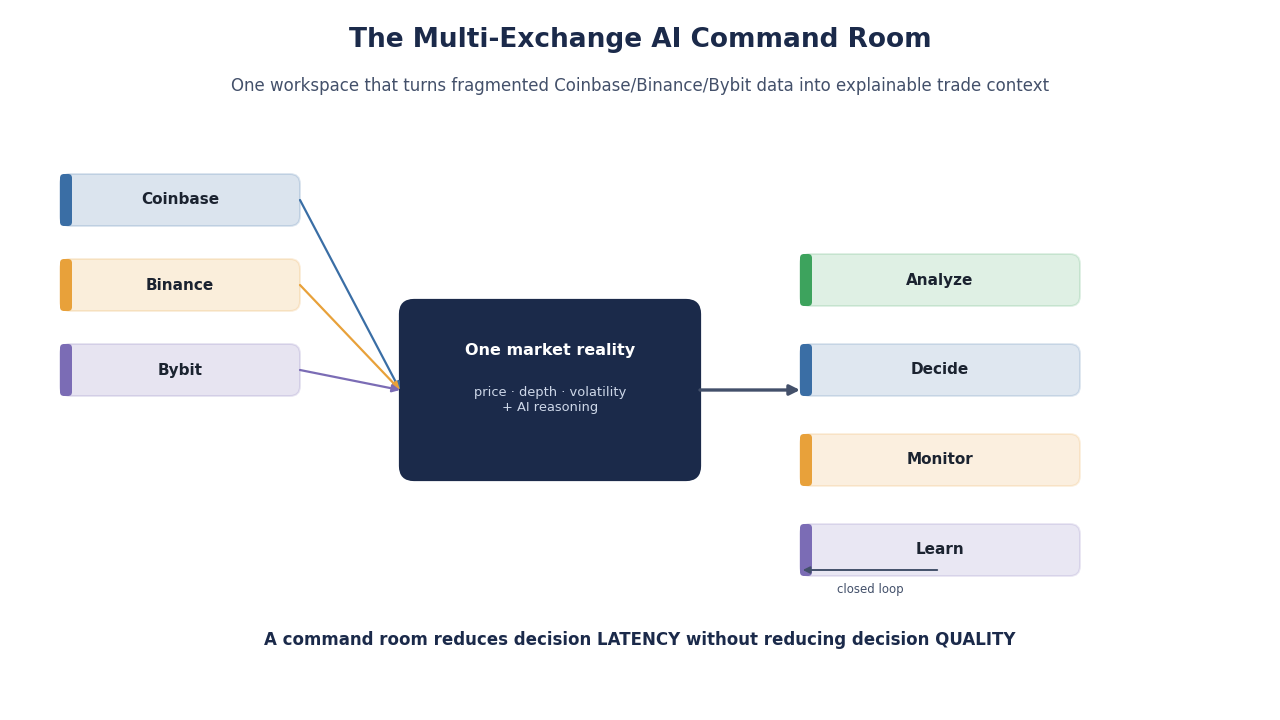
SimianX AI Multi-exchange crypto command room overview (price + depth + AI reasoning)
Multi-exchange crypto command room overview (price + depth + AI reasoning)

Why a Multi-Exchange “Command Room” Exists (and Why It Works)

Crypto is a multi-venue market. The same asset (e.g., BTC-USDT) can trade at slightly different prices and with different liquidity profiles across Coinbase, Binance, and Bybit. In calm markets, differences are small. In fast moves, the “best” venue can change in seconds.

A command room exists for one reason: reduce decision latency without reducing decision quality.

The fragmentation problem you feel every day

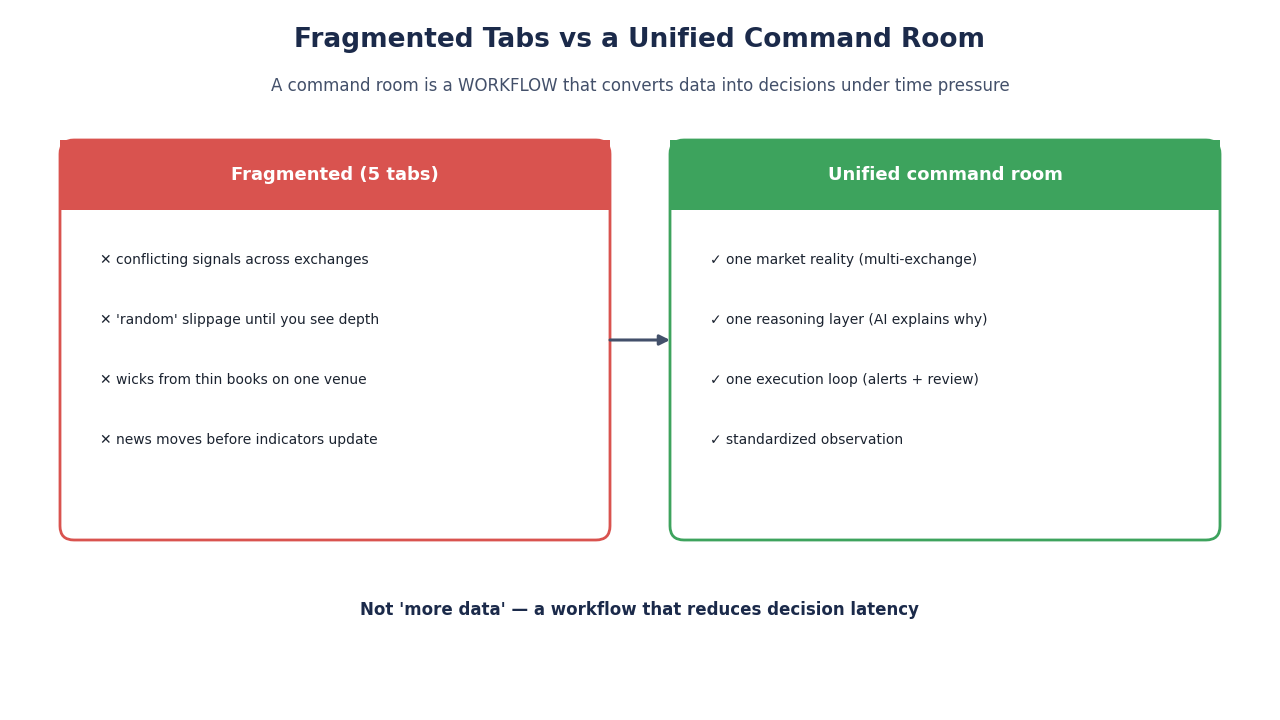
Most traders experience fragmentation as:

  • Conflicting signals between exchanges (price breaks on one venue, not another)
  • Slippage that appears “random” until you see depth
  • Sudden wicks caused by thin books on a single exchange
  • Funding/OI changes that don’t show up on spot charts
  • News-driven moves that trigger before your indicators update

A command room solves this by standardizing how you observe the market:

  1. One market reality (multi-exchange price, spread, depth)
  2. One reasoning layer (AI explains what changed and why)
  3. One execution loop (alerts, risk gates, and post-trade review)

Key takeaway: A command room is not “more data.” It’s a workflow that converts data into decisions under time pressure.

SimianX AI Fragmented dashboards vs. unified command room workflow
Fragmented dashboards vs. unified command room workflow

Research Lens: What “Real-Time” Actually Means in Crypto

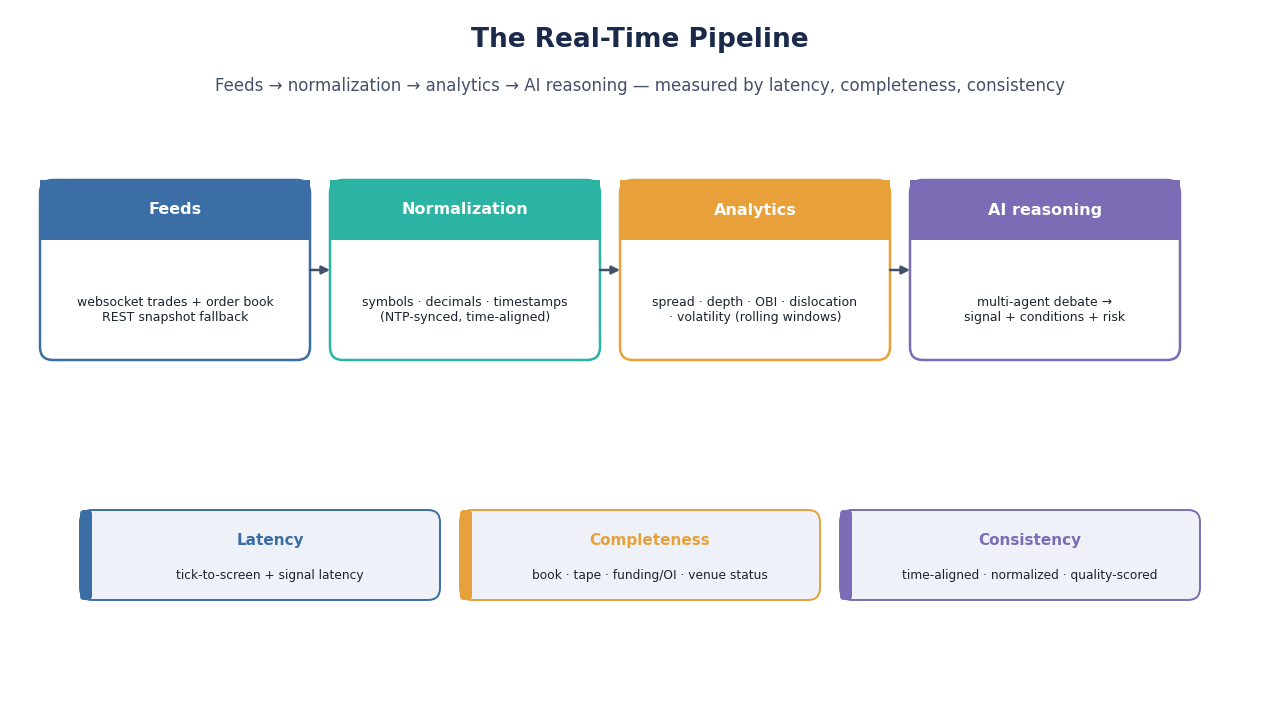
“Real-time” is often marketing language. In a command-room architecture, it has measurable properties:

1) Latency (how fast your view updates)

  • Tick-to-screen latency: exchange update → your UI update
  • Signal latency: update → computed metric → AI interpretation → alert

In high-volatility conditions, a 2–5 second lag can be the difference between a clean entry and a forced chase.

2) Completeness (what you’re seeing vs. missing)

Real-time is useless if the feed is missing:

  • Order book levels
  • Trade prints (tape)
  • Volume segmentation (spot vs perps)
  • Funding + OI changes
  • Venue outages / stale snapshots

3) Consistency (comparing venues fairly)

A command room only works if Coinbase, Binance, and Bybit data are:

  • Time-aligned (clock sync, consistent sampling)
  • Normalized (symbols, decimals, quote conventions)
  • Quality-scored (detect stale, noisy, or anomalous streams)
SimianX AI Real-time pipeline: feeds → normalization → analytics → AI reasoning
Real-time pipeline: feeds → normalization → analytics → AI reasoning

Core Design Principle: “One Truth Table” for Multi-Exchange Markets

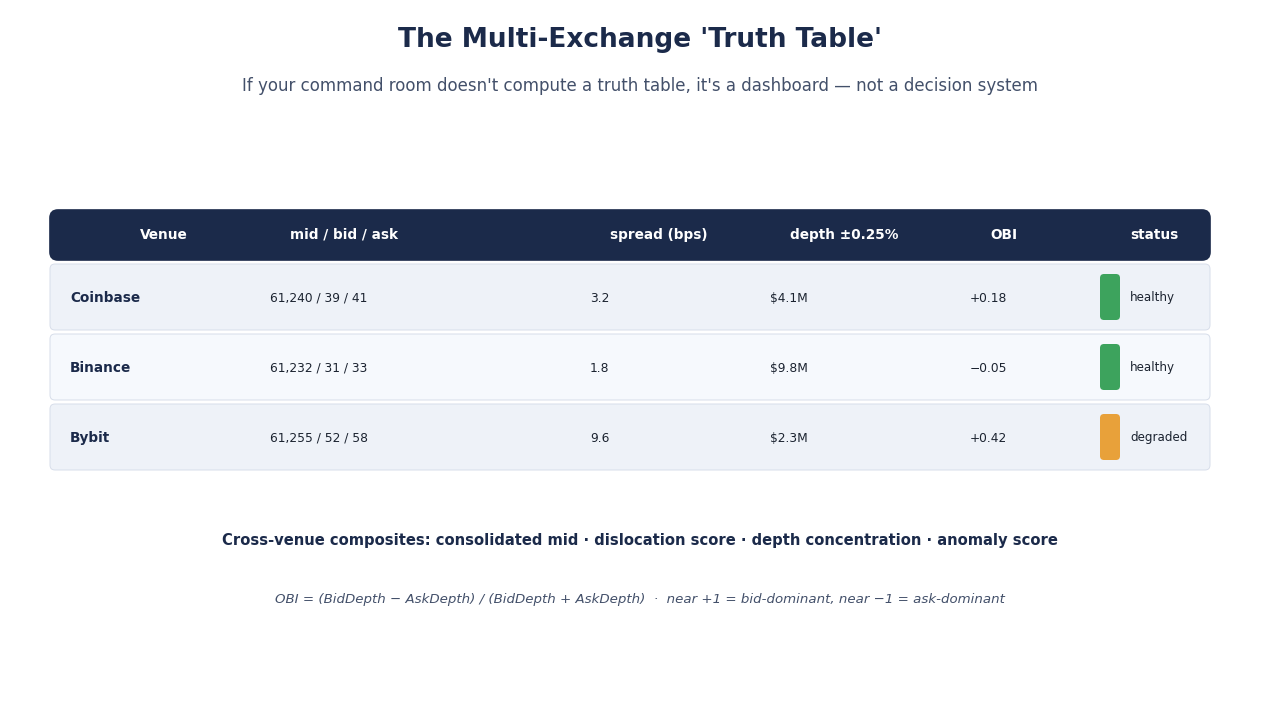
If you want a command room that traders trust, you need a single authoritative layer: a multi-exchange truth table.

What the truth table contains

At minimum, for each venue and symbol:

  • mid_price, best_bid, best_ask
  • spread_bps
  • top_depth_usd (e.g., within 0.10% / 0.25% / 0.50%)
  • order_book_imbalance
  • trade_volume_1m, trade_count_1m
  • volatility_realized (rolling)
  • microstructure_flags (thin book, spoof risk, jump risk)
  • venue status (healthy/degraded/stale)

Then you build cross-venue composites:

  • consolidated mid (liquidity-weighted)
  • cross-exchange spread and dislocation score
  • depth concentration (is liquidity clustered on one venue?)
  • anomaly score (is one venue “lying” today?)

If your command room doesn’t compute a truth table, it’s a dashboard—not a decision system.

SimianX AI Multi-exchange truth table concept illustration
Multi-exchange truth table concept illustration

The Five Panels Every Command Room Needs

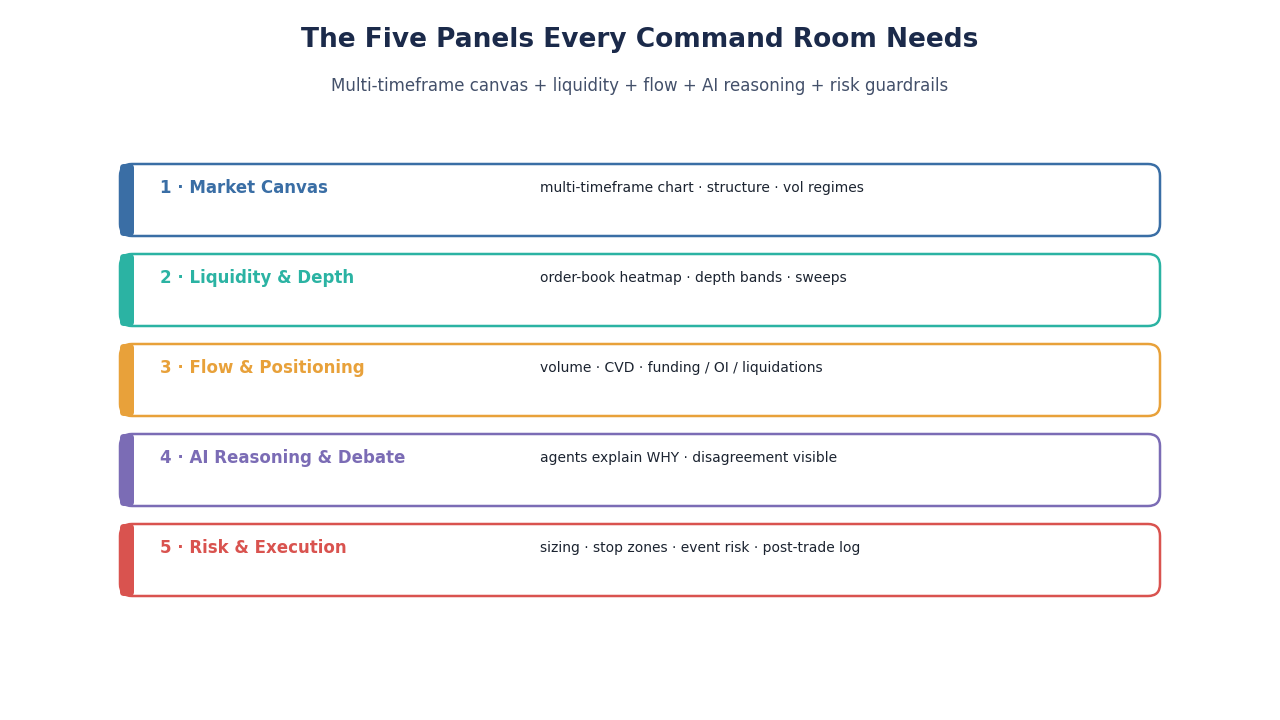
A professional Real-Time AI Crypto Command Room for Coinbase, Binance & Bybit usually converges to five core panels:

  1. Market Canvas (Multi-Timeframe Chart)

- timeframes like 1m/5m/15m/1h/4h/1d

- structure: trend, range, breakouts, volatility regimes

  1. Liquidity & Depth

- order book heatmap

- depth within bands (0.1/0.25/0.5%)

- imbalance and sweep detection

  1. Flow & Positioning

- volume, CVD (if available), large trade detection

- derivatives: funding, OI, liquidations (where relevant)

  1. AI Reasoning & Debate

- AI agents explain why conditions changed

- disagreement is visible (not hidden)

- decision summary with confidence and risks

  1. Risk & Execution Guardrails

- position sizing suggestions

- stop invalidation zones

- event risk alerts (macro/news)

- post-trade logging for review

SimianX AI Five-panel command room layout (concept)
Five-panel command room layout (concept)

Market Depth: The “Hidden” Variable That Explains Slippage and Wicks

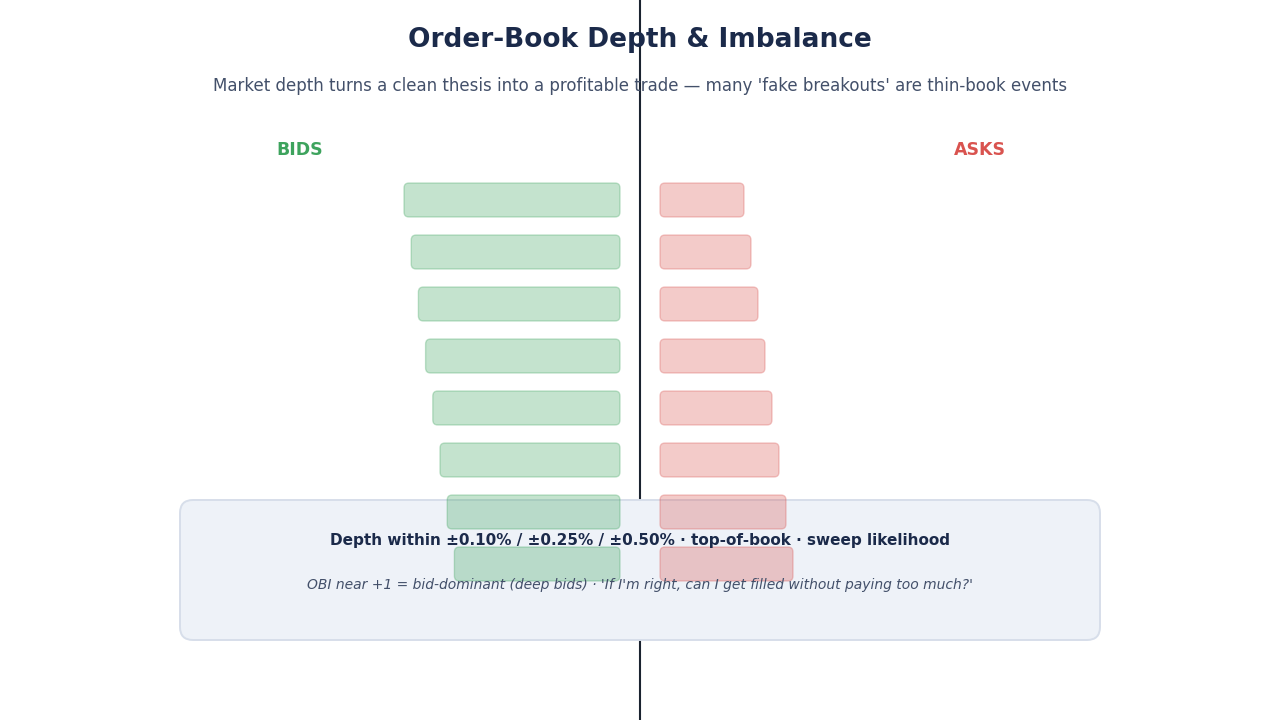
Market depth is what turns a clean thesis into a profitable trade.

Depth metrics that matter (practical definitions)

  • Top-of-book depth: liquidity at best bid/ask
  • Depth within X%: total liquidity within ±0.10% (or ±0.25%) of mid
  • Order book imbalance (OBI):

\[

OBI = \frac{\text{BidDepth} - \text{AskDepth}}{\text{BidDepth} + \text{AskDepth}}

\]

Values near +1 mean bid-dominant; near -1 mean ask-dominant.

  • Sweep likelihood: probability that a market order of size Q moves price by Y bps

Why depth differs across Coinbase vs Binance vs Bybit

Even for the same symbol:

  • user base differs (retail vs pro)
  • maker incentives differ
  • market maker presence differs
  • perps vs spot dominance differs

A command room turns this into a simple question:

If I’m right, can I get filled without paying too much?

Key insight: Many “fake breakouts” are simply thin-book events on one venue.

SimianX AI Order book depth and imbalance visualization
Order book depth and imbalance visualization

Cross-Exchange Price Dislocation: The Most Underused Signal

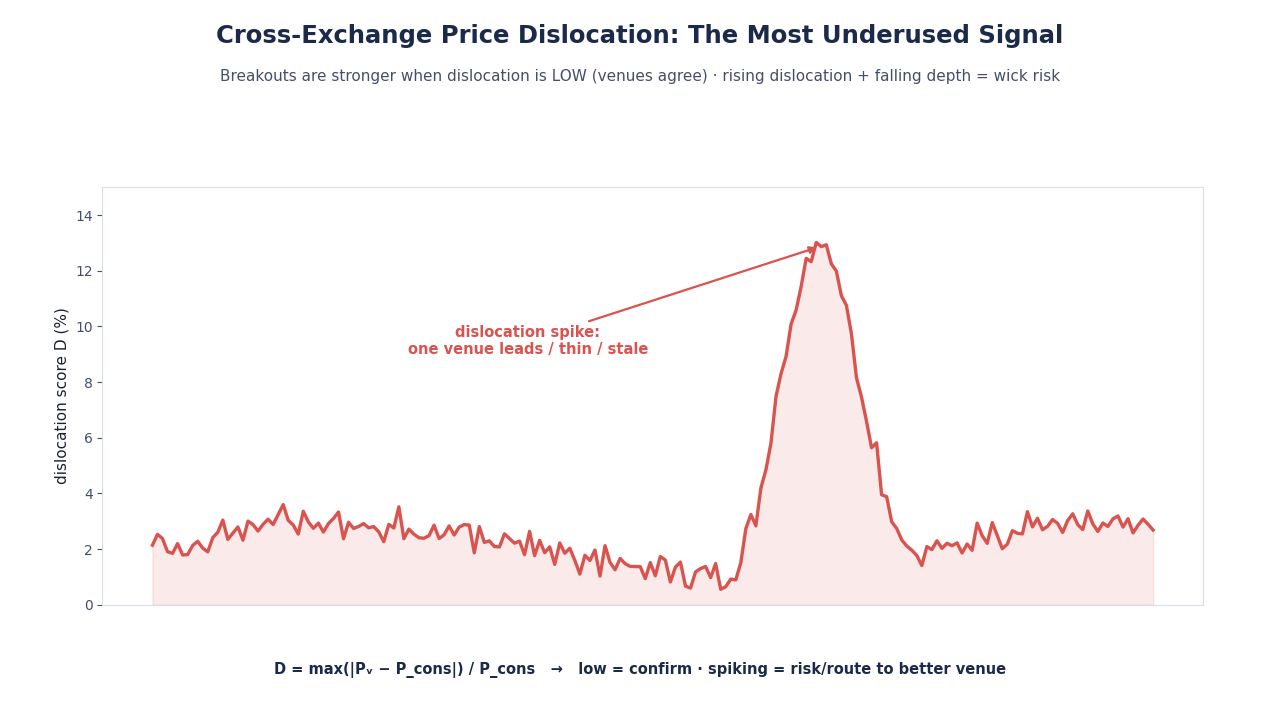
A multi-exchange command room lets you measure dislocation directly.

Dislocation score (a useful operational metric)

Define:

  • P_c, P_b, P_y = mid price on Coinbase, Binance, Bybit
  • P_cons = consolidated mid (liquidity-weighted)

Then a basic dislocation score:

\[

D = \max(|Pc - P{cons}|, |Pb - P{cons}|, |Py - P{cons}|) / P_{cons}

\]

If D spikes:

  • one venue is moving first (information lead), or
  • one venue is thin (liquidity issue), or
  • one feed is stale (data integrity issue)

Practical use

  • Signal confirmation: breakout is stronger when dislocation is low (venues agree)
  • Risk warning: dislocation rising + depth falling = “wick risk”
  • Execution routing: choose venue with better depth and lower spread
SimianX AI Cross-exchange dislocation spike example (concept)
Cross-exchange dislocation spike example (concept)

Volume Isn’t Just Volume: What to Measure in Real Time

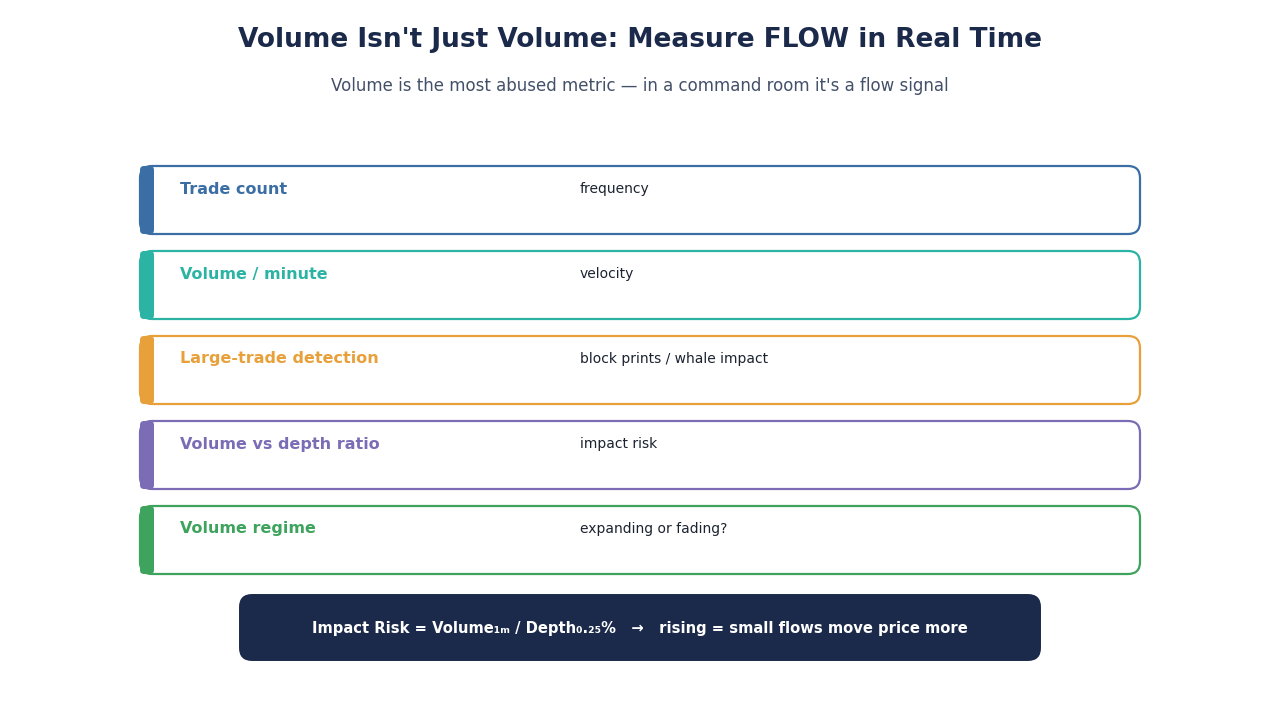
Volume is the most abused metric in trading. In a command room, volume is a flow signal.

The volume stack you actually need

  • Trade count (frequency)
  • Volume per minute (velocity)
  • Large trade detection (block prints / whale impact)
  • Volume vs depth ratio (impact risk)
  • Volume regime (is activity expanding or fading?)

A practical “impact risk” ratio

\[

ImpactRisk = \frac{Volume{1m}}{Depth{0.25\%}}

\]

If impact risk rises, small flows can move price more than expected.

SimianX AI Volume velocity + impact risk ratio visualization
Volume velocity + impact risk ratio visualization

Volatility Regimes: Stop Getting Surprised by “New Market Weather”

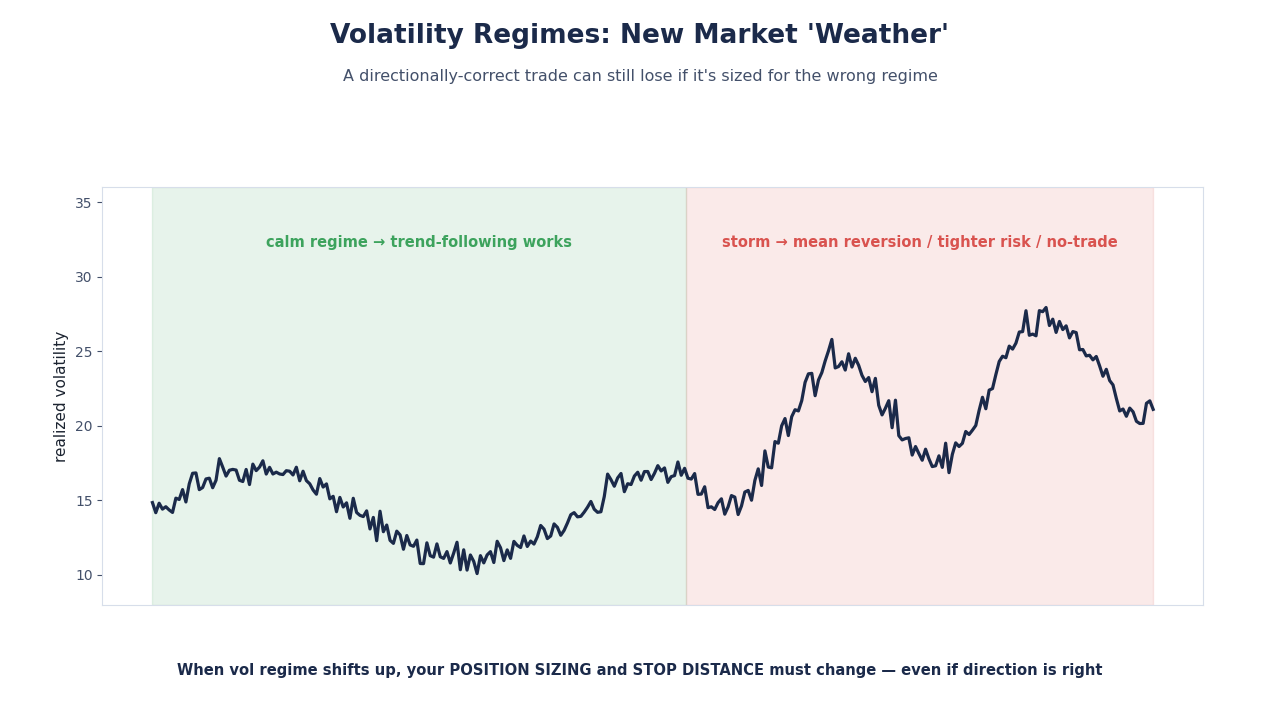
A command room should behave like a weather radar:

  • calm regime → trend-following works
  • storm regime → mean reversion, tighter risk, or no-trade zones

The minimum volatility toolkit

  • realized volatility (rolling) on multiple windows
  • range expansion (ATR-like measures)
  • volatility-of-volatility (how unstable the regime is)

Rule of thumb:

When volatility regime shifts up, your position sizing and stop distance must change—even if your direction is correct.

A directionally-correct trade can still be a losing trade if it’s sized for the wrong regime.

SimianX AI Volatility regime switch illustration
Volatility regime switch illustration

Derivatives Layer: Funding, Open Interest, and Liquidation Pressure

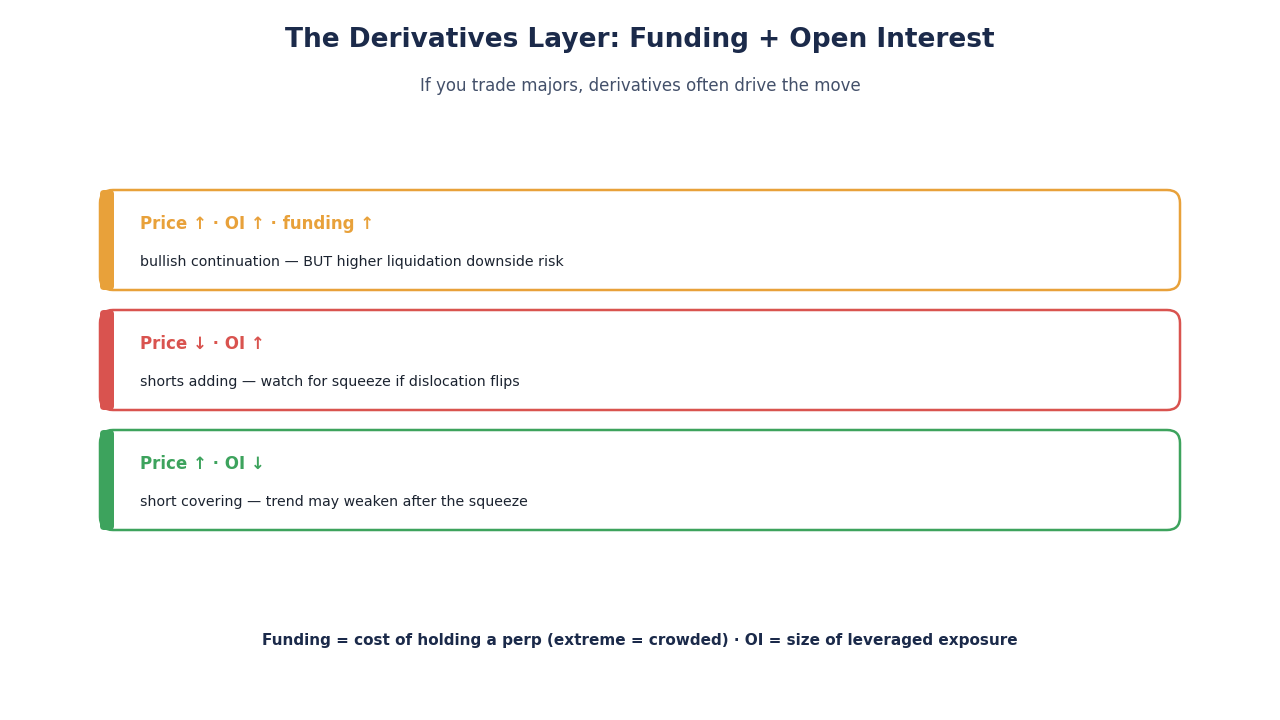
If you trade majors, derivatives often drive the move.

What funding and OI tell you

  • Funding rate: cost of holding a perp position; extreme funding = crowded positioning risk
  • Open interest (OI): size of leveraged exposure; rising OI can mean trend continuation or trapped leverage

The three high-signal combinations

  1. Price up + OI up + funding up

- bullish continuation but higher liquidation downside risk

  1. Price down + OI up

- shorts adding; watch for squeeze if dislocation flips

  1. Price up + OI down

- short covering; trend may weaken after the squeeze

SimianX AI Funding + OI quadrant model illustration
Funding + OI quadrant model illustration

The AI Layer: Why Multi-Agent Reasoning Beats Single-Indicator Alerts

A command room becomes “AI-powered” when it does two things:

  1. Explains what changed in market state
  2. Translates that into a decision with risk context

Why multi-agent beats one model

In real trading, you’re balancing competing truths:

  • trend looks bullish
  • depth is thin
  • funding is extreme
  • dislocation suggests one venue is unstable
  • volatility regime just shifted

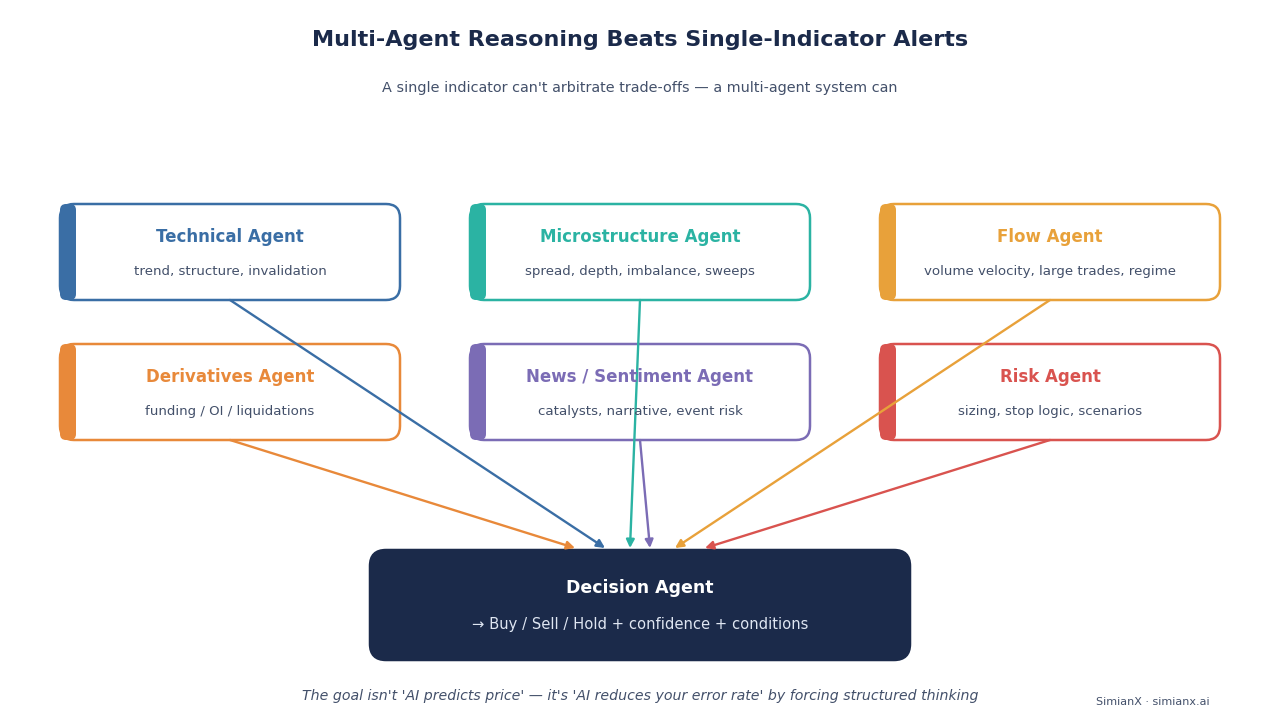
A single indicator can’t arbitrate trade-offs. A multi-agent system can.

Example agent roles (practical, not theoretical)

  • Technical Agent: trend, structure, momentum, invalidation zones
  • Microstructure Agent: spread, depth, imbalance, sweep risk
  • Flow Agent: volume velocity, large trades, regime shifts
  • Derivatives Agent: funding/OI/liquidations (if relevant)
  • News/Sentiment Agent: catalysts, narrative alignment, event risk
  • Risk Agent: sizing, stop logic, scenario analysis
  • Decision Agent: produces a final Buy/Sell/Hold with confidence and conditions

The goal is not “AI predicts price.”

The goal is AI reduces your error rate by forcing structured thinking under speed.

SimianX AI Multi-agent debate flow diagram
Multi-agent debate flow diagram

How to Turn AI Reasoning Into Tradeable Signals (Without Hype)

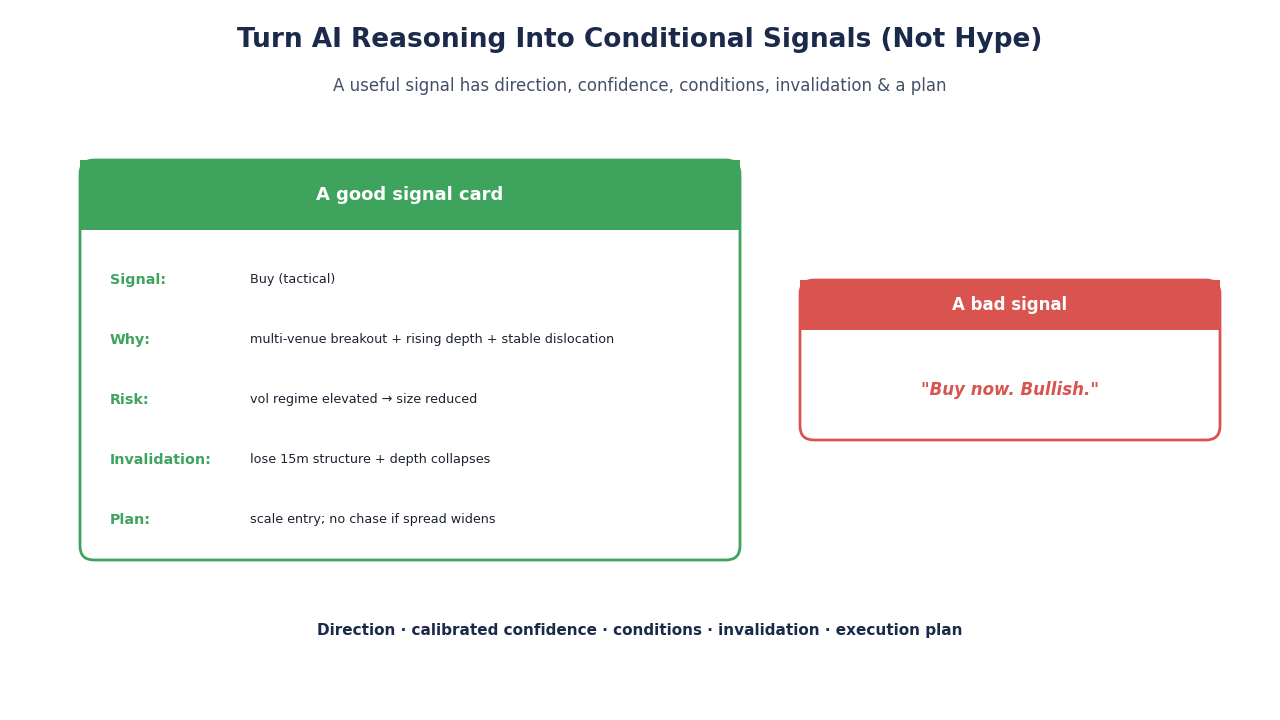
The command room should output conditional signals:

  • Direction (buy/sell/hold)
  • Confidence (calibrated, not vibes)
  • Conditions (what must remain true)
  • Invalidation (what breaks the thesis)
  • Execution plan (entries, stops, size)

A good signal template

Signal: Buy (tactical)

Why: multi-venue breakout confirmation + rising depth + stable dislocation

Risk: volatility regime elevated; size reduced

Invalidation: lose structure level on 15m and depth collapses

Plan: scale entry; avoid chase if spread widens

A bad signal template

“Buy now. Bullish.”

SimianX AI Signal card example (concept)
Signal card example (concept)

The “Command Room Scorecard”: A Repeatable Decision Framework

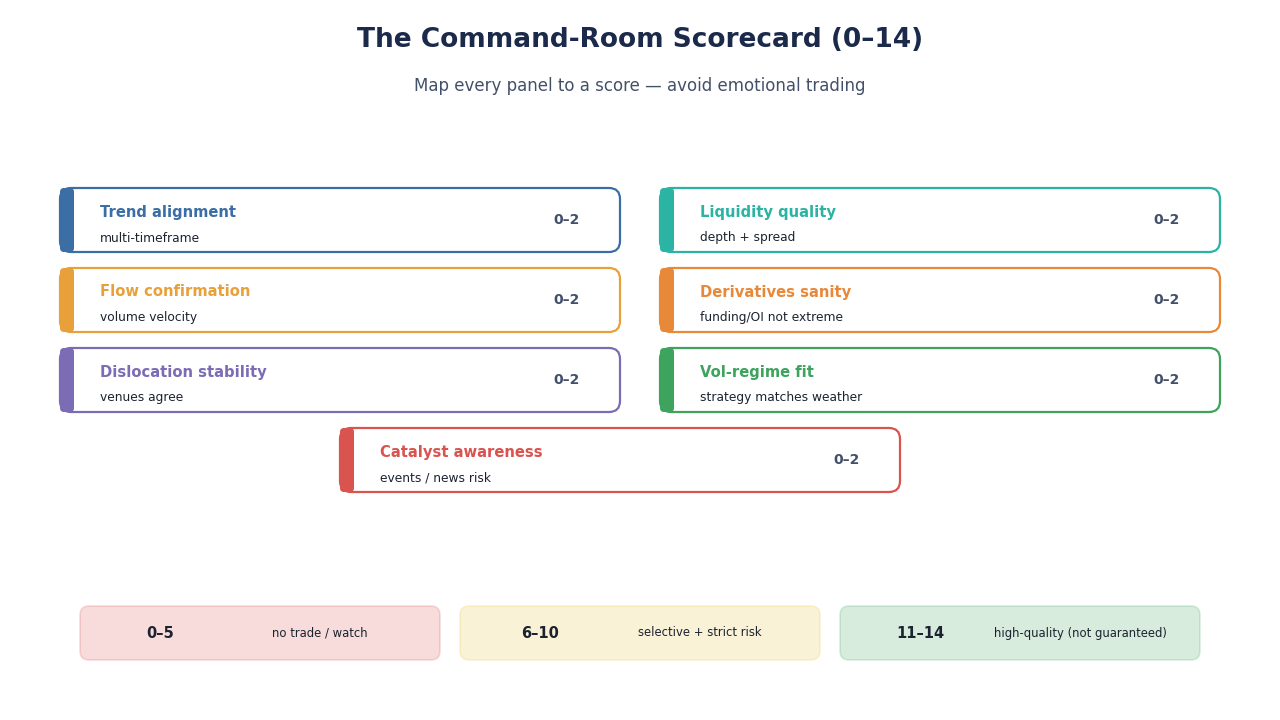
To avoid emotional trading, build a scorecard. Here’s a research-backed template that maps directly to command-room panels.

Scorecard dimensions (0–2 each)

  1. Trend alignment (multi-timeframe)
  2. Liquidity quality (depth + spread)
  3. Flow confirmation (volume velocity)
  4. Derivatives sanity (funding/OI not extreme)
  5. Dislocation stability (venues agree)
  6. Vol regime fit (strategy matches weather)
  7. Catalyst awareness (known events/news risk)

Total score: 0–14

  • 0–5: no trade / watch
  • 6–10: selective trades with strict risk
  • 11–14: high-quality setups (still not guaranteed)
Dimension0 (Bad)1 (Mixed)2 (Good)
Trendchoppy/conflictingpartial alignmentaligned across TFs
Liquiditythin/wide spreadsinconsistentdeep + tight
Flowfadingneutralexpanding
Derivativescrowded extremesmoderatesupportive
Dislocationunstableoccasional spikesstable
Vol regimemismatchpartialfits strategy
Catalystsunknownsome awarenessmapped + monitored
SimianX AI Command room scorecard illustration
Command room scorecard illustration

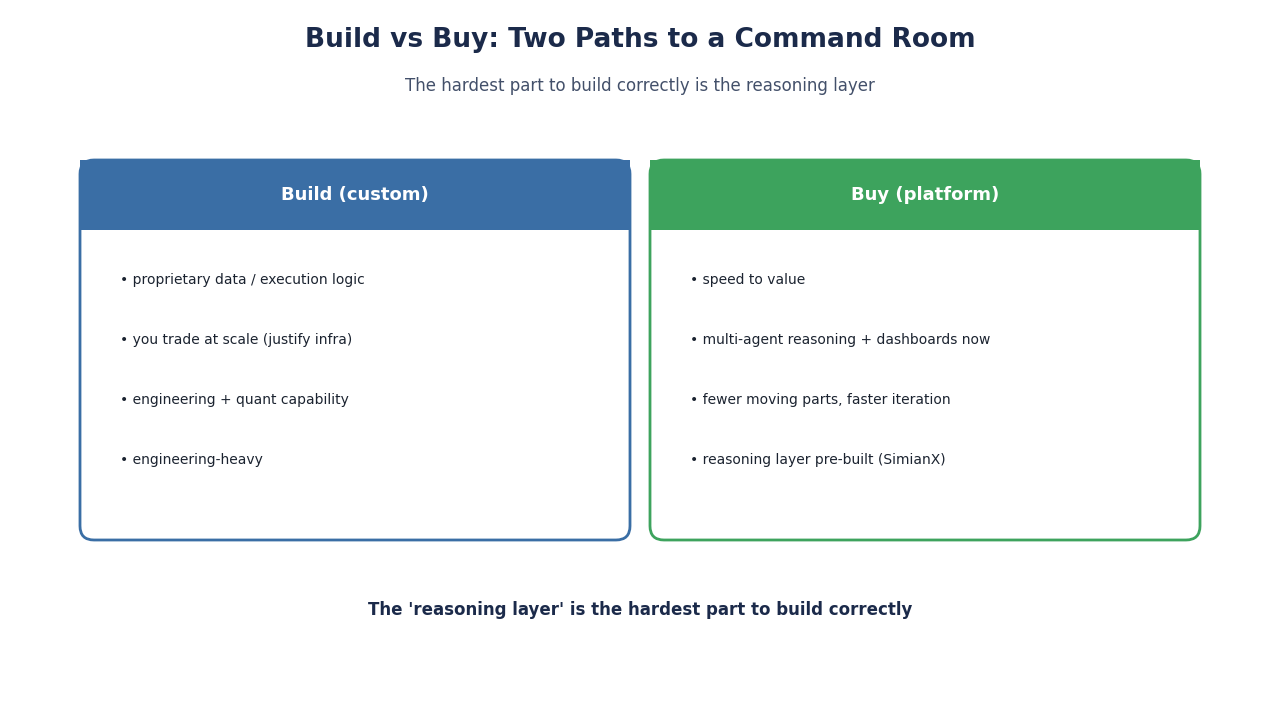
Build vs Buy: Two Paths to a Real-Time Command Room

You can:

  • Build a custom command room (engineering-heavy)
  • Use a platform that already operationalizes the workflow

When building makes sense

  • you need proprietary data or execution logic
  • you trade at scale and can justify infra cost
  • you have engineering + quant capability

When buying makes sense

  • you want speed to value
  • you want multi-agent reasoning + dashboards now
  • you want fewer moving parts and faster iteration

Platforms like SimianX AI position the command room as a unified workspace where multiple AI models can analyze markets in real time, and the trader sees not just a signal but also the reasoning and debate behind it. For many teams, that “reasoning layer” is the hardest part to build correctly.

SimianX AI Build vs buy decision diagram
Build vs buy decision diagram

A Practical Reference Architecture (for Builders)

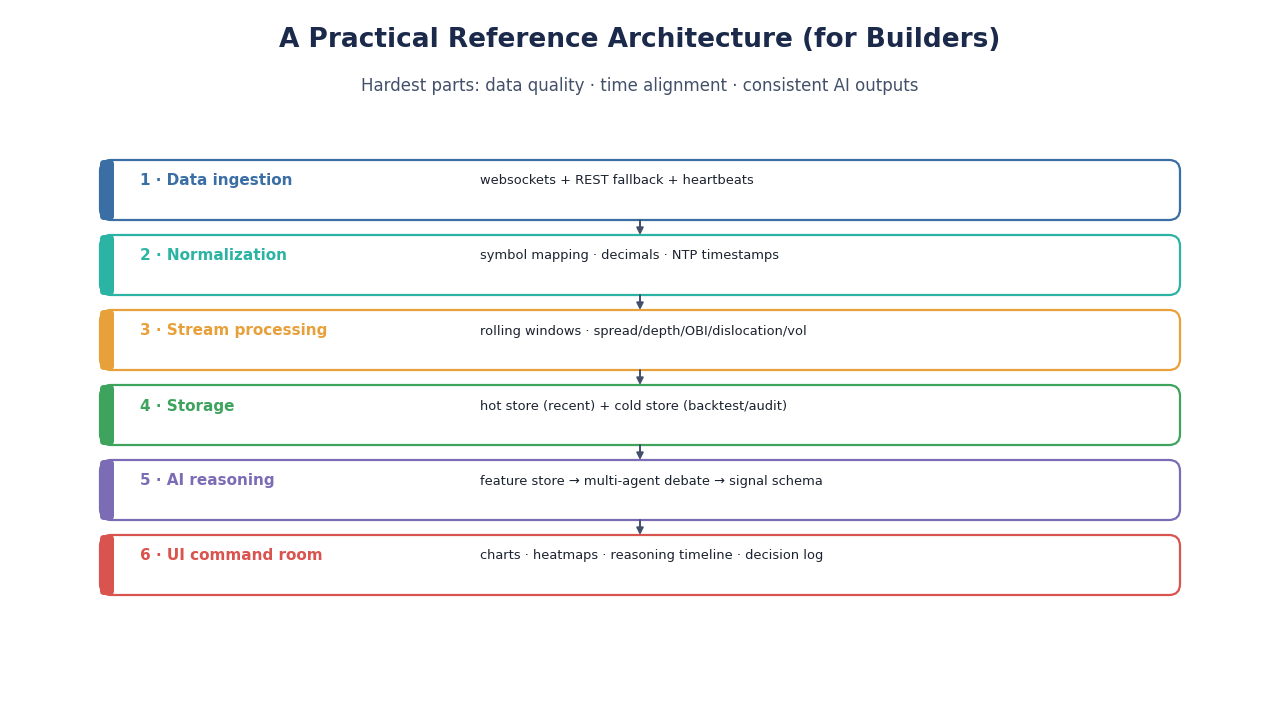
If you’re building a Real-Time AI Crypto Command Room for Coinbase, Binance & Bybit, use this architecture as a baseline.

1) Data ingestion layer

  • websocket feeds for trades + order book
  • REST fallback for snapshots
  • heartbeat monitoring per venue

2) Normalization layer

  • symbol mapping: BTC-USD vs BTCUSDT vs BTC/USDT
  • unified decimals + lot sizes
  • unified timestamps (NTP synced)

3) Stream processing layer

  • rolling windows (1s, 5s, 1m, 5m)
  • real-time metrics: spread, depth, OBI, dislocation, vol

4) Storage

  • hot store for recent windows (fast retrieval)
  • cold store for backtests and audits

5) AI reasoning

  • feature store → prompts / model inputs
  • multi-agent debate orchestration
  • output contracts (signal schema + conditions)

6) UI command room

  • low-latency chart rendering
  • depth and heatmaps
  • reasoning timeline + “decision log”

Engineering reality: The hardest parts are data quality, time alignment, and making AI outputs consistent.

SimianX AI System architecture diagram (concept)
System architecture diagram (concept)
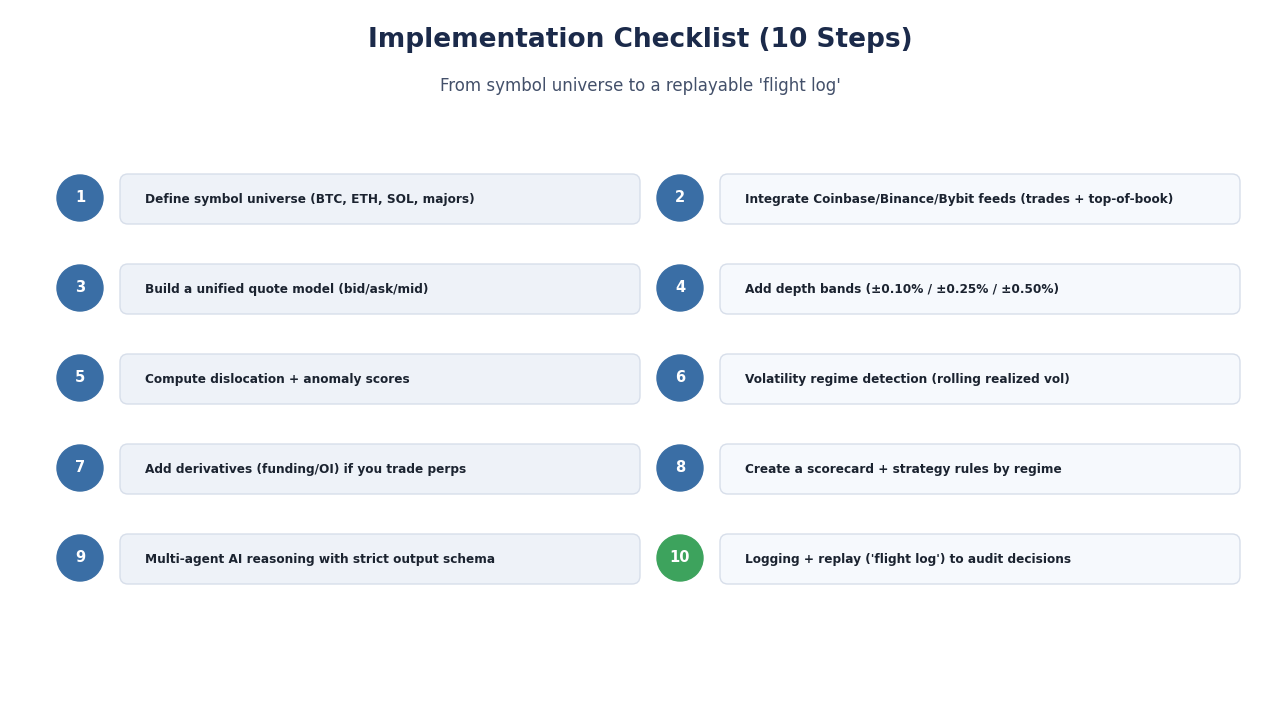
  1. Define your symbol universe (BTC, ETH, SOL, majors first)
  2. Integrate Coinbase/Binance/Bybit real-time feeds (start with trades + top-of-book)
  3. Build a unified quote model (best_bid, best_ask, mid)
  4. Add depth bands (±0.10%, ±0.25%, ±0.50%)
  5. Compute dislocation and anomaly scores
  6. Implement volatility regime detection (rolling realized vol)
  7. Add derivatives (funding/OI) if you trade perps
  8. Create a scorecard and strategy rules for regimes
  9. Add multi-agent AI reasoning with strict output schema
  10. Add logging + replay (“flight log”) to audit decisions
SimianX AI Implementation checklist illustration
Implementation checklist illustration

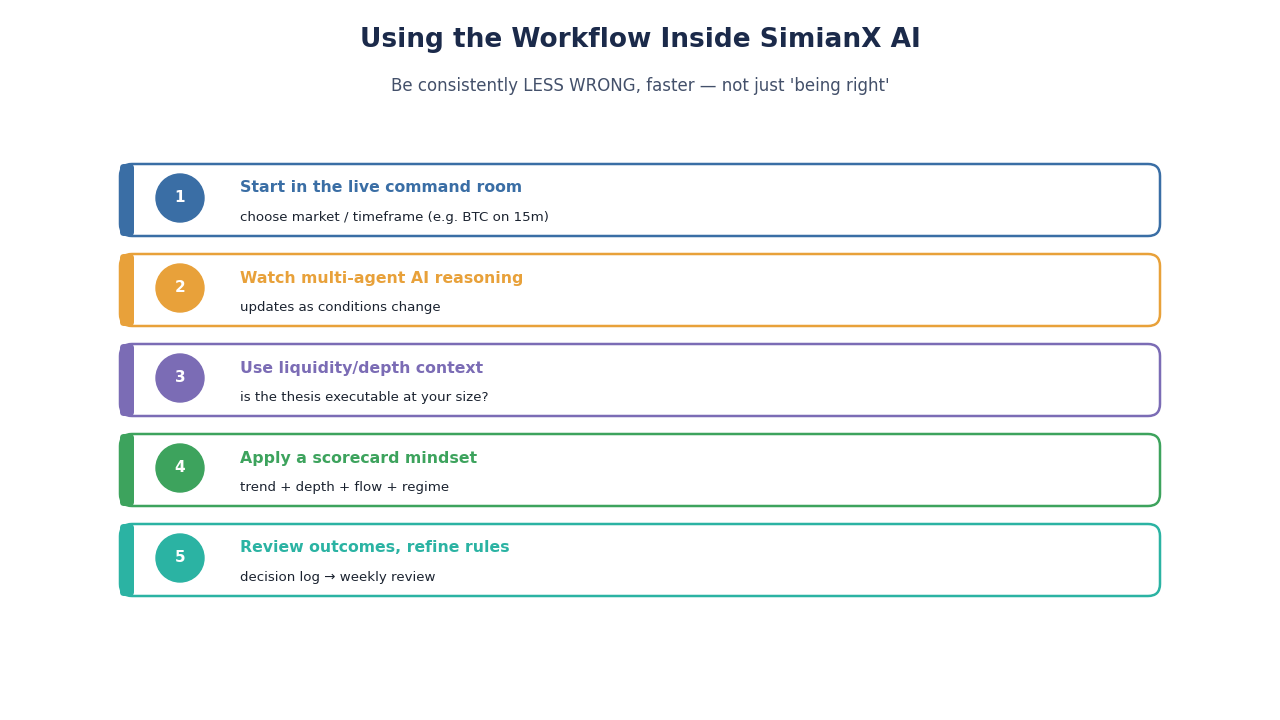
How to Use This Workflow Inside SimianX AI (Operational View)

If you want the command-room workflow without building the full stack, this is how traders typically apply it in SimianX AI:

  • Start in the live command room and choose a market/timeframe (e.g., BTC on 15m)
  • Watch multi-agent AI reasoning update as conditions change
  • Use liquidity/depth context to decide whether your thesis is executable
  • Use a scorecard mindset: trend + depth + flow + regime
  • Review outcomes and refine your rules over time

A strong command room isn’t just about “being right.” It’s about being consistently less wrong, faster.

SimianX AI Simulated command room workflow with AI reasoning timeline
Simulated command room workflow with AI reasoning timeline

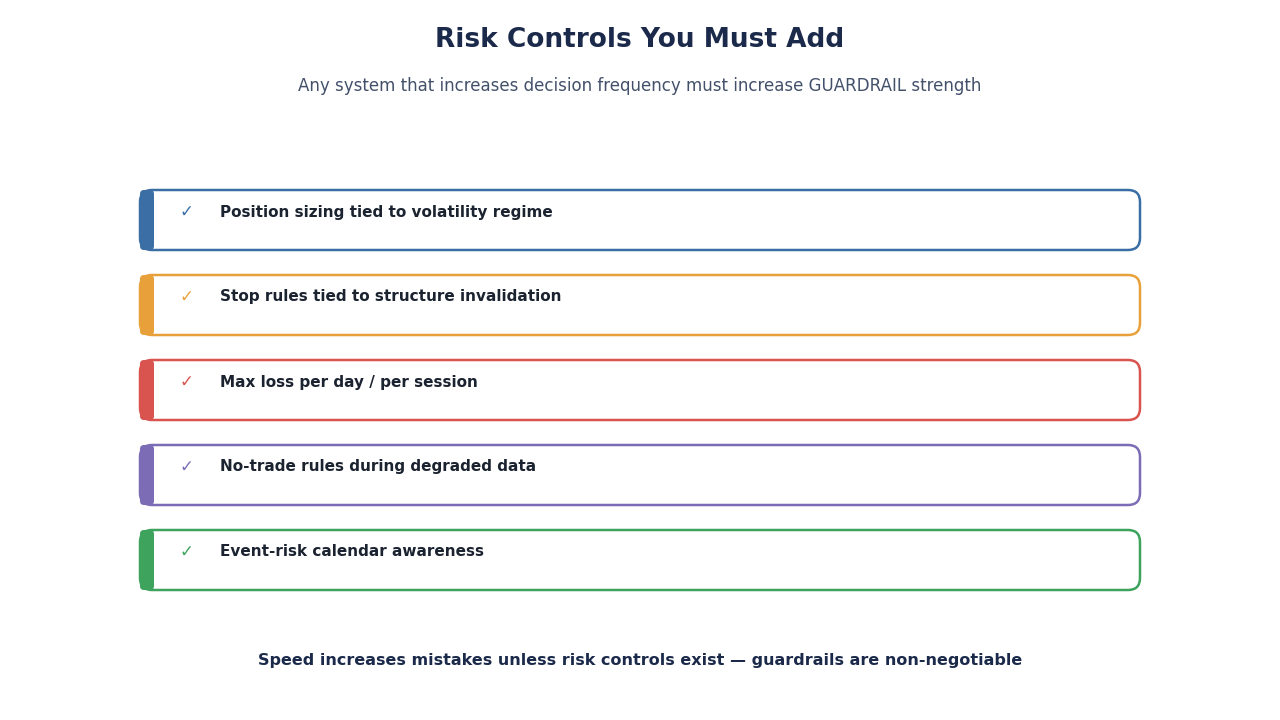
Risk Controls You Must Add (Even If You’re Just “Researching”)

Command rooms increase speed. Speed increases mistakes unless risk controls exist.

Non-negotiable risk controls

  • Position sizing tied to volatility regime
  • Stop rules tied to structure invalidation
  • Max loss per day / per session
  • No-trade rules during degraded data
  • Event risk calendar awareness

Research principle: Any system that increases decision frequency must also increase guardrail strength.

SimianX AI Risk guardrails panel concept
Risk guardrails panel concept

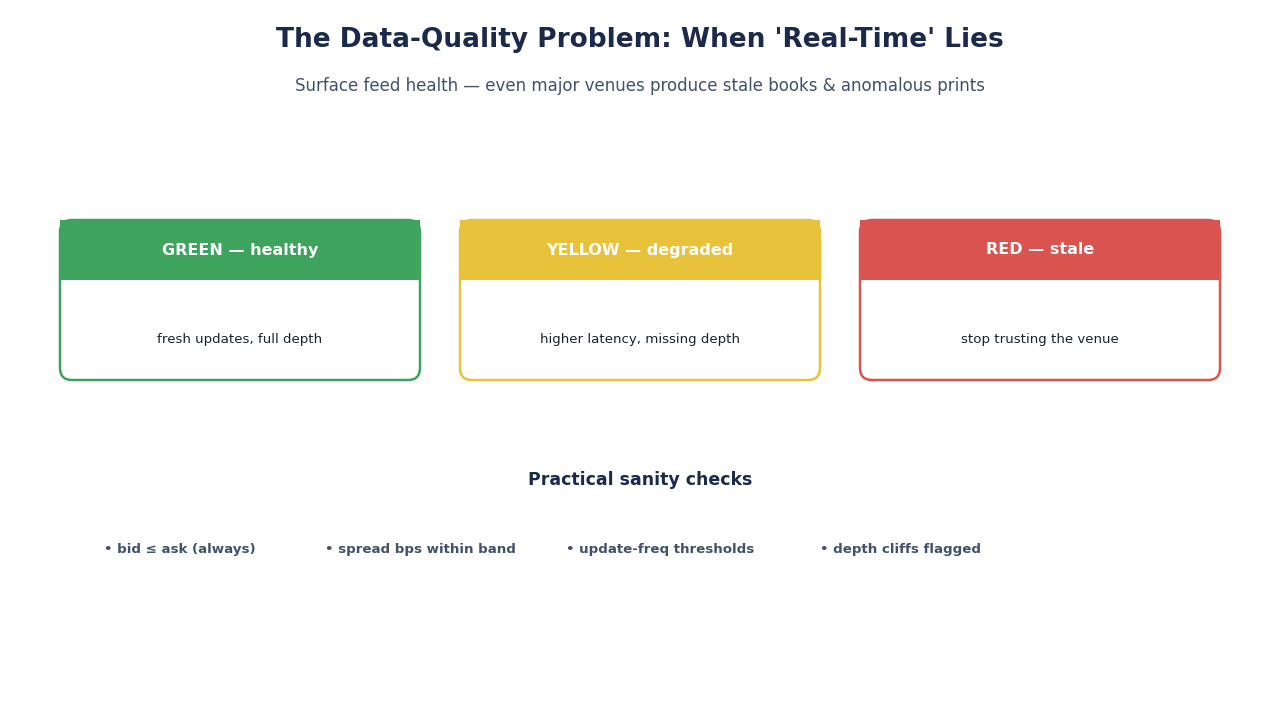
The Data Quality Problem: When “Real-Time” Lies

Even major venues can produce:

  • stale order books
  • partial outages
  • anomalous prints
  • sudden spread expansions

A command room should surface data health

Add visible “feed health” status:

  • green: healthy (fresh updates)
  • yellow: degraded (higher latency, missing depth)
  • red: stale (stop trusting the venue)

Practical sanity checks

  • bid ≤ ask (always)
  • spread bps within reasonable band (dynamic by regime)
  • update frequency thresholds
  • sudden depth cliffs flagged
SimianX AI Data health status indicators
Data health status indicators

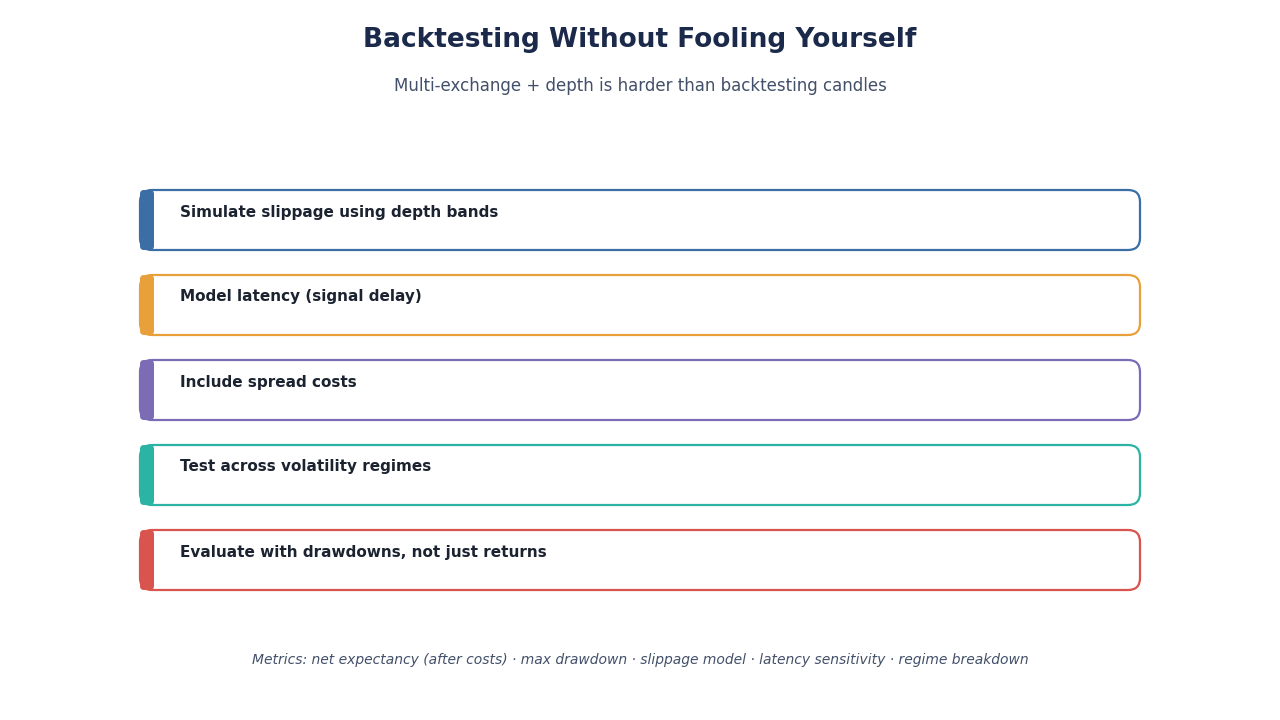
How to Backtest a Command Room Strategy (Without Fooling Yourself)

Backtesting multi-exchange + depth is harder than backtesting candles.

What you need to avoid false confidence

  • simulate slippage using depth bands
  • model latency (signal delay)
  • include spread costs
  • test across volatility regimes
  • evaluate with drawdowns, not just returns

Metrics that matter

  • hit rate (but only after costs)
  • average win / average loss
  • max drawdown
  • time-to-recover
  • regime-specific performance
MetricWhy it matters
Net expectancyreal profitability after costs
Max drawdownsurvival constraint
Slippage modelrealism in fast markets
Latency sensitivityrobustness to delays
Regime breakdowntells you when to stop
SimianX AI Backtest realism: latency + slippage illustration
Backtest realism: latency + slippage illustration

A Research-Based View of “Explainability” in AI Trading Tools

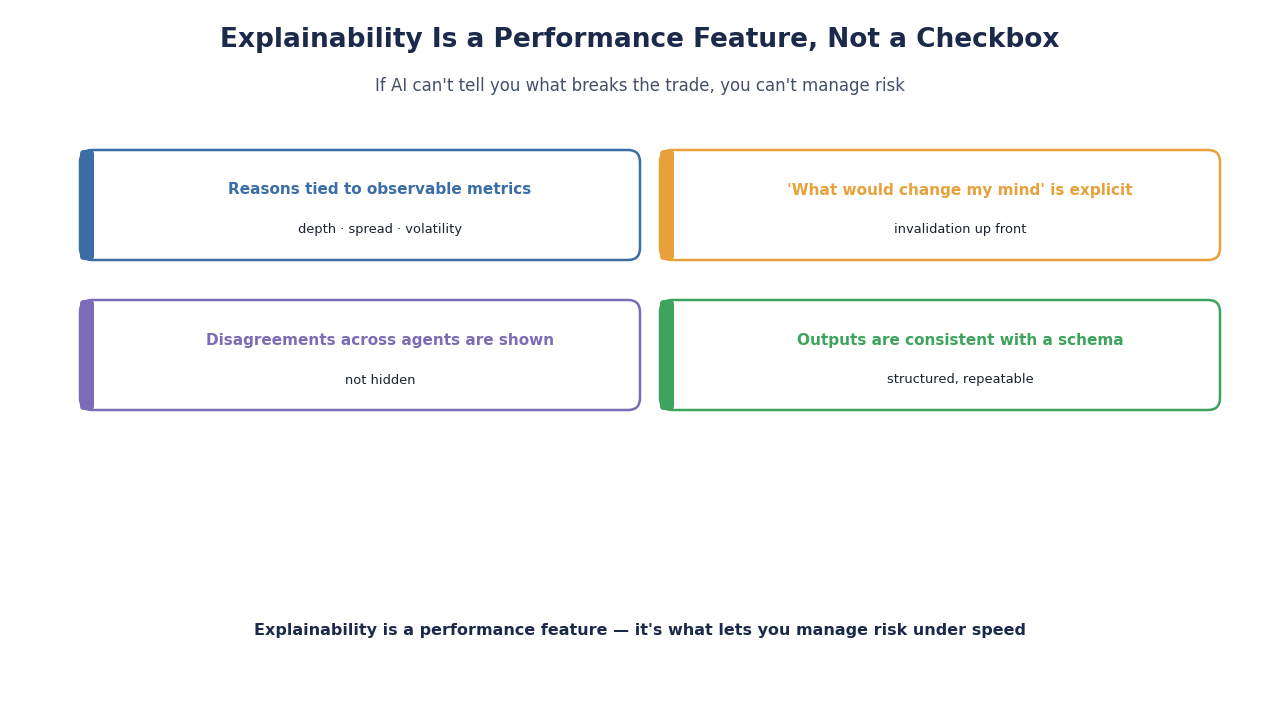
Explainability isn’t a legal checkbox—it’s a performance feature.

What explainability should look like in a command room

  • reasons are tied to observable metrics (depth, spread, volatility)
  • “what would change my mind” is explicit
  • disagreements across agents are shown
  • outputs are consistent with a schema

If AI can’t tell you what breaks the trade, you can’t manage risk.

SimianX AI Explainable AI reasoning card concept
Explainable AI reasoning card concept

Common Failure Modes (and How to Fix Them)

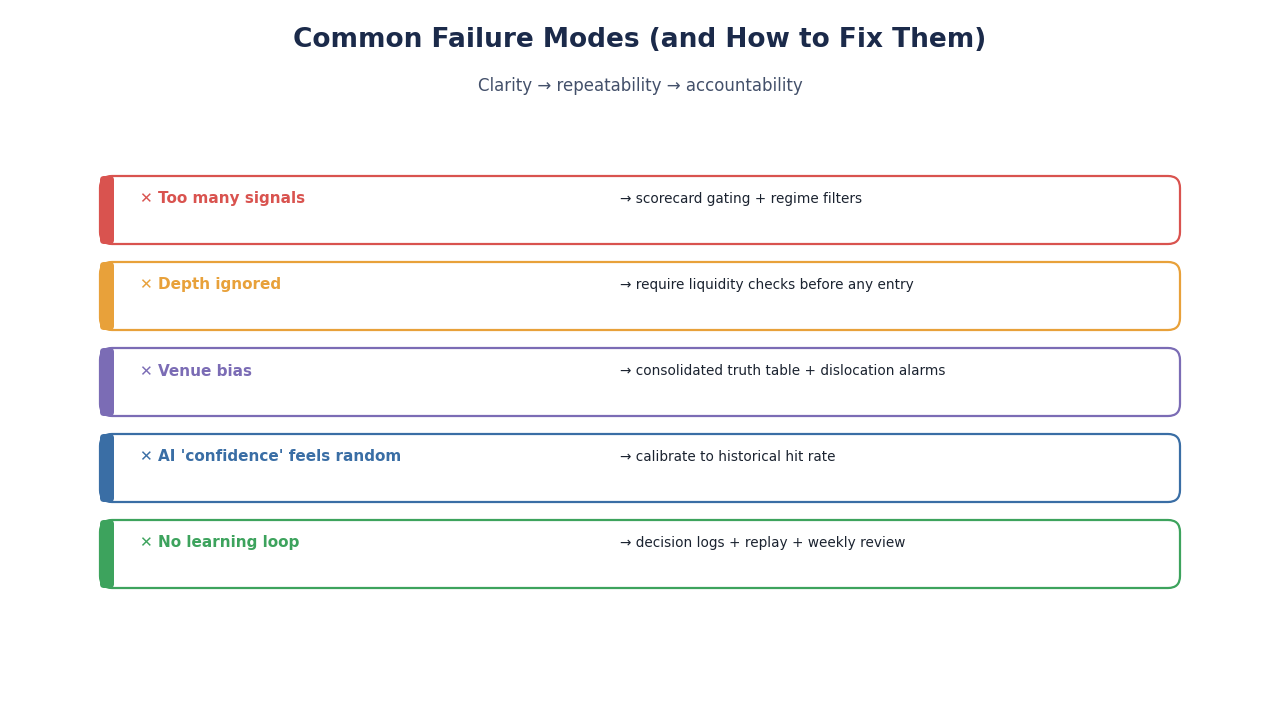
Failure mode 1: Too many signals

Fix: scorecard gating + regime filters

Failure mode 2: Depth ignored

Fix: require liquidity checks before any entry

Failure mode 3: Venue bias

Fix: consolidated truth table + dislocation alarms

Failure mode 4: AI “confidence” feels random

Fix: calibrate confidence to historical hit rate under similar conditions

Failure mode 5: No learning loop

Fix: decision logs + replay + weekly review

SimianX AI Failure modes and fixes diagram
Failure modes and fixes diagram

The Future: Agentic Command Rooms and Closed-Loop Execution

The next evolution is not “more indicators.” It’s closed-loop automation:

  • AI monitors conditions continuously
  • execution is conditional and risk-limited
  • post-trade logs train better rules and prompts

But even in the future, the winning pattern remains:

clarity → repeatability → accountability.

FAQ About Real-Time AI Crypto Command Room for Coinbase, Binance & Bybit

What is a real-time AI crypto command room?

A real-time AI crypto command room is a unified dashboard that combines multi-exchange market data (price, volume, depth) with AI reasoning to produce decision-ready context. The best implementations also include risk guardrails and a replayable decision log.

How do I compare Coinbase vs Binance prices without getting misled?

Use a consolidated mid price plus a dislocation score, and always check spread and depth on both venues. Price differences can reflect liquidity gaps, latency, or temporary microstructure effects—not true directional signals.

What is market depth in crypto, and why does it matter?

Market depth measures how much liquidity exists near the current price. It matters because it predicts slippage, wick risk, and whether a thesis is executable at your intended size.

How to build a crypto command room for multi-exchange trading?

Start with real-time trade + quote feeds, normalize symbols and timestamps, compute depth bands and dislocation, then add volatility regimes and a scorecard. Only then layer AI reasoning with a strict output schema and logging.

Is an AI-generated buy/sell/hold signal enough to trade?

Not by itself. A useful AI signal must include conditions, invalidation, and risk context. The command room’s job is to turn signals into managed decisions, not impulsive entries.

Conclusion

A Real-Time AI Crypto Command Room for Coinbase, Binance & Bybit is the fastest way to convert multi-venue chaos into structured decision-making. The research takeaway is simple: price alone is incomplete—you need depth, flow, regime awareness, and explainable reasoning to trade responsibly in real time.

Whether you build your own or adopt a ready workflow, focus on the essentials: a multi-exchange truth table, liquidity-first execution context, calibrated risk gates, and a learning loop that improves over time. If you want to explore how a multi-agent, explainable command-room workflow can look in practice, visit SimianX AI and evaluate it as a unified command room for real-time crypto decision-making.

Related Reading

References

Ready to Transform Your Trading?

Join thousands of investors using AI-powered analysis to make smarter investment decisions

Today's most analyzed — click to enter the Live Command Room