
 By Muke
S&P 500 Risk Radar: AI-Powered Signals from Breadth, Revisions & Spreads
An S&P 500 risk radar is not about predicting the next headline—it’s about measuring the probability that risk is rising before drawdowns force you to react. The most reliable “early warnings” usually appear inside the market (breadth), inside fundamentals (earnings revisions), and inside funding conditions (credit spreads). When you combine these three pillars and let AI summarize why they’re moving, you get a decision tool that helps you size risk, hedge earlier, and avoid getting trapped by a misleading index-level rally.
This is exactly the kind of workflow platforms like SimianX AI are built for: turning noisy, cross-market inputs into explainable, repeatable signals you can use every day—without running ten spreadsheets and a dozen tabs.
Why a “Risk Radar” beats a single indicator
A lot of investors rely on one favorite gauge—VIX, a moving average, or a recession model. The problem is that single indicators are fragile:
- They can fail in new regimes (e.g., disinflation vs. inflation shocks).
- They can be late (e.g., volatility often spikes after damage starts).
- They can be gamed or distorted (positioning, options flows, liquidity).
A radar approach is different: it blends independent information sources so you’re not overconfident in one lens.
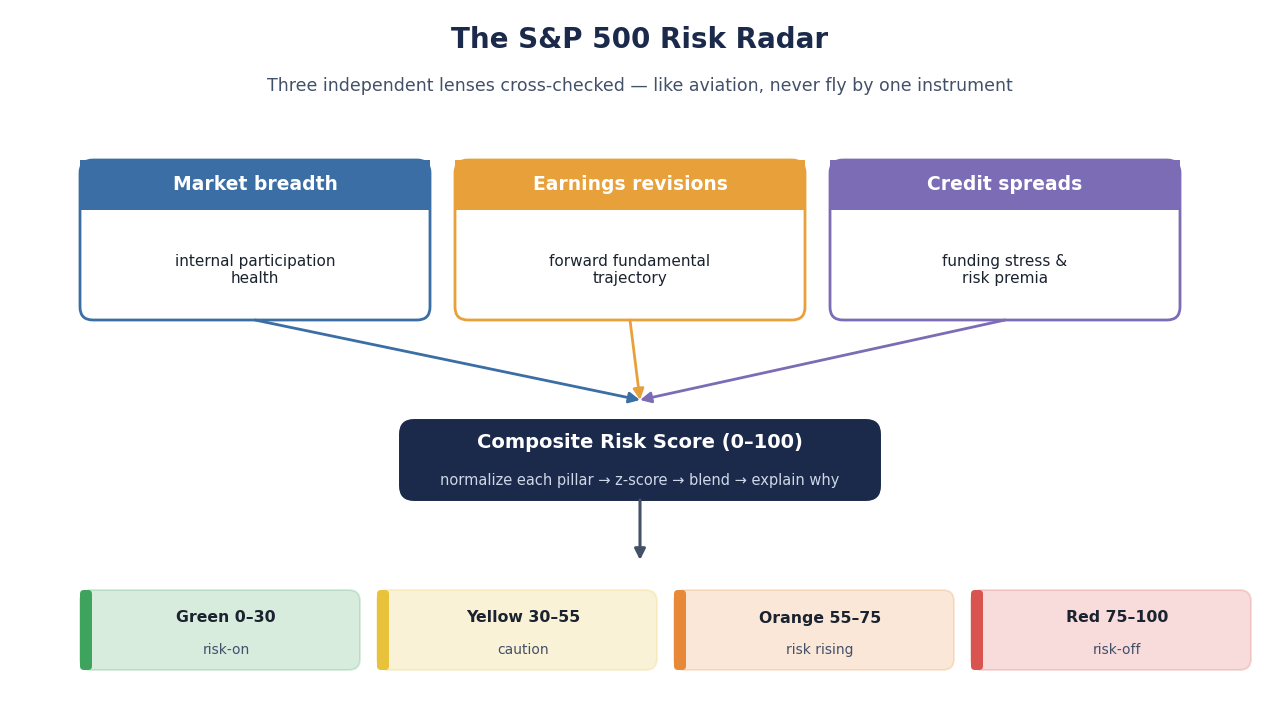
A strong risk radar works like aviation: you don’t fly by one instrument—you cross-check multiple systems to confirm whether conditions are changing.
Core idea: the S&P 500 (SPX or SPY) can look healthy while internal participation deteriorates, earnings expectations roll over, and credit quietly tightens. Your radar is designed to catch those divergences.
The three-pillar framework
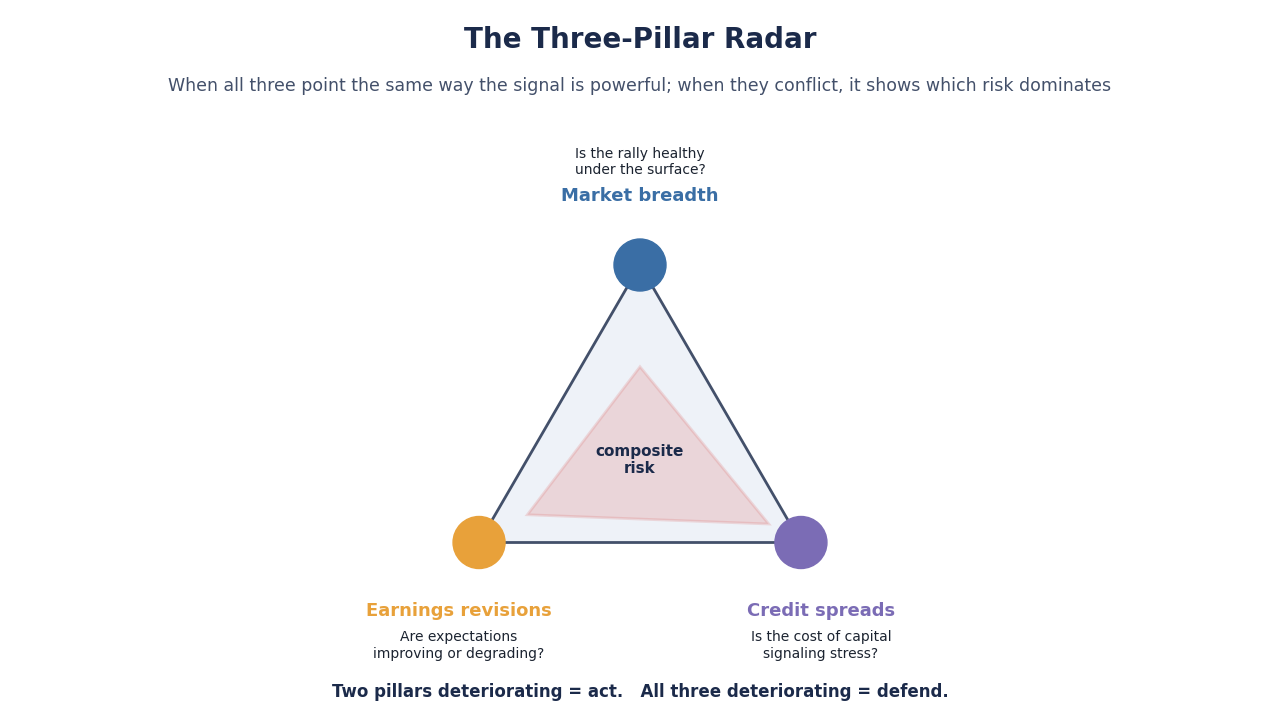
Think of the radar as a triangle. Each pillar answers a different question:
- Market breadth: Is the rally healthy under the surface?
- Earnings revisions: Are expectations improving or degrading?
- Credit spreads: Is the cost of capital signaling stress?
When all three point the same way, the signal is powerful. When they conflict, the radar helps you interpret which risk dominates.
Pillar 1 — Market breadth: the market’s “immune system”
Market breadth measures participation. In broad, sustainable uptrends, many stocks contribute. In fragile markets, fewer names carry the index (often mega-caps), while the average stock weakens.
High-signal breadth metrics (practical shortlist)
Use a small set that captures different angles:
- Advance/decline (A/D) trend: are more stocks rising than falling?
- % of stocks above key moving averages (e.g., 50-day, 200-day): is trend strength broad?
- New highs vs. new lows: is leadership expanding or narrowing?
- Equal-weight vs. cap-weight performance: is the average stock keeping up with the giants?
- Sector participation: are “risk-on” sectors confirming, or is leadership defensive?
Interpretation heuristic
- Breadth improving = risk appetite is spreading, trend is healthier.
- Breadth deteriorating while
SPXrises = rising fragility (divergence risk). - Breadth capitulation (washed-out readings) = potential tactical opportunity, but confirm with the other pillars.
Common breadth traps
- Overreacting to one-day extremes (breadth is noisy).
- Ignoring regime (breadth behaves differently in choppy, range-bound markets).
- Treating breadth as a “timing tool” instead of a risk condition tool.
Best practice: smooth signals (weekly or 10–20 day rolling) and focus on direction and divergence, not perfection.
Pillar 2 — Earnings revisions: fundamentals in motion
Prices can overshoot, but over time the index follows earnings power. Earnings revisions track whether analysts are raising or cutting forward estimates—often a more responsive lens than trailing EPS.
What to monitor
- Net revision breadth: % of upward revisions minus % of downward revisions.
- Forward EPS momentum: 3–6 month change in next-12-month EPS.
- Guidance tone proxies: upgrades/downgrades, sector-level estimate changes.
- Revision dispersion: are cuts concentrated (idiosyncratic) or broad (systemic)?
How revisions typically behave in risk cycles
- Early cycle: revisions trend up as demand strengthens.
- Late cycle: revisions flatten, then roll over.
- Stress: revisions fall sharply as margins compress and guidance resets.
In many drawdowns, the market doesn’t crash because earnings are bad—it crashes because earnings expectations stop getting better.
Key radar insight: revisions are often slower than breadth, but when they confirm weakness, risk regimes tend to persist longer.
Pillar 3 — Credit spreads: the funding stress seismograph
Credit spreads (investment grade and high yield) reflect how much compensation lenders demand versus safe rates. When spreads widen, it often signals tightening financial conditions, higher default risk, or reduced liquidity.
What to track (keep it simple)
- High yield (HY) spreads: sensitive to risk appetite and growth fear.
- Investment grade (IG) spreads: less volatile, still informative in stress.
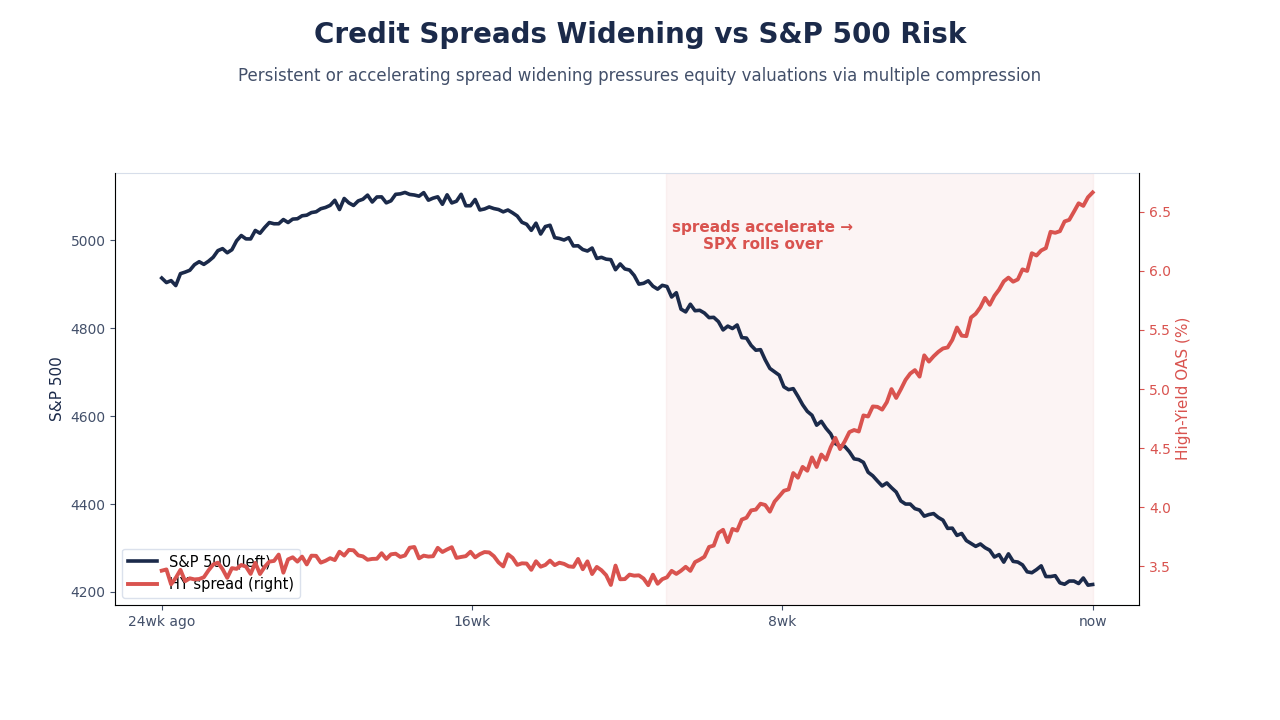
- Spread change and acceleration: the rate of widening matters.
Why spreads matter to equities
Equities and credit are linked through:
- corporate refinancing costs,
- default risk expectations,
- liquidity conditions,
- risk premia across assets.
When spreads widen persistently, equities often face multiple compression and weaker buyback/financing dynamics.
How does an S&P 500 risk radar work in practice?
A usable radar needs two things:
1) a composite score you can act on,
2) an explanation layer so you trust it under pressure.
Step 1: Convert each pillar into a normalized score (0–100)
A practical approach:
- Pick 3–5 metrics per pillar.
- Convert each metric to a z-score (how extreme vs. history).
- Clip extremes to avoid one indicator dominating.
- Average them into a pillar score.
Example mapping:
- 0–30 = low risk (supportive conditions)
- 30–60 = neutral / mixed
- 60–80 = rising risk (tighten exposure)
- 80–100 = high risk (defensive posture)
Step 2: Weight the pillars (start equal, then adapt)
A default is equal weight:
- Breadth 33%
- Revisions 33%
- Spreads 33%
Then adapt slightly by regime:
- If inflation/rate shocks dominate, spreads and breadth may deserve more weight.
- If earnings season and guidance dominate, revisions carry more weight.
Step 3: Define “regimes” you can trade
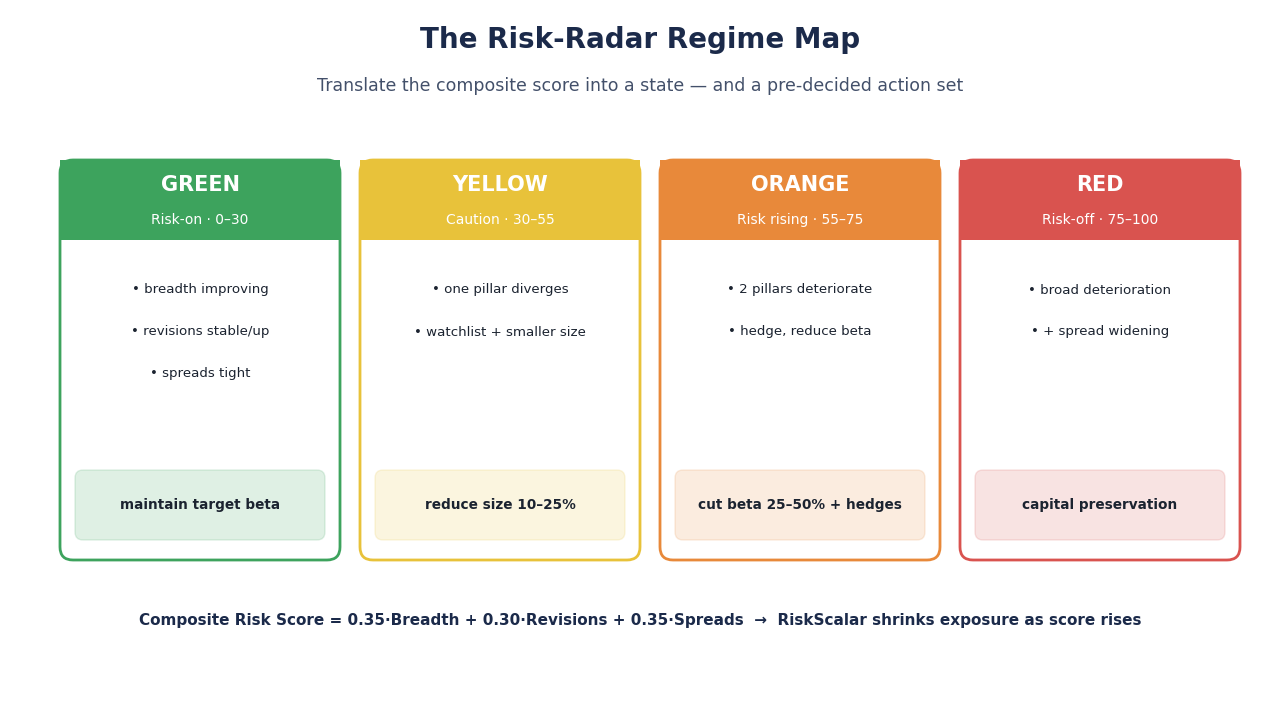
Turn the composite score into clear states:
- Green (Risk-on): breadth improving, revisions stable/up, spreads tight/stable
- Yellow (Caution): one pillar diverges (watchlist + smaller size)
- Orange (Risk rising): 2 pillars deteriorate (hedge, reduce beta)
- Red (Risk-off): broad deterioration + spread widening (capital preservation)
Step 4: Add AI for explanation, not mystique
This is where AI shines: turning a multi-input radar into a readable narrative:
- “Breadth is weakening because fewer sectors are participating.”
- “Revisions rolled over in cyclicals, suggesting profit expectations are fading.”
- “HY spreads widened quickly, signaling tighter risk conditions.”
In SimianX AI, you can operationalize this as a repeatable workflow: ingest the three pillars, have AI summarize drivers, and surface decision-ready alerts (not just raw charts). Include your own rules so the system matches your strategy style.
A decision playbook: what to do when the radar changes
A risk radar is only valuable if it changes your actions before the drawdown.
When the radar shifts from Green → Yellow
- Reduce leverage and “thin-margin” trades
- Tighten stops and shorten holding periods
- Prefer quality and strong balance sheets
- Watch for breadth divergences vs.
SPX
When the radar shifts from Yellow → Orange
- Reduce net exposure (beta) and concentrate into best setups
- Add hedges (index puts, collars, defensive tilts)
- Avoid crowded momentum if breadth is narrowing
- Pay attention to spread acceleration (fast widening is a red flag)
When the radar shifts to Red
- Prioritize capital preservation
- Increase cash or defensive positioning
- Avoid illiquid or highly levered names
- Use AI-generated scenario summaries to avoid emotional decisions
In Red regimes, the goal is rarely “maximize return.” It’s minimize mistakes.
A compact indicator table you can reuse
Use this table as a build checklist.
| Pillar | What it measures | Example signals | Risk rising when… | Common pitfall |
|---|---|---|---|---|
| Market breadth | Participation / internal health | A/D trend, % above 200DMA, new highs-lows | Index rises but participation falls | Treating one-day breadth as decisive |
| Earnings revisions | Forward fundamentals | net upgrades/downgrades, forward EPS momentum | Revisions roll over broadly | Using revisions without sector context |
| Credit spreads | Funding stress / risk premia | HY/IG spread level + rate of change | Spreads widen persistently or accelerate | Ignoring rates regime and liquidity |
How to build your S&P 500 risk radar in 7 steps
- Pick your universe:
SPXconstituents, orSPYproxies + sector breadth. - Select 3–5 metrics per pillar (avoid indicator bloat).
- Normalize metrics (z-scores, percentile ranks).
- Smooth noise (weekly or rolling windows).
- Create pillar scores and a composite score.
- Define regimes and actions (Green/Yellow/Orange/Red).
- Backtest behaviors, not perfection (does it reduce major drawdowns and improve decision quality?).
What is the best way to combine market breadth and credit spreads?
Use breadth as the early internal warning and spreads as the confirmation of tightening conditions:
- If breadth weakens but spreads stay calm → often a rotation or narrow leadership phase (caution, not panic).
- If breadth weakens and spreads widen → higher probability of systemic risk-off (reduce beta, hedge).
- If spreads tighten while breadth improves → healthier risk-on backdrop.
A simple rule that works surprisingly well:
- Two pillars deteriorating = act.
- All three deteriorating = defend.
And this is where an AI layer (like SimianX AI) can add real value: it can explain which pillar is driving the change, summarize cross-asset context, and keep a consistent decision log—so you learn from every regime shift instead of repeating the same mistakes.
Common mistakes (and how to avoid them)
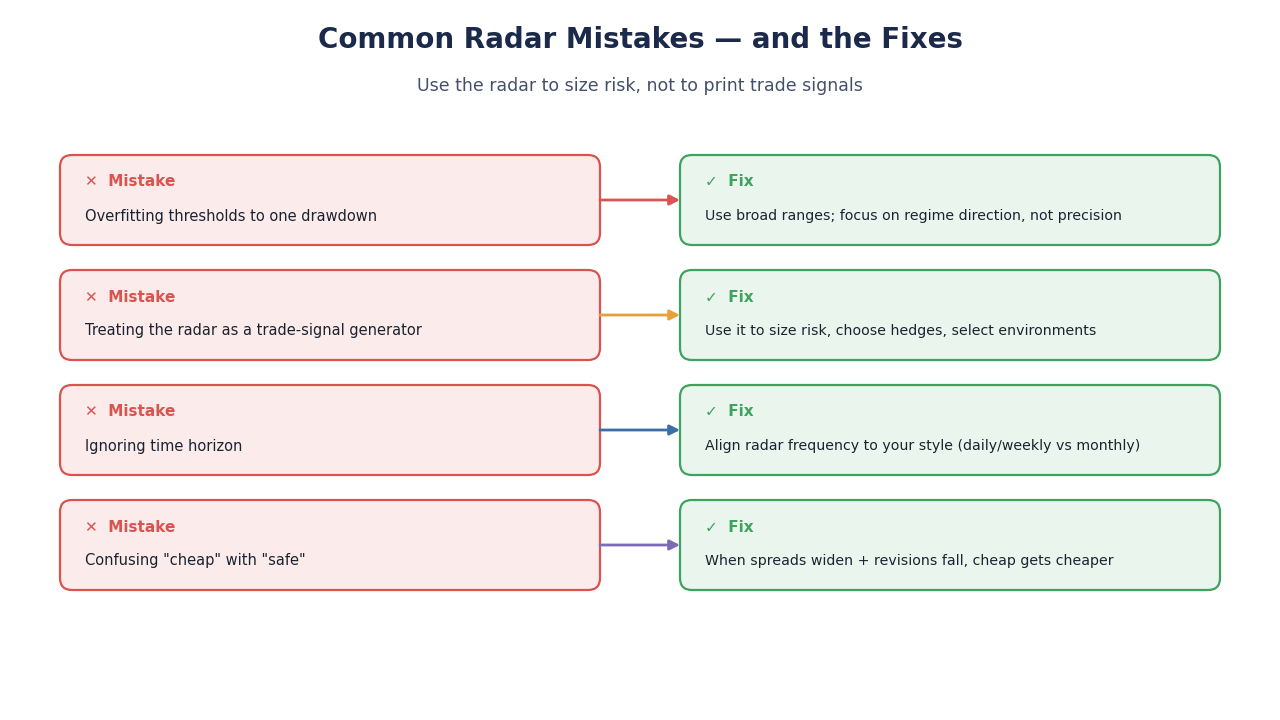
- Mistake: Overfitting thresholds to one historical drawdown
Fix: Use broad ranges and focus on regime direction, not precision.
- Mistake: Treating the radar like a trade signal generator
Fix: Use it to size risk, choose hedges, and select environments for strategies.
- Mistake: Ignoring time horizon
Fix: Align radar frequency with your style (daily/weekly for swing, weekly/monthly for investors).
- Mistake: Confusing “cheap” with “safe”
Fix: When spreads widen and revisions fall, “cheap” can get cheaper.
FAQ About S&P 500 risk radar
What is an S&P 500 risk radar used for?
An S&P 500 risk radar is used to monitor changing market risk conditions and translate them into actionable regime states (risk-on vs. risk-off). It helps investors adjust exposure, hedges, and time horizon before drawdowns deepen.
How often should I update a risk radar for US stocks?
Most traders update it daily with smoothing, while investors often update weekly. The best cadence is the one that matches your decision frequency—updating too fast can create noise, too slow can miss regime shifts.
What market breadth indicators work best for S&P 500 downside risk?
Broad participation measures like % above 200-day moving average, new highs vs. new lows, and equal-weight vs. cap-weight divergence tend to be useful. The most important feature is consistency: track a small set and interpret trend + divergence.
How do credit spreads warn about equity selloffs?
Credit spreads widen when lenders demand more compensation for risk, often reflecting tighter liquidity and rising default concerns. Persistent or accelerating widening can signal a shift toward risk-off conditions that often pressures equity valuations.
Can AI really improve a stock market risk dashboard?
Yes—when AI is used for explanation, anomaly detection, and workflow automation, not as a black box prediction engine. AI can synthesize breadth/revisions/spreads into clear narratives and alerts, which is especially valuable during fast regime shifts.
Conclusion
A strong S&P 500 risk radar is built on three complementary pillars: market breadth (internal health), earnings revisions (fundamental trajectory), and credit spreads (funding stress). When you normalize them into a composite score and translate that score into actionable regimes, you stop relying on hope and start operating with a process.
If you want a practical way to run this workflow consistently—signal ingestion, regime labeling, explainable summaries, and decision logging—explore how SimianX AI can support a daily risk radar process and help you make calmer, better-timed risk decisions: SimianX AI.
Advanced Signal Engineering: Turning Breadth, Revisions, and Spreads into “Machine-Readable” Risk Features
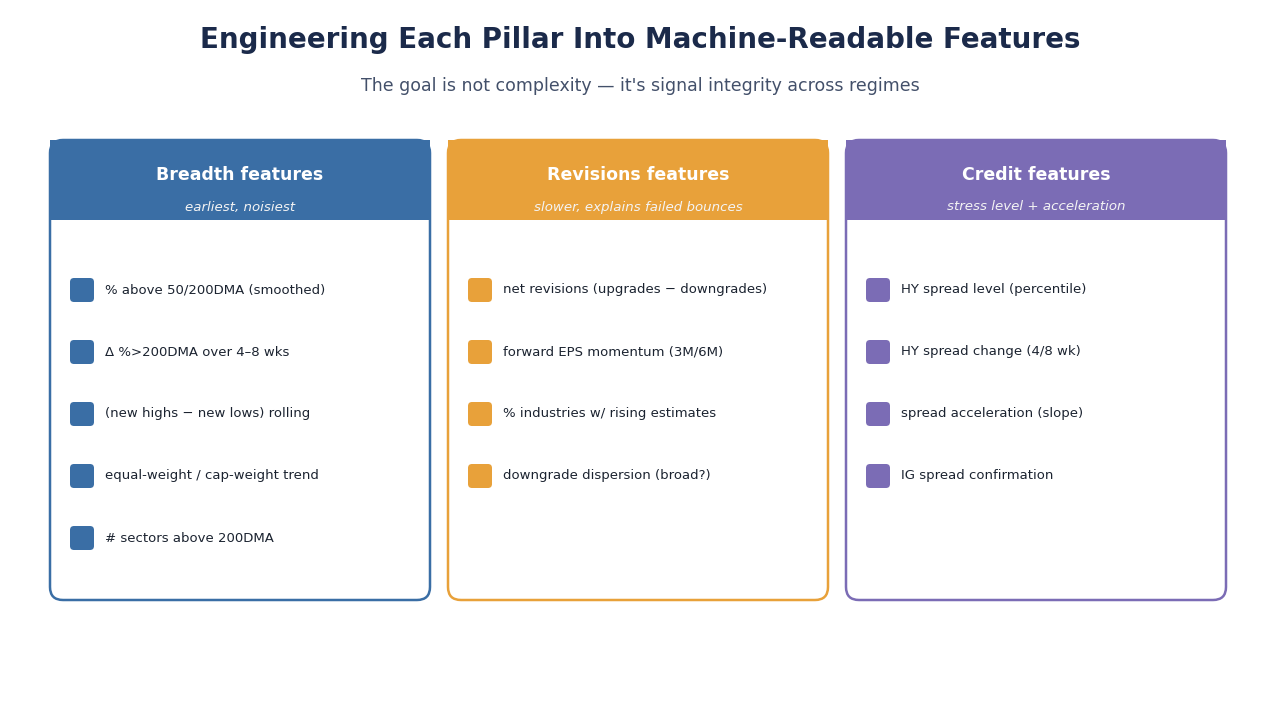
A strong S&P 500 risk radar becomes far more reliable when you engineer each pillar into a small set of robust features that an AI system can track consistently across regimes. The goal is not complexity—it’s signal integrity.
Breadth feature set (keep it tight, reduce noise)
Breadth is often the earliest warning, but it’s also the noisiest. Favor features that capture participation trend and divergence:
- Participation level:
% above 50DMA,% above 200DMA(smoothed) - Participation momentum: change in
% above 200DMAover 4–8 weeks - Leadership expansion:
(new highs - new lows)as a rolling measure - Index divergence:
equal-weight / cap-weightrelative trend - Sector confirmation: number of sectors above their 200DMA
Practical trick: convert each metric into a percentile rank vs. its own history, then compute a breadth risk score:
- Low risk when breadth percentile is high and rising
- Rising risk when breadth percentile is falling, especially while price stays strong
Earnings revisions feature set (fundamentals in motion)
Revisions are slower-moving, but they often explain why a “bounce” fails.
- Net revisions: upgrades minus downgrades (index + sector)
- Forward EPS momentum: 3M and 6M change in next-12-month EPS
- Revision breadth: % of industries with rising estimates
- Dispersion: how concentrated vs. broad-based the downgrades are
Interpretation pattern:
- If breadth weakens first and revisions follow, the risk regime tends to persist longer.
- If revisions stabilize while spreads remain calm, risk-off signals are often tactical rather than structural.
Credit spread feature set (stress level + stress acceleration)
Credit doesn’t just warn by “being wide.” It warns by widening quickly and by staying wide.
- HY spread level (percentile vs. history)
- HY spread change (4-week, 8-week)
- Spread acceleration (second derivative / slope steepening)
- IG spread confirmation (less volatile, useful for trend confirmation)
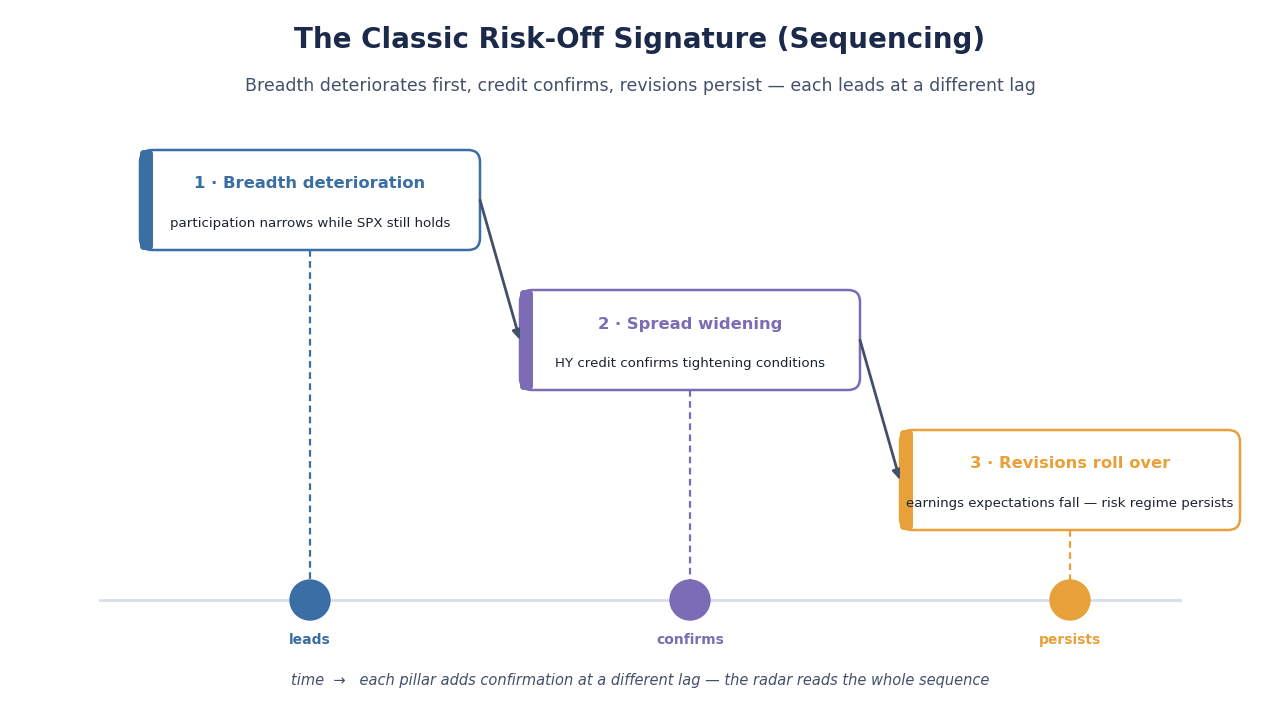
A classic risk-off signature is: breadth deterioration → spread widening → revisions rolling over.
Rule-Based vs. Machine Learning: A Hybrid Radar is Usually Best
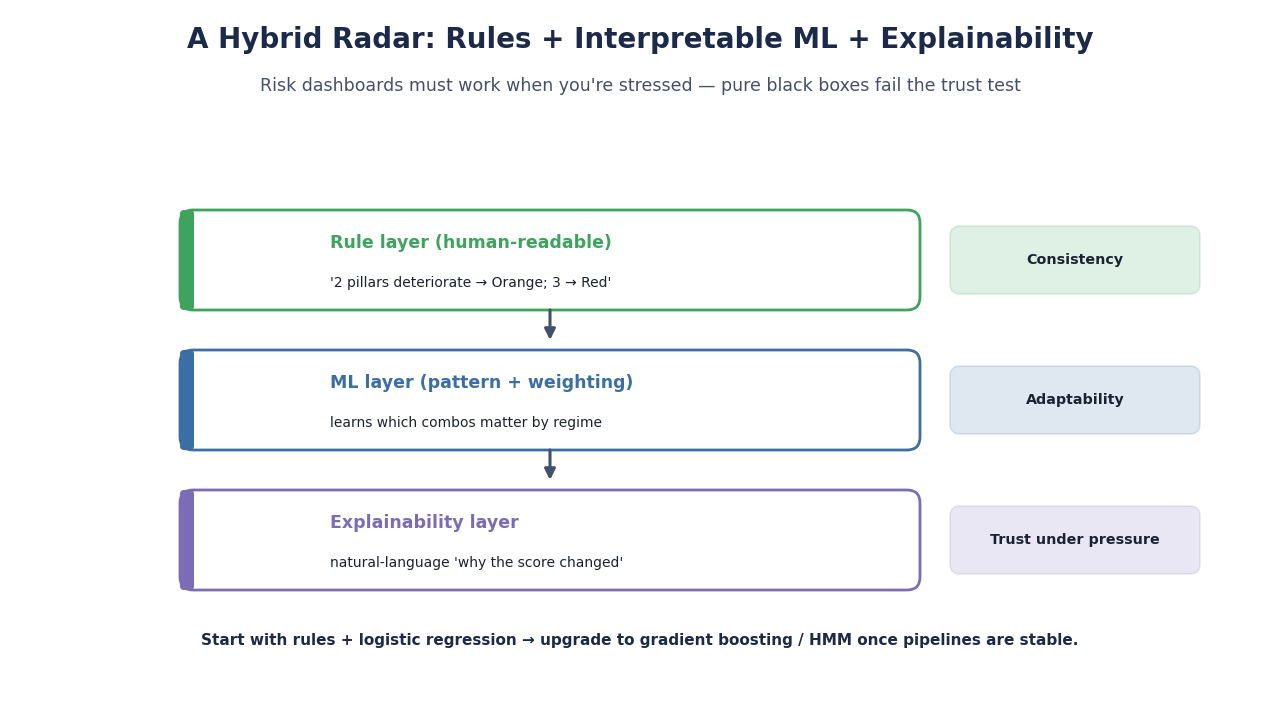
You can build the radar in two complementary layers:
- Rule layer (human readable):
“If two pillars deteriorate beyond threshold → shift to Orange; if three → Red.”
- ML layer (pattern recognition + weighting):
A model that learns which combinations matter most in different regimes.
Why not go “full black box”?
Because risk dashboards must work when you’re stressed. A pure black-box model often fails the trust test: you’ll ignore it precisely when it matters.
A hybrid approach gives you:
- Consistency (rules)
- Adaptability (ML weights)
- Explainability (natural-language summaries)
Model options that work well for regime detection
Below is a practical comparison (you don’t need all of these—pick one path and execute well):
| Approach | Strength | Weakness | Best use case |
|---|---|---|---|
| Threshold rules | Transparent, stable | Can be rigid | Daily/weekly risk toggles |
| Logistic regression | Simple, interpretable | Limited nonlinearity | “Risk-on vs risk-off” probability |
| Gradient boosting | Handles nonlinearity | Harder to explain | Higher accuracy composites |
| Hidden Markov Model (HMM) | True regime framework | Sensitive to setup | Detecting latent market states |
| Bayesian updating | Great with uncertainty | More complex | Probabilistic radar with confidence |
Recommendation: start with rules + logistic regression, then upgrade to boosting/HMM once you have stable pipelines.
Calibration: The Radar Must Match Your Time Horizon
A common reason risk models disappoint is time-horizon mismatch.
Align features and smoothing to your style
- Swing / tactical (days to weeks):
- Breadth: 10–20 day smoothing
- Spreads: 1–4 week changes + acceleration
- Revisions: weekly cadence is enough
- Investor / allocation (months):
- Breadth: weekly
- Spreads: 4–12 week trend
- Revisions: 1–3 month trend
A clean “regime score” design (0–100)
A simple template you can reuse:
- Compute a pillar score (0–100) for Breadth, Revisions, Spreads
- Compute composite:
Composite = 0.35*Breadth + 0.30*Revisions + 0.35*Spreads (example weights)
Then map to regimes:
- 0–30: Green (risk-on)
- 30–55: Yellow (mixed)
- 55–75: Orange (risk rising)
- 75–100: Red (risk-off)
The key is not the exact numbers—it’s stability and behavioral clarity.
Validation: How to Backtest a Risk Radar the Right Way
Backtesting a risk radar is different from backtesting a trading strategy. You’re testing whether the radar improves decisions such as reducing drawdowns, avoiding severe regimes, and controlling exposure.
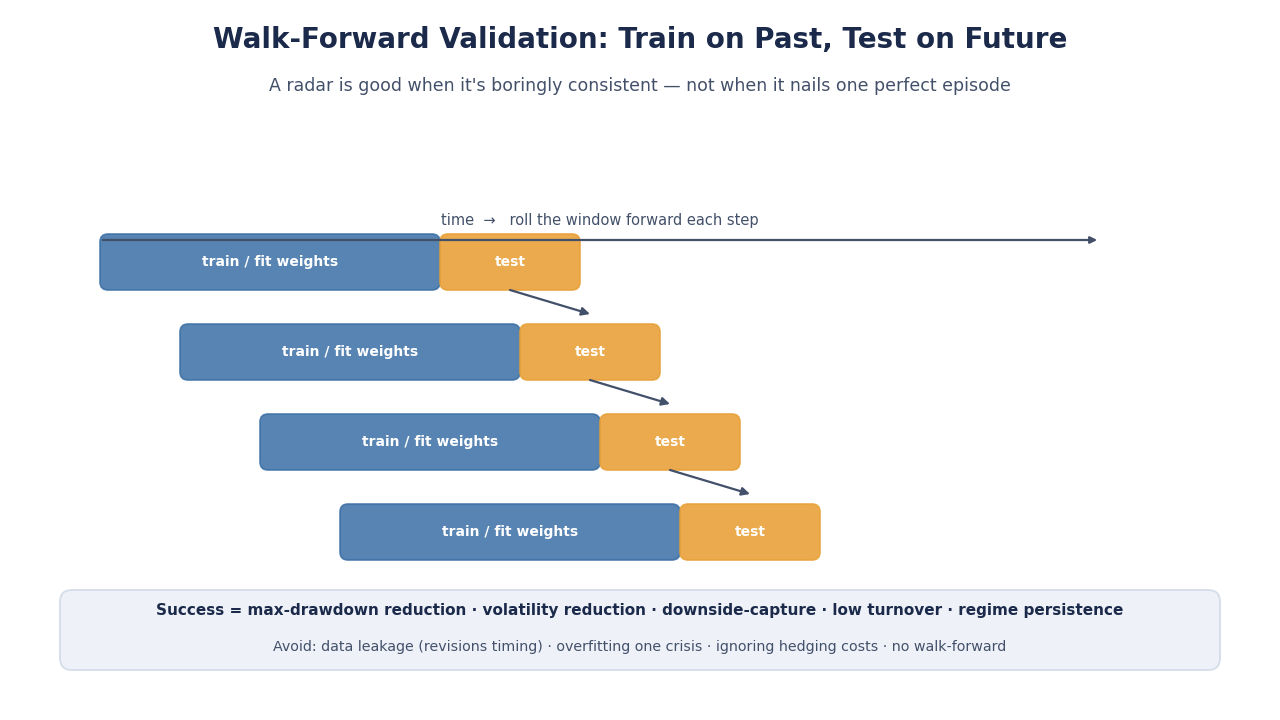
What success looks like (metrics that matter)
Instead of “win rate,” evaluate:
- Max drawdown reduction vs. a baseline (e.g., always invested)
- Volatility reduction while maintaining reasonable upside capture
- Downside capture ratio (how much of bear moves you avoided)
- Turnover (too many flips = noise)
- Regime persistence quality (does Red stay Red long enough to matter?)
Avoid the most common backtest mistakes
- Leakage: using future information (especially revisions data timing)
- Overfitting thresholds to one crisis period
- Ignoring transaction costs from frequent hedging changes
- Not using walk-forward testing (train on past, test on future)
Best practice: do a walk-forward approach:
- Pick an initial training window
- Fit thresholds / weights
- Test on the next period
- Roll forward and repeat
A radar is good when it’s boringly consistent, not when it nails one perfect historical episode.
Action Layer: Translating Radar Regimes into Portfolio Moves
The risk radar becomes useful when each state maps to a pre-decided action set. This prevents emotional overrides.
Example playbook (simple and effective)
Green (risk-on)
- Maintain target beta
- Use trend-following entries
- Broader sector exposure is acceptable
Yellow (caution)
- Reduce position size modestly (e.g., -10% to -25% gross)
- Tighten stops / shorten time horizon
- Favor quality + lower leverage
Orange (risk rising)
- Reduce beta meaningfully (e.g., -25% to -50%)
- Add systematic hedges (index puts, collars, or futures overlays)
- Avoid crowded momentum if breadth is narrowing
Red (risk-off)
- Capital preservation mode
- Raise cash / defensive posture
- Focus on liquidity, avoid leverage
- Optional: tactical mean-reversion only with strict risk limits
A clean position sizing template
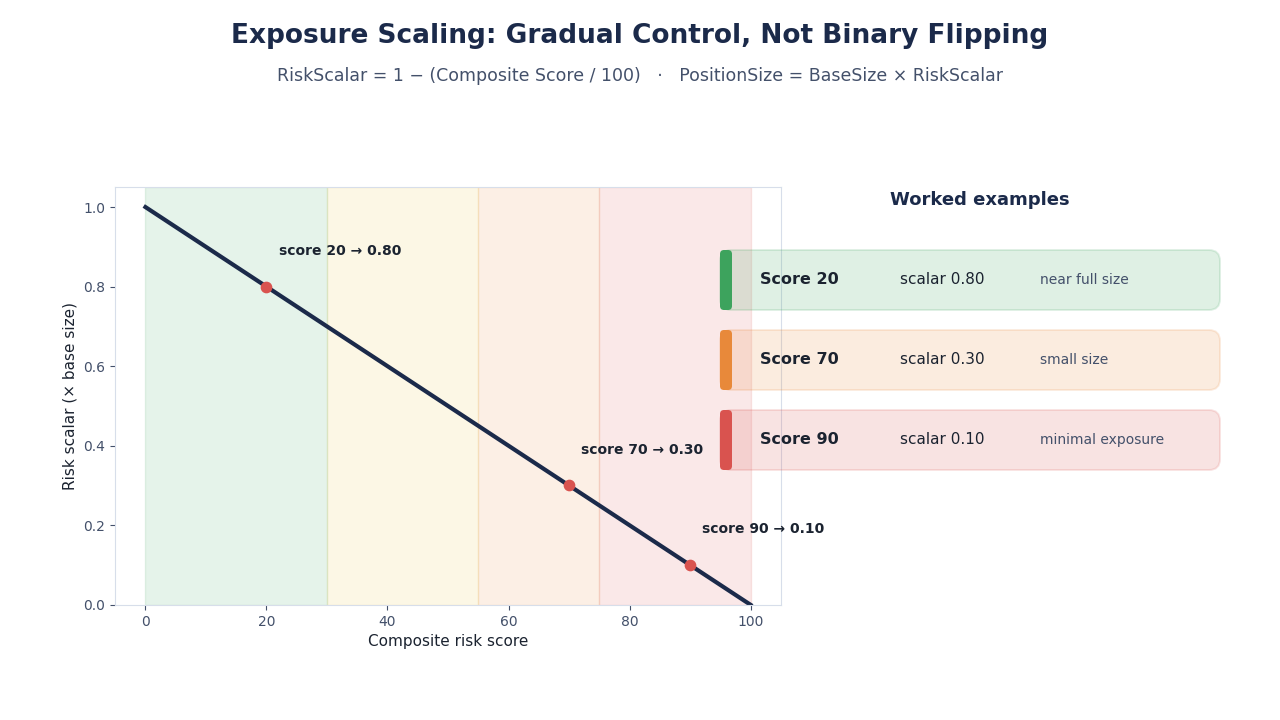
Use a simple risk scalar tied to the composite score:
- Define
RiskScalar = 1 - (CompositeScore / 100) - Size positions as:
PositionSize = BaseSize * RiskScalar
So:
- Score 20 → scalar 0.80 (near full size)
- Score 70 → scalar 0.30 (small size)
- Score 90 → scalar 0.10 (minimal exposure)
This turns the radar into gradual exposure control, not binary flipping.
Scenario Stress Testing: What Happens If the World Changes?
A robust S&P 500 risk radar should remain useful across multiple macro environments. Run scenario tests so you understand why the radar might shift.
Useful stress scenarios to simulate
- Growth scare / recession risk: revisions collapse + spreads widen
- Inflation shock: spreads widen while index holds up temporarily
- Liquidity event: spread acceleration spikes, breadth breaks rapidly
- Earnings reset: revisions roll over first; breadth weakens later
Scenario logic map
- If spreads widen without revisions deterioration, it may be a risk premium repricing.
- If revisions deteriorate without spreads widening, it may be an earnings narrative shift without systemic stress.
- If all three deteriorate, treat it as high-conviction risk-off.
Operationalizing the Radar with SimianX AI (From Research to Daily Workflow)
This is where most people fail: they understand the theory but can’t run it daily. A practical solution is to use SimianX AI as the workflow layer that turns the radar into a repeatable system.
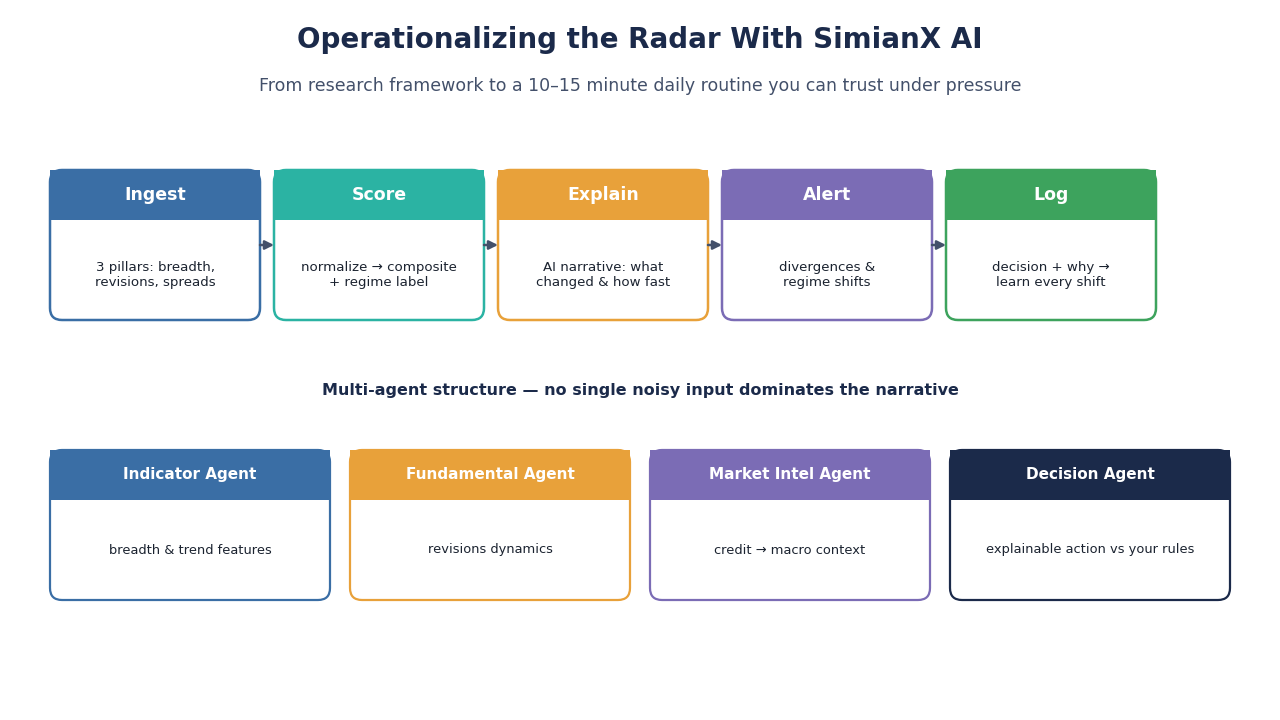
A daily “Risk Radar Routine” (10–15 minutes)
- Open the radar dashboard and review composite + pillar scores
- Read the AI explanation: what changed, what drove it, and how fast
- Check divergences:
- Index up but breadth down?
- Spreads accelerating?
- Revisions broadening negative?
- Apply the regime playbook (Green/Yellow/Orange/Red)
- Log a decision (what you changed and why)
In SimianX AI, the multi-agent structure can help separate responsibilities:
- An “Indicator Agent” interprets breadth and trend features
- A “Fundamental Agent” summarizes revisions dynamics
- A “Market Intelligence Agent” connects credit moves to macro context
- A “Decision Agent” outputs an explainable action suggestion based on your rules
This division is valuable because it reduces the risk of one noisy input dominating the narrative.
Include your internal link naturally:
Mini Case Studies: Three Common Patterns the Radar Should Catch
Case 1: The “Narrow Leadership Melt-Up”
SPXrises, but equal-weight stalls- % above 200DMA declines gradually
- Spreads stay calm
- Revisions mixed but not collapsing
Radar output: Yellow → Orange (depending on severity)
Action: reduce concentration risk, tighten risk, avoid chasing crowded leaders.
Case 2: The “Earnings Reset”
- Revisions turn broadly negative across cyclicals
- Breadth weakens after earnings season
- Spreads widen moderately but persistently
Radar output: Orange with high persistence risk
Action: reduce beta, rotate to quality/defensives, hedge systematically.
Case 3: The “Credit Shock”
- HY spreads accelerate wider quickly
- Breadth breaks sharply (new lows surge)
- Revisions lag initially but follow later
Radar output: Red (high confidence)
Action: capital preservation, liquidity-first positioning, avoid leverage.
Implementation Checklist (So You Can Actually Build This)
- [ ] Select 3–5 metrics per pillar (breadth, revisions, spreads)
- [ ] Normalize to percentiles or z-scores; clip extremes
- [ ] Add smoothing aligned to your horizon
- [ ] Define regimes and actions (Green/Yellow/Orange/Red)
- [ ] Validate with walk-forward testing
- [ ] Add explainability summaries (why the score changed)
- [ ] Operationalize with alerts + decision logs in SimianX AI
Updated Conclusion: Making the S&P 500 Risk Radar Actionable
A high-quality S&P 500 risk radar is not a crystal ball. It’s a disciplined system that monitors participation (breadth), fundamental trajectory (earnings revisions), and financial stress (credit spreads)—then translates them into regimes you can act on with confidence.
The biggest edge is behavioral: when your radar turns Orange or Red, you don’t “debate with the market.” You follow a playbook, scale exposure, hedge earlier, and preserve decision quality.
If you want to run this process consistently—data ingestion, composite scoring, regime alerts, and explainable summaries—use SimianX AI to turn the research framework into a daily workflow you can trust under pressure.
In SimianX, you can treat the S&P 500 (often via SPY as the tradable proxy) as your target and run a “risk radar” workflow: select the symbol and timeframe, then let the platform’s multi-agent analysis combine technical structure and breadth-style participation signals, fundamental/earnings expectation changes, and macro/credit stress cues (e.g., spread widening as a risk-off confirmation) into an explainable risk rating with key drivers, invalidation levels, and triggers; based on the output you translate the regime into actions—reduce beta when risk rises, add hedges, tighten stops/position sizing when signals turn Orange/Red, and log decisions for review so the model + your ruleset continuously improve.
Related Reading
- Nasdaq Up, Most Stocks Down: Narrow Rally Days 2019–2026
- US Stock Risk Dashboard: AI Signals from Breadth, Spreads
- S&P 500 to 7000: Momentum, Liquidity & Valuation Signals
- The S&P 500 Sector Rotation Playbook for AI Signals
- Wall Street Drawdown Watch: 10% Warnings, 40% Tail Risk
- Why US Stocks & Crypto Plummeted This Week: The Causes
- Russell 2000 Rotation in 2026: New Market Leaders Emerge
References
- FRED — Credit Spreads & Yields
- CBOE — VIX Volatility Index
- Investopedia — Market Breadth
- Investopedia — Advance/Decline Line
- Investopedia — Option-Adjusted Spread (OAS)
- Investopedia — Credit Spread
- Investopedia — High-Yield Bond
- Investopedia — Moving Average (200-Day)
- Investopedia — Earnings Estimate
- Wikipedia — Hidden Markov Model (HMM)