The 2026 Stablecoin Reference Map: Players, Rules, and Risks
Stablecoins stopped being a crypto-insider topic in 2026. The total stablecoin market crossed roughly $325 billion this year, and in June 2026 the biggest names in global payments — Visa, Stripe, and Mastercard — were reported to be building their own dollar stablecoin to challenge the two incumbents, Tether's USDT and Circle's USDC. When the companies that move trillions of dollars a year decide to mint their own digital dollars, it is worth understanding exactly what a stablecoin is, who controls the market, and where the risks sit.
This is the 2026 reference map: who the players are, how USDT stacks up against USDC and DAI, what the new GENIUS Act actually changes, whether you can still earn yield, and what the payments-giant land grab means for investors. If you want to see how the market prices these assets in real time, our crypto leaderboard tracks them alongside 30 AI models' live trading calls.
Why Visa, Stripe, and Mastercard Want a Stablecoin
A stablecoin is a token designed to hold a fixed value — almost always $1 — by being backed one-for-one with reserves such as cash and short-term US Treasury bills. That stability is what makes it useful as money rather than a speculative bet. The appeal for a payments network is obvious: a dollar that settles on a public blockchain moves in seconds, 24/7, across borders, without waiting for bank hours or correspondent-banking rails.
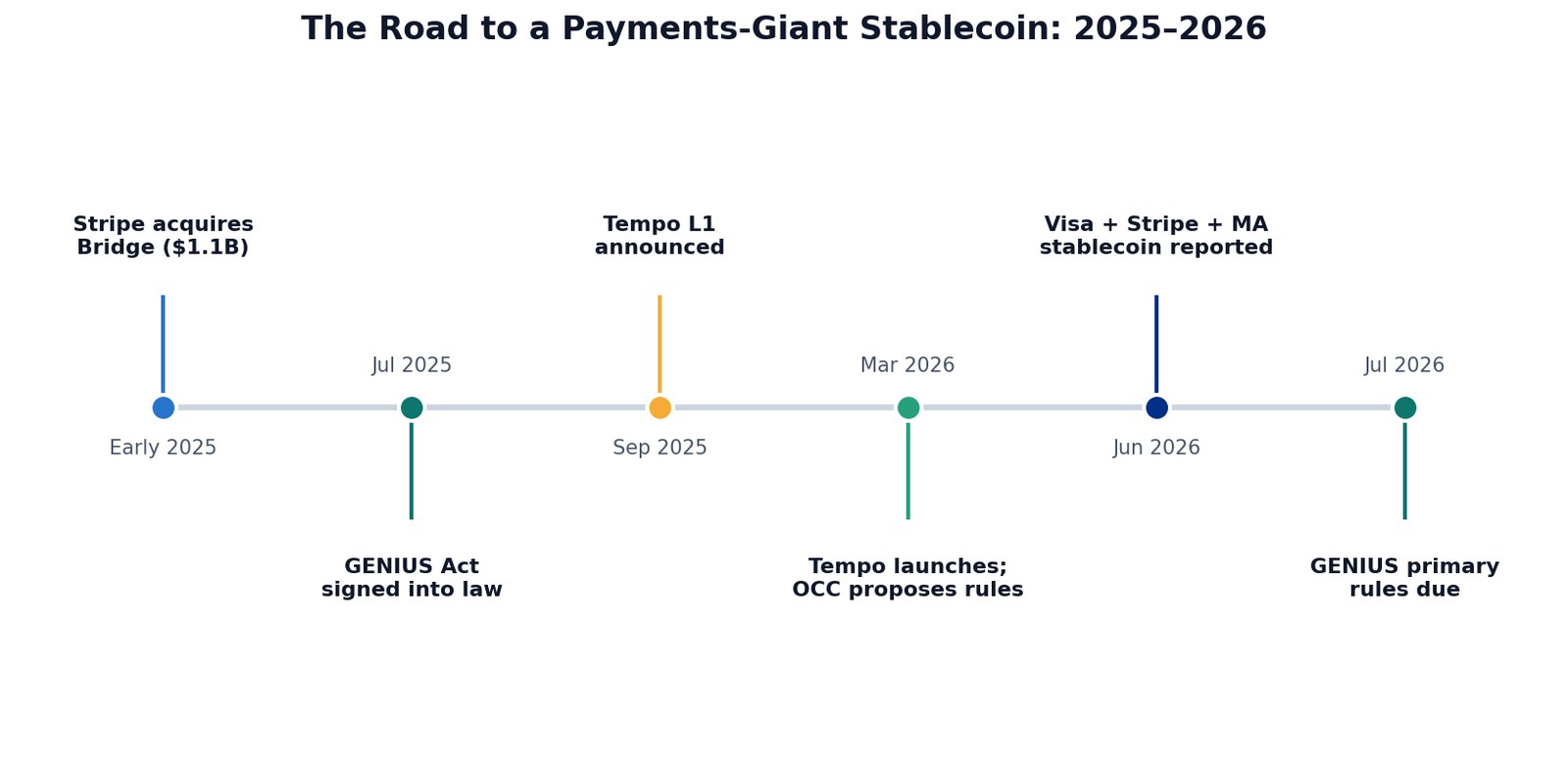
In June 2026, multiple outlets reported that Stripe, Visa, and Mastercard were in advanced talks on a jointly backed stablecoin, with Coinbase (COIN) reportedly weighing whether to join the consortium. No token name, issuer structure, or reserve model had been disclosed publicly — it is still early — but the strategic logic is clear. A network-backed token could undercut card-interchange economics, capture settlement float, and keep these firms relevant if money itself migrates on-chain.
Stripe is the most advanced of the three. Its push began with the $1.1 billion acquisition of Bridge in early 2025, the stablecoin-orchestration platform that gave Stripe the plumbing to issue and move dollars on-chain. In March 2026, Stripe and Paradigm launched Tempo, a payments-focused Layer-1 blockchain purpose-built for stablecoin settlement, which raised a $500 million Series A at a reported $5 billion valuation with Visa, Nubank, and Shopify among its launch partners. Klarna issued KlarnaUSD — billed as the first bank-issued stablecoin — natively on Tempo, and World Liberty Financial deployed its USD1 token there in May 2026. Stripe's crypto leadership has openly described the goal as becoming the "AWS for money."
The takeaway: the consortium headline is not a one-off. It is the visible tip of a deliberate, well-funded move by traditional payments to own the rails of digital dollars before crypto-native issuers lock the market up.
The $325 Billion Stablecoin Market in 2026
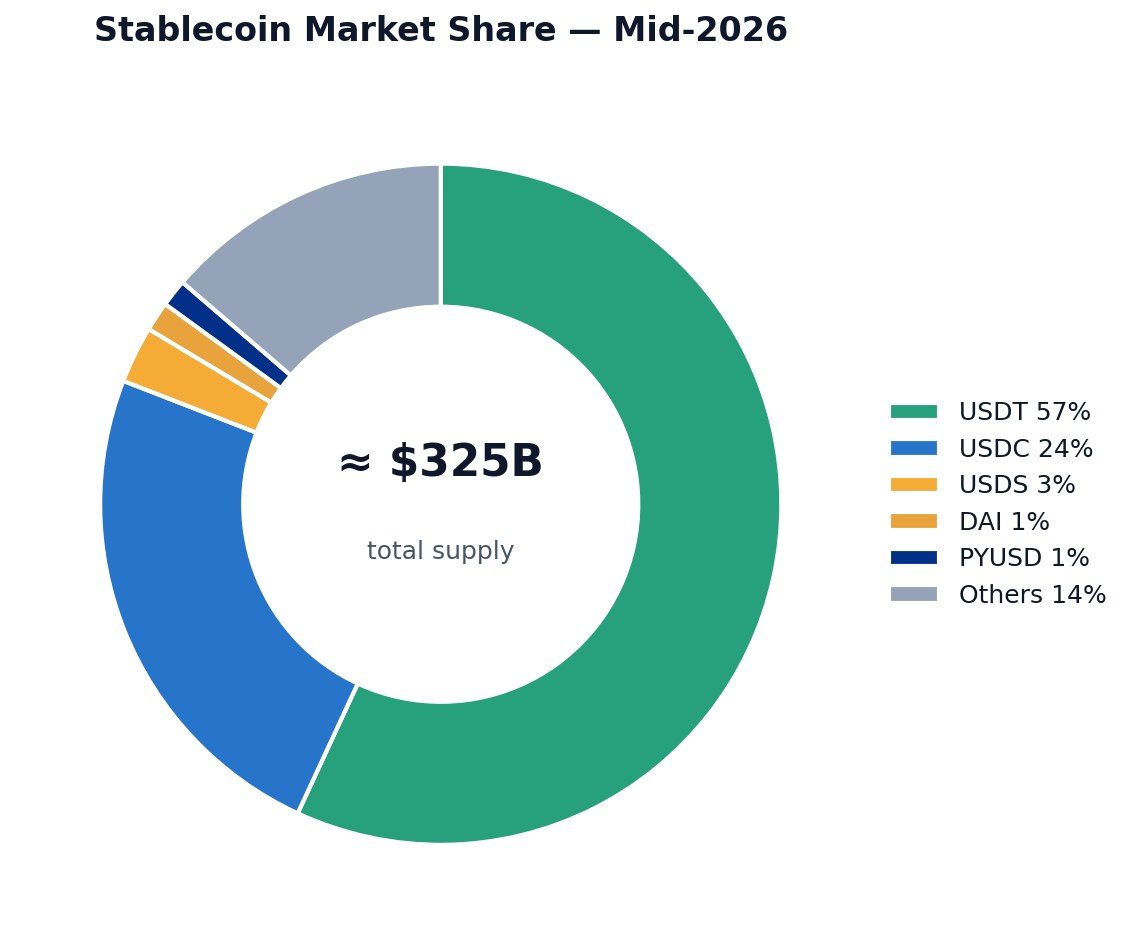
To understand why incumbents are nervous, look at how concentrated the market already is. By mid-2026 the total stablecoin supply sat around $320–325 billion, and just two issuers — Tether and Circle — controlled more than 80% of it.
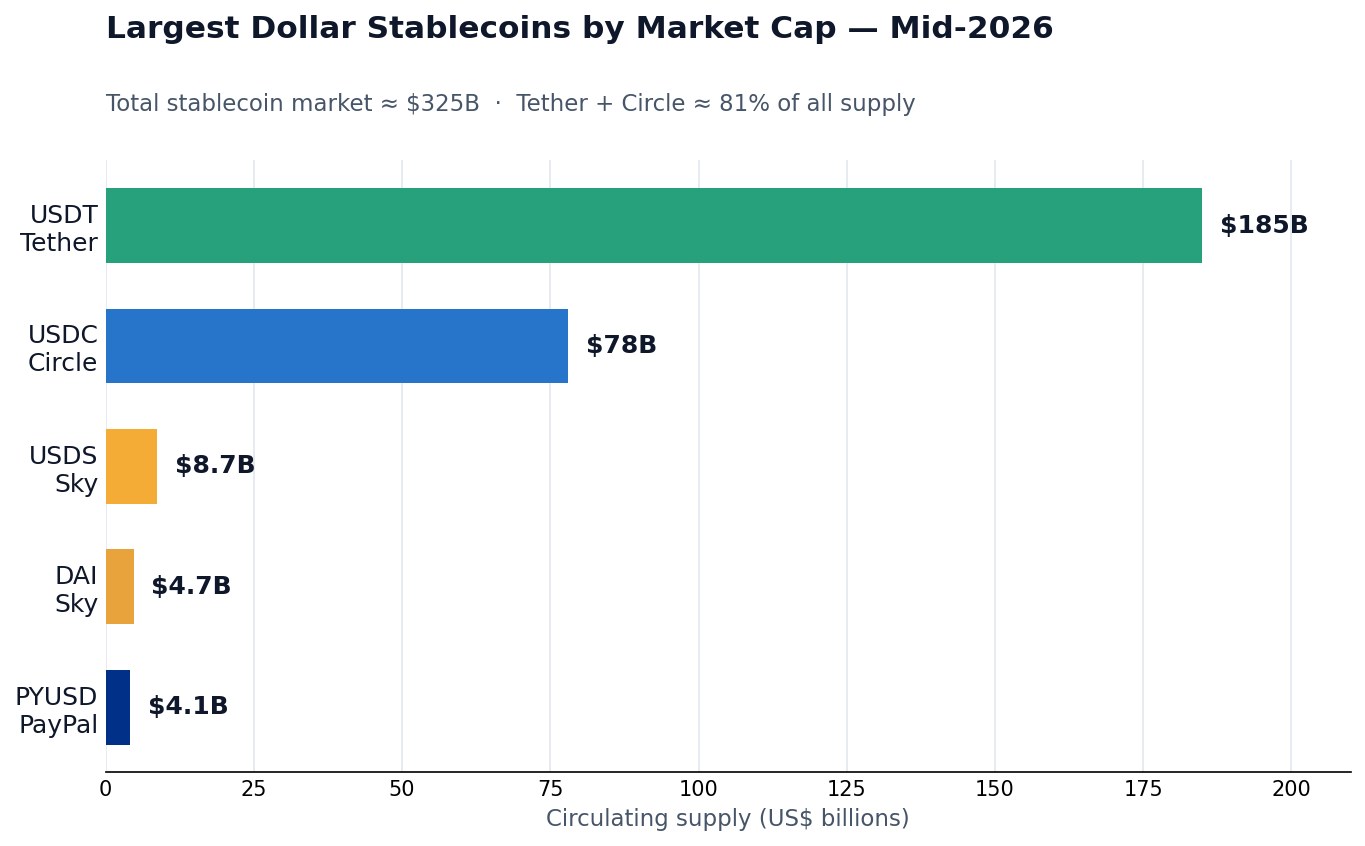
Here is the 2026 league table of the largest dollar stablecoins by circulating supply:
| Stablecoin | Issuer | Market cap (mid-2026) | Type |
|---|---|---|---|
| USDT | Tether | ~$185B | Centralized, fiat-backed |
| USDC | Circle (NYSE: CRCL) | ~$78B | Centralized, fiat-backed |
| USDS | Sky (ex-MakerDAO) | ~$8.7B | Decentralized, crypto-backed |
| DAI | Sky (ex-MakerDAO) | ~$4.7B | Decentralized, crypto-backed |
| PYUSD | PayPal | ~$4.1B | Centralized, fiat-backed |
USDT remains the runaway leader at roughly $185 billion and about 58% market share, dominant for trading liquidity and as a dollar proxy across emerging markets. USDC is the regulated number two near $78 billion. The fastest grower is PayPal (PYPL)'s PYUSD, which expanded to 70 markets in March 2026 and grew its supply nearly 680% year-over-year — proof that a trusted consumer brand can scale a stablecoin quickly. That is precisely the threat the Visa-Stripe-Mastercard group is built to answer.
USDT vs USDC vs DAI: The 2026 Reference Comparison
Not all stablecoins are the same. They differ in who issues them, what backs them, how transparent they are, and whether any single company can freeze your funds. Here is the head-to-head that matters most.
| Attribute | USDT (Tether) | USDC (Circle) | DAI / USDS (Sky) |
|---|---|---|---|
| Issuer | Tether (offshore, El Salvador) | Circle (CRCL, US-listed) | Sky Protocol (decentralized DAO) |
| Market cap | ~$185B | ~$78B | ~$4.7B DAI / ~$8.7B USDS |
| Backing | Cash, US T-bills, plus gold, BTC, secured loans | ~80% US T-bills, ~20% cash | Over-collateralized with crypto + real-world assets |
| Transparency | Quarterly attestations | Monthly attestations (Deloitte) | Fully on-chain, auditable in real time |
| Centralization | Can freeze addresses | Can freeze addresses | No single party can freeze funds |
| Best for | Liquidity, trading, EM dollar access | Regulated, institutional, US use | DeFi, censorship resistance |
USDT is the liquidity king. If you trade crypto, USDT is the deepest pair on almost every exchange, and in countries with weak local currencies it functions as a hard-dollar savings tool. Tether earns billions from the Treasury bills backing its reserves and publishes quarterly attestations, though critics have long wanted a full audit.
USDC is the compliance-first choice. Circle went public on the NYSE as CRCL in June 2025, holds reserves roughly 80% in short-dated US Treasuries and 20% in cash inside a BlackRock-managed reserve fund, and publishes monthly attestations signed by Deloitte. For institutions and US businesses that need a regulator-friendly digital dollar, USDC is usually the default.
DAI is the decentralized outlier — and it is changing. Issued by Sky (the protocol formerly known as MakerDAO), DAI is backed not by a company's bank account but by over-collateralized crypto and real-world assets governed on-chain. In April 2026, Sky began migrating DAI to its upgraded USDS token; USDS has already grown to roughly $8.7 billion, the largest genuinely decentralized stablecoin, while DAI holds near $4.7 billion. If you value censorship resistance over corporate backing, this is the family to watch.
The GENIUS Act: How US Law Reshapes Stablecoins
The single biggest reason payments giants are moving now is regulatory clarity. The GENIUS Act — Guiding and Establishing National Innovation for U.S. Stablecoins — passed the Senate 68–30 and the House 307–122, and was signed into law on July 18, 2025. It is the first federal framework for payment stablecoins in the United States, and you can read the full bill text on Congress.gov.
What it requires:
- 1:1 reserves. Every issued stablecoin must be fully backed by cash or short-term US Treasuries — no fractional reserves, no risky assets.
- Annual audits for any issuer above $50 billion in market supply, plus regular public disclosure of reserve composition.
- No issuer-paid yield. Issuers may not pay interest or rewards on the stablecoin balance itself (more on that below).
- Federal and state pathways for who may legally issue a payment stablecoin.
Implementation is still in motion. The OCC proposed its rulemaking in March 2026, with primary regulations due by July 18, 2026; the Act takes full effect on the earlier of 120 days after final rules or January 18, 2027. The practical effect is already visible: clear rules are exactly what a Visa or a Stripe needs before putting their brand on a digital dollar.
Can You Earn Yield on Stablecoins in 2026?
This is the question that trips up most newcomers, and the GENIUS Act made the answer more nuanced.
The law bans issuers from paying yield directly on the coin. Tether and Circle cannot simply credit you interest for holding USDT or USDC — that is now prohibited. The banking lobby pushed hard for this; a Treasury advisory analysis flagged $6.6 trillion of US transactional deposits as potentially "at risk" if stablecoins paid competitive interest.
But the ban is narrow. It does not cover:
- DeFi lending and liquidity protocols, which sit outside the issuer-focused rules. Lending your stablecoins through a protocol still earns a market yield.
- Exchange reward programs, such as Coinbase's USDC rewards — though these now must connect to genuine user activity, not passive holding.
- The DAI/USDS Savings Rate, where Sky shares protocol revenue with holders who lock their tokens.
So yield is still available in 2026 — but it now comes from a platform or protocol taking on risk, not from the issuer. That distinction matters, because every basis point of yield carries counterparty or smart-contract risk that a bare stablecoin does not. Before chasing a double-digit rate, understand who is generating it and how. Our AI autopilots and crypto leaderboard can help you weigh risk-adjusted opportunities instead of headline APYs.
How Safe Are Stablecoins? Depegs and Reserve Risk
A stablecoin is only as good as the reserves behind it — and history has two cautionary tales every holder should know.
In March 2023, USDC briefly depegged to about $0.87 when roughly $3.3 billion of Circle's cash reserves were stranded at the collapsing Silicon Valley Bank. It recovered to $1.00 within days once US regulators made SVB depositors whole, but it proved that even a well-run, fully-reserved stablecoin carries banking risk in its cash leg. This is part of why GENIUS-era reserves lean so heavily on Treasury bills over uninsured bank deposits.
The far worse example was TerraUSD (UST) in May 2022. UST was algorithmic — it tried to hold its peg through a trading mechanism with a sister token rather than real reserves. When confidence cracked, it spiraled to near zero and erased more than $40 billion in days. The lesson is blunt: a stablecoin backed by code and confidence is not the same as one backed by audited dollars. The GENIUS Act's 1:1 reserve mandate exists precisely to outlaw the UST model.
The safety checklist for 2026 is simple: prefer fully-reserved coins, favor Treasury-heavy backing over uninsured cash, read the attestations (monthly beats quarterly), and never assume a high yield is free of risk.
What the Payments-Giant Wave Means for Investors
The stablecoin race is no longer just a crypto story — it is an equities story. The reserves behind hundreds of billions of stablecoins are parked in US Treasury bills, which makes large issuers meaningful buyers of government debt. And the public-market proxies are multiplying:
- Circle (CRCL) — the purest public bet on stablecoins; about 95% of its revenue comes from interest on USDC reserves.
- Visa (V) and Mastercard (MA) — defending their settlement moat by joining, not fighting, the stablecoin shift.
- Coinbase (COIN) — earns a large share of USDC reward economics and would benefit from any consortium it joins.
- PayPal (PYPL) — proof that a consumer brand can scale a stablecoin fast with PYUSD.
For traders, the question is which of these names best captures the trend without the regulatory and competitive risk. That is exactly the kind of multi-factor call our platform is built for. SimianX runs 30 leading AI models on real profit-and-loss across both crypto and equities — see who is actually winning on our AI model leaderboard, or browse more market breakdowns in our stories hub.
Frequently Asked Questions
Are stablecoins safe in 2026?
Fully-reserved, audited stablecoins like USDC and USDT are far safer than they were a few years ago, thanks to the GENIUS Act's 1:1 reserve and audit mandates. The main residual risks are the banking exposure in their cash reserves (as the 2023 USDC depeg showed) and, for any token, the platform risk you take on if you chase yield. Algorithmic, unbacked stablecoins remain the dangerous category.
What is the GENIUS Act in one sentence?
It is the 2025 US law that requires payment stablecoins to be backed 1:1 by cash or Treasuries, audited above $50 billion in supply, and barred from paying issuer yield — the legal foundation that made big banks and payment networks comfortable entering the space.
USDT vs USDC — which is better?
USDT wins on liquidity and global reach; USDC wins on regulation and transparency. Traders who need the deepest order books lean USDT; institutions and US users who prioritize compliance lean USDC. Many holders use both.
Will Visa and Stripe's stablecoin replace USDT and USDC?
Unlikely to replace them outright, but a network-backed token from Visa, Stripe, and Mastercard could capture significant share in merchant and cross-border payments, where their distribution is unmatched. As of mid-2026 the project was still reported as early-stage with no token launched.
What is the difference between DAI and USDS?
Both are decentralized stablecoins from Sky (formerly MakerDAO). USDS is the upgraded successor token, and DAI is being migrated into it; USDS is now the larger of the two. Both are backed by over-collateralized crypto and real-world assets rather than a company's bank account.
The Bottom Line
In 2026, stablecoins graduated from crypto plumbing to mainstream financial infrastructure. The market is a $325 billion duopoly led by USDT and USDC, newly governed by the GENIUS Act, and now being contested by the most powerful names in payments. For users, the playbook is to understand what backs each coin, read the attestations, and treat yield as a risk decision rather than free money. For investors, the cleaner expression of the trend may be the public stocks — Circle, Visa, Mastercard, Coinbase, and PayPal — riding the same wave.
Track how AI models trade these names in real time on the SimianX crypto leaderboard, put a strategy on autopilot with our AI autopilots, and keep reading our market stories for the next move.
Related Reading
- AI Crypto Analysis: A Practical Trading Guide for 2026
- AI Agents Analyze DeFi Risks: TVL, Real Yield Rates
- AI DeFi Yield Analysis: APY, Liquidity, Hidden Risks
- Testing DeFi Yields with AI: Real Yield vs Tail Risk
- AI Early-Warning for DeFi Liquidity and Depeg Risks 2026
- 30+ AI Models, 6 Providers Live: Crypto Trade Leaderboard