
 By Muke
US Stock Market Risk Dashboard: AI Signals Based on Market Breadth, Earnings Revisions, and Credit Spreads
A US Stock Market Risk Dashboard is not a prediction machine—it’s a decision system. Its job is to answer one question every day: is market risk rising or falling, and why? This research builds a practical dashboard using three high-signal pillars—market breadth, earnings revisions, and credit spreads—then shows how AI can convert messy cross-market inputs into clear, explainable risk alerts. We’ll also map how teams can operationalize the workflow inside SimianX AI as a repeatable, decision-ready process.
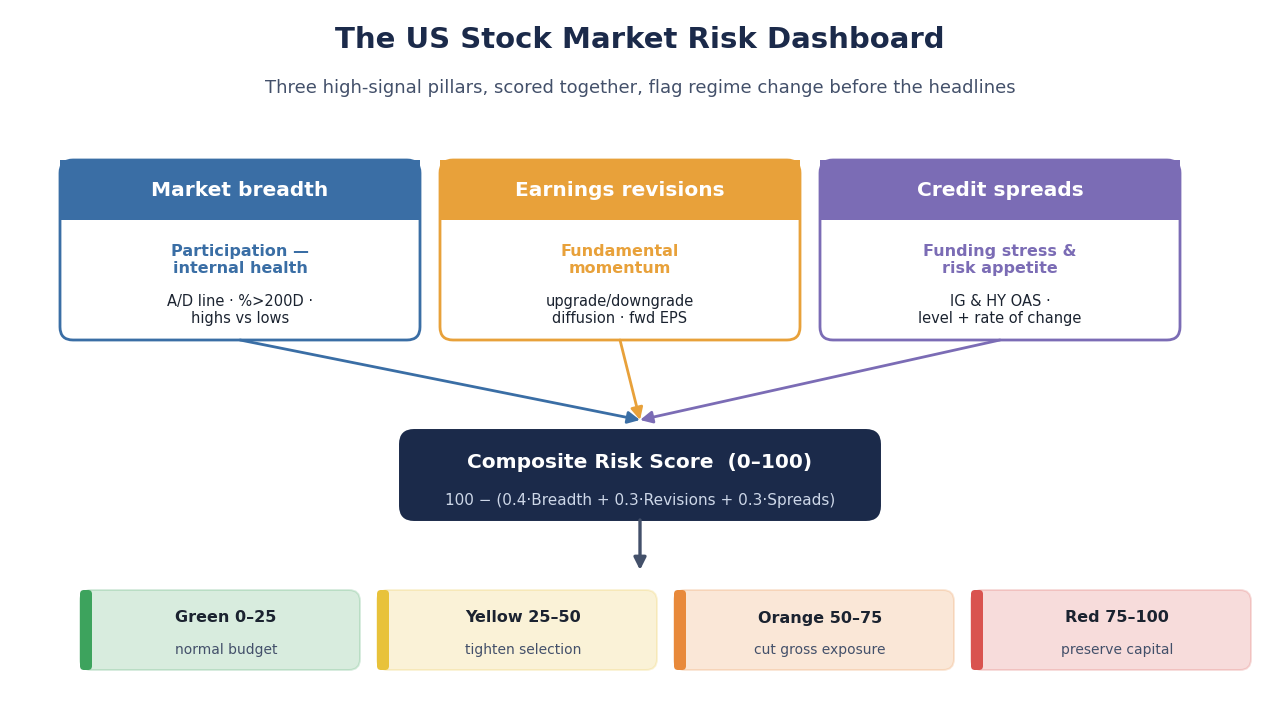
Why These Three Inputs Work Together (Breadth + Revisions + Spreads)
Think of the market as a living system with three layers:
- Breadth = participation (internal health). Are many stocks lifting the index, or just a handful of mega-caps?
- Earnings revisions = fundamental momentum. Are analysts raising or cutting expectations, and is that trend spreading?
- Credit spreads = funding stress. Is the bond market quietly charging a higher “risk tax” to borrowers?
When price looks fine but breadth weakens, revisions roll over, and spreads widen, risk is usually rising—even if the index hasn’t cracked yet.
Key benefit: a dashboard built on these pillars can surface early regime shifts (risk-on → transition → risk-off) with better context than price-only signals.
Pillar 1: Market Breadth Signals (Participation = Market “Immune System”)
Market breadth answers: How many stocks are actually participating in the move? In cap-weighted indices, a small group can dominate returns. Breadth is your defense against “false strength.”
Core Breadth Metrics to Track
Here are high-utility breadth signals that work well in a dashboard:
- Advance/Decline (A/D) line (cumulative advancers minus decliners)
- % of constituents above the 50/200-day moving average (trend participation)
- New 52-week highs vs new lows (momentum participation)
- Equal-weight vs cap-weight ratio (leadership concentration)
- Sector breadth (how many sectors are trending vs stalling)
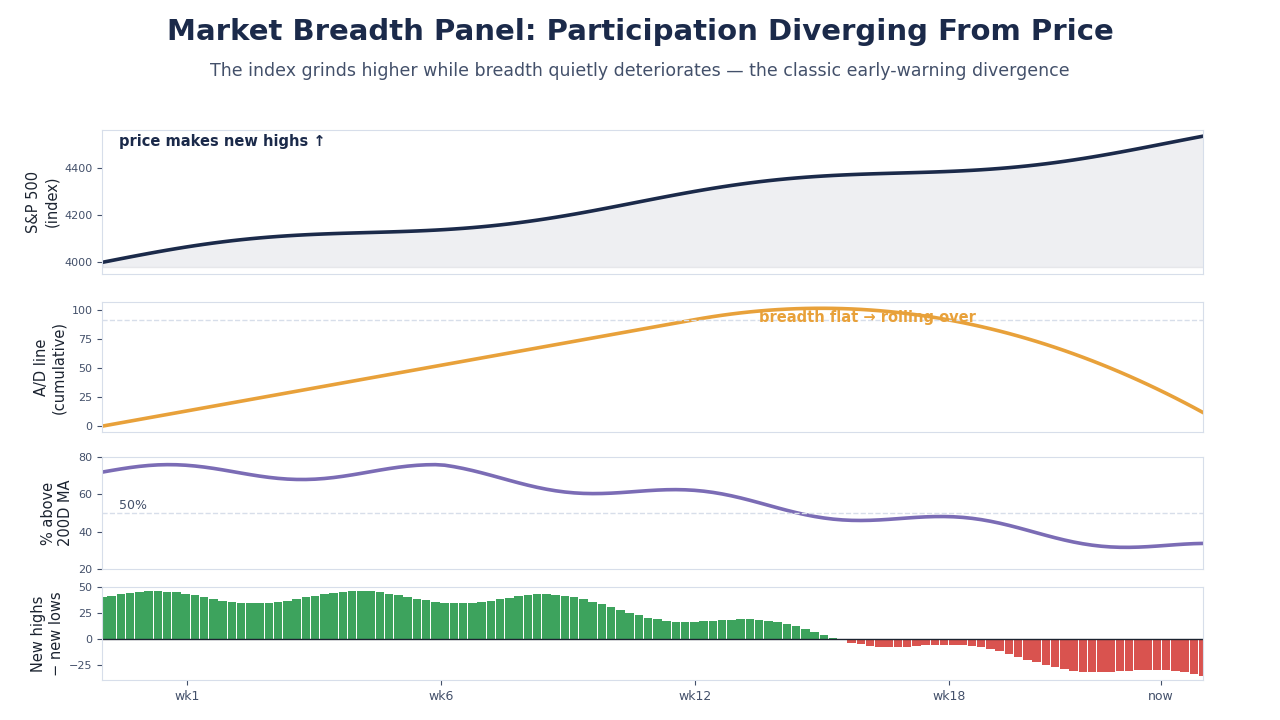
What breadth deterioration looks like:
- The index grinds higher, but fewer stocks make new highs.
- The % above
200D MAfalls even as headline price holds. - Leadership narrows into “safe winners,” while cyclicals and small caps lag.
Practical Breadth Rules (Dashboard-Ready)
You don’t need perfect thresholds—you need consistent triggers.
Breadth Warning Triggers (examples):
% above 200Drolling over for 2–4 weeks while index is flat/upHighs - Lowsturning negative for multiple sessions- Equal-weight underperforming cap-weight for a sustained window
Breadth Risk Labeling (simple):
- Green: broad participation (breadth rising with price)
- Yellow: mixed (price ok, breadth flat)
- Orange: divergence (price up, breadth down)
- Red: broad breakdown (breadth + price down)
Breadth Interpretation: The Divergence Playbook
A divergence is not an automatic sell—but it is a risk posture change signal.
- Reduce concentration risk (avoid only owning index proxies when leadership narrows)
- Tighten risk budgets (lower gross exposure, reduce leverage, cut tail bets)
- Demand confirmation from revisions and spreads (breadth alone can stay weak for a while)
Pillar 2: Earnings Revisions (Fundamental Momentum You Can Measure)
Earnings revisions answer: Are forward expectations improving or deteriorating? Price can levitate on narrative; revisions tend to track what companies are actually delivering and guiding.
What to Track (Beyond Headlines)
A dashboard should not rely on one number like “next quarter EPS.” Instead, track the shape of revisions:
- Net revision breadth: % of companies with upgrades vs downgrades
- Revision magnitude: average size of estimate changes
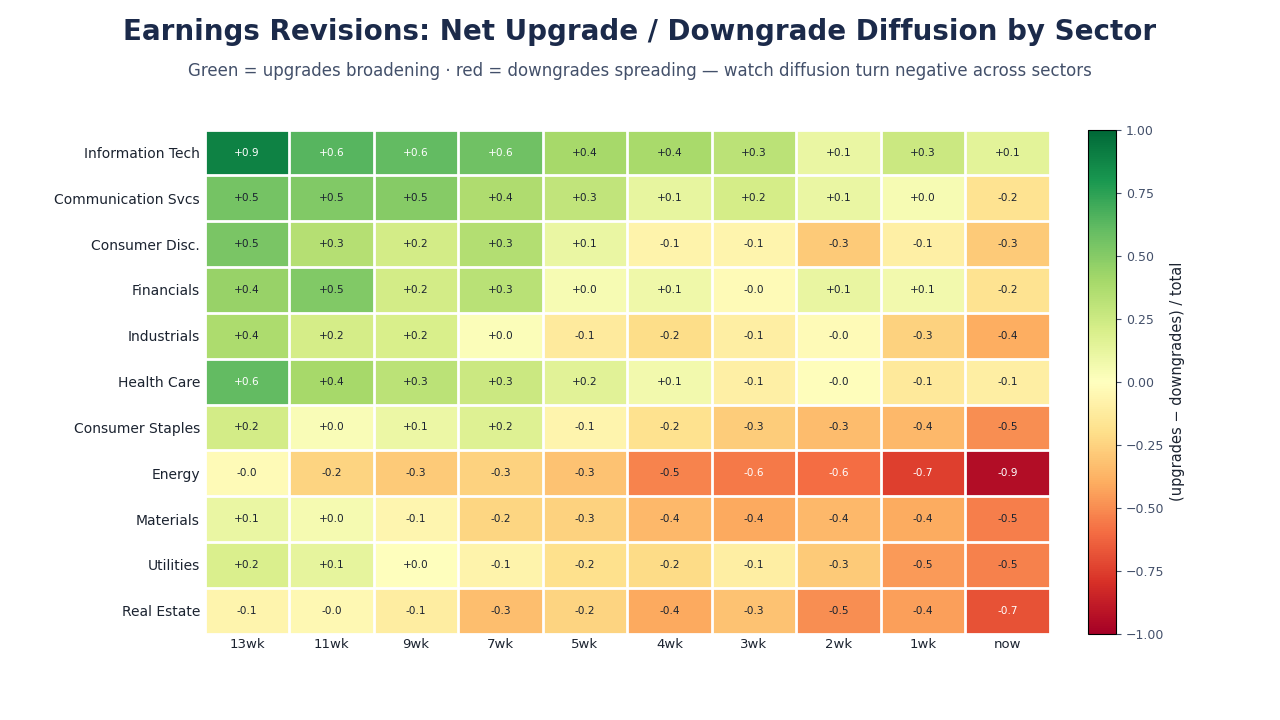
- Sector revision diffusion: are upgrades concentrated or widespread?
- Forward 12M EPS trend: direction + slope (acceleration/deceleration)
Why this matters: markets often re-rate when the earnings path shifts—especially when revisions roll over while valuation is stretched.
A Simple Earnings Revisions Score (Implementation-Friendly)
Build a weekly signal that updates as analyst estimates change.
Step-by-step:
- Universe: choose
S&P 500(or your investable universe) - Window: track revisions over
4 weeksand13 weeks - Compute two sub-scores:
- Diffusion: (upgrades - downgrades) / total
- Magnitude: average % change in forward EPS
- Standardize each (z-score or percentile rank)
- Combine into an Earnings Revisions Score from
0–100
Interpretation:
- 70–100: revisions tailwind (fundamentals improving)
- 40–70: neutral/mixed
- 20–40: deterioration risk
- 0–20: broad downgrade cycle (often aligns with risk-off)
Common Pitfalls (And Fixes)
- Earnings season noise: revisions can whipsaw around reports
Fix: use rolling windows + “post-earnings” smoothing.
- Mega-cap dominance: a few companies can distort index EPS
Fix: monitor median revision trends + sector diffusion.
- Sector rotation: revisions can improve in defensives while cyclicals worsen
Fix: show sector-by-sector revision breadth in the dashboard.
Pillar 3: Credit Spreads (The “Risk Thermometer” Behind Equities)
Credit spreads answer: How much extra yield do investors demand to hold corporate risk? When spreads widen, financing gets tighter, default risk is repriced, and equities often feel it—sometimes after credit moves.
Which Spreads Matter Most for an Equity Risk Dashboard?
Track at least two layers:
- Investment Grade (IG) spreads: early tightening/loosening in high-quality credit
- High Yield (HY) spreads: faster stress signal (risk appetite + default pricing)
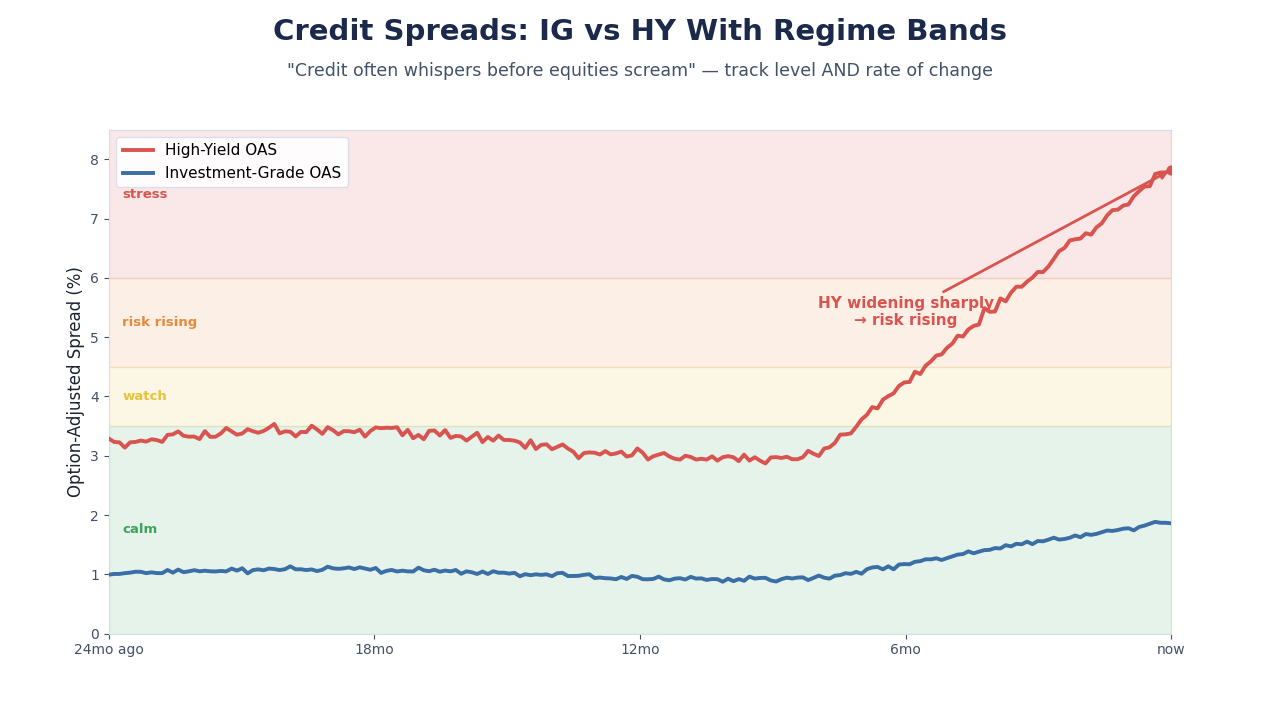
For a clean, widely referenced HY proxy, you can monitor the HY option-adjusted spread (OAS).
Credit Spread Rules That Actually Help
Credit spreads are most useful when you track level + rate of change.
Dashboard Triggers (examples):
- Level trigger: HY OAS above a high percentile vs last 2–5 years
- Momentum trigger: spreads widening sharply in 1–3 weeks
- Confirm trigger: HY widens while breadth deteriorates
Credit often whispers before equities scream.
Risk labels:
- Green: spreads stable/tightening
- Yellow: spreads drifting wider (watch)
- Orange: spreads widening fast (risk rising)
- Red: spreads spiking + breadth breaking (stress regime)
Combining the Three Pillars Into One Composite Risk Score
A dashboard becomes actionable when it answers: “What should I do differently today?” That requires synthesis.
A Robust (Not Overfit) Scoring Framework
Use a composite score built from standardized sub-signals.
Normalize each pillar:
- Breadth Score
0–100(higher = healthier participation) - Revisions Score
0–100(higher = improving fundamentals) - Spreads Score
0–100(higher = tighter credit / lower stress)
Then create a Risk Score that rises when conditions worsen:
Composite Risk Score = 100 − (0.4·Breadth + 0.3·Revisions + 0.3·Spreads)
You can adjust weights, but keep them stable over time to avoid narrative-driven tuning.
| Component | What It Measures | “Good” Direction | Typical Early Warning |
|---|---|---|---|
| Market breadth | Participation & internal health | Up | Divergence vs index |
| Earnings revisions | Forward fundamental momentum | Up | Diffusion turns negative |
| Credit spreads | Funding stress & risk appetite | Down (tighter) | Sudden widening |
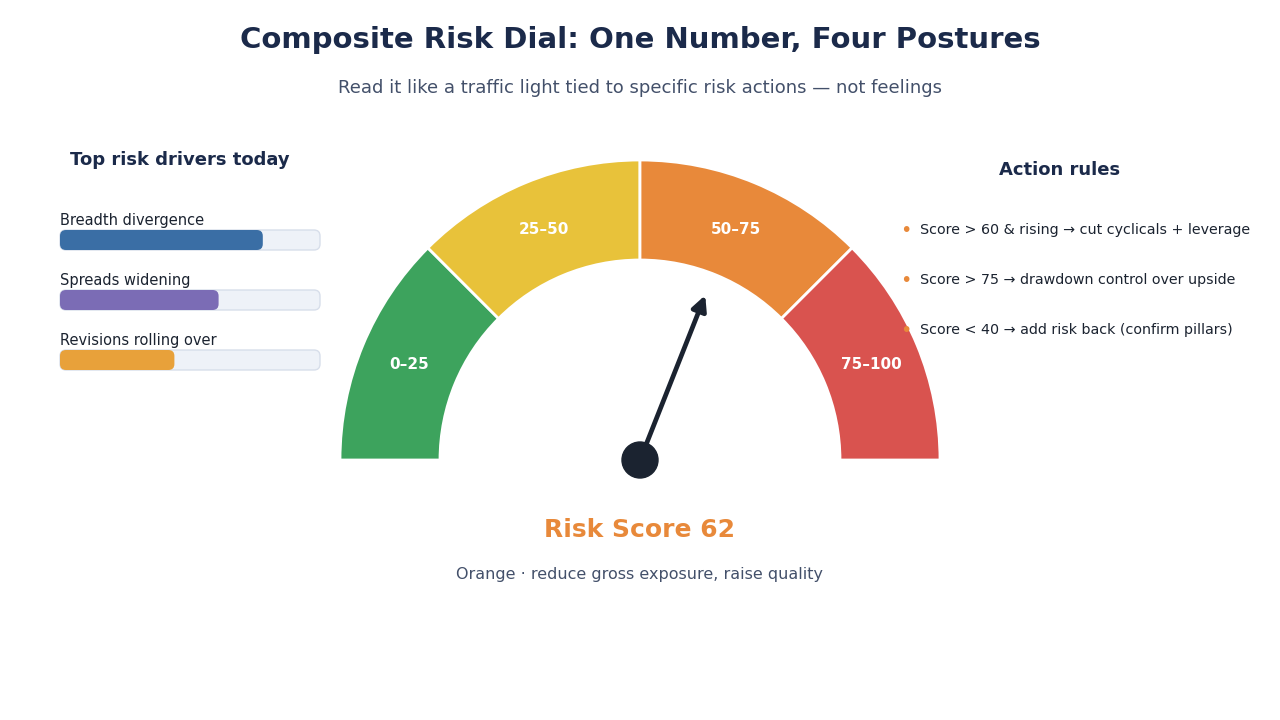
How Do You Interpret a US Stock Market Risk Dashboard in Real Time?
Use it like a traffic light system tied to specific risk actions—not feelings.
- Green (0–25): normal risk budget
- Yellow (25–50): tighten selection, reduce weak tails
- Orange (50–75): reduce gross exposure, shorten duration, raise quality
- Red (75–100): preserve capital (hedges, cash, defensive posture)
Action rules (example):
- If Risk Score > 60 and rising → reduce cyclicals + leverage
- If Risk Score > 75 → prioritize drawdown control over upside capture
- If Risk falls below 40 → selectively add risk back (confirm across pillars)
Dashboard Design: What to Show (So Humans Can Use It)
A great dashboard is not a data dump. It’s signal-first.
Recommended Layout (One Screen)
Top row:
- Composite Risk Dial + 1-line explanation (“what changed?”)
Middle row (the three pillars):
- Breadth panel (A/D, %>200D, highs-lows)
- Revisions panel (diffusion, sector heatmap)
- Spreads panel (HY/IG level + change)
Bottom row:
- “Drivers” table (top 3 contributors to risk)
- “Next actions” checklist (risk budget, hedges, watchlist changes)
Include One “Explainability” Box
Every signal should answer:
- What moved?
- Why does it matter?
- What do we do now?
This is where AI can help most.
How SimianX AI Fits the Workflow (From Signals → Decisions)
A risk dashboard is only useful if it changes decisions consistently. This is where SimianX AI can serve as a workflow layer that turns dashboard inputs into decision-ready narratives and checklists.
Practical ways to use SimianX AI with this dashboard approach:
- Ask a fundamentals-oriented agent to explain earnings revisions and sector dispersion
- Ask a technical/breadth agent to interpret participation divergence and trend damage
- Ask a macro/credit agent to summarize spread widening context and stress risk
- Generate structured reports for watchlists so your process is repeatable
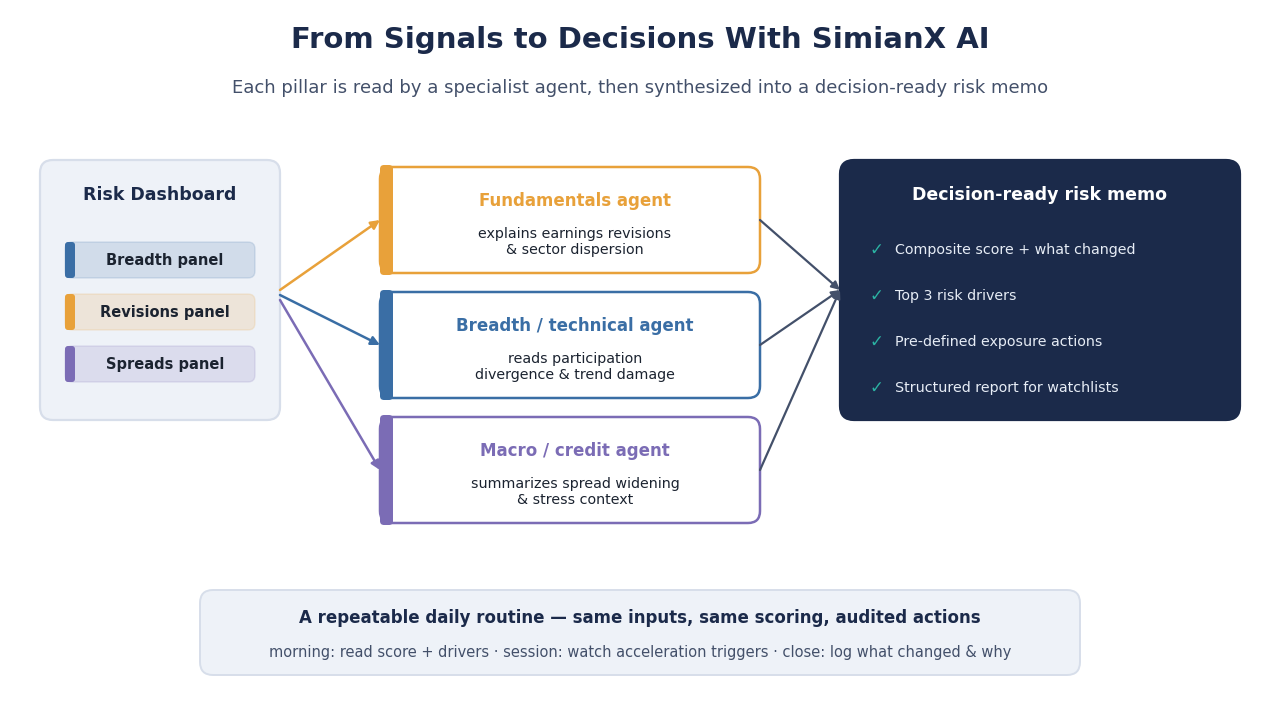
A Repeatable Daily Routine (Risk Ops Checklist)
- Morning (5–10 min): read composite score + top drivers
- Pre-market: review breadth + spreads for overnight regime changes
- During session: monitor “risk acceleration” triggers (spread widening + breadth breaks)
- After close: log what changed and what actions you took (build process memory)
Numbered playbook (easy to adopt):
- Check composite Risk Score and its 5-day slope
- If Yellow/Orange/Red: identify which pillar is driving risk
- Adjust exposure using pre-defined rules (not discretion)
- Use SimianX AI to generate a short “risk memo” for accountability
- Review weekly: did signals reduce drawdowns or add noise?
Backtesting: How to Validate Without Fooling Yourself
A “good” risk dashboard is not the one that predicts every dip. It’s the one that improves outcomes net of costs.
What to Measure
- Max drawdown reduction vs benchmark (
SPY,IVV) - Volatility and downside deviation
- Time to recover (drawdown duration)
- Hit rate of risk-off warnings (not perfect, but useful)
- Turnover / transaction costs (avoid signal whipsaw)
The dashboard’s edge often comes from avoiding the worst periods, not trading every wiggle.
Guardrails Against Overfitting
- Use simple thresholds, not dozens of tuned parameters
- Validate across multiple periods (calm, crisis, post-crisis)
- Prefer weekly revisions signals (less noise) + daily spreads/breadth monitoring
- Track false positives and define “acceptable cost” for safety
FAQ About US Stock Market Risk Dashboard
What is the best market breadth indicator for a risk dashboard?
No single indicator wins. A strong combo is A/D line + % above 200-day MA + new highs/new lows, because it captures participation, trend health, and momentum breadth in one view.
How do earnings revisions help predict market risk?
Revisions capture changes in forward expectations. When downgrades broaden across sectors, risk often rises because valuation support weakens and “earnings reality” starts to dominate narrative.
What do widening credit spreads mean for stocks?
Widening spreads usually signal tightening financial conditions and higher risk premiums. If spreads widen while breadth weakens, the probability of a broader equity drawdown tends to increase.
How often should I update a US stock risk dashboard?
Update spreads and breadth daily, and earnings revisions weekly (or with smoothing). The goal is stability—frequent enough to catch regime shifts, not so frequent that it becomes noise.
Conclusion
A US Stock Market Risk Dashboard works best when it blends breadth (participation), earnings revisions (fundamental momentum), and credit spreads (stress pricing) into one coherent signal system. The payoff is not perfect timing—it’s better risk posture, faster recognition of regime shifts, and a repeatable process you can audit and improve. If you want to operationalize these signals into clear daily actions and structured summaries, explore how SimianX AI can support your workflow at SimianX AI.
Related Reading
- S&P 500 to 7000: Momentum, Liquidity & Valuation Signals
- The S&P 500 Sector Rotation Playbook for AI Signals
- 2026 Fed Rate Cut Expectations: Live Market Pricing Map
- S&P 500 Risk Radar: AI Signals from Breadth, Revisions
- Wall Street Drawdown Watch: 10% Warnings, 40% Tail Risk
- Why US Stocks & Crypto Plummeted This Week: The Causes