
 By Muke
Wall Street Drawdown Watch: AI Early-Warning Signals from Breadth, Volatility Regimes, and Credit Stress
Wall Street drawdowns rarely arrive without warning. Long before headline indices collapse, subtle stress signals begin to surface across market breadth, volatility regimes, and credit conditions. A modern Wall Street drawdown watch framework uses AI early-warning signals to detect these changes in real time—helping investors shift from reactive loss control to proactive risk management.
This research explores how these signals work together and how SimianX AI integrates them into a unified, actionable early-warning system for US equity markets.
Why Drawdown Detection Matters More Than Market Timing
Traditional market timing focuses on predicting tops and bottoms. Drawdown monitoring, by contrast, asks a more practical question:
Is the market’s internal structure becoming fragile enough that downside risk is asymmetric?
Historically, the largest losses occur not during obvious crises, but during regime transitions—when liquidity, participation, and risk pricing quietly shift.
Key reasons drawdown monitoring matters:
- Capital preservation dominates long-term returns
- Volatility clustering amplifies losses once trends break
- Credit stress often precedes equity crashes
- Breadth deterioration reveals institutional distribution
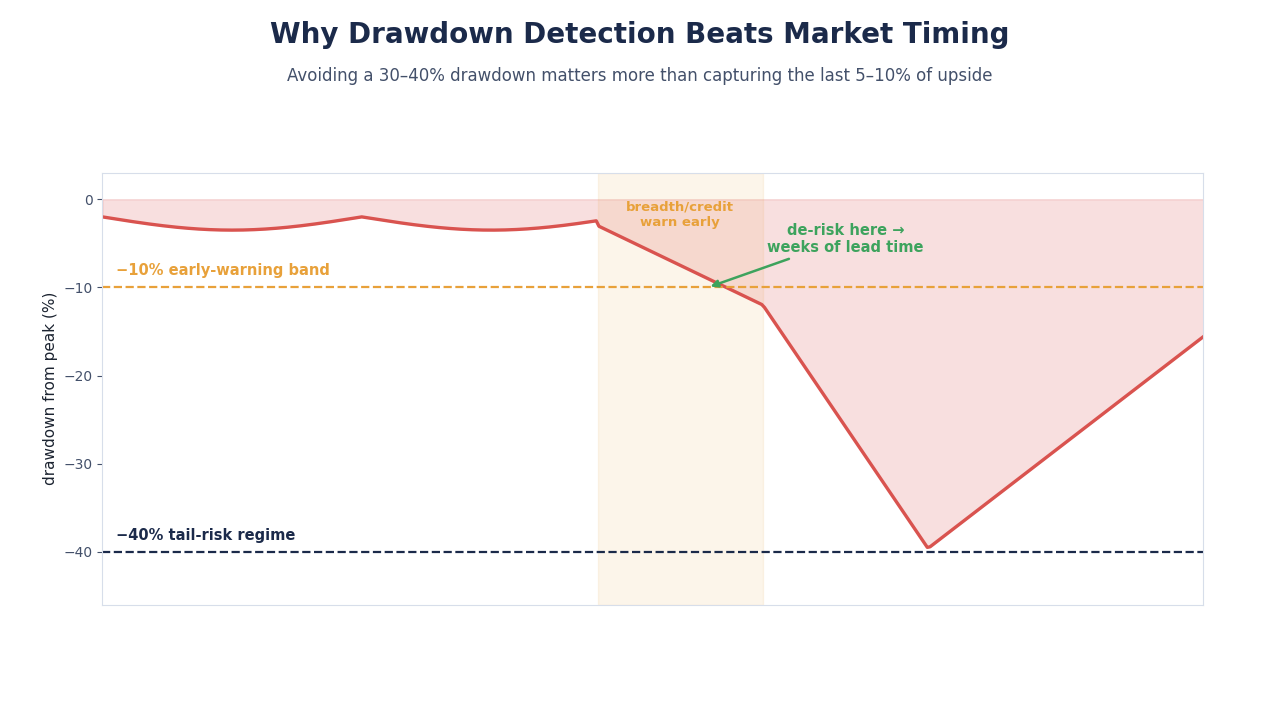
- Avoiding a 30–40% drawdown often matters more than capturing the last 5–10% of upside
- Early de-risking improves compounding outcomes
- Risk-aware positioning reduces behavioral errors
Market Breadth as the First Early-Warning Layer
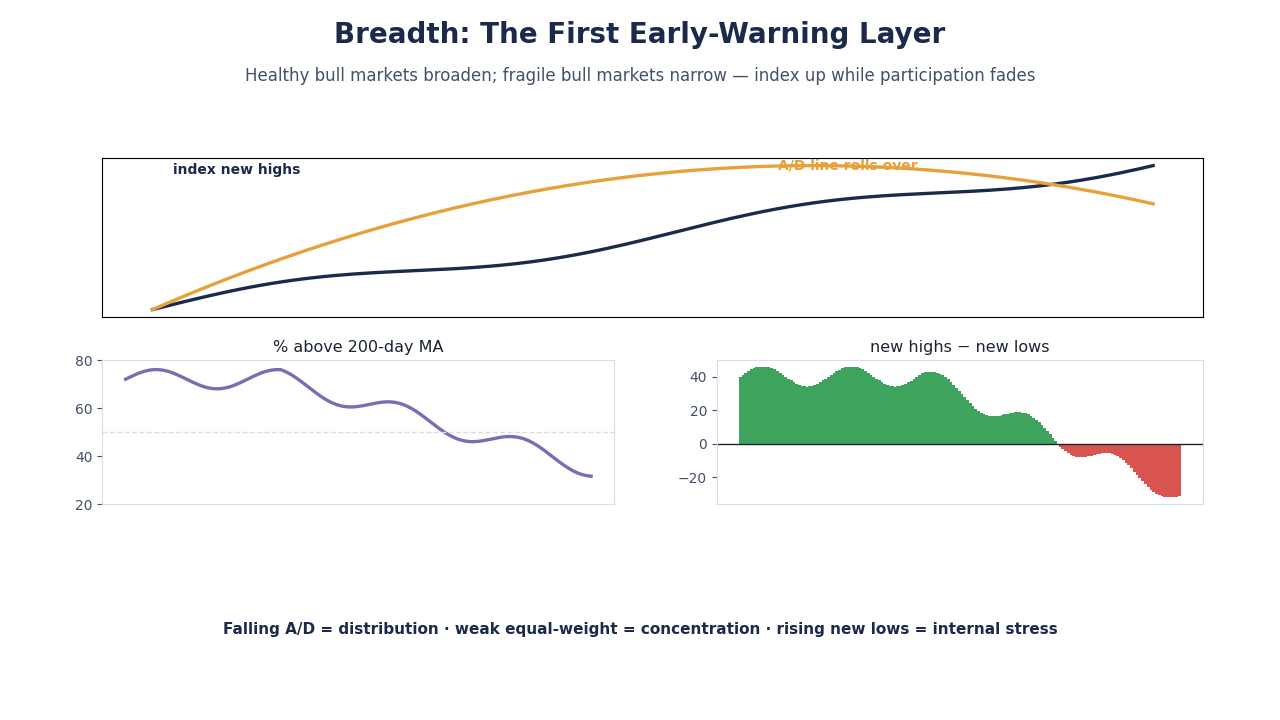
Market breadth measures how many stocks participate in a move, not just how far an index travels. Narrow leadership is one of the oldest precursors to major drawdowns.
Key Breadth Metrics Used in Drawdown Watch Systems
- Advance–decline lines
- Percentage of stocks above key moving averages
- New highs vs. new lows
- Equal-weight vs. cap-weighted index divergence
When indices rise but breadth weakens, institutional capital is rotating defensively, often before retail participants notice.
Healthy bull markets broaden. Fragile bull markets narrow.
Early breadth deterioration signals:
- Fewer stocks confirming index highs
- Leadership concentrated in defensives or mega-caps
- Rising dispersion across sectors
| Breadth Signal | Interpretation |
|---|---|
| Falling A/D line | Distribution phase |
| Weak equal-weight index | Concentrated risk |
| Rising new lows | Internal stress |
Volatility Regimes: Detecting Structural Risk Shifts
Volatility is not just a fear gauge—it is a market state variable. AI-driven drawdown models focus on volatility regimes, not isolated spikes.
What Is a Volatility Regime?
A volatility regime reflects the statistical behavior of price fluctuations over time:
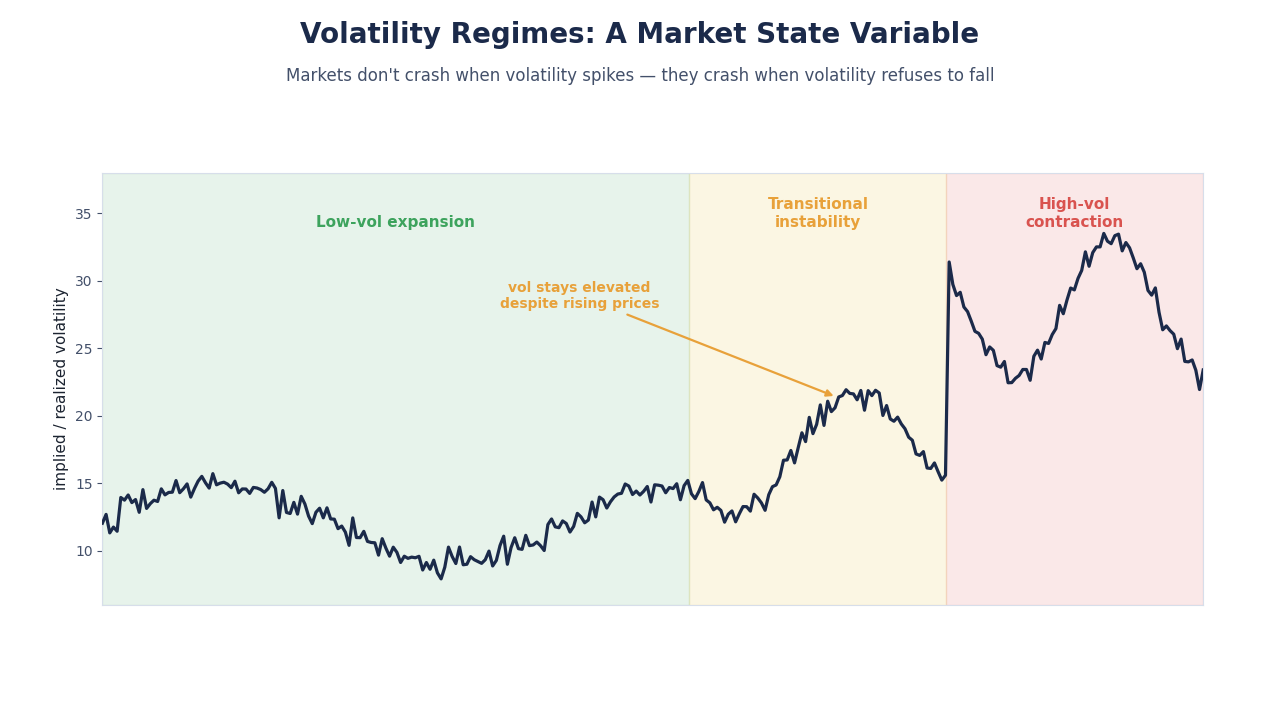
- Low-volatility expansion
- Transitional instability
- High-volatility contraction
Regime shifts often occur before price collapses, not after.
Common early regime signals:
- Rising volatility-of-volatility
- Asymmetric downside skew
- Volatility staying elevated despite rising prices
Markets don’t crash when volatility spikes—they crash when volatility refuses to fall.
Why AI Matters for Volatility Analysis
AI models excel at detecting:
- Non-linear regime transitions
- Multi-timeframe volatility clustering
- Hidden correlations between assets
This allows systems like SimianX AI to flag risk state changes rather than reacting to noise.
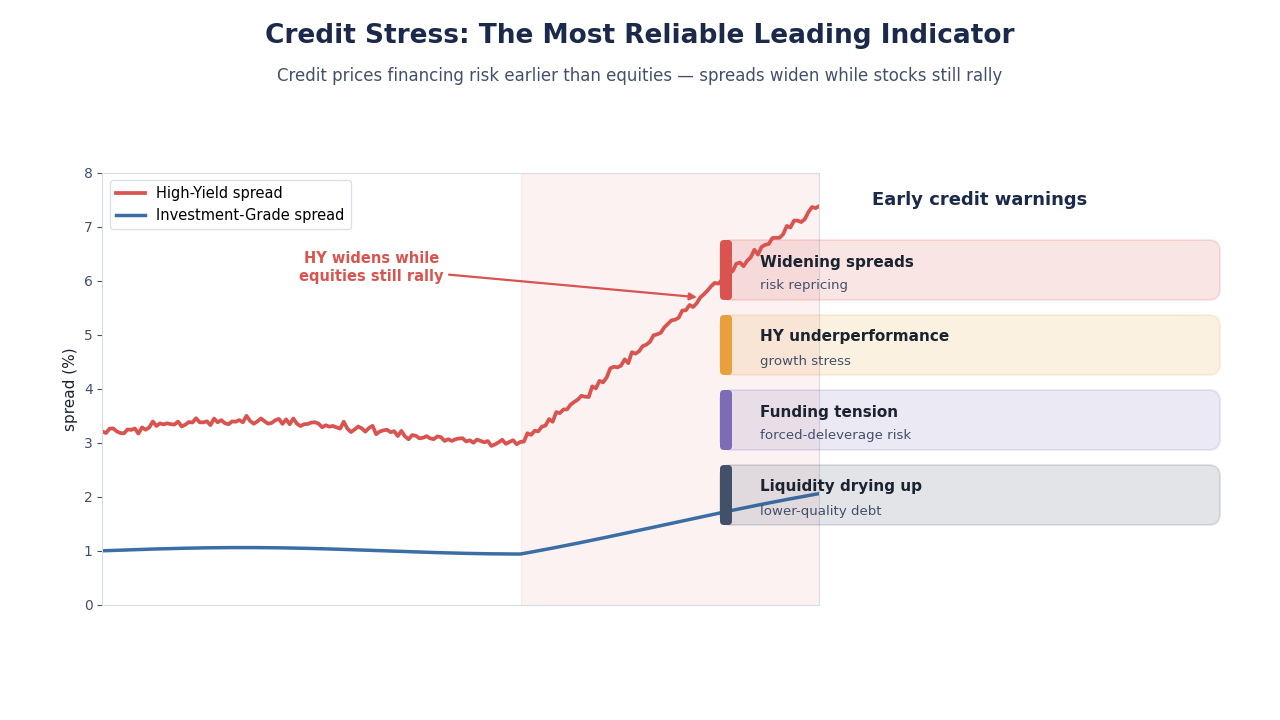
Credit Stress: The Most Reliable Leading Indicator
Equity markets often ignore credit stress—until they can’t. Credit conditions reflect real financing risk, not sentiment.
Core Credit Stress Indicators
- Corporate bond spreads
- High-yield vs. investment-grade divergence
- Funding market stress
- Liquidity premiums
Credit markets tend to price risk earlier and more accurately than equities.
Early credit warning patterns:
- Spreads widening while equities rally
- Rising default risk in cyclicals
- Liquidity drying up in lower-quality debt
| Credit Signal | Market Implication |
|---|---|
| Widening spreads | Risk repricing |
| HY underperformance | Growth stress |
| Funding tension | Forced deleveraging risk |
How AI Combines Breadth, Volatility, and Credit Signals
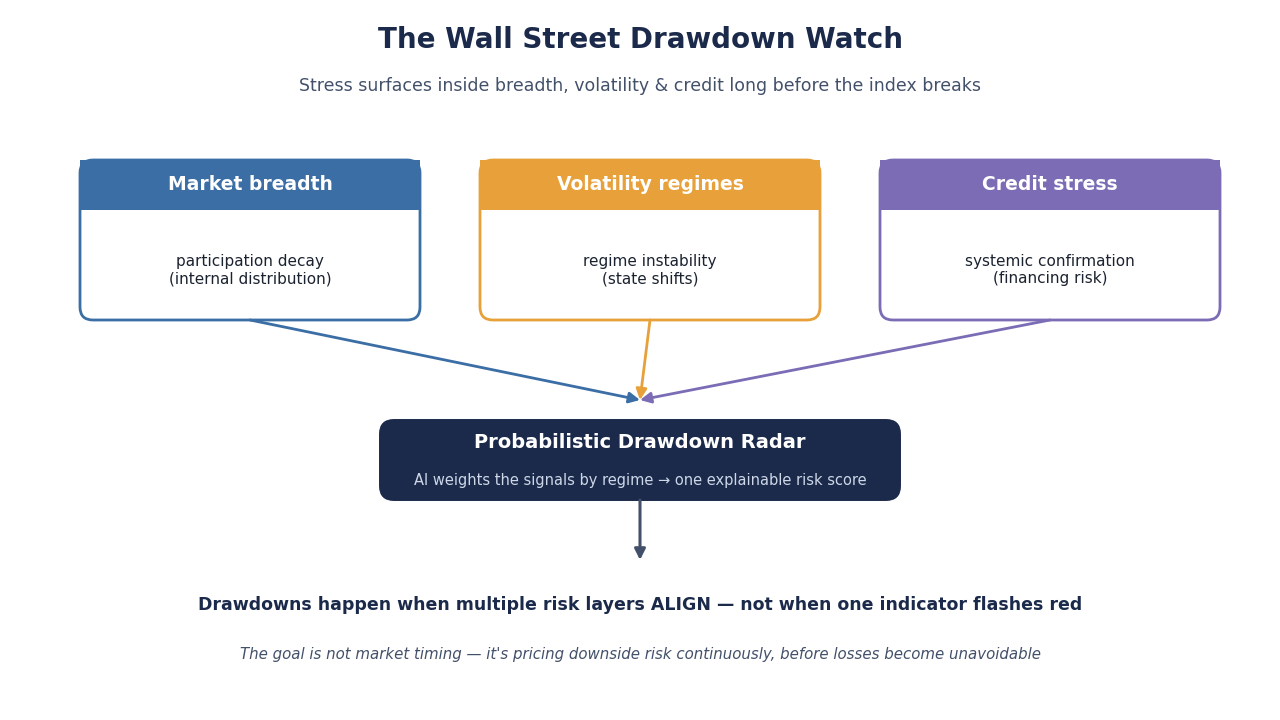
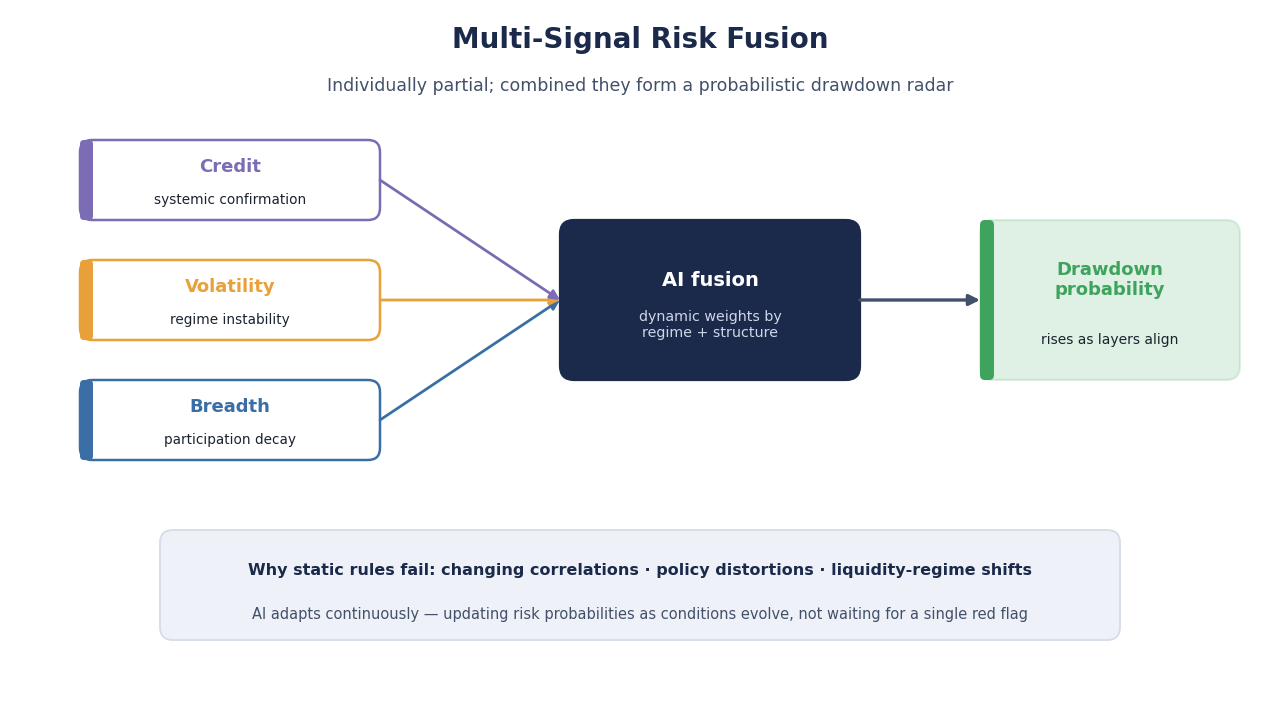
Individually, each signal offers partial insight. Combined, they form a probabilistic drawdown radar.
Multi-Signal Risk Fusion Framework
- Breadth detects participation decay
- Volatility identifies regime instability
- Credit stress confirms systemic risk
AI models dynamically weight these inputs based on historical context and current market structure.
Drawdowns happen when multiple risk layers align—not when a single indicator flashes red.
Why Static Rules Fail
Rule-based systems struggle with:
- Changing correlations
- Policy-driven distortions
- Liquidity regime shifts
AI adapts continuously, updating risk probabilities as conditions evolve.
How SimianX AI Implements a Wall Street Drawdown Watch
SimianX AI operationalizes this framework through an integrated risk intelligence layer designed for US equity markets.
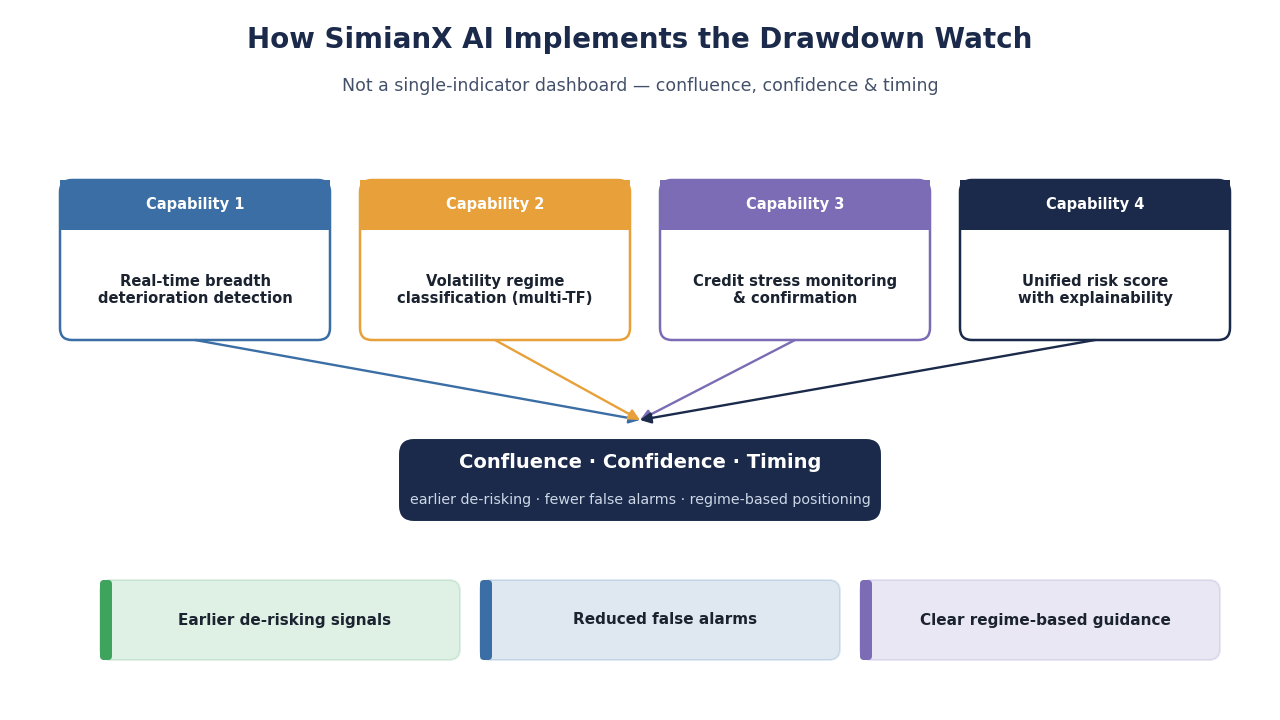
Core Capabilities
- Real-time breadth deterioration detection
- Volatility regime classification across timeframes
- Credit stress monitoring and confirmation
- Unified risk scoring with explainability
Unlike single-indicator dashboards, SimianX emphasizes confluence, confidence, and timing.
Practical benefits for investors:
- Earlier de-risking signals
- Reduced false alarms
- Clear regime-based positioning guidance
What a High-Risk Drawdown Environment Looks Like
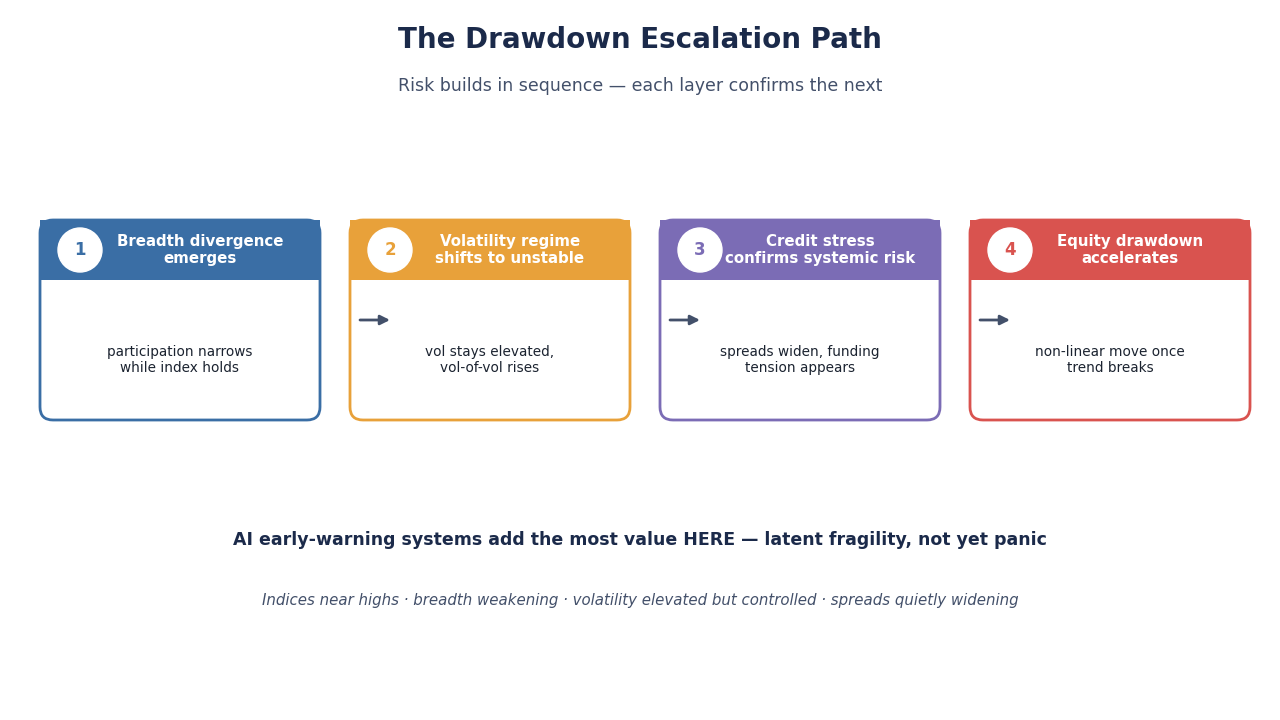
A typical pre-drawdown setup includes:
- Indices near highs, breadth weakening
- Volatility elevated but controlled
- Credit spreads quietly widening
This combination suggests latent fragility, not panic—precisely the environment where AI early-warning systems add the most value.
Example Risk Escalation Path
- Breadth divergence emerges
- Volatility regime shifts to unstable
- Credit stress confirms systemic risk
- Equity drawdown accelerates
FAQ About Wall Street Drawdown Watch
What is a Wall Street drawdown watch?
A Wall Street drawdown watch is a risk-monitoring framework designed to detect early warning signs of major equity market declines before prices collapse.
How do AI early-warning signals improve drawdown detection?
AI identifies non-linear patterns, regime shifts, and signal confluence that traditional indicators often miss or detect too late.
Are breadth signals reliable for predicting market crashes?
Breadth signals are not crash predictors on their own, but persistent deterioration often precedes major drawdowns when combined with volatility and credit stress.
Why is credit stress important for equity investors?
Credit markets price financing risk earlier than equities, making credit stress one of the most reliable leading indicators of systemic drawdowns.
Can retail investors use drawdown watch systems?
Yes. AI platforms like SimianX AI translate complex signals into interpretable risk states suitable for both professional and advanced retail investors.
Conclusion
A modern Wall Street drawdown watch goes beyond price charts. By integrating market breadth, volatility regimes, and credit stress, AI-driven systems provide earlier, more reliable warnings of downside risk.
Rather than predicting crashes, the goal is risk awareness, regime recognition, and capital preservation. As markets grow more complex and interconnected, tools like SimianX AI offer a structured way to stay ahead of drawdowns—before they become unavoidable losses.
Explore advanced AI-driven drawdown monitoring with SimianX AI.
From Signals to Strategy: Turning Drawdown Warnings into Action
Early-warning signals only matter if they translate into concrete portfolio decisions. One of the most common failures in risk management is recognizing elevated risk—but failing to adjust exposure in time.
A mature Wall Street drawdown watch framework therefore requires not just detection, but decision mapping: how signals evolve into portfolio actions under different regimes.
Risk States vs. Binary Signals
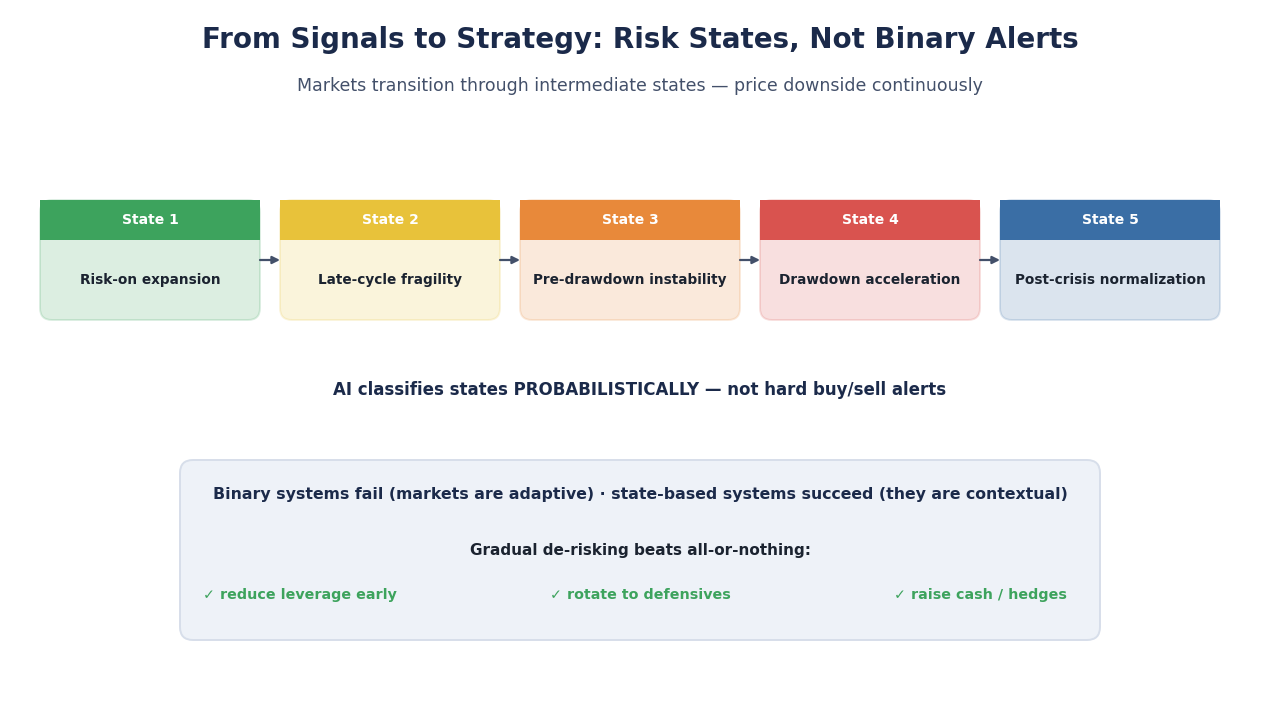
Markets do not move from “safe” to “crash” overnight. Instead, they transition through intermediate risk states:
- Risk-on expansion
- Late-cycle fragility
- Pre-drawdown instability
- Drawdown acceleration
- Post-crisis normalization
AI-driven systems classify these states probabilistically, rather than issuing hard buy/sell alerts.
The goal is not to predict crashes, but to continuously price downside risk.
This distinction is critical. Binary systems fail because markets are adaptive; state-based systems succeed because they are contextual.
Positioning Adjustments Across Drawdown Regimes
Once a drawdown watch framework identifies rising systemic risk, portfolio positioning should evolve accordingly.
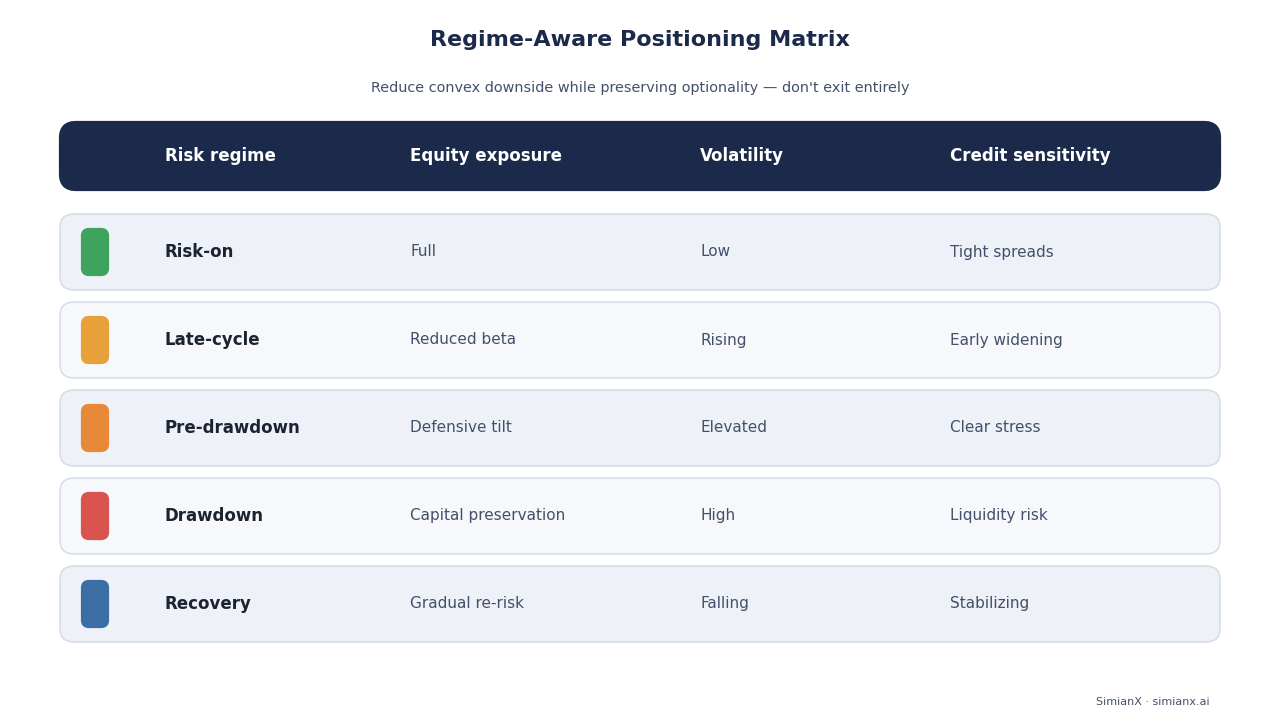
Regime-Aware Positioning Matrix
| Risk Regime | Equity Exposure | Volatility | Credit Sensitivity |
|---|---|---|---|
| Risk-on | Full | Low | Tight spreads |
| Late-cycle | Reduced beta | Rising | Early widening |
| Pre-drawdown | Defensive tilt | Elevated | Clear stress |
| Drawdown | Capital preservation | High | Liquidity risk |
| Recovery | Gradual re-risk | Falling | Stabilizing |
Rather than exiting markets entirely, risk-aware allocation reduces convex downside while preserving optionality.
Why Gradual De-Risking Beats All-or-Nothing
Empirical studies show that investors who:
- Reduce leverage early
- Rotate toward defensive sectors
- Increase cash or hedges
tend to outperform those who wait for confirmation from price alone.
AI early-warning systems provide time—the most valuable asset in drawdown management.
Sector Rotation as a Drawdown Signal Amplifier
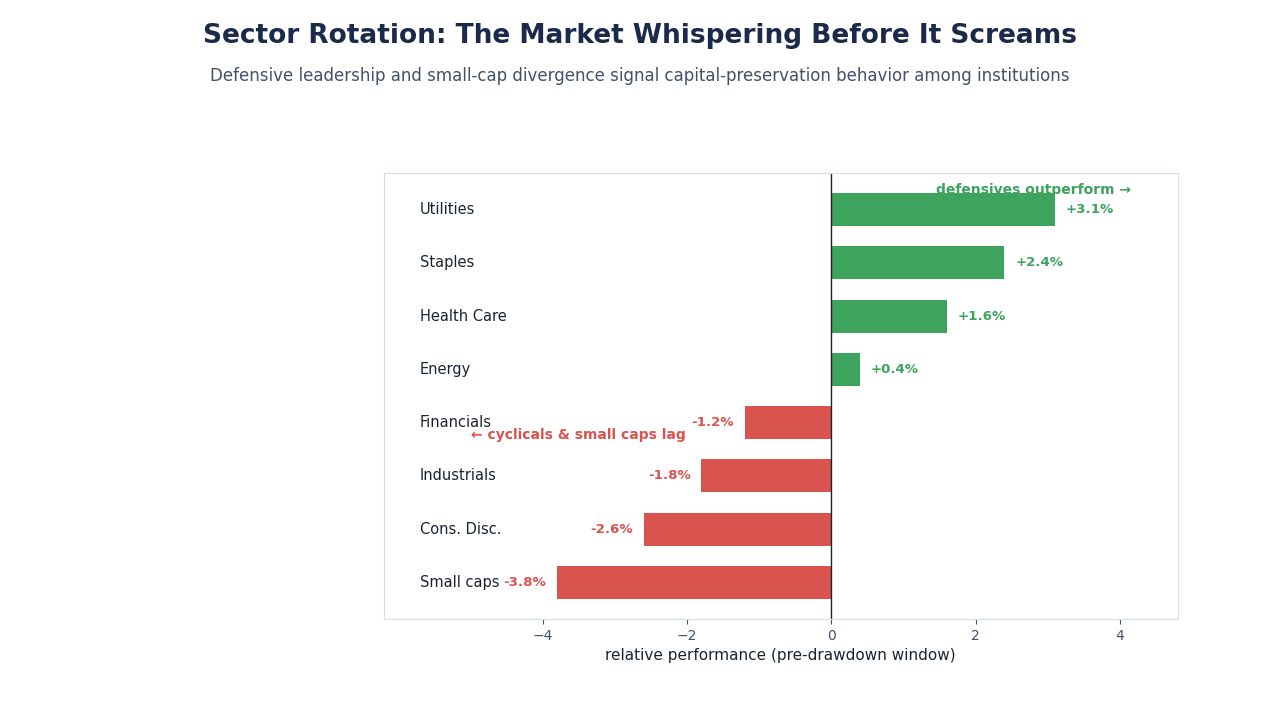
Sector behavior often reveals internal economic stress before indices react.
Typical Pre-Drawdown Sector Patterns
- Cyclicals underperform defensives
- Financials lag despite rising indices
- Utilities and staples quietly outperform
- Small caps diverge negatively
These shifts indicate capital preservation behavior among institutions.
Sector rotation is the market whispering before it screams.
By incorporating sector dispersion into drawdown models, AI systems gain an additional layer of confirmation.
Sector Breadth vs. Index Breadth
Index-level breadth may appear stable while sector-level breadth collapses, masking fragility.
AI models detect this divergence by tracking:
- Intra-sector participation
- Relative momentum decay
- Volatility asymmetry by sector
This is especially relevant in markets dominated by a handful of mega-cap stocks.
Liquidity as the Hidden Drawdown Catalyst
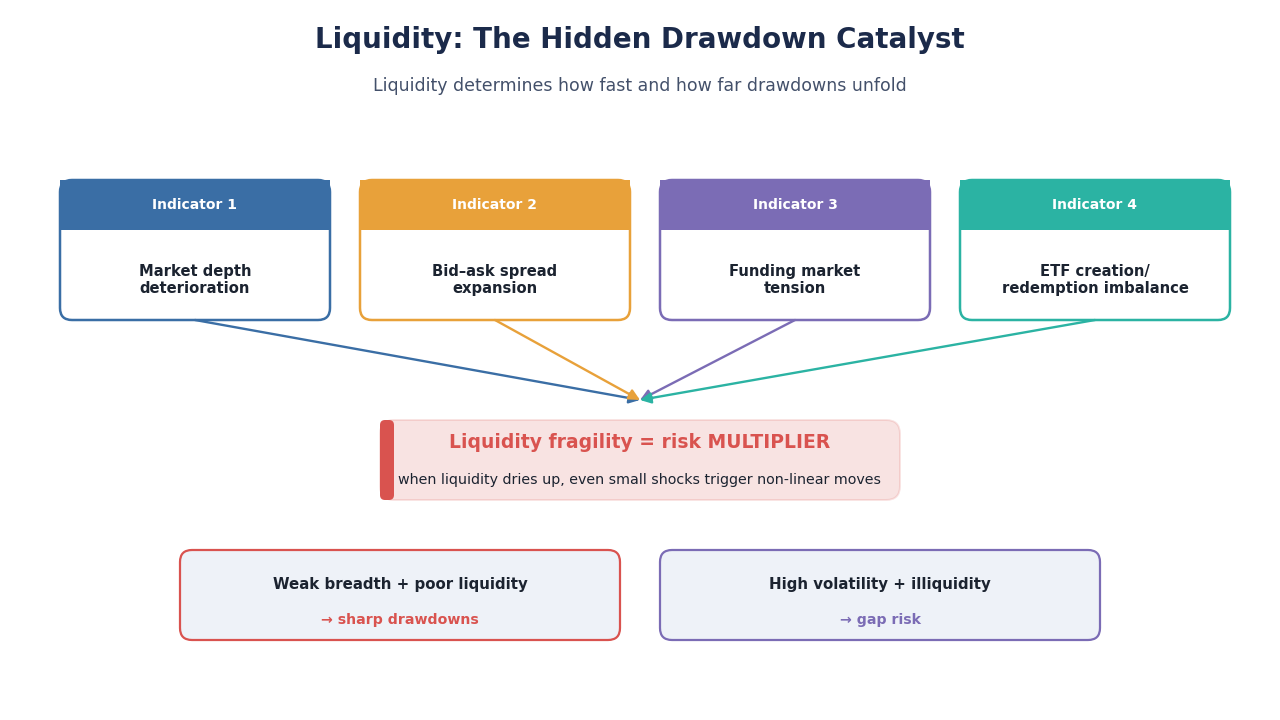
Liquidity conditions often determine how fast and how far drawdowns unfold.
Key Liquidity Indicators
- Market depth deterioration
- Bid–ask spread expansion
- Funding market tension
- ETF creation/redemption imbalances
When liquidity dries up, even small shocks can trigger non-linear price moves.
Why Liquidity Matters More Than Valuation
Markets can remain overvalued for years, but they cannot function without liquidity.
AI-based drawdown systems monitor liquidity fragility as a multiplier of other risks:
- Weak breadth + poor liquidity = sharp drawdowns
- High volatility + illiquidity = gap risk
This explains why some corrections cascade while others stabilize quickly.
Behavioral Feedback Loops During Drawdowns
Drawdowns are not purely mechanical; they are behavioral phenomena.
Common Behavioral Phases
- Denial (signals ignored)
- Rationalization
- Fear (loss potential acknowledged)
- Capitulation (panic-driven selling)
- Numbness (resignation phase)
- Recovery (selective re-engagement)
Why Behavioral Awareness Matters
AI early-warning systems quantify these phases through sentiment indicators, options-skew shifts, and volume profiles—turning behavioral fragility into a measurable, monitorable risk dimension.
Related Reading
- US Stock Risk Dashboard: AI Signals from Breadth, Spreads
- S&P 500 Risk Radar: AI Signals from Breadth, Revisions
- Why US Stocks & Crypto Plummeted This Week: The Causes
- Russell 2000 Rotation in 2026: New Market Leaders Emerge
- The S&P 500 Sector Rotation Playbook for AI Signals