
 By Muke
Advanced time series modeling techniques for cryptocurrency prediction and risk signals
Crypto markets are a perfect storm for forecasters: 24/7 trading, frequent structural breaks, reflexive narratives, and liquidity that can vanish in minutes. That’s why advanced time series modeling techniques for cryptocurrency prediction and risk signals must do more than predict the next return—they must quantify uncertainty, detect regime shifts, and surface actionable “stress” indicators. In this research-style guide, we connect modern forecasting methods to real risk signals, and show how platforms like SimianX AI can help operationalize these ideas into a repeatable workflow for analysts, traders, and risk teams.
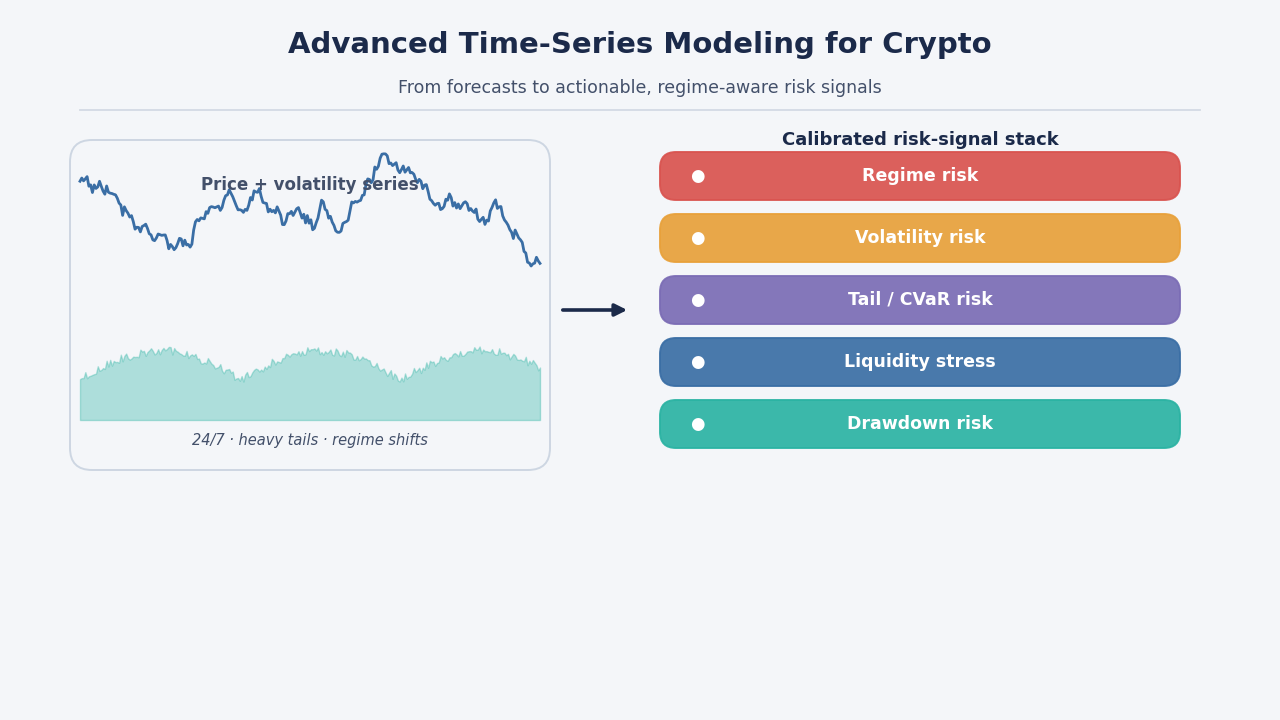
1) Why crypto time series are uniquely hard (and why it matters for risk)
A useful way to think about crypto is: the distribution is not stable, and the market microstructure changes faster than your model retrains. This breaks many assumptions that work “well enough” in traditional assets.
Key failure modes in crypto forecasting:
- Non-stationarity: mean/variance/seasonality drift across bull, bear, sideways regimes.
- Structural breaks: exchange outages, de-pegs, exploit news, governance attacks.
- Heavy tails: extreme moves are not “rare exceptions”—they are part of the process.
- Latency + leakage traps: on-chain metrics and exchange data have delays and revisions.
- Reflexivity: signals become crowded, then reverse violently (squeezes, cascades).
A model that is “directionally right” can still be a risk disaster if it underestimates tail probability.
So the goal shifts from “maximize accuracy” to optimize risk-adjusted decision quality:
- forecast distributions (not point estimates),
- detect regime changes early,
- transform forecasts into risk signals that drive sizing, hedging, and exposure limits.
2) Problem framing: what exactly are you predicting?
Before modeling, define target + horizon + decision. In crypto, this choice often matters more than the model family.
Common prediction targets (and what they imply)
- Return direction (e.g.,
P(r_{t+1} > 0)): useful for tactical signals, fragile across regimes. - Volatility (e.g., next-day realized vol): foundational for sizing and risk budgeting.
- Drawdown probability: “risk-first” target tied to capital preservation.
- Liquidity stress: predicts slippage risk / unwind risk, not just price moves.
- Event risk: probability of “shock days” (tail classification).
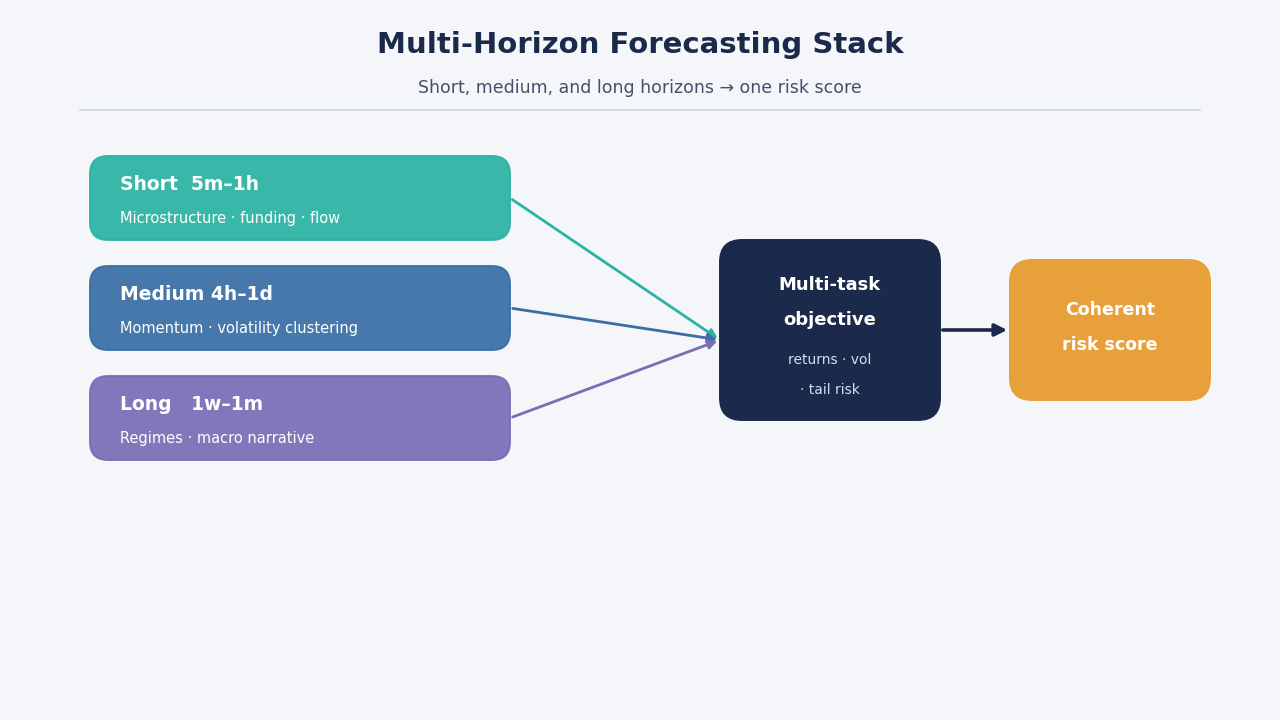
Horizons (multi-horizon is usually better)
Instead of one horizon, model a stack:
- short: 5m–1h (microstructure + funding + flow)
- medium: 4h–1d (momentum + volatility clustering)
- long: 1w–1m (regimes + macro narrative)
A practical research setup is a multi-task objective: predict returns and volatility and tail risk, then convert those into a single coherent risk score.
3) Data design: building features that don’t leak
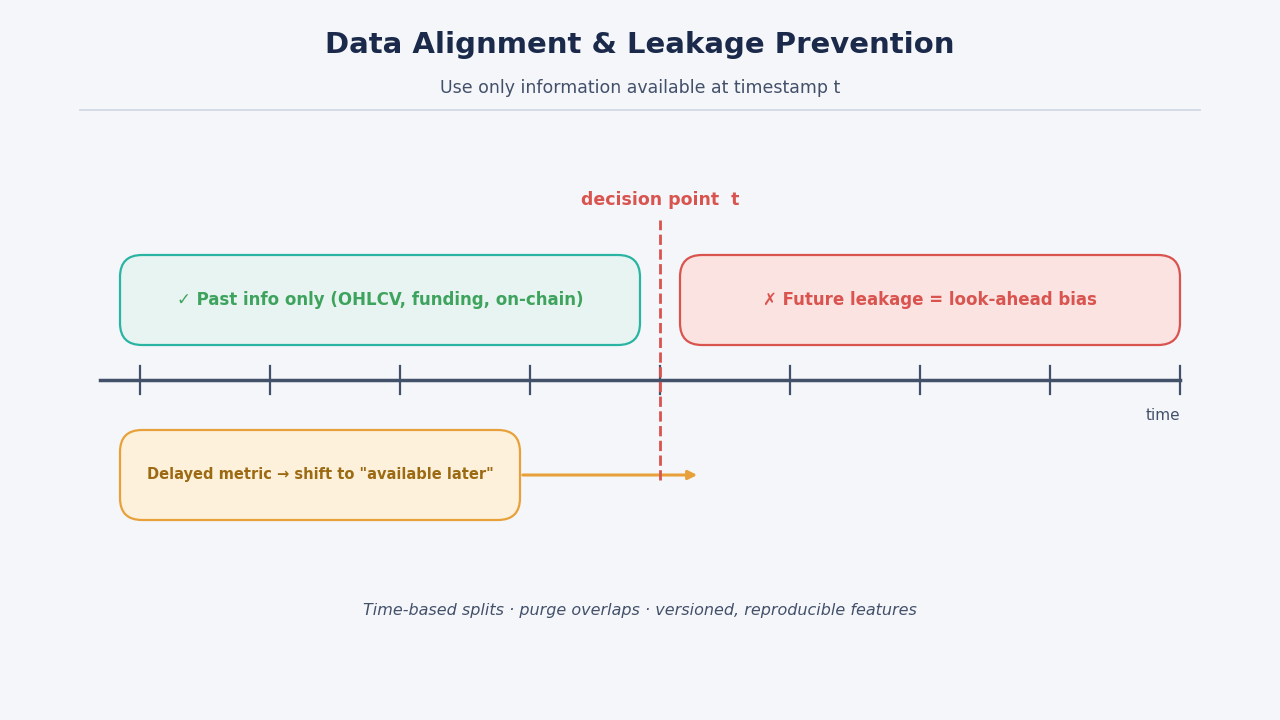
Crypto models live or die by data alignment. Advanced methods cannot rescue a pipeline with leakage.
A robust feature stack (market + derivatives + on-chain)
Market data
- OHLCV at multiple resolutions (e.g., 5m/1h/1d)
- microstructure proxies (spread, order book imbalance if available)
- realized volatility and range-based measures
Derivatives
- funding rate, basis, open interest (
OI) - liquidation volume, long/short ratios (exchange-specific)
On-chain
- net exchange inflows/outflows
- stablecoin supply changes, bridge flows
- large holder concentration, realized cap, MVRV-style metrics (if you use them, document definitions)
Risk-relevant engineered features
- volatility-of-volatility
- drawdown depth and duration
- “crowdedness” proxy:
ΔOI + funding(squeeze risk context) - liquidity proxy: depth, volume, or on-chain flow vs. available liquidity
Feature hygiene checklist
- Use only past information at timestamp
t. - Align to a single canonical clock (exchange time or UTC).
- If a metric is delayed, treat it as available later (shift it).
- Version features: definitions evolve; your backtests must be reproducible.
4) Strong statistical foundations (still relevant in 2026)
Advanced does not always mean deep learning. In crypto, interpretable statistical models often win on robustness and debuggability.
4.1 State space models + Kalman filtering (time-varying dynamics)
State space models let parameters drift:
- time-varying trend and seasonality
- dynamic regression with exogenous inputs (
volume,funding, on-chain flows)
Why it matters for risk:
- you can track latent regime states (trend strength, volatility level)
- you can produce uncertainty estimates naturally
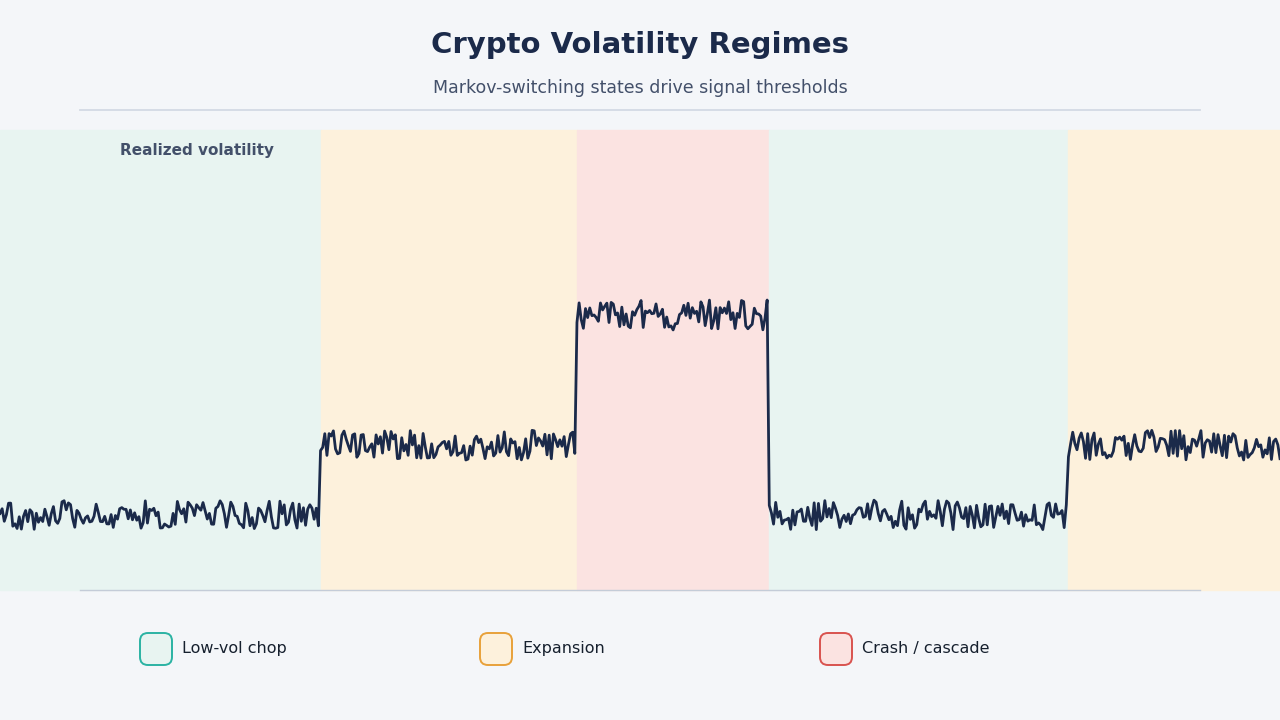
4.2 Regime-switching models (HMM / Markov switching)
A Markov switching model can represent “market modes”:
- low-vol chop
- trending expansion
- crash / liquidation cascade regime
Practical crypto use:
- switch signal thresholds by regime (avoid overtrading in chop)
- increase margin of safety when probability of crash regime rises
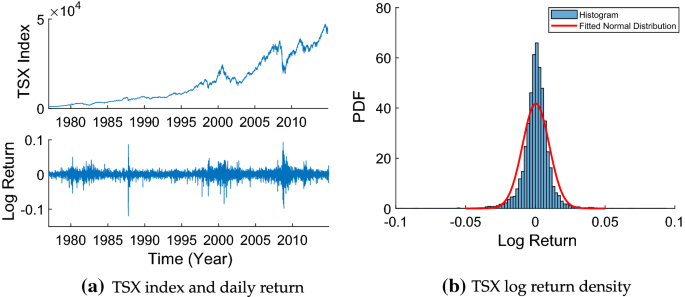
4.3 Extreme value theory (EVT) for tail modeling
Rather than assuming normal tails, EVT models the tail directly:
- estimate tail index
- compute quantiles for extreme loss regions
EVT becomes a risk signal engine:
- rising tail heaviness = higher required risk buffers
- tail quantile estimates feed VaR/CVaR-like controls
5) Volatility modeling as the backbone of crypto risk signals
In crypto, volatility forecasting is often more reliable than return forecasting—and it’s directly actionable.
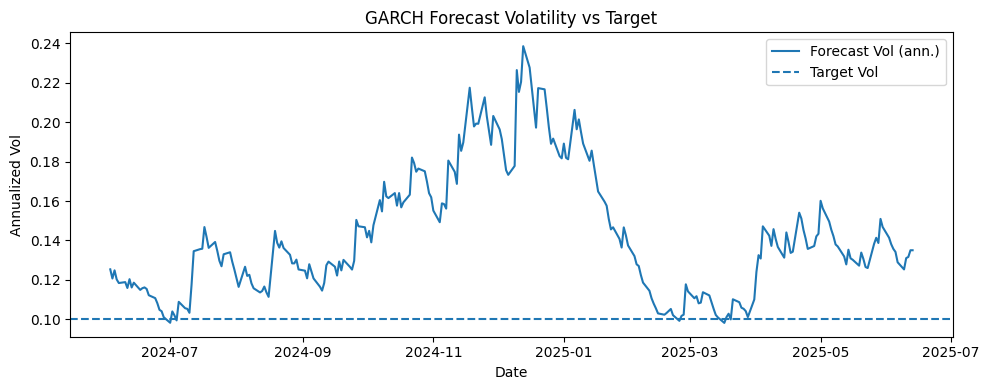
5.1 GARCH family and extensions
- GARCH captures volatility clustering
- EGARCH / GJR-GARCH handle asymmetry (“bad news” impact)
- DCC-GARCH (multivariate) models time-varying correlations across assets
Risk signals you can generate:
- volatility breakout likelihood
- correlation spike risk (diversification fails)
- portfolio stress probability
5.2 Realized volatility + high-frequency aggregation
If you can compute realized measures (even from 5m bars), you can model:
- realized vol
- realized skew/kurtosis proxies
- realized jump components
This improves:
- sizing rules
- stop distance calibration
- option/hedge timing (if applicable)
5.3 Stochastic volatility (SV) and volatility-of-volatility
SV models treat volatility as a latent process. This often aligns better with crypto’s “vol-of-vol” bursts.
- rising vol-of-vol is a pre-shock warning
- combine with liquidity proxies to detect unwind risk
6) Multivariate and cross-asset time series: where risk becomes systemic
Single-asset models miss systemic risk. Crypto’s biggest losses often come from correlation + liquidity failures.
6.1 VAR / VECM (cointegration and spread dynamics)
- VAR for multi-asset interactions (BTC, ETH, majors)
- VECM for cointegrated pairs / spreads (use carefully; breaks happen)
Risk signal:
- spread dislocation + regime change can indicate liquidity stress or leverage imbalance.
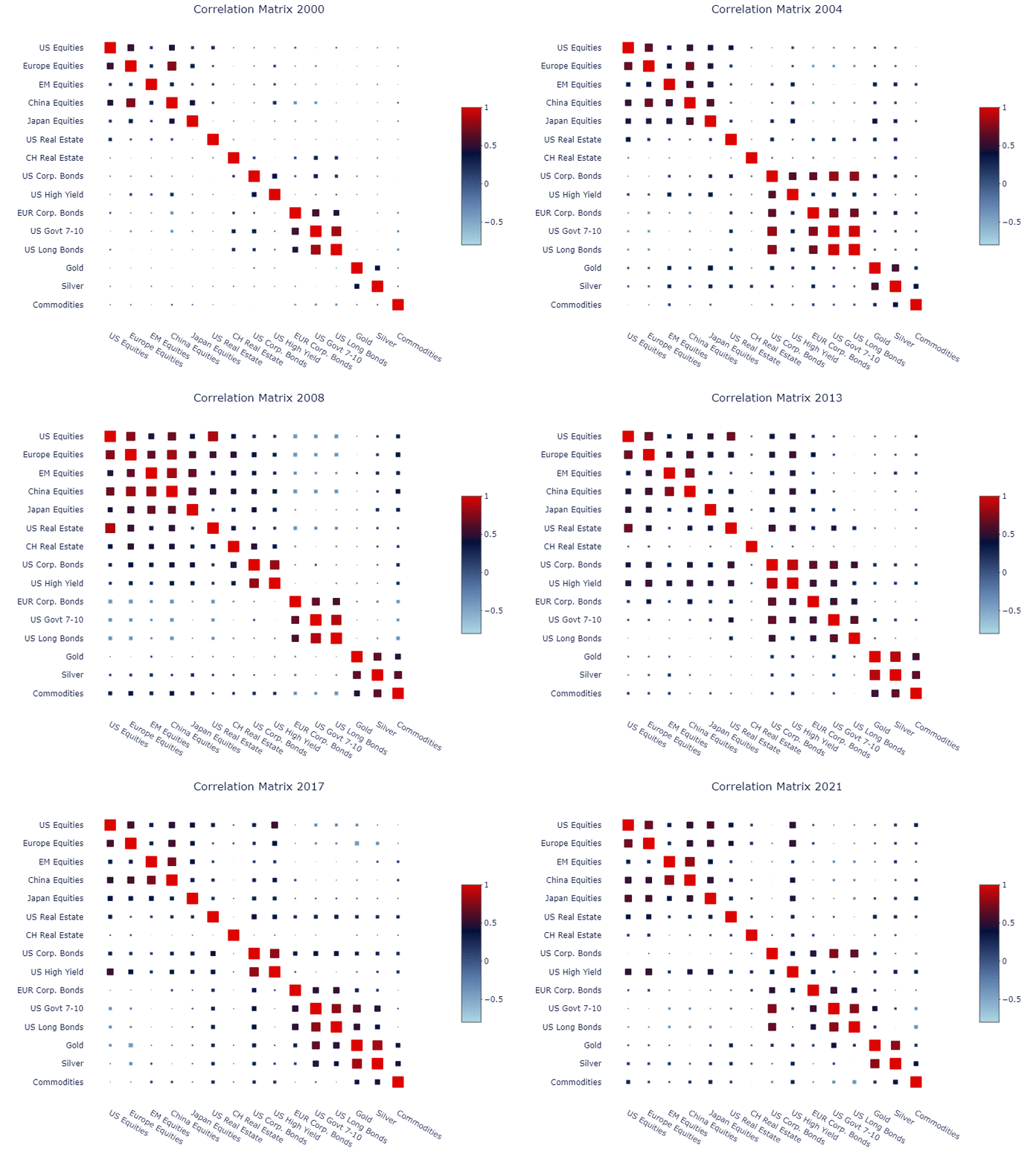
6.2 Dynamic correlation (DCC) and factor models
When correlation rises rapidly, diversification collapses. Track:
- time-varying correlation
- factor exposures (market beta, alt beta, narrative clusters)
Practical use:
- reduce gross exposure when correlation risk spikes
- hedge market factor when idiosyncratic signals are unreliable
6.3 Graph time series for on-chain networks
On-chain data is naturally graph-structured (addresses, protocols, flows). Graph time series models can detect:
- contagion pathways
- protocol-to-protocol stress transmission
- abnormal flow communities (bridge drains, exchange clustering)
This is often where risk signals beat price forecasts: you see the stress moving before price reprices.
7) Deep time series models that actually earn their complexity
Deep learning can help, but only when data quality, validation discipline, and objectives are aligned.
7.1 Temporal CNNs / TCNs (strong baselines)
TCNs often perform well in noisy markets because:
- they capture local patterns efficiently
- they’re easier to regularize than RNNs
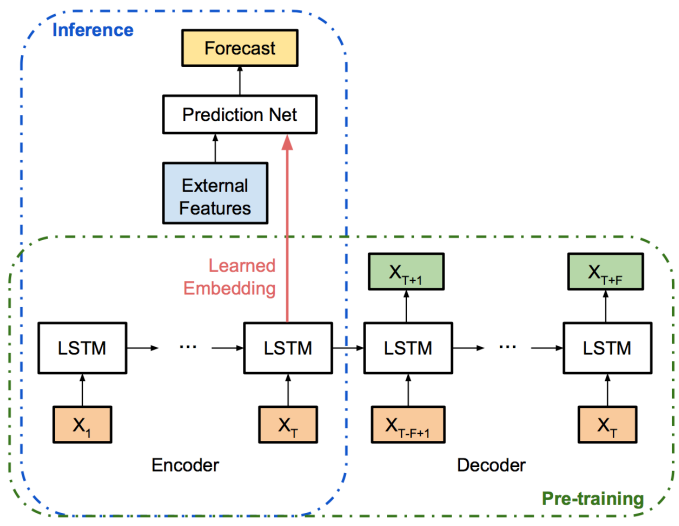
7.2 Sequence models: LSTM/GRU (use sparingly)
RNNs can work for specific horizons and features, but:
- they overfit easily
- they can become “regime memorization machines”
7.3 Transformer variants (TFT-like approaches)
Transformers can integrate many exogenous signals:
- price/volume + funding + on-chain metrics
- multiple horizons and attention over history
Best practice in crypto:
- optimize for calibrated probabilities and quantile forecasts, not raw direction.
- use strong regularization and walk-forward evaluation.
7.4 Neural forecasting for distributions (DeepAR-like ideas)
Probabilistic neural forecasting shifts focus:
- output a full predictive distribution
- support quantile-based risk rules
That’s a direct bridge to risk signals:
- “probability of 5% drawdown tomorrow”
- “99% worst-case return band” (model-based, not naïve)
8) Uncertainty, calibration, and conformal prediction (the “risk” layer)
In crypto, uncertainty is the product. A point forecast without uncertainty is not a signal—it’s a guess.
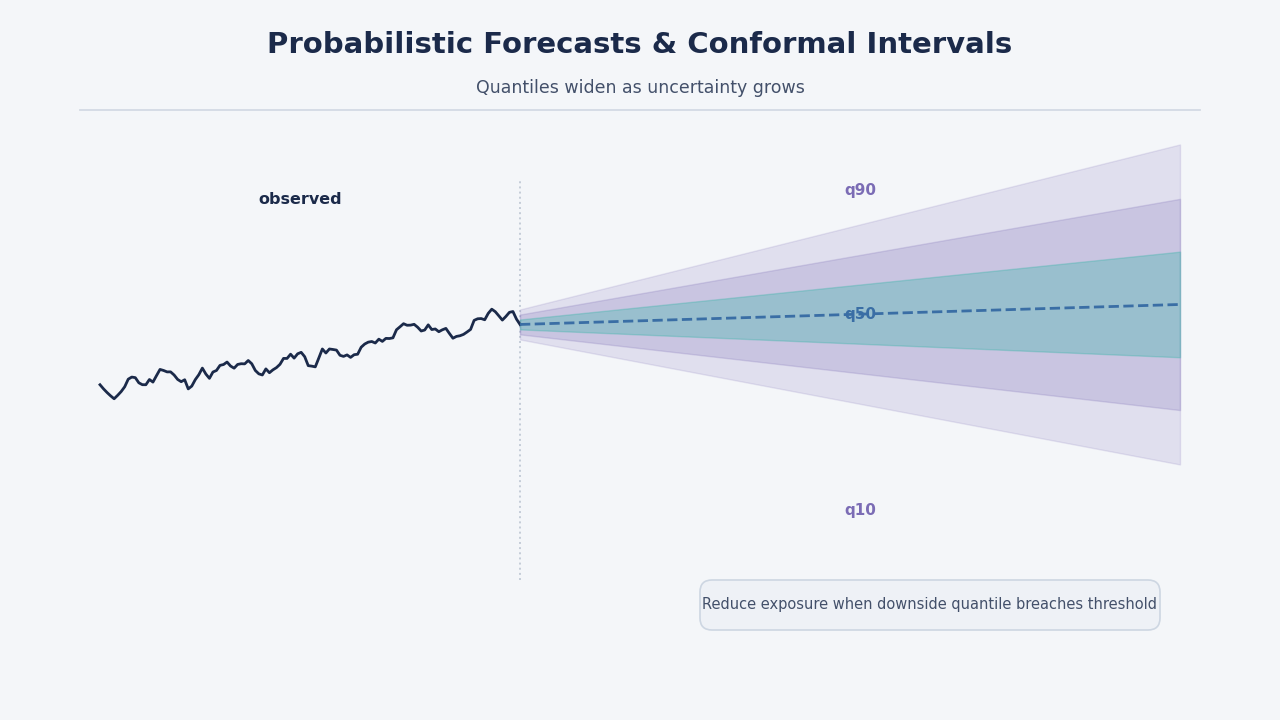
8.1 Probabilistic forecasting: quantiles and intervals
Prefer outputs like:
q10,q50,q90return forecasts- volatility interval forecasts
- tail-event probability
Then define risk rules:
- reduce exposure if downside quantile breaches threshold
- widen stops when volatility interval expands
8.2 Calibration: does your 70% mean 70%?
A model that claims P(up)=0.7 should be right ~70% of the time in that probability bucket. Calibration is essential for trustworthy risk controls.
Simple calibration tools:
- reliability curves
- isotonic regression / Platt-style scaling (conceptually)
- rolling recalibration by regime
8.3 Conformal prediction for “distribution-free” intervals
Conformal prediction can produce prediction intervals with coverage guarantees under mild assumptions—useful when distributions drift.
Crypto benefit:
- intervals adapt to drift without pretending the world is stationary
- you can generate confidence-aware risk signals (trade less when uncertainty widens)
9) Validation for crypto: walk-forward, purging, and stress tests
The fastest way to fool yourself in crypto is to “backtest” with leakage or favorable splits.
A leakage-proof evaluation protocol (practical standard)
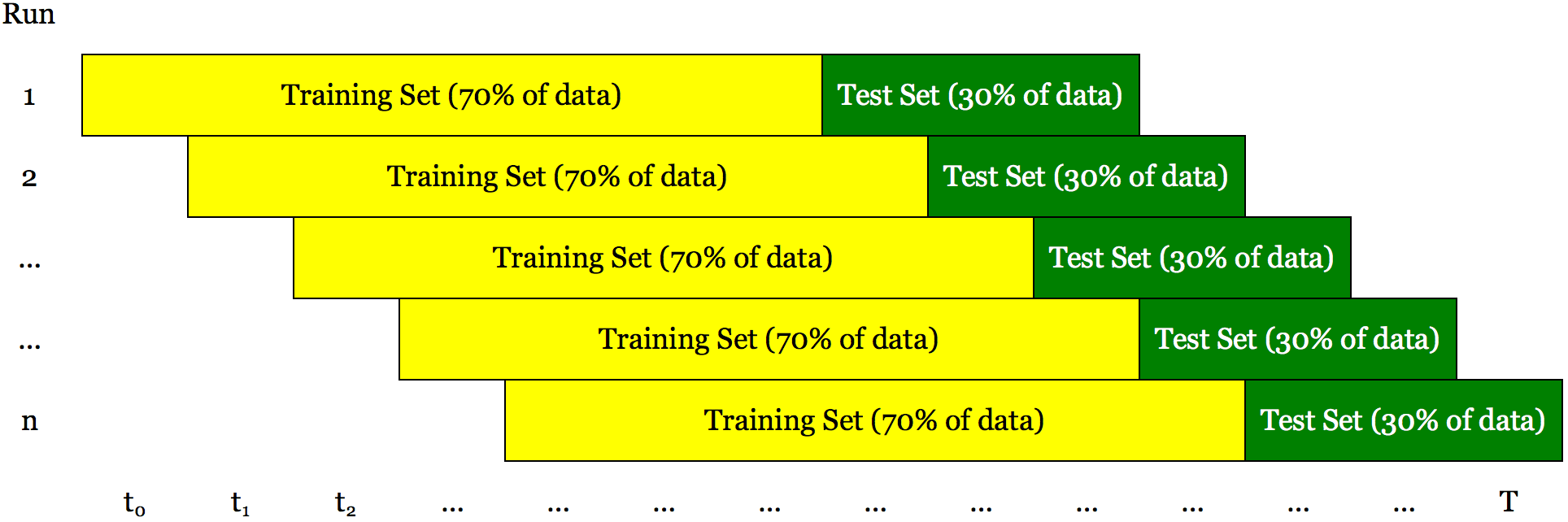
- Time-based splits only (never random).
- Walk-forward: train → validate → roll forward.
- If using overlapping windows, purge samples that leak information.
- Model costs: fees, slippage, funding, borrow, and liquidation risk.
- Add stress tests: worse spreads, delayed execution, and gaps.
Minimum reporting set
- out-of-sample hit rate by regime
- calibration error
- drawdown distribution
- tail loss frequency vs. predicted tail probability
If your evaluation doesn’t measure tail behavior, it’s not a crypto risk model—it’s a charting tool.
10) How do advanced time series models generate cryptocurrency risk signals?
This is the bridge from “forecasting” to “decision-grade risk intelligence.”
A reliable framework:
- Define risk events (what do you want to avoid?)
- 1-day drawdown > X%
- volatility spike > Y
- correlation jump
- liquidity stress (slippage proxy) > Z
- Choose model outputs that map to decisions
- quantile returns → downside thresholds
- volatility distribution → position sizing bands
- regime probabilities → strategy switching
- tail probability → exposure caps
- Calibrate outputs and turn them into signals
- probability scores that mean something
- intervals that widen during uncertainty
- stable thresholds that adapt by regime
- Validate signals, not just predictions
- does “high risk” precede worse outcomes?
- does “low risk” avoid missed upside excessively?
A practical “risk signal stack” (examples)
- Regime Risk Score: probability of crash regime (Markov switching / HMM)
- Tail Risk Score: EVT tail quantile or tail-event classifier probability
- Volatility Risk Score: forecast vol + vol-of-vol
- Liquidity Stress Score: depth/volume proxy + flow pressure
- Crowdedness Score:
ΔOI + funding+ liquidation sensitivity
Signal-to-action mapping (table)
| Model Output | Risk Signal | What It Warns About | Typical Action |
|---|---|---|---|
| Regime probability (crash) | Regime risk | Structural break / cascade | Reduce leverage, tighten limits |
| Vol forecast + interval | Vol risk | Bigger ranges, gaps | Lower size, widen stops |
| Tail quantile / CVaR proxy | Tail risk | Extreme loss likelihood | Cut exposure, add hedges |
| Dynamic correlation | Systemic risk | Diversification failure | De-risk portfolio, hedge beta |
| Liquidity proxy forecast | Unwind risk | Slippage + forced selling | Lower position concentration |
Calibrated P(drawdown>X) | Drawdown risk | Capital impairment | Pause signals, defensive mode |
11) A complete end-to-end workflow you can operationalize
Below is a field-tested blueprint that aligns with both research rigor and real-world constraints.
Step-by-step pipeline (implementation-ready)
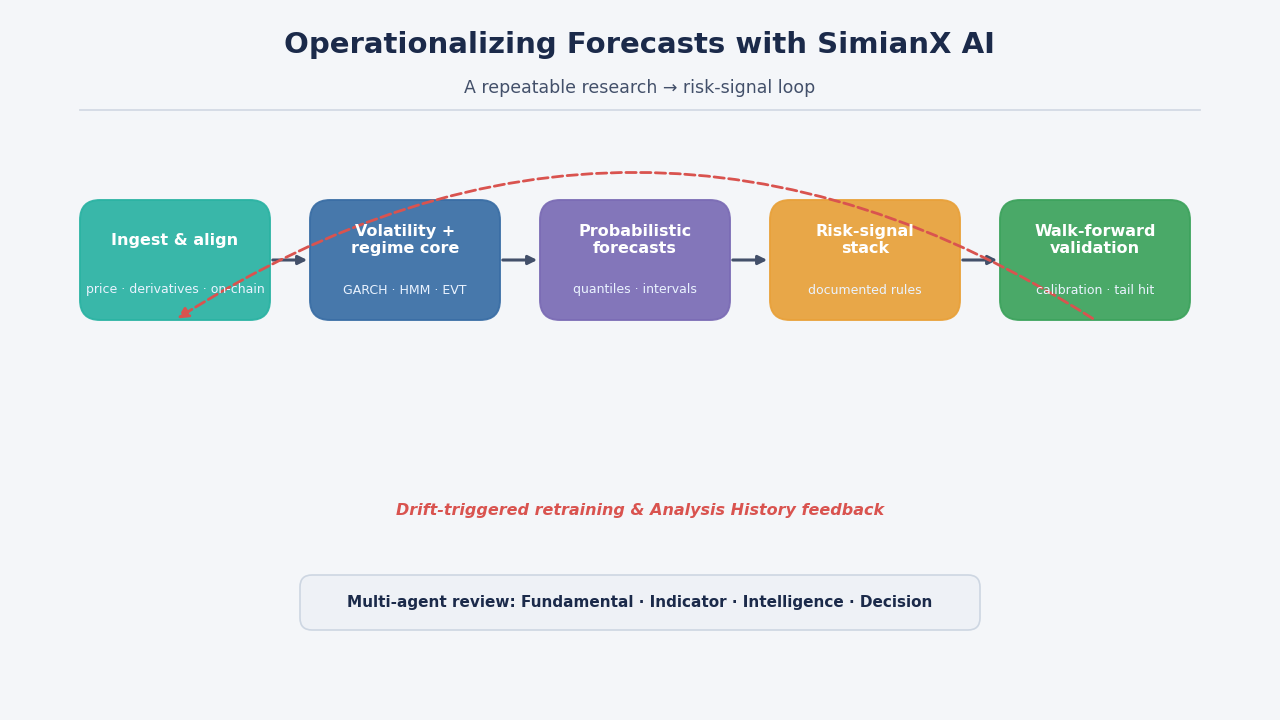
- Ingest and align data (price/derivatives/on-chain) to a single timeline.
- Create features at multiple resolutions; shift delayed metrics.
- Build baselines (simple models + engineered features) to benchmark.
- Add volatility + regime modeling as the first “risk core.”
- Introduce probabilistic forecasting (quantiles/intervals).
- Convert outputs into a risk signal stack with documented rules.
- Run walk-forward validation with purging and stress costs.
- Monitor live drift: calibration error, regime mix, tail hit rate.
- Retrain on a schedule, but also trigger retrains on drift events.
Where SimianX AI fits in practice
A common bottleneck isn’t “model choice”—it’s building a repeatable research loop that produces consistent, interpretable outputs. SimianX AI can be positioned as the layer that helps you:
- compare approaches in a structured way (forecasting + risk signals),
- standardize evaluation and avoid ad-hoc analysis,
- integrate market + on-chain signals into a coherent view,
- turn research into a practical dashboard for decision-making.
Explore the broader platform and tooling here: SimianX AI
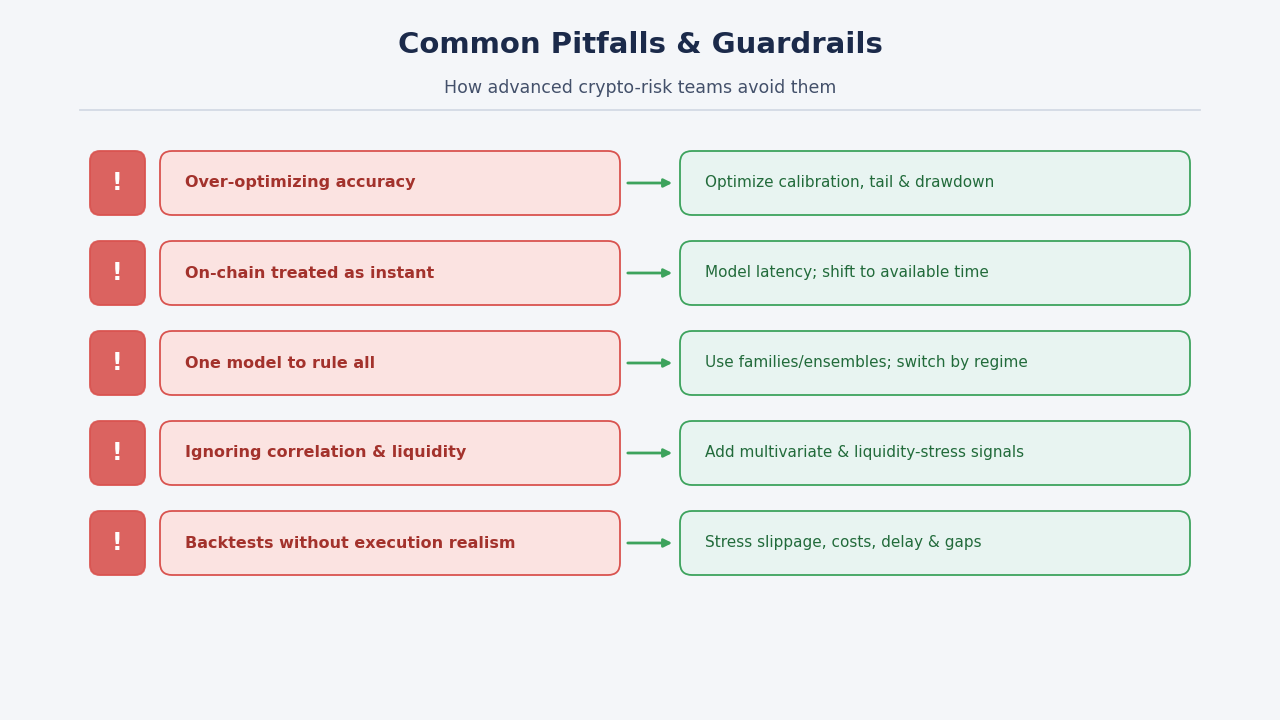
12) Common pitfalls (and how advanced teams avoid them)
Pitfall 1: Over-optimizing for accuracy
- Fix: optimize for calibration, tail performance, and drawdown control.
Pitfall 2: Treating on-chain metrics as instant
- Fix: model and document latency; shift features to “available time.”
Pitfall 3: One model to rule them all
- Fix: use model families and ensembles; switch behavior by regime.
Pitfall 4: Ignoring correlation and liquidity
- Fix: incorporate multivariate risk signals and liquidity stress proxies early.
Pitfall 5: Backtests without execution realism
- Fix: stress test slippage, costs, and delay; model “worst plausible” conditions.
FAQ About advanced time series modeling techniques for cryptocurrency prediction and risk signals
What is the best advanced time series model for crypto prediction?
There isn’t a single best model because crypto regimes change. Many teams use a hybrid stack: statistical volatility/regime models for robustness plus probabilistic deep models for multi-signal integration, evaluated via walk-forward testing.
How to detect crypto regime shifts using time series models?
Regime shifts are commonly modeled with Markov switching/HMMs, change-point detection, or volatility regime classifiers. The key is to validate whether the “high-risk” regime probability actually precedes worse drawdowns out-of-sample.
What is probabilistic forecasting in crypto trading?
Probabilistic forecasting outputs distributions or quantiles instead of a single number. This lets you create risk rules like “reduce size if the downside q10 breaches -X%” or “pause trading when prediction intervals widen.”
Best way to backtest crypto time-series prediction signals?
Use time-based splits and walk-forward validation, purge overlapping samples, and include realistic fees/slippage/funding. Evaluate not just returns, but calibration, tail hit rate, and drawdown behavior.
How can on-chain data improve crypto risk signals?
On-chain data can surface flow pressure and contagion pathways before price fully reflects them. When aligned correctly (no latency leakage), it can improve liquidity stress and regime-risk signals more reliably than direction-only forecasts.
Conclusion
Advanced time series modeling techniques for cryptocurrency prediction and risk signals are most valuable when they prioritize uncertainty, regimes, and tail behavior over simplistic point forecasts. The winning approach is usually a layered system: robust volatility and regime modeling, multivariate correlation and liquidity awareness, probabilistic forecasts with calibration, and a leakage-proof walk-forward research loop. If you want to turn these methods into an operational analytics workflow—rather than isolated experiments—explore how SimianX AI can support research, evaluation, and signal-to-risk translation at scale: SimianX AI
You can use SimianX AI as the “presentation + operationalization layer” for advanced time-series modeling by turning raw forecasts (e.g., multi-horizon return distributions, volatility intervals, regime probabilities, and tail-risk scores) into a live, inspectable command-room workflow: pick a trading pair, stream real-time charts/indicators alongside your model outputs, and let a multi-agent team (Fundamental, Indicator, Intelligence, Decision) continuously cross-check whether the latest regime/volatility shift is supported by market structure, technical state, and incoming news flow. Because SimianX keeps analysis traceable and reviewable, you can attach each risk signal to the evidence that moved it, then use Analysis History for post-trade evaluation and walk-forward learning (e.g., “did crash-regime probability rise before drawdowns?”). Finally, the platform’s customizable agent cadence/model selection and transparency tools (like the crypto model leaderboard) make it easier to compare different time-series approaches side-by-side and communicate results clearly to teammates or users without burying them in model internals.
Related Reading
- Specialized Time-Series Models for Crypto Prediction
- Time-Series Models vs LLMs for Crypto: Why Hybrid Wins
- AI for DeFi Volatility and Chain-Reaction Risk Modeling
- Emerging Encrypted Prediction: Cooperative Multi-Agent AI
- Predicting Crypto Market Trends with Collective AI
- Synthetic Prediction Engines in Decentralized Crypto
- Market Early-Warning Intelligence from Distributed AI Swarms
- SimianX Crypto Leaderboard