
 By Muke
What Would Have to Happen for AI to Re-Rate Autodesk
Autodesk earnings 2026 have given investors a more constructive starting point for evaluating ADSK as an artificial-intelligence investment. Autodesk is no longer simply a mature provider of AutoCAD and design software. It is attempting to become an AI-native platform for the physical economy — the same wager Synopsys is making one layer down, in chip design, connecting architecture, engineering, construction, manufacturing, media and entertainment workflows.
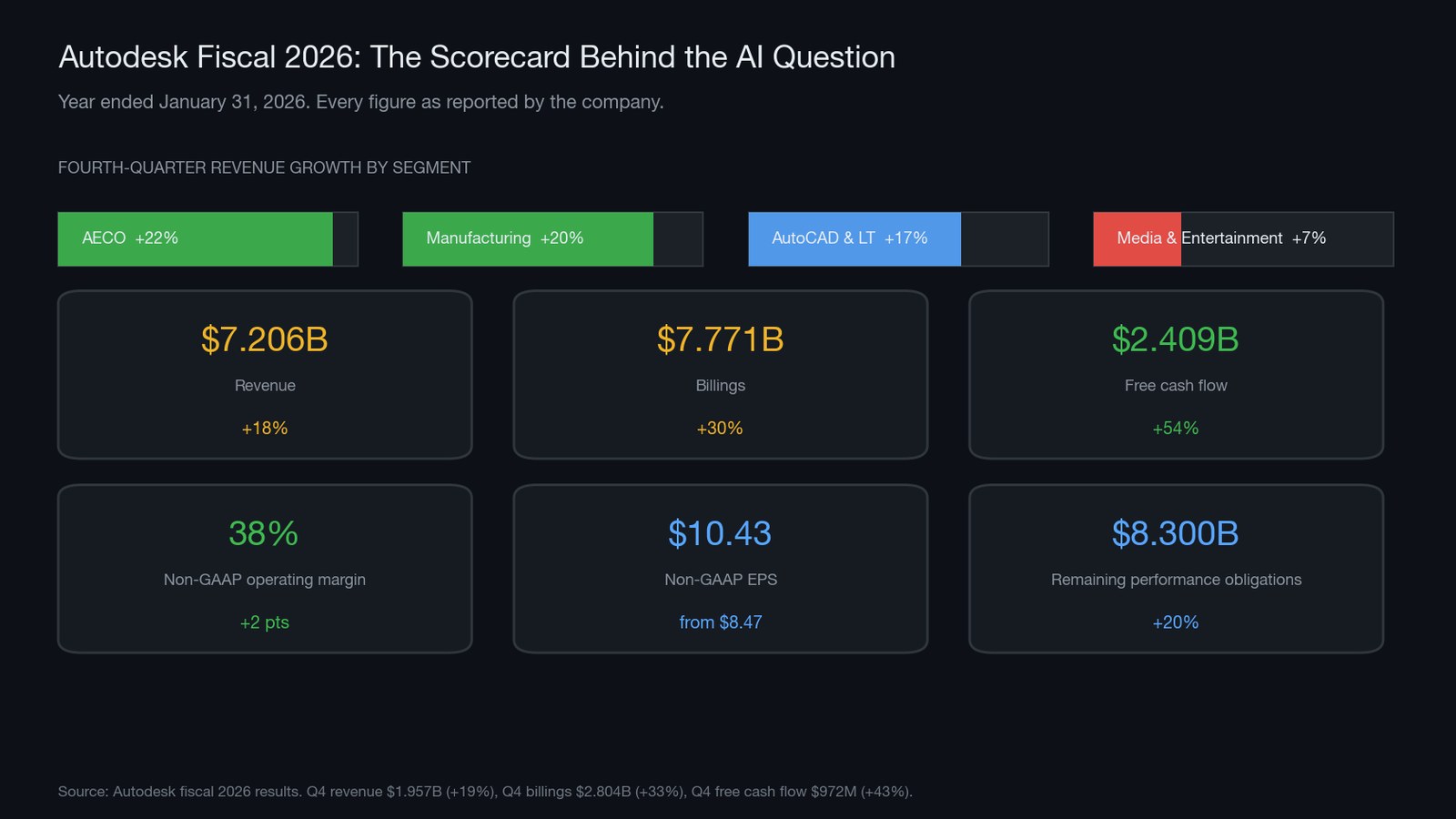
The company’s fiscal 2026 results were strong. Fourth-quarter revenue increased 19% year over year to $1.96 billion, while full-year revenue rose 18% to $7.21 billion. Full-year free cash flow reached $2.41 billion, up 54%, and non-GAAP earnings per share increased to $10.43. Autodesk fiscal 2026 results
The investment question, however, is more demanding than whether Autodesk can grow. Investors want to know whether Autodesk can use AI to accelerate revenue, expand margins, increase customer retention and create a new software category before competitors catch up.
SimianX AI provides a useful research workflow for this type of question because it combines fundamental analysis, technical indicators, market news and sentiment into one stock-research process. This article examines Autodesk’s financial position, AI strategy, competitive advantages, risks and valuation scenarios for ADSK in 2026 and beyond.
Autodesk Earnings 2026: The Numbers Investors Need to Know
Autodesk’s fiscal year ended January 31, 2026, and the filings are on SEC EDGAR. The reported results showed broad-based momentum across its product portfolio.
| Metric | Fiscal 2026 | Year-over-year change |
|---|---|---|
| Revenue | $7.206 billion | 18% |
| Billings | $7.771 billion | 30% |
| Non-GAAP operating margin | 38% | Up 2 percentage points |
| GAAP EPS | $5.23 | Up from $5.12 |
| Non-GAAP EPS | $10.43 | Up from $8.47 |
| Operating cash flow | $2.452 billion | Up 53% |
| Free cash flow | $2.409 billion | Up 54% |
| Remaining performance obligations | $8.300 billion | Up 20% |
The quarterly figures were also encouraging:
- Q4 revenue reached $1.957 billion, up 19%.
- Q4 billings increased 33% to $2.804 billion.
- Q4 non-GAAP operating margin was 38%.
- Q4 free cash flow rose 43% to $972 million.
- Current remaining performance obligations increased 23% to $5.479 billion.
Autodesk’s revenue growth was not limited to one product family. In Q4, Architecture, Engineering, Construction and Operations revenue increased 22%, AutoCAD and AutoCAD LT revenue rose 17%, and Manufacturing revenue grew 20%. Media and Entertainment was slower, increasing 7%.
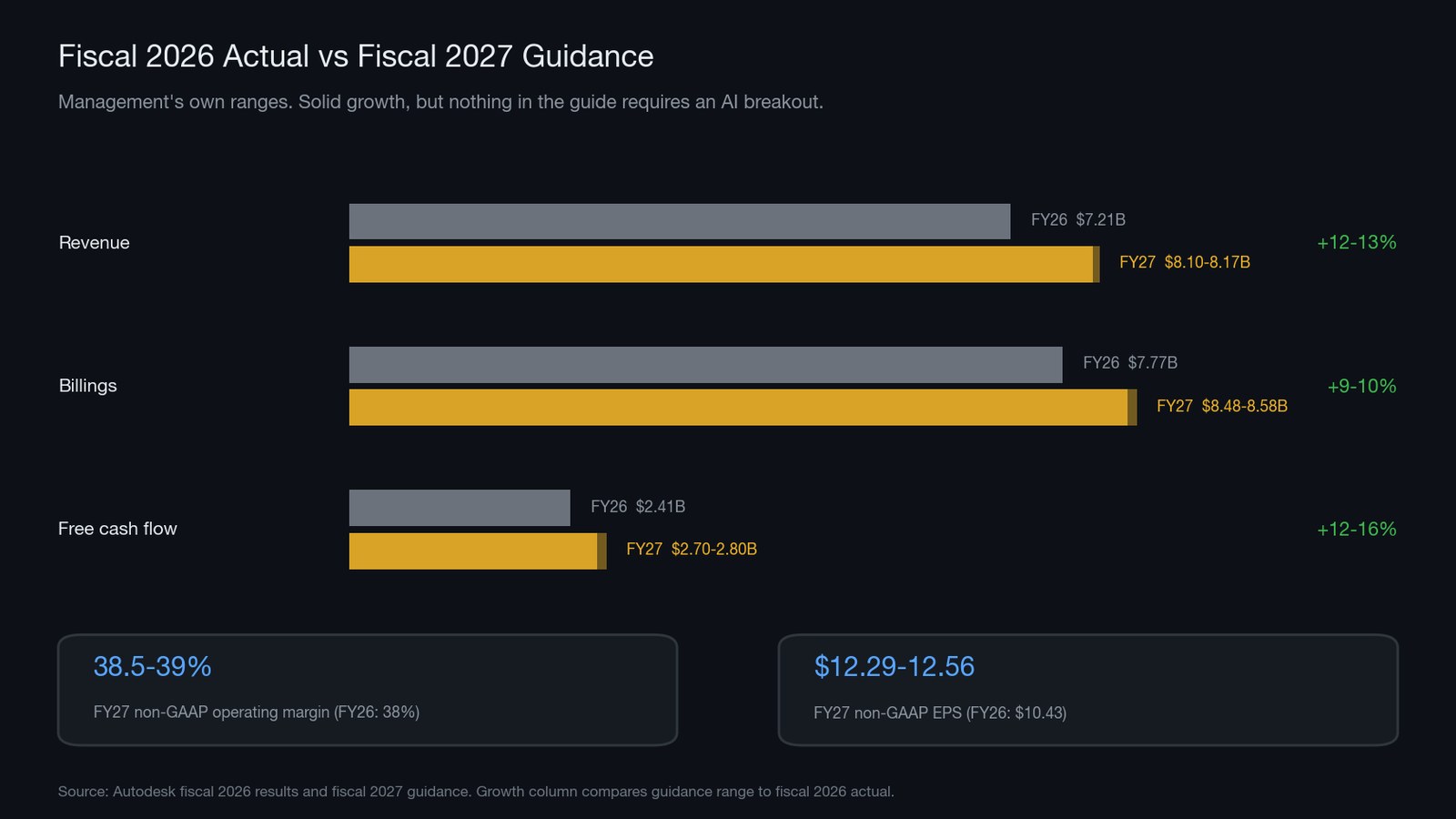
For fiscal 2027, management guided toward revenue of $8.10 billion to $8.17 billion, billings of $8.48 billion to $8.58 billion, non-GAAP operating margin of 38.5% to 39%, non-GAAP EPS of $12.29 to $12.56 and free cash flow of $2.7 billion to $2.8 billion. These figures imply continued growth, but they are not explosive projections. The potential breakout therefore depends on whether AI creates upside beyond the current guidance framework.
The AI re-rating scorecard: what fiscal 2027 guidance already assumes
| Metric | Fiscal 2026 actual | Fiscal 2027 guidance | Implied growth | What a real AI breakout would look like |
|---|---|---|---|---|
| Revenue | $7.206B | $8.10B–$8.17B | +12% to +13% | Above the top of the range, with the beat attributed to AI tiers |
| Billings | $7.771B | $8.48B–$8.58B | +9% to +10% | Reaccelerating rather than decelerating from +30% |
| Free cash flow | $2.409B | $2.7B–$2.8B | +12% to +16% | Guidance raised during the year, not just met |
| Non-GAAP operating margin | 38% | 38.5%–39% | +0.5 to +1.0 pt | Expanding while AI spend rises, not because it was deferred |
| Non-GAAP EPS | $10.43 | $12.29–$12.56 | +18% to +20% | Driven by revenue mix, not buybacks |
| Remaining performance obligations | $8.300B | not guided | — | Growing faster than revenue for consecutive quarters |
| Net revenue retention | not disclosed | not guided | — | Disclosed and rising, tied explicitly to AI attach |
Methodology: fiscal 2026 figures are as reported for the year ended January 31, 2026; fiscal 2027 figures are management's own guidance ranges. Implied growth compares the guidance range to the fiscal 2026 actual. The final column is this article's framing for reading future quarters, not company guidance or an analyst target. Note that none of the guided ranges require AI monetisation to succeed — which is precisely why the bull case has to be proven in the disclosures rather than in the guide.
Autodesk is already a high-quality subscription software company. The AI bull case requires it to become more than that—it must turn proprietary industry data into a new layer of recurring revenue.
Why Autodesk Has an Attractive AI Starting Position
Many software companies can add a chatbot. Far fewer possess decades of structured data describing buildings, machines, infrastructure, manufacturing processes, animation assets and engineering constraints.
Autodesk’s software is used to create and manage digital representations of real-world objects. AutoCAD files, Revit building models, Fusion manufacturing designs and Maya production assets contain information about geometry, materials, dimensions, dependencies and workflows.
That data can support AI systems that are more useful than general-purpose language models for specialized design-and-make tasks.
Autodesk’s CEO has described the company’s AI opportunity around three assets:
- Specialized data
- Industry context
- A platform capable of distributing AI across professional workflows
Autodesk’s fiscal 2026 earnings release stated that building agentic AI for the real world requires specialized data, context and expertise, while monetizing it requires a platform and new business models. This is important because Autodesk is not positioning AI merely as a productivity feature. It is presenting AI as a potential platform and monetization opportunity.
Autodesk Assistant
Autodesk Assistant is an AI-powered experience embedded in products such as AutoCAD, Fusion, Inventor, Revit, Maya, Vault and other applications. Autodesk says the Assistant can provide contextual guidance, answer product questions, automate routine tasks and use project or design context when directed by the user. Autodesk Assistant documentation
The strategic value of an embedded assistant is that users do not need to leave Autodesk’s environment. The assistant can understand product permissions, design files and workflow context better than a generic AI tool operating outside the application.
Potential monetization models include:
- Premium AI features bundled into higher-priced subscriptions.
- Additional usage credits or tokens.
- Enterprise AI packages.
- Consumption-based access through Flex.
- AI-powered automation sold to large organizations.
- New services built on Autodesk Platform Services.
Generative design and editable geometry
Autodesk is also developing AI systems that can generate or modify editable 3D geometry. This is more valuable than producing an attractive but unusable image because professional users need designs that can be inspected, adjusted, manufactured and documented.
If Autodesk can reliably generate engineering-ready models, AI could reduce repetitive work while preserving the company’s role in the production workflow.
Autodesk Forma and the Design-and-Make Platform
Autodesk’s long-term strategy is to connect design, construction and operations through cloud-based industry platforms.
In February 2026, Autodesk announced that Autodesk Construction Cloud would become part of Autodesk Forma. The company described Forma as an end-to-end, cloud-based and AI-native platform intended to connect the people, data and workflows shaping the built environment. Autodesk Forma and Construction Cloud announcement
This consolidation matters because construction projects are fragmented. Architects, engineers, contractors, owners and operators often work with separate systems, file formats and data repositories. A common data environment can create several benefits:
- Fewer duplicated files.
- Better project coordination.
- More accurate cost and schedule information.
- Faster detection of design conflicts.
- Improved handoff from design to construction.
- More data for AI-powered project analysis.
- Higher switching costs once a project team is fully integrated.
The 2025 Autodesk construction research report surveyed more than 3,500 industry leaders across 28 countries. It reported that digitally mature construction companies were more optimistic about financial performance and that 32% of construction leaders were approaching or had achieved their AI goals. The report also noted that trust in AI had declined as companies faced real-world implementation challenges. Autodesk construction research
That finding creates both an opportunity and a warning. Customers are interested in AI, but they increasingly want measurable outcomes rather than demonstrations. Autodesk must prove that AI reduces project delays, improves bidding, lowers rework and increases productivity.
Where AI Could Increase Autodesk’s Revenue
AI can influence Autodesk’s financial model through several channels.
1. Higher average revenue per user
If AI capabilities are packaged into premium tiers, Autodesk can increase average revenue per customer without requiring the same number of new seats.
2. Improved retention
Autodesk software is already embedded in important workflows. AI features that understand a customer’s files, standards and processes could make the platform even harder to replace.
3. More consumption revenue
Autodesk’s Flex model allows customers to purchase tokens for pay-as-you-go access to products. AI workloads may fit naturally into a consumption model because usage can vary by project, team and task.
4. Enterprise expansion
Large manufacturers, construction firms and media companies may purchase organization-wide AI capabilities, governance tools and data integrations.
5. New automation products
Autodesk could develop AI agents that perform specific tasks such as design validation, quantity takeoffs, documentation, scheduling, compliance checking or production tracking.
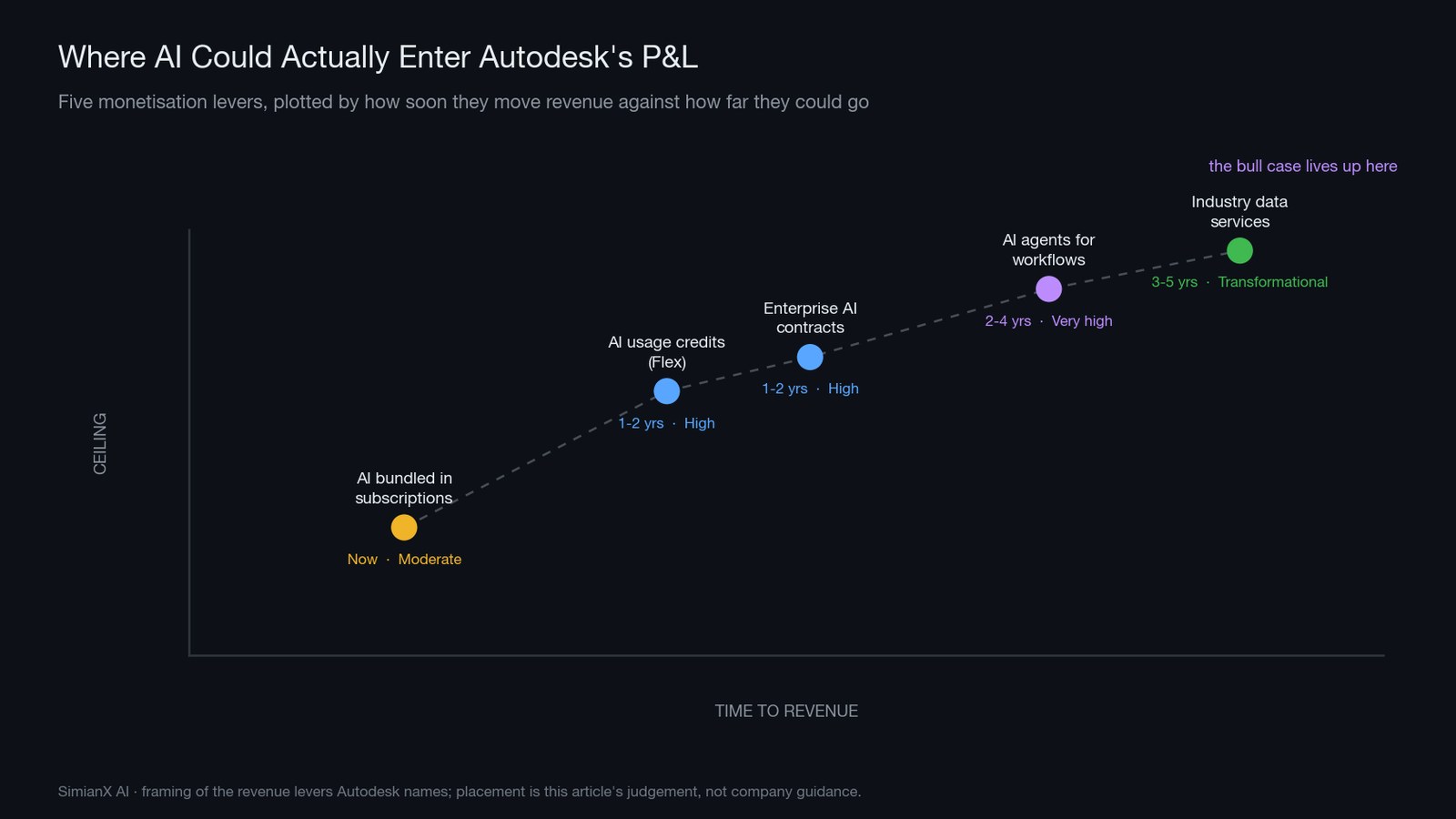
A simplified revenue framework looks like this:
| AI revenue lever | Near-term effect | Long-term potential |
|---|---|---|
| AI bundled in subscriptions | Higher pricing and retention | Moderate |
| AI usage credits | New consumption revenue | High if adoption scales |
| Enterprise AI contracts | Larger deal sizes | High |
| AI agents for workflows | New product categories | Very high |
| Industry data services | Platform monetization | Potentially transformational |
Can Autodesk AI Create a Durable Competitive Moat?
The answer depends on whether Autodesk’s advantages are difficult to reproduce.
Autodesk faces competition from Dassault Systèmes, Siemens Digital Industries Software, PTC, Bentley Systems, Nemetschek, Adobe, Unity, Epic Games and many specialized startups. General AI companies may also build tools that automate portions of design and engineering work.
Autodesk’s strongest defenses are likely to be:
- Large installed user base.
- Deep integration into professional workflows.
- Proprietary design and project data.
- Industry-specific foundation models.
- Existing relationships with enterprises and governments.
- File-format familiarity and ecosystem compatibility.
- High switching costs for mission-critical projects.
- Training, certification and partner networks.
However, installed-base advantages are not enough by themselves. If AI makes design software easier to use, new entrants may have an opportunity to attack the interface layer. Autodesk must therefore ensure that its AI tools are accurate, explainable, secure and integrated into production systems.
A generic model may generate an attractive concept. Autodesk must help customers produce a design that meets engineering constraints, building codes, manufacturing requirements and contractual obligations.
The most defensible Autodesk AI product will not be the one that creates the most impressive demo. It will be the one that safely completes a real professional workflow.
Autodesk’s Financial Quality and Cash-Flow Profile
Autodesk’s financial profile gives it time to invest in AI.
Fiscal 2026 operating cash flow was $2.45 billion, and free cash flow was $2.41 billion. The company ended the year with $2.25 billion in cash and cash equivalents, plus marketable securities. Autodesk also repurchased approximately $1.40 billion of stock during the year.
The company’s subscription model creates recurring revenue and deferred revenue. At the end of fiscal 2026, deferred revenue was $4.69 billion, while total remaining performance obligations were $8.30 billion.
These indicators provide visibility, but investors should not ignore several accounting details:
- Stock-based compensation was substantial.
- Capitalized contract-acquisition costs increased.
- Restructuring and facility-reduction expenses affected GAAP results.
- Free cash flow can benefit from working-capital movements.
- Billings growth may be affected by contract timing and transaction-model changes.
The quality of Autodesk’s cash flow remains a major strength, but investors should track whether free-cash-flow growth continues after restructuring costs normalize and AI-related spending increases.
Autodesk Earnings 2026: Key Risks to the Bull Case
AI may improve productivity without creating enough revenue
Customers may receive substantial benefits from AI while Autodesk captures only limited incremental revenue. If AI becomes a standard feature expected in every subscription, the technology may protect retention rather than produce a major new revenue stream.
AI could disrupt Autodesk’s own pricing model
If customers need fewer expert users to complete a task, seat counts could decline in some workflows. Autodesk must ensure that productivity gains are balanced by higher-value pricing or broader usage.
Generative AI could increase legal and intellectual-property risk
Design datasets may contain proprietary drawings, copyrighted assets or confidential engineering information. Autodesk must maintain strong data controls, training-data policies and customer permissions.
Construction technology adoption can be slow
Construction remains a fragmented industry with many small and mid-sized firms — the same adoption lag that shapes the data-centre build-out trade. Even when the return on investment is attractive, software deployment may be delayed by budget constraints, labor shortages, integration issues and change-management resistance.
Sales optimization may create temporary volatility
Autodesk’s fiscal 2027 guidance explicitly includes prudence around the operationalization of its sales-optimization plan. Changes to sales channels, billing models and customer segmentation can improve long-term efficiency but create short-term uncertainty in billings and revenue.
Competition is intensifying
Dassault Systèmes, Siemens, PTC and other industrial-software providers are investing heavily in cloud platforms, digital twins and AI. Meanwhile, startups may attack individual workflows with specialized tools that are faster to deploy than large enterprise platforms.
How to Analyze ADSK Stock in 2026
Investors should avoid judging Autodesk solely by its next earnings-per-share result. A better process is to monitor five operating questions:
- Is revenue growth remaining in the mid-to-high teens?
- Are billings and remaining performance obligations growing faster than revenue?
- Is non-GAAP operating margin stable or expanding despite AI investment?
- Are AI features increasing retention, pricing or consumption revenue?
- Is free cash flow growing in line with earnings?
A useful quarterly checklist includes:
- Subscription revenue growth.
- Net revenue retention.
- Renewal rates.
- Enterprise contract activity.
- Adoption of Autodesk Assistant.
- Flex and usage-based revenue.
- Forma and construction-cloud customer growth.
- Fusion and manufacturing adoption.
- R&D spending.
- Sales and marketing efficiency.
- Free-cash-flow conversion.
- Share repurchases and dilution.
SimianX AI can support this process by organizing public filings, earnings releases, news sentiment, technical indicators and valuation signals. Investors should still verify source documents and remember that an AI platform is a research aid, not a licensed investment adviser.
Autodesk Valuation Scenarios for 2026–2028
A scenario framework is more useful than a single price target because AI monetization is uncertain.
| Scenario | Revenue assumption | Margin assumption | AI outcome | Investor interpretation |
|---|---|---|---|---|
| Bear | Low-to-mid teens growth | Margins remain flat or decline | AI mainly protects retention | ADSK valued as mature design software |
| Base | Mid-teens growth | Gradual margin expansion | Premium AI tiers and workflow adoption | ADSK valued as a high-quality SaaS compounder |
| Bull | High-teens or better growth | Strong operating leverage | AI agents and usage revenue create a new platform | ADSK receives a premium software multiple |
Bear case
The bear case assumes AI features are expensive to develop but difficult to monetize. Customers may expect AI to be included in existing subscriptions, while competition pressures pricing. Construction and manufacturing customers could delay spending, causing growth to slow.
Under this scenario, ADSK remains profitable and cash generative, but the valuation multiple contracts because investors see limited incremental growth — the de-rating pattern catalogued in Every Tech Bubble Since 1929: How AI in 2026 Compares.
Base case
The base case assumes Autodesk maintains strong subscription growth, gradually improves margins and introduces AI features that raise retention and average contract value. The company remains a reliable compounder rather than a dramatic breakout stock.
This outcome could still generate attractive returns if the stock is purchased at a reasonable valuation.
Bull case
The bull case requires Autodesk to commercialize agentic AI, usage-based pricing and industry-specific automation. In this scenario, AI does more than improve existing products. It expands the addressable market by allowing smaller firms and less-experienced users to perform advanced design-and-make tasks.
The market could then value Autodesk as a strategic AI platform rather than a conventional CAD vendor.
Is ADSK Stock a Buy in 2026?
ADSK may appeal to investors who want exposure to AI through an established, cash-generative software company rather than through an early-stage technology business.
The potential advantages include:
- Strong recurring revenue.
- High gross margins.
- Mission-critical products.
- Broad exposure to construction, manufacturing and media.
- Large cash-flow generation.
- A substantial installed base.
- Multiple opportunities for AI monetization.
- Growing cloud and platform integration.
The main disadvantages include:
- Valuation sensitivity.
- Dependence on professional and enterprise budgets.
- Slow adoption cycles in construction.
- Competition from large industrial-software companies.
- Possible AI cannibalization of software seats.
- Execution risk from sales-model changes.
- Legal, privacy and security concerns surrounding AI.
A disciplined investor could use the following approach:
- Estimate normalized fiscal 2028 earnings and free cash flow.
- Assign bear, base and bull valuation multiples.
- Compare the implied value with the current share price.
- Track AI monetization evidence each quarter.
- Avoid increasing the position solely because of a short-term earnings beat.
- Reassess if revenue growth slows while R&D and sales expenses accelerate.
FAQ About Autodesk Earnings 2026
What were Autodesk’s main fiscal 2026 earnings results?
Autodesk reported fiscal 2026 revenue of $7.206 billion, up 18% year over year. Non-GAAP EPS rose to $10.43, and free cash flow increased 54% to $2.409 billion.
How will AI affect Autodesk earnings?
AI could increase Autodesk earnings through premium subscription tiers, higher renewal rates, enterprise contracts, usage-based pricing and new workflow-automation products. The impact will depend on whether customers pay extra for AI or simply receive it as part of existing plans — the question every AI-exposed software name now faces, from CrowdStrike to Microsoft.
What is Autodesk’s AI moat?
Autodesk’s potential moat comes from specialized design data, industry knowledge, embedded workflows, customer relationships and high switching costs. The company’s advantage will be strongest if its AI can produce reliable, editable and production-ready outputs.
Is Autodesk stock a buy after fiscal 2026 earnings?
That depends on valuation, investment horizon and risk tolerance. Autodesk’s financial quality is strong, but investors must determine whether the current stock price already reflects expected AI growth.
What should investors watch in the next Autodesk earnings report?
Investors should monitor revenue growth, billings, remaining performance obligations, net revenue retention, operating margins, free-cash-flow conversion and evidence that Autodesk Assistant, Forma, Fusion and other AI features are increasing monetization.
Conclusion
Autodesk enters 2026 with a strong financial foundation and a credible AI strategy. Fiscal 2026 revenue grew 18%, free cash flow rose 54% and remaining performance obligations increased 20%. The company also expanded its vision from individual software products toward connected, cloud-based and AI-native platforms.
The most important question is whether Autodesk can convert its specialized industry data into paid AI workflows. If AI only improves the user experience, ADSK may remain a dependable software compounder. If AI agents begin completing valuable design, engineering, construction and manufacturing tasks, Autodesk could become one of the more important AI platforms for the physical economy.
The bull case is real, but it requires evidence. Investors should look for higher retention, stronger pricing, growing consumption revenue, successful Forma adoption and continued free-cash-flow expansion.
For ongoing monitoring, SimianX AI can help investors combine fundamental, technical and news-based analysis of ADSK in one research environment. SimianX AI is designed to supplement independent research—not replace professional financial advice—so investors should verify all information and consider their own risk tolerance before making a decision.
Related Reading
- Synopsys Earnings 2026: The Hidden AI Chip Stock at 27x
- CrowdStrike Stock 2026: 26% Growth at 35x Forward Sales
- Microsoft Q4 Earnings 2026: Azure Growth vs AI Capex Risk
- Alphabet Q2 Earnings 2026: Can Gemini, Cloud Justify Capex?
- Amazon Q2 Earnings 2026: Can AWS Justify $200B AI Capex?
- AppLovin Stock 2026: Can AI Advertising Keep APP Growing?
- Comfort Systems Stock (FIX) 2026: AI Cooling Bottleneck
- Every Tech Bubble Since 1929: How AI in 2026 Compares
References
- Autodesk Investor Relations — fiscal 2026 results and fiscal 2027 guidance
- SEC EDGAR — Autodesk Inc. filings, CIK 0000769397
- Autodesk Assistant — supported products and usage
- Autodesk — Construction Cloud joins Forma
- Autodesk — 2025 State of Design & Make construction research
- Autodesk Flex — pay-as-you-go token model
- Autodesk Platform Services — developer platform
- Dassault Systèmes — competitor
- Siemens Digital Industries Software — competitor
- PTC — competitor
- Bentley Systems — competitor
- Nemetschek — competitor
- SimianX — ADSK stock fundamentals