Buy the Invasion 2026: 9 of 12 Wars Saw S&P 500 Rally

Buy the Invasion 2026: 9 of 12 Wars Saw S&P 500 Rally

Reference table of 12 modern wars from Pearl Harbor to Ukraine 2022, showing when the S&P 500 rallied after invasion and when oil shocks broke the pattern.

2026-05-19
·
20 min read
Listen to article

Buy the Invasion: 9 of 12 Wars Saw Stocks Rally

Buy the Invasion: 9 of 12 Wars Saw Stocks Rally sounds counterintuitive, even uncomfortable. War is destructive, tragic, and deeply human; equity markets, however, price expectations, liquidity, earnings, rates, and risk premiums. The historical pattern is not that war is “bullish.” The more accurate research conclusion is that markets often sell off during the uncertainty phase and can rebound once the event becomes easier to model.

For investors using SimianX AI, the practical question is not “Should I buy war?” but how to analyze geopolitical shocks without reacting emotionally.

SimianX AI geopolitical risk and stock market research
geopolitical risk and stock market research

The Big Claim: Did 9 of 12 Wars Really See Stocks Rally?

There does not appear to be one single authoritative source that proves the exact phrase “9 of 12 wars saw stocks rally” as a standalone dataset. A more defensible approach is to build a 12-event sample from publicly available sources, including First Trust’s geopolitical shock data, Ben Carlson’s market-history work at A Wealth of Common Sense, Motley Fool’s war-and-markets research, Federal Reserve history on the 1973 oil shock, NBER research on wartime volatility, and SimianX AI’s own Iraq War market study.

First Trust’s dataset is especially useful for post-event analysis because it reports 1-day return, 1-year return, maximum drawdown, days until bottom, and days until recovery for major geopolitical shocks, using market-cap-weighted U.S. total market returns from the Ken French Data Library.

Key insight: “Buy the Invasion” is not a moral statement or a mechanical trading rule. It is a market-structure observation: when uncertainty collapses, risk assets can rebound if the macro backdrop does not deteriorate.

Core Dataset: 12 Wars and Military Shocks

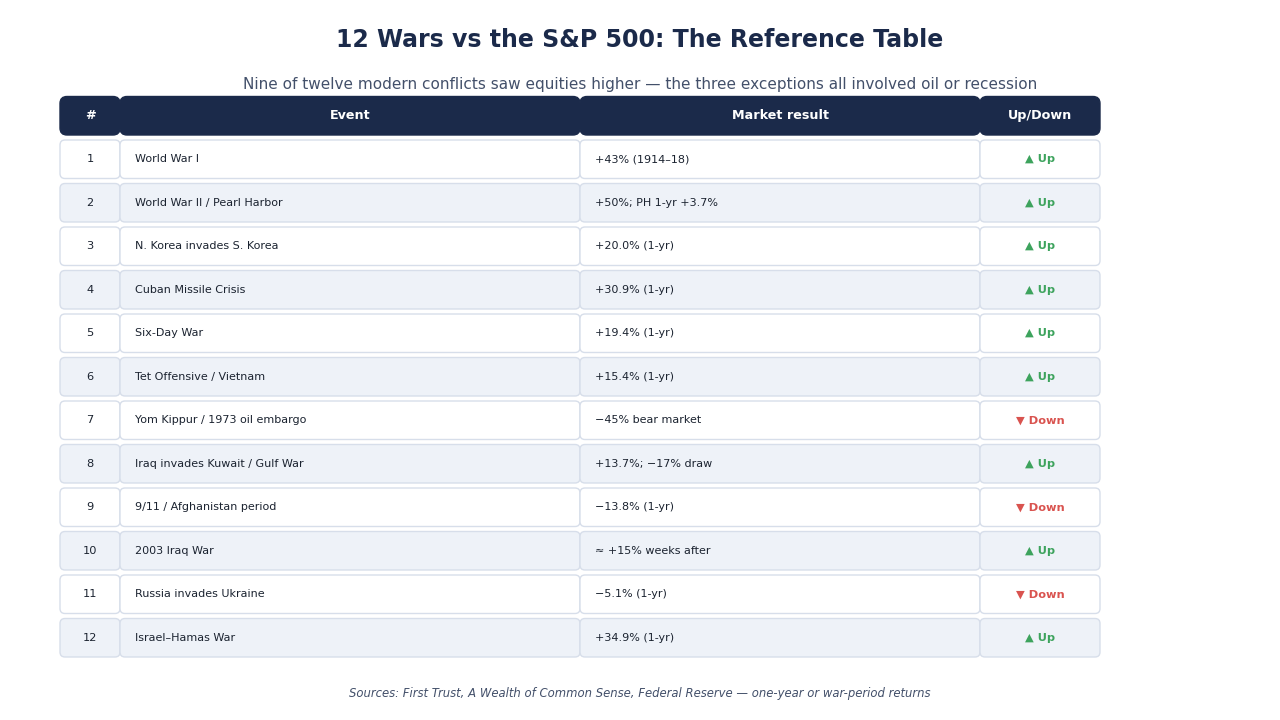
The table below combines event-after-one-year data where available with broader wartime market performance where that is the cleaner historical comparison.

#EventMarket ResultUp / DownMain Research Source
1World War IDow total return of more than +43% from 1914 to 1918UpA Wealth of Common Sense
2World War II / Pearl HarborDow gained about +50% from 1939 to 1945; Pearl Harbor one-year return +3.70%UpA Wealth of Common Sense / First Trust
3North Korea invades South KoreaOne-year return +20.03%UpFirst Trust
4Cuban Missile CrisisOne-year return +30.91%; Dow fell only about 1.2% during the crisisUpFirst Trust / A Wealth of Common Sense
5Six-Day WarOne-year return +19.36%UpFirst Trust
6Tet Offensive / Vietnam WarOne-year return after Tet +15.43%; Vietnam War period up about +43%UpFirst Trust / A Wealth of Common Sense
7Yom Kippur War / 1973 Oil EmbargoS&P 500 fell about 45% during the 1973–1974 bear marketDownJason Zweig / Federal Reserve History
8Iraq invades Kuwait / Gulf WarOne-year return +13.66%, after a max drawdown of -17.47%UpFirst Trust
99/11 attacks / Afghanistan War periodOne-year return -13.75%DownFirst Trust
102003 Iraq WarS&P 500 gained roughly +15% in the weeks after invasionUpSimianX AI / Motley Fool
11Russia invades UkraineOne-year return -5.13%DownFirst Trust
12Israel-Hamas WarOne-year return +34.88%UpFirst Trust

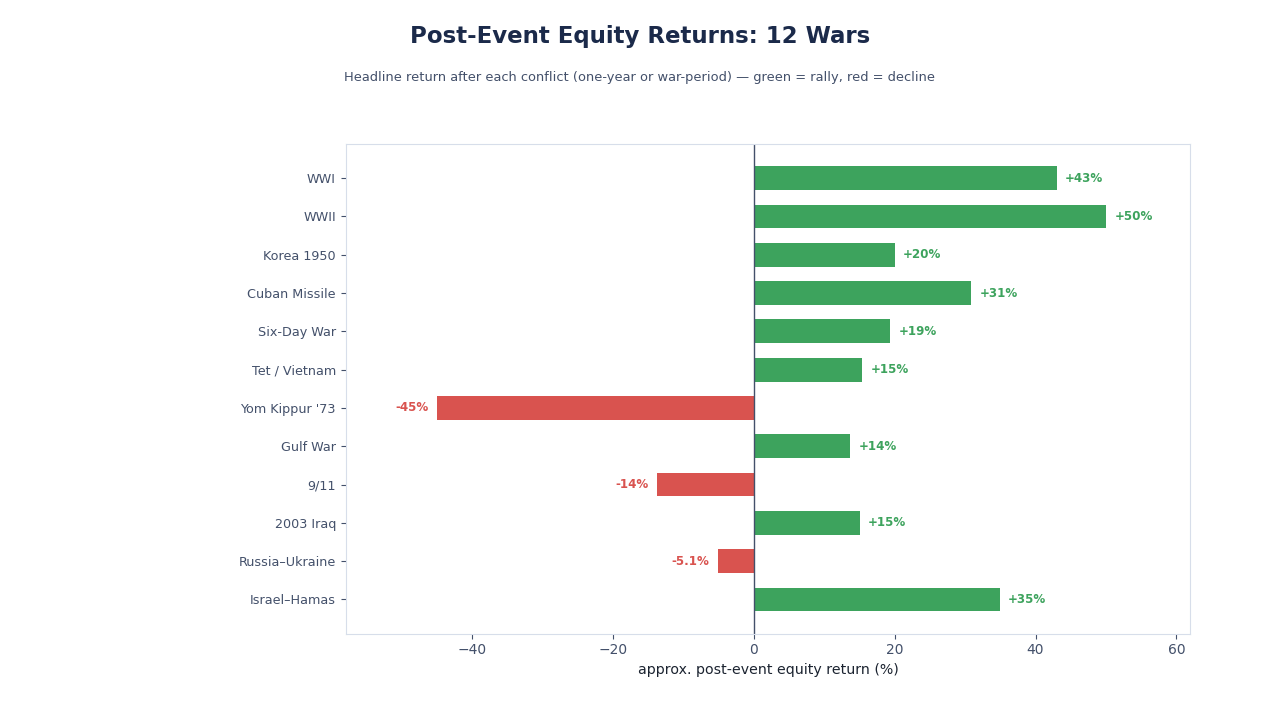
Result: 9 up, 3 down.

The positive cases are World War I, World War II / Pearl Harbor, Korea, Cuban Missile Crisis, Six-Day War, Vietnam / Tet, Gulf War, 2003 Iraq War, and Israel-Hamas. The negative cases are the Yom Kippur War / 1973 oil shock, 9/11, and Russia’s 2022 invasion of Ukraine.

SimianX AI stock market reactions to wars table
stock market reactions to wars table

Why Does “Buy the Invasion” Sometimes Work?

The phrase “Buy the Invasion” is shorthand for a broader behavioral and macro pattern:

  1. Before the event, investors fear open-ended outcomes.
  2. During the event, risk becomes more observable.
  3. After the event, markets reprice based on escalation risk, oil prices, rates, earnings, and policy response.

Markets often dislike uncertainty more than bad news itself. Before a conflict begins, investors may not know whether the event will happen, how long it will last, whether energy supply will be disrupted, whether central banks will respond, or whether corporate earnings will fall. Once the invasion or military shock happens, investors can begin assigning probabilities.

SimianX AI is relevant here because geopolitical analysis requires more than reading headlines. Investors need to monitor market sentiment, macro data, volatility, commodities, earnings expectations, and sector rotation at the same time.

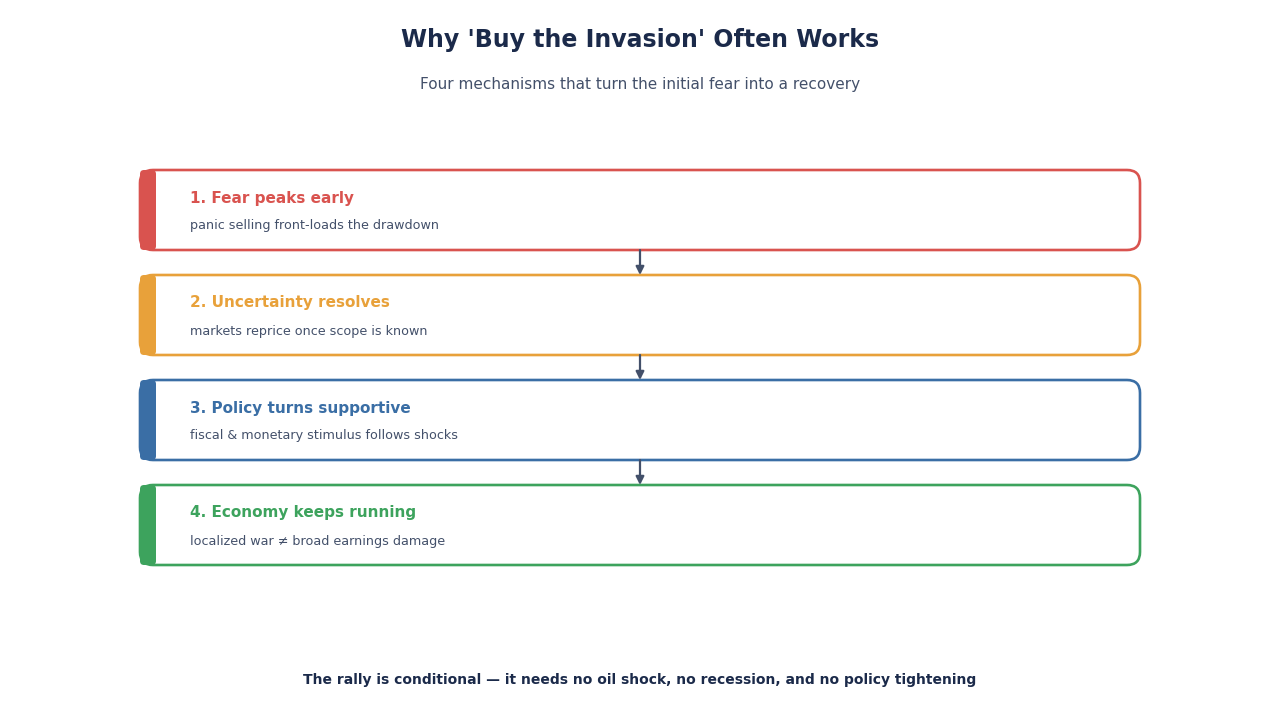
The Four Mechanisms Behind Post-Invasion Rallies

1. The uncertainty premium collapses

Markets often price a “worst-case scenario” before a major event. If the event occurs but does not escalate beyond expectations, the risk premium can compress quickly.

2. Investors rotate out of defensive positioning

Before conflict, investors may increase cash, gold, Treasuries, volatility hedges, or defensive sectors. When the event becomes clearer, some of that capital can rotate back into equities.

3. Fiscal spending can support selected sectors

War periods may increase demand for defense, aerospace, cybersecurity, energy infrastructure, logistics, industrials, and materials. This does not make war good for society, but it can change expected cash flows for certain industries.

4. Macro context decides whether the rally survives

The same geopolitical shock can produce very different market outcomes depending on inflation, oil prices, interest rates, valuations, credit spreads, and recession risk.

The market does not buy the war. It buys the reduction of uncertainty when the worst-case scenario fails to appear.

What Does “Buy the Invasion: 9 of 12 Wars Saw Stocks Rally” Miss?

The headline is useful for attention, but incomplete for serious research. It hides three important weaknesses:

  • Different measurement windows: Some events use one-year returns; others use full wartime performance or the first few weeks after invasion.
  • Different market indexes: The Dow, S&P 500, and broad U.S. total market data are not identical.
  • Different macro regimes: A war during falling inflation and easier liquidity is not the same as a war during oil shocks and aggressive tightening.

This is why the phrase should be treated as an event-study framework, not an investment rule.

Is “Buy the Invasion” a Reliable Stock Market Strategy?

No, not by itself. The better question is: Has the market already priced the uncertainty, and is the conflict likely to become a systemic macro shock?

A practical framework should examine:

  • Oil and gas exposure: Does the conflict threaten energy supply?
  • Inflation impulse: Will the conflict push headline and core inflation higher?
  • Central bank reaction: Will policymakers ease, pause, or tighten?
  • Credit spreads: Are funding markets showing stress?
  • Equity positioning: Have investors already de-risked?
  • Earnings sensitivity: Which sectors benefit or suffer?
  • Escalation probability: Is the conflict local, regional, or global?

SimianX AI can be positioned here as a practical tool for investors who want to monitor market signals across news sentiment, technical indicators, macro data, and risk conditions instead of relying on one headline-driven rule.

SimianX AI oil shock inflation and stock market drawdown
oil shock inflation and stock market drawdown

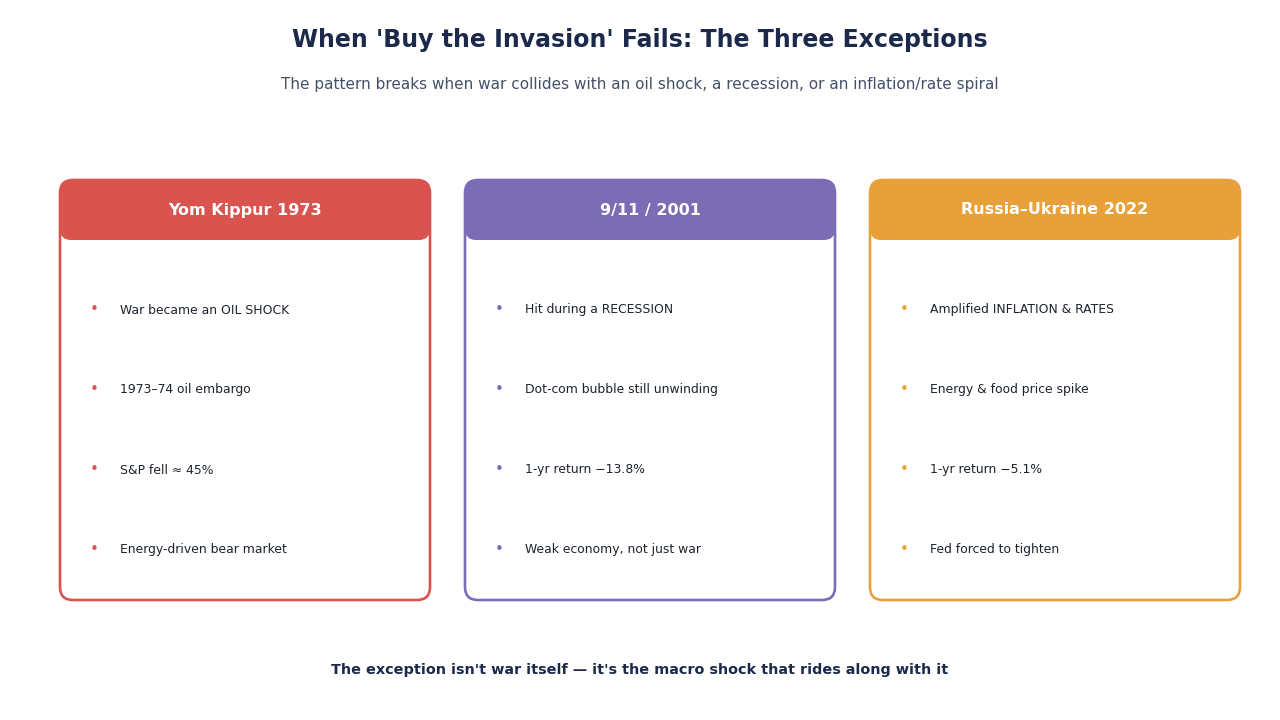
The Three Negative Cases Matter Most

The three down markets in the 12-event sample are more useful than the nine positive cases because they show when Buy the Invasion fails.

1. The 1973 Yom Kippur War: When War Becomes an Oil Shock

The 1973 case is the clearest warning. The issue was not only the Yom Kippur War itself. The real market damage came when the conflict became a global energy shock.

Federal Reserve History explains that the OAPEC embargo stopped U.S. oil imports from participating nations and began production cuts that changed the world oil price. Oil prices nearly quadrupled from $2.90 per barrel before the embargo to $11.65 per barrel in January 1974.

Jason Zweig’s review of the 1973–1974 bear market notes that the S&P 500 fell about 45%, while Middle East war, quadrupling oil prices, Watergate, and high inflation combined into a prolonged market crash.

This is the key lesson: wars that disrupt energy supply are different from wars that mainly reduce uncertainty.

2. 9/11: When War Hits During a Recession and Bubble Unwind

The 9/11 attacks were a geopolitical shock, a national trauma, and a market event. First Trust’s data show a one-year U.S. market return of -13.75% after the attacks.

But the market backdrop matters. The U.S. economy was already under pressure, and stocks were still falling after the technology bubble burst. This means 9/11 did not create weakness from a clean starting point. It hit a market already stressed by recession risk, overvaluation, and collapsing technology shares.

3. Russia-Ukraine 2022: When War Amplifies Inflation and Rate Risk

Russia’s 2022 invasion of Ukraine is another important exception. First Trust shows a one-year return of -5.13% after the invasion.

This period coincided with inflation pressure, energy and food supply stress, and a major shift toward tighter monetary policy. The lesson is not that geopolitical shocks always hurt stocks. The lesson is that geopolitical shocks hurt more when they reinforce existing macro pressure.

The 2003 Iraq War: The Classic “Buy the Invasion” Case Study

The 2003 Iraq War is probably the cleanest modern example of the Buy the Invasion pattern. SimianX AI’s Iraq War analysis notes that in the months before the March 2003 invasion, markets were volatile because investors were unsure about the timing, duration, and economic consequences of war. Once the invasion began, the S&P 500 gained roughly 15% in the following weeks as the uncertainty premium collapsed.

The logic was not “war is good for stocks.” The logic was:

  1. War fears had already been priced in.
  2. The invasion removed timing uncertainty.
  3. The early military path appeared more contained than feared.
  4. Investors rotated back into risk assets.
  5. Markets shifted from fear of the unknown to analysis of measurable outcomes.

Motley Fool’s research supports the broader post-1990 pattern, noting that stocks rose strongly in the months after several U.S. military conflicts, while surprise wars such as Pearl Harbor and Korea initially hit harder.

SimianX AI Iraq War 2003 stock market rebound
Iraq War 2003 stock market rebound

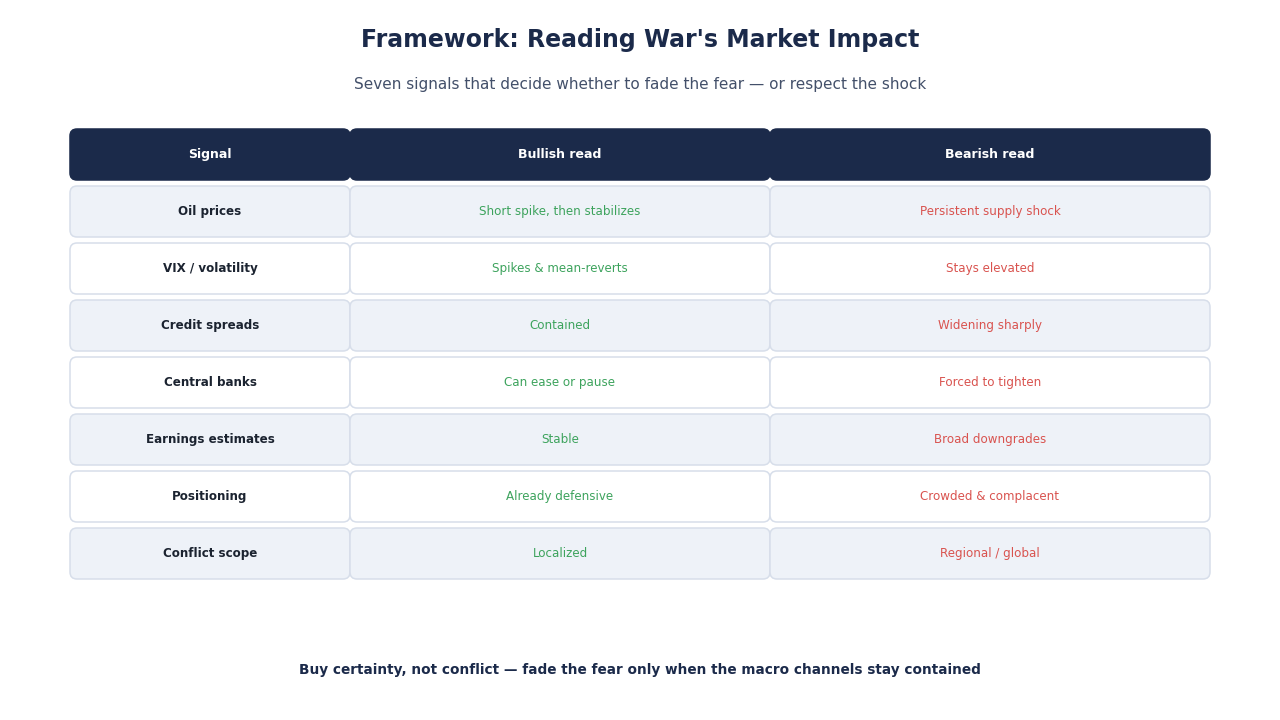
A Practical Framework for Analyzing War and Stock Market Returns

Investors should replace the slogan “Buy the Invasion” with a repeatable checklist. The goal is not to predict geopolitical events; it is to understand whether the market reaction is emotional, fundamental, or systemic.

SignalBullish InterpretationBearish Interpretation
Oil pricesShort spike, then stabilizesPersistent supply shock
VIX / volatilitySpikes and mean revertsRemains elevated
Credit spreadsContainedWidening sharply
Central banksAble to ease or pauseForced to tighten
Earnings estimatesStableBroad downgrades
Market positioningAlready defensiveStill crowded and complacent
Conflict scopeLocalizedRegional or global escalation

Step-by-Step Event Analysis

  1. Define the event date

Is the relevant date the invasion, attack, sanctions package, ceasefire, or escalation?

  1. Measure the pre-event move

A post-event rally is more likely when markets already sold off before the event.

  1. Check commodities first

Oil, gas, wheat, shipping rates, and insurance costs can reveal whether the conflict is becoming a supply shock.

  1. Compare equity sectors

Defense and energy may outperform while airlines, travel, consumer discretionary, and rate-sensitive growth stocks may lag.

  1. Watch rates and central banks

A geopolitical shock during an easing cycle is different from one during an inflation-driven tightening cycle.

  1. Monitor credit stress

Equities can recover from scary headlines; they struggle when credit markets freeze.

  1. Reassess after the first relief rally

The first move may be a short-covering rally. The second phase depends on earnings and macro conditions.

How SimianX AI Fits Into Geopolitical Market Research

A human analyst can track oil, rates, news sentiment, earnings, options positioning, technical levels, and sector rotation manually—but doing it in real time is difficult. This is where SimianX AI fits naturally into the research workflow.

For geopolitical market analysis, a multi-signal approach can help separate competing explanations:

  • Is the selloff about oil?
  • Is it about rates?
  • Is it about earnings?
  • Is it about valuation?
  • Is it about credit stress?
  • Is the market reacting to headlines or fundamentals?
  • Which sectors are absorbing risk and which are leading recovery?

SimianX AI can help investors organize these signals into a more disciplined research process. That matters because geopolitical market reactions are rarely driven by one variable. They are usually the result of news, positioning, macro data, policy expectations, and sector-specific earnings risk interacting at the same time.

SimianX AI multi-agent AI geopolitical market analysis
multi-agent AI geopolitical market analysis

Investment Implications: Buy Certainty, Not Conflict

The best interpretation of Buy the Invasion: 9 of 12 Wars Saw Stocks Rally is not “buy every war headline.” It is:

When markets sell uncertainty before a geopolitical shock, and the event arrives without a worse-than-feared escalation, equities often rebound.

That conclusion leads to several practical rules.

What to Do

  • Study pre-event positioning
  • Track oil and inflation expectations
  • Monitor central bank reaction functions
  • Compare sector leadership
  • Watch credit spreads and liquidity
  • Separate first-day reaction from one-year return
  • Use probabilistic scenarios instead of binary predictions

What Not to Do

  • Do not assume every invasion is bullish.
  • Do not ignore energy supply risk.
  • Do not treat one-year averages as short-term trading signals.
  • Do not confuse relief rallies with durable bull markets.
  • Do not rely on one historical analogy without checking macro context.

The historical record suggests that markets can look “heartless” during war, but the market is not making a moral judgment. It is discounting cash flows, policy, inflation, and uncertainty.

FAQ About Buy the Invasion: 9 of 12 Wars Saw Stocks Rally

What does “Buy the Invasion” mean in stock market research?

“Buy the Invasion” means markets sometimes rally after a military action begins because uncertainty falls and investors can price the event more clearly. It does not mean war is good for the economy or that investors should automatically buy stocks after every conflict.

Did 9 of 12 wars really see stocks rally?

Using a combined 12-event sample from public market-history sources, 9 events showed positive market performance over the selected post-event or wartime window, while 3 were negative. The result depends heavily on measurement window, index choice, and macro context.

Why do stocks sometimes rise after wars start?

Stocks may rise because the worst-case scenario was already priced in before the event. Once the event occurs, uncertainty can decline, defensive positioning can unwind, and investors may rotate back into equities if oil, rates, and credit conditions remain stable.

When does the Buy the Invasion pattern fail?

It tends to fail when war becomes a systemic macro shock. The main failure cases include energy supply disruptions, inflation spikes, recession, credit stress, overvalued markets, or aggressive central bank tightening.

How can investors analyze geopolitical risk without guessing?

Investors can use a structured framework that monitors oil prices, volatility, credit spreads, rates, earnings revisions, sector rotation, and escalation risk. Tools such as SimianX AI can help organize these signals into a more disciplined market research process.

Conclusion

Buy the Invasion: 9 of 12 Wars Saw Stocks Rally is a useful headline, but the deeper truth is more nuanced. Wars do not automatically lift stocks. Markets rally when uncertainty falls, when the worst-case scenario does not materialize, and when macro conditions allow risk assets to recover.

The 12-event sample shows 9 positive cases and 3 negative cases, but the exceptions are the real lesson. The 1973 oil shock, 9/11 during recession and the dot-com unwind, and Russia-Ukraine during inflation and tightening all show that geopolitical shocks become dangerous when they collide with weak macro conditions.

For investors and researchers, the right takeaway is simple: do not buy conflict; analyze uncertainty, oil, rates, credit, earnings, and positioning. To build a more repeatable geopolitical market research process, explore SimianX AI and use its real-time market intelligence to turn geopolitical headlines into structured investment analysis.

Sources

  • First Trust, Wars & Geopolitical Shocks: Market Performance
  • A Wealth of Common Sense, The Relationship Between War and the Stock Market
  • A Wealth of Common Sense, Hedging Against World War III
  • Federal Reserve History, Oil Shock of 1973–74
  • Jason Zweig, Learning from the Bear Market of 1973–1974
  • Motley Fool, How War Affects Stocks
  • NBER, The War Puzzle: Contradictory Effects of International Conflicts on Stock Markets
  • SimianX AI, Iraq War 2003 and the Stock Market: Why Stocks Rebounded

Related Reading

References

Ready to Transform Your Trading?

Join thousands of investors using AI-powered analysis to make smarter investment decisions

Today's most analyzed — click to enter the Live Command Room