
Ano ang Itinuturo ng Isang Siglong S&P 500 Bear Market sa mga Investor
Na-update noong Oktubre 2026 · Datos ng S&P 500 hanggang sa pagsasara noong Oktubre 15, 2026
Kailan ang huling bear market? Ang huling bear market ng S&P 500 — pagbaba na 20% o higit pa mula sa pinakamataas na pagsasara hanggang sa pinakamababang pagsasara — ay tumagal mula Enero 3, 2022 (4,796.56) hanggang Oktubre 12, 2022 (3,577.03), isang pagbagsak na 25.4%. Nagsara ang index sa itaas ng dati nitong pinakamataas noong Enero 19, 2024, mga 15 buwan matapos ang pinakamababang punto.
Paano ang 2025? Lumapit ang bentahang dulot ng taripa noong Pebrero–Abril 2025 pero hindi umabot sa pamantayan: bumaba ang S&P 500 ng 18.9% batay sa pagsasara (mula 6,144.15 noong Pebrero 19 hanggang 4,982.77 noong Abril 8), bagama't umabot sa 21.3% ang pagbaba sa loob ng araw noong Abril 7. Nagtala ito ng bagong rekord na pagsasara noong Hunyo 27, 2025. Sa kabilang banda, talagang nagsara sa bear market ang Nasdaq Composite (−24.3%). Hanggang Oktubre 15, 2026, 1.0% na mas mababa ang S&P 500 sa rekord nitong pagsasara.
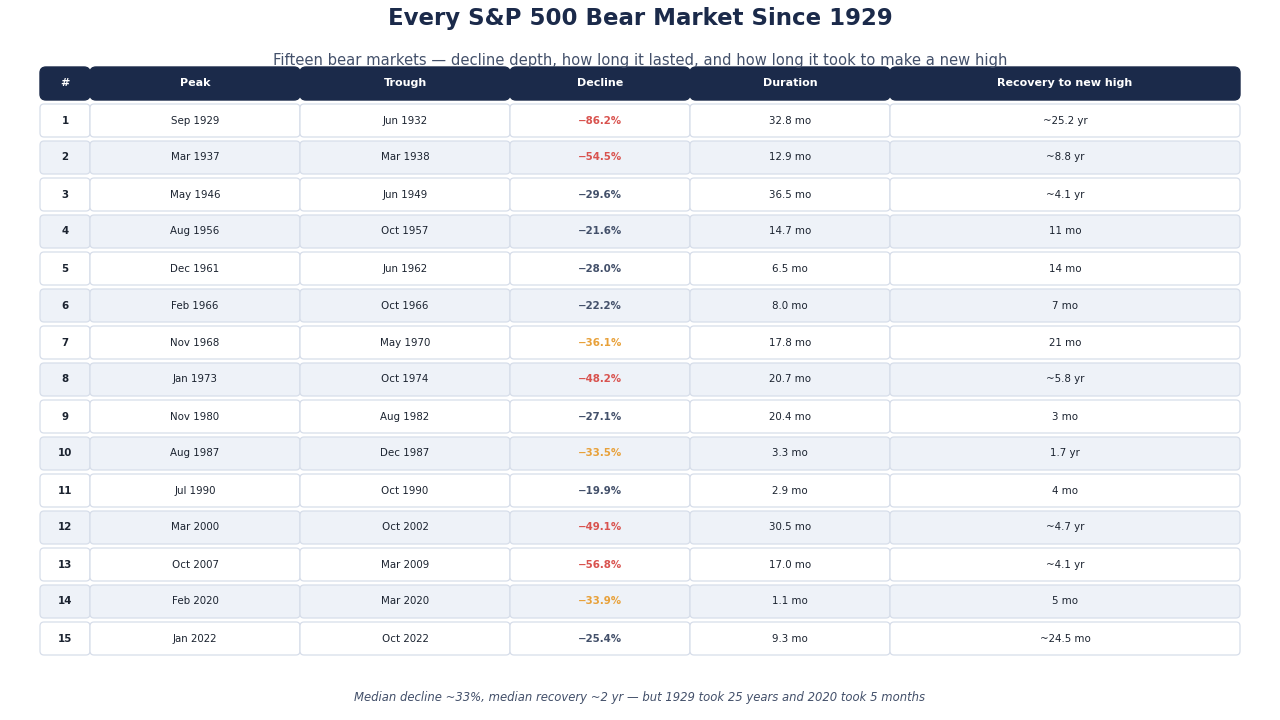
Ang mga bear market ang mga bihira, may-kumpiyansang "reset events" na nagtatakda ng kapalaran ng isang henerasyon ng mga investor. Ang mga ito rin ang pinakamaraming pinag-aralan at pinakamaraming mitolohiya sa kasaysayan ng pananalapi — at ang datos tungkol sa mga ito ay mas malinis na masusubaybayan kaysa halos kahit anong ibang distribusyon ng kita sa merkado. Ang artikulong ito ang kumpletong reference table ng bawat bear market ng S&P 500 mula 1929, kasama ang petsa ng peak, petsa ng trough, porsiyento ng pagbaba, tagal, at ilang panahon bago bumalik ang index sa isang bagong all-time high.
"Bear market" dito ay nangangahulugang pagbaba ng 20% o higit pa, batay sa closing price, sa S&P 500 (at sa nauna nitong index bago 1957, ang S&P 90). Iyan ang threshold na ginagamit ng Standard & Poor's, ng US SEC, ng Yardeni Research, at ng karamihan ng pangunahing brokerage. Ang mga sukat na intraday, total return, o ibang index ay magpapagalaw ng partikular na bilang ng isa o dalawang puntos, ngunit ang istruktura ng table ay matatag sa lahat ng pinagmulan.
Kung sinusubaybayan mo ang index nang live, ang pahina ng ETF ng S&P 500 ay nag-uupdate ng parehong serye sa real time. Kung gusto mong malaman kung paano nakatayo ang kasalukuyang tape laban sa mga nakaraang bear, ang kapatid nitong artikulo na S&P 500 Risk Radar ang sumasaklaw sa AI-driven na maagang babala; ang table sa ibaba ang historical baseline na pinaghahambingan ng mga signal na iyon.
Ang Kumpletong Table
Bawat hanay ay gumagamit ng closing prices ng S&P 500. Ang Tagal ay sinusukat mula sa araw ng peak hanggang sa araw ng trough. Ang Recovery ay sinusukat sa susunod na araw kung saan nagsara ang index sa katumbas o mas mataas pa sa naunang peak.
| # | Peak | Trough | Pagbaba | Tagal | Recovery sa bagong high |
|---|---|---|---|---|---|
| 1 | Set 16, 1929 | Hun 1, 1932 | −86.2% | 32.8 buwan | ~25.2 taon (Set 1954) |
| 2 | Mar 6, 1937 | Mar 31, 1938 | −54.5% | 12.9 buwan | ~8.8 taon (Peb 1945) |
| 3 | Mayo 29, 1946 | Hun 13, 1949 | −29.6% | 36.5 buwan | ~4.1 taon (Set 1950) |
| 4 | Ago 2, 1956 | Okt 22, 1957 | −21.6% | 14.7 buwan | 11 buwan (Set 1958) |
| 5 | Dis 12, 1961 | Hun 26, 1962 | −28.0% | 6.5 buwan | 14 buwan (Set 1963) |
| 6 | Peb 9, 1966 | Okt 7, 1966 | −22.2% | 8.0 buwan | 7 buwan (Mayo 1967) |
| 7 | Nob 29, 1968 | Mayo 26, 1970 | −36.1% | 17.8 buwan | 21 buwan (Mar 1972) |
| 8 | Ene 11, 1973 | Okt 3, 1974 | −48.2% | 20.7 buwan | ~5.8 taon (Hul 1980) |
| 9 | Nob 28, 1980 | Ago 12, 1982 | −27.1% | 20.4 buwan | 3 buwan (Nob 1982) |
| 10 | Ago 25, 1987 | Dis 4, 1987 | −33.5% | 3.3 buwan | 1.7 taon (Hul 1989) |
| 11 | Hul 16, 1990 | Okt 11, 1990 | −19.9% | 2.9 buwan | 4 buwan (Peb 1991) |
| 12 | Mar 24, 2000 | Okt 9, 2002 | −49.1% | 30.5 buwan | ~4.7 taon (Mayo 2007) |
| 13 | Okt 9, 2007 | Mar 9, 2009 | −56.8% | 17.0 buwan | ~4.1 taon (Mar 2013) |
| 14 | Peb 19, 2020 | Mar 23, 2020 | −33.9% | 1.1 buwan (33 araw) | 5 buwan (Ago 2020) |
| 15 | Ene 3, 2022 | Okt 12, 2022 | −25.4% | 9.3 buwan | ~15 buwan (Ene 2024) |
Ang hanay ng 1990 ay may dalang asterisk na kailangan ng bawat reference table: sa closing-basis nitong trough, lumabas ito sa −19.9%, isang tick lang sa ilalim ng karaniwang 20% threshold. Isinama ito rito dahil kapwa kinukuwenta ito ng Yardeni Research at ng sariling historical research ng S&P bilang bear, at dahil ang pagtatanggal nito ay magpapabaluktot sa mga statistics ng recovery sa pagtanggal ng pangalawang pinakamabilis na recovery na pangyayari sa pahinang ito.
Muntikang Bear Market: Ang mga Pagbagsak na Huminto Bago Umabot sa 20%
Kumbensiyon lamang ang linyang 20%, hindi batas ng kalikasan, at ilang bentahan sa S&P 500 ang huminto nang isa o dalawang puntos bago ito batay sa pagsasara. Ang mga muntikang bear market na ito ang pinagmumulan ng karamihan sa mga pagtatalong "bear market na ba ito?", dahil madalas na lumampas sa −20% ang pinakamababang presyo sa loob ng araw kahit walang pagsasarang umabot doon.
| Muntikang bear market | Pinakamataas na pagsasara | Pinakamababang pagsasara | Pagbaba sa pagsasara | Pagbaba sa loob ng araw | Mula rurok hanggang pinakamababa | Balik sa dating pinakamataas |
|---|---|---|---|---|---|---|
| 1976–1978 | Set 21, 1976 (107.83) | Mar 6, 1978 (86.90) | −19.4% | walang datos | 531 araw | Ago 15, 1979 |
| 1990 | Hul 16, 1990 (368.95) | Okt 11, 1990 (295.46) | −19.9% | −20.4% | 87 araw | Peb 13, 1991 |
| 1998 | Hul 17, 1998 (1,186.75) | Ago 31, 1998 (957.28) | −19.3% | −22.4% (pinakamababa noong Okt 8) | 45 araw | Nob 23, 1998 |
| 2011 | Abr 29, 2011 (1,363.61) | Okt 3, 2011 (1,099.23) | −19.4% | −21.6% | 157 araw | Peb 24, 2012 |
| 2018 | Set 20, 2018 (2,930.75) | Dis 24, 2018 (2,351.10) | −19.8% | −20.2% | 95 araw | Abr 23, 2019 |
| 2025 | Peb 19, 2025 (6,144.15) | Abr 8, 2025 (4,982.77) | −18.9% | −21.3% | 48 araw | Hun 27, 2025 |
Sinusukat ang pagbaba sa pagsasara mula pagsasara hanggang pagsasara. Ang pagbaba sa loob ng araw ay mula sa pinakamataas na presyo sa loob ng araw malapit sa rurok hanggang sa pinakamababang presyo sa loob ng araw bago ang pagbangon; noong 1998, ang pinakamababang iyon (923.32) ay dumating noong Oktubre 8, matapos ang pinakamababang pagsasara. Walang maaasahang datos sa loob ng araw para sa 1976–78, kaya minarkahan ng "walang datos" ang selulang iyon. Lumalabas din ang 1990 sa pangunahing talahanayan sa itaas na may asterisk; sa mahigpit na panuntunan ng pagsasara, isa itong muntikang bear market. Pang-araw-araw na datos mula sa Yahoo Finance at CNBC, na pinagtugma sa isa't isa at, para sa 2018 at 2025, sa FRED.
Tatlong bagay ang kapansin-pansin:
- Lumampas sa −20% sa loob ng araw ang bawat muntikang bear market na may maaasahang datos. Ganito ang 1990, 1998, 2011, 2018 at 2025, kaya bawat isa ay tinawag na bear market sa ilang pangunahing balita noon. Sa panuntunang batay sa pagsasara na ginagamit sa buong artikulong ito, wala ni isang pumasa.
- Mabilis silang nakabawi. Kapag sinukat mula sa pinakamababang pagsasara, nabawi ang dating pinakamataas sa loob ng 80 araw noong 2025, 84 araw noong 1998, 120 araw noong 2018, 125 araw noong 1990 at 144 araw noong 2011. Ang mabagal na eksepsiyon ay ang 1976–78, isang matagal at unti-unting 17-buwang pagbaba na nangailangan pa ng 17 buwan bago tuluyang nakabawi.
- Ang 2025 ang pinakamababaw at pinakamabilis. Ang −18.9% na pagkalugi nito mula pagsasara hanggang pagsasara ang pinakamaliit sa listahan, at ang 80-araw na pag-akyat nito mula sa pinakamababang punto noong Abril 8 hanggang sa bagong rekord na pagsasara noong Hunyo 27, 2025 ang pinakamabilis. Talagang nagsara naman sa bear market ang Nasdaq Composite: −24.3% mula 20,173.89 noong Disyembre 16, 2024 hanggang 15,267.91 noong Abril 8, 2025, bago nito nabawi ang rurok noong Hunyo 27, 2025. Para sa pinagmulan, tingnan ang konteksto ng mga anunsiyo ng taripa noong Abril 2025 at ng pagbagsak ng stock market noong 2025.
Gaano Katagal ang mga Bear Market, at Gaano Katagal ang Pagbangon?
Sa parehong panuntunang batay sa pagsasara, nagkaroon ang S&P 500 ng 11 bear market mula 1950 (1956–57 hanggang 2022, hindi kasama ang −19.9% ng 1990). Sinukat mula sa pang-araw-araw na datos:
- Haba ng pagbaba: median na 14.7 buwan mula rurok hanggang pinakamababa (karaniwan 13.6). Ang pinakamaikli ay ang 2020 sa 33 araw; ang pinakamahaba ay ang 2000–02 sa mga 30 buwan.
- Laki ng pagbaba: median na −33.5% (karaniwan −34.7%).
- Pagbangon mula sa pinakamababa: median na 15.2 buwan mula sa pinakamababang punto hanggang sa bagong rekord na pagsasara (karaniwan 24.5). Ang pinakamabilis ay ang 2020, wala pang limang buwan; ang pinakamabagal ay ang 1973–74, halos anim na taon (69.5 buwan, hanggang Hulyo 1980).
- Buong balikan mula sa dating rurok: median na 24.5 buwan mula sa naunang rurok hanggang sa bagong rekord (karaniwan 38.1). Ang bear market ng 2022 ay tumagal ng 9.3 buwan pababa at 15.2 buwan pabalik, 24.5 buwan sa kabuuan.
Nakadepende ang orasan ng pagbangon sa kung saan mo ito sinimulan. Kapag sinukat mula sa naunang rurok — gaya ng nararanasan ng mamumuhunang bumili sa tuktok — ang buong talahanayan, kasama ang mga 25-taong balikan matapos ang 1929, ay nasa aming kasamang sanggunian, Gaano Katagal Bago Nakabawi ang Bawat Bear Market: 1929-2022.
Ang Tunay na Sinasabi ng Datos
Sa labinlimang bear market sa loob ng 96 taon, sobra-sobra ang dispersion — ngunit ang mga central tendency ay namamangha sa pagiging consistent.
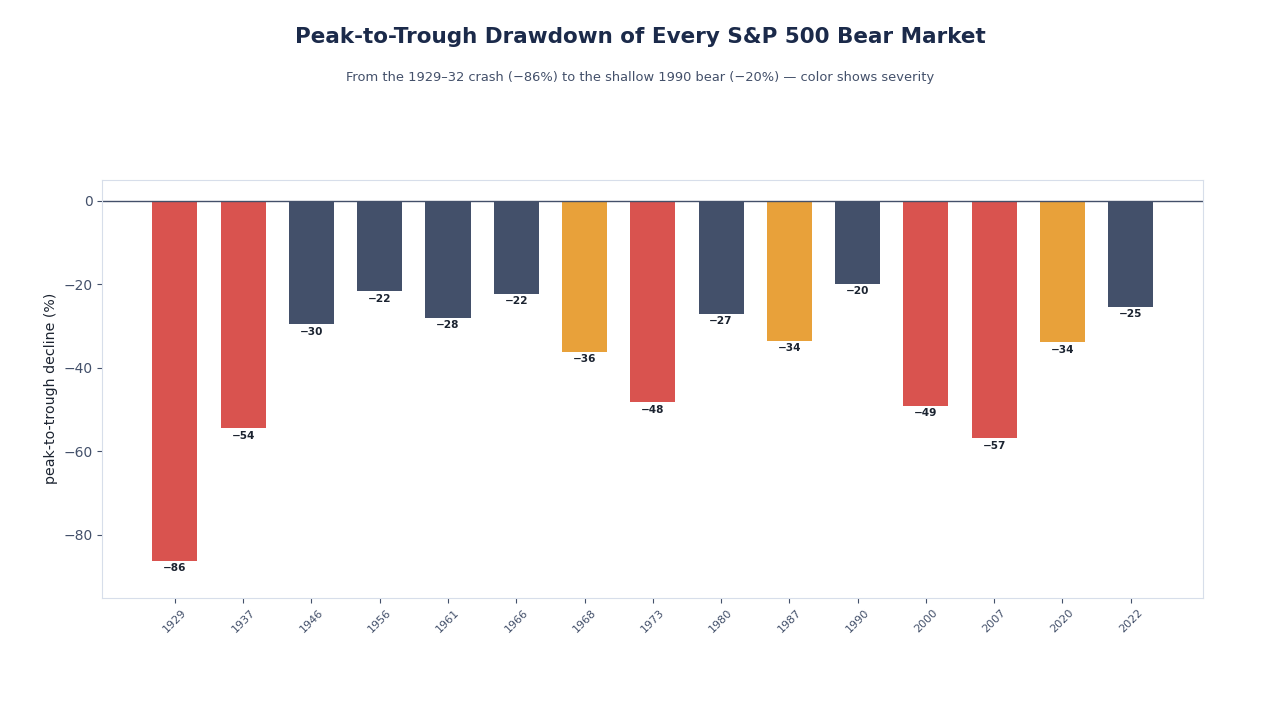
- Average na pagbabang peak-to-trough: −36.7%
- Median na pagbaba: −33.5%
- Average na tagal (peak hanggang trough): 15.6 buwan
- Median na tagal: 14.7 buwan
- Average na recovery (trough hanggang bagong high): ~50 buwan
- Median na recovery: 14 buwan
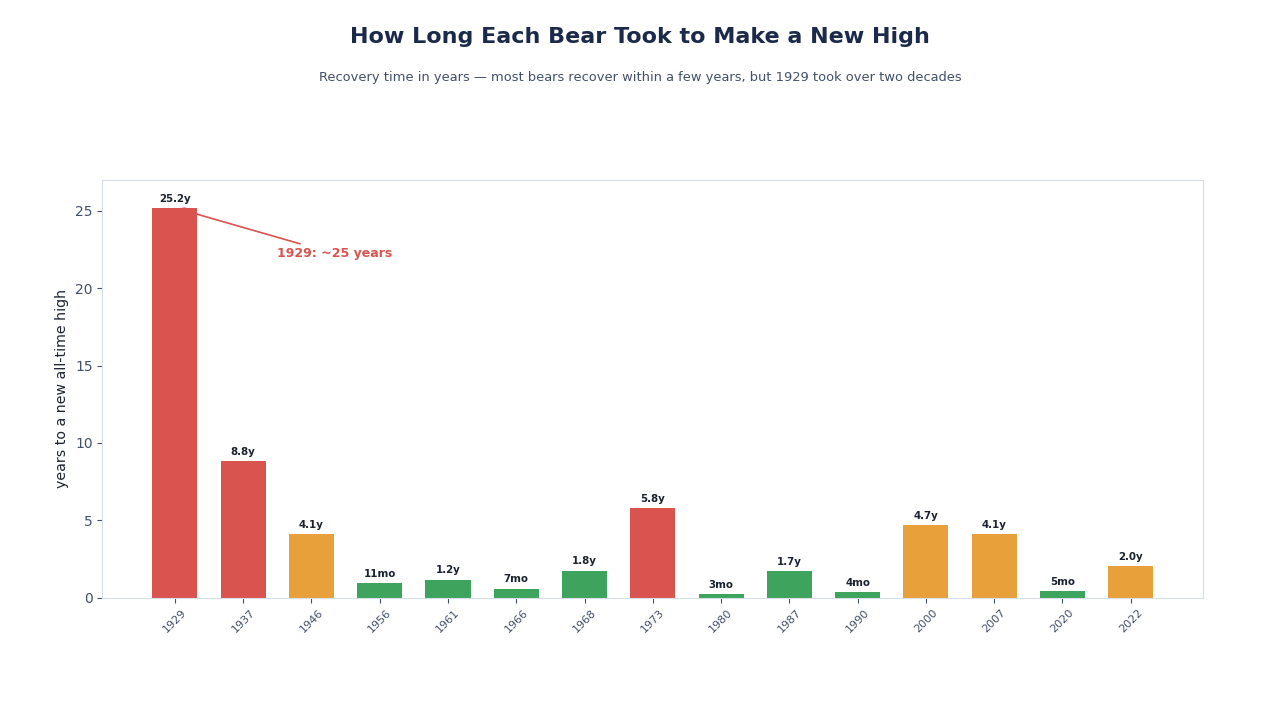
Magkalayo ang mean at median sa recovery time. Iyon ay dahil ang distribusyon ay may iilang generational na pangyayari — 1929, 1937, 1973, 2000, 2007 — na umabot ng halos apat hanggang dalawampu't limang taon bago makagawa ng bagong high, at isang mas malaking kumpol ng ordinaryong bear na natapos sa loob ng isa o dalawang taon. Mas mahaba ang inflation-adjusted recoveries sa lahat ng kaso, at ang window na 1968–1982 sa nominal terms ay nagkukubli sa esensiyal nito na isa pang tuloy-tuloy na 15-taong secular bear sa real terms.
Kapag hindi isinama ang Great Depression — isang natatanging structural event na nakaugnay sa pagbagsak ng sistema ng pagbabangko at sa 25% na unemployment shock —, ang average na pagbabang post-1937 ay umiipit sa humigit-kumulang −33%, at ang average na recovery ay umiiksi sa mga 30 buwan.
May dalawang pattern na sulit tandaan.
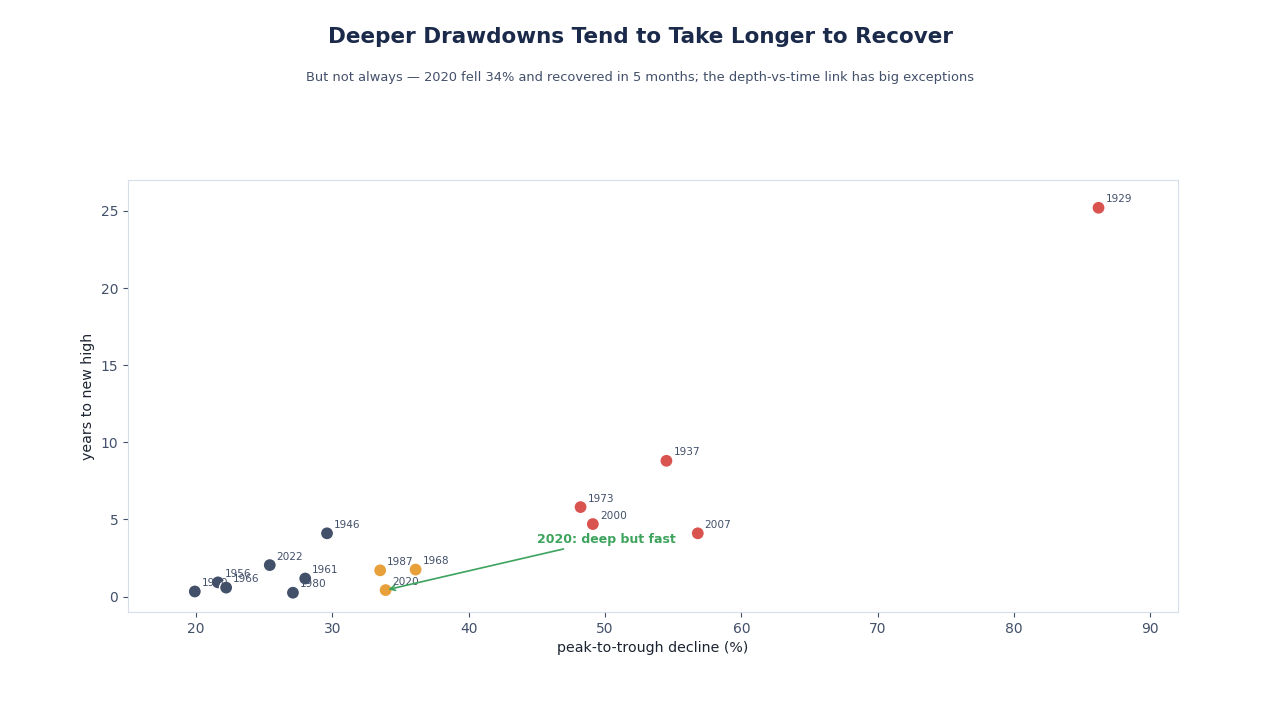
- Mahina ang correlation ng lalim ng bear at oras ng recovery. Ang −33% na bear (1987) ay nakarecover sa 20 buwan. Ang −34% (2020) sa 5. Ang bilis ng policy response, ang panimulang valuation, at ang trajectory ng kita ay mas mahalaga kaysa sa porsiyentong pagbaba mismo.
- Karamihan ng bear ay natatapos sa loob ng 18 buwan mula sa peak. Labing-isa sa labinlima ang nakarating sa trough sa window na iyon. Ang mga exception — 1929, 1937, 1946, 2000 — ay tunay na mga secular bear, lahat may shock sa pagbabangko, sustained na pagbagsak ng kita, o multi-year valuation reset.
Pasyal sa Bawat Bear, Isang Talata Bawat Isa
Ang reference table ay magagamit lamang kung mailalagay sa konteksto ang bawat hanay. Sa ibaba, bawat pangyayari sa isang talata.
1929–1932 (−86.2%). Hindi ito kwento ng stock market — ito ay pagbagsak ng sistema ng pagbabangko, isang 25% na unemployment shock, at 30% na pag-urong ng real GDP. Bumagsak ang S&P 90 ng 86% sa 33 buwan, at sa inflation-adjusted terms ay hindi nakapagrekord ng bagong high ang index hanggang sa pagtatapos ng dekada 1950. Ito ang outlier sa bawat chart at ang dahilan kung bakit umiiral ang modernong crisis playbook ng Federal Reserve. Ang overview ng Great Depression sa Investopedia ang standard na macro reference.
1937–1938 (−54.5%). Isang pagkakamali sa monetary policy. Maaga at agad na hinigpit ng Fed at ng Treasury, dinoble ang reserve requirements at binawi ang fiscal stimulus habang marupok pa ang recovery. Nawalan ng higit sa kalahati ng halaga ang index sa loob ng higit-kumulang isang taon. Walong taon at tulong ng war economy bago bumalik.
1946–1949 (−29.6%). Ang post-war demobilization bear. Bumagsak nang malala ang produksiyong industriyal nang matapos ang mga wartime contract; pumaibabaw ang inflation. Mas mababaw ang pagbaba sa pamantayan ng panahon ng Depresyon, ngunit magulo ang ilalim at tatlong taon bago lumitaw.
1956–1957 (−21.6%) at 1961–1962 (−28.0%). Dalawang maikli at matalim na cyclical bear sa paligid ng recession noong 1957 at ng "Kennedy Slide" noong 1962. Pareho ay nag-reset ng matataas na valuation kaysa sa pagsasalamin ng tunay na pagbagsak ng kita.
1966 at 1968–1970 (−22.2% at −36.1%). Ang unang alon ng Great Inflation. Ang mini-bear ng 1966 ay pinasimulan ng credit crunch. Ang 1968–1970 ay mas mahaba at mas masakit, at naghanda ng entablado para sa pinakamalalang pangyayari ng panahon pagkatapos ng digmaan.
1973–1974 (−48.2%). Ang oil embargo ng 1973 kasama ang stagflation. Nawalan ang S&P ng halos kalahati ng halaga sa 21 buwan at hindi nakapag-rekord ng bagong nominal high hanggang sa Hulyo 1980. Sa real terms, dumating lang ang recovery sa simula ng dekada 90. Sinasaklaw ng kapatid na artikulo na 1973 oil shock ang geopolitical na mekaniko.
1980–1982 (−27.1%). Ang giyera laban sa inflation ni Volcker. Ang fed funds na 20% ang nagdulot ng pinakamalalim na post-war recession noong panahon at sumira sa equity multiples. Nang humupa ang inflation, hinupa rin ang bear — tatlong buwan lang mula trough hanggang bagong high.
1987 (−33.5%). Black Monday. Nawalan ang S&P ng higit sa 20% sa isang single session noong Oktubre 19, 1987. Ang pagbaba mula Agosto ay 33.5% at tatlong buwan lang ang tagal. Ang kawili-wili ay ang recovery: 20 buwan bago makagawa ng bagong high kahit tatlong buwan lang ang buong pagbaba. Mas mabagal hinihinog ng markets ang isang crash kaysa sa ipinahihiwatig ng mga headline.
1990 (−19.9%). Ang bear ng Gulf War at S&L (Savings & Loan) crisis. Nasa hangganan ng 20% threshold sa closing-basis, ngunit unibersal na ibinibilang sa reference series. Tatlong buwan na pagbaba, apat na buwan pabalik sa bagong high — ang pangalawang pinakamabilis na cycle sa table, kasunod lamang ng 2020.
2000–2002 (−49.1%). Ang pag-deflate ng dotcom. Inabot ng 30 buwan ang S&P bago sumadsad; nawalan ang Nasdaq 100 ng 83%. Ang recovery ng S&P 500 sa bagong high ay dumating lang noong Mayo 2007 — at limang buwan pagkatapos nagsimula ang susunod na bear.
2007–2009 (−56.8%). Ang Global Financial Crisis. Isang bank balance-sheet event ng laki na hindi nakita mula 1929, ngunit sinagot ng pinagsama-samang monetary at fiscal response na hindi nakuha ng dekada 1930. Ang trough na 676.5 noong Marso 9, 2009 ang naging launchpad ng pinakamahabang bull market sa kasaysayan. Bagong high noong Marso 2013.
2020 (−33.9%). Ang COVID crash. Ang pinakamabilis na 30%+ na pagbaba sa kasaysayan ng S&P 500 — 33 araw sa kalendaryo mula peak hanggang trough — at ang pinakamabilis na recovery: bagong high sa limang buwan, sa likod ng pinaka-agresibong monetary at fiscal response noong panahon ng kapayapaan. Ang outlier na hanay ng table, at ang datos na nagpapahirap iwasan ng "iba na ngayon" na argumento nang walang ebidensiya.
2022 (−25.4%). Ang bear ng inflation pagkatapos ng COVID, pinapatakbo ng pinakamabilis na rate-hike cycle simula kay Volcker. Siyam na buwan ng pagbaba, dalawang taon pabalik sa bagong high — mas mabagal kaysa recovery ng COVID, mas mabilis kaysa pag-aararo pagkatapos ng 2008.
Mga Aral na Pinilit ng Table na Harapin
May mga katotohanan sa datos na hindi komportable sa mga karaniwang naratibo.
Mas mahalaga ang oras sa merkado kaysa pag-time sa merkado — ngunit dahil lang sa madalang ang secular bear. Kung naiwasan mo ang apat na generational na pangyayari (1929, 1937, 1973, 2000), ang recovery math sa labing-isang naiwan ay tila banayad. Ang problema, hindi mo maaaring malaman nang maaga kung ang kasalukuyang bear ay tipong 1987 (tatlong buwang pagbaba, dalawampung buwang pagbalik) o tipong 2000 (tatlumpong buwang pagbaba, halos limang taong pagbalik) hanggang sa nailagak na ang ilalim. Iyan ang buong dahilan kung bakit umiiral ang mga sistematikong "risk-off" rules.
Hindi laging epektibo ang diversification sa mga asset class. Sa 1973 at 2022, parehong nawalan ng real purchasing power ang mga stock at mataas ang kalidad na bonds. Sa 1987, 2000, 2008, at 2020, tumaas ang bonds habang bumababa ang mga stock. Maraming beses nagpalit ng tanda ang correlation ng kita ng stocks at bonds sa table.
Higit na mahalaga ang Fed kaysa sa valuation. Bawat isa sa apat na pinakamabilis na recovery (1982, 1990, 2020, 2022) ay sinundan o sinundo ng isang mapagpasyang policy pivot. Bawat isa sa apat na pinakamabagal na recovery (1929, 1937, 1973, 2000) ay nagpakita ng pagkakamali sa policy o ng multi-year secular regime change na hindi mapagkakatiwalaang maibawasan ng Fed.
Hindi pare-pareho ang epekto ng bear market sa lahat. Ang isang sistematikong istratehiya na nagre-rebalance pabalik sa equities sa nakatakdang drawdown thresholds — halimbawa, bawat 10% — ay sumipa sa buy-and-hold sa halos dalawang-katlo ng mga bear sa table. Ito mismo ang isinasakatuparan ng SimianX autopilots na rule-based behavior; sinasaklaw ng kapatid na artikulo Crypto bear playbook ang katulad na lohika para sa digital assets.
Saan Nakatayo ang S&P 500 Ngayon
Kung binabasa mo ito sa real time, ang tunay na tanong ay hindi "ano ang ginawa ng mga nakaraang bear" kundi "kumusta ang kasalukuyang tape kumpara sa kanila". Ang pahina ng S&P 500 ETF ay nagpapakita ng live na drawdown mula sa kamakailang high, ang rolling 200-day moving average, at ang breadth indicators na may posibilidad na lumala bago lumala ang index mismo. Ang AI model leaderboard ay naglalathala ng araw-araw na "drawdown probability" signals mula sa 30 frontier models mula sa 6 providers — kapaki-pakinabang bilang pangalawang opinyon laban sa puro technical screens. Para sa mga investor na mas gustong rule-based na pag-execute, isinasalin ng SimianX autopilots ang mga signal na ito sa sistematikong pagbabago ng posisyon.
Para sa mas malawak na konteksto — kasalukuyang mga valuation, breadth, sentiment, at kung paano ito ikinukumpara sa mga reading sa nakaraang bear-market peaks — ang 2026 US stock outlook ang live na katapat ng historical reference na ito.
Mga Madalas na Tanong
Kailan ang huling bear market? Ang huling bear market ng S&P 500 ay mula Enero 3, 2022 hanggang Oktubre 12, 2022, isang pagbaba na 25.4% mula pagsasara hanggang pagsasara. Nakabawi ang index sa bagong rekord na pagsasara noong Enero 19, 2024. Wala pang pagbabang umabot sa 20% na pamantayang batay sa pagsasara mula noon.
Bear market ba ang 2025? Hindi para sa S&P 500 sa karaniwang depinisyon. Bumaba ito ng 18.9% mula sa pinakamataas na pagsasara noong Pebrero 19, 2025 hanggang sa pinakamababang pagsasara noong Abril 8, at 21.3% sa loob ng araw. Talagang nagsara naman sa bear market ang Nasdaq Composite, na bumaba ng 24.3% mula Disyembre 16, 2024 hanggang Abril 8, 2025. Kapwa bumalik sa rekord ang dalawang index noong Hunyo 27, 2025.
Nasa bear market ba tayo ngayon? Hindi. Hanggang sa pagsasara noong Oktubre 15, 2026, nasa 7,744.06 ang S&P 500, 1.0% na mas mababa sa rekord nitong pagsasara na 7,818.93 noong Oktubre 6, 2026. Ang pinakamalaki nitong pagbaba mula sa pagbangon noong Hunyo 2025 ay −9.1% (Enero 27 hanggang Marso 30, 2026), isang galaw na kasinlaki ng koreksiyon at hindi bear market.
Ilang beses muntik nang pumasok sa bear market ang S&P 500 nang hindi umaabot dito? Anim na beses mula 1950 itong bumaba nang pagitan ng 18.9% at 19.9% batay sa pagsasara: 1976–78 (−19.4%), 1990 (−19.9%), 1998 (−19.3%), 2011 (−19.4%), 2018 (−19.8%) at 2025 (−18.9%). Lima sa mga ito ang lumampas sa −20% sa loob ng araw. Tingnan ang talahanayan ng muntikang bear market sa itaas.
Gaano kadalas nangyayari ang mga bear market? Mula 1950, nagkaroon ang S&P 500 ng 11 bear market batay sa pagsasara — 12 kung bibilangin ang 1990 — o humigit-kumulang isa bawat anim hanggang pitong taon. Napaka-hindi pantay ng mga agwat: dalawa ang dumating sa loob ng dalawang taon noong 2020 at 2022, habang walang naganap mula 1990 hanggang 2000.
Gaano katagal, sa average, ang isang S&P 500 bear market? Halos 15.6 buwan mula peak hanggang trough, may median na 14.7. Labing-isa sa labinlimang bear sa table ay nakarating sa trough sa loob ng 18 buwan.
Gaano katagal, sa average, ang recovery? Ang mean (trough hanggang bagong high) ay halos 50 buwan. Median 14 buwan. Malakas ang skew ng mean dahil sa apat na secular events (1929, 1937, 1973, 2000); kung tatanggalin ang mga ito, ang average na recovery ay nababawasan sa halos 16 buwan.
Ano ang pinakamasamang bear market sa kasaysayan? Ang pagbagsak noong 1929–1932, na may peak-to-trough na pagbaba na −86.2% at nominal-price na recovery na umabot ng halos 25 taon. Sa total-return na inflation-adjusted basis, mas matagal pa.
Ano ang pinakamabilis na bear market sa kasaysayan? Ang COVID crash ng 2020. Nawalan ang S&P 500 ng 33.9% sa loob ng 33 araw sa kalendaryo mula sa peak na Pebrero 19, at nakagawa ng bagong high noong Agosto 2020 — limang buwan mula sa trough.
Talaga bang bear market ang pagbaba ng 1990? Sa closing-basis, nasa −19.9% ito, isang tick lang sa ilalim ng karaniwang 20% threshold. Kasama ito bilang bear sa pangunahing reference series (Yardeni, S&P); sa intraday ay bahagyang mas mababa sa −20%. Isinama ito sa table na may asterisk.
Paano binibigyan ng kahulugan ang "bear market" dito? Sa closing-basis na S&P 500 (at S&P 90 bago 1957), pagbaba ng 20% o higit pa mula peak hanggang trough. Sinusukat ang tagal sa calendar months mula peak close hanggang trough close. Ang recovery ay ang unang sumunod na pagsasara na katumbas o mas mataas pa sa naunang peak.
Mga Tala sa Metodolohiya
Lahat ng petsa at porsiyento sa itaas ay kinakalkula mula sa nakalathalang serye ng closing ng S&P 500, na ini-cross-reference sa CRSP, Bloomberg, at Yahoo Finance — magkakaiba ang tatlo sa pinakamarami na isang araw ng pagti-trade sa ilang kaganapan bago 1990. Ang pagbaba sa Great Depression ay paminsan-minsang sinasabing −89% kapag ginamit ang monthly averages o ibang konbensyon ng index; ang numero na ginamit dito (−86.2%) ay ang peak-to-trough na pagbaba sa closing-basis.
Para sa mga praktikal na investor, hindi gaanong mahalaga ang eksaktong numero kaysa sa istruktura: 15 bear market sa 96 taon, average na pagbaba na halos isang-katlo, average na tagal na halos isang taon, at isang distribution ng recoveries na tunay na bimodal — karamihan sa mga bear ay natatapos sa 12 hanggang 24 buwan, ngunit isang minorya ang nagiging generational na pangyayari na umaabot ng kalahating dekada o mas matagal pa bago bumawi. Trabaho ng SimianX Risk Radar ang magpalit sa pagkakaiba ng dalawang kaso sa real time. Trabaho ng table sa itaas ang ipaalala sa iyo kung ano ang posible — at kung ano ang hindi.
Kaugnay na Babasahin
- Buy the Invasion 2026: 9 sa 12 Digmaan, S&P 500 Rally
- Wall Street Drawdown Watch: 10% Warning at 40% Tail Risk
- Pearl Harbor 1941: Dow -19.8% Crash, 307-Day Recovery
- Gaano Katagal Bago Nakabawi ang Bawat Bear Market: 1929-2022
- Stock Market Matapos ang Midterm: Bawat Siklo 1950–2026
- S&P 500 Seasonality: Pinakamahusay na Buwan 1950–2026 Gabay
- Mga bear market ng semiconductor: bawat SOX crash 1995–2026
- Bawat Pagbagsak ng Bitcoin Higit 50%: Oras ng Pagbawi
Mga Sanggunian
- Macrotrends — Dow 100-Year History
- Investopedia — Bear Market
- FRED — S&P 500 Historical Data
- Bloomberg — Balitang Pinansyal at Datos ng Merkado
- Nasdaq — Stock Exchange at Datos ng Merkado
- Yahoo Finance — Pang-araw-araw na kasaysayan ng S&P 500 (^GSPC)
- CNBC — Indeks ng S&P 500 (.SPX)
- Hartford Funds — 10 bagay na dapat mong malaman tungkol sa bear market
- Wikipedia — Pagbagsak ng stock market noong 2025
- Wikipedia — Mga taripa ng "Araw ng Paglaya" (Liberation Day)