Reading GitLab's Quarter Through Its Filings, Not Its Headline
GitLab shares jumped after the company reported a surprisingly strong second quarter for fiscal 2027. The stock, which trades under the ticker GTLB, rose on record bookings, accelerating annual recurring revenue, stronger customer acquisition and early evidence that GitLab can charge for the expansion of AI-generated software.
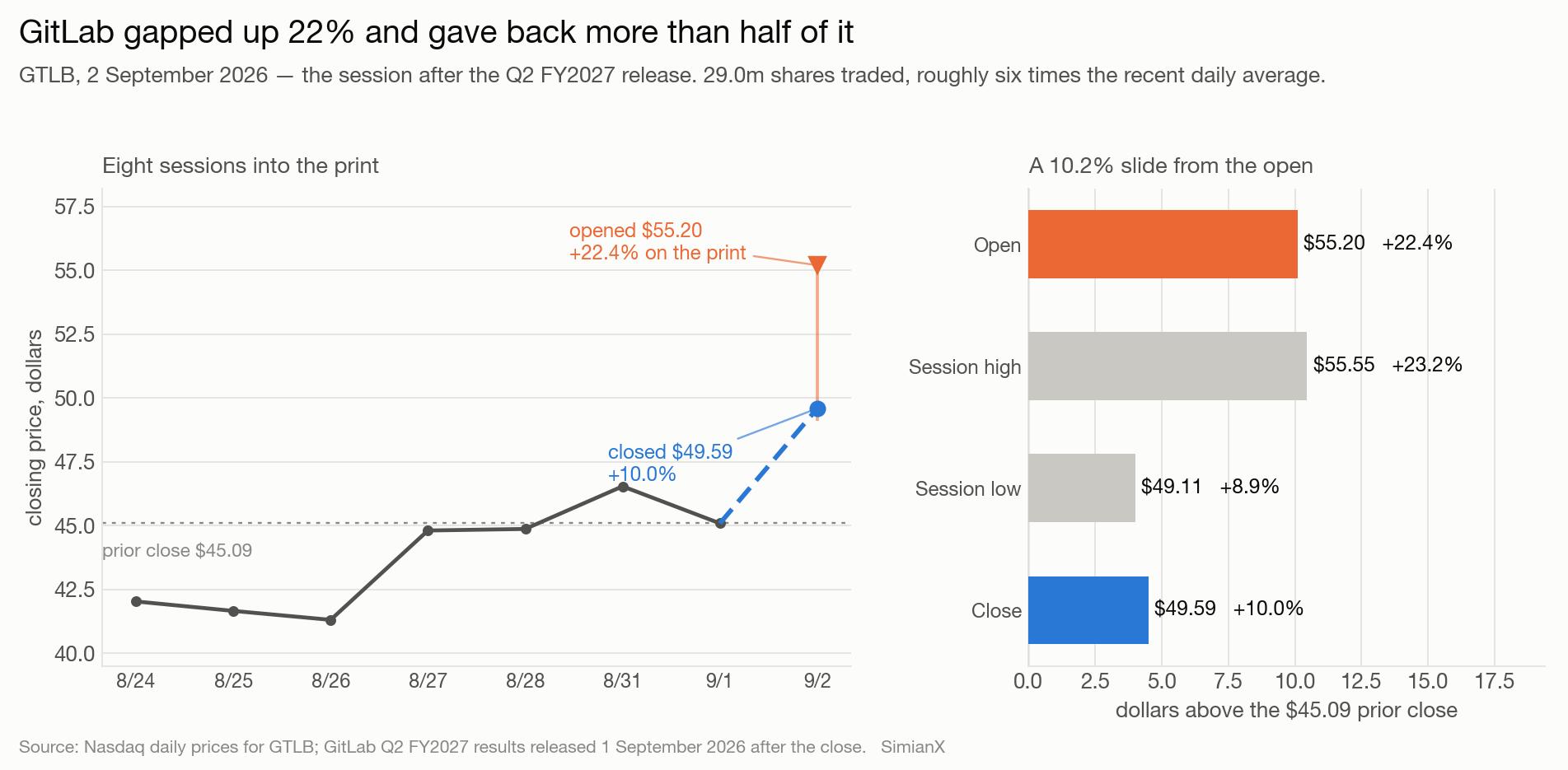
The headline numbers were impressive. Revenue reached $286.3 million, up 21% year over year and well above the roughly $273 million analyst consensus. Adjusted earnings per share of $0.24 also beat the $0.18 expectation. GitLab released the results after the close on 1 September 2026. The next morning the stock opened at $55.20, a 22.4% gap above the prior close of $45.09, then slid all session to finish at $49.59 — up 10.0% on the day but 10.2% below its own open, on 29.0 million shares, roughly six times the recent daily average. GitLab's Q2 FY2027 results as filed with the SEC
But the real investment question extends beyond one earnings beat. GitLab is not the largest AI coding-assistant vendor, and it competes against Microsoft-owned GitHub, one of the strongest developer ecosystems in the world. Its potential advantage lies elsewhere: GitLab could become the governance, security and orchestration layer through which human developers and AI agents build, test, review and deploy software.
That would make GitLab a less obvious—but potentially important—beneficiary of the AI coding boom.
This research examines GitLab’s latest results, AI strategy, competitive advantages, valuation, risks and possible return scenarios. Investors can also use SimianX AI to monitor GTLB fundamentals, technical indicators, earnings revisions and market sentiment as the thesis evolves.
Data and market prices in this analysis are current through September 2, 2026. GitLab’s fiscal 2027 ends on January 31, 2027.
Why Did GitLab Stock Surge?
GitLab’s fiscal second-quarter report contained more than a routine revenue beat. Several forward-looking metrics indicated that underlying demand may be strengthening after a period of revenue-growth deceleration.
According to GitLab’s official Q2 FY2027 earnings release, the company delivered:
- Revenue of $286.3 million, up 21% year over year.
- Record gross bookings.
- Net new annual recurring revenue growth exceeding 40%.
- More than 100% year-over-year growth in first orders.
- A dollar-based net retention rate of 117%.
- Current remaining performance obligations of $744.7 million, up 20%, inside total remaining performance obligations of about $1.2 billion, up 16% — the near-term book is growing faster than the whole book.
- 1,571 customers generating more than $100,000 in ARR, up 17%.
- A 15% non-GAAP operating margin.
- Non-GAAP adjusted free cash flow of $9.8 million.
- Raised full-year revenue guidance of $1.129 billion to $1.133 billion.
Management later clarified that net ARR grew 42%, its second-highest growth quarter in four years. GitLab also secured approximately 1,700 first orders, more than double the number recorded a year earlier, while new-logo net ARR increased 39%.
These numbers matter because recognized revenue is a lagging indicator in subscription software. Bookings, new orders and ARR provide a more current view of commercial momentum. A company can report slowing revenue growth while the underlying sales engine begins to accelerate, with the improvement appearing in reported revenue over subsequent quarters.
The rally was driven less by 21% revenue growth than by evidence that GitLab’s future revenue pipeline may be inflecting upward.
The market had entered the report with restrained expectations. GitLab’s shares had suffered from concerns about slowing growth, leadership transitions, sales execution and uncertainty about whether its AI products would generate meaningful incremental revenue. The scale of the earnings beat forced investors to reconsider those assumptions.
GitLab’s Latest Financial Scorecard
| Metric | Q2 FY2027 | Year-over-year change | Investment interpretation |
|---|---|---|---|
| Revenue | $286.3 million | +21% | Healthy, although slower than the prior year |
| Subscription revenue | $258.3 million | +21% | Recurring revenue remains the core |
| GAAP gross margin | 84% | Down from 88% | AI and cloud costs require monitoring |
| Non-GAAP gross margin | 86% | Down from 90% | Still excellent, but moving lower |
| GAAP operating margin | -20% | Down from -8% | Restructuring and stock compensation weighed on results |
| Non-GAAP operating margin | 15% | Down from 17% | Profitable on an adjusted basis |
| GAAP net loss | $36.8 million | Versus $9.2 million loss | GAAP profitability has not arrived |
| Adjusted free cash flow | $9.8 million | Down from $46.5 million | Quarterly cash flow can be seasonal |
| Dollar-based net retention | 117% | Sequential improvement | Existing customers continue expanding |
| Customers above $100,000 ARR | 1,571 | +17% | Enterprise penetration is strengthening |
| Current RPO | $744.7 million | +20% | Supports future revenue visibility |
The results contain both bullish and cautionary signals.
Revenue, bookings, customer wins and retention were strong. However, gross margin declined by four percentage points, GAAP operating losses widened, and adjusted quarterly free cash flow fell sharply from the prior year.
Part of the GAAP deterioration reflected $75 million of stock-based compensation and $23.3 million of restructuring charges, of which $3.9 million was itself accelerated stock compensation. Nevertheless, stock compensation is a genuine cost to shareholders because it can dilute ownership. Investors should not completely disregard it simply because management excludes it from non-GAAP profit.
For the first six months of fiscal 2027, GitLab generated $146.1 million in operating cash flow, compared with $155.7 million a year earlier. The company therefore remains cash-generative despite the weak standalone Q2 figure.
How GitLab Makes Money
GitLab sells a DevSecOps platform that combines functions traditionally provided by several separate tools:
- Source-code management.
- Project planning.
- Continuous integration and continuous delivery.
- Automated testing.
- Application security.
- Vulnerability management.
- Compliance and governance.
- Software deployment.
- AI-assisted development and workflow automation.
GitLab’s main plans include Free, Premium and Ultimate. Premium has a published annual-billing price of $29 per user per month, while Ultimate uses custom enterprise pricing. Ultimate includes more advanced security, compliance, portfolio-management and supply-chain capabilities.
The company generates most of its revenue from subscriptions for its SaaS and self-managed products. In Q2 FY2027, subscription revenue was $258.3 million, representing roughly 90% of total revenue.
This recurring model has several attractive characteristics:
- Customers integrate GitLab deeply into development workflows.
- Replacing a source-code and CI/CD platform can be disruptive.
- Additional users, repositories and security requirements create expansion opportunities.
- Enterprise customers often adopt higher-priced functionality over time.
- Deferred revenue and multi-year contracts improve visibility.
GitLab reported more than 50 million registered users and said approximately half of the Fortune 100 use its platform. Registered users should not be confused with paying customers, but the figure demonstrates the reach of its developer ecosystem.
The company’s open-core model is also strategically important. Developers can adopt GitLab’s free or open-source functionality before an enterprise makes a large commercial commitment. This can create a bottom-up path into organizations while GitLab’s sales team pursues top-down enterprise agreements.
Is GitLab the Hidden Winner of the AI Coding Boom?
The strongest version of the GitLab bull case is not that GitLab will defeat every AI coding assistant. It is that the proliferation of AI coding assistants increases the amount of software passing through GitLab’s platform.
AI agents can generate code quickly, but enterprises still need to answer difficult questions:
- Where did the code originate?
- Who approved it?
- Does it contain a security vulnerability?
- Does it comply with internal policies?
- Can the code pass automated tests?
- Which model or agent produced a change?
- Can the change be deployed safely?
- Who is responsible if the software fails?
GitLab operates in precisely these downstream workflows.
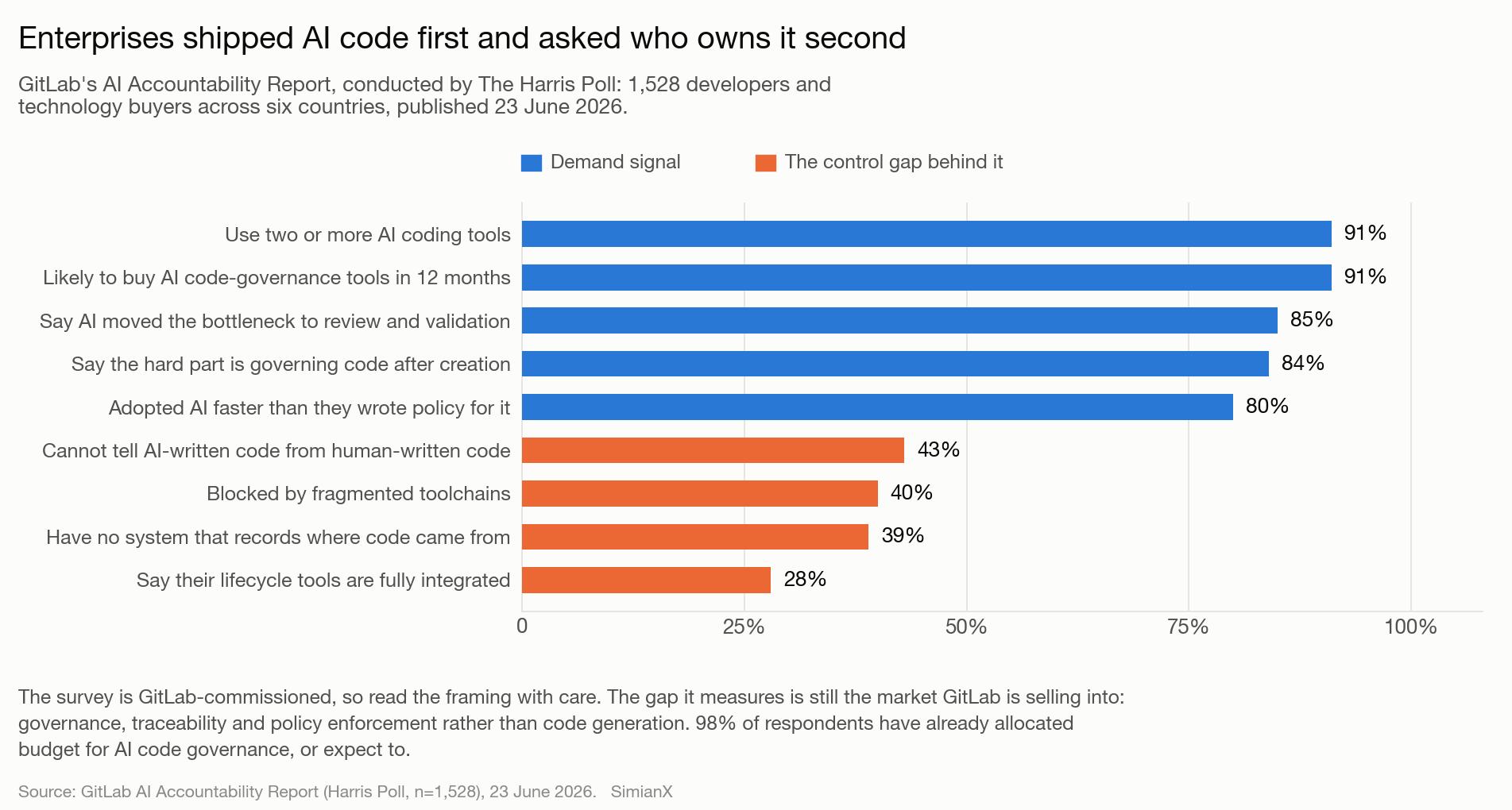
GitLab's own AI Accountability Report, conducted by The Harris Poll among 1,528 developers and technology buyers across six countries, puts numbers on that gap. 91% of organisations already run two or more AI coding tools. 85% agree AI has moved the bottleneck from writing code to reviewing and validating it, and 84% say the hard part is governing what happens to code after it is created. Meanwhile 80% concede they adopted AI faster than they wrote policy for it, 43% cannot reliably tell AI-written code from human-written code in their own codebase, and only 28% say their lifecycle tools are fully integrated. The commercial punchline: 91% expect to buy AI code-governance tooling within twelve months, and 98% have already allocated budget or expect to. GitLab's 2026 AI Accountability research
The survey was sponsored by GitLab and should therefore be interpreted with appropriate caution. However, its central logic is persuasive: if AI produces more code, organizations require more testing, security scanning, observability, documentation, governance and deployment automation.
AI may commoditize code generation while increasing the value of trusted software-delivery infrastructure.
That is why GitLab could benefit even when customers use third-party agents such as Anthropic Claude Code, OpenAI Codex or other AI development tools.
GitLab Duo Agent Platform: The Direct AI Monetization Opportunity
GitLab is not relying exclusively on indirect platform usage. It is building its own AI product suite through the GitLab Duo Agent Platform.
Duo is designed to apply AI across the software-development lifecycle rather than only within the code editor. Its capabilities include:
- Agentic chat with multi-step reasoning.
- Code generation and refactoring.
- Automated code review.
- CI/CD pipeline diagnosis and repair.
- Security analysis.
- Test generation.
- Planning and issue creation.
- Custom agents and automated workflows.
- An AI Catalog for discovering and managing agents.
- Connections to external AI coding agents.
GitLab has shifted Duo toward a consumption model based on GitLab Credits. The on-demand list price is $1 per credit, with different AI models and tasks consuming credits at different rates. Premium customers currently receive a limited-time allocation of $12 in monthly credits per user, while Ultimate customers receive $24.
This hybrid pricing model matters for investors. Traditional GitLab revenue mainly grows through additional seats, plan upgrades and price increases. AI creates a new consumption-based revenue stream that can grow as agents execute more work—even when employee headcount does not increase.
Why usage-based pricing could be powerful
An AI agent may review hundreds of merge requests, investigate failed pipelines or conduct security analysis continuously. The work generated by these agents is not naturally tied to the number of human employees. Consumption pricing allows GitLab to monetize machine activity separately from human seats.
The latest results provide early evidence of traction:
- Duo Agent Platform paid committed recurring revenue grew 50% sequentially.
- Platform-wide paid consumption run rate exceeded $40 million exiting Q2, up from $15 million exiting Q1: a 2.7-fold increase in a single quarter.
- GitLab launched Secrets Manager during the quarter as a usage-based add-on for Premium and Ultimate customers on GitLab.com, a second consumption meter alongside GitLab Credits.
- A commissioned Forrester Total Economic Impact study put the Duo Agent Platform at a 400% return on investment and $7.5 million of net present value over three years, with payback in under six months. Sponsored studies flatter their sponsor, but that is the figure GitLab's sales team will be quoting.
- More than 130 customers committed over $20 million to GitLab Flex within six weeks.
- GitLab Flex allows customers to allocate one annual commitment between platform seats, GitLab Credits and other eligible products.
These numbers remain small relative to GitLab’s $1 billion-plus revenue base. They do not yet prove that Duo will become a major profit contributor. Still, they indicate that customers are willing to experiment with the commercial model.
GitLab Orbit could strengthen the moat
GitLab Orbit is intended to connect repositories, pipelines, deployments, work items and production signals into a unified context graph. GitLab said internal testing showed that this broader context enabled AI agents to respond up to 11 times faster with as many as 45 times fewer hallucinations.
Those are company-provided internal testing results, not independent benchmarks. Even so, the concept highlights GitLab’s potential advantage: an AI agent is more valuable when it understands the full history and operating context of an enterprise’s software.
The Three-Layer GitLab AI Thesis
| AI opportunity | How GitLab benefits | Revenue mechanism |
|---|---|---|
| More AI-generated code | More repositories, pushes, pipelines and security scans | Higher seat and platform demand |
| More AI governance | Enterprises need traceability, permissions and audit trails | Ultimate-tier adoption |
| GitLab’s own agents | Customers automate reviews, fixes and workflows | Consumption-based GitLab Credits |
The second and third layers may be more valuable than basic code completion.
Code-generation tools can be highly competitive and may become difficult to differentiate as foundation models improve. Governance and orchestration are more closely connected to enterprise systems, policies and historical data. These functions can create higher switching costs.
GitLab reported that Ultimate represented 59% of total ARR in Q2, up from 56% at the end of fiscal 2026. Ultimate ARR grew approximately 35% year over year. That suggests demand for security and governance is already expanding faster than the company as a whole.
The GitLab Flex Deferral Gap
The most useful number in GitLab's quarter is not in the press release. It is in the 10-Q, and almost nobody quotes it.
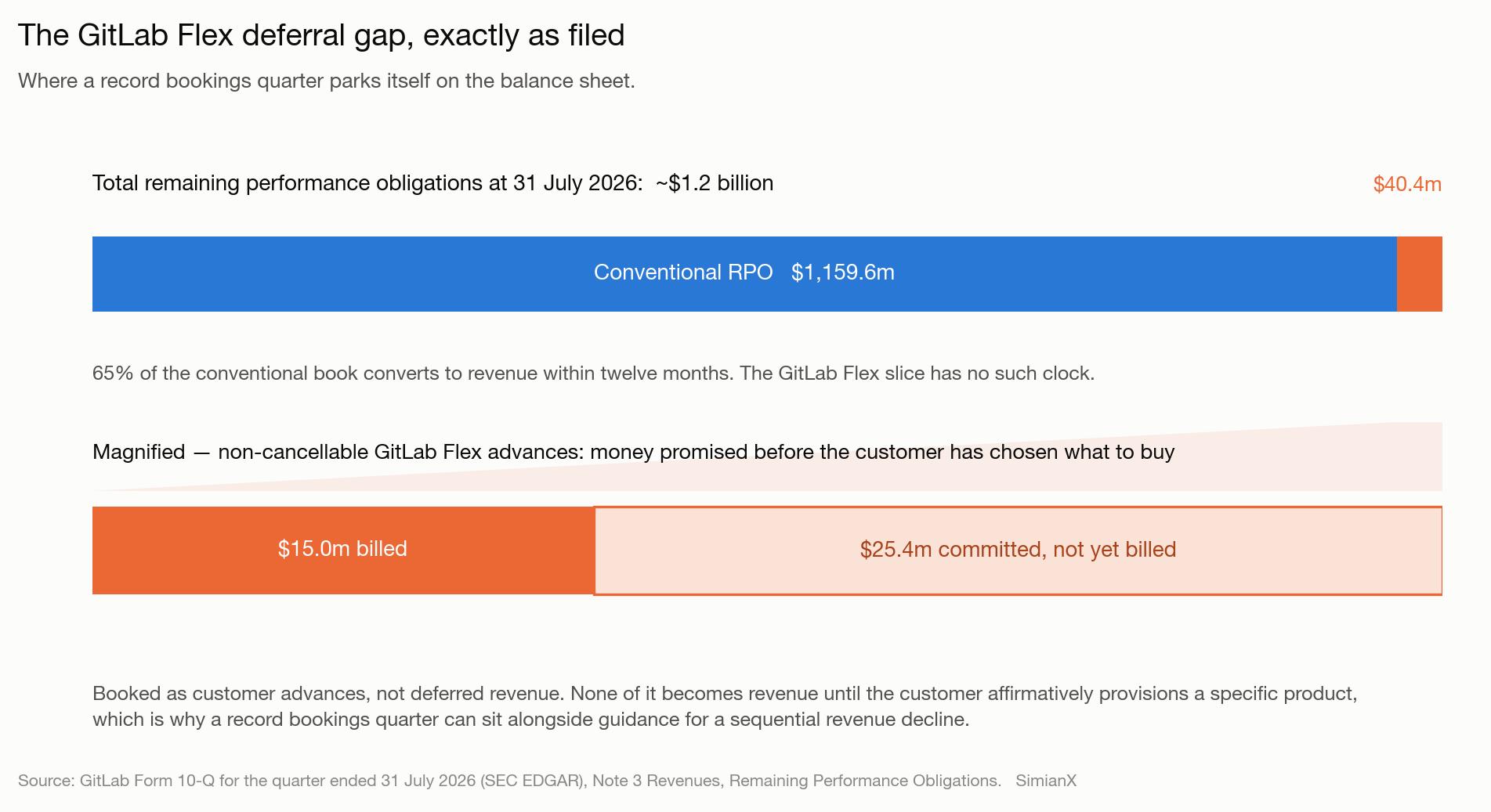
GitLab introduced Flex in June 2026: a single annual dollar commitment that a customer can reallocate month to month across platform seats, GitLab Credits and newly eligible capabilities, without contract amendments. Management said more than 130 customers committed over $20 million within six weeks. Commercially that is good news. In the accounts it creates a gap.
Under the revenue standard, a commitment cannot be recognised as revenue — or even parked in deferred revenue — until the customer says what they are buying. Unprovisioned Flex money is booked as customer advances, a separate liability, and it stays there until the customer affirmatively elects a specific product or service.
Here is exactly what that looked like on 31 July 2026, taken from the filing.
| Line | Amount | What it means |
|---|---|---|
| Total remaining performance obligations | about $1.2bn | the whole contracted book |
| Non-cancellable Flex advances inside that book | $40.4m | committed, product not yet chosen |
| Of which already billed | $15.0m | held in customer advances, not deferred revenue |
| Of which committed but not yet billed | $25.4m | no invoice raised |
| Book excluding Flex, recognised within 12 months | 65% | the portion with a normal clock |
This is the mechanism behind the strangest pair of numbers in the quarter: record gross bookings sitting alongside third-quarter guidance of $281m to $283m, below the $286.3m GitLab had just delivered. Management estimated that every $50 million of self-managed contracts converting to Flex could move roughly $5 million of revenue out of fiscal 2027 and into later periods.
GitLab says as much in its own risk factors. The timing of revenue recognition under Flex depends on the pace at which the self-managed base converts, on customer adoption and on usage patterns, none of which the company controls. The filing then warns that this "could lead investors and analysts to misinterpret our performance and contribute to volatility in the price of our securities."
That is a company telling you in writing that its reported revenue is about to become a worse signal than usual.
What to do with that. Treat reported revenue as the lagging series it now is and track four things instead: total remaining performance obligations, current remaining performance obligations, the customer-advance balance, and net new ARR. Note one detail while you are there. Total obligations grew 16% while the current portion grew 20%, so the near-term book is growing faster than the whole book. The average contract is getting shorter, not longer. That is a genuine yellow flag inside an otherwise strong quarter, and it is invisible if you read only the headline.
GitLab Versus GitHub Copilot and Microsoft
GitLab’s greatest competitive threat is Microsoft, which owns GitHub and GitHub Copilot.
GitHub benefits from:
- The world’s largest developer network.
- Strong brand recognition.
- Integration with Visual Studio Code.
- Microsoft’s enterprise sales organization.
- Azure cloud integration.
- Access to Microsoft’s AI infrastructure and partnerships.
- The ability to bundle products across a broad software portfolio.
GitLab cannot match Microsoft’s distribution scale or balance sheet. A company already using Microsoft 365, Azure and GitHub may prefer a consolidated Microsoft agreement.
However, GitLab has meaningful differentiators.
| GitLab advantage | Why it may matter |
|---|---|
| Full-lifecycle platform | Planning, source code, CI/CD, security and deployment share one data model |
| Cloud neutrality | Customers can avoid dependence on a single hyperscaler |
| Model neutrality | Enterprises can use multiple AI models and agents |
| Self-managed deployment | Important for regulated, sovereign and security-sensitive environments |
| Open-core model | Encourages developer adoption and community contributions |
| Integrated security | Security controls are embedded throughout development |
| Enterprise governance | Permissions, audit trails and compliance can cover human and agent activity |
GitLab was named a Leader in the 2026 Gartner Magic Quadrant for DevSecOps Platforms for the fourth consecutive year. Gartner’s assessment is useful evidence of enterprise credibility, though it does not guarantee future commercial success. GitLab’s summary of the 2026 Gartner recognition
The best competitive outcome for GitLab may not require displacing GitHub everywhere. GitLab can win organizations that prioritize platform consolidation, private deployment, regulatory control, cloud independence or a multi-model AI strategy.
The Bull Case for GTLB Stock
1. AI expands the number of software builders
AI allows employees without traditional programming backgrounds to create applications, dashboards and automations. Every useful application still requires storage, testing, deployment and governance.
If the population of software builders expands, GitLab can sell more seats and process more workloads even if AI makes individual developers more productive.
2. AI-generated code increases platform activity
Management reported that secure repositories were growing roughly 60%, code pushes approximately 50%, and CI/CD pipelines more than 40% year over year. These operational measures were increasing substantially faster than revenue.
That creates future monetization opportunities, particularly if activity converts into security scans, premium features and AI-credit consumption.
3. Enterprise expansion remains healthy
A 117% dollar-based net retention rate means existing customers, as a group, are spending 17% more than they did a year earlier after accounting for churn and contraction. The figure is below the extreme levels achieved by some high-growth SaaS companies, but it is solid and improved sequentially for the first time since 2024.
Large customers are also expanding:
- Customers above $5,000 in ARR increased 8%.
- Customers above $100,000 increased 17%.
- Deals worth at least $500,000 grew more than 150%.
- Ultimate ARR increased approximately 35%.
4. New-customer acquisition may be reaccelerating
First-order growth above 100% is one of the most bullish data points in the quarter. More than half of GitLab’s current $1 billion-plus run-rate revenue reportedly came from customers whose initial purchase was below $5,000.
Small new customers can therefore become meaningful expansion accounts over time.
5. The balance sheet is strong
As of July 31, 2026, GitLab held:
- $226.5 million of cash and cash equivalents.
- $1.03 billion of short-term investments.
- Approximately $1.26 billion of combined cash and investments.
- No large conventional debt balance shown in its condensed balance sheet.
That liquidity provides flexibility to invest in AI infrastructure, product development, acquisitions and share repurchases.
6. Capital allocation has become more shareholder-friendly
GitLab authorized a $400 million share-repurchase program in March 2026. During Q2, it repurchased approximately 3.5 million shares, and total repurchases during the first six months reached about $154.7 million.
Repurchases can partially offset stock-based compensation, although investors should verify whether the diluted share count actually declines over time.
GitLab as Customer Zero
Every AI-software company claims its product makes teams more productive. GitLab is the rare one that has bet its own payroll on the claim, in public, with the numbers filed afterwards.
On 11 May 2026 chief executive Bill Staples published a letter, filed with the SEC as an exhibit rather than merely posted to a blog, titled "GitLab Act 2". It announced a restructuring and set out what the company intended to do with the savings. Four operational changes were named: reduce the number of countries GitLab operates in by up to 30% where teams were small, remove up to three layers of management, reorganise research and development into roughly 60 smaller teams with end-to-end ownership, and — the part that matters here — "rewire internal processes with AI agents, automating the reviews, approvals, and handoffs", then "right-size roles across the company to follow suit".
The board approved the plan on 1 June 2026. It affected approximately 14% of GitLab's global workforce, with total charges expected between $30 million and $35 million. The same letter committed GitLab to "being customer zero of our platform".
Q2 FY2027 is the first quarter reported against that decision, and the result is genuinely interesting.
| What the plan promised | What the quarter delivered |
|---|---|
| Fewer people | 14% workforce reduction, board-approved 1 June 2026 |
| Equal or better commercial output | Record gross bookings, first orders up more than 100%, net ARR growth above 40% |
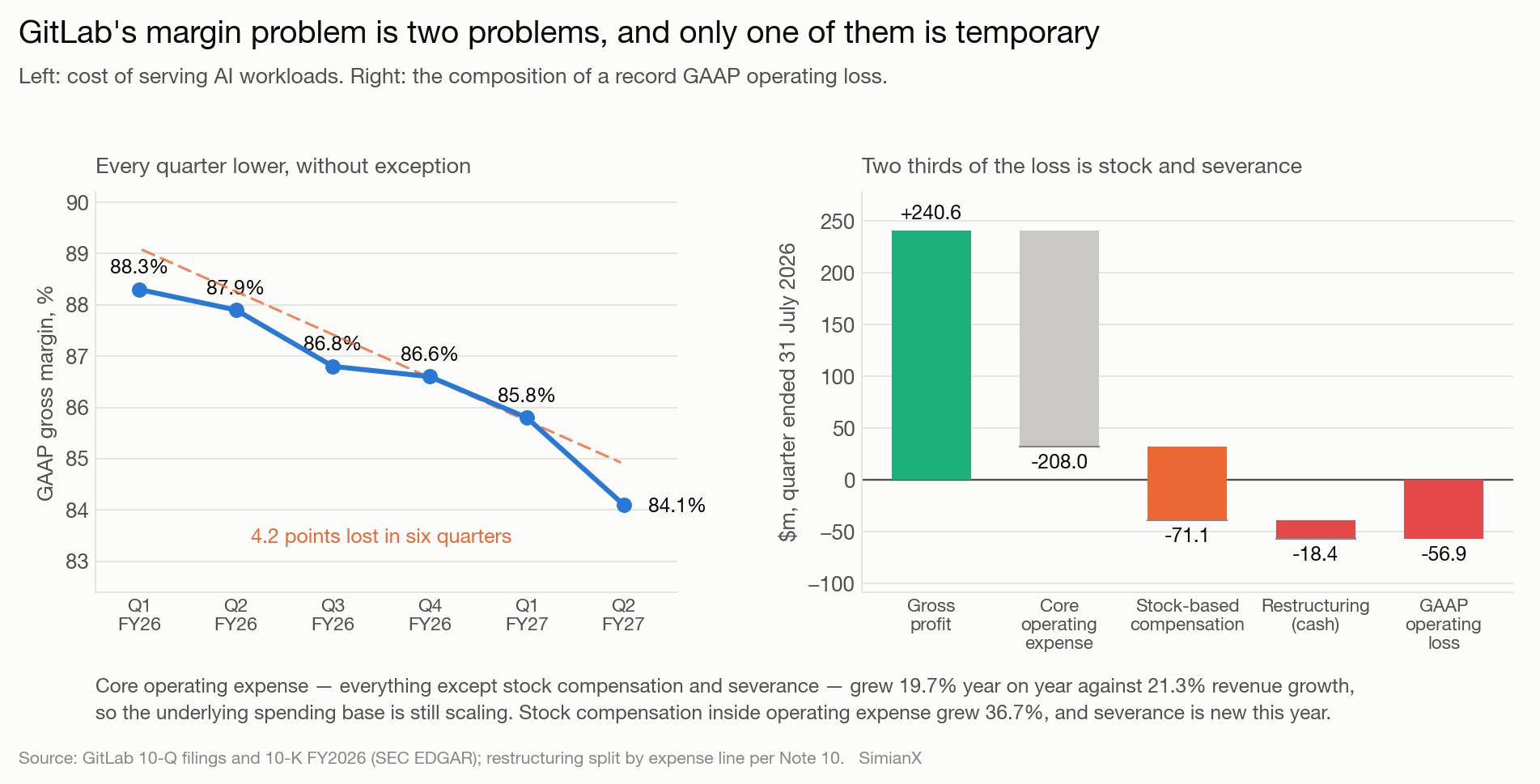
| Operating leverage | Core operating expense up 19.7% against revenue up 21.3% |
| The cost of getting there | $23.3m of restructuring charges booked in the quarter |
| The GAAP result | A $56.9m operating loss, the widest in more than two years |
Read the last two rows together. GitLab booked $23.3 million of restructuring charges in Q2: $16.2 million of severance, $2.0 million of retention, $3.9 million of accelerated stock compensation and $1.1 million of other costs. Strip out the non-stock portion and the operating loss is closer to $38 million than to $56.9 million. Strip out stock compensation as well and the business is comfortably profitable, which is what the 15% non-GAAP operating margin is telling you.
The honest reading sits between the two. Core operating expense — everything except stock compensation and severance — grew 19.7% year on year while revenue grew 21.3%. That is real, if modest, operating leverage, and it arrived in the same quarter the company cut 14% of its staff. Stock compensation inside operating expense grew 36.7%, far faster than revenue, and that is the part which does not disappear when the restructuring ends.
Why this matters beyond GitLab. If a DevSecOps company can run a smaller organisation on its own agents while accelerating bookings, that is the strongest available evidence for the thesis it is selling to everyone else. If the cost line reasserts itself two quarters from now, the demonstration fails in public, on a schedule, in filings anyone can check. Very few AI theses come with a test this legible.
The Bear Case: Why the AI Winner Thesis Could Fail
A strong earnings report does not eliminate substantial risks.
Revenue growth is still decelerating
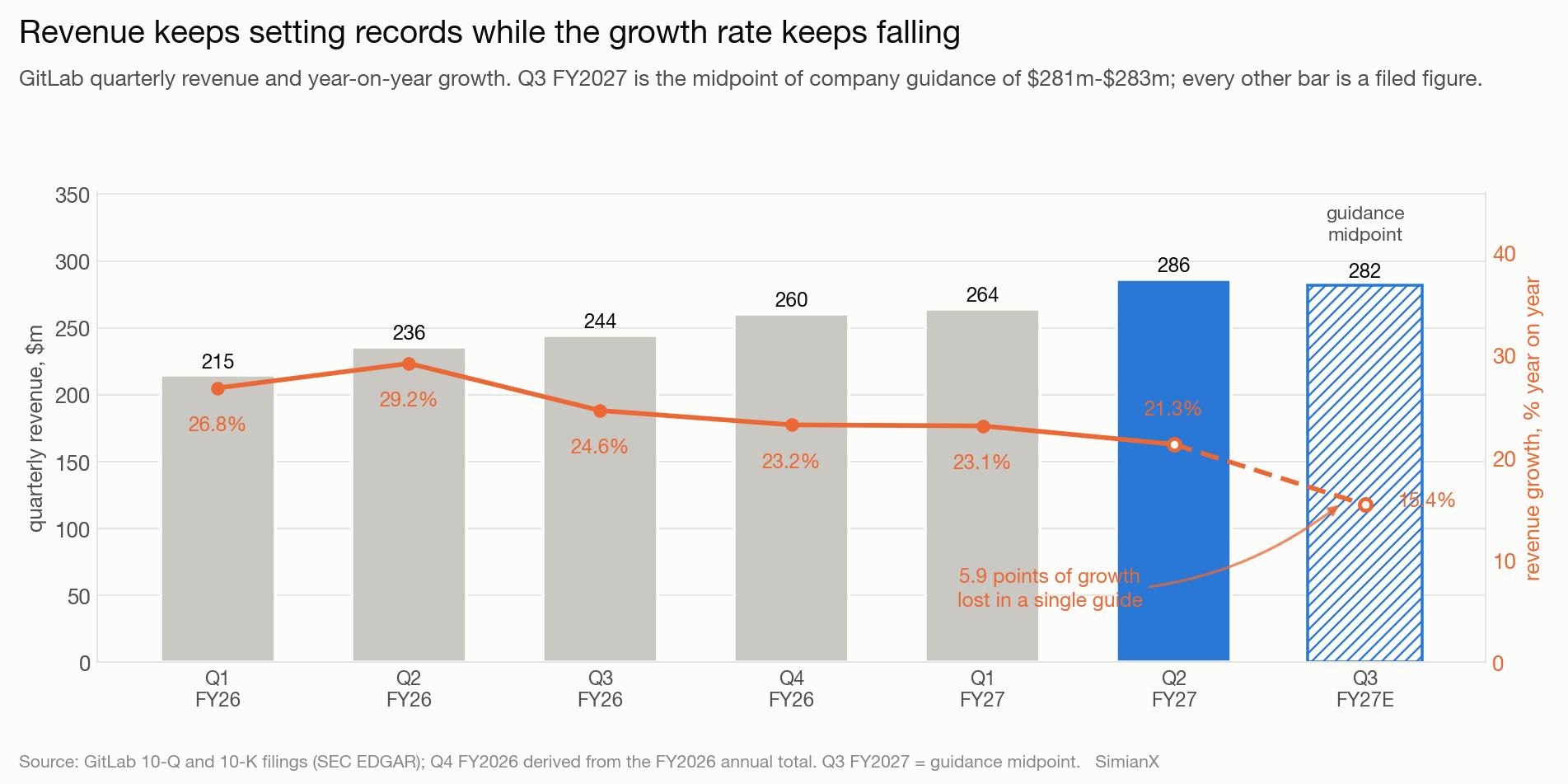
GitLab grew fiscal 2026 revenue by 26%. Q1 FY2027 revenue grew 23%, followed by 21% in Q2. Full-year guidance of approximately $1.131 billion implies growth of only about 18% from the $955.2 million reported in fiscal 2026.
The bookings surge could eventually reaccelerate revenue, but investors should not assume that it will. Contract timing, customer budgets and the GitLab Flex transition can all affect recognized revenue.
The Q3 outlook implies a sequential decline
Management guided Q3 revenue to $281 million–$283 million, below Q2’s $286.3 million. Some of this reflects revenue-recognition timing related to customers shifting toward GitLab Flex. Management estimated that every $50 million of self-managed contracts converted to Flex could move approximately $5 million of revenue out of fiscal 2027 and into later periods.
This may be an accounting-timing issue rather than weaker demand, but it makes near-term growth harder to interpret.
Gross margins are falling
GAAP gross margin declined from 88% to 84%, while non-GAAP gross margin fell from 90% to 86%.
AI inference, cloud hosting and third-party model expenses can be more costly than traditional software delivery. Usage revenue is not automatically high-margin revenue. If GitLab charges too little for AI consumption or relies heavily on expensive external models, Duo could dilute rather than improve margins.
GAAP losses and stock compensation remain significant
GitLab recorded a $56.9 million GAAP operating loss in Q2. Stock-based compensation reached $75 million, equal to approximately 26% of quarterly revenue.
For the full fiscal year 2026, stock-based compensation was about $215 million, or 22.5% of revenue. Investors who focus only on non-GAAP margins may underestimate the economic cost of issuing equity to employees.
Microsoft remains a formidable competitor
Microsoft can bundle GitHub, Copilot, Azure and security products. It can also tolerate lower margins in one product to strengthen the broader ecosystem.
GitLab must continue innovating quickly while spending far less than Microsoft. Its model-neutral positioning is valuable only if customers consider independence important enough to overcome Microsoft’s distribution advantage.
AI coding tools could bypass traditional platforms
There is a possibility that autonomous agents reshape software development so profoundly that today’s DevOps workflows become less important. New AI-native platforms could integrate code generation, testing and deployment from the ground up.
GitLab argues that more agents require more orchestration. That is plausible, but not guaranteed. The incumbent platform could benefit—or a new architecture could capture the value.
Management execution is still being tested
Bill Staples became GitLab's chief executive on 5 December 2024, not last year, succeeding co-founder Sytse Sijbrandij, who moved to executive chair. Staples ran New Relic before that and, before New Relic, spent seventeen years at Microsoft, finishing as vice president of the Azure Application Platform. That is a useful detail when judging how GitLab thinks about competing with GitHub. The company also increased account-executive capacity by roughly 30%, and on 1 June 2026 the board approved the restructuring plan that cut about 14% of the global workforce.
Two governance items belong on the same page. Sijbrandij converted 15,134,451 Class B shares into Class A on 14 May 2026, effectively collapsing the ten-votes-per-share structure: Class B outstanding fell from 16.7 million to 1.1 million over the half year. And in the same 8-K that carried the Q2 results, GitLab disclosed that chief accounting officer Simon Mundy would resign effective 16 September 2026, with chief financial officer Jessica Ross taking on the principal-accounting-officer role. The filing states the resignation was not the result of any disagreement over financial reporting, accounting practices or internal controls, which is the standard formulation and worth exactly what it says.
The record bookings quarter is encouraging, but investors need several more quarters to determine whether the improvement reflects a repeatable sales process or a temporary concentration of large deals.
GTLB Stock Valuation After the Fade
GitLab closed at $49.59 on 2 September 2026, up 10.0% from the prior close of $45.09. That was after opening at $55.20 — a 22.4% gap — and sliding 10.2% through the session. Anyone anchoring on the premarket print is anchoring on a price the stock never closed at.
As of 18 August 2026 GitLab had 165.5 million Class A and 1.1 million Class B shares outstanding, 166.6 million in total. At the close that is a market capitalisation of roughly $8.26 billion. Cash of $226.5 million plus $1,030.5 million of short-term investments gives about $1.26 billion of net cash against no conventional debt, so enterprise value is roughly $7.01 billion.
| Measure | At the 2 September 2026 close | Basis |
|---|---|---|
| Share price | $49.59 | Nasdaq close |
| Shares outstanding | 166.6m | Class A plus Class B, 18 August 2026 |
| Market capitalisation | $8.26bn | price times shares |
| Cash and short-term investments | $1.26bn | balance sheet, 31 July 2026 |
| Enterprise value | $7.01bn | market capitalisation less net cash |
| EV / FY2027 guided sales | 6.2x | $1,131m guidance midpoint |
| Price / FY2027 guided sales | 7.3x | same |
| Price / FY2027 guided non-GAAP EPS | 57.7x | $0.86 midpoint |
On the company's own 172 million diluted-share guidance the same arithmetic produces an $8.53 billion capitalisation and a 6.4x EV/sales multiple. Either way, GitLab is not cheap on sales and is expensive on earnings. That is normal for enterprise software, but it leaves no room for a growth disappointment.
A scenario frame built on the guidance, not on hope
The flaw in most GTLB scenario tables is that the base case quietly assumes faster growth than the company has just guided to. Full-year fiscal 2027 guidance implies 18.4% growth. Anchoring fiscal 2028 on that exit rate rather than on a hoped-for reacceleration gives a very different picture.
| Scenario | FY2028 revenue growth | FY2028 revenue | EV/sales | Enterprise value | Implied value per share | Versus the $49.59 close |
|---|---|---|---|---|---|---|
| Bear | +14% | $1.29bn | 4.0x | $5.16bn | $37 | -25% |
| Base | +20% | $1.36bn | 6.5x | $8.82bn | $59 | +18% |
| Bull | +27% | $1.44bn | 9.0x | $12.93bn | $82 | +66% |
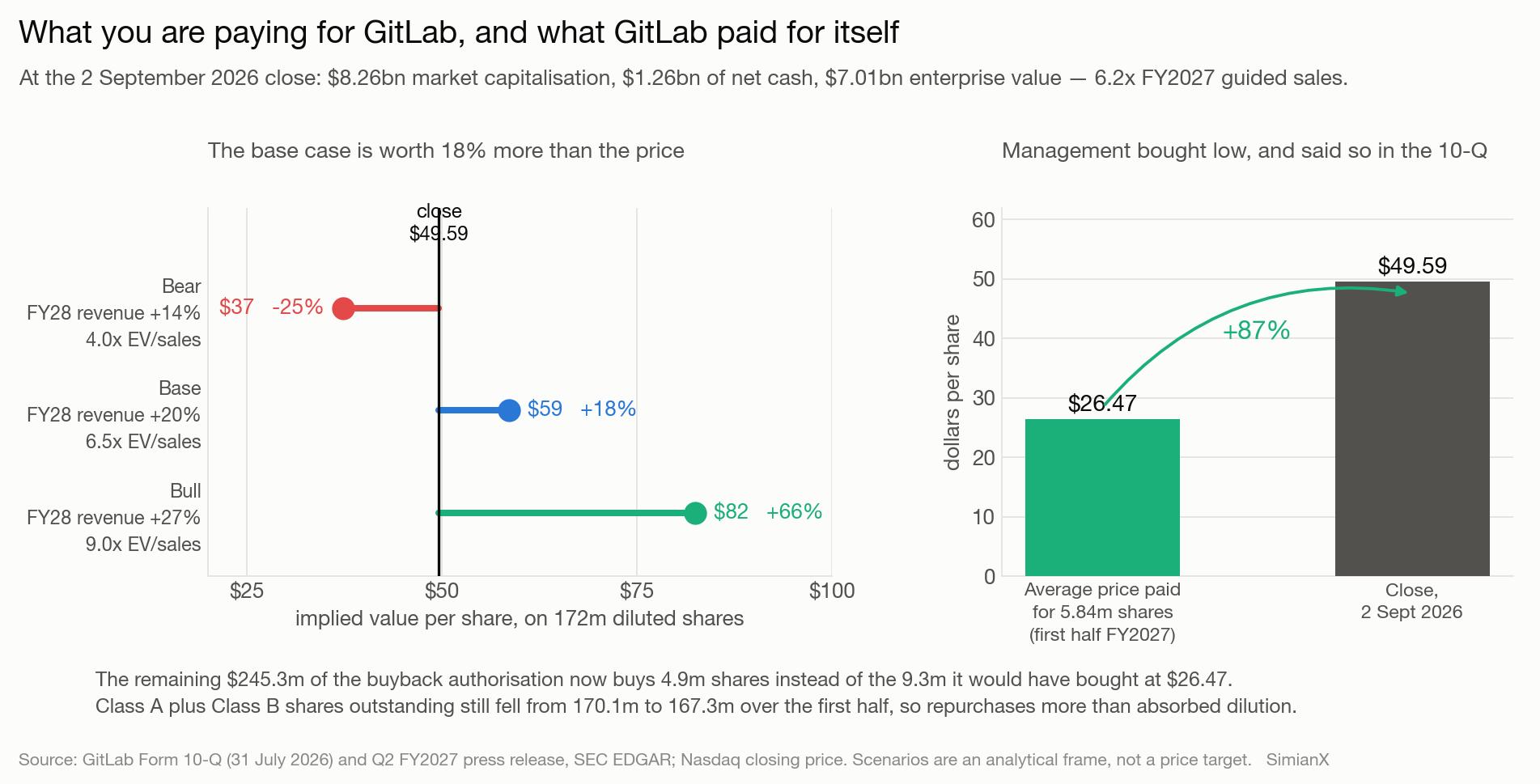
Per-share figures add back the $1.26 billion of net cash and divide by the company's own 172 million diluted-share guidance. This is an analytical frame rather than a price target, and it ignores further dilution.
Read the middle row carefully. Twenty per cent revenue growth on a 6.5x multiple — neither assumption heroic — is worth about 18% more than the price. That is the honest summary of the setup. The market is already paying for the base case and a little more, so the return has to come from the bull column or from nowhere.
The key valuation sensitivity is not one quarter's adjusted EPS. It is whether GitLab can eventually combine:
- Revenue growth around or above 20%.
- Non-GAAP operating margins above 20%.
- Sustainable free-cash-flow margins above 20%.
- Lower stock compensation as a percentage of revenue.
- Stable gross margins despite AI inference costs.
If GitLab achieves that combination, a premium software multiple could be justified. If growth falls toward the low teens while stock compensation stays above 20% of revenue, the current valuation could contract substantially.
What GitLab paid for its own stock
GitLab repurchased 5,840,297 Class A shares in the first half of fiscal 2027 for $154.7 million, at an average of $26.47 per share. The stock closed at $49.59 on 2 September. The buyback is up roughly 87%, which is the most shareholder-friendly thing management has done this year and the least discussed.
It cuts the other way too. The $245.3 million still authorised buys 4.9 million shares at $49.59 against the 9.3 million it would have bought at $26.47. Repurchases become less effective exactly as the thesis becomes more popular.
The dilution question also has an answer, and it is better than sceptics assume. Class A plus Class B shares outstanding fell from 170.1 million on 31 January 2026 to 167.3 million on 31 July, a 1.6% reduction, despite $125.1 million of stock compensation over the same six months. The weighted-average count still rose year on year, to 168.7 million from 166.0 million, so the improvement is recent rather than established.
How to Analyze GitLab Stock After the Rally
Investors should avoid chasing the stock solely because the price moved sharply after earnings. A better process is to monitor whether operating evidence continues validating the AI thesis.
Step 1: Track ARR rather than headlines
Focus on net new ARR, first-order ARR, Ultimate ARR and paid AI-consumption commitments. These measures provide a clearer indication of recurring demand than short-term share-price movements.
Step 2: Separate direct and indirect AI benefits
Ask two different questions:
- Is AI increasing usage of GitLab’s existing DevSecOps platform?
- Is GitLab generating incremental revenue from its own AI products?
The first effect appears visible in repository, code-push and pipeline activity. The second remains earlier-stage.
Step 3: Monitor gross-margin economics
AI revenue is attractive only if pricing covers model, hosting and infrastructure costs. Watch whether gross margin stabilizes as consumption grows.
Step 4: Compare GAAP and non-GAAP results
Non-GAAP earnings demonstrate the underlying operating model, but GAAP results capture dilution and restructuring costs. Both views are necessary.
Step 5: Watch the diluted share count
Repurchases are valuable only if they reduce dilution or acquire shares below intrinsic value. Compare shares outstanding, stock-based compensation and repurchase spending each quarter.
Step 6: Evaluate competitive wins
Look for examples of customers choosing GitLab over GitHub, consolidating multiple DevOps tools or adopting GitLab specifically for AI governance. Competitive anecdotes are more meaningful when supported by improving win rates and customer growth.
A platform such as SimianX AI can assist with this process by tracking earnings revisions, SEC filings, news, sentiment and technical indicators. However, SimianX AI is a research and educational tool rather than a registered investment adviser, so material data should be independently verified.
What Would Confirm the GitLab AI Bull Case?
The following developments would strengthen the thesis:
- Revenue growth reaccelerates toward or above 20%.
- Dollar-based net retention rises above 120%.
- Duo paid consumption becomes a material percentage of revenue.
- GitLab Flex commitments consistently convert into consumption.
- Gross margin stabilizes despite greater AI usage.
- Ultimate continues gaining share of ARR.
- GAAP operating losses narrow.
- Stock compensation declines as a percentage of revenue.
- New-customer growth remains elevated for several quarters.
- GitLab reports more large competitive wins against Microsoft.
Conversely, the thesis would weaken if:
- The bookings surge fails to appear in future revenue.
- AI usage grows while gross margin falls rapidly.
- Duo adoption depends mainly on free promotional credits.
- Customers consolidate around GitHub and Microsoft.
- Net retention falls below 110%.
- Free cash flow deteriorates outside normal seasonality.
- Share dilution offsets most of the repurchase program.
- New products add complexity without improving customer economics.
Is GitLab Stock a Buy in 2026?
GitLab presents a credible but higher-risk AI software thesis.
The company has several qualities that growth investors typically seek:
- Recurring subscription revenue.
- High gross margins.
- Strong enterprise customer growth.
- A large net-cash position.
- Improving sales momentum.
- Direct and indirect exposure to AI development.
- A clear path toward consumption-based monetization.
At the same time, the post-earnings valuation already prices in meaningful execution. Revenue growth is decelerating on a reported basis, GAAP profitability remains negative, stock compensation is high, and Microsoft represents an unusually powerful competitor.
A reasonable investment conclusion is therefore constructively bullish but valuation-sensitive.
GitLab may be attractive to long-term investors who believe that AI will increase the volume and complexity of enterprise software while making security, governance and orchestration more valuable. Investors seeking predictable GAAP earnings, low valuation multiples or minimal competitive risk may find GTLB less suitable.
Position sizing matters. Rather than treating GitLab as a proven AI winner, investors could view it as an emerging platform with promising evidence that still requires several quarters of confirmation.
FAQ About GitLab Stock and the AI Coding Boom
Why did GitLab stock surge after earnings?
GitLab exceeded Wall Street’s revenue and adjusted-earnings expectations while reporting record bookings, 42% net ARR growth and more than 100% growth in first orders. Investors also responded positively to early adoption of GitLab Flex and the Duo Agent Platform.
Is GitLab stock an AI stock?
Yes, but its AI exposure differs from semiconductor or foundation-model companies. GitLab benefits from AI-generated software flowing through its repositories, pipelines and security tools, while also selling its own AI agents and workflow automation through consumption-based credits.
How does GitLab make money from AI?
GitLab can monetize AI in three ways: additional platform seats, higher adoption of its security-focused Ultimate tier and consumption of GitLab Credits by AI agents. The direct consumption opportunity is still early but had exceeded a $40 million paid run rate across the platform by the end of Q2 FY2027.
Can GitLab compete with GitHub Copilot?
GitHub has superior scale and Microsoft distribution, making it a difficult competitor. GitLab differentiates itself through full-lifecycle DevSecOps integration, cloud and model neutrality, self-managed deployment, security and enterprise governance.
Is GTLB stock overvalued after the surge?
At roughly 6.5–6.7 times forward enterprise value to sales, GitLab is not obviously cheap. The valuation may be reasonable if revenue growth stabilizes near 20% and margins expand, but it could prove expensive if growth slows toward the low teens.
What is the biggest risk to GitLab stock?
The largest risk is that investors pay a premium for an AI growth story that does not translate into sustained revenue acceleration or attractive margins. Competition from Microsoft, high stock compensation and declining gross margins add to that risk.
Will GitLab benefit if companies use third-party AI coding agents?
Potentially. Code created by third-party agents still needs to be stored, reviewed, tested, secured and deployed. GitLab’s model-neutral strategy is designed to make its platform useful regardless of which coding agent an enterprise chooses.
Conclusion
The argument that GitLab is a hidden winner of the AI coding boom has become more credible—but it is not yet fully proven.
GitLab does not need to dominate code generation to benefit from AI. Its opportunity lies in becoming the trusted orchestration and governance layer for a world in which humans and autonomous agents produce far more software. More code can mean more repositories, pipelines, security scans, deployments and compliance requirements—all areas in which GitLab already has an established enterprise platform.
The Q2 FY2027 results offered several encouraging signals: record gross bookings, 42% net ARR growth, more than 100% first-order growth, improving retention and early demand for GitLab Flex and Duo consumption. These data points explain why GitLab stock surged.
Nevertheless, the investment case contains real tensions. Full-year guidance implies revenue growth below 20%, gross margins have declined, GAAP losses widened and stock-based compensation remains substantial. Meanwhile, Microsoft-owned GitHub possesses distribution and ecosystem advantages that cannot be ignored.
The most balanced conclusion is that GitLab is a credible second-order AI beneficiary with a potentially valuable direct AI business attached. The company could become more important as AI shifts the software bottleneck from writing code to validating, securing and governing it. Whether that strategic position produces superior shareholder returns will depend on monetization, margin discipline and competitive execution.
Investors can use SimianX AI to follow GTLB earnings, valuation, technical trends and AI-related news in real time. Treat the platform as a supplement to independent research, verify important figures through GitLab’s filings and consult a qualified financial professional before making investment decisions.