
Which AI Model Analyzes Stocks Best: GPT, Gemini or Claude
GPT vs Gemini vs Claude for AI stock analysis is no longer a simple question of “which chatbot gives the smartest answer?” In 2026, serious investors need a workflow that can read filings, parse earnings calls, inspect charts, compare valuation, follow live news, explain uncertainty, and produce a decision-ready research note. That is why this guide looks beyond model hype and compares GPT, Gemini, Claude, and the multi-agent approach used by SimianX AI for practical market research. It also tests the three families against 4,992 live AI-managed positions from our own command room, because the most revealing comparison is not which model sounds smartest, but how each lab’s training shows up when a position is losing money.
Why AI Stock Analysis Needs More Than One Smart Model
A stock research decision is not just a language problem. It is a multi-signal reasoning problem. A model may summarize a 10-K well but miss a live catalyst. Another may be excellent at long-context reading but weaker at spreadsheet-style sensitivity analysis. A third may write polished investment memos but depend heavily on the quality of connected data.
For AI stock research, the most useful system must answer questions like:
- What changed in the latest earnings call?
- Are valuation multiples expanding faster than revenue or free cash flow?
- Is momentum supported by volume, or is price action fragile?
- Does news sentiment contradict the fundamentals?
- What assumptions drive the upside and downside cases?
- What would make the thesis wrong?
Key takeaway: The best AI for stock analysis is usually not a single model. It is a workflow that combines fresh data, specialized reasoning, transparent citations, risk checks, and human review.
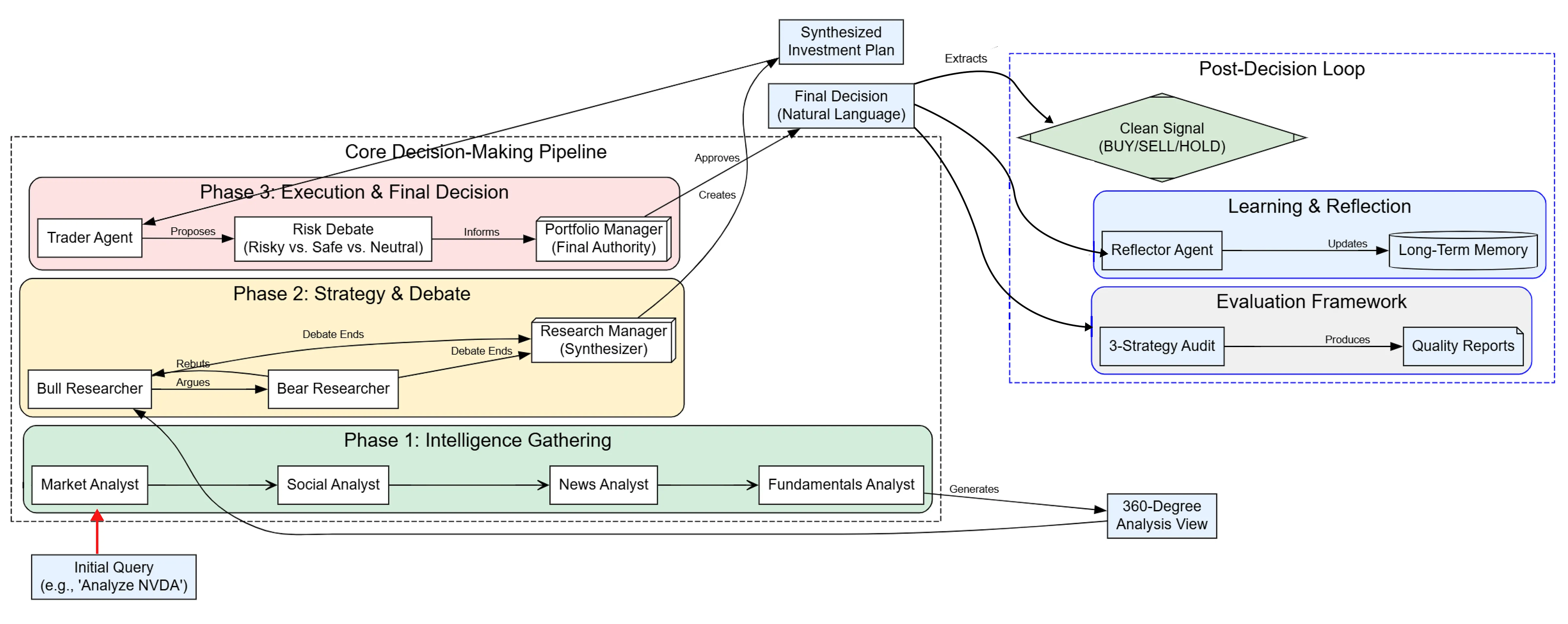
This is where multi-agent stock analysis becomes important. SimianX AI uses a multi-agent approach to help investors compare fundamentals, market structure, technical signals, sentiment, and risk in a more structured way than a single chatbot response.
GPT vs Gemini vs Claude for AI Stock Analysis: Quick Verdict
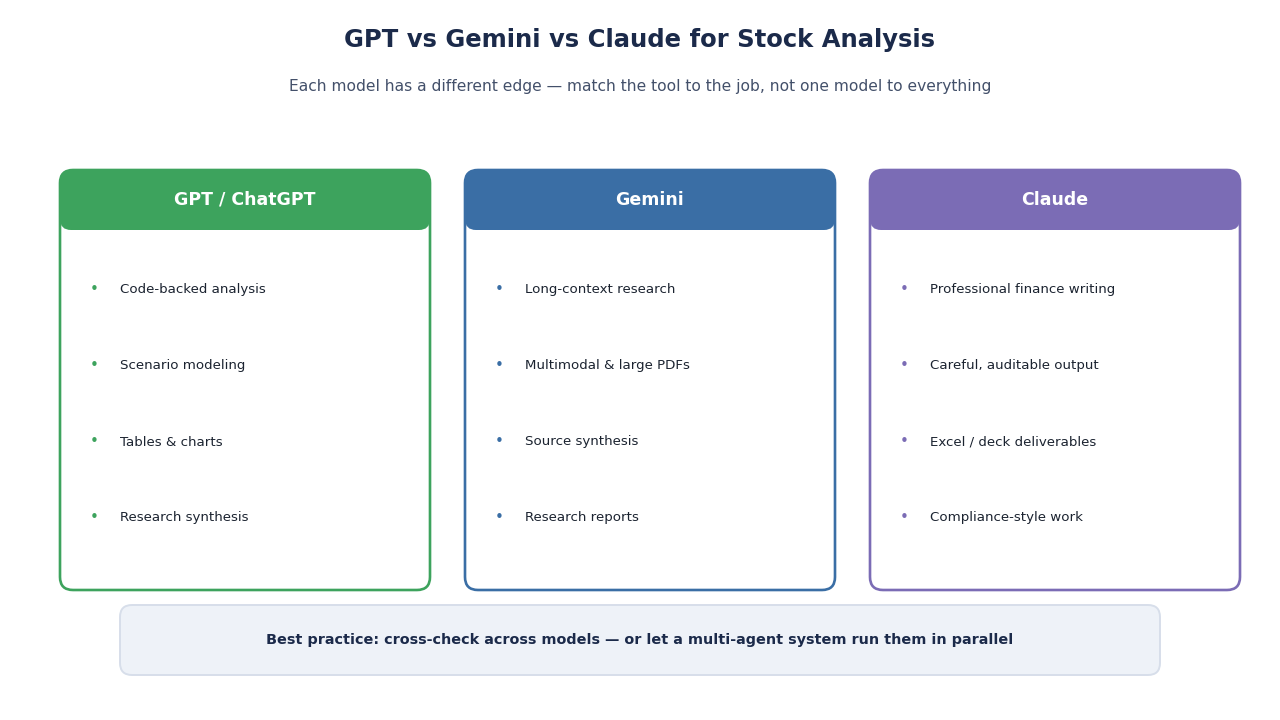
Each model family has a different “best use” in stock research. The practical answer depends on whether you need data analysis, long-context research, financial workflow integration, or multi-agent debate.
| Platform | Strongest stock-analysis use case | Watch-outs | Best paired with |
|---|---|---|---|
| GPT / ChatGPT | Code-backed analysis, scenario modeling, tables, charts, research synthesis | Needs verified sources and careful prompt design | Python-style data checks, filings, valuation templates |
| Gemini | Long-context, multimodal research, large PDFs, research reports, charts | Output quality depends on source selection and configuration | Huge document sets, market maps, analyst note synthesis |
| Claude | Professional finance workflows, careful writing, Excel/PowerPoint style deliverables | Enterprise finance features may depend on paid access/connectors | Investment memos, pitchbooks, model review, compliance workflows |
| SimianX AI | Multi-agent stock analysis with technical, fundamental, news, and debate layers | Still requires investor judgment; no AI can guarantee returns | Traders and researchers who want model diversity in one workflow |
OpenAI’s GPT models are often useful for structured financial reasoning, custom data analysis, and scenario modeling. Google Gemini is compelling for broad document-heavy research, especially when comparing filings, reports, images, and long context. Claude is strong when the output needs to look like a professional finance memo, pitchbook outline, or investment committee brief.
GPT for AI Stock Analysis: Best for Data Work and Scenario Modeling
GPT is especially useful when the research task involves turning messy financial data into structured analysis. In a stock research workflow, that can mean inspecting uploaded files, creating tables and charts, calculating growth rates, and explaining assumptions in plain English. GPT can help analyze exported price history, clean a CSV of quarterly metrics, or build a simple discounted cash flow model from user-provided assumptions.
For example, a GPT-powered stock workflow might look like this:
- Upload a spreadsheet of revenue, gross margin, operating income, free cash flow, and share count.
- Ask GPT to calculate compound growth, margin trends, and free-cash-flow conversion.
- Ask for bull, base, and bear case assumptions.
- Generate a valuation table using
EV/Sales,EV/EBITDA, orP/E. - Compare the output against actual filings and market data.
GPT’s biggest advantage is flexible reasoning with code-backed analysis. It is very good at turning raw inputs into calculations, charts, and written explanations. For investors who already have data from SEC filings, financial APIs, or a spreadsheet, GPT can become a powerful research assistant.
However, GPT is not automatically a reliable stock picker. If you ask, “Should I buy NVDA today?” without providing a time horizon, risk tolerance, portfolio context, or live data source, the answer can sound confident while still being incomplete. Use GPT for analysis construction, not blind trade execution.
When should you use GPT for stock market research?
Use GPT when you need to model, calculate, explain, and document. It works well for custom screens, scenario analysis, earnings summary templates, portfolio exposure tables, and plain-English explanations of complex ratios. It is also helpful for checking whether your own thesis has missing assumptions.
A strong GPT prompt for AI stock analysis might be:
Analyze this company's last 12 quarters of revenue, gross margin, operating margin, free cash flow, debt, and share count. Identify trend breaks, calculate bull/base/bear valuation ranges, and list the five assumptions most likely to be wrong.
That prompt works because it asks for structured analysis, calculations, and uncertainty, not just a buy/sell answer.
Gemini for AI Stock Analysis: Best for Long-Context Research and Source Synthesis
Gemini’s major advantage is long-context, multimodal research. For stock analysis, that matters because public-company research often spans annual reports, quarterly filings, transcripts, product videos, regulatory PDFs, analyst commentary, and macro documents. A model that can process large context windows can compare far more source material in one workflow.
This makes Gemini useful for questions such as:
- “Compare the last three annual reports of
AAPL,MSFT, andGOOGLfor AI capex language.” - “Summarize every risk-factor change across two years of filings.”
- “Create a market map of semiconductor supply-chain exposure.”
- “Extract and compare management tone from five earnings-call transcripts.”
- “Build a chart-friendly research brief from multiple PDFs.”
Gemini is strongest when the task is broad, document-heavy, and multimodal. It can help investors find patterns across large research corpora that would be tedious to inspect manually.
The watch-out is that large-context capability does not automatically mean better investment judgment. If the sources are stale, biased, promotional, or incomplete, the output may still be flawed. In stock research, source selection is part of the analysis. Gemini is powerful when you feed it high-quality filings, transcripts, market data, and research sources.
Claude for AI Stock Analysis: Best for Professional Finance Workflows
Claude’s advantage is workflow discipline. Claude is often useful when financial research must become a polished written deliverable, such as an investment memo, earnings summary, portfolio update, or due-diligence note. Its writing style can be careful, balanced, and easy to adapt for professional readers.
That makes Claude valuable for:
- Drafting investment memos with balanced reasoning
- Reviewing valuation methodology
- Building or checking financial models
- Preparing pitchbook-style outputs
- Summarizing earnings transcripts
- Creating board-level or client-ready commentary
- Stress-testing a thesis before an investment committee meeting
Claude’s limitation is practical access. The most finance-specific workflows may depend on available connectors, paid features, or manual uploads. For an individual investor, Claude can still be excellent for reasoning and writing, but the data pipeline may require external tools.
What Is the Best Way to Compare GPT vs Gemini vs Claude for AI Stock Analysis?
The best way to compare these models is not by asking each one for a stock pick. A better test is to give each model the same research task and grade the output on evidence, calculations, risk awareness, and usefulness.
Use this evaluation framework:
| Evaluation factor | What to check | Why it matters |
|---|---|---|
| Data freshness | Does it use current filings, news, and prices? | Old data can break a trading thesis |
| Source quality | Are citations from filings, company releases, credible financial data, or reputable news? | Weak sources create weak conclusions |
| Numerical accuracy | Are ratios, growth rates, and valuation tables correct? | Small calculation errors can change the thesis |
| Risk analysis | Does it explain downside, uncertainty, and invalidation points? | Good research is not only bullish evidence |
| Transparency | Can you trace why the model reached its conclusion? | Auditability helps prevent blind trust |
| Actionability | Does it provide next steps, not just a summary? | Investors need decisions, watchlists, and triggers |
A simple comparison test:
- Choose one ticker, such as
TSLA,NVDA, orAAPL. - Collect the same source packet: latest 10-K/10-Q, recent earnings transcript, one year of price data, recent news, and key valuation metrics.
- Ask GPT, Gemini, and Claude to produce the same output: thesis, key drivers, risks, valuation range, and what would change the conclusion.
- Check every number against the source packet.
- Compare which output is most useful for your actual investing process.
The model that sounds most confident is not always the model that is most correct. For stock analysis, the winner is the system that is easiest to verify.
What 4,992 Live AI Trades Reveal About How Each Lab Trains
Everything above is the qualitative case. The harder question is whether these differences actually show up in outcomes — so we went to our own logs.
SimianX runs a live command room in which AI models take real, monitored positions with defined entries, stop-losses, and targets. Between 22 January and 28 August 2026, that system closed 4,992 positions, producing 20,016 model-position records across 35 models from 6 providers.
Read this section correctly: we are measuring house style, not trading skill
Two caveats decide how you should use these numbers, and both matter more than the numbers themselves.
First, no lab currently ships a model trained specifically to trade. GPT, Gemini, Claude, Grok, DeepSeek, and Qwen are all general-purpose systems being asked to do a job none of them was optimized for. A table of win rates is therefore not a leaderboard of trading ability. What it actually exposes is each lab's house temperament — the way an organization's training and alignment choices make its models behave when forced to act under uncertainty with real consequences. How fast does it admit it is wrong? How much does it hedge? Will it commit to a number? That disposition is a fingerprint of the lab rather than of the model version, which is why it tends to persist across releases — and why it is a more reliable guide to how that lab's next model will behave than any benchmark score.
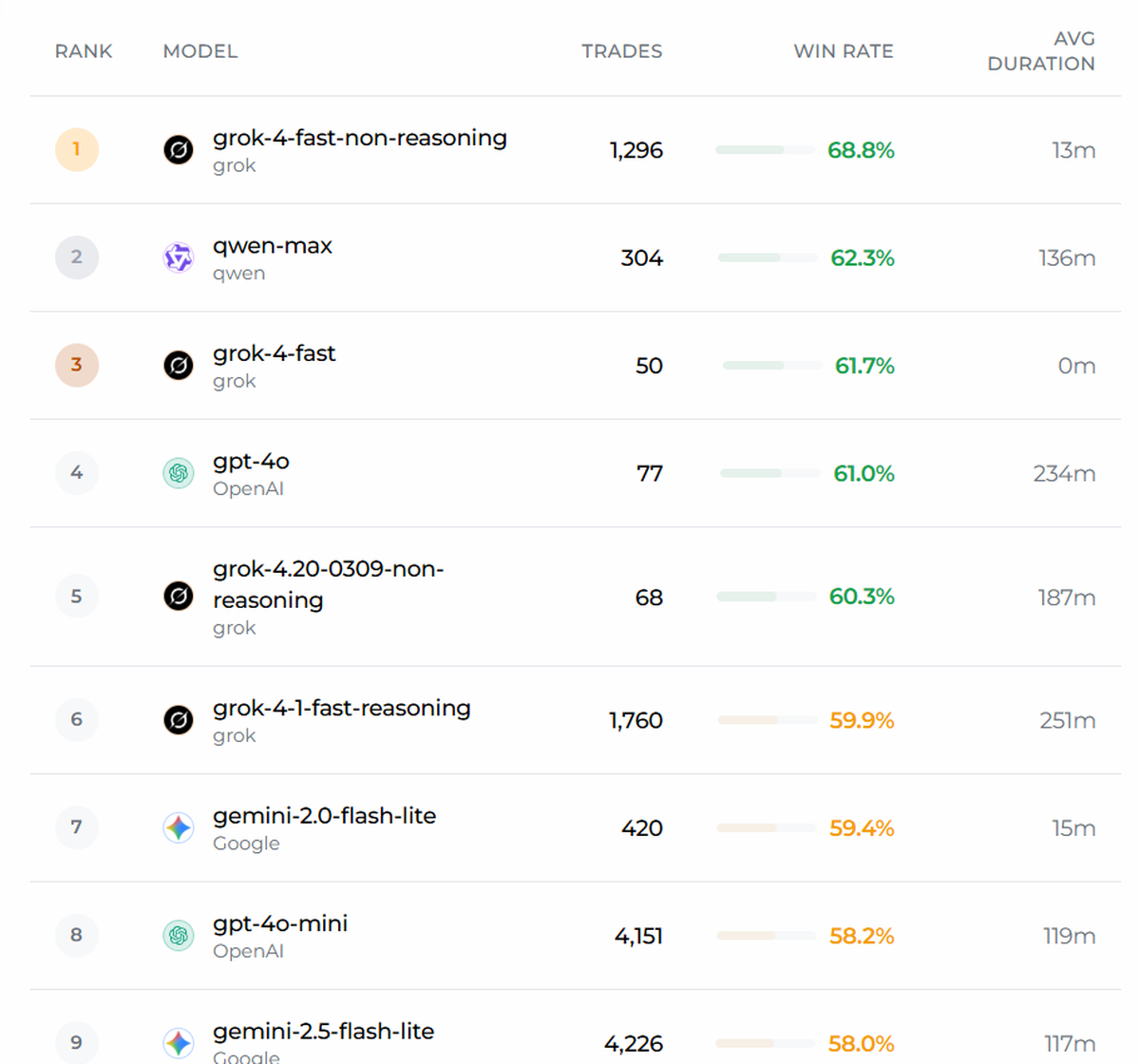
Second, these are crypto positions, not equities. We publish them in a stock-research guide because the property being measured — reasoning posture under uncertainty — belongs to the model, not the asset. Crypto trades 24/7, which produces a usable sample in months instead of years. Treat the direction of these findings as transferable to equity research, and the absolute percentages as crypto-specific. The full ranking is public on the SimianX Crypto Leaderboard, and we break the methodology down further in Which AI Model Is the Best Trader?.
Method notes: "decisive" excludes positions closed flat. A single position can involve several models in different agent roles, so it may count toward more than one provider — the same convention used by our public leaderboard. Models were not randomly assigned; users chose them, so the mix of timeframes and instruments differs by model. That confound turns out to be the most important finding in the entire dataset.
Finding 1 — On raw accuracy, the leading families are indistinguishable
| Model | Closed positions | Win rate | Avg P&L per position |
|---|---|---|---|
gpt-4o-mini | 4,340 | 59.0% | +0.075% |
gemini-2.5-flash-lite | 4,458 | 58.8% | +0.080% |
grok-4-1-fast-non-reasoning | 2,647 | 57.1% | +0.085% |
At provider level the picture is identical: OpenAI 58.7%, xAI 58.6%, Google 58.3% — each on roughly 4,500 decisive positions. A 0.4-point spread on samples that large is noise, not an edge.
If you came looking for "which model wins," that is the answer, and it is deflating: at the level of realized outcomes, swapping GPT for Gemini changes almost nothing.
Finding 2 — The setup matters about 25x more than the model
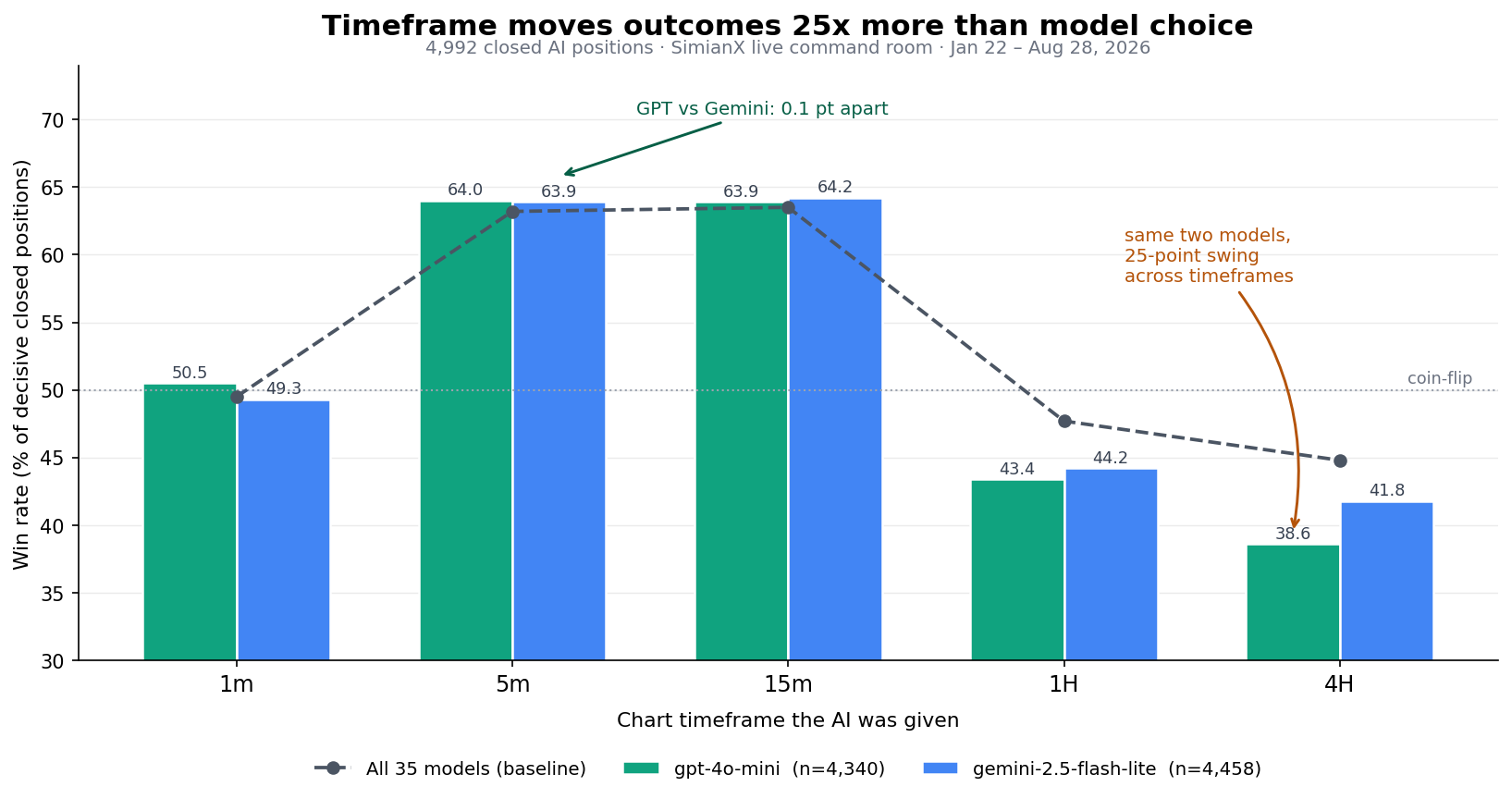
The same two models, sorted by the chart timeframe they were given:
| Timeframe | gpt-4o-mini | gemini-2.5-flash-lite | All 35 models |
|---|---|---|---|
| 1m | 50.5% | 49.3% | 49.5% |
| 5m | 64.0% | 63.9% | 63.2% |
| 15m | 63.9% | 64.2% | 63.5% |
| 1H | 43.4% | 44.2% | 47.7% |
| 4H | 38.6% | 41.8% | 44.8% |
The two models track each other to within roughly a point in every single cell. The same model swings 25 points between its best timeframe and its worst.
This is the most useful thing in the dataset, and it transfers directly to equity research: before you blame the model, check the setup. A weak answer is far more often a badly framed question — wrong horizon, wrong evidence packet, wrong context — than a weak model.
Finding 3 — Headline numbers lie until you control for the setup
Claude is the worked example. claude-haiku-4-5 posts a 52.4% headline win rate, which reads as a clear loss to GPT and Gemini. But 66% of its positions ran on the 1-minute chart — the worst timeframe in the dataset for every model tested. Compare like with like, and Claude scores 52.8% on 1m against a 49.5% all-model baseline: above the field on the setup it was actually given.
Nothing in the raw table was false. It was simply an unmatched comparison. Any "we tested the models" article that does not control for the task is reporting mix, not ability.
Finding 4 — Same accuracy, completely different temperament
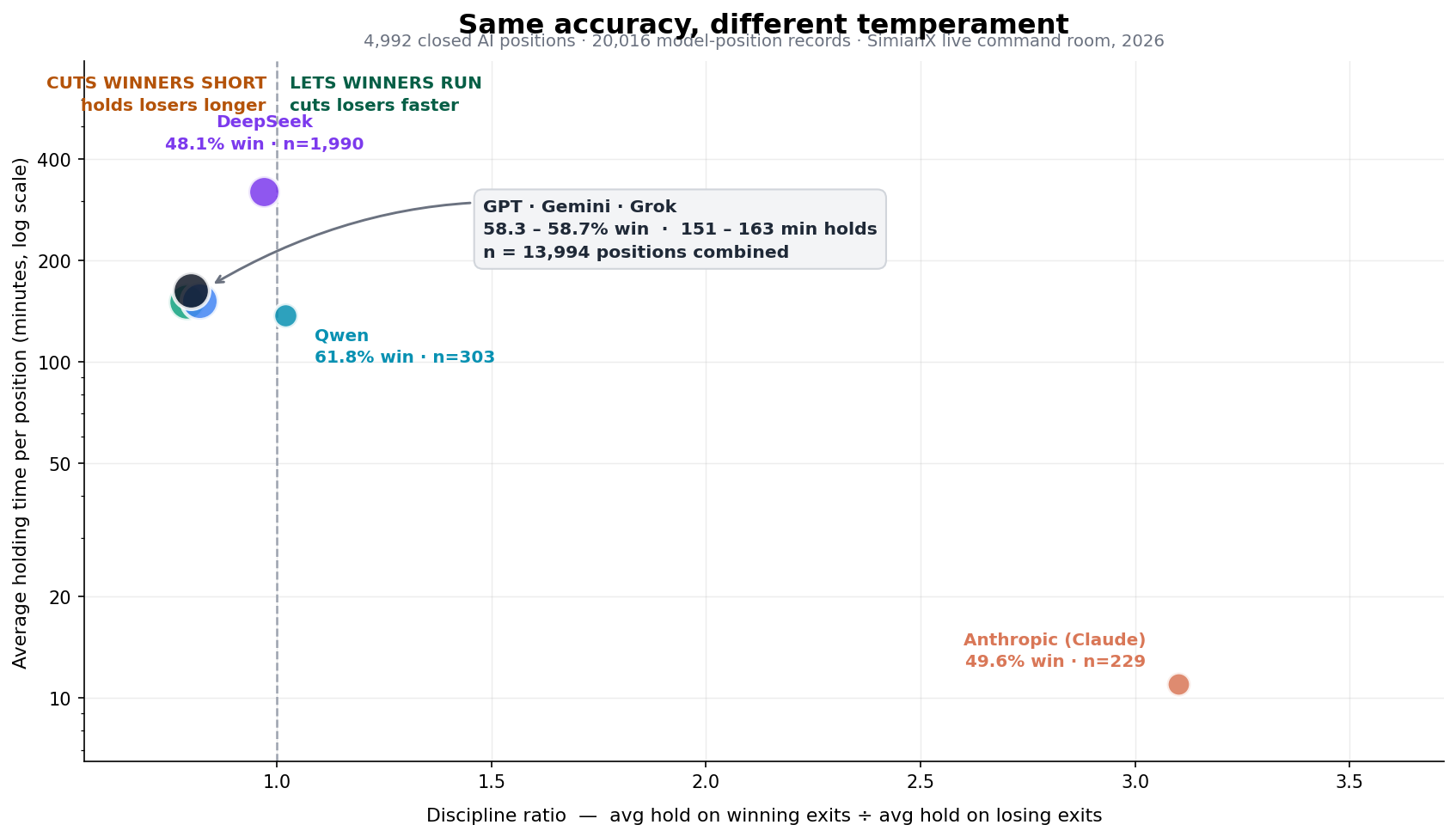
Where the families genuinely separate is behavior.
| Family | Avg hold | Stopped out | Avg confidence | Flags "high risk" | Discipline ratio* |
|---|---|---|---|---|---|
| OpenAI (GPT) | 151 min | 22.7% | 0.604 | 3% | 0.79 |
| Google (Gemini) | 152 min | 23.5% | 0.682 | 9% | 0.82 |
| xAI (Grok) | 163 min | 22.5% | 0.678 | <1% | 0.80 |
| Anthropic (Claude) | 11 min | 32.3% | 0.677 | 0% | 3.10 |
| DeepSeek | 320 min | 21.5% | 0.645 | 1% | 0.97 |
| Qwen | 137 min | 38.3% | 0.684 | 2% | 1.02 |
*Discipline ratio = average holding time on winning exits ÷ average holding time on losing exits. Below 1.0 means the model sat on its losers longer than its winners.
Three things stand out.
GPT, Gemini, and Grok all inherit the retail investor's worst habit. Each holds losing positions longer than winning ones — 68 minutes versus 54 for OpenAI, 64 versus 52 for Google. That is the disposition effect, the same reluctance to realize a loss that costs human traders money, reproduced by models trained largely on human writing.
Anthropic is the outlier, in the right direction. Claude cuts a losing position in an average of 7 minutes and holds a winner for 21 — a discipline ratio of 3.10, which is textbook risk management. It is also the family most willing to be wrong quickly, which shows up as an elevated stop-out rate. Its lower headline win rate is not carelessness; it is the arithmetic of taking many small, fast losses on the hardest setups.
OpenAI is the best calibrated. GPT reports an average confidence of 0.604 against roughly 0.68 for everyone else — the family least likely to tell you it is certain. For research work, that is a feature, not a weakness.
Gemini is the most willing to raise its hand: it flags a setup as "high risk" in 9% of decisions — three times more often than OpenAI, and infinitely more often than Claude, which never used the label once in this sample.
One more system-wide result worth noting: across all six families, take-profit targets filled on only 1.5-2.8% of positions. Every lab's models overwhelmingly manage exits by live judgment rather than letting a pre-set target do the work. Whether that is discipline or interference is exactly the kind of question a multi-agent review is designed to surface, and we examine the crash-behavior version of it in Do AI Models Panic-Sell in a Crash?.
Sample-size warning: Anthropic (229 positions) and Qwen (303) are far smaller than the big three (4,500+ each). Read those two rows as indicative rather than settled.
Finding 5 — Reasoning modes did not help on short horizons
Holding the lab constant and varying only the reasoning mode:
| Model | Positions | Win rate | Avg hold |
|---|---|---|---|
grok-4-fast-non-reasoning | 1,356 | 68.4% | 13 min |
grok-4-1-fast-reasoning | 1,733 | 61.5% | 240 min |
deepseek-chat | 1,486 | 49.1% | 205 min |
deepseek-reasoner | 389 | 44.4% | 766 min |
In both labs, the extended-reasoning variant did worse on short-horizon calls than its faster sibling. Longer deliberation produced longer holds and more time for the thesis to decay — not better entries. For slow, document-heavy equity research the trade-off very likely runs the other way, but do not assume a reasoning model is automatically the better instrument for a time-sensitive decision.
Finding 6 — Each lab has a recognizable writing signature
Across 1,581 decision records where the deciding model is attributable, the prose itself gives each lab away.
GPT hedges. About half its rationales lean on soft framing, and it rarely commits to a price:
"The analysis suggests a long position due to potential short-term bullish reversals, supported by RSI and news sentiment, despite the overall bearish trend. The trade setup offers a reasonable risk-to-reward ratio."
Gemini commits to numbers. It names a specific level in 12% of rationales, roughly double most rivals:
"Short the market based on the 15-minute chart showing a downtrend and bearish technical indicators. The target profit is at 89,120.00."
Claude is the most technically specific and the least hedged — only 32% of its rationales use hedging language, against 51-63% for every other family:
"The analysis suggests a short position due to a breakdown point with structural bearish evidence such as lower highs, failed EMA50 reclaims, and declining volume. Confirmation is needed before entry."
Grok time-boxes its forecasts. It attaches an explicit window to 11% of calls, against 2-6% elsewhere:
"Short position recommended due to bearish signals, resistance at 9.0, and potential for price to fall to 8.93 within the next 45-95 minutes."
Notice what these are: stylistic dispositions, not capabilities. They reflect what each lab's post-training rewarded — caution at OpenAI, decisiveness and explicit risk-flagging at Google, structural precision and fast loss-admission at Anthropic, committal and time-bounded framing at xAI. Those preferences are stable properties of the house. Because none of them were tuned for markets, they are the closest thing available to a forecast of how each lab's next model will behave when you point it at a stock.
The 6-Axis Scorecard: turn the framework into a number
Score any model's research output on the six factors from the evaluation table above, 1-5 each, then weight them by how much damage a failure on that axis actually does:
| Axis | Weight | Scores 1 | Scores 5 |
|---|---|---|---|
| Data freshness | 25% | Undated claims | Every figure dated and sourced |
| Numerical accuracy | 25% | Figures do not reconcile to the filing | Every number ties out |
| Source quality | 15% | Unattributed or blog-level | Primary filings and company releases |
| Risk analysis | 15% | Bull case only | Explicit invalidation levels |
| Transparency | 10% | Conclusion with no visible chain | Every step traceable |
| Actionability | 10% | Summary only | Triggers, levels, monitoring cadence |
Take the weighted total out of 5. Anything below 3.5 goes back for another pass. Anything above 4.5 that still has no named invalidation point is usually overconfident rather than excellent. Run the same ticker through two families and score both — based on the data above, expect the scores to land close together and the style of failure to differ.
What this actually means for your stock research
- Stop shopping for the best model; start fixing the setup. A 25-point timeframe effect against a 0.4-point model effect is the entire argument for investing in workflow rather than model selection.
- Match the lab to the job by temperament, not by benchmark. Want a second opinion that will tell you when it is unsure? Use the best-calibrated family. Want a memo that commits to levels? Use the one that names numbers. Want a risk reviewer that will concede the thesis broke? Use the one that cuts losers in seven minutes.
- Expect the house style to persist. Because no lab trains for this task specifically, what you are observing is general disposition — and it will carry into their next release.
- Run more than one, and make them disagree in the open. The families fail differently, which is precisely why a debate between them surfaces more than any single answer does.
Why SimianX AI Takes a Multi-Agent Approach
A single model can summarize, calculate, and write. But stock analysis often benefits from specialist disagreement. A technical signal may look bullish while valuation looks stretched. News sentiment may improve while insider selling raises questions. A model that blends everything into one answer too quickly can hide those conflicts.
SimianX AI focuses on multi-agent market analysis rather than a single chatbot answer. Its value is workflow design: specialized agents can examine fundamentals, technicals, sentiment, news, and risk, then compare their findings before a final report is produced.
This matters because the best AI stock analysis workflow should separate roles:
- Fundamental agent: revenue growth, margins, free cash flow, leverage, valuation
- Technical agent:
RSI,MACD, moving averages, volatility, support/resistance - News agent: catalysts, analyst updates, SEC filings, management changes
- Risk agent: thesis breakers, drawdown risk, position sizing concerns
- Decision agent: integrates the evidence into buy/hold/sell-style research language
That does not mean SimianX AI, GPT, Gemini, Claude, or any AI platform can guarantee returns. Stock analysis always involves uncertainty. AI should support better research, not replace risk management, position sizing, or investor judgment.
Practical AI Stock Research Workflow You Can Use Today
Here is a repeatable workflow for using GPT, Gemini, Claude, or SimianX AI without turning AI into a black-box stock picker.
Step 1: Start with the investment question
Bad prompt:
Is this stock a buy?
Better prompt:
Evaluate whether AAPL is attractive for a 6-12 month swing trade based on recent earnings, valuation, technical trend, news catalysts, and downside risk. Show assumptions and cite sources.
The second prompt defines the ticker, time horizon, research dimensions, and required evidence.
Step 2: Separate facts from interpretation
Ask the AI to produce two sections:
- Facts: numbers, dates, filings, management statements, price levels
- Interpretation: what those facts may imply for the thesis
This reduces hallucination risk because you can verify the factual layer before reading the opinion layer.
Step 3: Force a bear case
Every AI stock analysis should include a serious bear case. Ask:
What evidence would make this thesis wrong, and what data should I monitor weekly?
This is where models often become more useful. They help you convert vague risk into concrete monitoring points.
Step 4: Use multiple models or agents
A robust workflow might use:
- Gemini to digest a large packet of filings, transcripts, and market reports.
- GPT to calculate valuation scenarios and build tables.
- Claude to draft a polished investment memo and critique assumptions.
- SimianX AI to run a multi-agent review and compare technical, fundamental, news, and risk perspectives in one platform.
Step 5: Verify before acting
AI-generated market research should always be checked against reliable sources. Verify filings, market data, news dates, and calculations before making any investment decision.
Never treat an AI-generated stock recommendation as final. Verify sources, check numbers, understand risks, and consider consulting a licensed financial professional for advice tailored to your situation.
GPT vs Gemini vs Claude: Which One Should Investors Choose?
Choose GPT if you want a flexible analyst for data cleanup, calculations, chart explanations, valuation tables, and scenario modeling. It is especially useful when you can provide structured data and want code-backed reasoning.
Choose Gemini if you need to process very large document sets, compare many PDFs, synthesize long research packets, or generate cited research reports from broad source material.
Choose Claude if your work looks like professional finance documentation: investment memos, pitchbooks, model reviews, earnings summaries, and polished internal reports.
Choose SimianX AI if you want the comparison itself to become a workflow: multiple agents examining the same ticker from different perspectives, debating the evidence, and producing a clearer research output.
The strongest answer is not “GPT beats Gemini” or “Claude beats GPT.” The strongest answer is:
Use the right model for the right research job, then combine outputs through a transparent, multi-agent, human-reviewed process.
FAQ About GPT vs Gemini vs Claude for AI Stock Analysis
What is the best AI for stock market research in 2026?
There is no universal winner. GPT is strong for calculations and flexible data analysis, Gemini is strong for long-context research and multimodal source synthesis, and Claude is strong for professional finance workflows and polished deliverables. For many investors, the best setup is a multi-agent platform like SimianX AI that combines different analytical roles.
Is GPT more accurate than Gemini for stock analysis?
Not measurably. Across 4,992 live AI-managed positions, gpt-4o-mini closed at a 59.0% win rate and gemini-2.5-flash-lite at 58.8% — a 0.2-point gap on roughly 4,300 positions each, which is statistical noise. Controlling for the chart timeframe, the two tracked within about a point of one another in every bucket. What differs is temperament rather than accuracy: the timeframe you hand a model moved outcomes roughly 25 times more than the choice of model did.
How do I use AI for stock research without hallucinations?
Use high-quality source packets, require citations, separate facts from interpretation, and verify all numbers against filings or trusted financial data. Ask the model to show assumptions, uncertainty, and the bear case. Avoid prompts that ask for unsupported “guaranteed” predictions.
Can GPT, Gemini, or Claude predict stock prices accurately?
They can help analyze factors that influence price, but no AI model can reliably predict stock prices with certainty. Markets react to earnings, liquidity, macro shocks, regulation, positioning, and unexpected news. AI is best used for research acceleration, not guaranteed forecasting.
Is SimianX AI better than using ChatGPT, Gemini, or Claude alone?
SimianX AI is different because it focuses on multi-agent market analysis rather than a single chatbot answer. Its advantage is workflow design: specialized agents can examine fundamentals, technicals, news, and risk, then compare the conclusion. That can be more practical for investors who want structured, auditable stock research.
Which AI model is best for analyzing SEC filings?
Gemini is attractive for very large document sets, GPT is useful for extracting metrics and building tables, and Claude is strong for turning filing analysis into professional memos. The best approach is to combine extraction, calculation, and written synthesis, then verify every figure against the original filing.
Conclusion
The GPT vs Gemini vs Claude for AI stock analysis debate is really about workflow quality. GPT is excellent for data analysis and scenario modeling. Gemini is powerful for long-context research and large source synthesis. Claude is strong for finance-style writing, document creation, and professional research outputs. But stock analysis is a multi-signal problem, which means the best answer often comes from combining models, sources, and specialist perspectives.
That is the core value of SimianX AI: it turns AI stock research into a multi-agent process where technical signals, fundamentals, news, sentiment, and risk can be reviewed together instead of hidden inside one chatbot response. Explore SimianX AI to build a more transparent, disciplined, and research-ready approach to AI-powered stock analysis.
Related Reading
- SimianX AI: 4-Stage Multi-Agent Stock Analysis Platform
- 8 AI Analysts vs 1: 37% More Accurate, 41% Less Risk
- Multi-Agent AI Pipelines for Hedge Fund Deep Research
- Which AI Model Is the Best Trader? 30 LLMs on Real P&L
- 30+ AI Models, 6 Providers Live: Crypto Trade Leaderboard
- Do AI Models Panic-Sell in a Crash? What 31 Bots Reveal
- Multi-Agent AI vs ChatGPT for NVDA Signals: 2026 Comparison