 By Muke
SimianX AI vs TradingView: Which Is Better for Real-Time Trading Signals?
In today’s fast-moving markets, choosing the right platform for real-time trading signals can determine whether you capture opportunities or miss them entirely. The debate around SimianX AI vs TradingView: which is better for real-time trading signals is increasingly relevant as traders shift from manual charting to AI-assisted decision-making.
While TradingView has long been the industry standard for charting, SimianX AI introduces a fundamentally different paradigm—a multi-agent AI system that actively analyzes markets in real time and produces actionable insights.
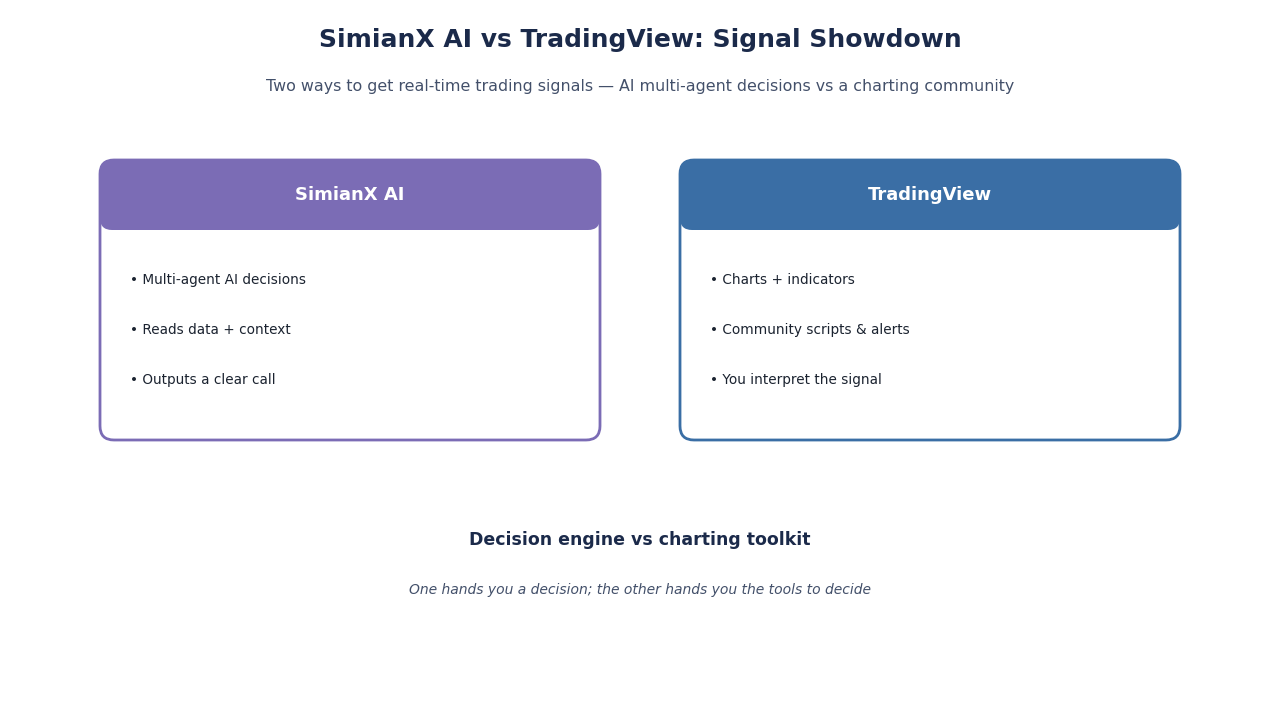
Understanding the Core Difference: AI vs Charting
At a high level, the comparison comes down to how signals are generated:
| Platform | Core Approach | Signal Generation |
|---|---|---|
| TradingView | Chart-first | User-defined indicators & alerts |
| SimianX AI | AI-first | Multi-agent real-time analysis |
TradingView shows you the data. SimianX AI interprets it for you in real time.
Key distinction:
- TradingView = tool for analysis
- SimianX AI = team of analysts doing analysis for you
How TradingView Generates Real-Time Signals
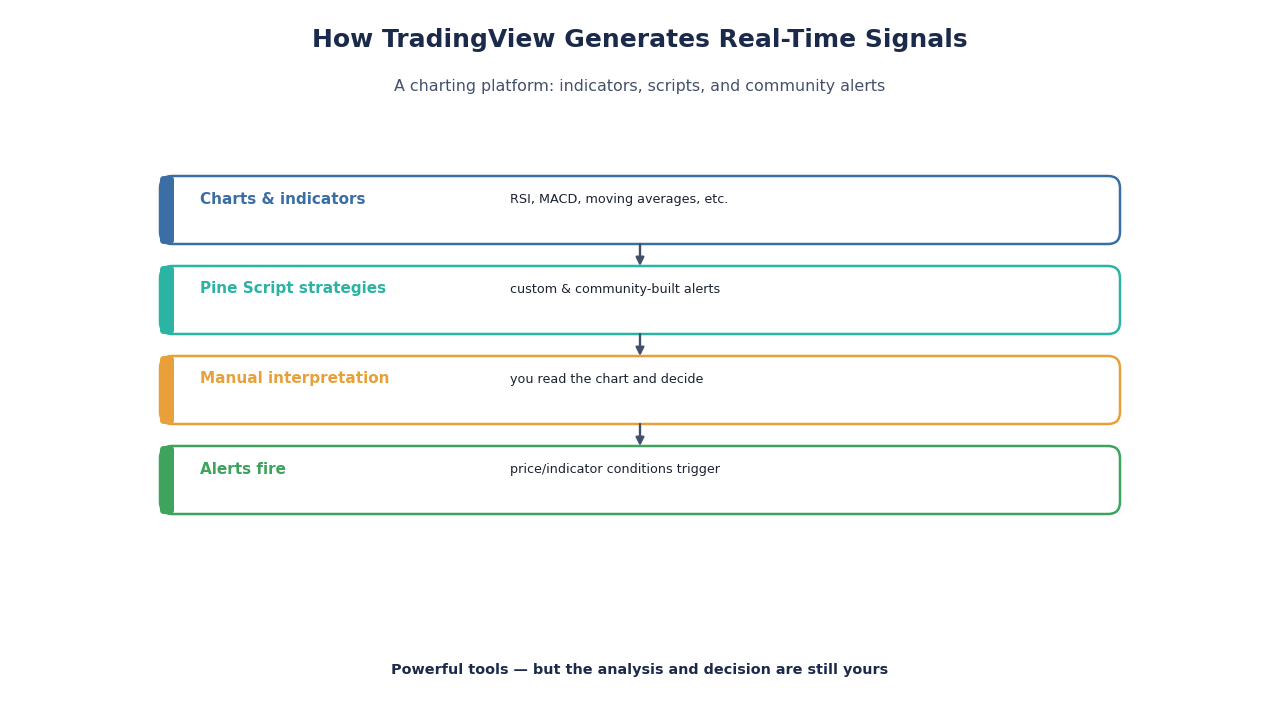
TradingView relies on technical indicators, scripts, and alerts.
Key Strengths
- Advanced charting (100+ indicators)
- Pine Script customization
- Price and indicator alerts
- Community-generated strategies
Typical workflow:
- Select a chart (e.g., BTC/USD)
- Apply indicators (RSI, MACD, EMA)
- Set alerts (e.g., RSI < 30)
- Wait for signal triggers
Limitations for Real-Time Signals
- Requires manual setup and interpretation
- Signals are often single-factor (indicator-based)
- No built-in multi-source reasoning (news + fundamentals + sentiment)
How SimianX AI Delivers Real-Time Trading Signals
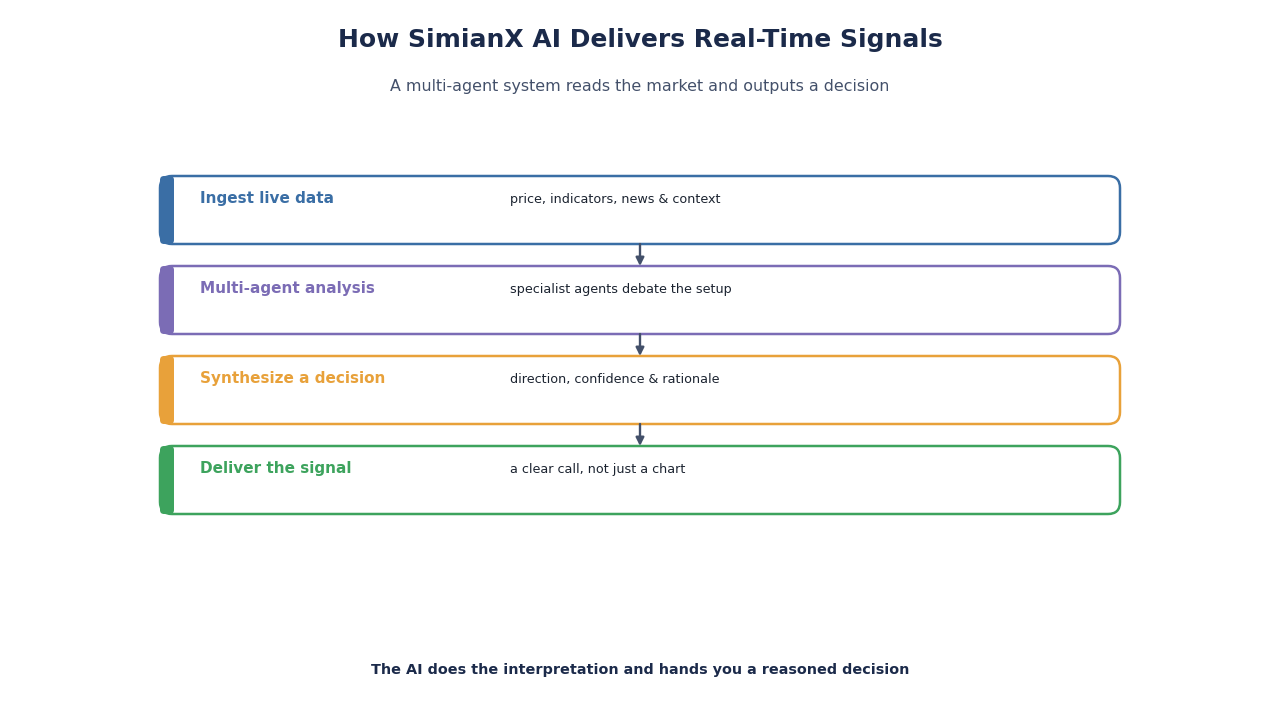
Unlike TradingView, SimianX AI is built around a multi-agent system that continuously monitors the market.
The 4-Agent Real-Time System
According to the platform architecture:
- Fundamental Agent → analyzes macro + project/company context
- Indicator Agent → processes technical signals
- Intelligence Agent → evaluates news & sentiment
- Decision Agent → produces final trading signal
This creates a multi-layered signal system, not just a single indicator trigger.
What Makes SimianX Signals Different?
1. Multi-factor analysis (not single indicator)
Signals combine:
- Technical indicators
- Real-time news
- Sentiment scoring
- Market structure
2. Structured trade outputs
Instead of vague signals, you get:
- Action:
LONG / SHORT / HOLD - Entry price
- Stop-loss
- Take-profit
- Confidence level
- Risk level
3. Continuous real-time updates
Signals are not static—they evolve as market conditions change.
SimianX AI vs TradingView: Feature Comparison
Real-Time Signal Capabilities
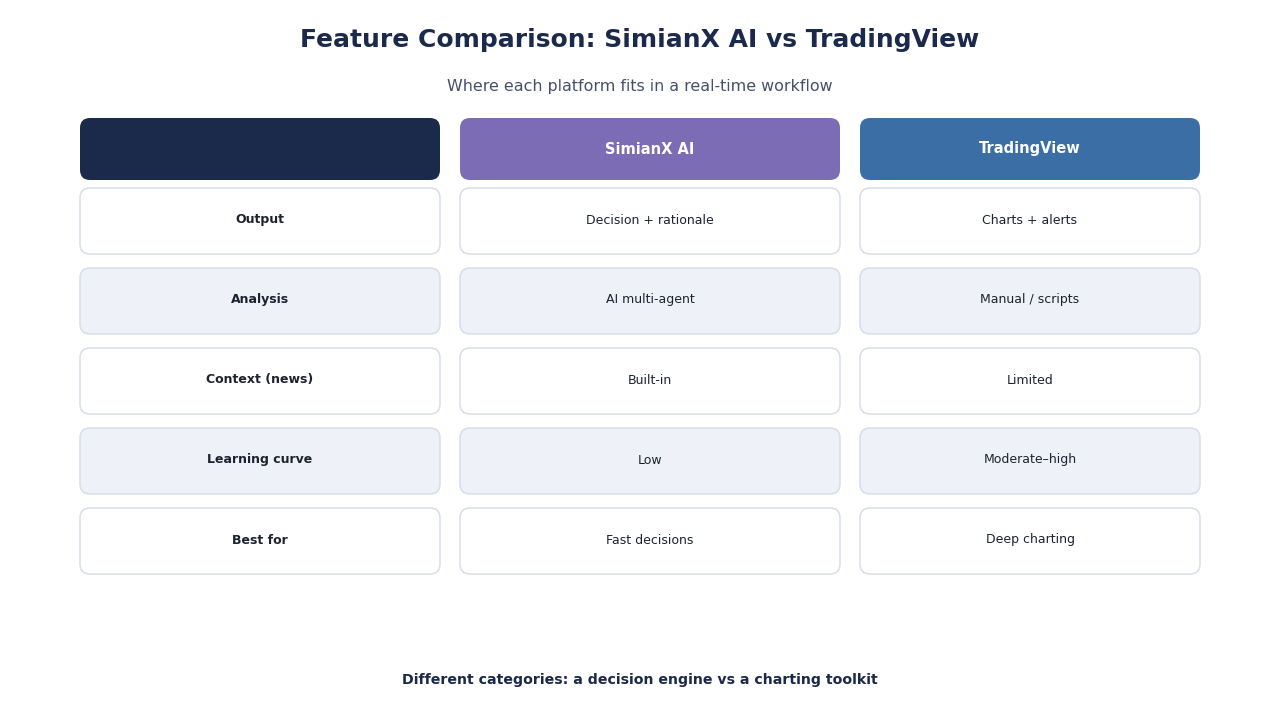
| Feature | TradingView | SimianX AI |
|---|---|---|
| Real-time signals | Indicator-based | AI multi-agent |
| Signal context | Limited | Multi-source (news + TA + fundamentals) |
| Automation | Alerts only | Full AI analysis loop |
| Signal clarity | User interpretation | Structured outputs |
| Adaptability | Manual | Dynamic AI updates |
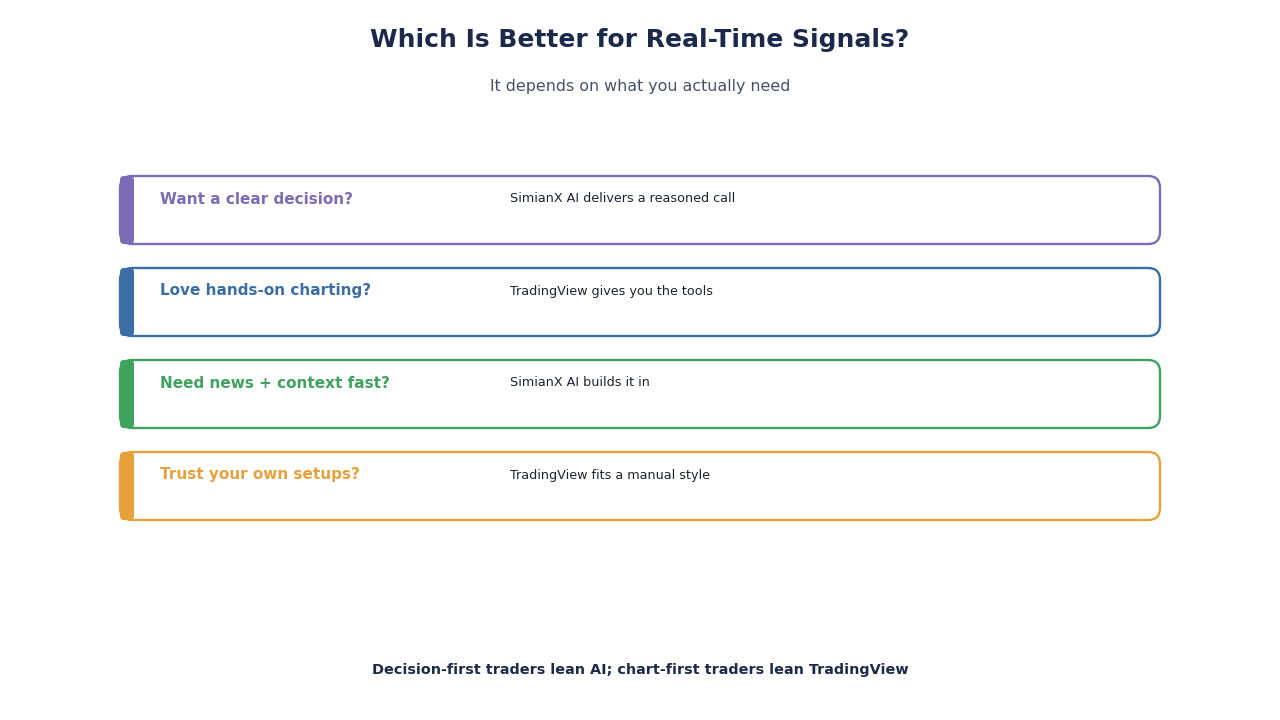
Which Is Better for Real-Time Trading Signals?
Scenario 1: Technical Traders
If you:
- Prefer drawing charts
- Build custom indicators
- Trust your own analysis
👉 TradingView is better
Scenario 2: AI-Assisted Decision Making
If you:
- Want real-time insights without manual work
- Need multi-factor signal validation
- Prefer clear trade recommendations
👉 SimianX AI is better
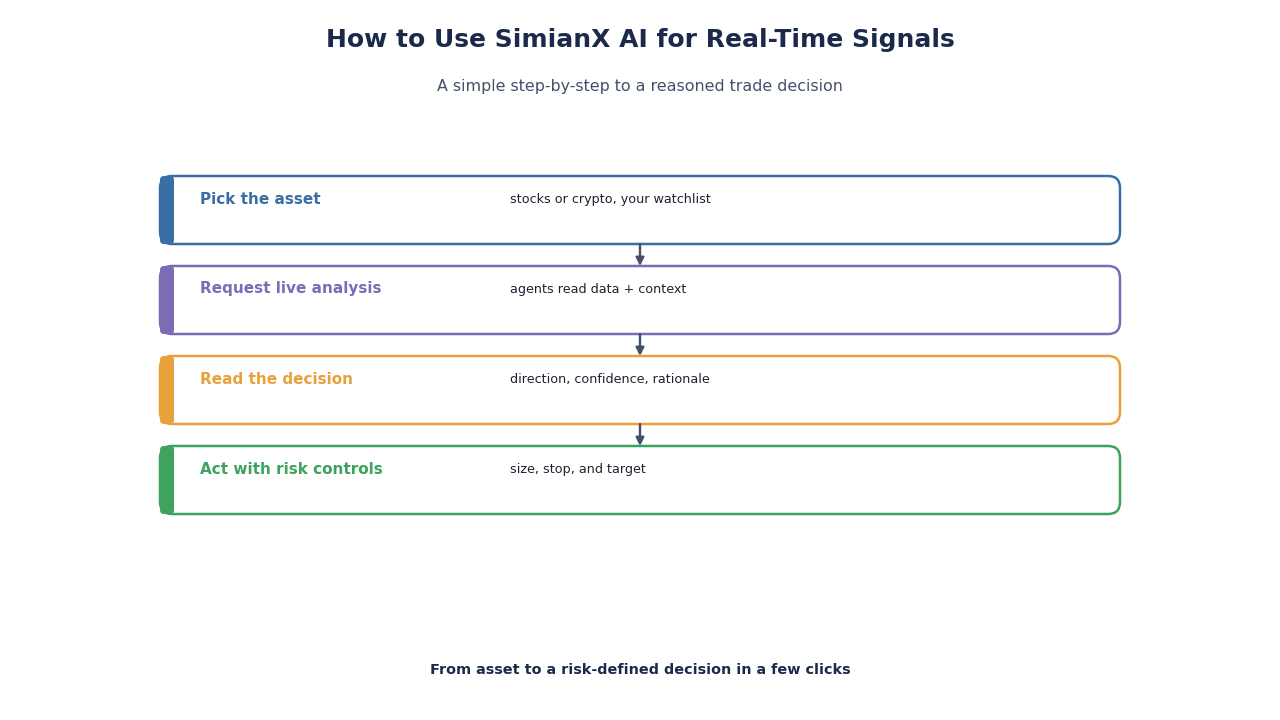
How to Use SimianX AI for Real-Time Signals (Step-by-Step)
Step 1: Choose a Market
Select crypto pair or stock (e.g., BTC-USDT or AAPL)
Step 2: Select Timeframe
- 1m → scalping
- 15m → intraday
- 1D → swing trading
Step 3: Monitor AI Agents
Watch how:
- Indicators update
- News flows in
- AI agents debate
Step 4: Execute Based on Decision Output
Use:
- Entry point
- Stop-loss
- Confidence level
This replaces hours of manual chart analysis with continuous AI monitoring.
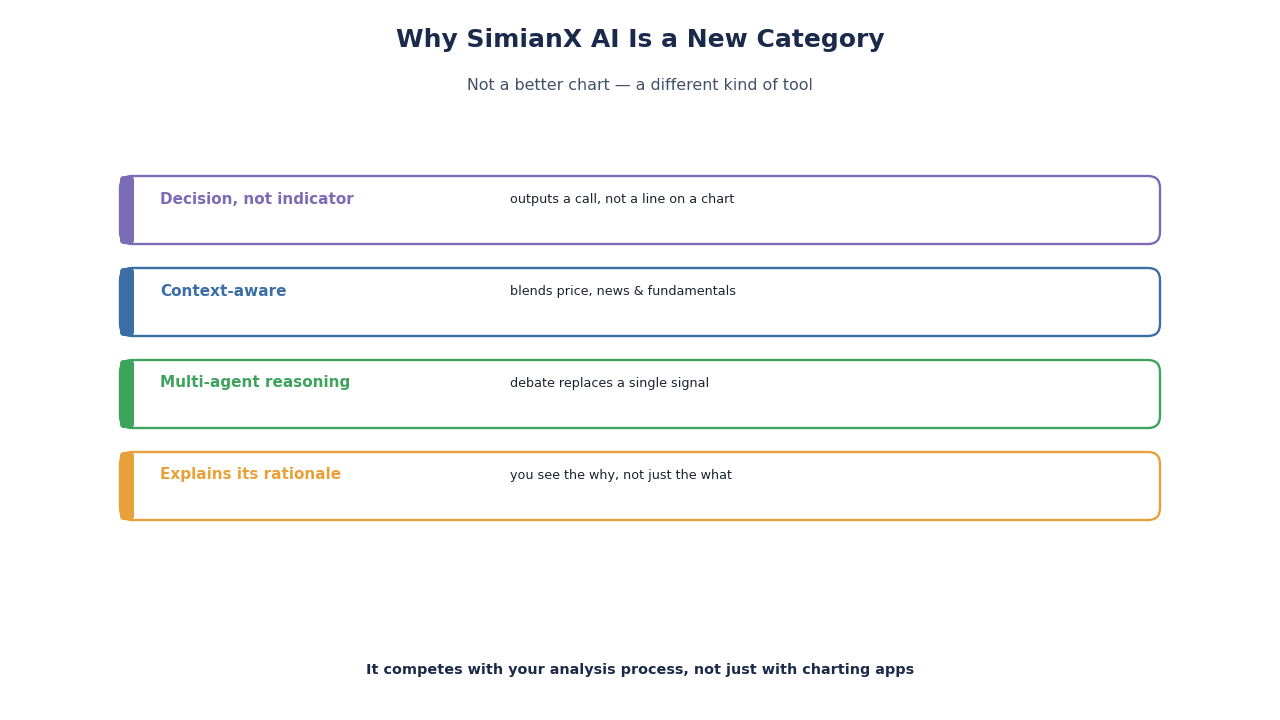
Why SimianX AI Is a New Category
SimianX isn’t just a better version of TradingView—it represents a shift in trading workflow.
Traditional Workflow (TradingView)
- Data → Indicator → Human decision
AI Workflow (SimianX)
- Data → Multi-agent analysis → Decision output
Can You Use Both Together?
Yes—and many advanced traders do.
Hybrid Strategy
- Use TradingView for:
- Charting
- Strategy testing
- Visualization
- Use SimianX AI for:
- Real-time signal validation
- AI-generated trade ideas
- Risk assessment
This creates a human + AI trading edge.
FAQ About SimianX AI vs TradingView
Is SimianX AI better than TradingView for trading signals?
SimianX AI is better for automated, real-time trading signals because it combines multiple data sources and outputs structured decisions. TradingView is better for manual analysis.
Can beginners use SimianX AI?
Yes. SimianX simplifies trading by providing clear entry, stop-loss, and confidence levels, making it easier for beginners to understand decisions.
Does TradingView have AI trading signals?
TradingView has limited AI features, but it mainly relies on user-created indicators and alerts, not full AI-driven decision systems.
What is the best platform for real-time crypto trading signals?
For AI-driven signals, SimianX AI is more advanced. For charting and technical analysis, TradingView remains the industry standard.
Conclusion
When comparing SimianX AI vs TradingView for real-time trading signals, the answer depends on your trading style:
- TradingView excels in charting and manual analysis
- SimianX AI excels in automated, multi-agent real-time decision-making
If you want to analyze the market yourself, TradingView is unmatched.
But if you want a system that:
- Monitors markets 24/7
- Combines technicals, news, and fundamentals
- Produces clear, actionable trading signals
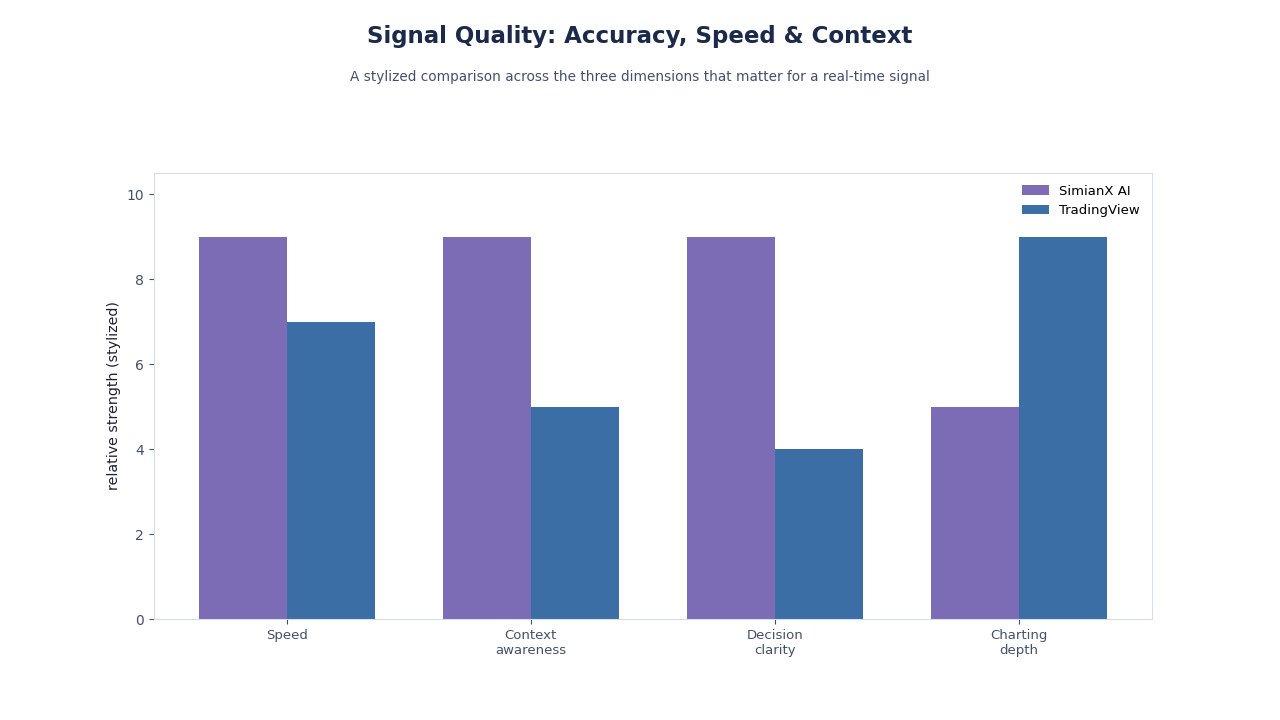
Advanced Signal Quality Analysis: Accuracy, Speed, and Context
When evaluating SimianX AI vs TradingView for real-time trading signals, it’s not enough to compare features—you need to analyze signal quality across three critical dimensions:
- Speed (how fast signals appear)
- Accuracy (how often signals align with outcomes)
- Context depth (how much information supports the signal)
1. Signal Speed: Reaction Time in Volatile Markets
In high-volatility environments (crypto, earnings season, macro events), milliseconds matter.
TradingView:
- Signals depend on:
- Indicator refresh cycles
- User-defined alert conditions
- Reaction is conditional, not proactive
SimianX AI:
- Continuously scanning:
- Market data streams
- News pipelines
- Sentiment shifts
- Agents react immediately to new inputs
Key Insight:
TradingView reacts when conditions are met.
SimianX AI reacts when context changes.
2. Signal Accuracy: Single Signal vs Multi-Agent Consensus
Accuracy is not just about being right—it’s about reducing false positives.
TradingView limitations:
- Indicators often conflict:
- RSI oversold vs trend continuation
- No built-in mechanism to resolve contradictions
SimianX AI advantage:
- Agents challenge each other
- Decision Agent produces a consensus output
| Signal Type | Risk of False Signal |
|---|---|
| Single indicator | High |
| Multi-indicator manual | Medium |
| Multi-agent AI | Lower |
Multi-agent validation significantly reduces noise and improves decision clarity.
3. Context Depth: Why a Signal Happens
A trading signal without context is dangerous.
TradingView:
- You see what happened
- You must interpret why
SimianX AI:
- Provides:
- News-driven reasoning
- Indicator alignment
- Fundamental context
This transforms signals into decision frameworks, not just triggers.
Real-World Use Cases: When Each Platform Wins
Use Case 1: Crypto Scalping (1m–5m)
Best Tool: SimianX AI
Why:
- High-frequency updates
- Real-time sentiment + flow integration
- Fast AI decision cycles
Use Case 2: Swing Trading (1D–1W)
Best Tool: Hybrid
- TradingView → trend structure
- SimianX AI → macro + sentiment confirmation
Use Case 3: News-Driven Trading
Best Tool: SimianX AI
Because:
- News is scored, filtered, and integrated
- Signals adapt instantly
Use Case 4: Strategy Development
Best Tool: TradingView
- Backtesting
- Pine Script strategies
- Historical validation
Deep Dive: The Psychology Advantage of AI Signals
One of the most underestimated aspects of real-time trading signals is psychology.
Human Weaknesses in Trading
- Fear during drawdowns
- Greed during rallies
- Overtrading
- Confirmation bias
TradingView problem:
- Leaves decision entirely to the user
SimianX AI solution:
- Provides structured, unemotional outputs
AI does not panic.
AI does not chase.
AI follows logic.
Decision Discipline Framework
SimianX AI enforces discipline through:
- Pre-defined stop-loss
- Risk categorization
- Confidence scoring
This creates a repeatable decision process.
Signal Transparency: Black Box vs Glass Box
TradingView Transparency
- Fully transparent (you build everything)
- But requires expertise
SimianX AI Transparency
- AI reasoning is visible and traceable
- Signals show:
- Inputs used
- Conflicts resolved
- Final weighting
This is a glass-box AI system, not a black box.
Performance Tracking and Learning
Another major difference in SimianX AI vs TradingView is how traders improve over time.
TradingView Learning Loop
- Analyze chart
- Execute trade
- Review manually
SimianX AI Learning Loop
- AI generates signal
- Trade executed (manual or AI-controlled)
- Full history recorded
- Review:
- Agent reasoning
- Signal evolution
- Outcome
This enables data-driven learning, not guesswork.
Risk Management: Built-In vs User-Defined
TradingView
- Risk management is:
- Manual
- Strategy-dependent
SimianX AI
- Risk is:
- Automatically assessed
- Included in every signal
| Component | Included in SimianX |
|---|---|
| Stop-loss | ✅ |
| Take-profit | ✅ |
| Risk level | ✅ |
| Confidence score | ✅ |
Multi-Timeframe Intelligence
TradingView Approach
- User manually switches timeframes
- Must synthesize data mentally
SimianX AI Approach
- Agents analyze:
- Short-term momentum
- Mid-term trend
- Long-term structure
The system delivers multi-timeframe coherence automatically.
The Future of Trading Signals: AI vs Traditional Tools
The shift from TradingView to platforms like SimianX AI reflects a broader trend:
From Tools → Systems
- Tools require input
- Systems produce outcomes
From Indicators → Intelligence
- Indicators = data transformations
- AI = decision-making frameworks
From Manual → Autonomous
- Alerts → Autopilots
- Signals → Execution systems
Competitive Landscape: Where the Industry Is Heading
The market is evolving toward:
- AI-native platforms
- Multi-agent reasoning systems
- Real-time decision engines
SimianX AI sits at the forefront of this transition.
Strategic Framework: Choosing the Right Platform
Use this decision matrix:
| Trader Type | Best Choice |
|---|---|
| Beginner | SimianX AI |
| Technical analyst | TradingView |
| Quant trader | TradingView + SimianX |
| Crypto trader | SimianX AI |
| Long-term investor | SimianX AI |
Advanced Workflow: Professional Setup
Step 1: Chart on TradingView
- Identify key levels
- Draw support/resistance
Step 2: Validate on SimianX AI
- Check AI signal alignment
- Review confidence level
Step 3: Execute with Discipline
- Follow structured plan
- Track outcomes
Key Takeaways
- TradingView is the best analysis tool
- SimianX AI is the best decision system
- The real edge comes from combining both
Final Thoughts: The Evolution of Trading Intelligence
The comparison between SimianX AI vs TradingView for real-time trading signals is not just about tools—it’s about how trading itself is evolving.
We are moving from:
- Charts → Intelligence
- Indicators → Decisions
- Manual → AI-assisted
And ultimately:
From guessing → to structured decision-making
Final Call to Action
If you’re still relying solely on charts, you’re competing against traders using AI systems.
To stay ahead:
- Keep using TradingView for visualization
- Add AI-powered signal intelligence with SimianX AI
Start exploring how real-time, multi-agent trading signals can transform your results—before the market fully shifts to AI-first trading.
Related Reading
- Real-Time AI Crypto Command Room: Coinbase, Binance, Bybit
- AI Crypto Trading with Real-Time Insights via SimianX
- 30+ AI Models Ranked Live: Crypto Trade Leaderboard
- Multi-Agent AI vs ChatGPT for NVDA Signals: 2026 Comparison
- GPT vs Gemini vs Claude for AI Stock Analysis: 2026 Guide
- Stock Analysis: AI Agents Cover US Stocks Real Time