Multi-Agent AI vs ChatGPT for Stock Analysis: NVDA Live Signals Research
Multi-Agent AI vs ChatGPT for Stock Analysis is no longer a theoretical comparison. For active investors watching NVDA, the difference shows up in the workflow: one system answers a prompt, while the other continuously combines market data, technical indicators, news, SEC fundamentals, and risk logic into a live decision framework.
This research article compares both approaches through the lens of NVDA live signals, showing where ChatGPT is useful, where it becomes limited, and why a multi-agent AI platform can provide a more structured workflow for modern stock analysis. For investors who want actionable research rather than a one-off chatbot response, SimianX AI offers a practical example of how multi-agent systems can support real-time market decision-making.
Why NVDA Is the Right Test Case for AI Stock Analysis
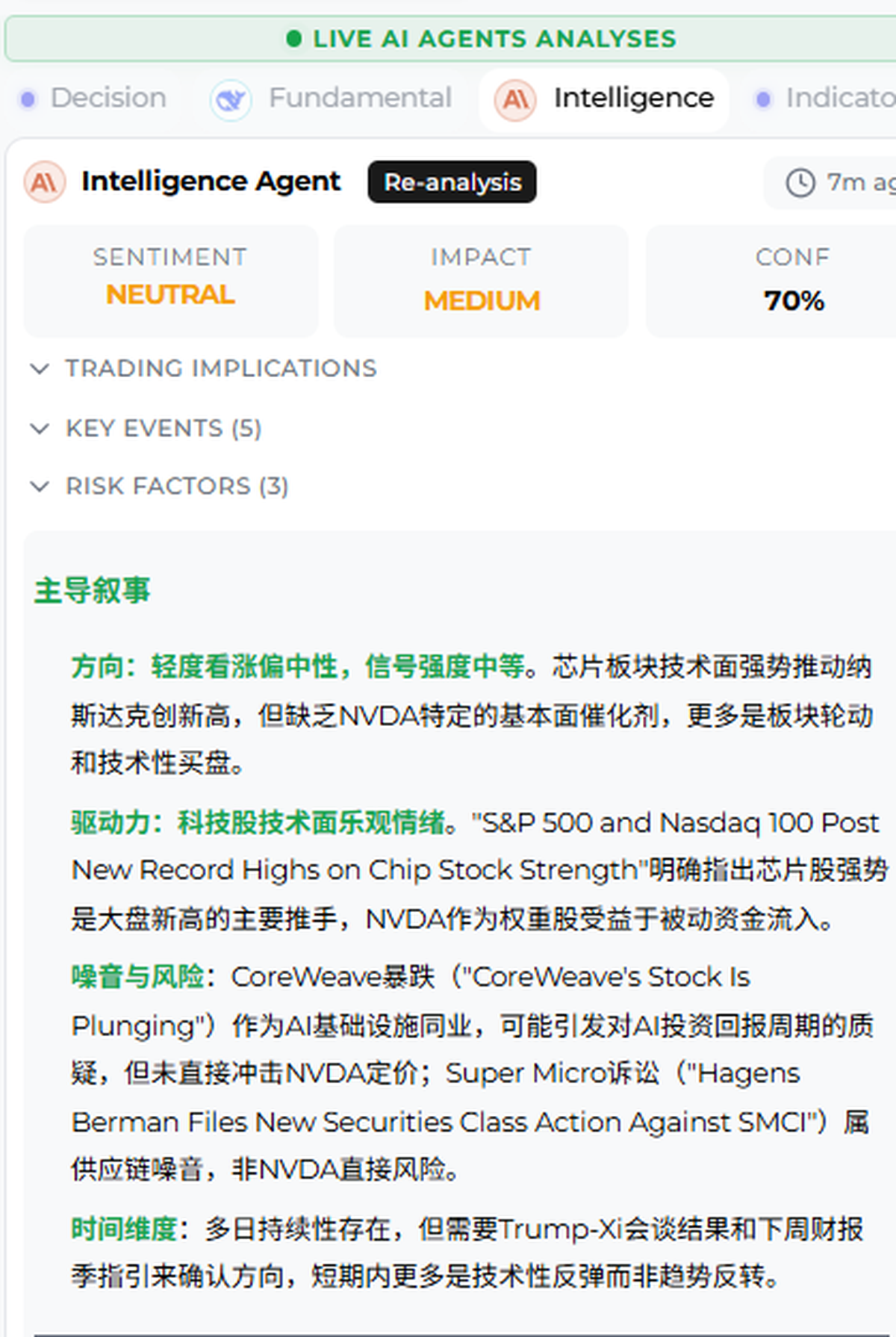
NVDA is one of the most demanding stocks for any AI analysis workflow because it combines fast price movement, AI infrastructure narratives, earnings sensitivity, valuation debate, and constant news flow. A basic AI model can summarize NVIDIA’s business, but live analysis requires something deeper: the ability to update views as price, volume, catalysts, and fundamentals change.
NVIDIA is not just another mega-cap technology stock. It sits at the center of several high-growth themes:
- Artificial intelligence infrastructure
- Data center acceleration
- GPU demand from hyperscalers
- AI model training and inference
- High-performance computing
- Enterprise AI adoption
- Edge AI and robotics
Because of this, NVDA often reacts strongly to earnings guidance, analyst commentary, chip demand trends, supply chain updates, export control headlines, and broader market sentiment around AI. That makes it an ideal case study for comparing ChatGPT stock analysis with multi-agent AI stock analysis.
Key insight: NVDA analysis is not just “is the company good?” It is “what is already priced in, what changed today, and how do multiple signals agree or disagree?”
For active traders, the key question is often short-term: Is the current price action supported by momentum, volume, and catalysts? For long-term investors, the question is different: Does NVIDIA’s growth justify its valuation over the next several years? A strong AI stock analysis workflow should help with both.
What ChatGPT Does Well for Stock Analysis
ChatGPT is valuable for research explanation, thesis structuring, scenario analysis, spreadsheet review, and plain-English interpretation. If you give ChatGPT the right context, it can help investors understand a company, summarize documents, compare strategic scenarios, and organize investment thinking.
For stock analysis, ChatGPT can help you:
- Explain NVIDIA’s business model and major revenue segments.
- Summarize an earnings release or transcript.
- Build a bull, base, and bear case.
- Create a valuation checklist.
- Analyze uploaded financial data.
- Draft an investment memo.
- Compare
NVDAwith peers such asAMD,AVGO,TSM, orMSFT. - Translate complex financial concepts into plain English.
This makes ChatGPT strong as a research assistant. It is especially helpful when the investor already has the data and wants to reason through it more clearly.
For example, a user might ask:
Explain the key drivers of NVDA's data center revenue growth and summarize the risks in plain English.
Or:
Create a bull, base, and bear case for NVDA based on earnings growth, valuation, and AI infrastructure demand.
In these cases, ChatGPT can produce a useful research framework. It can organize information, explain relationships, and help the user think more clearly. However, this is different from generating live NVDA stock signals.
Where ChatGPT Falls Short for NVDA Live Signals
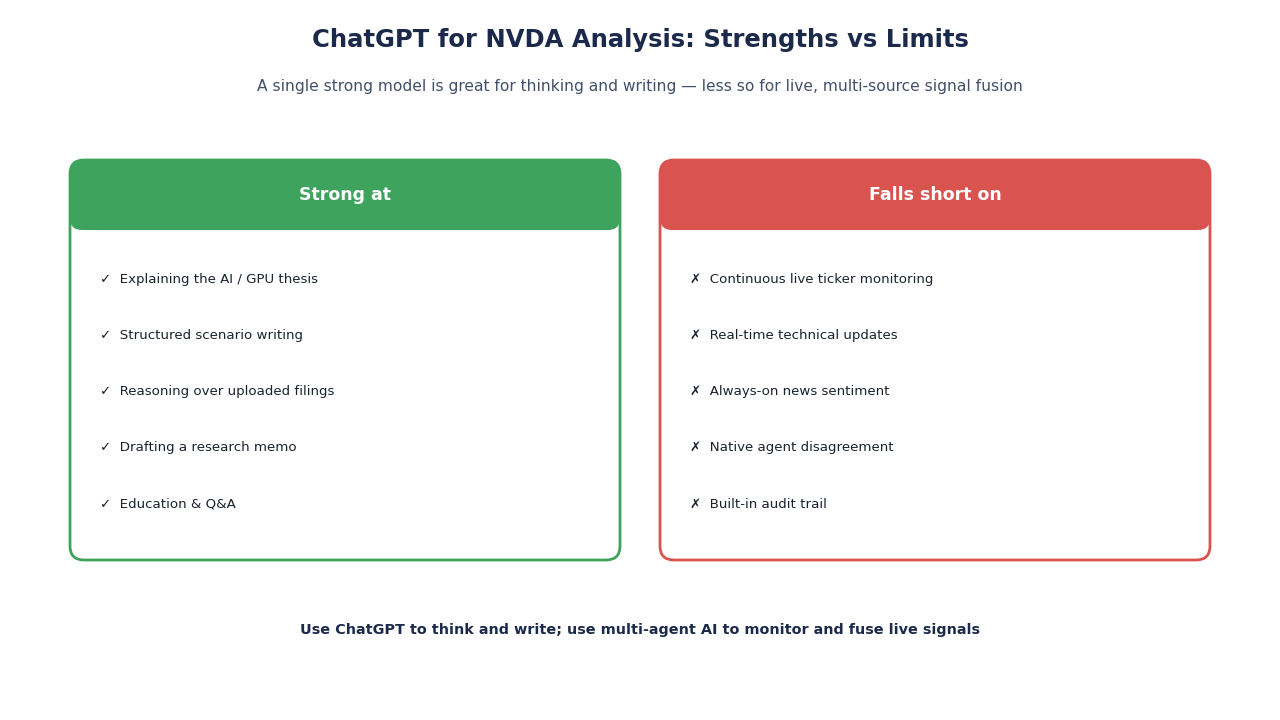
The phrase NVDA live signals implies something specific: real-time or near-real-time evaluation of price action, technical triggers, news catalysts, and updated fundamentals.
A normal ChatGPT conversation is not automatically built around continuous market-state monitoring. Unless it is connected to live data, browsing tools, APIs, uploaded files, or external feeds, it cannot independently maintain a live view of the market.
That creates several limitations:
| Requirement for NVDA Live Signals | ChatGPT Alone | Multi-Agent AI System |
|---|---|---|
| Live ticker monitoring | Limited unless connected to data | Built around streaming market inputs |
| Technical indicator updates | Requires data upload or tool access | Dedicated technical agent can track RSI, MACD, EMA, ATR, volume |
| News sentiment scoring | Possible with search, not continuous by default | News agent can score catalysts and sentiment |
| SEC and fundamental parsing | Good for uploaded documents | Fundamental agent can pull structured filings |
| Agent debate | Must be simulated in one prompt | Native multi-agent disagreement and reconciliation |
| Decision card | User must ask for structure | Generated as part of workflow |
| Audit trail | Depends on prompt discipline | Built into agent outputs and reports |
ChatGPT can simulate a multi-analyst debate if prompted carefully, but simulation is not the same as an architecture where separate agents read different data streams, produce independent conclusions, challenge each other, and generate a final signal.
This is where multi-agent AI for stock analysis becomes more useful.
What Is Multi-Agent AI for Stock Analysis?
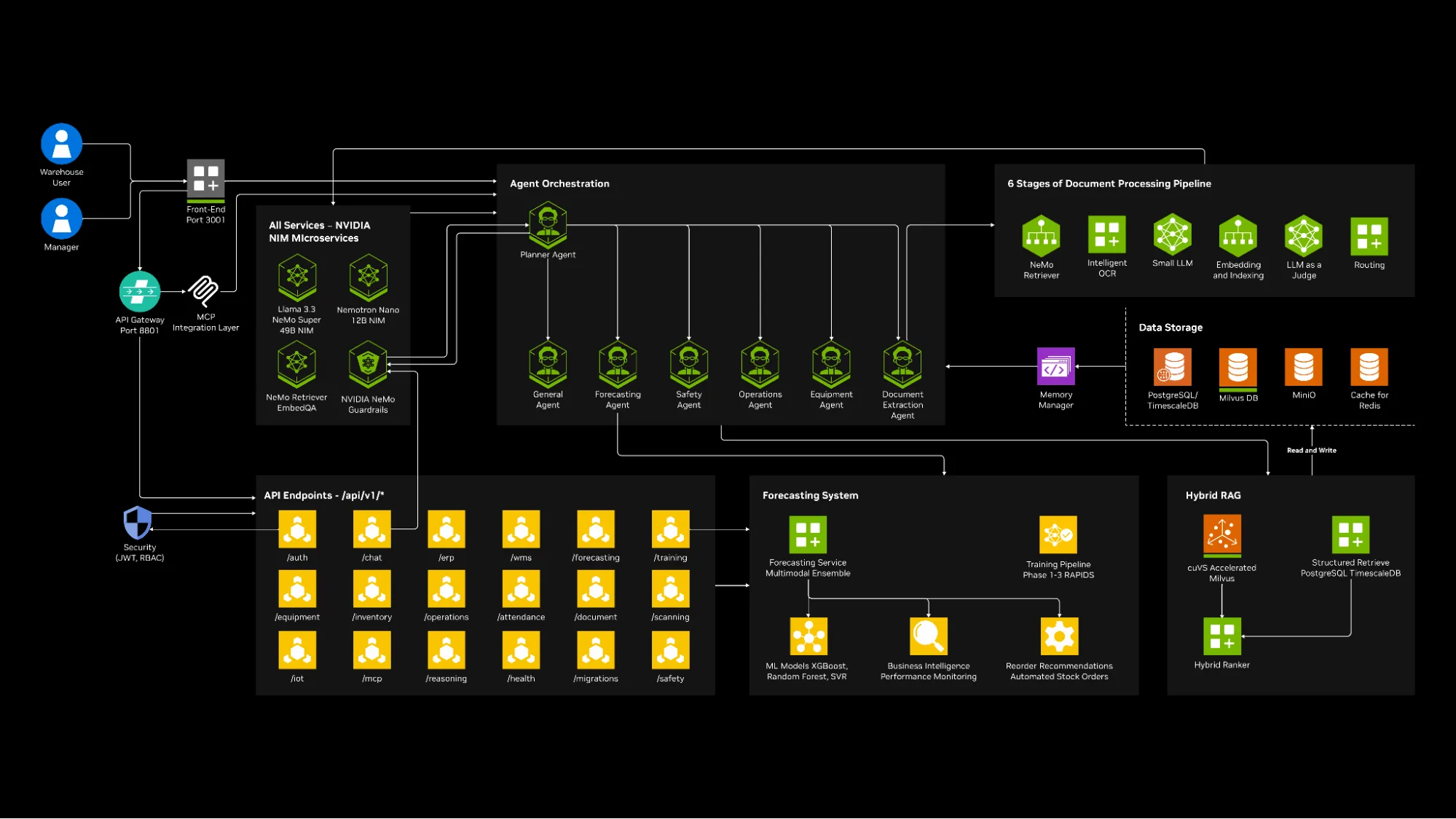
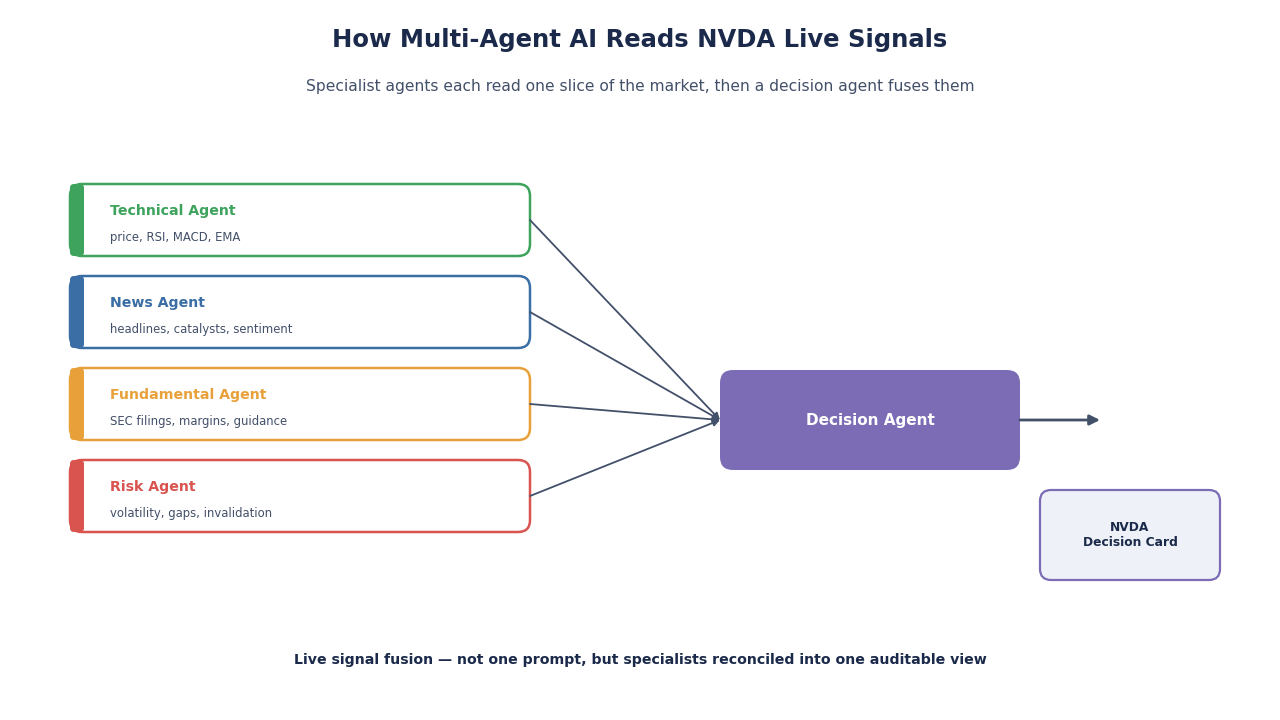
Multi-agent AI for stock analysis uses multiple specialized AI agents instead of one general-purpose model. Each agent focuses on a distinct market lens, such as technical analysis, fundamentals, news sentiment, valuation, risk, or trade decisioning.
Instead of asking one model to “analyze NVDA,” a multi-agent system breaks the task into specialized roles:
| Agent | Reads | Produces |
|---|---|---|
| Technical Agent | Price, volume, RSI, MACD, EMA, Bollinger Bands, ATR | Trend strength, momentum, support/resistance |
| News Agent | Headlines, analyst notes, market-moving stories | Catalyst score and sentiment direction |
| Fundamental Agent | SEC filings, revenue, margin, EPS, balance sheet | Business quality and valuation context |
| Risk Agent | Volatility, gap risk, concentration risk, macro exposure | Risk level and invalidation points |
| Decision Agent | All other agent outputs | Buy / Hold / Sell research view with confidence |
The advantage is not only speed. The deeper advantage is division of labor. A technical signal should not be mixed casually with a fundamental signal. A news headline should not override valuation logic without explanation. A risk warning should not be buried under a bullish narrative.
A multi-agent architecture forces each perspective to be evaluated separately before a final synthesis is generated.
Multi-Agent AI vs ChatGPT for Stock Analysis: Which Is Better for NVDA?
For deep research, ChatGPT can be excellent. For live NVDA signal generation, a dedicated multi-agent AI platform is usually better because it is structured around market data flow rather than a single user prompt.
ChatGPT Is Better When You Need Thinking and Writing
ChatGPT is best when the task is exploratory or explanatory:
- “Explain NVIDIA’s data center growth.”
- “Summarize this earnings transcript.”
- “Create a bull/base/bear scenario for NVDA.”
- “Help me understand why gross margin matters.”
- “Write an investment memo from these notes.”
These tasks require reasoning, summarization, writing, and structured thinking. ChatGPT can help investors clarify their thesis and reduce cognitive load.
Multi-Agent AI Is Better When You Need Signal Fusion
A multi-agent AI system is better when the question is operational:
- “Did NVDA momentum just flip?”
- “Is the news catalyst strong enough to matter?”
- “Are fundamentals supporting the current multiple?”
- “Should I wait, hold, or reduce risk?”
- “What invalidates today’s signal?”
For this type of workflow, SimianX AI is designed around multi-agent analysis rather than one-off prompting. Instead of asking the user to manually assemble technical data, news context, financials, and risk rules, SimianX AI structures the research process into specialized agent outputs and a final decision-oriented summary.
Practical takeaway: ChatGPT helps you understand the thesis. Multi-agent AI helps you monitor whether the thesis is still valid under live market conditions.
How Would a Multi-Agent AI System Read NVDA Live Signals?
A robust NVDA live signals AI workflow should avoid relying on one indicator. Instead, it should check whether multiple independent signals align.
1. Technical Signal Layer
The technical layer asks: What is price doing right now?
For NVDA, the technical agent should monitor:
RSI(14)for overbought or oversold conditions.MACDfor momentum shifts.EMA 12/26for short-term trend changes.50DMAand200DMAfor broader trend structure.ATRfor volatility expansion.- Volume spikes for institutional participation.
- Gap behavior around earnings, analyst upgrades, or AI infrastructure news.
A technical signal alone is not enough. For example, an overbought RSI may suggest caution, but if the stock is breaking out on strong volume after a major earnings beat, the signal may reflect strength rather than immediate reversal risk.
That is why a multi-agent system should separate signal detection from signal interpretation.
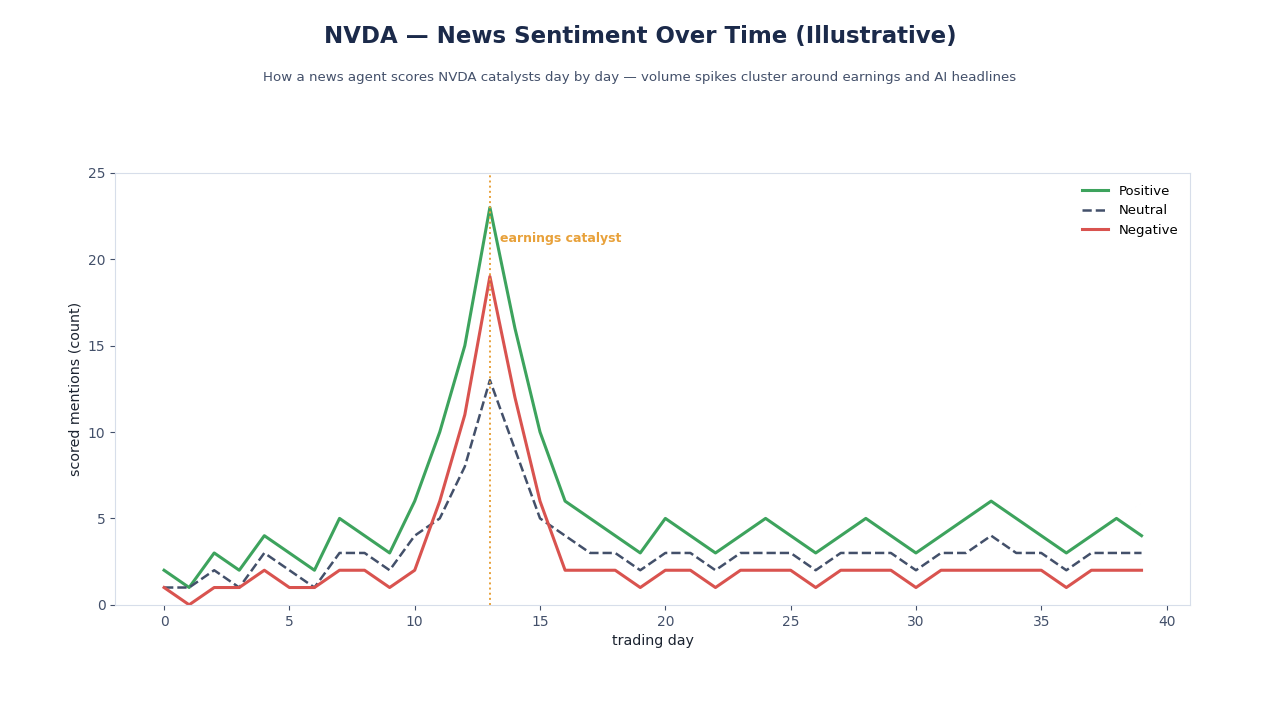
2. News and Catalyst Layer
The news layer asks: Did something happen that changes expectations?
For NVIDIA, examples include:
- Earnings guidance.
- AI chip demand commentary.
- Export control news.
- Cloud provider capex announcements.
- Blackwell, Rubin, or future GPU platform updates.
- Partnerships with hyperscalers or AI labs.
- Analyst price target changes.
- Supply chain constraints.
- Margin pressure concerns.
- Competitive updates from AMD, Google TPU, AWS Trainium, or custom silicon.
A simple chatbot might summarize recent news. A multi-agent system should go further by asking:
- Is this headline actually material?
- Does it affect revenue expectations?
- Does it affect margins?
- Does it change the AI infrastructure demand story?
- Is the market already pricing this in?
- Does the news conflict with technical behavior?
3. Fundamental Layer
The fundamental layer asks: Does the business justify the price?
For NVIDIA, this requires looking beyond price momentum. A strong fundamental agent should evaluate:
| Fundamental Question | Why It Matters for NVDA |
|---|---|
| Is Data Center growth accelerating or slowing? | Core driver of the AI thesis |
| Are gross margins stable? | Signals pricing power and supply efficiency |
| Is guidance above market expectations? | Drives post-earnings repricing |
| How dependent is growth on hyperscaler capex? | Identifies concentration and cycle risk |
| Are export controls affecting demand? | Adds geopolitical risk |
| Is valuation already discounting perfection? | Determines margin of safety |
A fundamental agent should not simply say “NVIDIA is a great company.” It should translate financial performance into investment relevance. Strong revenue growth may already be expected. High margins may be priced in. Guidance may matter more than historical results.
4. Risk Layer
The risk layer asks: What could go wrong?
For NVDA, common risk factors include:
- Valuation compression.
- Earnings disappointment.
- Slower hyperscaler spending.
- AI infrastructure digestion cycles.
- Supply chain constraints.
- Export restrictions.
- Competitive pressure.
- Margin normalization.
- Broad market risk-off rotation.
- Profit-taking after strong rallies.
The risk agent should define not only general risks but also invalidation triggers. For example:
| Signal Type | Possible Invalidation Trigger |
|---|---|
| Bullish technical trend | Break below key moving average on heavy volume |
| Positive news catalyst | Market ignores headline or sells into strength |
| Strong earnings thesis | Guidance misses expectations |
| Fundamental strength | Margins decline faster than expected |
| Momentum setup | Relative strength weakens versus Nasdaq or semiconductor peers |
This is crucial because a useful signal must explain when it becomes wrong.
Can ChatGPT Produce NVDA Live Signals by Itself?
ChatGPT can help produce a manual signal framework, but it should not be mistaken for a fully automated live trading system.
The user would need to provide fresh market data, technical indicators, recent news, and filings—or use available browsing and connected tools—then ask ChatGPT to reason through them.
A strong ChatGPT prompt might be:
Analyze NVDA using the latest price, volume, RSI, MACD, recent news, earnings data, and valuation. Separate technical, news, fundamental, and risk signals. Return a Buy/Hold/Sell research view, confidence score, and invalidation triggers. Do not provide financial advice; treat this as educational analysis.
That prompt improves structure, but the system still depends on the data you provide or the tools enabled in your session.
Multi-agent platforms like SimianX AI are designed to reduce that manual assembly burden by putting the data layers, agents, debate, and decision card into one workflow.
Decision Quality: Single Answer vs Agent Debate
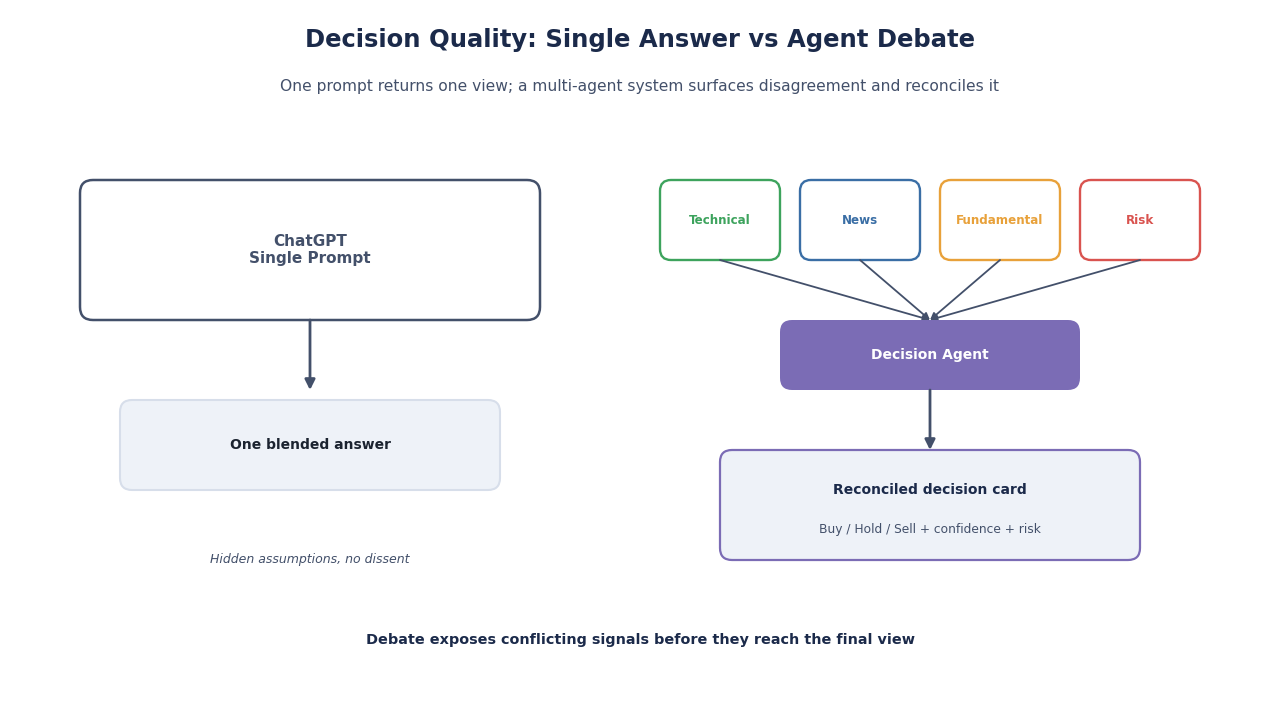
The biggest difference in Multi-Agent AI vs ChatGPT for Stock Analysis is not raw intelligence. It is process design.
A single ChatGPT answer can be coherent but overly smooth. It may understate uncertainty unless instructed to challenge itself. Multi-agent systems are designed to create productive disagreement:
- The technical agent may be bullish because momentum is strong.
- The valuation agent may be cautious because expectations are high.
- The news agent may be bullish because a catalyst just appeared.
- The risk agent may warn that volatility makes position sizing dangerous.
- The decision agent must reconcile all of them.
This matters because markets are full of conflicting evidence. A stock can be fundamentally strong and technically extended. It can have great earnings and still fall if expectations were too high. It can have negative headlines but still rise if the bad news was already priced in.
Opinion without friction is fragile. For volatile AI stocks like
NVDA, the best workflow is not the fastest answer—it is the most defensible answer.
Practical Framework: How to Compare AI Tools for NVDA Analysis
Use this checklist when comparing ChatGPT, SimianX AI, or any other AI stock analysis tool.
Step-by-Step Evaluation
- Check data freshness.
Does the tool know the latest price, volume, news, and filings?
- Separate signal types.
Does it distinguish technical, fundamental, sentiment, and risk signals?
- Look for disagreement.
Does the tool show where indicators conflict?
- Demand confidence scoring.
A signal without confidence is just a headline.
- Require invalidation triggers.
Good analysis says what would make it wrong.
- Avoid black-box outputs.
A simple “Buy” or “Sell” without rationale is not enough.
- Review risk disclosures.
Stock analysis tools should be educational unless provided by licensed professionals.
Comparison Table
| Evaluation Category | ChatGPT | SimianX AI-Style Multi-Agent Workflow |
|---|---|---|
| Best use case | Research, explanation, memo writing | Live signal fusion and decision support |
| Data workflow | User-driven or tool-dependent | Platform-driven live inputs |
| Transparency | Depends on prompt | Agent-level reasoning and decision trace |
| NVDA technicals | Possible with uploaded data | Dedicated technical monitoring |
| NVDA news | Search-based unless connected | Dedicated news intelligence layer |
| Fundamentals | Strong if documents are supplied | SEC and financials integrated |
| Output | Conversational answer | Decision card, report, confidence, risk |
| Ideal user | Researcher, analyst, writer | Active investor, trader, research workflow user |
How Should Investors Use SimianX AI for NVDA Live Signals?
SimianX AI is most useful when investors want a structured workflow that combines speed, breadth, and debate. Instead of manually switching between charting tools, news feeds, earnings releases, and AI prompts, users can evaluate a stock through a more organized multi-agent process.
A practical NVDA workflow in SimianX AI would look like this:
- Enter
NVDAinto the live stock analysis interface. - Review the technical agent’s momentum and volatility signals.
- Read the news agent’s catalyst and sentiment summary.
- Check the fundamental agent’s revenue, margin, EPS, and valuation context.
- Watch for disagreement between agents.
- Review the decision card and confidence score.
- Treat the output as research support, not automatic financial advice.
- Re-run analysis after major catalysts such as earnings, guidance, macro news, or hyperscaler capex updates.
The goal is not to outsource judgment. The goal is to make judgment better informed.
What Is the Best Way to Use Multi-Agent AI vs ChatGPT for Stock Analysis?
The best approach is not necessarily choosing one tool and ignoring the other. A practical investor can use both:
| Workflow Stage | Best Tool | Why |
|---|---|---|
| Learn the company | ChatGPT | Strong at explanation and education |
| Build an investment thesis | ChatGPT | Useful for structured writing and scenarios |
| Monitor live signals | Multi-agent AI | Better for real-time data fusion |
| Evaluate catalysts | Multi-agent AI | Can separate news impact from noise |
| Draft a final research memo | ChatGPT | Strong at synthesis and communication |
| Track ongoing thesis drift | Multi-agent AI | Better for repeated signal updates |
A powerful workflow might look like this:
- Use ChatGPT to understand NVIDIA’s business model.
- Use ChatGPT to build a bull/base/bear investment memo.
- Use SimianX AI to monitor live
NVDAsignals. - Use the multi-agent output to detect technical, news, and fundamental changes.
- Use ChatGPT again to convert findings into a written investment note.
This hybrid method gives investors the best of both worlds: ChatGPT for thinking and writing, SimianX AI for multi-agent signal monitoring.
Common Mistakes When Using AI for NVDA Stock Analysis
AI can improve research quality, but it can also create false confidence if used poorly.
Avoid these common mistakes:
- Mistake 1: Asking for a simple buy or sell answer.
Better question: “What are the bullish, bearish, and neutral signals for NVDA today?”
- Mistake 2: Ignoring data freshness.
A stock analysis answer is only as good as the data behind it.
- Mistake 3: Mixing time horizons.
A bullish five-year thesis does not automatically mean a good one-day entry.
- Mistake 4: Treating news sentiment as truth.
Headlines can be noisy. The key is whether the news changes expectations.
- Mistake 5: Skipping risk management.
Every AI signal should include invalidation levels, confidence, and risk context.
- Mistake 6: Confusing explanation with prediction.
A model can explain why something happened without reliably predicting what happens next.
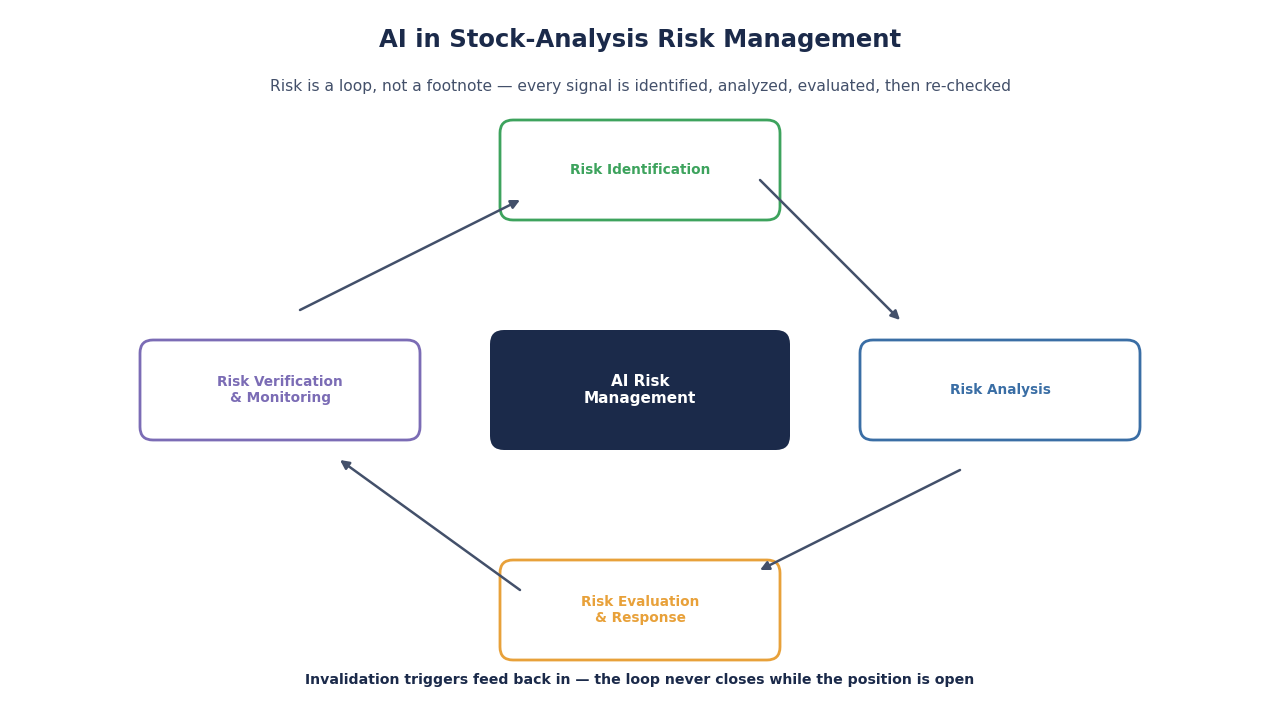
Risk Management: The Part AI Stock Analysis Must Never Skip
Any serious article about AI stock analysis for NVIDIA must include risk. NVIDIA may be a high-quality company with strong AI demand, but that does not mean every entry price is attractive.
High expectations can create downside if growth slows, margins compress, supply improves for competitors, export restrictions intensify, or customers reduce AI infrastructure spending.
For NVDA, the key risk categories are:
- Valuation risk: Strong businesses can still become expensive.
- Earnings risk: Guidance changes can reprice the stock quickly.
- Concentration risk: Data Center demand is heavily tied to hyperscaler AI spending.
- Geopolitical risk: Export restrictions can affect addressable markets.
- Volatility risk: High-volume mega-cap momentum can reverse quickly.
- Narrative risk: AI enthusiasm can amplify both upside and downside moves.
A responsible AI stock analysis workflow should never remove the human investor from the process. Instead, it should improve the investor’s ability to ask better questions, test assumptions, and react with discipline.
FAQ About Multi-Agent AI vs ChatGPT for Stock Analysis
What is the best AI tool for NVDA live signals?
The best AI tool for NVDA live signals is one that combines real-time price data, technical indicators, news sentiment, fundamentals, risk controls, and transparent reasoning. ChatGPT is useful for research and explanation, while a multi-agent platform like SimianX AI is better suited for continuous signal fusion.
Can ChatGPT analyze NVIDIA stock accurately?
ChatGPT can analyze NVIDIA stock well when it has current, reliable data and clear instructions. It is especially useful for explaining earnings, building scenarios, and drafting research memos. For live signals, it needs fresh market data, news, and technical inputs.
How does multi-agent AI improve stock analysis?
Multi-agent AI improves stock analysis by assigning specialized roles to different agents. One agent may read technicals, another may read news, another may evaluate fundamentals, and a decision agent reconciles the disagreement. This reduces blind spots compared with a single-model answer.
Is Multi-Agent AI vs ChatGPT for Stock Analysis only useful for traders?
No. Long-term investors can also benefit because multi-agent systems help track catalysts, valuation changes, risk scenarios, and thesis drift. Traders may use live signals more actively, while investors can use them to monitor whether a long-term thesis remains intact.
Should I buy NVDA based on AI live signals?
No AI signal should be treated as a standalone buy or sell instruction. Use AI outputs as research support, compare them with your own risk tolerance and time horizon, and consult a licensed financial adviser for personalized investment decisions.
Conclusion
The key difference in Multi-Agent AI vs ChatGPT for Stock Analysis is workflow. ChatGPT is excellent for asking questions, explaining market concepts, summarizing documents, and building research frameworks. But for NVDA live signals, investors need more than a smart answer: they need fresh data, specialized agents, technical monitoring, catalyst scoring, fundamental context, risk checks, confidence levels, and an auditable decision trail.
That is where SimianX AI stands out. By turning stock analysis into a multi-agent research process, SimianX helps investors move from scattered tools and one-off prompts toward a more disciplined, transparent, and real-time workflow.
For traders and researchers watching NVIDIA, the best approach is not “AI says buy” or “AI says sell.” It is a structured process that shows what changed, why it matters, how confident the system is, and what would invalidate the signal.
Explore SimianX AI to compare multi-agent stock analysis workflows, test NVDA live signals, and build a more transparent AI research process for high-conviction market decisions.
Related Reading
- GPT vs Gemini vs Claude for AI Stock Analysis: 2026 Guide
- 8 AI Analysts vs 1: 37% More Accurate, 41% Less Risk
- Multi-Agent AI Pipelines for Hedge Fund Deep Research
- SimianX AI: 4-Stage Multi-Agent Stock Analysis Platform