Inside Warsh's Fed Debut: How the Dot Plot Rewrote 2026
On June 17, 2026, Kevin Warsh chaired his first meeting of the Federal Open Market Committee — and Wall Street did not like what it heard. The Fed left interest rates exactly where they were, yet the S&P 500 still fell 1.21% to close at 7,420.10, the Dow shed roughly 500 points, and the 2-year Treasury yield jumped about 11 basis points. It was the worst first-Fed-day reaction for a new chair since 1994.
The selloff had nothing to do with the rate decision itself, which was a unanimous hold, and everything to do with the dots. The Fed's quarterly "dot plot" — the chart of where each official expects rates to go — flipped from implying a cut to implying a hike by the end of 2026. In a single afternoon, the market's mental model of the year ahead was rewritten.
This story breaks down what the Warsh Fed actually decided, why the committee turned hawkish, the paradox of a historically hawkish chair who was nominated to deliver cuts, the sweeping reform agenda Warsh unveiled the same day, and what "higher for longer" means for AI stocks, Bitcoin, and your portfolio.
What the Warsh Fed actually decided on June 17
The headline action was no action. The FOMC held its benchmark federal funds rate at a target range of 3.50% to 3.75% — a midpoint of 3.625% — unchanged since December 2025. The vote was a clean 12-0. For a debut meeting watched this closely, the chair clearly wanted no public dissent on day one.
So if the rate didn't move, why did stocks fall more than a percent? Because the Fed releases far more than a rate decision in June. It also publishes the Summary of Economic Projections (SEP), including the dot plot and updated forecasts for growth, unemployment, and inflation. Those projections are how the market reads the committee's intentions — and the intentions had shifted hard toward higher rates.
The other surprise was structural. Warsh used his first press conference not to dwell on the dots but to announce a sweeping internal overhaul of the Federal Reserve itself. More on that below — it matters for how you should read every Fed communication for the rest of 2026.
Why the Fed turned hawkish: inflation reaccelerated
The dot plot did not flip in a vacuum. Inflation reaccelerated in the spring of 2026, and the data left the committee little room to keep promising cuts.
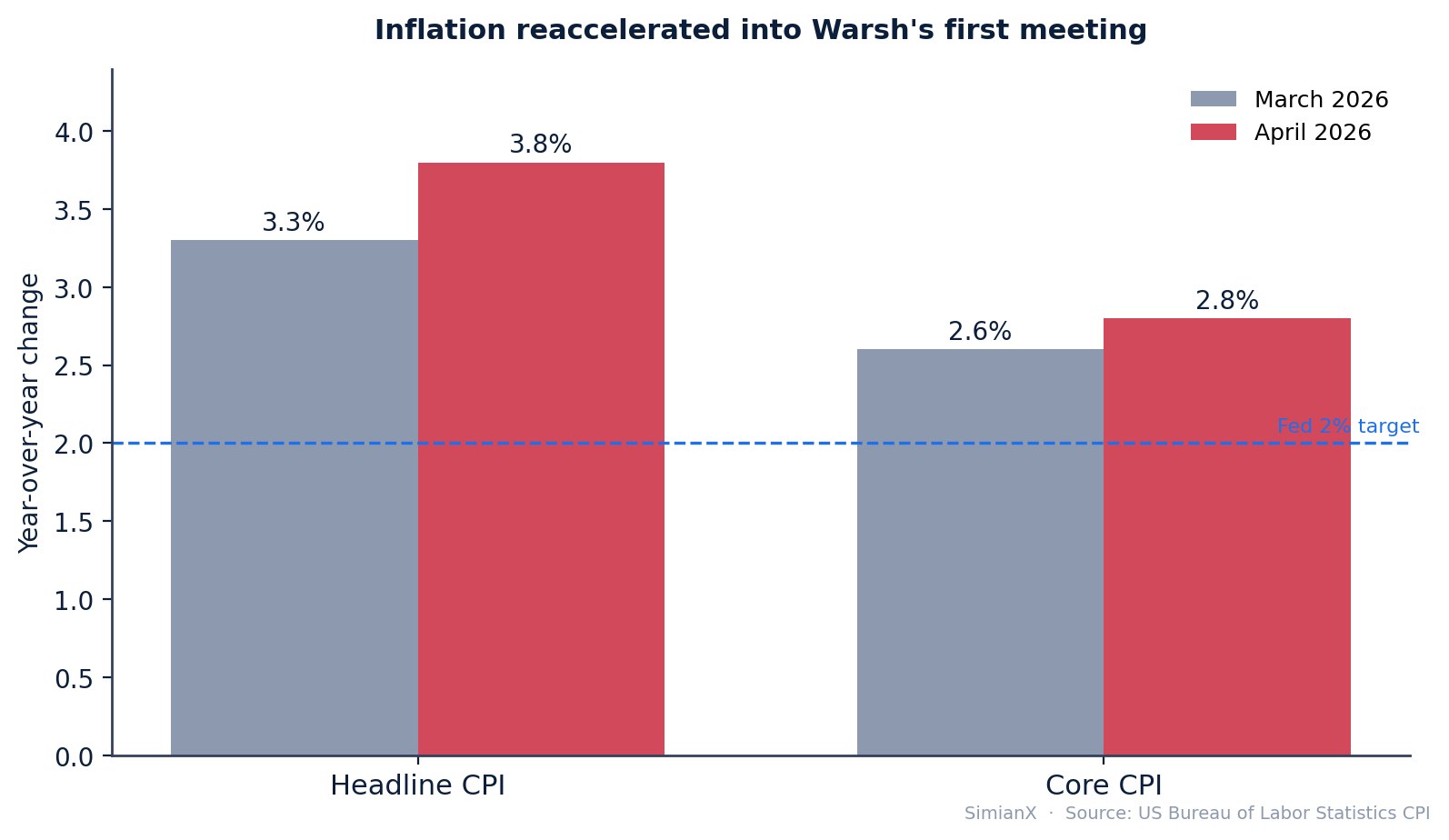
Headline CPI rose to 3.8% in April, up from 3.3% in March. Core CPI, which strips out food and energy, ticked up to 2.8% from 2.6%. Services inflation ran at 3.3%, and wholesale prices soared roughly 6% year over year in April. On top of that, fresh U.S.–Iran tensions in early June pushed oil higher and revived the inflation scare that markets thought had faded after the spring de-escalation.
Crucially, the Fed raised its own 2026 forecast for PCE inflation — its preferred gauge — to 3.6%, up from 2.7% in March. That is a nearly full percentage-point upward revision in three months. When your own staff lifts the inflation forecast by that much, you cannot credibly keep penciling in rate cuts. The dots had to move.
| Inflation gauge | Earlier reading | Latest reading |
|---|---|---|
| Headline CPI (YoY) | 3.3% (March) | 3.8% (April) |
| Core CPI (YoY) | 2.6% (March) | 2.8% (April) |
| Services CPI (YoY) | — | 3.3% (April) |
| Fed 2026 PCE forecast | 2.7% (March SEP) | 3.6% (June SEP) |
The dot plot flipped to a 2026 hike
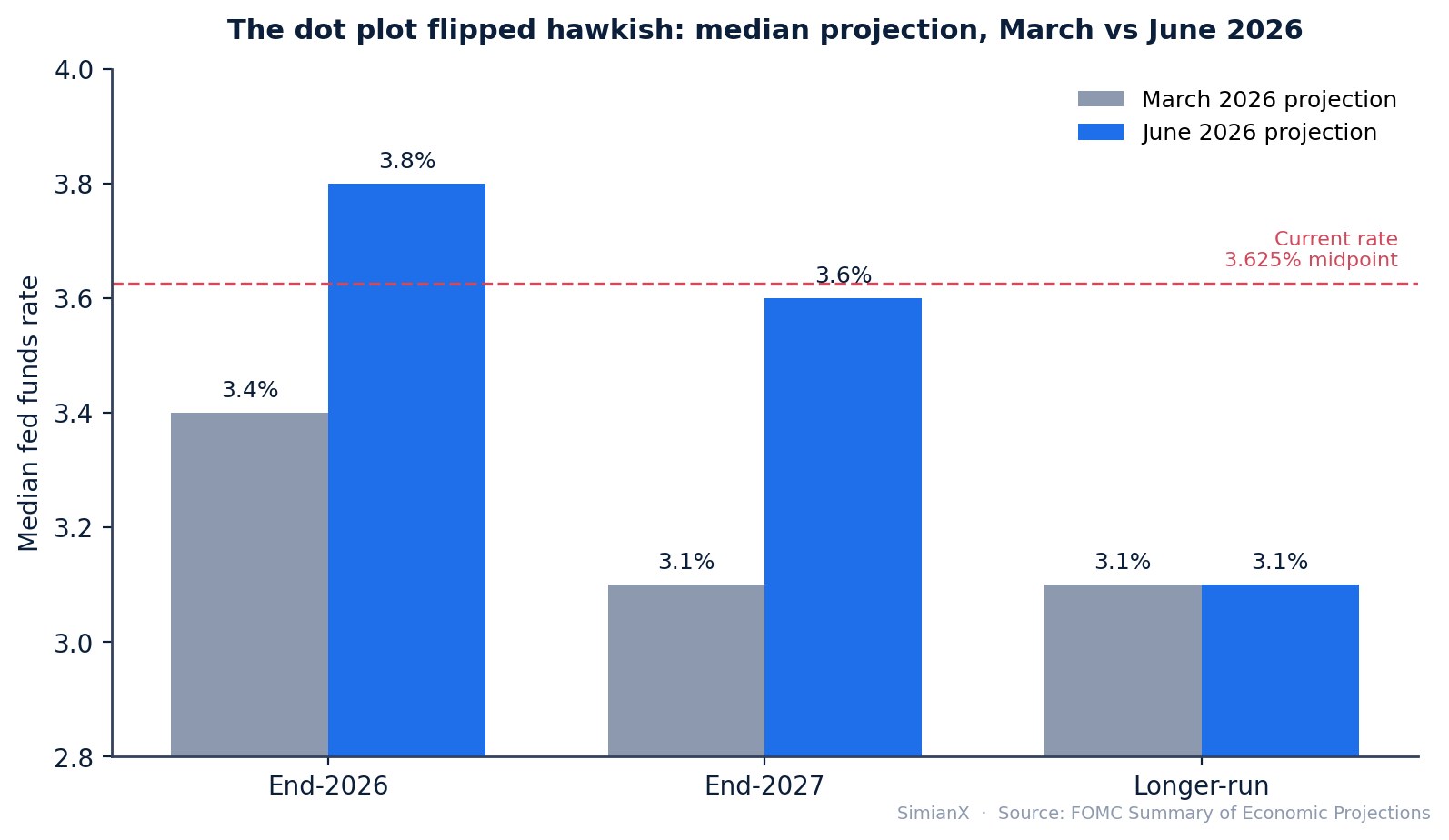
Here is the move that rattled markets. In March, the median FOMC official still expected the funds rate to end 2026 lower than today, at roughly 3.4% — implying a cut. By June, the median had climbed to 3.8%, which sits above the current 3.625% midpoint and therefore implies one rate hike before year-end. For 2027, the median rose from 3.1% to 3.6%. The longer-run "neutral" estimate held at 3.1%.
Just as telling was the distribution of the dots. Of the 18 officials submitting 2026 projections, 9 placed their dot above the current rate, 8 sat at the current midpoint, and only 1 was below it. In other words, half the committee now leans toward tightening, and essentially nobody is arguing for cuts this year. The Fed also reported that 17 of 18 officials judged inflation risks to be tilted to the upside, with none seeing downside risk — about as one-sided a risk assessment as the dot plot ever produces.
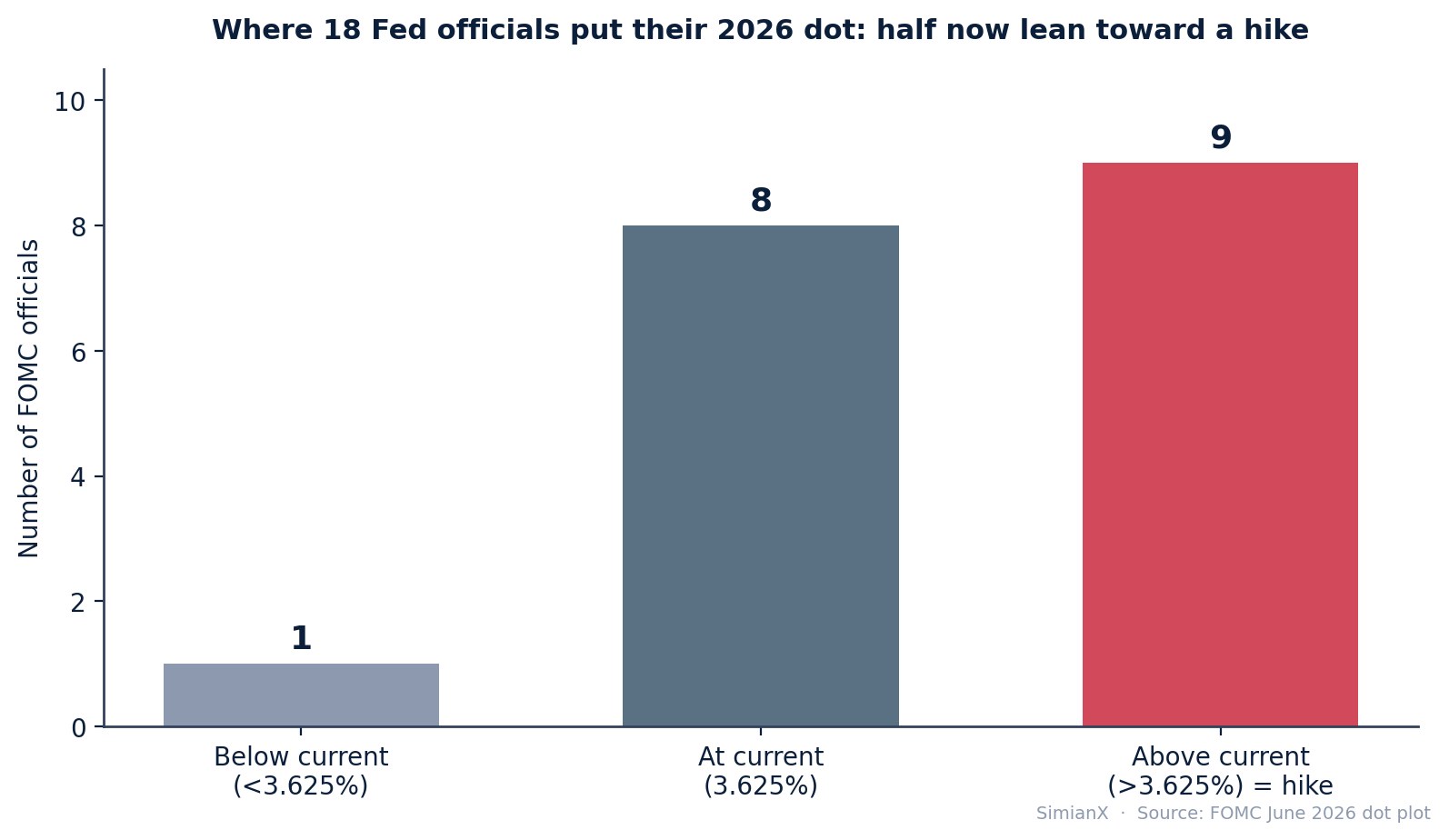
Markets repriced immediately. According to CME FedWatch, traders moved to a roughly 57% probability of at least one hike by December, and the odds of zero cuts in 2026 climbed toward 69%. As New Century Advisors chief economist Claudia Sahm put it, "The market reaction at this point is largely to the dot plot being much more hawkish." The rate decision was a non-event; the projections were the story.
The Warsh paradox: a hawkish history, a dovish thesis
To understand why this matters, you have to understand the man now holding the gavel. Kevin Warsh is the 17th chair of the Federal Reserve, nominated by President Trump in January 2026 and confirmed by the Senate on May 13 in a 54-45 vote — the most divisive confirmation in Fed history, with Pennsylvania's John Fetterman the lone Democrat to vote yes. He took the chair when Jerome Powell's term expired in mid-May.
Warsh carries a reputation as a hawk. During the 2008 financial crisis, as a sitting Fed governor, he resisted aggressive easing out of concern that inflation risks were being underestimated. That history made his nomination curious, because Trump nominated him explicitly to deliver lower rates.
The bridge between those two positions is an idea: productivity. In the run-up to his nomination, Warsh argued that the AI boom would lift productivity enough to let the economy grow faster without generating inflation — which, in theory, would allow the Fed to cut rates safely. It is an elegant, optimistic thesis. The problem is timing. The hard data landing on his desk in June — 3.8% CPI, 6% wholesale inflation, an oil shock — does not yet show disinflationary productivity gains. It shows sticky, broadening price pressure. The committee, reading the same data, refused to pencil in the cuts the productivity thesis would justify. Hence the paradox: a chair appointed to ease, presiding over a dot plot that flipped to a hike.
A reform agenda: five task forces and a missing dot
Warsh did something else on June 17 that long-time Fed watchers called extraordinary. Rather than simply explain the decision, he announced five independent task forces, each charged with a first-principles review of a core piece of Fed machinery — and all expected to report by year-end, a breakneck timeline for an institution founded in 1913.
The five reviews target: the Fed's communications doctrine (including the future of forward guidance and the dot plot itself), its balance sheet philosophy, its reliance on existing data sources, productivity and the labor market, and the economic impact of AI and other general-purpose technologies. Crucially, membership will reach beyond academic economists to outside experts — a direct shot at the insularity critics blame for the Fed's recent forecasting misses.
There was a tell hidden in the projections, too: Warsh did not submit his own dot. He abstained from the rate forecast entirely. For a chair who wants to overhaul how the Fed communicates, leaving his own dot blank is a statement — a signal that he views the dot plot as a flawed tool he intends to reform rather than be bound by. For investors, the takeaway is that Fed communication will be less predictable and more personality-driven in 2026 than it has been in years.
How markets reacted: stocks down, yields up
The mechanics of the selloff were textbook "higher for longer." When the expected path of short-term rates rises, two things happen at once: bond yields climb, and the present value of future corporate earnings — especially for long-duration growth stocks — falls.
- Equities. The S&P 500 finished down 1.21% at 7,420.10. The Nasdaq Composite fell about 0.7% in the initial reaction and the Dow dropped roughly 500 points. Rate-sensitive growth names led the decline.
- Treasuries. The 2-year yield, the maturity most sensitive to Fed policy, jumped about 11 basis points to roughly 4.15%. The 10-year rose about 4 basis points to around 4.47%. A bigger move at the front end than the long end is the bond market's way of saying "rates will stay high for longer than we thought."
- Rate expectations. Futures swung toward pricing a hike rather than a cut as the next move — a regime change in sentiment, even though the Fed did nothing on the day.
If you want the longer arc of how rate decisions ripple through asset classes, our reference on every Fed rate-cut cycle since 1980 maps what stocks, bonds, and gold actually did each time — useful context now that the cutting cycle markets expected has been put on ice.
What "higher for longer" means for AI stocks
The AI trade has been the engine of this bull market, and it is precisely the kind of trade a hawkish Fed pressures most. High-growth technology stocks are valued on cash flows far in the future; when the discount rate rises, those distant cash flows are worth less today. That is the math behind why the Magnificent 7 tend to wobble on hawkish Fed days.
But the picture is not uniformly bearish. The same productivity thesis Warsh champions is bullish for the companies actually building AI infrastructure. Earnings, not multiples, increasingly carry the load: the Magnificent 7 are projected to grow profits about 23% in 2026 versus roughly 13% for the rest of the S&P 500. A business compounding earnings at 23% can absorb a higher discount rate far better than a speculative name with no profits. The lesson of a higher-for-longer regime is selectivity — quality and cash flow over story stocks. Names like Nvidia, Microsoft, and Amazon will live or die on whether AI capital spending converts into real returns, exactly the debate Warsh's task force on AI and productivity intends to study.
What it means for Bitcoin and crypto
Crypto trades like the most rate-sensitive asset of all. Bitcoin and Ethereum have spent 2026 under pressure as the market priced out rate cuts, and a dot plot that flips toward a hike removes one of the bullish catalysts the crypto market had been counting on. Higher real yields raise the opportunity cost of holding a non-yielding asset, and a stronger dollar — the typical companion of a hawkish Fed — is a historic headwind for crypto.
That said, the relationship is not mechanical. Our analysis of Bitcoin's reaction to every Fed rate cut since 2019 shows the response is often counterintuitive and lagged. The cleaner read for now: with cuts off the table, the easy-liquidity tailwind is gone, and crypto will have to climb on its own fundamentals — ETF flows, halving-cycle dynamics, and adoption — rather than on the Fed.
New Fed chairs and markets: a short history
A rocky debut does not define a chairmanship. History shows that markets often test a new chair early, then settle once the chair's reaction function becomes clear.
| Fed chair | First year as chair | Early market backdrop |
|---|---|---|
| Paul Volcker | 1979 | Inherited runaway inflation; brutal tightening, then a historic disinflation and 1980s bull market |
| Alan Greenspan | 1987 | The 1987 crash struck weeks into his tenure; his liquidity response built his reputation |
| Ben Bernanke | 2006 | Took over near a market top; soon faced the 2008 crisis |
| Janet Yellen | 2014 | Oversaw the "taper" era and the first post-crisis hikes with relative calm |
| Jerome Powell | 2018 | A hawkish lean triggered a sharp Q4 2018 selloff before he pivoted dovish |
| Kevin Warsh | 2026 | Hawkish dot-plot flip on debut; worst first-Fed-day reaction for a new chair since 1994 |
The Powell parallel is the most instructive. His hawkish start in 2018 produced a near-bear-market scare, and then he pivoted. Markets will be watching whether Warsh's productivity thesis eventually pulls the committee back toward easing — or whether sticky inflation forces him to govern as the hawk his record suggests. For the broader pattern of how the index behaves through these stress episodes, see our reference on every S&P 500 bear market since 1929.
What to watch next
- The next CPI and PCE prints. With 17 of 18 officials worried about upside inflation, every inflation report is now a hike-or-hold referendum. A cooling trend is the fastest path back to a dovish dot plot.
- CME FedWatch odds. The market currently prices roughly a 57% chance of a hike by December. Watch that number move with the data.
- Oil and the dollar. Renewed Middle East tension feeds directly into the inflation forecast that drove the hawkish turn.
- Warsh's task forces. Any early signal that the Fed will downgrade or replace the dot plot would change how every future meeting is read.
- The September meeting. The next SEP arrives in September. If the dots stay above the current rate, "higher for longer" becomes the base case for the rest of the year.
For the full play-by-play of the meeting itself, see our companion piece on the June 2026 FOMC decision.
How SimianX helps you trade a hawkish Fed
Macro regime shifts are exactly where disciplined, data-driven trading earns its keep — and where emotion does the most damage. SimianX is built for this environment:
- AI trading autopilots run a defined strategy 24/7 without flinching on a hawkish headline, sizing positions and managing risk by rule rather than by gut.
- The AI model leaderboard lets you see, in real time, which AI models are calling the market correctly across regimes like this one — so you can follow proven decision-making instead of guessing.
- The crypto leaderboard tracks how AI-driven strategies are navigating the higher-for-longer backdrop in BTC, ETH, and beyond.
A hawkish surprise like June 17 is a reminder that the market can reprice an entire year in one afternoon. The investors who do best are the ones with a plan that survives the surprise.
Frequently asked questions
Did the Fed raise interest rates at Warsh's first meeting?
No. The FOMC held the federal funds rate at 3.50%–3.75% in a unanimous 12-0 vote on June 17, 2026. What spooked markets was the dot plot, not the rate decision: the median projection flipped to imply a hike by year-end.
What is the dot plot and why did it matter so much?
The dot plot is a chart in the Fed's quarterly projections showing where each official expects rates to go. In March the median implied a 2026 cut; in June it implied a hike (median rose from 3.4% to 3.8%). It is the market's primary read on the Fed's intentions, so a flip of this size moves prices even when the current rate is unchanged.
Why is Kevin Warsh considered hawkish if Trump wanted lower rates?
Warsh opposed aggressive easing during the 2008 crisis, earning a hawkish reputation. He was nominated on the argument that AI-driven productivity gains would let the Fed cut rates without stoking inflation. With inflation reaccelerating in 2026, that dovish thesis has so far been overruled by the data — and by his own committee.
How does a hawkish Fed affect AI stocks and Bitcoin?
Higher-for-longer rates lower the present value of future earnings, pressuring long-duration growth stocks and removing a liquidity tailwind for crypto. Quality names with strong current earnings tend to weather it better than speculative, profitless ones.
Will the Fed actually hike in 2026?
As of mid-June 2026, markets price roughly a 57% chance of at least one hike by December, per CME FedWatch. The outcome hinges on incoming inflation data — a clear cooling trend could pull the dots back toward a hold or even a cut.
This article is for educational and informational purposes only and is not financial advice. Markets carry risk; always do your own research.
Related Reading
- June 2026 FOMC Decision: Dot Plot, AI Stocks & Bitcoin
- Every Fed Rate-Cut Cycle Since 1980: Stocks, Bonds & Gold
- Every S&P 500 Bear Market Since 1929: Duration and Recovery
- The Magnificent 7 in 2026: Weights & Concentration Risk
- Bitcoin After Every Fed Rate Cut: 2019-2026 Reference