XRP/USDT Analysis
Data scope and caveat
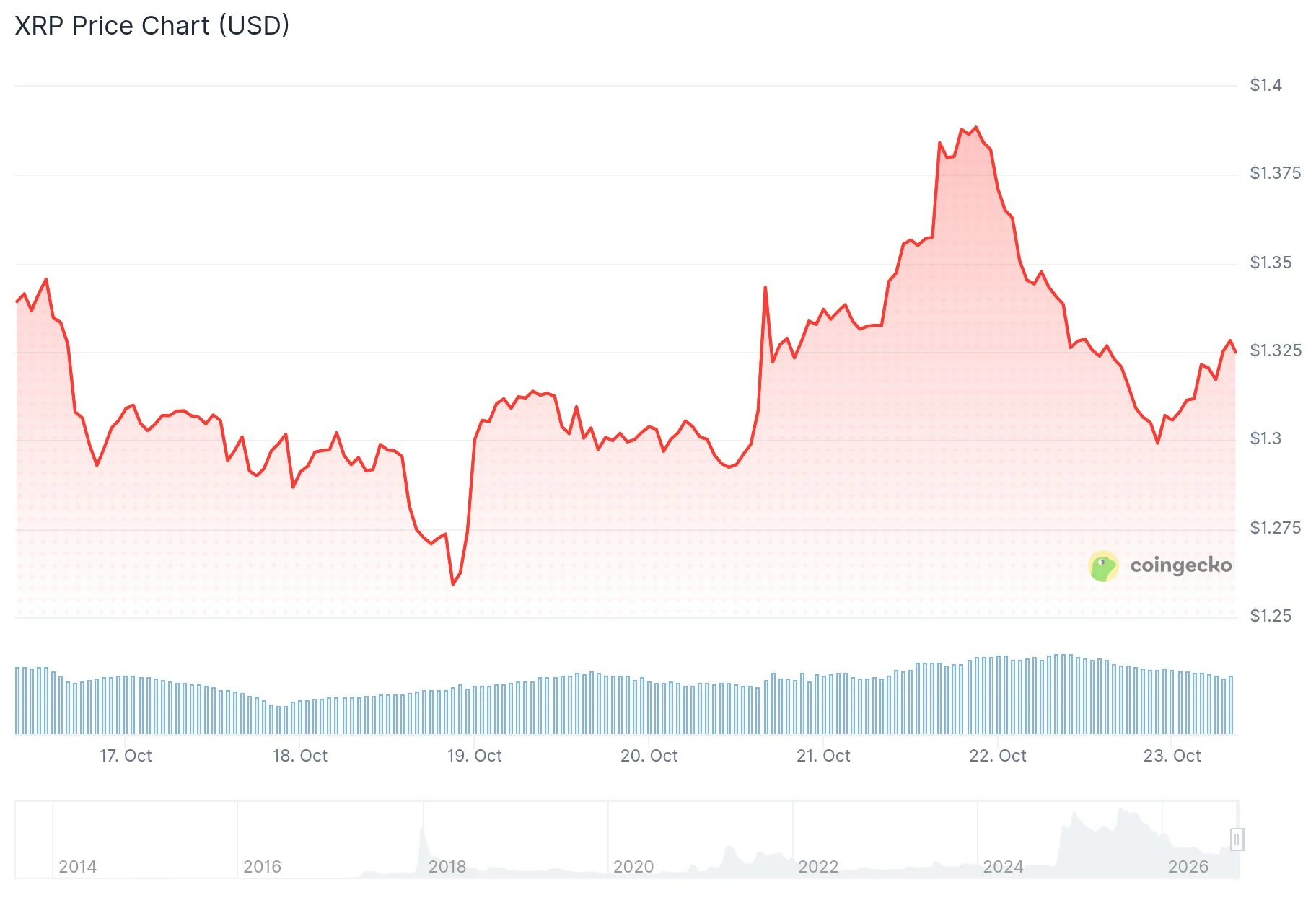
This assessment uses the supplied daily candles and indicators only. The history covers about 21 daily bars, so it is too short to establish a reliable long-term trend or fully assess broader market structure. The latest daily candle is still open, and its volume is far below the 20-day average; do not treat that volume as a completed-session signal. The figures support a technical market assessment, but do not include enough information to independently evaluate XRP’s fundamentals, news, or wider crypto-market conditions.
1. Trend analysis
Near-term trend: bearish, with price showing signs of short-term stabilization.
- XRP has declined from a recent daily close of 1.5206 to 1.3140, a drop of about 13.6%. The sequence of lower highs and lower lows over much of the period supports a near-term downtrend.
- Price is below the EMA 12 (1.3396), EMA 26 (1.3717), EMA 50 (1.3711), and SMA 20 (1.3726). This alignment indicates overhead trend resistance and weak short-term momentum.
- The MACD (-0.0321) is below its signal line (-0.0277), and the negative histogram (-0.0044) confirms bearish momentum. The histogram is not, by itself, evidence that downside momentum is accelerating.
- RSI at 37.34 is weak but not yet conventionally oversold. That leaves room for further declines, though a relief bounce is also possible.
- Price is above the SMA 200 (1.2802), a constructive longer-lookback observation. However, the supplied history is too limited to infer a durable long-term bullish trend from this alone.
Interpretation: The dominant signal in the available data is downside pressure. A sustained recovery above the clustered short-term averages would be needed to weaken that view.
2. Key support and resistance levels
These are approximate zones, not guaranteed turning points.
Support
- 1.306–1.295: Immediate support zone, near the latest price and the previous daily low of 1.2954.
- 1.284–1.280: Important lower support, around the recent daily low of 1.2840 and SMA 200 at 1.2802.
- 1.256: Major recent swing support, matching the lowest daily low shown and the monthly candle low. A decisive break below this area would materially worsen the chart.
Resistance
- 1.335–1.346: First resistance zone, around the EMA 12 (1.3396) and recent candle highs.
- 1.365–1.373: More significant resistance cluster: recent price action, EMA 26 (1.3717), EMA 50 (1.3711), and SMA 20 (1.3726).
- 1.399–1.410: Higher resistance around the recent rebound high and SMA 50 (1.4103).
- 1.486–1.526: Broader resistance area near the earlier daily highs. Reaching it would require a substantial recovery from current levels.
The Bollinger middle band (1.3726) coincides with the short-term average cluster, reinforcing 1.37 as a key test. The lower band is 1.2329, but it is a volatility reference—not a confirmed support level.
3. Market structure and sentiment
Structure: The recent price action is consistent with a correction: lower highs and lower lows after the early-period peak, followed by a modest rebound that failed to hold and another decline. The move from the 1.256 low to the 1.3992 high shows that buyers did respond at lower prices, but the subsequent retreat to around 1.31 suggests that buying has not yet established control.
Momentum and positioning signals from the supplied data:
- RSI below 50 and a negative MACD configuration indicate sellers currently have the momentum advantage.
- Price below the short-term moving averages means rallies may encounter selling pressure around 1.34–1.37.
- Holding above the 1.28–1.256 support area would help preserve the possibility of a base forming. A breakdown there would indicate that the recent rebound did not establish a durable floor.
- The latest candle is incomplete, and its volume is only 1,586,128.3 versus a 20-day average of 87,782,715.0. This is not a valid basis for concluding that participation or selling pressure has dried up.
- No derivatives, order-book, on-chain, news, or broader-market data were provided. Therefore, positioning and sentiment cannot be assessed comprehensively.
4. Overall directional bias
Bias: Bearish to neutral; bearish while below 1.37.
The trend, moving-average positioning, and MACD favor caution. The main counterpoint is that XRP remains above the SMA 200 at 1.2802, with further historical support near 1.256. This creates a possible support zone, but there is not yet clear evidence of a bullish reversal.
- Bearish continuation condition: A confirmed daily close below 1.28, especially followed by a break of 1.256, would strengthen the downside case.
- Improvement condition: Reclaiming 1.34 would ease immediate pressure; sustained closes above 1.37 would provide stronger evidence that momentum is shifting.
- Until then: A bounce is possible, but it would be countertrend unless price recovers the resistance cluster.
Summary
- Trend: Near-term bearish; longer-term direction uncertain from the limited sample.
- Key support: 1.306–1.295, 1.284–1.280, then 1.256.
- Key resistance: 1.335–1.346, 1.365–1.373, then 1.399–1.410.
- Directional bias: Bearish-to-neutral, with the bearish case stronger below 1.37.
- Confidence score: 38/100 — this indicates a modest bearish tilt, not a strong sell conviction. Confidence is limited by the short data history, incomplete latest candle, and absence of broader market and fundamental inputs.