Reading AppLovin as an Auction Machine, Not an AI Story
The debate around AppLovin in 2026 is no longer about whether artificial intelligence improved the company’s advertising engine. The financial evidence says it did. The harder question is whether AppLovin can turn that advantage into a durable, diversified advertising platform before growth slows or competition, privacy rules, and valuation pressure catch up.
As of August 10, 2026, APP presents an unusual mix: 53% year-over-year revenue growth, a 66% GAAP net margin, and a sharp post-earnings reset in the share price. For investors trying to separate operating performance from market emotion, SimianX AI offers a relevant workflow: compare SEC fundamentals, valuation, news, and technical signals through multiple specialist agents rather than relying on one bullish or bearish narrative.
Bottom line: AI advertising can keep AppLovin growing, but the next leg depends on three things—continued model improvement in gaming, credible scaling in e-commerce and lead generation, and proof that the June self-serve launch can add advertisers without weakening returns or margins.

Research date: August 11, 2026. Market data use the August 10 U.S. close. This article is informational and is not personalized investment advice.
AppLovin’s 2026 Investment Thesis in One Table
AppLovin now operates primarily as an advertising technology company after completing the sale of its Apps business in June 2025. Its system connects advertiser demand with mobile inventory, while the Axon AI recommendation engine predicts which ad is most likely to produce a profitable action. MAX helps publishers monetize inventory, and AppLovin Ads gives advertisers a performance-buying interface.
| Question | Evidence as of Q2 2026 | Investor interpretation |
|---|---|---|
| Is demand still growing? | Q2 revenue reached $1.924 billion, up 53% YoY | Yes, but sequential growth slowed to about 4.4% |
| Is AI improving monetization? | Net revenue per installation rose 58%, while installations fell 2% | Growth came from better economics, not more install volume |
| Are profits converting to cash? | Q2 free cash flow was $863 million; H1 FCF was about $2.15 billion | Strong conversion, though Q2 cash flow fell from Q1 |
| Are margins durable? | Adjusted EBITDA was $1.614 billion, about 84% of revenue | Exceptional, but Q3 guidance implies roughly 83% |
| Is the platform diversifying? | AppLovin Ads opened to all advertisers on June 22 | Promising, but Q2 included only days of open access |
| Is the stock cheap? | At $339, trailing P/E was about 26x and EV/EBITDA about 21x | Cheaper after the selloff, but not priced for stagnation |
The numbers come from AppLovin’s Q2 2026 earnings release, June 2026 Form 10-Q, and August 10 market and valuation data.
What Actually Drove AppLovin’s Q2 2026 Growth?
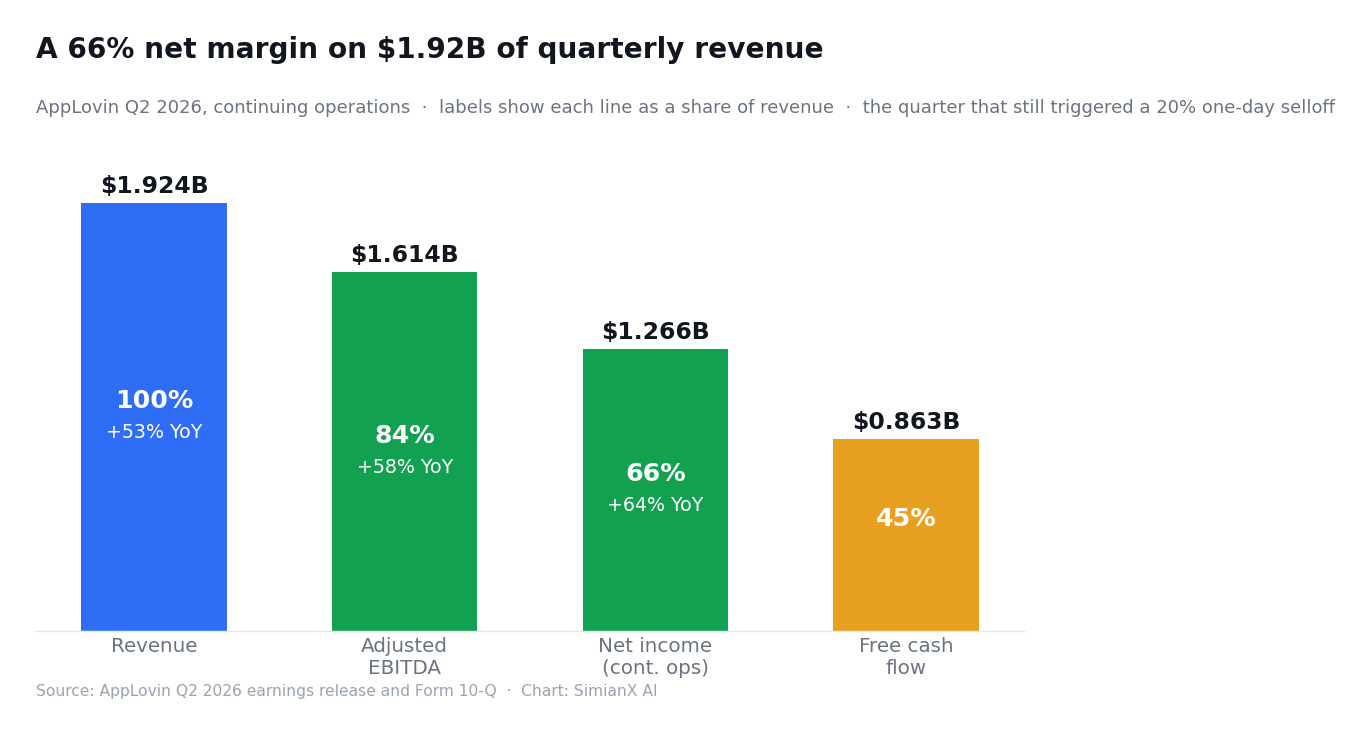
AppLovin reported Q2 revenue of $1.9237 billion, compared with $1.2588 billion a year earlier. Net income from continuing operations increased 64% to $1.2665 billion, diluted EPS reached $3.76, and adjusted EBITDA increased 58% to $1.614 billion. Those are elite results even before considering that AppLovin’s continuing business is unusually asset-light.
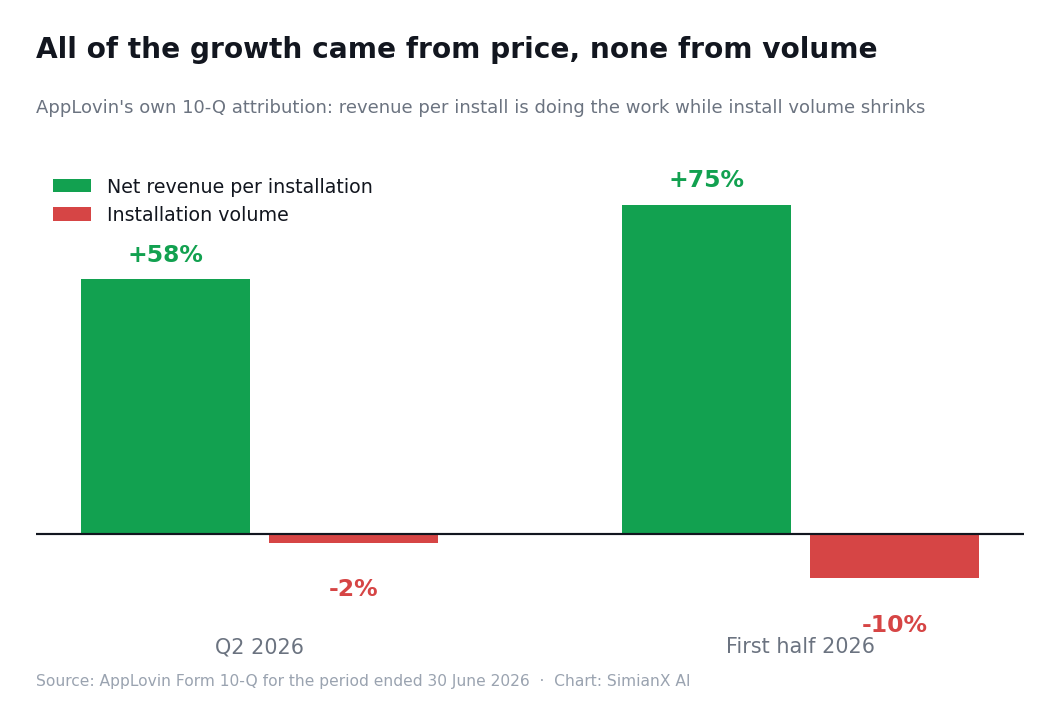
The most important disclosure, however, was not the headline growth rate. In its 10-Q, AppLovin said quarterly revenue growth was primarily driven by a 58% increase in net revenue per installation, partially offset by a 2% decline in installations. For the first half, net revenue per installation rose 75%, while installation volume fell 10%.
That distinction matters:
- Bullish reading: Axon is producing materially more value from each conversion, validating the AI-driven optimization thesis.
- Cautious reading: Falling install volume means the company cannot rely indefinitely on efficiency gains alone; it also needs more advertisers, more inventory, or new transaction types.
- Best test: Watch whether installation volume stabilizes while revenue per install continues to rise. That would show the marketplace is broadening rather than merely extracting more value from existing activity.

Why Did APP Stock Fall After 53% Revenue Growth?
Because markets price the change in expectations, not the absolute quality of a quarter. Q2 revenue grew approximately 4.4% sequentially, from $1.842 billion in Q1, and landed near the lower half of AppLovin’s $1.915–$1.945 billion guidance range. Adjusted EBITDA of $1.614 billion was effectively at the bottom of the guided range after rounding.
Management also indicated on the earnings call that model progress during the quarter was lighter than its internal standard, with a more meaningful improvement released after quarter-end. That creates a clean but demanding Q3 test. Guidance calls for revenue of $2.055–$2.085 billion and adjusted EBITDA of $1.710–$1.740 billion. At the midpoint, revenue would reaccelerate to roughly 7.6% sequential growth, while the adjusted EBITDA margin would settle near 83%.
The stock closed at $339 on August 10, down substantially from its recent highs. The selloff was not evidence that the business stopped growing. It reflected concern that a company valued as a near-flawless compounder had produced a merely strong quarter—and that management’s ability to generate frequent AI model step-ups may be uneven.
How Axon AI Creates AppLovin’s Advertising Advantage
Axon is not a consumer chatbot or a generic large language model. It is a recommendation and prediction system designed around performance advertising. In simplified form, the engine must estimate:
expected value = conversion probability × customer value − acquisition cost
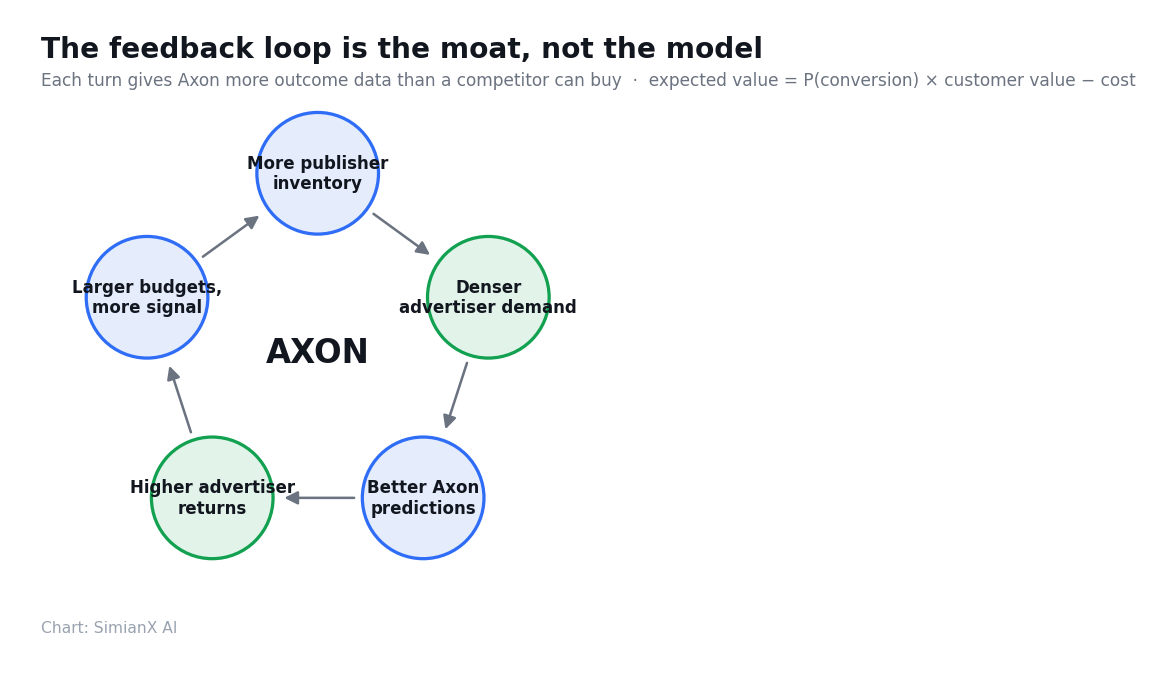
It then allocates ad opportunities toward combinations of user context, creative, advertiser goal, and bid that should maximize return on ad spend. The commercial flywheel looks like this:
- More publisher inventory creates more ad opportunities.
- More advertisers produce denser auction demand and broader conversion data.
- Better predictions improve advertiser returns and publisher monetization.
- Better returns attract larger budgets, which generate more learning signals.
- More data and experimentation improve future predictions.
AppLovin’s core mobile-gaming position is valuable because outcomes can be observed relatively quickly: an impression leads to an install, and subsequent engagement or spending can be measured. The company’s reported increase in net revenue per installation is the financial signature investors would expect if prediction quality improved.
AI is not the moat by itself. The potential moat is the combination of models, scaled mobile inventory, advertiser demand, measurable outcomes, and a feedback loop that competitors cannot reproduce cheaply.

Can AI Advertising Keep APP Growing Beyond Mobile Games?
Potentially, but this is the thesis that still requires proof. On June 22, 2026, AppLovin Ads opened to all advertisers, ending the company’s referral requirement. Management said businesses could reach a billion-plus daily active users and buy against three measurable goals: return on ad spend, cost per purchaser, or lead value.
This expansion can increase AppLovin’s addressable market in several directions:
- E-commerce: Online stores can optimize toward purchases and lifetime value.
- Subscription and on-demand services: Advertisers can target a cost per purchaser.
- Lead generation: Insurance, home services, and other categories can bid against lead economics.
- Hybrid mobile gaming: Games that once depended only on in-app purchases can add advertising, increasing supply.
- AI-created advertising: Automated interactives and video can reduce the creative burden for smaller businesses.
AppLovin says its multi-agent creative pipeline has generated thousands of interactive ads and is expanding into video. Its creative automation overview describes agents that collect brand context, develop concepts, generate assets, and perform quality checks. This matters because performance platforms need creative variety as much as targeting intelligence. If onboarding requires hundreds of costly assets, self-service will never become truly self-service.
Still, investors should avoid counting the entire digital advertising market as immediately addressable revenue. AppLovin must prove that mobile-game inventory can deliver incremental customers for non-game advertisers; that attribution is credible; that creative quality remains brand-safe; and that smaller customers retain spending after initial tests.
AppLovin Versus Meta, Google, The Trade Desk, and Unity
AppLovin is not competing in one uniform advertising market. Its rival changes with the customer and inventory type.
| Competitor | Primary advantage | Where AppLovin can win | Principal threat to APP |
|---|---|---|---|
| Meta | Social graph, enormous advertiser base, mature self-serve tools | Full-screen mobile-game inventory and different audience behavior | Meta can copy automation features and bundle vast demand |
| Search intent, YouTube, Android, measurement infrastructure | Performance inventory outside search and traditional social feeds | Google controls important mobile ecosystem rules and advertiser relationships | |
| The Trade Desk | Independent access to open-internet and CTV inventory | Mobile in-app performance and closed-loop optimization | Strong agency relationships and cross-channel buying |
| Unity | Game engine relationships and mobile monetization tools | AppLovin’s demonstrated monetization scale and Axon performance | Direct competition for game developers, inventory, and ad budgets |
| TikTok/Amazon | Entertainment discovery or commerce intent data | Alternative reach and high-attention game placements | Powerful first-party signals and established brand budgets |
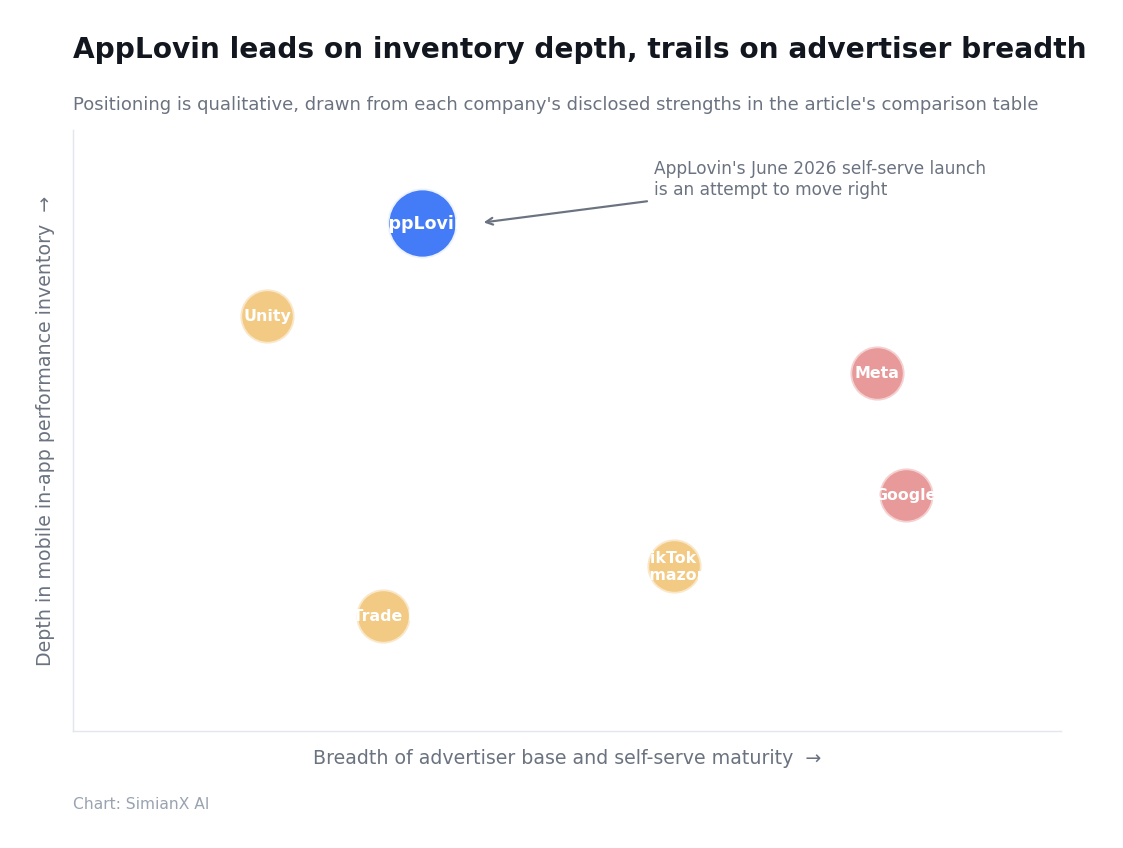
The strategic challenge is distribution. Meta and Google already have millions of advertisers, proven measurement, mature account management, and familiar creative formats. AppLovin’s June launch removes the referral gate, but opening a portal does not automatically create customer trust or budget scale.
There are encouraging external signals. A 2026 Jefferies survey reported by Investing.com found increased AppLovin share among 30 surveyed e-commerce advertisers. Yet a small survey is directional evidence, not a substitute for company-level disclosure. Investors need cohort retention, customer concentration, or consumer-vertical revenue data to evaluate diversification rigorously.

Is AppLovin Stock a Buy in 2026 at Its Current Valuation?
There is no universal answer because the valuation depends on an investor’s required return, time horizon, and confidence in the growth duration. At the August 10 close of $339, AppLovin had a market capitalization near $113.5 billion and enterprise value near $113.9 billion. Third-party market data placed the shares at approximately:
- 26.1x trailing earnings
- 18.5x forward earnings estimates
- 21.0x trailing EV/EBITDA
- 25.1x trailing free cash flow
Those multiples are far below AppLovin’s peak valuation, but they are not distressed. The market is still assuming meaningful growth and continued high margins. The forward P/E also depends on analyst estimates that can fall quickly if consumer advertising ramps more slowly than expected.
A Practical Three-Scenario Framework
| Scenario | 2026–2028 operating path | What it would mean for valuation |
|---|---|---|
| Bull | Gaming compounds strongly; self-serve adds durable e-commerce and lead-gen demand; AI creative increases activation; margins stay above 80% | Current valuation could prove modest relative to earnings growth |
| Base | Core advertising grows, but model gains normalize; consumer adoption is gradual; margins ease into the high 70s/low 80s | Returns depend on earnings compounding more than multiple expansion |
| Bear | Revenue-per-install gains stall; installs keep falling; non-gaming customers churn; regulation or platform rules impair targeting | Even the post-selloff multiple could compress materially |
Investors can make this framework more useful by attaching observable checkpoints rather than arbitrary price targets. In SimianX AI’s stock research workflow, fundamental, technical, news, and decision agents can be used to monitor the same thesis from different angles. For APP, the fundamental checklist should focus on revenue-per-install, sequential revenue growth, FCF conversion, margin, buybacks, and disclosures about consumer advertisers. The news agent should separately flag privacy actions, platform-policy changes, and competitor product launches.
The Market Repriced APP Before This Quarter Landed
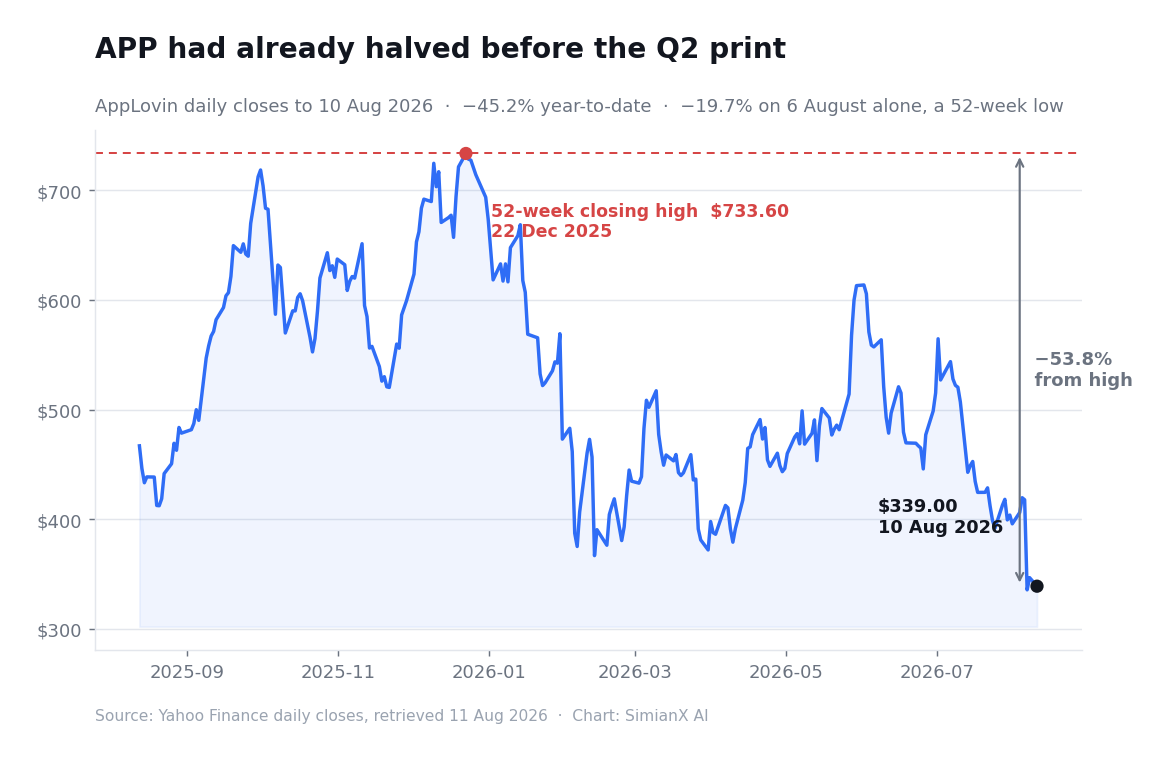
The phrase "down substantially from its recent highs" understates what happened. APP closed at $733.60 on December 22, 2025 — its highest close of the trailing twelve months — and finished August 10 at $339.00. That is 53.8% below the high and 45.2% lower year to date. On August 6 alone the stock fell from $417.80 to $335.67, a 19.7% single-session drop that marked a fresh 52-week low, four days before the reference date used throughout this article. Figures are from Yahoo Finance daily closes for APP.
That context changes what the multiples above mean. A 26x trailing and 18.5x forward earnings multiple is not a growth stock holding its premium; it is what is left after the market removed more than half the equity value. The bull case no longer needs multiple expansion from a peak — it needs the operating case to hold from a level the market has already marked down twice. Equally, the bear case is not hypothetical: the market has spent 2026 testing it. For how long comparable drawdowns have historically taken to repair, see How Long Every Bear Market Took to Recover: 1929-2022.

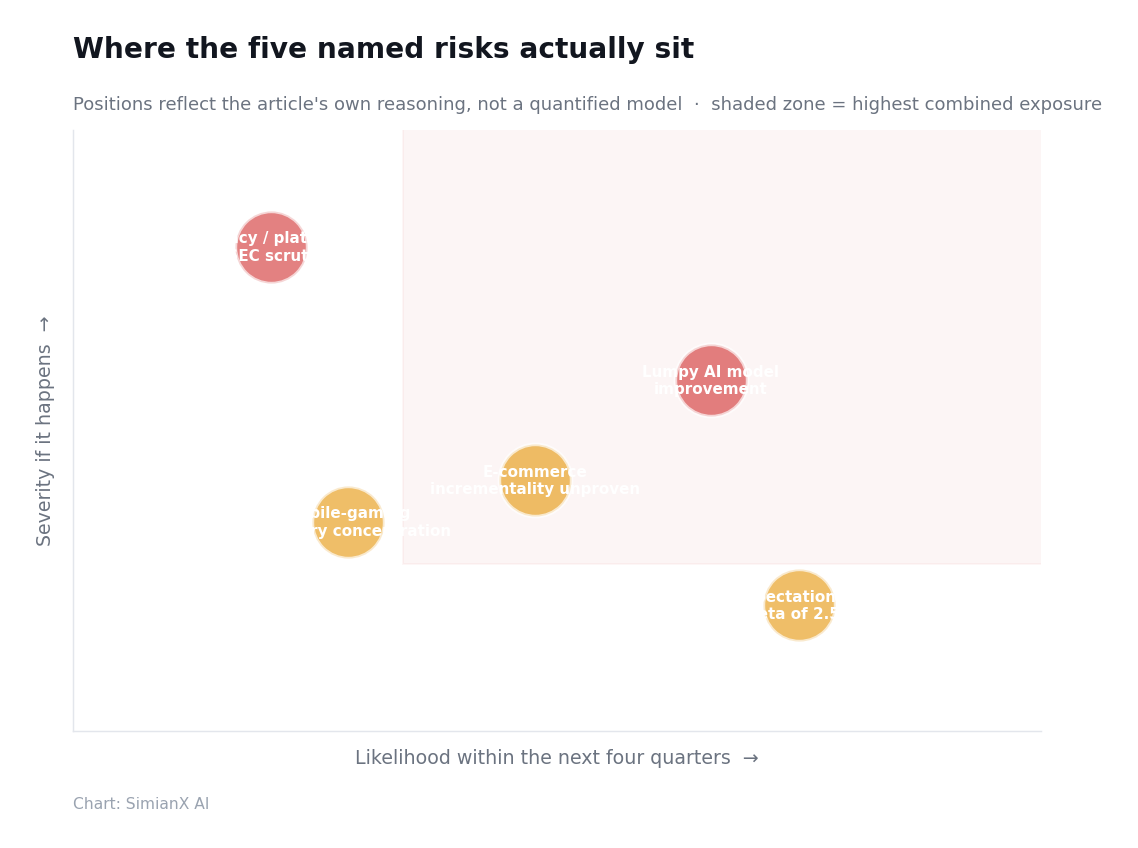
The Five Biggest Risks to AppLovin Stock
1. AI Model Improvement May Be Lumpy
AppLovin’s growth has benefited from repeated improvements in predicted returns. Machine-learning progress is not guaranteed to arrive on a smooth quarterly schedule. If incremental model releases deliver smaller lifts, advertisers may stop expanding budgets at the rates embedded in bullish forecasts.
2. E-Commerce Attribution and Incrementality Need Independent Proof
An ad platform can report conversions that might have happened anyway. Advertisers care about incremental purchases, not merely attributed purchases. AppLovin needs continued validation through third-party measurement, repeat spending, and controlled tests. Without it, non-gaming growth may remain concentrated among aggressive direct-response marketers.
3. Privacy, Platform Rules, and Regulatory Scrutiny
Apple, Google, privacy laws, and advertising partners influence what data can be collected and how ads are measured. Bloomberg reported in 2025 that the SEC had examined allegations concerning AppLovin’s data-collection practices; Reuters summarized that report while noting AppLovin generally does not comment on potential regulatory matters. An investigation is not a finding of wrongdoing, but it is a material risk category.
AppLovin’s latest 10-Q also discloses securities litigation alleging misleading statements about its advertising solutions and growth. The company says the allegations lack merit and is contesting the action. Investors should distinguish allegations from adjudicated facts while recognizing that legal costs, operational remedies, or reputation damage could affect valuation.
4. Dependence on Mobile Gaming Inventory
Mobile games provide AppLovin’s differentiated reach, but concentration can become a ceiling. If game engagement weakens, publishers switch mediation providers, or advertiser returns deteriorate, both sides of the marketplace can slow together. Diversification is therefore essential, not optional.
5. Expectations and Stock Volatility
AppLovin’s five-year beta was about 2.53 as of August 10, meaning the shares have historically been much more volatile than the broad market. High margins, limited quarterly disclosure by vertical, short-seller attention, and changing growth expectations can produce violent price moves in both directions.

What Investors Should Monitor Over the Next Four Quarters
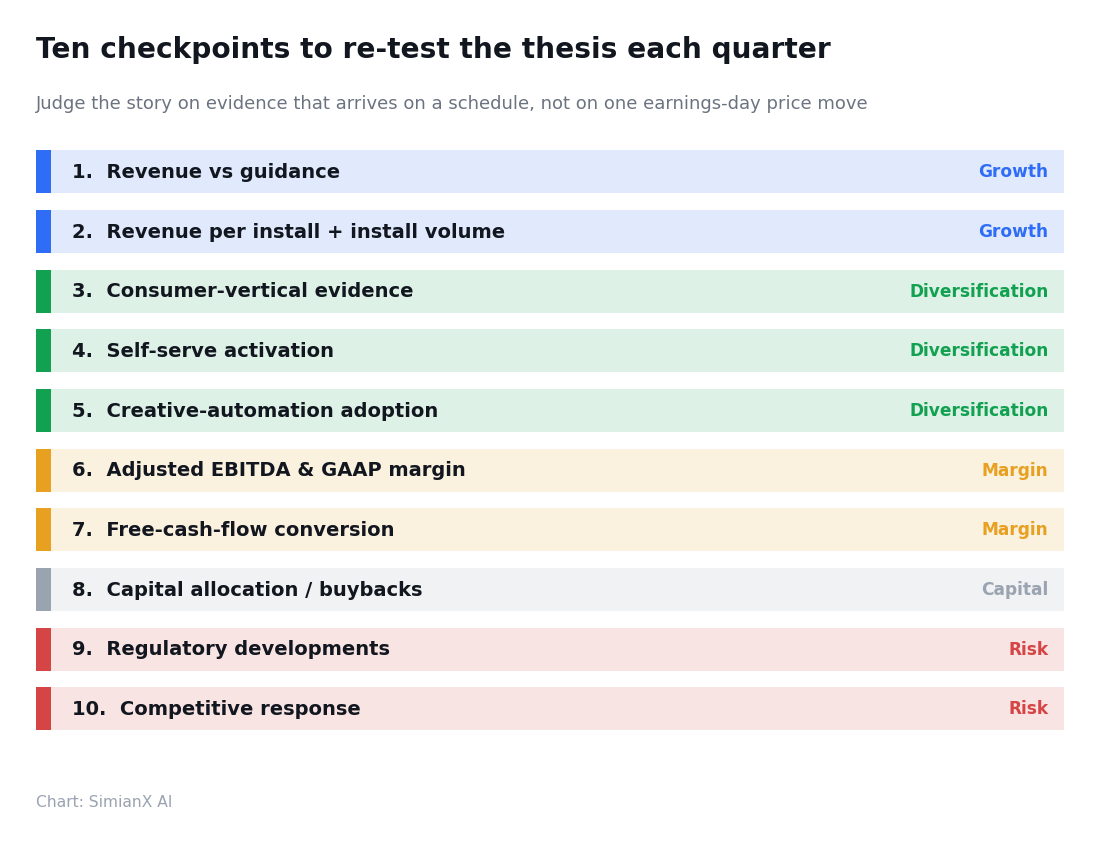
Use a repeatable scorecard instead of reacting to one earnings-day move:
- Revenue versus guidance: Does AppLovin beat its own range, and does sequential growth remain healthy?
- Revenue per installation and install volume: Efficiency plus stable volume is stronger than efficiency masking volume decline.
- Consumer-vertical evidence: Look for non-gaming customer growth, repeat spending, retention, or a clearer revenue contribution.
- Self-serve activation: Does open access generate funded, durable campaigns rather than registrations?
- Creative automation adoption: Are AI-generated assets improving campaign launch rates and returns?
- Adjusted EBITDA and GAAP margins: Does expansion require materially more sales support, incentives, or compute expense?
- Free-cash-flow conversion: Q2 FCF was lower than Q1 despite higher revenue; watch taxes, receivables, and publisher payments.
- Capital allocation: AppLovin repurchased $1.5 billion of stock in H1 and had $1.8 billion remaining under its authorization at June 30.
- Regulatory developments: Track formal disclosures, court rulings, and changes in Apple or Google policies.
- Competitive response: Monitor Meta, Google, Unity, and The Trade Desk for mobile measurement, automation, and inventory initiatives.
This is an ideal use case for a watchlist and automated digest. SimianX can combine SEC updates, earnings, technical changes, and news alerts, but investors should still verify high-impact claims against original filings. AI can accelerate research; it cannot eliminate uncertainty.

FAQ About AppLovin Stock 2026
Is AppLovin stock a buy in 2026 after the earnings selloff?
The selloff reduced the valuation to roughly 26x trailing earnings and 18.5x forward estimates as of August 10, but the stock still assumes continued growth. It may appeal to investors confident in Axon and consumer-ad expansion, while investors requiring proof may wait for stronger self-serve and e-commerce disclosures.
Can AI advertising keep APP growing above 30%?
It is possible, especially if Axon continues improving gaming economics while AppLovin Ads adds non-gaming demand. It is not assured: Q2 sequential growth slowed, installation volumes declined, and model improvements can be uneven.
What is Axon AI in AppLovin’s business?
Axon is AppLovin’s AI recommendation system. It predicts which ads and users are most likely to produce profitable outcomes, helping allocate advertiser budgets and monetize publisher inventory.
What is the biggest risk to AppLovin’s 2026 outlook?
The central operating risk is that efficiency gains slow before new advertiser categories reach scale. Privacy or platform-policy changes are a separate tail risk because they could affect targeting, measurement, and business practices.
How should investors research APP stock with AI tools?
Use AI to compare filings, valuation, news, and price behavior, then test bull and bear cases against explicit metrics. A multi-agent platform such as SimianX can reduce single-model bias, but no signal or generated report should replace source verification or personal risk controls.
Conclusion
The evidence behind the AppLovin Stock 2026 thesis is stronger than a generic “AI stock” label. In Q2, revenue rose 53%, net revenue per installation rose 58%, GAAP net margin reached 66%, and AppLovin generated $863 million of free cash flow. Those results show that Axon has created real economic value.
But the next phase is harder. AppLovin must turn a powerful mobile-gaming optimization engine into a broader performance-advertising platform. The June self-serve launch, e-commerce adoption, lead generation, hybrid game monetization, and AI creative tools are credible growth vectors; they are not yet fully proven at the scale implied by the most optimistic forecasts.
The most defensible conclusion is therefore conditionally bullish on the business, valuation-sensitive on the stock. AI advertising can keep APP growing if model improvement continues and new advertiser cohorts retain spend without damaging margins. If those signals weaken, the stock’s premium can contract even while the company remains highly profitable.
To keep the thesis current, run APP through SimianX AI, build a multi-agent fundamental and risk review, and set recurring monitoring around the ten checkpoints above. The goal is not to predict every price move—it is to know quickly when the evidence supporting the investment case changes.
Related Reading
- AI Momentum Unwind 2026: Why Semiconductor Stocks Fall
- CrowdStrike Stock 2026: 26% Growth at 35x Forward Sales
- Robinhood Stock 2026: Crypto Is Only 8% of HOOD Revenue
- How Long Every Bear Market Took to Recover: 1929-2022
- Meta Compute 2026: Can Excess AI Capacity Drive Revenue?
- Apple WWDC 2026: Siri AI & Gemini Impact on AAPL Stock
References
- AppLovin Investor Relations — quarterly results and filings
- SEC EDGAR — AppLovin Corporation filings (CIK 0001751008)
- AppLovin Q2 2026 earnings release
- AppLovin Form 10-Q for the period ended 30 June 2026
- AppLovin Ads opens to all advertisers, 22 June 2026
- AppLovin — creative automation overview
- Yahoo Finance — APP daily price history
- Nasdaq — APP market activity
- Stock Analysis — APP valuation statistics
- Bloomberg — business and markets coverage
- Reuters — business and markets coverage
- SimianX Crypto Leaderboard — live AI model performance