
What Four Bitcoin Halvings Reveal About the Next Cycle
Every four years, Bitcoin's protocol cuts the reward miners earn for adding a new block in half. That single line of code — written by Satoshi Nakamoto in 2009 — is the single most important calendar event in crypto. It has produced four completed cycles since 2012, each with its own bull run, peak, and brutal drawdown, and the patterns those four cycles trace are the closest thing the asset has to a long-term roadmap. This is the complete reference: every halving date, every halving-day price, every cycle peak, every bear-market trough, and what the numbers say about the cycle still in progress.
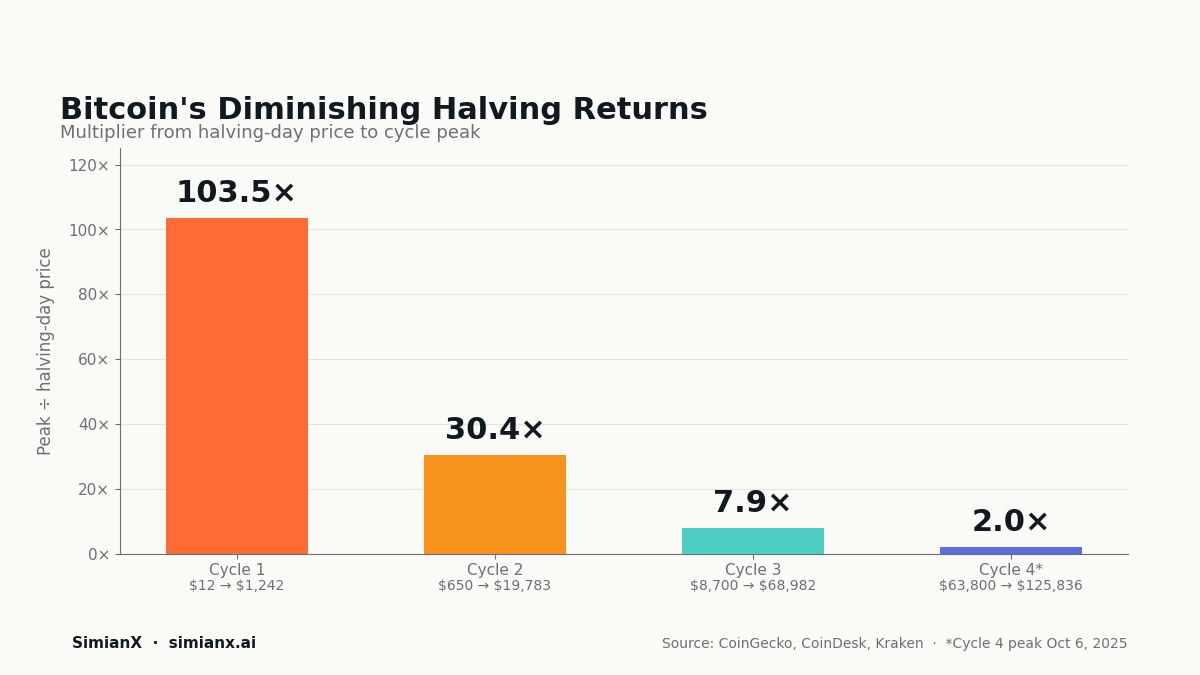
If you only remember one thing from this page, remember this: Bitcoin has now produced four full post-halving rallies, and the multiplier from halving-day price to cycle peak has been 103×, 30×, 8×, and 2×. The cycle is still firing — but it is firing with a smaller and smaller punch every time. That single fact reframes almost every other question about the asset.
What the Bitcoin Halving Actually Does
Bitcoin's monetary policy is hardcoded. New coins are minted only as the reward miners receive for sealing a new block, and that reward is cut in half exactly every 210,000 blocks. At a ten-minute average block time, that works out to roughly every four years. The schedule is mechanical, not discretionary — there is no central bank that can speed it up, slow it down, or postpone it.
The result is an asset with a fixed, transparently advertised supply schedule. The block reward started at 50 BTC in 2009. It dropped to 25 BTC in November 2012. Then 12.5 BTC in July 2016, 6.25 BTC in May 2020, and 3.125 BTC in April 2024. The next cut — to 1.5625 BTC per block — is scheduled for block 1,050,000, which the network is on pace to mine around April 19, 2028.
Every halving cuts the rate of new supply in half overnight. In 2024, daily new issuance dropped from roughly 900 BTC to 450 BTC. After the 2028 halving, it will fall to about 225 BTC per day. The thesis behind the "halving cycle" — popularised first by anonymous quant pseudonym PlanB and then absorbed into broader crypto discourse — is that a sudden, predictable cut in supply, met by even flat demand, has to push price higher.
Whether that thesis still holds in a world of spot Bitcoin ETFs and corporate treasuries is the central debate in this market. The four cycles below are the data the debate has to grapple with.
Cycle 1 — The 2012 Halving
- Halving date: November 28, 2012 (block 210,000)
- Block reward: 50 BTC → 25 BTC
- Halving-day price: ~$12.35
- Cycle peak: ~$1,242 on November 30, 2013
- Days to peak: 367
- Multiplier: ~103×
- Subsequent bear-market low: ~$152 in January 2015
- Peak-to-trough drawdown: ~88%
The first halving happened in near silence. Bitcoin was a $12 oddity that fit easily inside a college student's portfolio, traded on a handful of barely-functional exchanges, and was discussed almost entirely in cypherpunk forums. Within twelve months it had crossed $1,000 for the first time, briefly traded above $1,200, and triggered the first wave of mainstream financial-press attention — most of it skeptical, most of it premature. By January 2015, after the Mt. Gox collapse and a long grind down, BTC was back near $150. A 103× multiplier from halving day to peak, then an 88% drawdown into the next halving. That is the original cycle template.
Cycle 2 — The 2016 Halving
- Halving date: July 9, 2016 (block 420,000)
- Block reward: 25 BTC → 12.5 BTC
- Halving-day price: ~$650
- Cycle peak: ~$19,783 on December 17, 2017
- Days to peak: 526
- Multiplier: ~30×
- Subsequent bear-market low: ~$3,200 in December 2018
- Peak-to-trough drawdown: ~84%
The 2016 halving was the cycle that turned Bitcoin into a household name. ICOs, the first Ethereum-led altcoin season, an 18-month grind from $650 to almost $20,000, and the December 2017 mania that pulled "blockchain" into every corporate strategy deck. The multiplier from halving to peak shrank from 103× to 30× — still life-changing, but already a fraction of the prior cycle. The 2018 bear market that followed bled prices down by 84% and lasted a full calendar year. The pattern that would define the next two cycles — peak roughly 18 months after halving, deep but ultimately survivable drawdown — was set here.
Cycle 3 — The 2020 Halving
- Halving date: May 11, 2020 (block 630,000)
- Block reward: 12.5 BTC → 6.25 BTC
- Halving-day price: ~$8,700
- Cycle peak: ~$68,982 on November 10, 2021
- Days to peak: 548
- Multiplier: ~8×
- Subsequent bear-market low: ~$15,500 in November 2022
- Peak-to-trough drawdown: ~77%
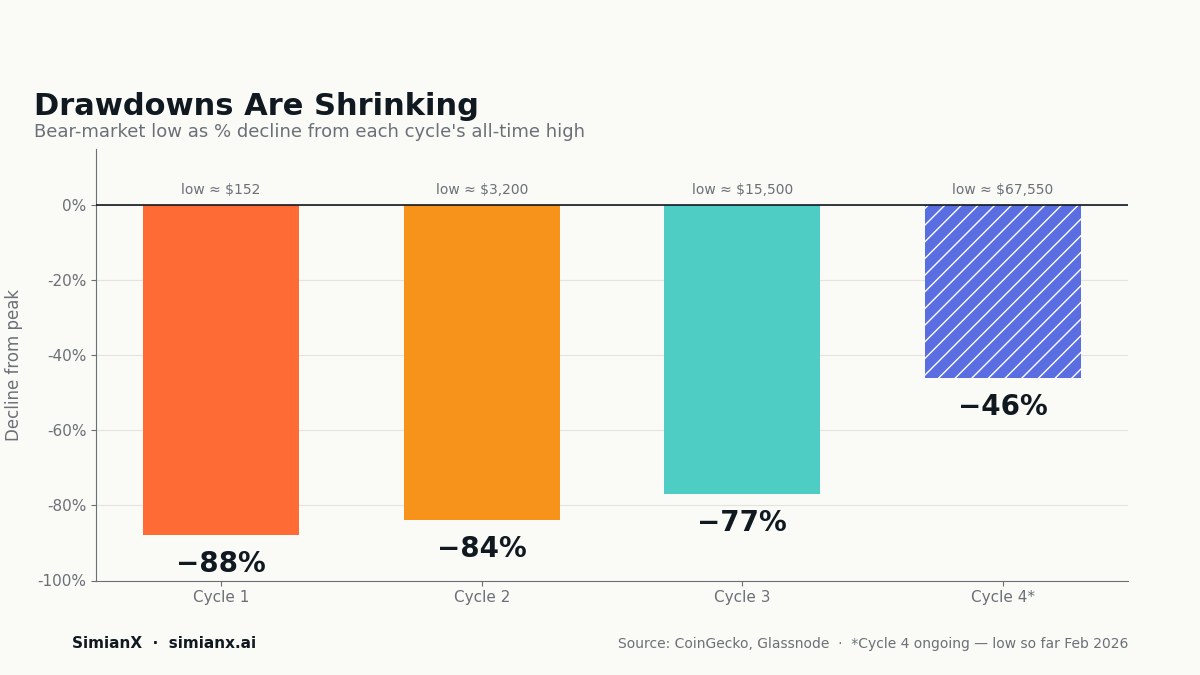
The third halving arrived in the middle of the Covid macro shock. Six weeks after BTC crashed alongside everything else to $4,000 in March 2020, the halving fired right on schedule. What followed was the cleanest textbook cycle of the four — a long, grinding rally interrupted by the May 2021 China-mining selloff, then a final blow-off into the $69,000 ATH in November 2021. The multiplier from halving to peak compressed again, from 30× to 8×. And the bear market that followed — driven by the Terra/Luna collapse, the Three Arrows blow-up, and FTX — was savage in absolute terms ($69K to $15.5K) but milder in percentage (–77%) than either of its predecessors. Drawdowns were already getting shallower.
Cycle 4 — The 2024 Halving (When the Script Started Cracking)
- Halving date: April 19, 2024 (block 840,000)
- Block reward: 6.25 BTC → 3.125 BTC
- Halving-day price: ~$63,800
- Cycle peak (so far): ~$125,836 on October 6, 2025
- Days to peak: ~535
- Multiplier: ~2×
- Drawdown low so far: ~$67,550 in February 2026
- Peak-to-trough drawdown so far: ~46%
The fourth halving is the cycle that broke the script. For the first time, Bitcoin entered a halving already trading at an all-time high — the spot Bitcoin ETFs, approved in January 2024, had already pulled forward demand that historically arrived later in the cycle. BTC went on to set a new ATH near $126,000 in October 2025, but the multiplier from halving day to that peak was only ~2×. Compare that to 103× in cycle one, 30× in cycle two, and 8× in cycle three, and you see the diminishing-returns curve in its full glory.
The post-peak action has been just as anomalous. By February 2026, BTC had pulled back to roughly $67,550 — a –46.7% drawdown from the October 2025 peak. By the time you read this, the cycle 4 bear may have made a deeper low; it may also have found its floor already. Either way, the comparison is striking: the three prior cycles each lost 77% to 88% peak-to-trough, while cycle 4 has so far only given back about half of its bull run. Shallower, but also extended — analysts increasingly describe what is happening as a five-year cycle rather than a four-year one, with peaks pulled forward and troughs softened by institutional buying.
The Complete Halving Reference Table
| # | Halving | Block | Reward | Price at Halving | Cycle Peak | Peak Date | Multiplier | Days to Peak | Bear-Market Low | Drawdown |
|---|---|---|---|---|---|---|---|---|---|---|
| 1 | Nov 28, 2012 | 210,000 | 50 → 25 BTC | $12 | $1,242 | Nov 30, 2013 | 103× | 367 | $152 (Jan 2015) | –88% |
| 2 | Jul 9, 2016 | 420,000 | 25 → 12.5 BTC | $650 | $19,783 | Dec 17, 2017 | 30× | 526 | $3,200 (Dec 2018) | –84% |
| 3 | May 11, 2020 | 630,000 | 12.5 → 6.25 BTC | $8,700 | $68,982 | Nov 10, 2021 | 8× | 548 | $15,500 (Nov 2022) | –77% |
| 4 | Apr 19, 2024 | 840,000 | 6.25 → 3.125 BTC | $63,800 | $125,836* | Oct 6, 2025* | 2×* | 535* | $67,550* (Feb 2026) | –46%* |
| 5 | ~Apr 19, 2028 | 1,050,000 | 3.125 → 1.5625 BTC | — | — | — | — | — | — | — |
\* Cycle 4 still in progress as of the publication date. Peak, days-to-peak, and drawdown numbers may revise if a higher ATH or deeper low prints before the next halving.
Patterns That Persist Across All Four Cycles
Three patterns have survived from 2012 to today.
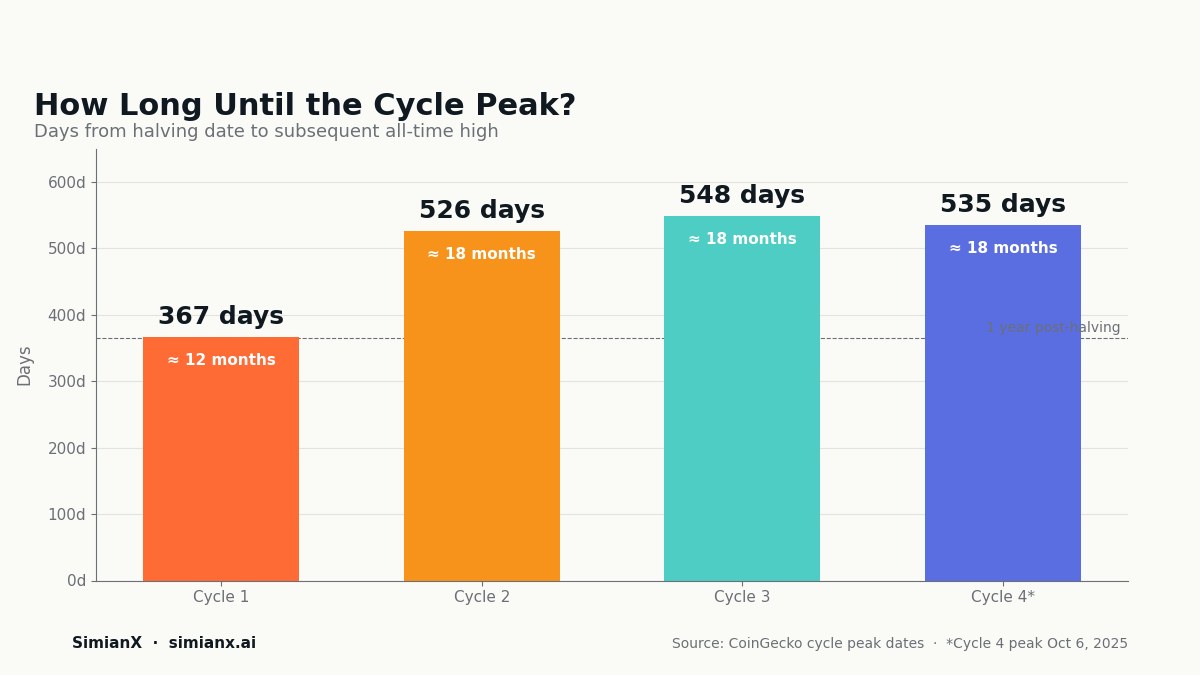
The peak comes 12 to 18 months after the halving — every time. Cycle 1 peaked in 367 days. Cycle 2 in 526 days. Cycle 3 in 548 days. Cycle 4 in roughly 535. Despite all the structural changes between 2012 and 2024 — ETFs, derivatives markets, treasury buyers, regulators — the calendar window has been almost mechanically consistent.
The multiplier shrinks each cycle. From 103× to 30× to 8× to 2×. The intuition is straightforward: each cycle starts from a much bigger market cap, so the same dollar inflows produce a much smaller percentage move. A $5B market cap can 100×; a $1.2T market cap cannot.
Drawdowns are getting shallower. –88%, –84%, –77%, and so far –46%. A more institutional holder base, with longer time horizons and the ability to buy on weakness, has progressively absorbed the panic that used to drive cycles to obliterate prior gains.
Cycle 5 — The 2028 Halving
The next halving will occur at block 1,050,000. At the current ~10-minute average block time, that points to roughly April 19, 2028. The block reward will fall from 3.125 BTC to 1.5625 BTC, and daily new issuance will halve from about 450 BTC to roughly 225 BTC.
Three structural facts will frame whatever cycle 5 looks like. First, the supply shock is smaller in absolute terms than any prior halving — 225 BTC per day is a rounding error against ETF demand of 5,000–20,000 BTC per day in active months. Second, by 2028 the percentage of Bitcoin held by spot ETFs and corporate treasuries will be materially higher than it was in April 2024. Third, every halving since 2012 has produced a new ATH within 18 months. A failure of cycle 5 to do the same would be the first such failure in Bitcoin's history.
Is the Four-Year Cycle Dead?
It is fashionable in 2026 to declare the halving cycle dead. The argument: ETFs, institutional flows, and macro liquidity now dominate the price action so completely that the halving has become noise — a curiosity, not a catalyst. The fact that the year after the 2024 halving (i.e. 2025) ended in the red for the first time in Bitcoin's history is the headline exhibit.
The counterargument is structural. The halving still cuts new supply by 50%. Miners still have to sell roughly the same dollar amount of BTC to cover the same dollar-denominated cost base — meaning the halving forcibly reduces the daily sell-side from natural new issuance. That mechanic does not stop working because ETFs exist. It just becomes a smaller component of total flow.
The most useful read is probably the middle one: the cycle is not dead, but it is being stretched and dampened. Peaks may stretch further past 18 months. Drawdowns may stop at 40–50% instead of 80%. The 100× cycles of 2012 are gone forever; what replaces them is closer to a tradeable equity volatility regime than to a meme-coin parabola. That is exactly what you would expect from an asset crossing the threshold from speculative outlier to global macro asset.
How to Track Halving Cycles in Real Time
If you want to follow the cycle 4 → cycle 5 transition with more than a price chart, the SimianX crypto leaderboard runs 30 large language models — including the latest from Anthropic, OpenAI, Google, xAI, DeepSeek, and Alibaba — through live BTC and altcoin predictions every cycle. You can drill into the Bitcoin asset page to see how each model's call has performed against actual price action, or compare it with cycle leaders like Ethereum and Solana. For automated execution against those signals, the SimianX autopilots layer translates leaderboard consensus into rule-based crypto strategies.
Frequently Asked Questions
When is the next Bitcoin halving?
The next halving is scheduled for block 1,050,000, which the network is currently on pace to mine on or around April 19, 2028. The exact date can drift by a few days depending on average block time over the preceding months.
What is the block reward after the 2028 halving?
The block reward drops from 3.125 BTC to 1.5625 BTC. Daily new BTC issuance falls from roughly 450 BTC to roughly 225 BTC.
Does Bitcoin always go up after a halving?
Every halving since 2012 has been followed by a new all-time high within 18 months. The peak multiplier has shrunk each cycle (103× → 30× → 8× → 2×) and the path is not a straight line — every cycle has included multiple 20%+ pullbacks on the way up.
How long do bear markets last after a halving cycle peak?
The 2014 bear lasted about 14 months. The 2018 bear lasted about 12 months. The 2022 bear lasted about 12 months. Cycle 4's bear, if it has begun, started around October 2025; its full duration is not yet known.
What was Bitcoin's all-time high in the current cycle?
Bitcoin reached approximately $125,836 on October 6, 2025 — the cycle 4 high so far. That number can be revised higher if a new ATH prints before the April 2028 halving.
Will the halving still matter once Bitcoin's market cap is $5 trillion?
The mechanical effect — cutting new supply in half — will continue until the last fraction of a BTC is mined around the year 2140. The market impact has been shrinking each cycle and will likely keep shrinking. By the cycle 7 or 8 halving, the new-supply cut will be small enough that the halving may be more symbolic than market-moving. The first four cycles, summarised in this article and in our companion story library, are the ones with the cleanest signal.
The Bottom Line
Four halvings, four cycles, four new all-time highs — each smaller in magnitude and each followed by a shallower drawdown than the last. The 2024 halving has, for the first time, produced a cycle that looks more like a maturing macro asset than a speculative supernova. Whatever happens between now and the April 2028 halving, the historical record above is the data set every Bitcoin thesis has to reconcile with. Bookmark it, come back to it on each anniversary, and watch as the fifth row of the reference table gets filled in.
Related Reading
- Bitcoin Crash Feb 2026: $60K Bottom or More Pain Ahead?
- Crypto Open Interest Spike: What It Really Signals
- How to Trade a Crypto Bear Market: 2026 Survival Playbook