Nvidia Hugging Face Deal 2026: $12.9B at 86x Revenue

Nvidia Hugging Face Deal 2026: $12.9B at 86x Revenue

Nvidia's reported $12.9B Hugging Face deal values the open-model hub at 86x revenue. What it buys, the regulatory risk, and what NVDA holders should watch.

2026-08-27
·
23 min read
Market Pulse
Listen to article

Buying the Top of the AI Funnel: Inside Nvidia's Reported Hugging Face Acquisition

The reported Nvidia Hugging Face deal could become one of the most strategically important transactions in the artificial-intelligence industry. According to The Information, Nvidia has agreed to acquire Hugging Face for approximately $12.9 billion, valuing the open-source AI platform at roughly 80 times forward revenue. However, other reports have described the transaction as ongoing talks without a signed agreement, and neither Nvidia nor Hugging Face had publicly confirmed the deal when this research was prepared. The Information report, TechCrunch analysis

The potential acquisition matters because Hugging Face is more than a model repository. It is a developer community, collaboration layer, model-distribution network and increasingly important gateway between open-source software and commercial AI infrastructure.

For Nvidia, buying Hugging Face could mean gaining influence over which models developers discover, download, fine-tune and deploy. That is why the transaction is being described as a purchase of the “AI developer funnel.” SimianX AI, which combines fundamental, technical and news-based research tools, can help investors track how this type of strategic acquisition affects Nvidia’s valuation and competitive position.

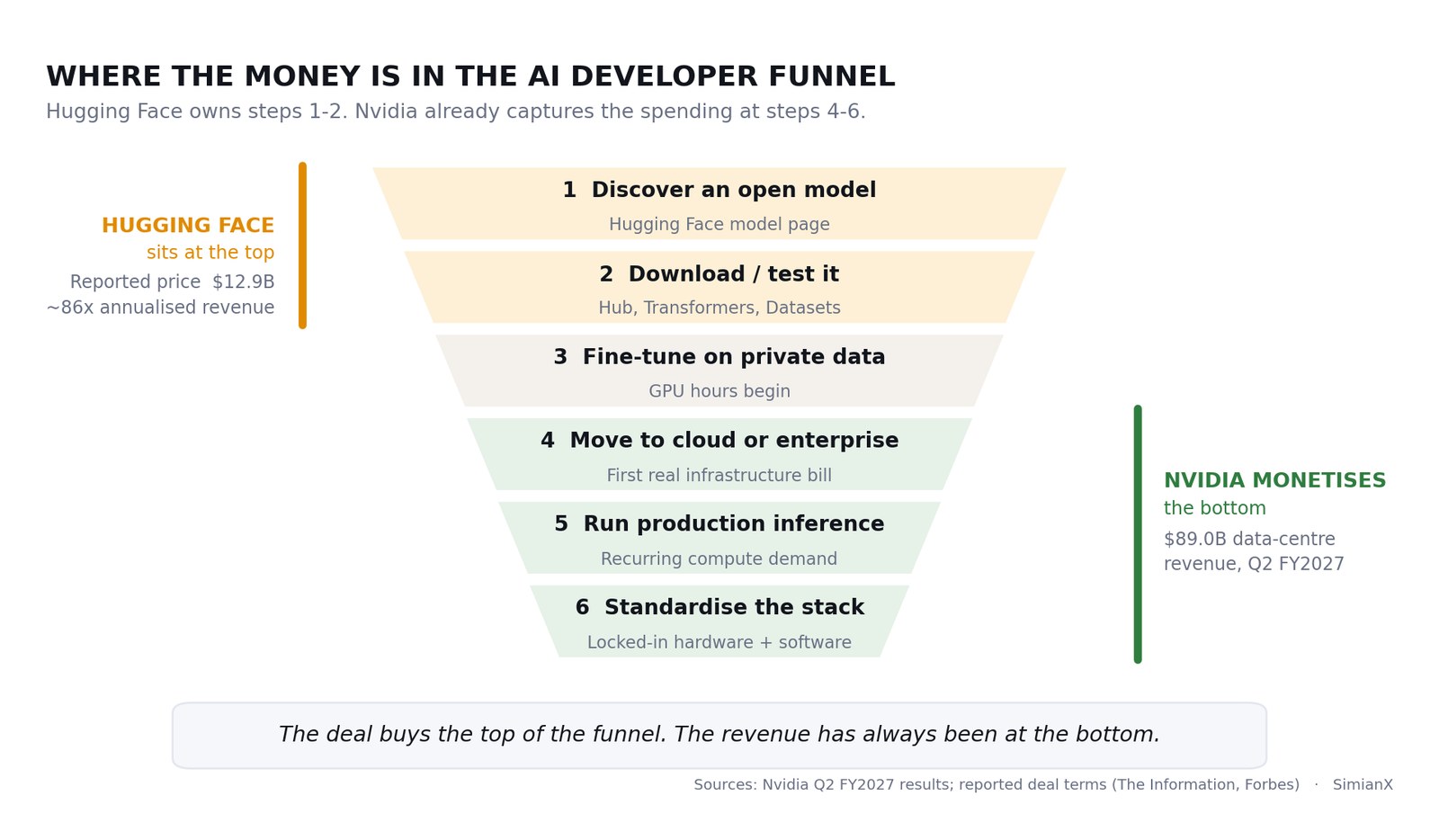
SimianX AI Where value is captured in the AI developer funnel, from model discovery to production compute
Where value is captured in the AI developer funnel, from model discovery to production compute

What Is the Reported Nvidia Hugging Face Deal?

The reported transaction would place Hugging Face inside Nvidia’s broader AI ecosystem. The exact structure—cash, stock, retention packages or a combination—has not been publicly disclosed. It is also not yet clear whether the agreement is final, conditional or still subject to due diligence and regulatory review.

The reported price represents a significant increase from Hugging Face’s previous private-market valuation. In August 2023, Hugging Face raised $235 million in Series D funding at a valuation of approximately $4.5 billion. Nvidia participated in that round alongside investors including Salesforce Ventures, Google, Amazon, Intel, AMD, Qualcomm and IBM. Axios coverage of Hugging Face’s 2023 funding

The proposed $12.9 billion value would therefore be almost three times the 2023 valuation. That increase could be justified if Hugging Face has become a central distribution layer for open models, enterprise AI tools and developer workflows. But it also creates a demanding financial question: can Nvidia generate enough strategic and economic value to justify paying a very high revenue multiple for a private software company?

Deal-status caution

Investors should separate confirmed facts from reported claims:

  • The Information reported that Nvidia agreed to acquire Hugging Face for $12.9 billion.
  • TechCrunch reported that the deal was not confirmed and could still fall apart.
  • Business Insider previously reported takeover interest and negotiations.
  • Nvidia and Hugging Face had not issued a definitive public announcement at the time of writing.
  • The final price, closing date, financing structure and regulatory conditions remain unknown.

This distinction is essential. A reported agreement is not the same as a completed acquisition. The transaction could be renegotiated, delayed or abandoned.

Why Hugging Face Matters to the AI Industry

Hugging Face is often compared with GitHub, but the comparison is incomplete. GitHub is primarily a platform for sharing source code. Hugging Face is focused on models, datasets, machine-learning applications and development tools.

The platform allows developers and researchers to:

  • Upload and download open-weight models.
  • Share datasets for training and evaluation.
  • Run model demonstrations and applications.
  • Collaborate on natural-language, image, audio and multimodal systems.
  • Fine-tune models for specialized use cases.
  • Access libraries such as Transformers, Datasets and Diffusers.
  • Deploy models through hosted inference and enterprise services.

The platform’s strategic value comes from network effects. More developers attract more models. More models attract more users. More usage creates feedback, documentation and community knowledge, which in turn makes the platform more useful.

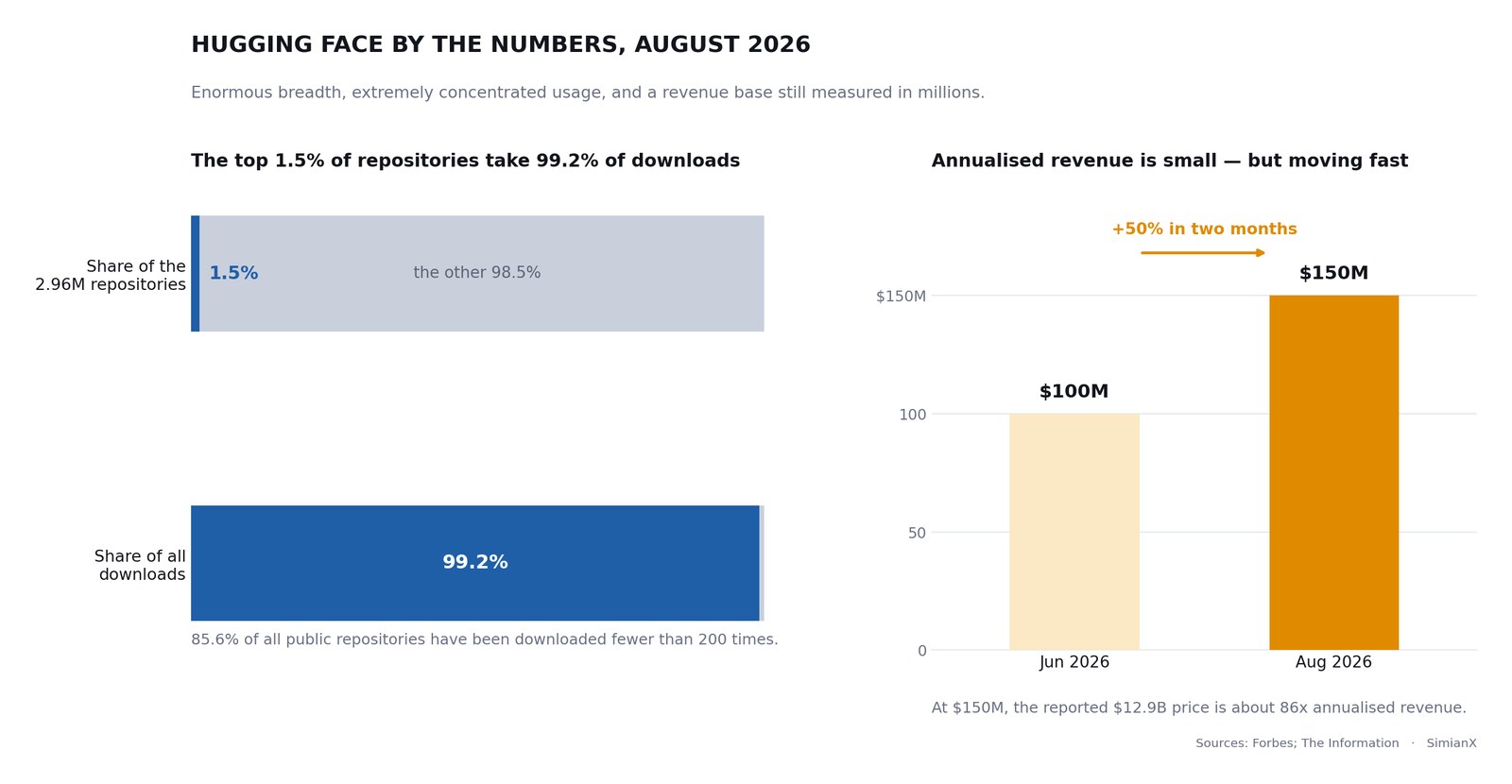
According to reporting cited by Forbes, Hugging Face hosted approximately 2.96 million public model repositories, although downloads are extraordinarily concentrated: 85.6% of those repositories have been downloaded fewer than 200 times, and the top 1.5% of repositories account for 99.2% of all downloads. Forbes analysis

That concentration has two implications. First, Hugging Face has enormous breadth and visibility. Second, the company must continue identifying, supporting and commercializing the models that generate meaningful enterprise demand.

Hugging Face is valuable because it helps determine where AI experimentation begins—and which infrastructure providers benefit when experiments become production workloads.

SimianX AI Hugging Face by the numbers: 2.96 million repositories, 99.2% of downloads in the top 1.5%
Hugging Face by the numbers: 2.96 million repositories, 99.2% of downloads in the top 1.5%

Is Nvidia Buying the AI Developer Funnel?

The “developer funnel” concept describes the path from experimentation to infrastructure spending:

  1. A developer discovers an open model.
  2. The developer downloads or tests it.
  3. The model is fine-tuned on proprietary data.
  4. The project moves into a cloud or enterprise environment.
  5. Production inference creates recurring demand for compute.
  6. The organization standardizes its software and hardware stack.

Nvidia currently captures enormous value at the infrastructure stage through GPUs, networking, CUDA software and full data-center systems. Hugging Face operates much closer to the beginning of the funnel.

By owning the discovery and collaboration layer, Nvidia could influence technical decisions before a company commits to hardware. That influence could be strategically powerful even if Hugging Face’s direct revenue remains modest.

Potential funnel advantages for Nvidia

Earlier visibility into developer preferences

Hugging Face can reveal which model architectures, libraries and optimization techniques are gaining adoption. This information could help Nvidia prioritize software integrations, inference optimizations and hardware road maps.

More Nvidia-native workflows

Nvidia could integrate CUDA, TensorRT, NIM microservices and DGX Cloud more deeply into Hugging Face tools. Developers might move from a model page directly into an Nvidia-optimized training or deployment environment.

Higher conversion from experimentation to production

Many AI projects fail to move beyond prototypes. Nvidia could use Hugging Face to simplify deployment, benchmarking, security reviews and enterprise support. A smoother path to production could increase demand for Nvidia compute.

Stronger defense against competing ecosystems

Google, Amazon, Microsoft, AMD and custom-chip providers are all trying to build software ecosystems that reduce reliance on Nvidia. Hugging Face could serve as a neutral-looking distribution layer while still offering Nvidia optimized paths.

The Strategic Fit With Nvidia’s Existing AI Platform

Nvidia’s business has expanded well beyond selling graphics processors. The company now promotes a full-stack platform that includes:

  • Accelerated computing hardware.
  • Networking and data-center systems.
  • CUDA software.
  • AI libraries and developer tools.
  • DGX Cloud.
  • NIM inference microservices.
  • Enterprise support and reference architectures.
  • Investments in AI startups and infrastructure providers.

Nvidia and Hugging Face already announced a partnership in 2023 to connect Hugging Face developers with Nvidia DGX Cloud for model training and tuning. Nvidia’s partnership announcement

The acquisition would therefore extend an existing relationship rather than create an entirely new one.

Nvidia’s latest financial performance gives it substantial capacity for acquisitions. In the second quarter of fiscal 2027, Nvidia reported $96.2 billion in revenue, up 106% year over year, with data-center revenue of $89.0 billion, up 117%. Gross margin was 75%, and net income reached $59.7 billion. Nvidia Q2 fiscal 2027 results

A $12.9 billion acquisition would be large in absolute terms but manageable relative to Nvidia’s cash generation and market capitalization. The bigger risk is not affordability. It is whether the purchase creates durable shareholder value.

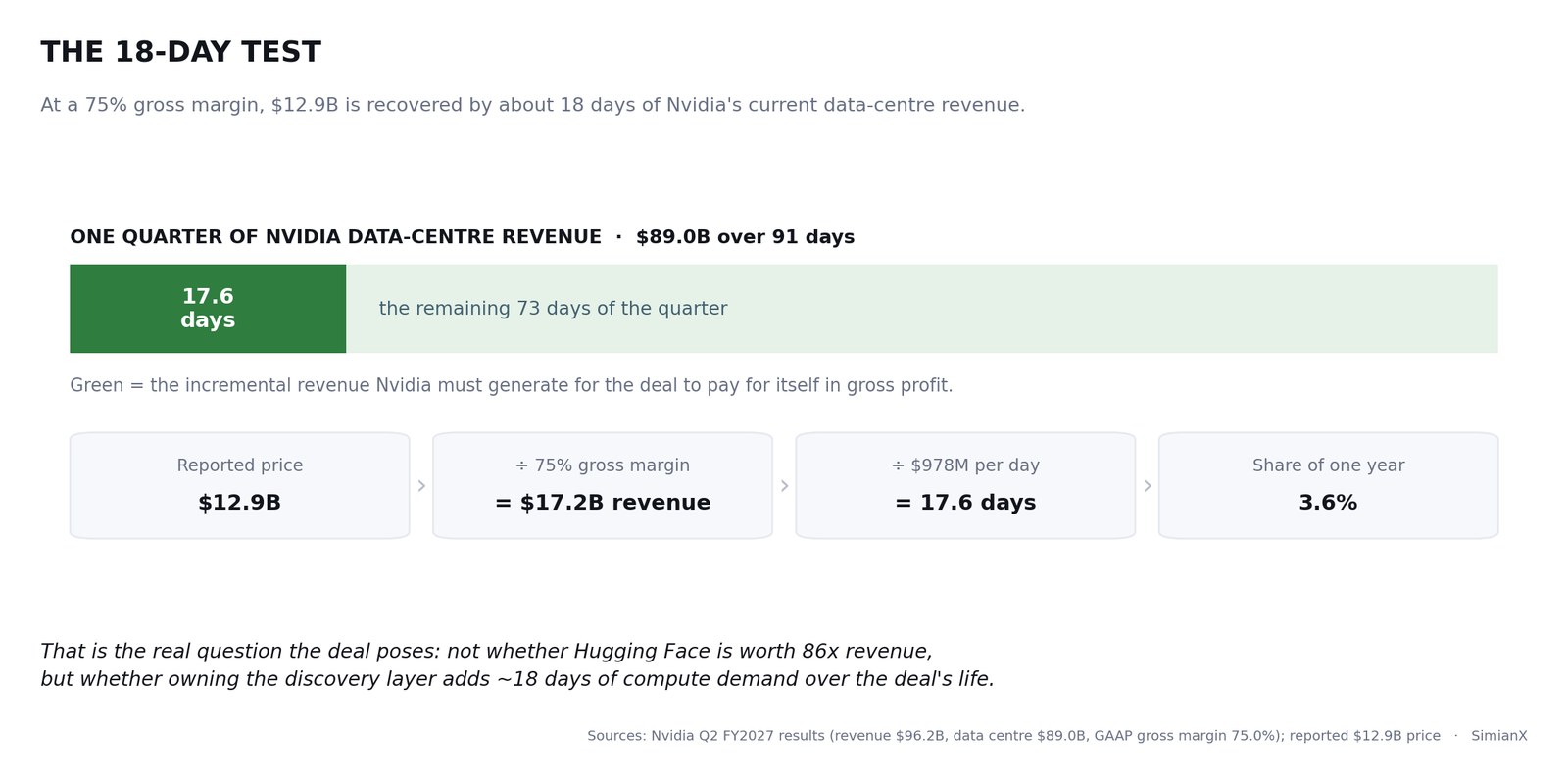
SimianX AI The 18-day test: $12.9 billion measured against Nvidia's $89.0 billion quarterly data-centre revenue
The 18-day test: $12.9 billion measured against Nvidia's $89.0 billion quarterly data-centre revenue

Why Pay $12.9 Billion for a Company With Reported Revenue Near $150 Million?

The reported valuation appears aggressive on conventional metrics. Forbes estimated that a $12.9 billion purchase price could represent approximately 86 times annualized revenue if Hugging Face generates around $150 million in annual revenue. That revenue base is small but moving quickly: Hugging Face reportedly crossed $100 million in annualized revenue in June 2026 and passed $150 million about two months later, a 50% increase in a single quarter.

That multiple is far above the valuation of mature software companies. Nvidia is not likely buying Hugging Face for current profits alone. It would be paying for strategic control over:

  • Open-model distribution.
  • Developer mindshare.
  • Enterprise AI workflows.
  • Dataset and model metadata.
  • Inference and deployment demand.
  • Future software subscriptions.
  • Potential protection against alternative hardware platforms.

The transaction resembles a platform-control investment more than a standard software acquisition.

A simple strategic valuation framework

Value sourceHow Nvidia could benefitKey uncertainty
Developer reachMore developers enter Nvidia-compatible workflowsDevelopers may resist vendor lock-in
Model distributionNvidia gains influence over model discoveryOpen-source communities can migrate
Cloud conversionMore experiments become DGX or cloud workloadsConversion rates are difficult to measure
Enterprise softwareBundled subscriptions and supportHugging Face monetization is still developing
Competitive defenseSlows AMD, Google and custom-chip adoptionRegulators may scrutinize ecosystem control
Data and insightBetter visibility into model trendsPrivacy and governance constraints

For the deal to generate an attractive return, Nvidia probably needs to measure value through the broader AI platform rather than Hugging Face’s standalone income statement.

What Could Go Right for Nvidia?

1. Open-source models become the default enterprise layer

Open models are increasingly attractive to companies that want lower cost, customization, data control and reduced dependence on a single vendor. If open-source adoption accelerates, Hugging Face could become an increasingly important commercial gateway.

2. Nvidia becomes the easiest place to deploy open models

Nvidia could combine Hugging Face’s community with its own optimized inference stack. A developer might discover a model on Hugging Face, test it on Nvidia cloud infrastructure and deploy it using Nvidia software without leaving the ecosystem.

3. Enterprise monetization scales

Hugging Face offers paid services such as private repositories, enterprise collaboration and model deployment. Nvidia could add security, compliance, performance guarantees and technical support for large customers.

4. Nvidia gains software valuation support

Chip cycles can be volatile — as documented in Semiconductor Bear Markets: Every SOX Crash, 1995-2026. A stronger software and developer platform could make Nvidia’s revenue less dependent on hardware refresh cycles and improve recurring revenue visibility.

5. The acquisition accelerates AI adoption overall

Nvidia has an incentive to increase total AI workloads, even when individual customers experiment with alternative models or providers. If Hugging Face lowers barriers to development, the resulting compute demand could benefit Nvidia broadly.

What Could Go Wrong?

The transaction also has meaningful risks.

Open-source developers may fear loss of neutrality

Hugging Face’s credibility depends partly on being perceived as a community platform rather than a sales channel for one hardware vendor. If Nvidia pushes its own models, cloud services or software too aggressively, developers could move to alternative repositories.

The platform’s value is partly based on neutrality. Nvidia must avoid turning Hugging Face into a closed Nvidia storefront.

Regulators could examine ecosystem foreclosure

Authorities may ask whether Nvidia is using its dominant position in AI accelerators to control model distribution and disadvantage competitors. Potential concerns include:

  • Preferential ranking of Nvidia-optimized models.
  • Exclusive access to performance data.
  • Bundling model hosting with Nvidia hardware.
  • Restrictions on AMD, Google or custom-chip integrations.
  • Use of developer data to disadvantage competing platforms.

The deal could attract scrutiny in the United States, European Union and other jurisdictions, especially as regulators focus on AI infrastructure concentration.

Integration could damage the community

Hugging Face has a different culture from a large public technology company. Its community includes researchers, hobbyists, startups and open-source contributors. Excessive corporate integration, monetization pressure or product changes could weaken the very network Nvidia is trying to acquire.

The valuation could embed unrealistic growth

At roughly 80–86 times forward revenue, the deal requires exceptional expansion or large strategic synergies. If Hugging Face grows slowly, Nvidia could face criticism for overpaying even if the platform remains strategically useful.

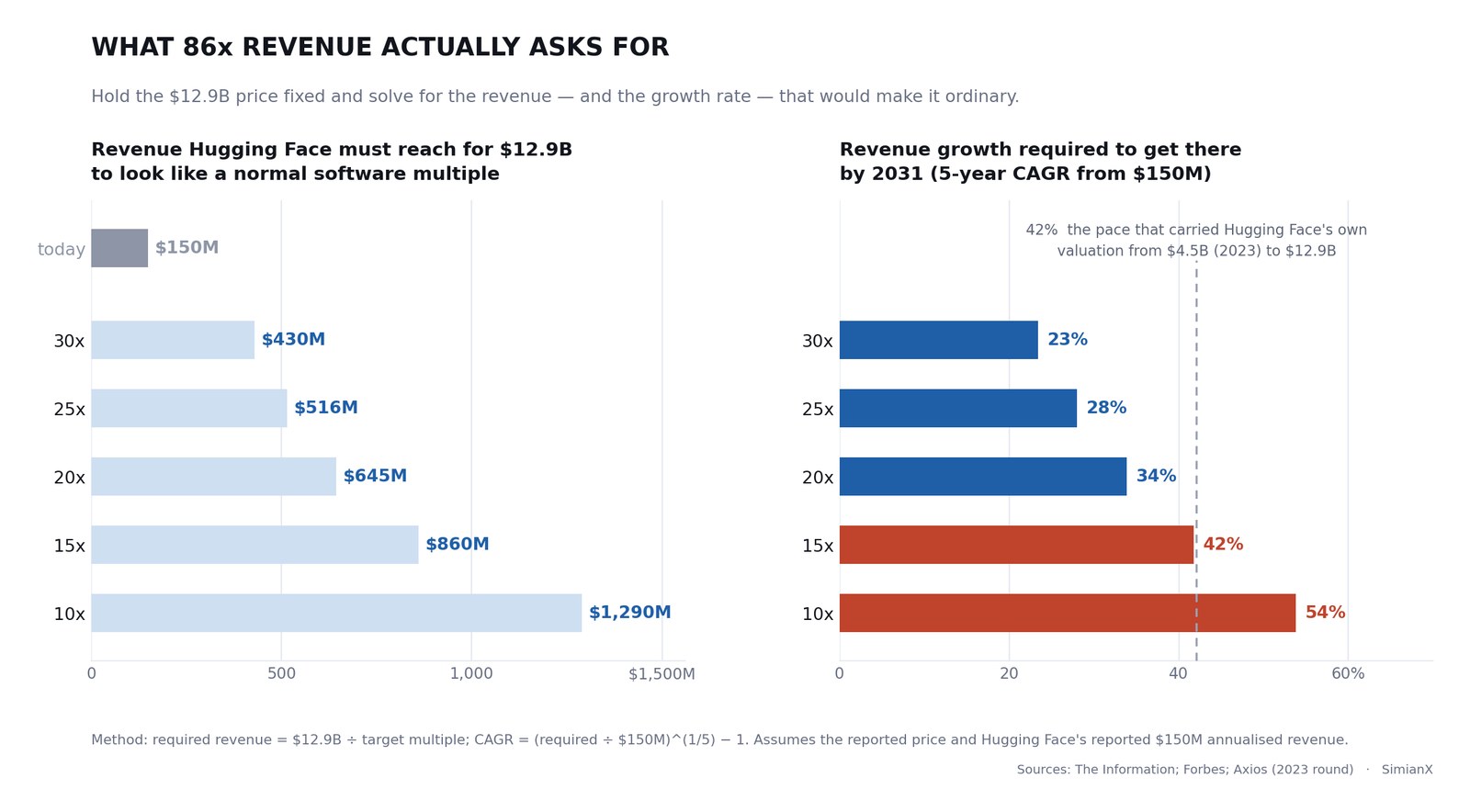
SimianX AI Revenue and growth Hugging Face would need for $12.9 billion to be a normal software multiple
Revenue and growth Hugging Face would need for $12.9 billion to be a normal software multiple

What Does the Deal Mean for Nvidia Stock?

For Nvidia shareholders, the acquisition is unlikely to materially change near-term earnings. Nvidia’s quarterly revenue is measured in tens of billions of dollars, while the transaction value would be spread over years through amortization, integration costs and potential stock issuance.

The stock-market impact will depend more on investor interpretation than immediate EPS.

Possible positive reaction

Investors may view the deal as evidence that Nvidia is building a complete AI operating system—from hardware to software to developers. This could strengthen the long-term moat and support a premium valuation.

Possible negative reaction

Investors may worry that Nvidia is spending aggressively to defend growth while its core valuation already assumes extraordinary execution. Buying a high-multiple startup could reinforce concerns about capital discipline and an AI acquisition bubble — the debate examined in Is Jensen Huang Fueling an AI Bubble? and set against a century of precedents in Every Tech Bubble Since 1929.

Neutral interpretation

The market may treat the transaction as strategically interesting but financially immaterial. Nvidia’s share price will probably remain more sensitive to data-center growth, gross margins, hyperscaler spending and export restrictions than to Hugging Face’s standalone financial contribution — a pattern visible in NVDA After Earnings: Every Reaction Since 2016.

How to Analyze Nvidia’s AI Acquisitions

Investors can use a structured framework when reviewing the reported Nvidia Hugging Face deal.

  1. Confirm the transaction.

Look for official filings, press releases, merger agreements or regulatory disclosures.

  1. Identify the asset being purchased.

Is the value in revenue, technology, talent, distribution, data or ecosystem control?

  1. Estimate standalone economics.

Review revenue growth, gross margin, recurring revenue, customer concentration and cash burn.

  1. Model synergy scenarios.

Consider cloud conversion, GPU demand, software subscriptions and reduced competitive risk.

  1. Assess community and regulatory risk.

A developer platform can lose value if users perceive vendor capture or restrictions.

  1. Compare alternatives.

Nvidia could also build similar functionality, invest in multiple platforms or partner without acquiring.

  1. Track post-deal evidence.

Watch developer activity, enterprise adoption, model downloads, Nvidia software usage and disclosures about revenue contribution.

SimianX AI can support this process by combining SEC data, earnings releases, price action, analyst sentiment and breaking news into a multi-agent research workflow. Its analysis should be treated as a supplement to independent research, not as personalized financial advice.

How Could Hugging Face Remain Independent After an Acquisition?

If the deal closes, Nvidia may need to preserve substantial operational independence. A successful structure could include:

  • Separate branding and product governance.
  • Continued support for AMD, Google TPU and other hardware.
  • Transparent ranking and recommendation policies.
  • Open APIs and exportable model formats.
  • Independent security and trust processes.
  • Clear separation between community data and Nvidia commercial sales.
  • Public commitments to open-source licenses.

This approach may seem less efficient from a corporate-control perspective, but it could maximize long-term strategic value. Nvidia does not need to control every user interaction. It needs to remain the preferred infrastructure destination when open-source projects scale.

Competitive Implications for AMD, Google, Microsoft and Amazon

The acquisition would affect more than Nvidia and Hugging Face.

AMD

AMD could face pressure to improve support for Hugging Face models, ROCm software and open-source deployment tools, an angle explored in AMD Stock 2026: The AI Chip Comeback Nvidia Can’t Ignore. A stronger Nvidia-Hugging Face integration might make hardware switching more difficult for developers.

Google

Google has major AI research capabilities and its own Tensor Processing Units, and its own capex case is set out in Alphabet Q2 Earnings 2026. It may respond by strengthening partnerships with open-model communities or expanding access to TPU-compatible tools.

Microsoft

Microsoft benefits from GitHub, Azure and its relationships with OpenAI and other AI developers; see Microsoft Q4 Earnings 2026. A Nvidia-Hugging Face combination could intensify competition between Azure’s developer funnel and Nvidia’s hardware-centered ecosystem.

Amazon

Amazon Web Services may use Bedrock, SageMaker and open-model partnerships to keep developers inside its cloud, the spending question examined in Amazon Q2 Earnings 2026. The company could emphasize multi-model portability and price competition.

Startup ecosystem

Smaller AI infrastructure companies may gain opportunities if developers seek independent alternatives to a Nvidia-controlled model hub. Open-source projects often respond to centralization by creating competing tools, mirrors or federated communities.

What Should Investors Watch After the Deal?

If the acquisition closes, several indicators will reveal whether Nvidia is creating real value.

Developer activity

Monitor model uploads, downloads, active contributors, enterprise accounts and usage of hosted inference services.

Hardware neutrality

Check whether Hugging Face continues to support non-Nvidia accelerators. A decline in neutrality could damage community trust.

Enterprise revenue

Look for disclosures about subscriptions, inference services, private hubs and large customer contracts.

Nvidia software adoption

Watch usage of CUDA, TensorRT, NIM and DGX Cloud within Hugging Face workflows.

Regulatory commitments

Track remedies, behavioral commitments, investigations and requirements related to interoperability.

Financial reporting

Nvidia may not disclose Hugging Face as a separate segment, but management could eventually discuss revenue contribution, operating expenses or strategic milestones.

FAQ About the Nvidia Hugging Face Deal

Is Nvidia buying Hugging Face for $12.9 billion?

The Information reported that Nvidia agreed to acquire Hugging Face for approximately $12.9 billion. Other reporting indicated that talks had not produced a signed agreement, and the companies had not publicly confirmed the transaction when this article was prepared.

What does the Hugging Face acquisition mean for open-source AI?

The deal could provide Hugging Face with more capital, computing resources and enterprise distribution. However, developers may worry that Nvidia could reduce the platform’s neutrality or favor Nvidia hardware and software.

Why is Hugging Face strategically important to Nvidia?

Hugging Face sits near the beginning of the AI development process, where developers choose models, tools and deployment environments. Nvidia could use that position to increase conversion from open-source experimentation into Nvidia-powered production workloads.

Is Nvidia overpaying for Hugging Face?

The reported price appears very high relative to estimated revenue, potentially around 80–86 times forward sales. The valuation could still make strategic sense if Hugging Face materially increases Nvidia’s compute demand, software revenue and ecosystem defensibility.

How should investors analyze Nvidia’s AI acquisitions?

Investors should evaluate deal certainty, standalone financials, strategic synergies, integration risks, developer sentiment and regulatory exposure. The most important question is whether the acquisition strengthens Nvidia’s long-term platform moat without damaging the open ecosystem that creates its value.

The 18-Day Test: Sizing $12.9 Billion Against Nvidia's Own Revenue

Eighty-six times revenue is the wrong yardstick for this transaction, because Nvidia is not buying an income statement. A more useful test holds the price fixed and asks how much incremental compute demand the acquisition has to create before it pays for itself.

At the 75.0% GAAP gross margin Nvidia reported for the second quarter of fiscal 2027, recovering a $12.9 billion purchase price in gross profit requires roughly $17.2 billion of additional revenue. Measured against data-center revenue of $89.0 billion for the quarter — about $978 million per day — that is 17.6 days, or 3.6% of a single year at the current run rate.

Framed that way, the question changes. It is no longer whether an open-model hub is worth 86 times its revenue. It is whether owning the discovery layer adds roughly eighteen days of compute demand over the life of the deal. That is a much lower bar than the multiple implies — and it is also why a price this high can be rational for Nvidia and irrational for almost any other buyer.

Nvidia Hugging Face deal: reference table

MeasureValueSource or derivation
Reported purchase price$12.9BThe Information, 26-27 Aug 2026
Hugging Face annualised revenue>$150MThe Information, Aug 2026
Implied revenue multiple~86x$12.9B / $150M
Annualised revenue two months earlier$100M+50% in roughly one quarter
Public model repositories2.96MForbes
Repositories downloaded fewer than 200 times85.6%Forbes
Share of downloads from the top 1.5% of repositories99.2%Forbes
Series D valuation, August 2023$4.5BAxios
Uplift versus the 2023 valuation2.87x$12.9B / $4.5B
Nvidia revenue, Q2 FY2027$96.2BNvidia investor relations
Nvidia data-center revenue, Q2 FY2027$89.0BNvidia investor relations
Nvidia GAAP gross margin, Q2 FY202775.0%Nvidia investor relations
Price as a share of one quarter of Nvidia revenue13.4%$12.9B / $96.2B
Incremental revenue needed to recover the price$17.2B$12.9B / 0.750
Days of data-center revenue that represents17.6$17.2B / ($89.0B / 91)
Price as a share of annualised data-center revenue3.6%$12.9B / $356B

What each valuation multiple would require

Hold the $12.9 billion price fixed and solve backwards. For the deal to look like an ordinary software acquisition rather than a strategic one, Hugging Face has to grow into the price.

Target multipleRevenue requiredVersus $150M today5-year CAGR needed
30x$430M2.9x23%
25x$516M3.4x28%
20x$645M4.3x34%
15x$860M5.7x42%
10x$1,290M8.6x54%

A 42% five-year compound growth rate is demanding but not unprecedented: it is roughly the pace at which Hugging Face's own valuation moved from $4.5 billion in 2023 to a reported $12.9 billion in 2026. The 54% required to reach a conventional 10x software multiple is a considerably harder ask.

Methodology. Figures are as reported on 27 August 2026 and describe a transaction neither company has confirmed. Required revenue = $12.9B divided by the target multiple. CAGR = (required revenue / $150M) raised to the power 1/5, minus 1. Daily data-center revenue = $89.0B divided by 91 days. All Nvidia figures are GAAP, from the company's second-quarter fiscal 2027 results.

Conclusion

The reported Nvidia Hugging Face deal is best understood as a strategic bet on the distribution layer of artificial intelligence. Nvidia already controls much of the infrastructure stack through GPUs, networking, CUDA and data-center systems. Hugging Face would give it a stronger position at the developer and model-discovery layer.

The upside is substantial. Nvidia could gain earlier visibility into model trends, convert more developers into paying infrastructure users, expand enterprise AI software and defend itself against competing chips and cloud platforms.

The risks are equally significant. A $12.9 billion price implies extraordinary expectations. Open-source developers may resist vendor control, regulators may investigate ecosystem foreclosure, and integration could weaken Hugging Face’s neutrality. The transaction is also not fully confirmed, so investors should avoid treating the reported agreement as a completed acquisition.

The most important long-term test will be whether Hugging Face remains an open, trusted developer community while becoming a more effective bridge into Nvidia-powered production AI. Investors can use SimianX AI to monitor Nvidia’s fundamentals, valuation, technical trends, filings and news as the deal develops. SimianX AI is a research and education platform—not a substitute for professional financial advice—so verify major claims independently and consider your own risk tolerance before making investment decisions.

Related Reading

References

Ready to Transform Your Trading?

Join thousands of investors using AI-powered analysis to make smarter investment decisions

Today's most analyzed — click to enter the Live Command Room