 By Muke
Why PayPal's 13% Drop Was a Premium Unwind, Not a Verdict
PayPal stock crashes 13% after the reported $53 billion Stripe-Advent takeover pursuit falls apart—but the headline tells only half the story.
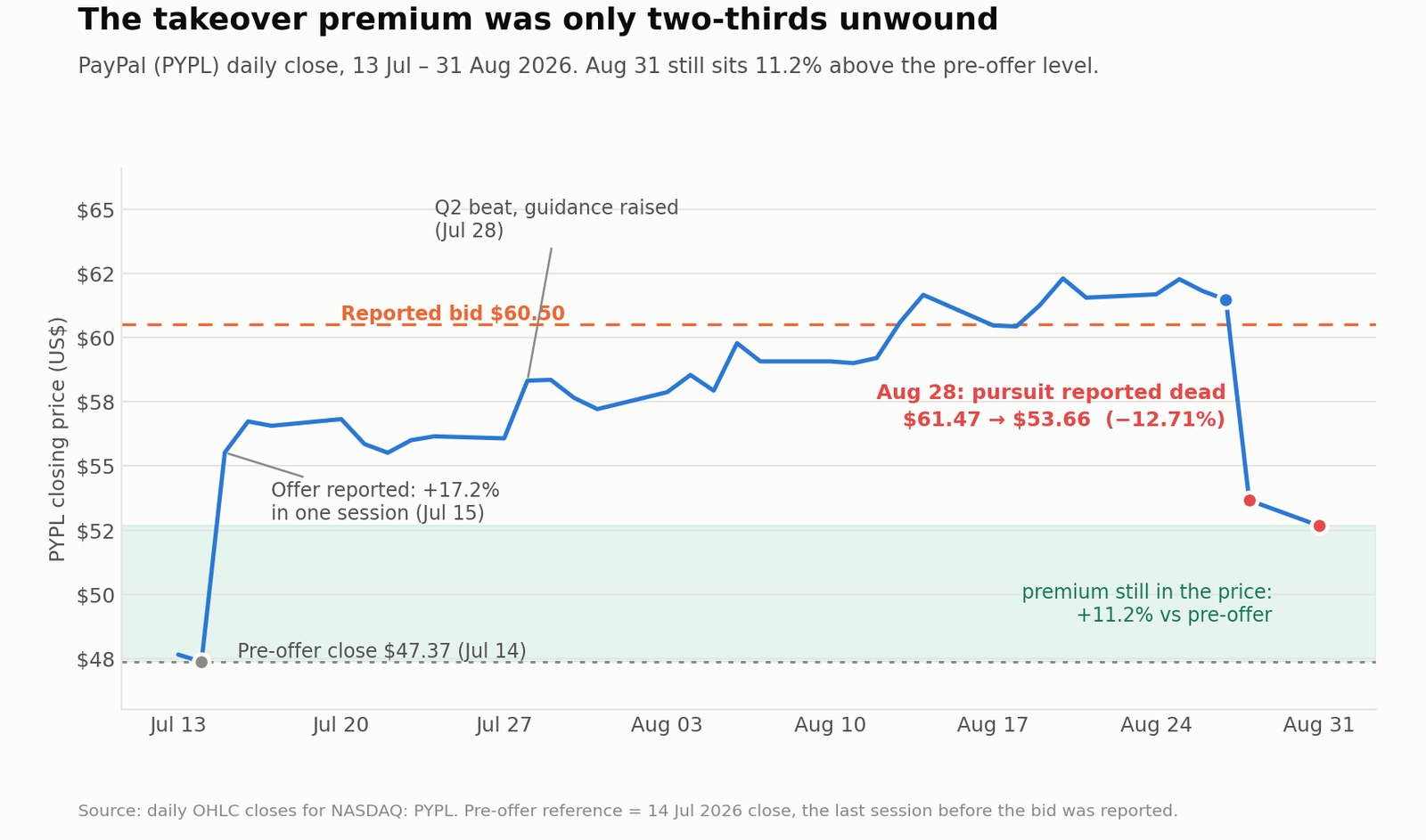
On August 28, 2026, shares of PayPal Holdings (NASDAQ: PYPL) closed at $53.66, falling 12.71% in one session on unusually heavy trading volume. The decline followed reports that payment processor Stripe and private-equity firm Advent International had abandoned their pursuit of PayPal.
The proposed price had reportedly been $60.50 per share, valuing PayPal at more than $53 billion. However, an essential distinction is being lost in some coverage: PayPal never announced a signed merger agreement. The offer and negotiations were reported by media outlets citing people familiar with confidential discussions. PayPal, Stripe and Advent declined to publicly confirm the details.
Therefore, this was not the cancellation of a completed buyout. It was the removal of a takeover scenario that had become embedded in PayPal’s share price.
The market’s message is nevertheless clear: without a potential buyer establishing a valuation floor, investors must decide what PayPal is worth as an independent company. That requires examining branded checkout, Venmo, Braintree, margins, free cash flow, capital returns and the turnaround led by CEO Enrique Lores.
This detailed PayPal turnaround analysis for 2026 separates takeover speculation from operating reality. Investors can also use SimianX AI to follow changes in PayPal’s fundamentals, technical indicators, filings and news sentiment as the standalone thesis develops.
All market prices and public information in this article are based on data available through August 31, 2026. This research is for informational purposes and is not personalized investment advice.
What Happened to the $53 Billion Stripe-PayPal Deal?
In July 2026, reports said Stripe and Advent International had jointly offered to acquire PayPal for $60.50 per share, representing a premium of approximately 28% to PayPal’s price before the offer became public.
The reported transaction would have been one of the largest leveraged buyouts in history and potentially the largest fintech acquisition ever. The proposal reportedly had roughly $50 billion of committed bank financing behind it.
The strategic logic was understandable:
- Stripe would gain PayPal’s enormous consumer network.
- Stripe could add Venmo as a direct consumer-finance channel.
- PayPal’s Braintree operation would expand Stripe’s merchant-processing scale.
- PayPal Credit and buy-now-pay-later products would add financial-services capabilities.
- PayPal’s
PYUSDstablecoin could complement Stripe’s crypto and stablecoin infrastructure. - Advent could supply acquisition capital and restructuring expertise.
However, PayPal’s board reportedly considered the initial offer insufficient. The difference between PayPal’s expectations and the consortium’s willingness to pay appears to have remained too large.
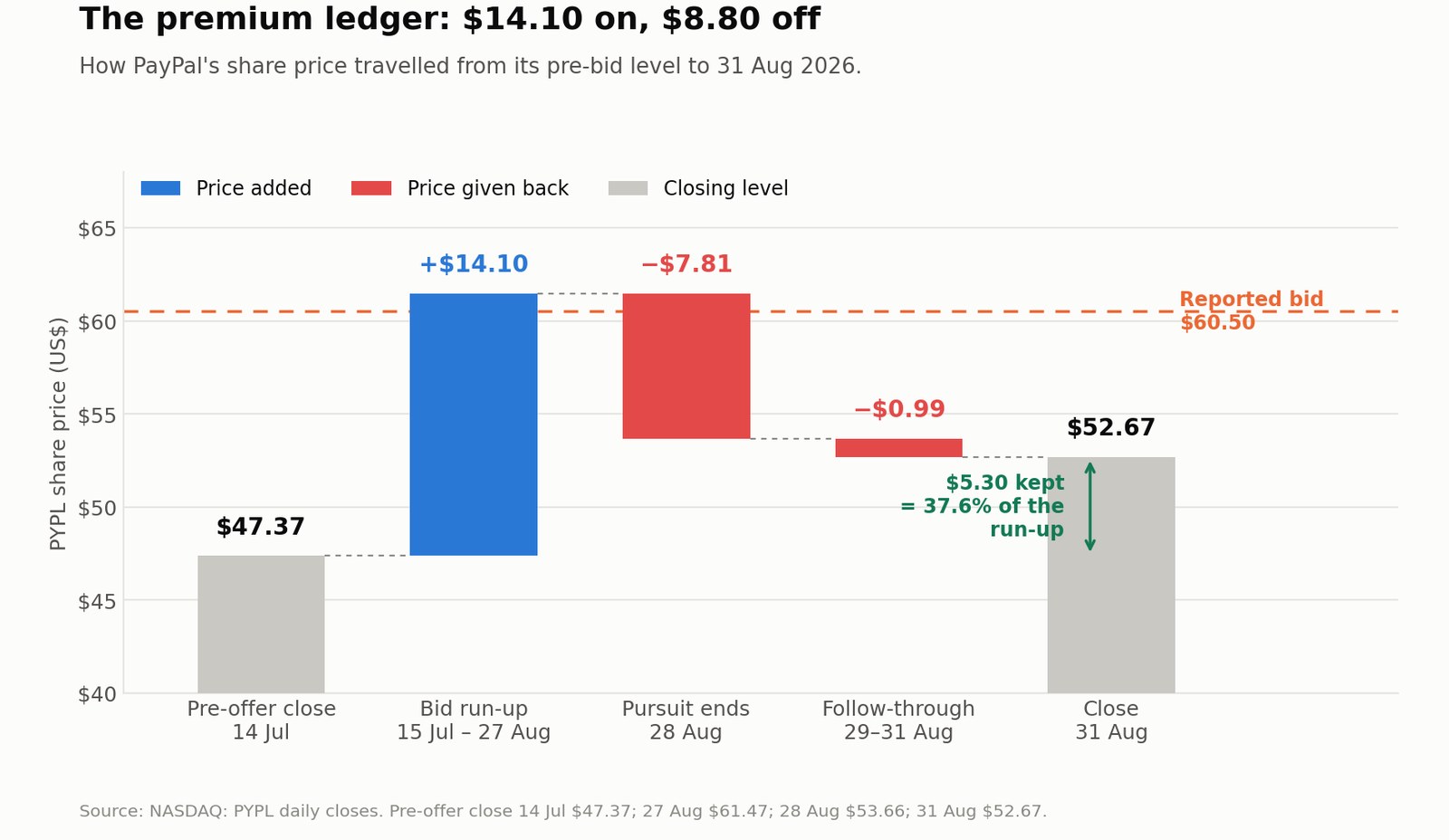
PayPal shares closed at $61.47 on August 27, slightly above the reported $60.50 offer. That price implied that investors expected one of three outcomes:
- Stripe and Advent would raise the bid.
- Another buyer would appear.
- PayPal’s improving results justified a valuation above the original proposal.
When reports emerged that Stripe and Advent had ended their pursuit, this merger premium disappeared. PayPal closed the following session at $53.66, down 12.71%. Historical market data show the August 28 close and decline.
| Takeover timeline | Reported development | Market significance |
|---|---|---|
| July 2026 | Stripe and Advent reportedly offer $60.50 per share | Establishes a perceived valuation floor |
| July 15 | PayPal shares surge after the offer is reported | Investors price in takeover probability |
| Late July | PayPal reports better-than-expected Q2 results | Board gains a stronger standalone argument |
| August 27 | PayPal closes at $61.47 | Market expects a higher offer or improving fundamentals |
| August 28 | Consortium reportedly ends its pursuit | Takeover premium disappears |
| August 28 close | PayPal falls 12.71% to $53.66 | Standalone valuation returns to focus |
Bloomberg, Reuters and Axios all reported that valuation disagreements and potential regulatory difficulties complicated the transaction. The combination of two large payment-processing businesses would also have attracted extensive antitrust review. Reuters’ report on the consortium ending its pursuit noted that PayPal continued to trade at a discount to payment-industry peers.
The 13% decline does not mean PayPal’s operations lost 13% of their value overnight. It means the market abruptly removed a probability-weighted takeover premium.
Why Did PayPal Reject a $53 Billion Offer?
A $53 billion valuation sounds enormous in isolation, but context changes the interpretation.
At the height of the pandemic-era digital-commerce boom in 2021, PayPal’s equity value approached $360 billion. Although that valuation was excessive, accepting roughly $53 billion would have crystallized an extraordinary loss of shareholder value.
PayPal’s board also had reasons to believe the offer undervalued the company:
- PayPal generated $33.2 billion of revenue in 2025.
- Full-year 2025 free cash flow reached approximately $5.6 billion.
- The company ended Q2 2026 with 439 million active accounts.
- PayPal processed $486.4 billion of payment volume in Q2 alone.
- The company was repurchasing stock aggressively.
- Q2 results exceeded expectations and management raised its non-GAAP guidance.
- Venmo and Braintree were showing stronger momentum than branded checkout.
- A new restructuring program had only recently begun.
At $60.50 per share, the consortium may have been attempting to acquire PayPal before the turnaround produced visible results. From the buyer’s perspective, that was rational. From PayPal’s perspective, selling too early could transfer most of the turnaround upside to Stripe and Advent.
The tension can be summarized simply:
| PayPal board’s possible view | Buyer’s possible view |
|---|---|
| Current earnings understate long-term potential | Legacy technology requires expensive modernization |
| Venmo is becoming more valuable | Venmo monetization remains incomplete |
| Branded checkout can recover | Apple Pay and Shop Pay are taking share |
| Buybacks can lift per-share value | Financial engineering cannot replace growth |
| Braintree provides strategic processing scale | Braintree has lower margins than branded checkout |
| The reported bid undervalues optionality | A higher bid would make returns unattractive |
| The balance sheet supports independence | Regulatory and integration risks demand a discount |
The board’s decision can only be judged over time. Rejecting $60.50 will look disciplined if PayPal sustainably exceeds that price through operating improvement. It will look costly if branded checkout continues losing relevance and shares fall back toward their pre-offer level.
PayPal’s Q2 2026 Results: Better Than the Stock Narrative
PayPal’s second-quarter results were not spectacular, but they were stronger than the post-crash narrative might suggest.
According to PayPal’s Q2 2026 earnings release filed with the SEC:
| Q2 2026 metric | Result | Year-over-year change |
|---|---|---|
| Net revenue | $8.682 billion | +5% |
| Currency-neutral revenue | — | +3% |
| Total payment volume | $486.4 billion | +10% |
| Currency-neutral TPV | — | +9% |
| Payment transactions | 6.75 billion | +8% |
| Active accounts | 439 million | +0.3% |
| Transactions per active account | 60.0 | +3% |
| Transaction margin dollars | $3.900 billion | +1% |
| GAAP operating income | $1.427 billion | -5% |
| GAAP operating margin | 16.4% | -171 basis points |
| GAAP net income | $1.104 billion | -12% |
| GAAP diluted EPS | $1.25 | -3% |
| Non-GAAP diluted EPS | $1.38 | -1% |
| Free cash flow | $1.775 billion | +157% |
These figures reveal two competing realities.
The positive interpretation
PayPal’s network remains enormous and active. Payment volume rose 10%, transaction growth accelerated, engagement improved and free cash flow rebounded sharply. Management also raised full-year non-GAAP guidance.
The negative interpretation
Revenue grew much more slowly than payment volume. Transaction margin dollars increased just 1%, operating income declined, margins contracted and active-account growth was nearly flat.
The central problem is monetization quality. Processing a larger amount of money does not necessarily create attractive shareholder value if lower-margin volume accounts for most of the growth.
PayPal’s unbranded processing business, including Braintree, can add large volumes at relatively low take rates — the share of each payment PayPal keeps. Branded checkout generally produces better economics because consumers actively choose PayPal and merchants pay for access to its trusted network.
PayPal’s turnaround does not depend on TPV growth alone. It depends on converting TPV into higher transaction-margin dollars, earnings and sustainable free cash flow.
Branded Checkout Is Still the Make-or-Break Business
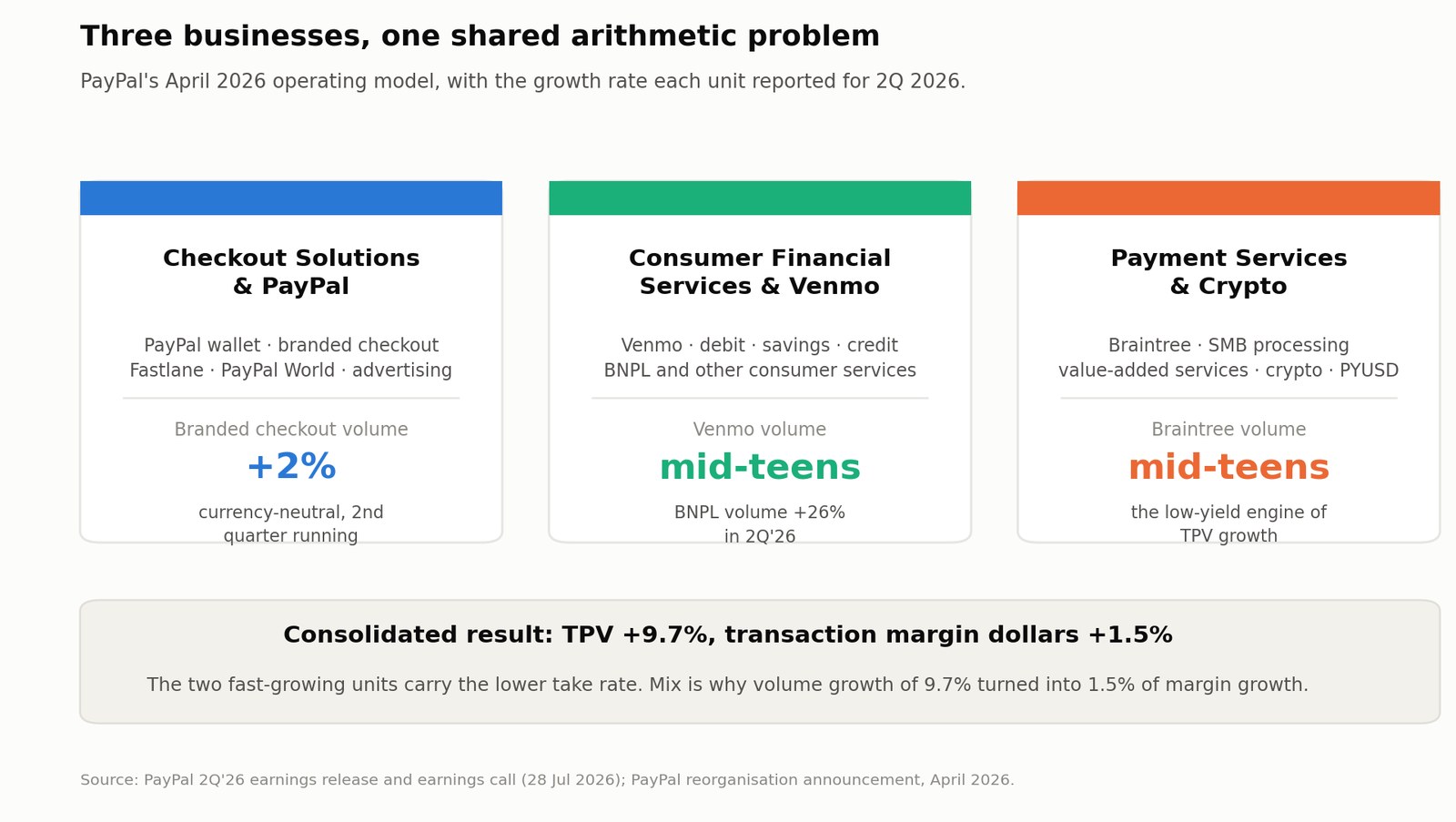
PayPal’s branded checkout volume grew only 2% on a currency-neutral basis in Q2 2026, roughly stable with the first quarter. Management described this as further stabilization, which is better than deterioration but far from a convincing recovery. It was the second consecutive quarter at that rate, and management raised its full-year branded-checkout outlook to low-single-digit currency-neutral growth.
Branded checkout matters because it represents the most recognizable and economically attractive part of PayPal’s ecosystem. When consumers select a PayPal button at checkout, PayPal owns more of the relationship, has stronger pricing power and can cross-sell additional products.
The competitive threat is severe.
Apple Pay
Apple Pay benefits from default placement across iPhones, Safari and Apple’s broader device ecosystem. Authentication is fast, and consumers do not need to open a separate PayPal app or remember a password.
Google Pay
Google can integrate its wallet into Android, Chrome and other services, giving it a distribution advantage on mobile devices and web browsers.
Shop Pay
Shopify’s checkout product benefits from direct integration with millions of online merchants. Shop Pay can remember customer information and create a low-friction buying experience across participating stores.
Stripe
Stripe is deeply embedded in developer workflows and merchant infrastructure. It can control much of the payment stack before the consumer ever encounters a branded PayPal button.
Affirm and Klarna
Buy-now-pay-later companies compete for customer attention at checkout by offering financing as part of the payment decision.
The Associated Press reported that Apple had overtaken PayPal as a leading checkout option according to estimates cited by analysts, highlighting the difficulty PayPal faces as wallet functionality becomes integrated into operating systems. AP’s examination of PayPal’s checkout challenge also noted that PayPal’s stock remained dramatically below its pandemic-era peak.
For the turnaround to work, branded checkout must move beyond stabilization toward durable growth.
Investors should monitor:
- Branded-checkout TPV growth.
- Mobile checkout conversion rates.
- Merchant adoption of Fastlane.
- Guest-checkout improvements.
- The number of consumers using PayPal as a preferred wallet.
- Cross-selling between PayPal checkout, debit cards and rewards.
- International checkout growth.
- Transaction-margin contribution from branded experiences.
Can Venmo Become PayPal’s Second Growth Engine?
Venmo is one of PayPal’s strongest strategic assets. It has cultural relevance among younger U.S. consumers and a strong position in peer-to-peer payments.
The problem is that peer-to-peer transfers often generate little direct revenue. Sending money between friends may build engagement, but PayPal must convert that activity into profitable financial behavior.
The opportunity includes:
- Venmo debit-card spending
- Pay with Venmo at merchants
- Instant-transfer fees
- Credit products
- Direct deposit
- Merchant offers
- Advertising and commerce discovery
- Savings and broader financial services
Management said Q2 growth was being diversified through Venmo and Braintree. Both grew volume in the mid-teens during the quarter, and buy-now-pay-later volume rose 26%. The company’s new organizational model places Venmo inside Consumer Financial Services & Venmo, suggesting that management wants to turn it from a payment utility into a broader financial-services relationship.
The bull case is not that Venmo will defeat every peer-to-peer competitor. It is that Venmo can increase revenue per active user by moving transactions from free transfers toward debit purchases, checkout activity, instant transfers and financial products.
However, competition remains formidable:
- Zelle is integrated into major banking apps.
- Cash App combines transfers, cards, investing and consumer finance.
- Apple Cash benefits from native iPhone distribution.
- Traditional banks increasingly offer instant digital-payment tools.
Venmo must become more useful without damaging the simple experience that made it popular.
Braintree: Volume Growth or Low-Margin Distraction?
Braintree processes payments for large merchants and digital platforms. It gives PayPal exposure to enterprise commerce even when shoppers do not explicitly choose PayPal.
Braintree’s strategic value is clear:
- It expands PayPal’s merchant relationships.
- It generates extensive transaction data.
- It supports cross-selling of fraud, checkout and value-added services.
- It helps PayPal compete with Stripe, Adyen and other payment processors.
- It provides infrastructure for large global customers.
The concern is profitability. Enterprise processing is highly competitive, and major merchants negotiate aggressively. Braintree may generate substantial TPV without producing margins comparable to branded PayPal checkout.
This helps explain why PayPal’s Q2 TPV grew 10% while transaction margin dollars increased only 1%.
A successful Braintree strategy requires more than winning processing volume. PayPal must attach higher-value services:
- Fraud protection
- Foreign-exchange services
- Tokenization
- Payouts
- Recurring billing
- Orchestration
- Merchant lending
- Branded PayPal and Venmo checkout options
- Stablecoin and crypto infrastructure
If Braintree becomes the entry point for a broader merchant relationship, it can support the turnaround. If it remains primarily a low-price processing service, it may inflate volume while suppressing consolidated margins.
Enrique Lores’ Three-Business Turnaround Plan
PayPal announced on February 3, 2026 that former HP chief executive Enrique Lores would replace Alex Chriss as president and CEO, effective March 1. Lores was not an outsider: he had served on PayPal's board for roughly five years and as its chair since 2024. Lores took control of a company with valuable assets but fragmented execution, slowing branded growth and an unclear market narrative.
In April, PayPal announced a simplified structure built around three businesses:
| New business | Main assets | Strategic objective |
|---|---|---|
| Checkout Solutions & PayPal | PayPal wallet, branded checkout, Fastlane, PayPal World and advertising | Restore checkout growth and connect consumers with merchants |
| Consumer Financial Services & Venmo | Venmo, debit, savings, credit and other consumer services | Increase engagement and revenue per user |
| Payment Services & Crypto | Braintree, SMB processing, value-added services, crypto and PYUSD | Build a scalable merchant-services platform |
PayPal said the reorganization was designed to accelerate decisions, clarify accountability and simplify operations. The official reorganization announcement also created a Chief AI Transformation & Simplification Officer role.
This structure is sensible because PayPal historically operated valuable products without fully integrating them. Venmo, Braintree, PayPal Credit, branded checkout and crypto often appeared more like adjacent assets than a unified platform.
The new structure gives each business a clearer economic purpose:
- Checkout must defend PayPal’s brand and high-margin network.
- Venmo must convert engagement into financial-services revenue.
- Braintree must turn volume into profitable merchant relationships.
- Crypto must produce useful payment infrastructure rather than speculative publicity.
- Corporate functions must become faster and less costly.
But restructuring an organizational chart is easier than changing consumer behavior. Investors need measurable evidence that the new model is improving product velocity, customer experience and margins.
The Strongest Part of the Bull Case: Free Cash Flow and Buybacks
PayPal’s most persuasive bull argument is not explosive growth. It is the combination of a depressed valuation, substantial free cash flow and aggressive share repurchases.
PayPal produced approximately $5.6 billion of free cash flow in 2025. In Q2 2026 alone, it generated $1.775 billion.
During the first six months of 2026, PayPal repurchased approximately 67 million shares for $3.0 billion, paying an average price of $44.99 per share. At June 30, another $10.9 billion remained under the authorized repurchase program. These figures are disclosed in PayPal’s Q2 2026 Form 10-Q.
The buybacks are materially changing per-share economics:
- Diluted weighted-average shares fell from 977 million in Q2 2025 to 882 million in Q2 2026.
- That represents a reduction of almost 10%.
- GAAP net income declined 12%, but diluted EPS declined only 3%.
- At lower share prices, each dollar allocated to repurchases retires more shares.
PayPal also initiated a quarterly dividend of $0.14 per share, paying two dividends during the first half of 2026.
This capital-return program provides support, but investors should not confuse financial engineering with operating improvement.
Buybacks create value when a healthy company repurchases undervalued shares. They destroy value when they conceal long-term business deterioration or are funded with excessive debt.
PayPal’s liquidity position is adequate but not unlimited. At June 30, it reported approximately $13.53 billion of cash, cash equivalents and investments, excluding strategic investments and customer funds. Short- and long-term debt totaled roughly $13.4 billion. The company also issued $2 billion of notes in May 2026.
PayPal is therefore not a deeply net-cash company. Its buybacks should ultimately be supported by recurring free cash flow, not a permanently rising debt balance.
PayPal Stock Valuation After the 13% Crash
At the August 28 closing price of $53.66 and approximately 862 million shares outstanding at the end of Q2, PayPal’s implied market capitalization was roughly $46 billion. The exact value changes with the share price and ongoing repurchases.
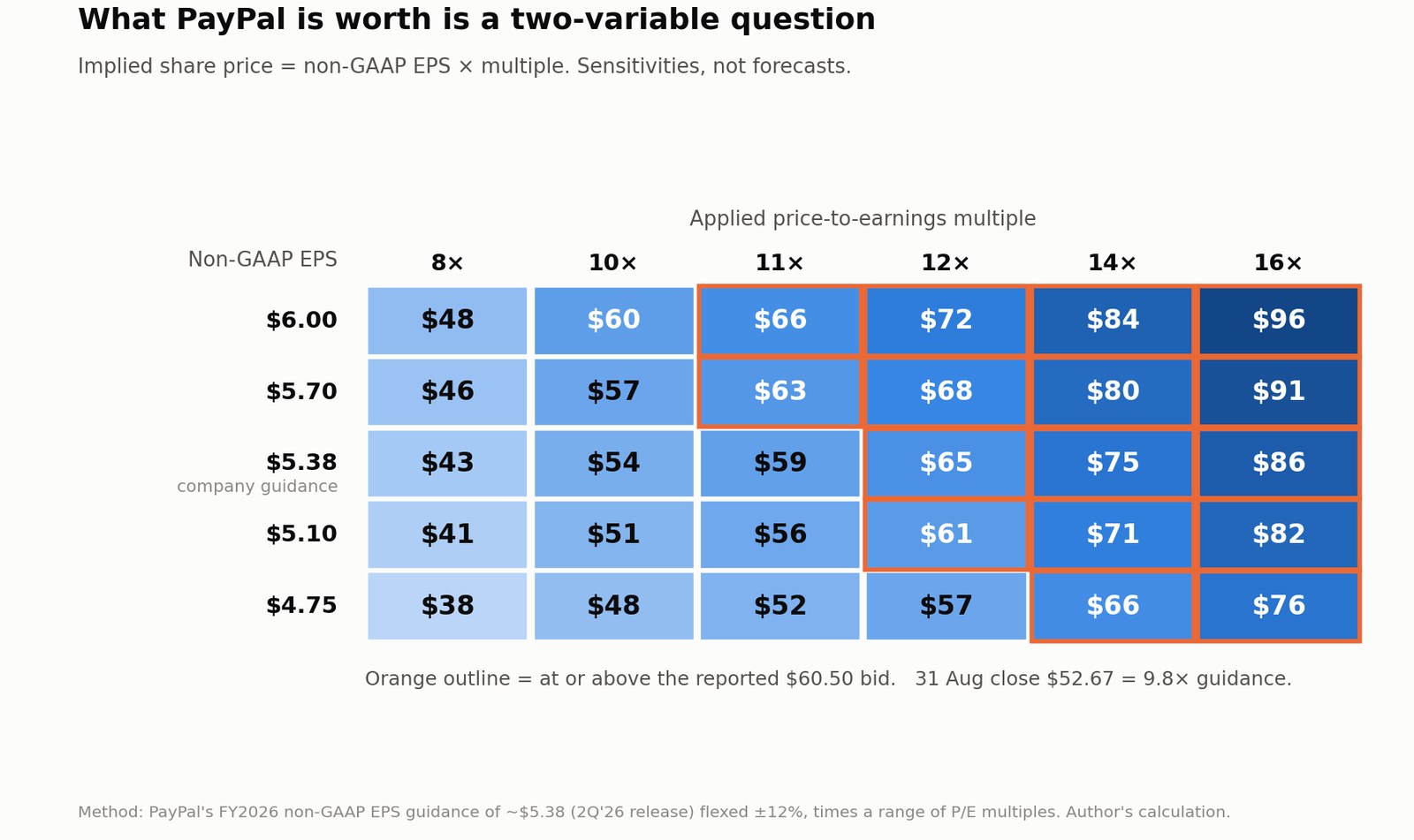
Management raised its 2026 non-GAAP EPS guidance to approximately $5.38. Dividing $53.66 by $5.38 produces a forward non-GAAP price-to-earnings ratio of approximately 10 times.
That is inexpensive relative to many payment and software companies, but the discount reflects real concerns:
- Branded checkout is barely growing.
- Operating margins are contracting.
- Active-account growth is nearly flat.
- PayPal faces platform-level competition from Apple and Google.
- Braintree volume has weaker economics.
- Management has changed repeatedly.
- The turnaround requires significant investment.
- Regulatory and credit risks remain.
- Non-GAAP earnings exclude certain costs.
A simple scenario analysis is more useful than one definitive target.
| Scenario | Earnings assumption | Applied multiple | Illustrative value |
|---|---|---|---|
| Bear case | $4.75 EPS | 8× | $38 |
| Base case | $5.38 EPS | 11× | $59 |
| Bull case | $6.00 normalized EPS | 14× | $84 |
These figures are valuation sensitivities, not price forecasts.
Bear case: approximately $38
Branded checkout remains stagnant, margin pressure persists, Braintree adds low-quality volume and management’s cost reductions fail to offset investment. The market treats PayPal as an ex-growth financial utility and assigns a low multiple.
Base case: approximately $59
Branded checkout gradually improves, Venmo monetization continues, Braintree produces modest transaction-margin growth and buybacks lift per-share results. PayPal remains a slow-growth but highly cash-generative payments platform.
Bull case: approximately $84
Checkout growth accelerates, Fastlane adoption increases, Venmo becomes a meaningful consumer-finance platform and Braintree successfully attaches higher-margin services. Operating leverage returns, justifying a higher multiple.
Interestingly, the reported $60.50 bid falls close to the base-case sensitivity. Stripe and Advent may have viewed PayPal as a mature cash-flow asset with restructuring potential rather than as a high-growth fintech platform.
What Could Break the PayPal Turnaround?
Investors should not assume that a low valuation automatically creates a bargain. PayPal could remain inexpensive for years if its competitive position continues weakening.
1. Branded checkout never returns to market growth
A 2% growth rate is not enough if digital commerce expands substantially faster. Continued underperformance would imply ongoing share loss.
2. Apple and Google control digital identity at checkout
PayPal’s brand advantage may matter less if device-native wallets offer equally trusted and faster authentication.
3. Braintree dilutes the revenue mix
Large amounts of low-margin processing volume can make TPV look healthy without creating sufficient earnings.
4. Venmo monetization disappoints
Venmo is valuable because of its users and cultural relevance. If PayPal cannot turn that engagement into merchant spending and financial-services revenue, its strategic value may remain largely theoretical.
5. Cost reductions damage innovation
PayPal needs simplification, but excessive cost cutting could slow product development and worsen customer service.
6. Credit losses increase
Expanding consumer and merchant finance introduces lending risk. A weaker economy could raise delinquencies and transaction losses.
7. Regulatory intervention raises costs
PayPal operates across payments, lending, money transmission and crypto. Its Q2 filing lists investigations involving the FTC, CFPB, German Federal Cartel Office and U.K. Financial Conduct Authority — the last of these opened in March 2026 over PayPal's contractual arrangements with Visa and Mastercard. The same filing discloses a consolidated securities class action, In re PayPal Branded Checkout Securities Litigation, plus related shareholder derivative suits.
8. Buybacks occur above intrinsic value
PayPal’s average first-half repurchase price of $44.99 looks attractive relative to the August 28 close. Future buybacks must remain disciplined.
9. Management credibility deteriorates
The company has already experienced several strategic resets. Investors need consistent execution rather than another cycle of ambitious product announcements followed by limited financial impact.
What Would Prove the Turnaround Is Working?
Investors should use a quarterly scorecard instead of reacting only to the stock price.
| Indicator | Positive signal | Warning signal |
|---|---|---|
| Branded checkout TPV | Growth rises above low single digits | Remains around 2% or turns negative |
| Transaction margin dollars | Consistently exceeds revenue growth | Lags TPV by a wide margin |
| Operating margin | Stabilizes and begins expanding | Continues contracting |
| Venmo | Debit, checkout and revenue accelerate | P2P engagement fails to monetize |
| Braintree | Higher-margin services expand | Volume rises without profit contribution |
| Active accounts | Return to sustained growth | Remain flat or decline |
| Engagement | Transactions per account continue rising | Growth relies on fewer heavy users |
| Free cash flow | Remains above roughly $5 billion annually | Falls as restructuring costs increase |
| Buybacks | Reduce shares at attractive prices | Debt rises faster than cash generation |
| Product execution | Fastlane and mobile checkout adoption improve | Competitors retain conversion advantage |
A practical monitoring process is:
- Read PayPal’s earnings release and SEC filing.
- Separate TPV growth from transaction-margin growth.
- Compare branded checkout with overall e-commerce growth.
- Track share count, debt and free cash flow together.
- Monitor Venmo debit and merchant-payment adoption.
- Review management’s full-year guidance changes.
- Compare PayPal’s valuation with Visa, Mastercard, Block, Adyen and traditional financial companies.
- Watch whether technical price strength is supported by improving fundamentals.
SimianX AI can support this process by bringing together fundamental analysis, SEC information, live news, sentiment and technical indicators. Its multi-agent approach can help investors examine competing bull and bear interpretations, though important figures should always be verified against PayPal’s filings.
Is PayPal Stock a Buy After the Crash?
PayPal is neither an obvious bargain nor a broken company. It is a cash-generative incumbent facing a serious relevance test.
The stock may appeal to investors who believe:
- Branded checkout can recover from 2% growth.
- Venmo can become a broader financial-services platform.
- Braintree can improve its revenue quality.
- Management can simplify operations without weakening innovation.
- Free cash flow will remain durable.
- Aggressive buybacks will compound per-share value.
- A valuation around 10 times non-GAAP earnings adequately compensates for execution risk.
The stock may be unsuitable for investors who require:
- Double-digit revenue growth.
- Expanding near-term operating margins.
- A clear competitive advantage over native mobile wallets.
- Stable management and predictable strategy.
- Minimal regulatory or credit exposure.
- A guaranteed acquisition floor.
A staged position may be more prudent than treating the 13% decline as an automatic buying opportunity. Investors could require evidence from several quarters before assuming the turnaround has succeeded.
The most important distinction is between cheap because temporarily misunderstood and cheap because competitively impaired.
The Volume Treadmill: What PayPal Keeps Per $100 It Moves
PayPal's problem is not that money has stopped flowing through it. It is the price of moving that money.
Divide transaction margin dollars by total payment volume and you get one number: how much gross margin PayPal keeps for every $100 it processes. Quarter by quarter since 2Q 2024, it looks like this.
| Quarter | TPV ($m) | Net revenue ($m) | Transaction margin ($m) | Margin per $100 of TPV | Revenue per $100 of TPV |
|---|---|---|---|---|---|
| 2Q'24 | 416,814 | 7,885 | 3,608 | 86.6 bps | 189.2 bps |
| 3Q'24 | 422,641 | 7,847 | 3,654 | 86.5 bps | 185.7 bps |
| 4Q'24 | 437,836 | 8,366 | 3,935 | 89.9 bps | 191.1 bps |
| 1Q'25 | 417,208 | 7,791 | 3,716 | 89.1 bps | 186.7 bps |
| 2Q'25 | 443,547 | 8,288 | 3,844 | 86.7 bps | 186.9 bps |
| 3Q'25 | 458,088 | 8,417 | 3,871 | 84.5 bps | 183.7 bps |
| 4Q'25 | 475,135 | 8,676 | 4,034 | 84.9 bps | 182.6 bps |
| 1Q'26 | 463,955 | 8,353 | 3,810 | 82.1 bps | 180.0 bps |
| 2Q'26 | 486,448 | 8,682 | 3,900 | 80.2 bps | 178.5 bps |
Figures from PayPal's quarterly earnings releases (SEC Form 8-K, Exhibit 99.1). Yield is transaction margin dollars divided by TPV, in basis points; the calculation is ours.
Two things fall out of the table.
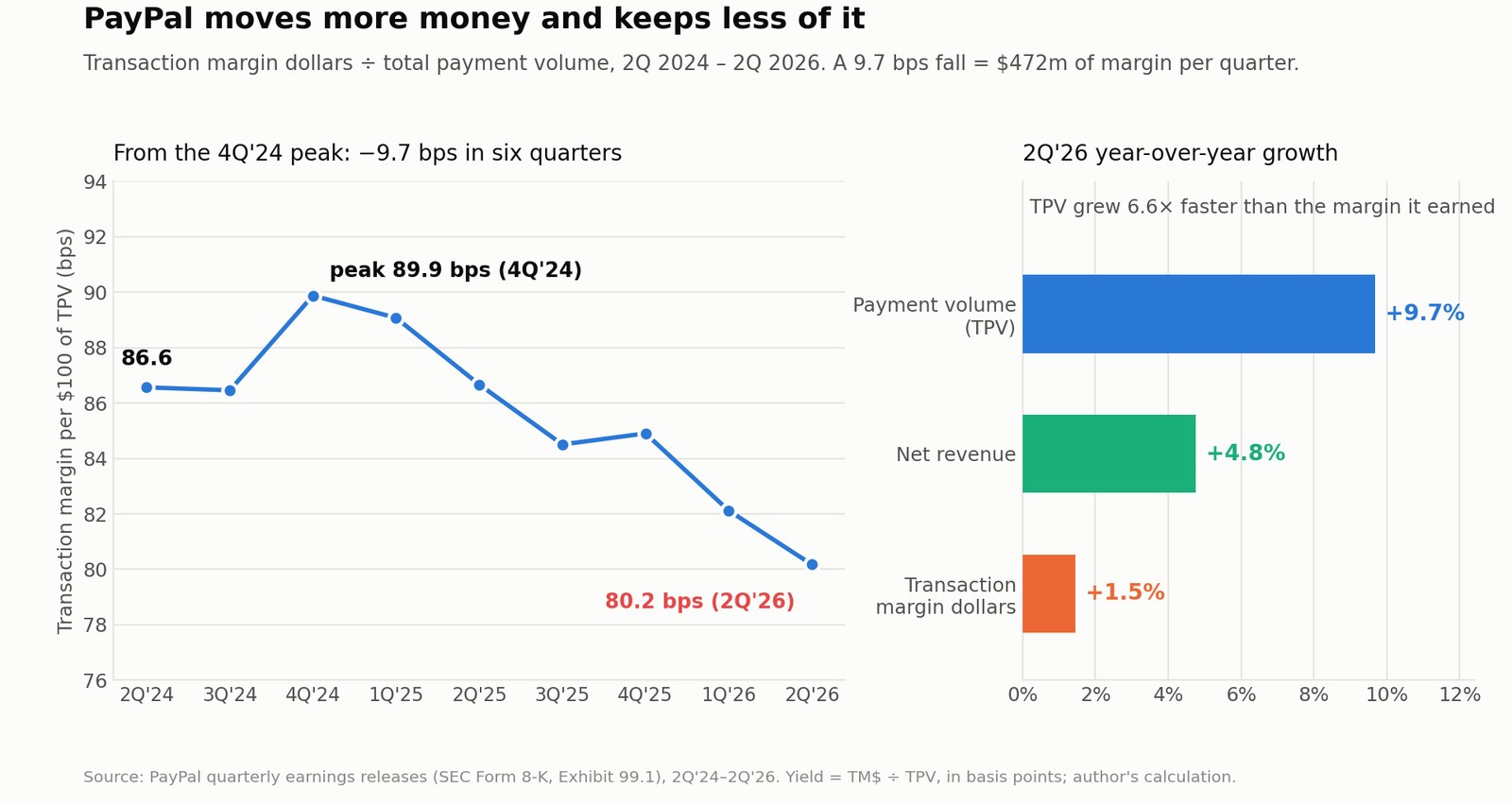
The yield peaked in 4Q 2024 at 89.9 basis points and has since fallen to 80.2 — 9.7 basis points, or 10.8%, in six quarters. Only one quarter, 4Q 2025, interrupted the slide.
Everything else follows from that. Transaction margin growth is not an independent variable; it is volume growth multiplied by the change in yield. For Q2 2026 the arithmetic closes exactly:
TPV +9.67% × margin yield −7.49% = transaction margin dollars +1.46%
That identity is the whole debate in one line. It is also why "more volume" is not automatically an answer. The same gap between what a buyer will pay and what a business actually earns ran through the Nvidia–Hugging Face deal; the slower version of it is what we called hype premium decay.
The 7.5% toll
Because the yield fell 7.5% year over year, PayPal had to grow payment volume 7.5% simply to hold transaction margin flat. It grew volume 9.7%. The 2.2 points of surplus is what actually reached shareholders.
In dollars: had the 2Q 2025 yield of 86.7 bps held, PayPal's 2Q 2026 volume would have produced $4,216m of transaction margin instead of $3,900m — $316m more in a single quarter, roughly $1.26bn a year. Measured against the 4Q 2024 peak, the gap is $472m a quarter, close to $1.9bn a year.
For scale: $316m pre-tax is about $0.30 a share after tax on 883 million diluted shares — a little over a fifth of the $1.38 PayPal reported for the quarter.
The buyback clock
This is where the bull case answers back. PayPal cannot yet reverse the yield decline, but it can shrink the denominator.
| Input | Figure | Source |
|---|---|---|
| Remaining repurchase authorization, 30 Jun 2026 | $10.9bn | Form 10-Q |
| Shares outstanding, 22 Jul 2026 | 855.5m | Form 10-Q cover |
| Share price, 31 Aug 2026 close | $52.67 | market data |
| Shares that authorization would retire | 207m | calculation |
| Share of the company | 24.2% | calculation |
| FY2025 free cash flow | $5.56bn | FY2025 results |
| Dividends at $0.14 a quarter | ~$0.48bn a year | Q2'26 release |
| Free cash flow after dividends | ~$5.1bn a year | calculation |
| Years of free cash flow the authorization represents | ~2.1 | calculation |
At the 31 August price, the remaining authorization alone is worth about a quarter of the company, and PayPal generates enough cash to retire roughly 11% of its shares a year.
That is not theory. Between 2Q 2025 and 2Q 2026 the diluted share count fell from 977.5m to 883.2m, a 9.6% reduction. GAAP net income fell 12% over the same span; GAAP earnings per share fell 3%. The buyback absorbed nine points of earnings decline. It can keep doing that for about two years at this pace. It cannot do it forever, and it does nothing to the yield.
What the market is still paying for
One last piece of arithmetic, because the takeover story is not finished. If a renewed $60.50 bid is the only thing separating today's price from PayPal's standalone worth, the implied probability of that bid is fixed by where you think standalone value sits:
| Assumed standalone value | Implied probability of a renewed $60.50 bid |
|---|---|
| $45.00 | 49.5% |
| $47.37 (pre-offer close) | 40.4% |
| $50.00 | 25.4% |
| $51.00 | 17.6% |
| $52.00 | 7.9% |
From the 31 August close of $52.67, using p = (price − standalone) ÷ (60.50 − standalone). This is an identity, not a forecast: it turns a price into the assumption embedded in it.
Read the table backwards and it says something uncomfortable for both camps. If you think PayPal is worth $50 on its own, roughly a quarter of today's price is still a bet on a buyer coming back. If you think it is worth $52 or more on its own, the deal is already irrelevant — and the 13% fall was the market correcting an overshoot.
FAQ About PayPal Stock After the Stripe Deal Collapse
Why did PayPal stock crash 13%?
PayPal fell 12.71% on August 28, 2026, after reports that Stripe and Advent International had stopped pursuing an acquisition. The decline primarily reflected the removal of a takeover premium, although it also exposed investor doubts about PayPal’s standalone growth.
Was the $53 billion PayPal buyout officially signed?
No signed merger agreement was publicly announced. Media reports described a $60.50-per-share proposal and confidential negotiations, but PayPal, Stripe and Advent did not publicly confirm the reported deal terms.
Is PayPal stock undervalued at about $54?
At $53.66, PayPal traded at approximately 10 times its 2026 non-GAAP EPS guidance of $5.38. That valuation may be attractive if branded checkout stabilizes and free cash flow remains strong, but it may be justified if PayPal continues losing market share and margins decline.
Can PayPal compete with Apple Pay and Stripe?
PayPal retains a globally recognized brand, 439 million active accounts, large merchant relationships and strong cash generation. Its challenge is delivering a mobile checkout experience as convenient as Apple Pay while providing merchant infrastructure competitive with Stripe.
Could Stripe return with another offer for PayPal?
A future proposal is possible, but investors should not base a valuation on an unconfirmed transaction. Any renewed offer would depend on price, financing, regulation, PayPal’s performance and the strategic priorities of Stripe and Advent.
Conclusion
The headline “PayPal stock crashes 13% after the $53 billion Stripe buyout dies” captures the market drama but not the complete investment case.
The takeover pursuit was reportedly abandoned, but no signed acquisition agreement had been publicly announced. What disappeared on August 28 was a takeover premium and the expectation of a higher bid. PayPal’s underlying network, cash flow, Venmo franchise and merchant-processing operations did not vanish overnight.
The standalone turnaround nevertheless faces a demanding test.
PayPal must transform branded checkout from stabilization into growth, monetize Venmo without damaging engagement, improve Braintree’s economics and restore operating leverage. Management must accomplish those goals while competing with Apple, Google, Shopify, Stripe, Block, banks and buy-now-pay-later providers.
The bull case rests on approximately $5 billion to $6 billion of annual free-cash-flow capacity, aggressive share repurchases, 439 million active accounts, rising payment volume and a valuation near 10 times guided non-GAAP earnings.
The bear case is that PayPal is buying back shares in a business whose most profitable product is gradually losing strategic relevance.
For now, the turnaround appears alive but unproven. The Stripe-Advent bid offered investors an external validation of PayPal’s assets. With that support removed, management must provide a stronger form of validation: sustained branded growth, improving transaction margins and durable per-share cash flow.
Investors can use SimianX AI to monitor PYPL fundamentals, earnings revisions, technical signals and market-moving news as new evidence emerges. Treat the platform as a research aid, verify material information independently and consult a qualified financial professional before making an investment decision.
Related Reading
- Nvidia Hugging Face Deal 2026: $12.9B at 86x Revenue
- Stablecoins 2026: Visa, Stripe & the USDT vs USDC Race
- Coinbase Stock 2026: Crypto Comeback Wall Street May Miss
- Robinhood Stock 2026: Crypto Is Only 8% of HOOD Revenue
- PDD Stock 2026: Temu Slows, Revenue Up, Profit Down 15%
- JPMorgan Stock 2026: 23% ROTCE vs a 3.2x Book Premium
- Apple WWDC 2026: Siri AI & Gemini Impact on AAPL Stock
- Alphabet Q2 Earnings 2026: Can Gemini, Cloud Justify Capex?
- CLARITY Act Tracker: Latest Status, Senate Vote & Timeline
- Hype Premium Decay: Why Hot Stocks Often Underperform
References
- PayPal Investor Relations — investor relations, quarterly results and filings
- PayPal Q2 2026 (SEC 8-K) — Q2 2026 earnings release filed with the SEC
- PayPal Form 10-Q — Q2 2026 Form 10-Q: balance sheet, buybacks and legal proceedings
- SEC EDGAR — every PayPal filing on EDGAR
- PayPal Newsroom — the April 2026 reorganisation announcement
- Bloomberg — report that Stripe and Advent ended their pursuit
- Reuters — report that Stripe and Advent ended their pursuit
- Axios — report that Stripe and Advent ended their pursuit
- PYMNTS — report that Stripe and Advent ended their pursuit
- Associated Press — Apple Pay overtaking PayPal at checkout
- StockAnalysis — PYPL daily price history
- Stripe — company site
- Advent International — company site
- Venmo — company site
- Braintree — company site
- Apple Pay — company site
- Google Pay — company site
- Shop Pay — company site
- Affirm — company site
- Klarna — company site
- Zelle — company site
- Cash App — company site
- Adyen — company site
- SimianX — PYPL fundamentals, news and technical signals
- SimianX — live AI analysis room