
 By Muke
PDD Stock 2026: Temu Growth Slows—Is China’s E-Commerce Price War Breaking the Bull Case?
PDD stock 2026 is no longer the simple “Temu growth story” that drove investor enthusiasm in previous years. PDD Holdings still owns two powerful discount-commerce platforms—Pinduoduo in China and Temu internationally—but the investment debate has shifted from explosive user growth to growth quality, profitability, regulation and capital allocation.
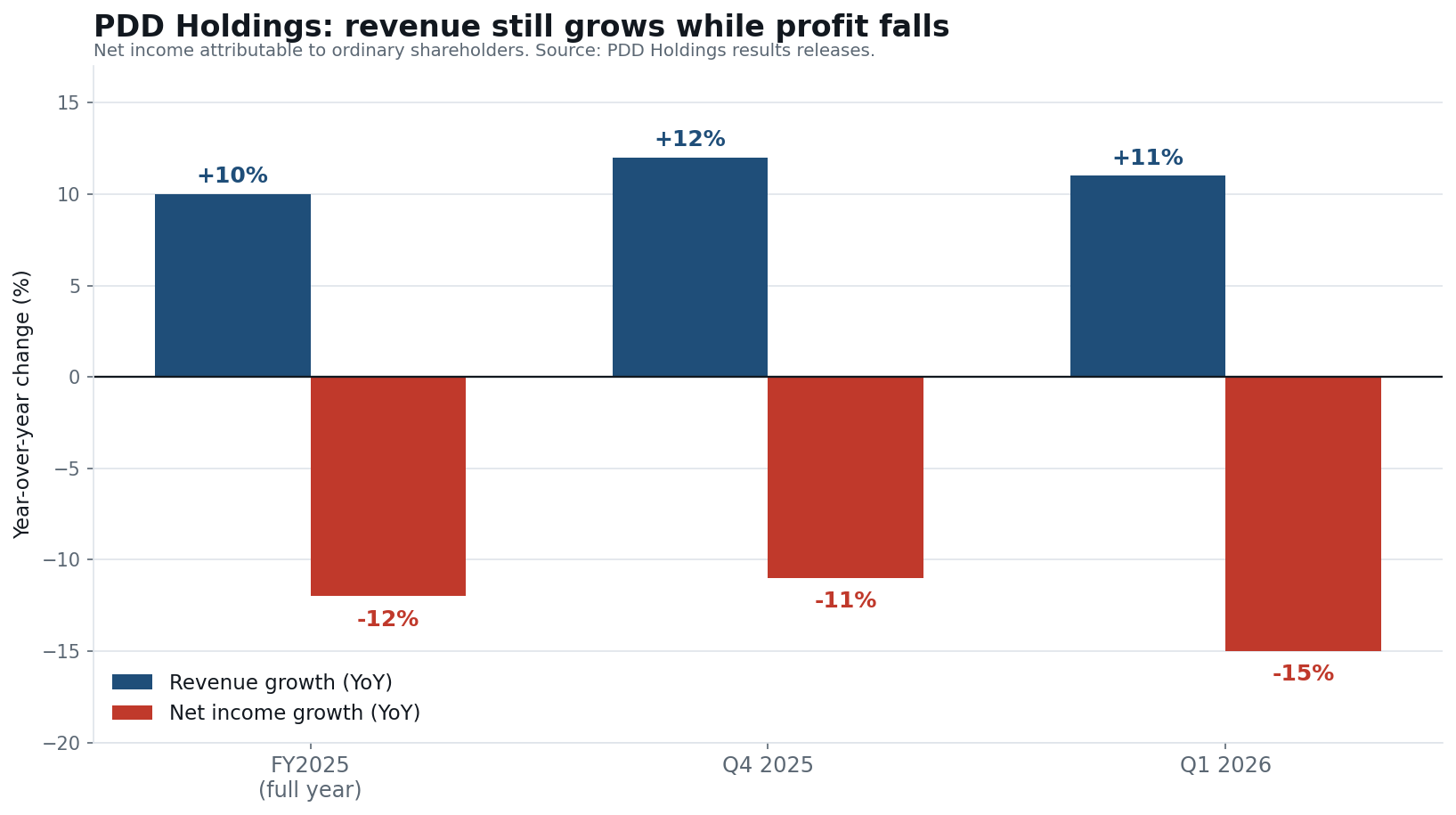
PDD’s latest reported numbers show a company that remains financially strong but is entering a more difficult phase. First-quarter 2026 revenue increased 11% year over year to RMB106.2 billion, while net income attributable to ordinary shareholders fell 15% to RMB12.5 billion. Transaction-services revenue grew 20%, but the company warned that it would commit significant resources to supply-chain investment over the long term. PDD Holdings’ Q1 2026 results suggest that sales momentum is still positive, but earnings are becoming more sensitive to investment spending.
This creates a difficult question for investors: is the Temu slowdown temporary, or is China’s e-commerce price war breaking the original PDD bull case?
This research examines the company’s operating model, Temu’s international risks, the domestic price war, financial trends, valuation logic and three possible scenarios for PDD stock in 2026. SimianX AI can help investors monitor these moving parts by combining fundamental, technical, news and sentiment analysis in one research workflow.
PDD Holdings at a Glance
PDD Holdings is best understood as a platform ecosystem rather than a single e-commerce website.
| Business | Core market | Strategic role | Main challenge |
|---|---|---|---|
| Pinduoduo | China | Cash-generating domestic discount marketplace | Slower consumption and intense price competition |
| Temu | International | Global growth option | Customer-acquisition costs, tariffs and regulation |
| Merchant and supply-chain ecosystem | China and overseas | Improves selection, fulfillment and product quality | Requires long-term investment |
| Advertising and transaction services | Mainly platform monetization | Converts user activity into revenue | Monetization can hurt merchants if overused |
Pinduoduo’s core advantage is its ability to match consumers with low-cost suppliers through social commerce, algorithmic recommendations and group-buying behavior. Temu exports parts of that model to international markets, offering a large assortment of low-priced goods through a mobile-first marketplace.
The key point is that PDD does not disclose Temu as a separate reporting segment. Investors therefore cannot directly see Temu’s revenue, gross margin, operating loss or contribution to cash flow. That lack of transparency makes valuation more difficult than for a traditional company with clear divisional reporting.
What the Latest Financial Results Say About PDD Stock 2026
The 2025 financial year marked a clear transition. PDD reported full-year revenue of RMB431.8 billion, up 10% from 2024. However, operating profit declined 13% to RMB94.6 billion, while net income attributable to ordinary shareholders decreased 12% to RMB99.4 billion. Sales and marketing expenses rose 13%, and research-and-development spending increased 30%. PDD’s FY2025 results
The fourth quarter displayed the same pattern:
- Revenue increased 12% year over year to RMB123.9 billion.
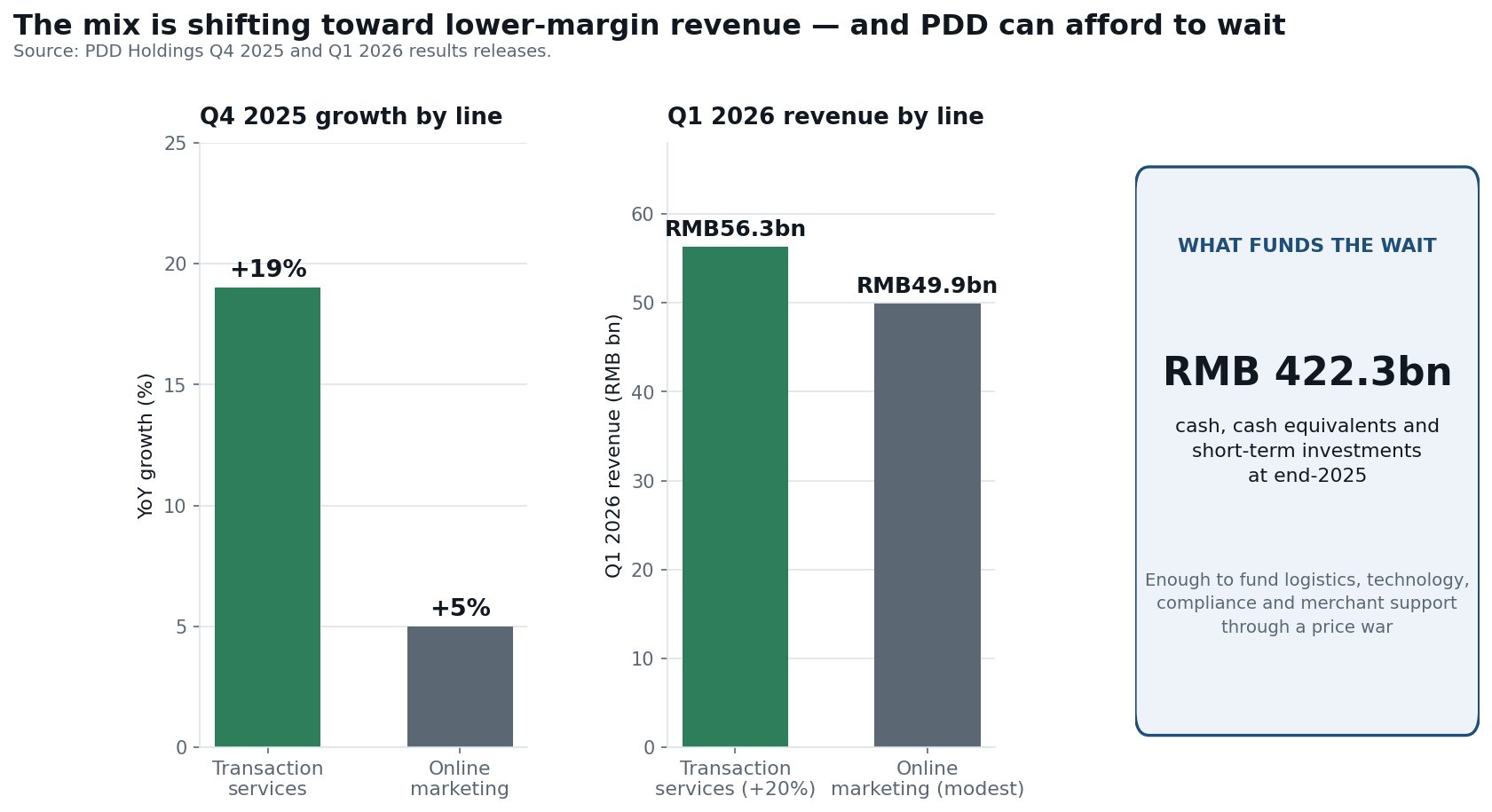
- Transaction-services revenue rose 19%.
- Online-marketing revenue increased only 5%.
- Net income declined 11%.
- Sales and marketing expenses increased 10%.
- Cash, cash equivalents and short-term investments reached RMB422.3 billion.
In the first quarter of 2026, revenue growth remained at 11%, but net income fell 15% and non-GAAP net income dropped 17%. Transaction-services revenue grew 20% to RMB56.3 billion, while online-marketing services increased only modestly to RMB49.9 billion.
For reference, the reported scorecard across the transition looks like this:
| Period | Revenue (RMB) | Revenue YoY | Net income (RMB) | Net income YoY | Transaction services YoY | Online marketing YoY |
|---|---|---|---|---|---|---|
| FY2025 (full year) | 431.8bn | +10% | 99.4bn | −12% | — | — |
| Q4 2025 | 123.9bn | +12% | — | −11% | +19% | +5% |
| Q1 2026 | 106.2bn | +11% | 12.5bn | −15% | +20% (to 56.3bn) | modest (to 49.9bn) |
FY2025 operating profit fell 13% to RMB94.6 billion; sales and marketing expenses rose 13% and research and development spending rose 30%. Net income refers to income attributable to ordinary shareholders. Figures as reported by PDD Holdings.
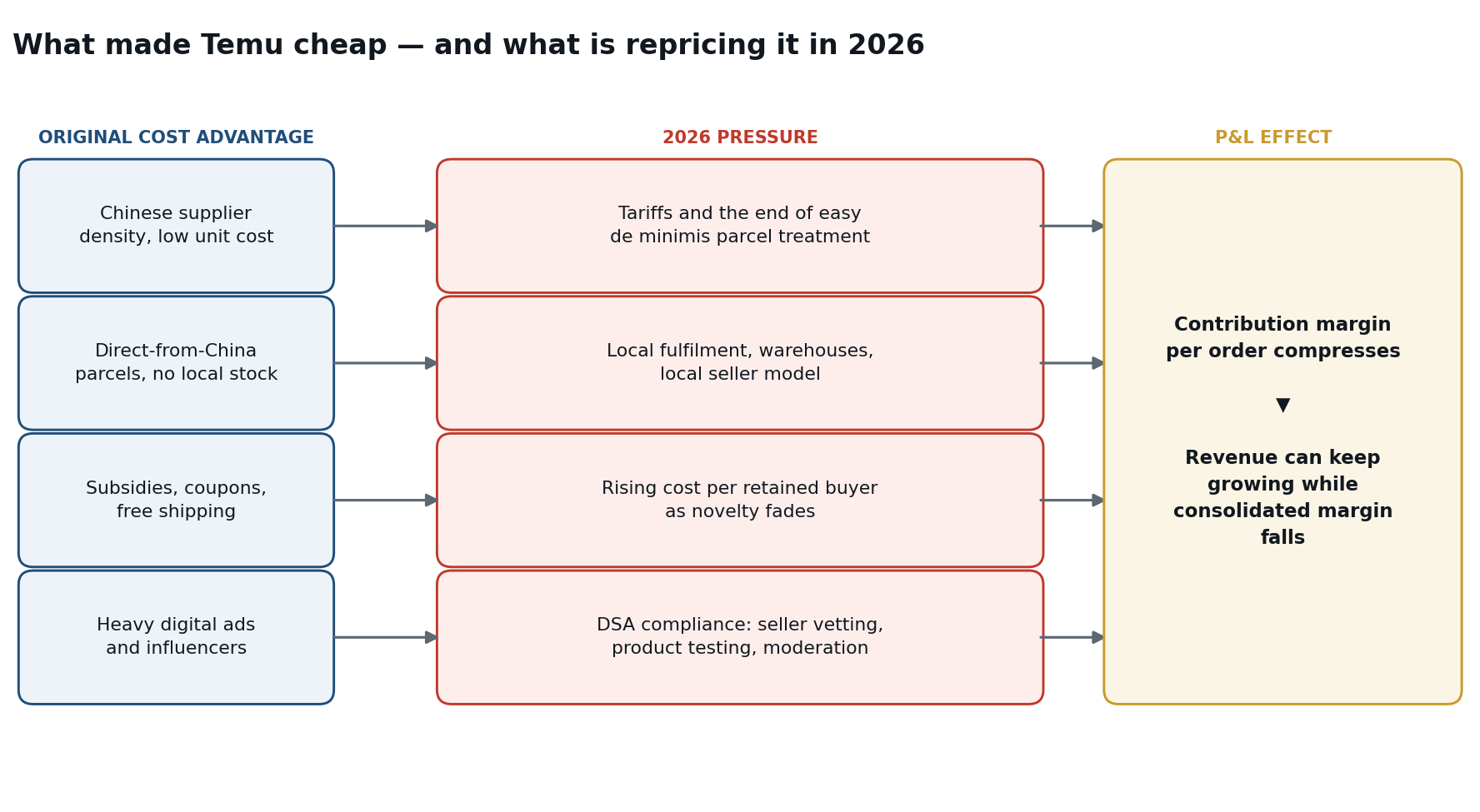
This mix matters. Transaction-services growth may reflect higher order volume, fulfillment activity and Temu-related commerce, but transaction revenue generally carries different economics from advertising revenue. If a larger portion of sales comes from lower-margin transactions, total revenue can grow while consolidated margins decline.
The central financial issue is not whether PDD can grow revenue. It is whether it can grow revenue without permanently sacrificing operating leverage.
Why Temu Growth Is Slowing
Temu’s original expansion strategy relied on a powerful combination:
- Extremely low consumer prices.
- Aggressive digital advertising and influencer marketing.
- Subsidies, coupons and free-shipping incentives.
- Chinese supplier density and manufacturing cost advantages.
- Cross-border parcel delivery that reduced the need for local inventory.
That formula helped Temu acquire users quickly. But the same formula creates structural problems as the platform becomes larger.
Customer acquisition becomes more expensive
Early adopters were attracted by novelty and unusually low prices. As the platform matures, Temu must spend more to retain users, increase purchase frequency and convince customers to buy higher-value products. Advertising, coupons, returns and logistics subsidies can all reduce contribution margin. The other side of that budget is a business in its own right — AppLovin Stock 2026 shows how AI-driven ad platforms monetize exactly this kind of performance spending.
The de minimis advantage has weakened
Temu historically benefited from low-value shipment rules that allowed many small parcels to enter the United States with simplified customs treatment. Changes in U.S. trade policy and tariffs have made the direct-from-China model more expensive and operationally complex. Temu has responded by increasing local fulfillment and adjusting its seller model, but those changes can raise logistics and inventory costs. Parcel economics are being repriced across the chain, as FedEx Earnings 2026 shows on the carrier side.
Product quality and trust are now strategic issues
Temu’s low-price proposition attracts scrutiny over product safety, intellectual property, data practices and consumer protection. In May 2026, the European Commission fined Temu €200 million under the Digital Services Act, stating that the company failed to properly assess systemic risks related to illegal products. The Commission cited unsafe chargers and baby toys in its investigation. European Commission decision on Temu
Compliance is more than a one-time fine. Temu may need to invest in seller verification, product testing, traceability, content moderation and local regulatory teams. Those investments can reduce short-term profitability but may be necessary for sustainable growth.
Is China’s E-Commerce Price War Breaking the Bull Case?
China’s domestic e-commerce market is mature, highly competitive and increasingly focused on value. Alibaba, JD.com, Douyin, Kuaishou and Pinduoduo are competing for consumers who are more price-sensitive and cautious about discretionary spending.
PDD helped create the discount-commerce category, but its success also encouraged competitors to respond. Alibaba has invested more heavily in value-oriented platforms and merchant subsidies. JD.com has emphasized low prices, logistics and supply-chain efficiency. Short-video platforms use algorithmic discovery and live-streaming to compete for both traffic and transactions.
The result is a platform-level price war. Companies may subsidize consumers, reduce merchant fees, increase advertising support or invest in logistics. These actions can protect market share but reduce margins.
PDD’s management has repeatedly emphasized long-term investment in merchants, consumers and supply-chain capabilities. In Q1 2026, management said supply-chain investments would be a core strategic priority and that the company was prepared to invest over the long term. That statement supports the view that margin pressure is intentional, not necessarily evidence of a broken business model.
However, investors must distinguish between two types of investment:
- Productive investment: better logistics, higher-quality sellers, improved recommendation systems and stronger international infrastructure.
- Defensive spending: coupons, subsidies and advertising used merely to stop competitors from taking market share.
Productive investment can create future returns. Defensive spending can become a permanent tax on profitability.
PDD’s Bull Case for 2026
The bullish thesis remains credible if several conditions hold.
1. Pinduoduo remains a powerful domestic cash engine
Even with slower growth, Pinduoduo benefits from large-scale traffic, supplier relationships and strong consumer engagement. Its discount positioning is well suited to an environment in which consumers prioritize value.
2. Temu can transition from subsidies to a more efficient marketplace
The most important Temu milestone would be improving unit economics. This does not require Temu to become highly profitable immediately. It requires evidence that each additional customer, order and seller eventually produces better contribution margins.
Positive indicators would include:
- Lower marketing expense per new active buyer.
- Higher repeat-purchase rates.
- More local sellers and warehouses.
- Higher average order values.
- Fewer refunds and chargebacks.
- Better advertising monetization.
- Reduced dependence on free shipping and coupons.
3. Supply-chain investment creates a stronger moat
A larger first-party brand business, better product selection and improved quality control could make Temu less dependent on generic low-priced goods. PDD’s Q1 2026 management commentary specifically highlighted first-party brands and supply-chain partners as strategic priorities.
4. PDD’s balance sheet provides flexibility
At the end of 2025, PDD held RMB422.3 billion in cash, cash equivalents and short-term investments. This gives the company substantial capacity to fund logistics, technology, compliance and merchant support during a competitive downturn.
The balance sheet also reduces near-term financial risk. PDD can continue investing even if Temu’s profitability takes longer to mature.
5. Valuation already discounts substantial pessimism
The stock has experienced major volatility as investors reassessed Temu’s growth and margin outlook. If the market is valuing PDD primarily as a mature Chinese e-commerce company while assigning little value to Temu’s long-term option, positive execution could produce upside.
The Bear Case for PDD Stock 2026
The bearish argument is not simply that Temu is growing more slowly. It is that Temu may require persistent spending without generating attractive returns.
Temu could become a low-margin global retailer
International e-commerce is more complicated than domestic marketplace operations. The incumbent benchmark is instructive: Amazon Q2 Earnings 2026 shows how much fulfillment, cloud and capex weight sits behind a mature global marketplace. Temu must manage customs, taxes, local labor, payment processing, returns, consumer protection and product liability across many jurisdictions.
If local warehousing and regulatory compliance become necessary, Temu’s cost structure may converge toward traditional retailers. In that case, its low-price advantage could weaken while its operating complexity increases.
Price competition may permanently reset margins
PDD’s domestic platform is strong partly because it offers low prices. But if every major platform matches those prices, consumers benefit while platforms lose pricing power. A prolonged price war could prevent PDD from returning to its former margin profile.
Regulatory risk can create unpredictable costs
The EU fine demonstrates that regulators are increasingly focused on marketplace safety and governance. The United States, the European Union and other jurisdictions may impose additional rules involving product traceability, data, customs and seller responsibility.
China’s macroeconomic environment remains uncertain
Weak consumer confidence, property-market stress, youth unemployment and cautious household spending can limit the growth of online retail. Discount platforms may gain market share during weak conditions, but lower spending can still restrict absolute revenue growth. The same trade-down behaviour is visible in the United States, where Walmart and Target’s 2026 warnings described value-seeking consumers and thinner discretionary baskets.
Corporate governance and disclosure remain investor concerns
Investors receive limited segment-level information about Temu. Without a clear Temu profit-and-loss statement, the market must infer performance from consolidated revenue, transaction-services growth and management commentary. This can increase the valuation discount applied to PDD stock.
How to Value PDD Holdings in 2026
A single price target is less useful than a scenario framework because Temu’s economics remain uncertain.
| Scenario | Operating assumptions | Likely market interpretation |
|---|---|---|
| Bear | Temu growth slows sharply, margins remain negative and domestic price competition intensifies | PDD valued as a mature, lower-growth Chinese marketplace |
| Base | Revenue grows at a moderate pace, Temu improves efficiency gradually and domestic margins stabilize | PDD receives a balanced marketplace valuation |
| Bull | Temu reaches improving contribution margins, supply-chain investment produces stronger retention and Pinduoduo protects share | PDD receives a premium for global growth optionality |
A practical valuation process can follow five steps:
- Estimate consolidated revenue growth for 2026–2028.
- Model operating margins under continued investment.
- Separate sustainable earnings from temporary investment pressure.
- Add a conservative value for excess cash and investments.
- Apply a discount for geopolitical, regulatory and governance risks.
Investors should avoid valuing PDD solely on a short-term price-to-earnings ratio. A low multiple may indicate opportunity, but it may also reflect uncertainty about future earnings power.
The more important question is:
What normalized margin can PDD achieve after Temu and supply-chain investment mature?
If the answer is structurally lower than historical levels, a cheap-looking stock may be fairly valued. If the answer is only temporarily depressed, the stock could offer significant upside.
What Investors Should Monitor in Upcoming PDD Reports
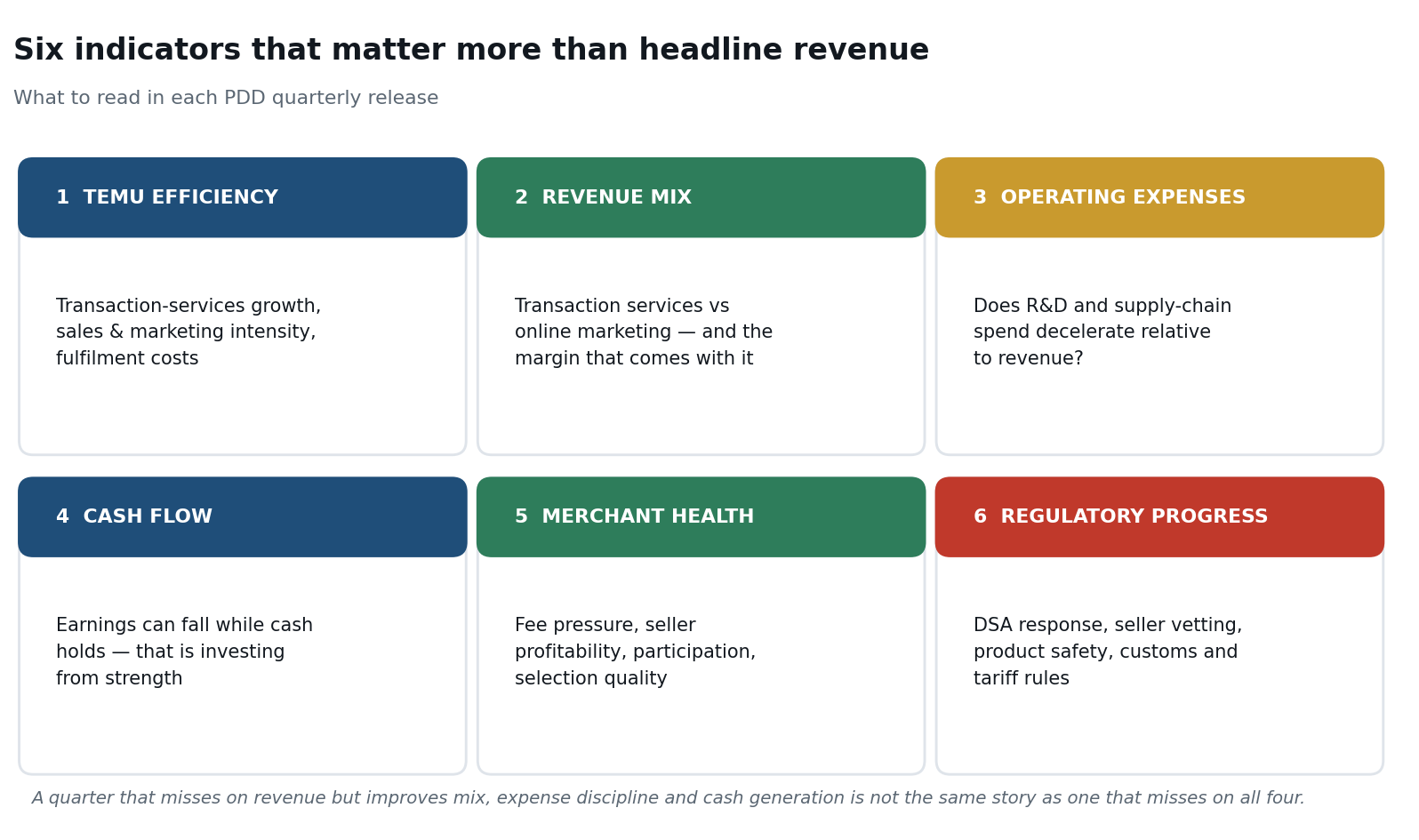
For PDD stock 2026, the following indicators are more informative than headline revenue alone:
Temu efficiency
Management does not disclose all Temu metrics, so investors should monitor transaction-services growth, sales-and-marketing intensity, fulfillment costs and qualitative comments about international operations.
Revenue mix
A shift toward transaction-services revenue may indicate stronger marketplace activity, but investors should examine whether that growth comes with acceptable margins.
Operating expenses
R&D and supply-chain spending may rise for valid strategic reasons. The question is whether expense growth eventually decelerates relative to revenue.
Cash flow
Operating cash flow is a critical test. If earnings decline but cash generation remains resilient, the company may be making investments from a position of strength. If both earnings and cash flow deteriorate, the risk profile is more serious.
Merchant health
PDD’s ecosystem depends on sellers. Excessive fee pressure, weak profitability or declining merchant participation could damage product selection and long-term platform quality.
Regulatory progress
Investors should watch Temu’s response to the EU DSA fine, seller verification changes, product-safety systems and any new customs or tariff rules in the United States.
SimianX AI can help organize this monitoring process by combining SEC filings, earnings releases, market data, technical signals and news sentiment. The live PDD workspace collects the same fundamentals, filings and technical levels in one place. Its platform describes eight specialized AI agents that analyze different aspects of a stock, but users should independently verify important information and treat the output as research support rather than financial advice. Explore SimianX AI
Is PDD Stock a Buy in 2026?
PDD stock may suit investors who can tolerate:
- Chinese regulatory and geopolitical risk — the same overhang examined in Apple Q3 Earnings 2026.
- Volatile share-price movements.
- Uncertainty around Temu’s profitability.
- A multi-year investment horizon.
- Periods of lower earnings caused by reinvestment.
It may be unsuitable for investors seeking predictable dividends, transparent segment reporting or low-volatility exposure to e-commerce.
A disciplined investor could consider a staged approach rather than relying on a single earnings release:
- Establish a valuation range using bear, base and bull assumptions.
- Set a maximum portfolio allocation before buying.
- Track operating indicators each quarter.
- Add exposure only if the investment thesis improves.
- Reassess if Temu spending rises without evidence of better retention or margins.
This framework does not eliminate risk, but it prevents the decision from becoming a simple reaction to a headline earnings beat or miss.
FAQ About PDD Stock 2026
What is slowing Temu growth in 2026?
Temu is facing higher customer-acquisition costs, tougher competition, tariff and customs changes, and increased regulatory requirements. The platform is also moving from rapid user acquisition toward a more complex phase focused on retention, product quality and local fulfillment.
Is PDD Holdings profitable without Temu?
PDD does not disclose a standalone Temu income statement, so investors cannot precisely calculate Pinduoduo’s independent profit. The domestic business appears to be a major source of cash generation, but consolidated results include both domestic operations and international investment.
How does China’s e-commerce price war affect PDD stock?
A price war can increase order volume and protect market share, but it may require subsidies, merchant support and advertising spending. If competitors continue matching Pinduoduo’s prices, PDD’s revenue can grow while operating margins remain under pressure.
What are the biggest PDD regulatory risks?
The main risks include product safety, counterfeit or non-compliant goods, data privacy, customs treatment, consumer-protection rules and platform liability. The EU’s €200 million DSA fine shows that regulatory enforcement can create both direct costs and long-term compliance obligations.
Is PDD stock undervalued in 2026?
PDD could be undervalued if Temu eventually improves unit economics and domestic margins stabilize. It may not be undervalued if the market is correctly pricing permanently lower margins, slower growth and sustained regulatory risk. Investors should use scenario valuation rather than relying on one headline multiple.
Conclusion
The PDD stock 2026 thesis is becoming more nuanced. Temu remains a potentially valuable international growth option, but its original hypergrowth model is under pressure from tariffs, competition, customer-acquisition costs and regulation. At the same time, Pinduoduo’s domestic business is operating in one of the world’s most aggressive e-commerce price wars.
The bull case depends on better Temu unit economics, disciplined supply-chain investment, strong cash generation and a stable domestic market position. The bear case depends on Temu becoming a permanent low-margin cash consumer while China’s price competition prevents PDD from restoring operating leverage.
PDD’s large cash balance and platform scale provide meaningful strategic flexibility, but they do not guarantee attractive shareholder returns. The most important evidence will come from future trends in transaction-services growth, operating expenses, cash flow, merchant health and international compliance.
For investors conducting ongoing research, SimianX AI can provide a centralized way to review PDD’s fundamentals, filings, technical indicators and market sentiment. Use it as a research tool, verify key facts independently and consult a qualified financial professional before making investment decisions.
Related Reading
- Walmart & Target 2026: Decoding US Consumer Stress Signals
- Amazon Q2 Earnings 2026: Can AWS Justify $200B AI Capex?
- AppLovin Stock 2026: Can AI Advertising Keep APP Growing?
- FedEx Earnings 2026: Freight Spinoff, Fuel Surcharges & FDX Stock
- Apple Q3 Earnings 2026: Can Growth Offset AI Delays?
- TSMC Stock 2026: Why Nvidia Still Can’t Replace Its Chipmaker
References
- PDD Holdings — first quarter 2026 unaudited results
- PDD Holdings — fourth quarter and fiscal year 2025 results
- PDD Holdings — investor relations
- PDD Holdings — SEC filings on EDGAR (CIK 0001737806)
- European Commission — Temu fined €200 million for breaching the Digital Services Act
- European Commission — Digital Services Act package
- U.S. Customs and Border Protection — e-commerce and low-value shipments
- Alibaba Group · JD.com investor relations · Kuaishou investor relations
- National Bureau of Statistics of China — macro and retail data
- Temu — marketplace
- SimianX AI — live PDD research workspace