
Small Caps Lead Tech and Semiconductor Rebound as Yields Ease
Small Caps Lead Tech and Semiconductor Rebound as Yields Ease is more than a market headline. It captures a familiar but important risk-on rotation: falling bond yields reduce valuation pressure, small-cap companies gain relief from financing concerns, and semiconductor stocks regain leadership as investors reprice artificial intelligence demand. For traders, analysts, and long-term investors, the key question is not simply what moved today, but whether the move is durable.
That is where a structured research process matters. Markets often react quickly to rate changes, earnings reports, oil prices, and AI-related news. But fast-moving rallies can also create false signals. Investors need a clear framework to separate a short-term rebound from a sustainable rotation. For readers looking to organize market data, news sentiment, sector momentum, and risk signals, SimianX AI offers a useful lens for AI-assisted market research and stock analysis.
Market Snapshot: Why Small Caps, Tech, and Chips Rebounded Together
A rally led by small caps, technology, and semiconductors usually reflects a shift in investor appetite. When Treasury yields ease, investors often become more willing to buy growth-oriented and economically sensitive assets. This is especially true when the decline in yields is accompanied by improving sentiment around inflation, corporate earnings, or AI infrastructure demand.
Small caps tend to be more sensitive to interest rates because many smaller companies depend more heavily on external financing. When borrowing costs rise, investors may worry about refinancing risk, margin pressure, and weaker growth. When yields ease, those concerns can fade, at least temporarily.
Technology stocks respond to yields in a different way. Many tech companies are valued based on future cash flows. When discount rates fall, those future cash flows become more valuable in present-value terms. This can support higher valuation multiples, especially for companies with strong growth expectations.
Semiconductor stocks sit at the intersection of both dynamics. They are growth stocks, but they are also cyclical businesses tied to capital spending, hardware demand, AI infrastructure, cloud computing, industrial automation, and consumer electronics.
When yields ease, the market often reopens its appetite for duration, cyclicality, and growth. Small caps and semiconductors can benefit quickly—but only if earnings and liquidity conditions support the move.
The phrase Small Caps Lead Tech and Semiconductor Rebound as Yields Ease therefore signals more than a one-day market move. It suggests that investors may be reassessing risk, growth, and valuation across several important parts of the equity market.
Why Lower Yields Matter for Small Caps and Tech Stocks
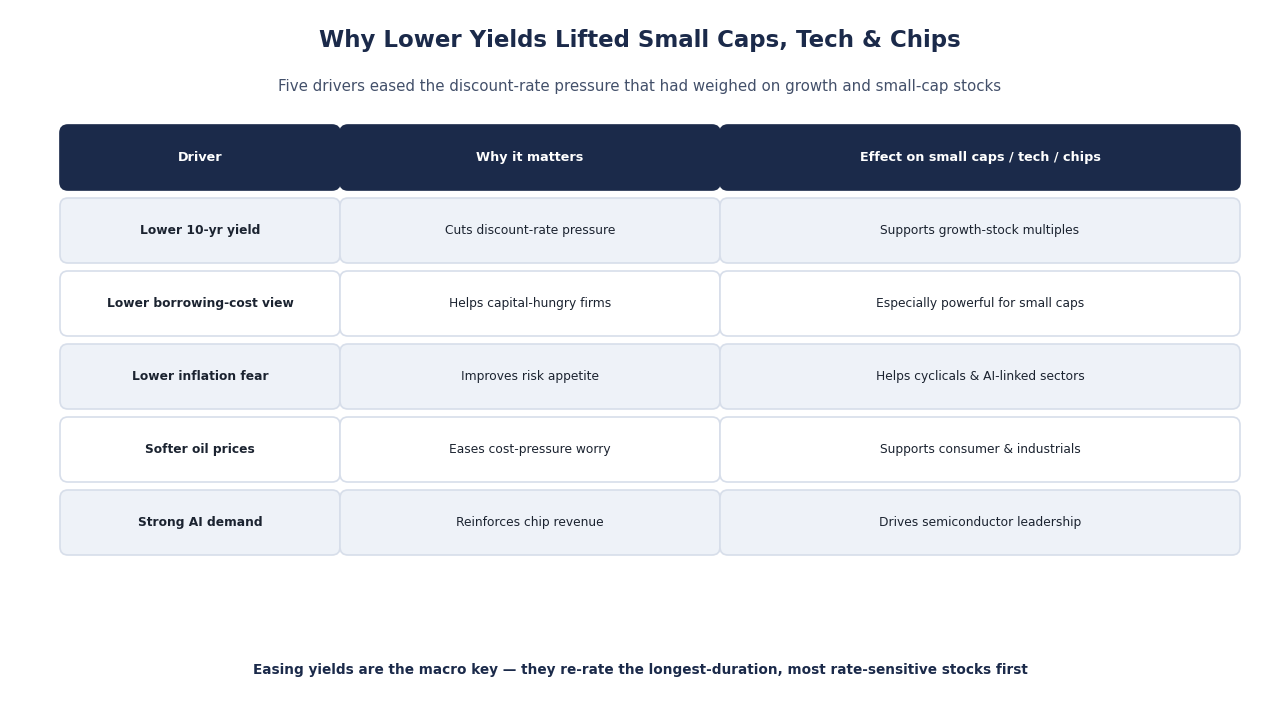
Lower yields can support equities through three main channels: valuation, financing, and sentiment.
| Market Driver | Why It Matters | Impact on Small Caps / Tech / Semiconductors |
|---|---|---|
| Lower 10-year Treasury yield | Reduces discount-rate pressure | Supports growth-stock multiples |
| Lower borrowing-cost expectations | Helps companies that need capital | Especially important for small caps |
| Lower inflation fear | Improves risk appetite | Helps cyclical and AI-linked sectors |
| Softer oil prices | Reduces cost-pressure concerns | Supports consumer and industrial demand |
| Strong AI demand | Reinforces chip revenue visibility | Helps semiconductor leadership |
For small-cap companies, lower yields can reduce the perceived cost of growth. Many small companies need to borrow, raise capital, or refinance debt more frequently than large-cap companies. A more favorable rate environment can improve investor confidence in their ability to expand.
For technology stocks, lower yields can make future earnings more attractive. This is particularly important for software, cloud infrastructure, cybersecurity, data centers, and AI-related companies. These businesses often trade at higher multiples because investors expect strong future growth.
For semiconductor stocks, the rate effect is combined with industry-specific demand. A chip stock rally may be driven by AI server demand, GPU shortages, stronger memory pricing, improving order books, or optimism about data-center buildouts.
The important point: lower yields can create the conditions for a rebound, but they do not guarantee a lasting bull move. Investors still need to confirm whether earnings, guidance, margins, and demand trends support the rally.
How Did the Semiconductor Rebound Fit Into the Broader Tech Rally?
The semiconductor rebound fits naturally into a broader technology rally because chips are the foundation of modern computing. Artificial intelligence, cloud infrastructure, smartphones, electric vehicles, industrial automation, robotics, and edge computing all require semiconductors.
However, the chip sector is not a single story. It includes several different business models:
- AI accelerators, including GPUs and custom AI chips.
- Memory suppliers, exposed to DRAM and NAND pricing cycles.
- Foundries, which manufacture chips for fabless designers.
- Semiconductor equipment companies, tied to fabrication capacity and capital expenditure.
- Analog and industrial chipmakers, linked to autos, factories, and connected devices.
- Networking and interconnect companies, supporting high-performance AI data centers.
A semiconductor stock rebound is most durable when it is supported by earnings revisions, order visibility, pricing power, and capex discipline. A short-term bounce driven only by lower yields can fade if demand weakens or valuations become stretched.
Why AI Demand Matters for Semiconductor Stocks
AI demand has become one of the strongest long-term themes in semiconductor investing. Training and deploying large AI models requires massive compute power. This creates demand for GPUs, accelerators, high-bandwidth memory, networking chips, advanced packaging, and power management components.
But AI demand does not benefit every chip company equally. Some companies sell directly into AI data centers, while others benefit indirectly through memory, servers, networking, or manufacturing equipment. Investors should avoid assuming that every semiconductor stock is an AI winner.
A better approach is to ask:
- Does the company have direct exposure to AI infrastructure?
- Are customers increasing orders or capital spending?
- Are margins improving as demand rises?
- Is supply constrained in a way that supports pricing power?
- Is valuation still reasonable after the rebound?
This is where a multi-layer research process can help. SimianX AI can support investors by organizing news, earnings signals, financial metrics, and market movement into a more structured view instead of relying on headlines alone.
What Does “Small Caps Lead Tech and Semiconductor Rebound as Yields Ease” Mean for Investors?
The phrase Small Caps Lead Tech and Semiconductor Rebound as Yields Ease describes a market regime where investors move back into risk assets after pressure from bond yields cools. But investors should avoid treating one strong session as a complete trend reversal.
A practical research framework includes three steps:
- Confirm the macro trigger.
Was the move driven by a real decline in yields, softer inflation data, lower oil prices, or a temporary technical bounce?
- Check breadth and leadership.
Did the rally extend beyond mega-cap technology? Small-cap outperformance is meaningful because it suggests wider risk appetite.
- Validate earnings support.
Are chip stocks rising because of stronger demand, positive guidance, analyst upgrades, or simply multiple expansion?
This distinction matters because markets often rally on relief. A lower-yield environment can spark a broad rebound, but sustainable gains usually require stronger fundamentals. If earnings estimates continue to rise and sector breadth improves, the rally has a stronger foundation. If yields fall only briefly and earnings disappoint, the rebound may reverse.
The best semiconductor rebound analysis separates macro relief from fundamental confirmation. Falling yields can open the door, but earnings quality decides whether the rally stays open.
Using SimianX AI to Analyze Tech and Semiconductor Rebounds
A market day like this creates both opportunity and noise. Headlines move fast, but investors need a structured way to decide whether the rebound is actionable. SimianX AI is relevant for this workflow because it helps investors think across market data, news, earnings, sentiment, and risk factors.
A semiconductor rebound requires multiple lenses at once:
- Macro lens: What are yields, inflation expectations, and oil prices doing?
- Sector lens: Is tech leadership broadening or narrowing?
- Industry lens: Which parts of the semiconductor value chain are leading?
- Company lens: Are revenues, margins, and guidance improving?
- Sentiment lens: Are news flow and analyst revisions becoming more positive?
- Risk lens: What could invalidate the bullish thesis?
SimianX AI can help turn these questions into a repeatable research workflow. Instead of reacting emotionally to a strong market session, investors can evaluate whether the rally is supported by fundamentals, technical confirmation, and risk-adjusted opportunity.
A Practical Framework for Reading the Small-Cap Tech Rally
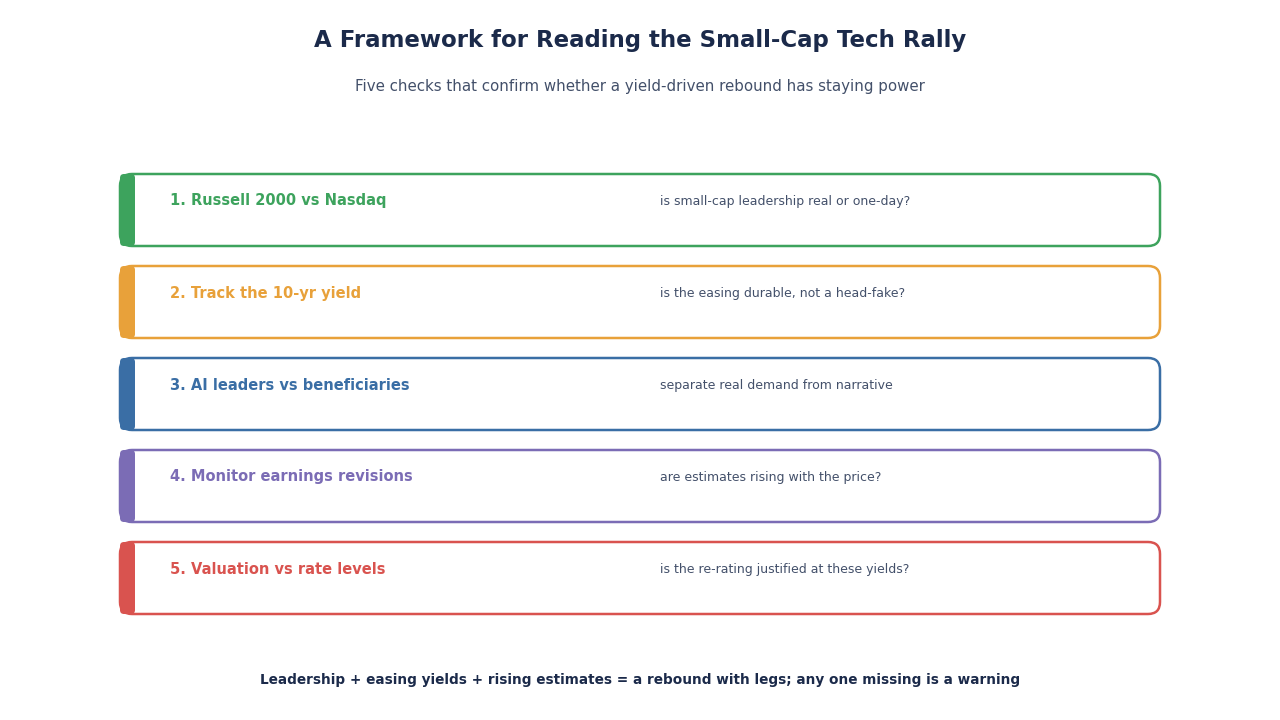
When small caps lead a technology rebound, investors should test whether the move is broad, liquid, and supported by improving fundamentals.
1. Watch the Russell 2000 Versus the Nasdaq
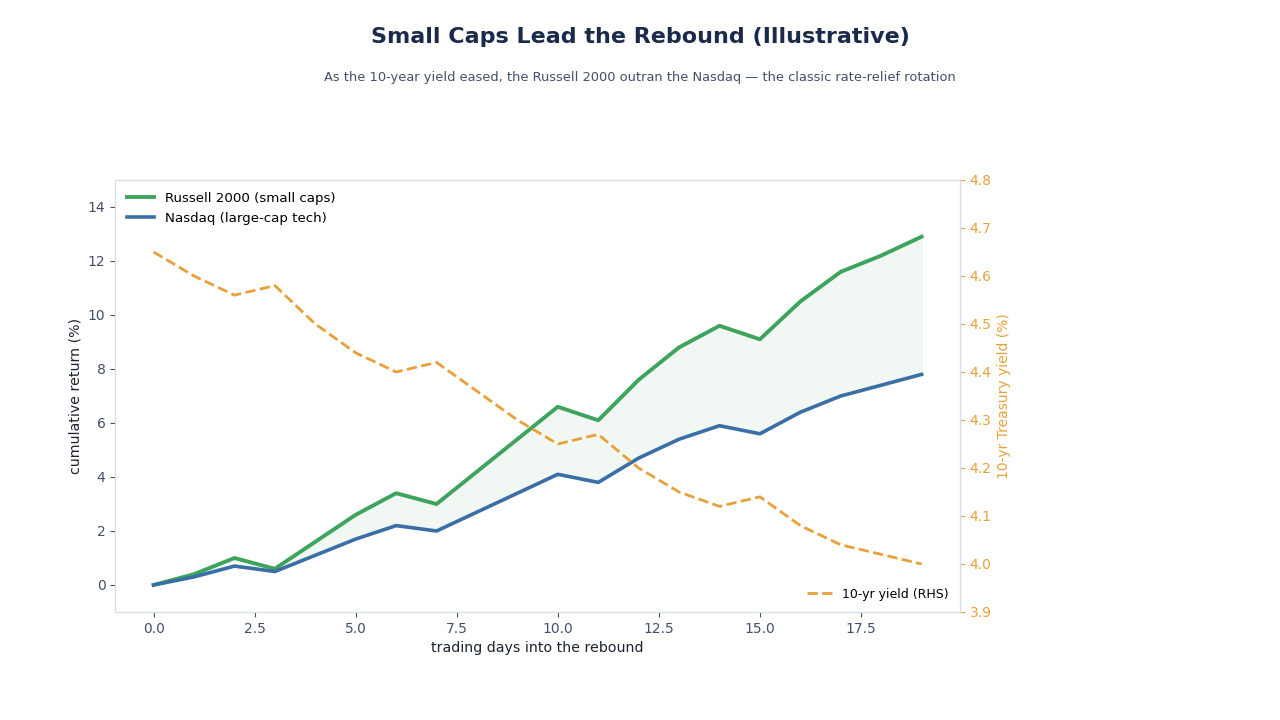
If the Russell 2000 rises faster than the Nasdaq, the market may be rotating beyond mega-cap technology. That can indicate broader confidence in economic growth. However, if small caps outperform for only one day and then lose momentum, the move may be more technical than fundamental.
Small-cap leadership is especially important because it can suggest that investors are becoming more comfortable with risk. But investors should also check whether the move is concentrated in a few speculative names or spread across profitable, fundamentally stronger companies.
2. Track the 10-Year Treasury Yield
The 10-year Treasury yield remains central to the market’s risk appetite. If yields continue to ease, growth stocks and small caps may receive more support. If yields rebound sharply, the same groups can come under pressure again.
Investors should pay attention to both the level and direction of yields. A falling yield from a high level can support equities, but a rapid decline caused by recession fears may send a different message. Context matters.
3. Separate AI Leaders From AI Beneficiaries
Not every semiconductor company has the same AI exposure. Some firms directly supply AI accelerators. Others benefit from memory demand, server upgrades, networking equipment, or manufacturing tools.
A clear research process should separate:
- Direct AI revenue exposure.
- Indirect AI infrastructure exposure.
- Cyclical recovery exposure.
- Valuation-driven rebound.
- Short-covering or momentum-driven gains.
4. Monitor Earnings Revisions
A rebound becomes more credible when earnings estimates rise. Semiconductor stocks can rerate quickly, but sustained gains usually require evidence that revenue growth and margins are improving.
Important signals include:
- Higher revenue guidance.
- Improved gross margin outlook.
- Strong backlog or order visibility.
- Customer capex growth.
- Reduced inventory risk.
- Positive analyst revisions.
5. Review Valuation Against Rate Levels
A stock can be fundamentally strong and still overvalued. When yields are elevated, valuation discipline matters. Investors should compare current multiples to growth rates, free cash flow, balance sheet quality, and peer-group expectations.
A high-quality semiconductor company is not automatically a good buy at any price. Investors need to understand how much future growth is already reflected in the share price.
Best Way to Track Tech Sector Rotation With AI Tools
The best way to track tech sector rotation with AI tools is to combine macro, fundamental, sentiment, and technical signals into one repeatable process.
| Research Layer | Key Question | Example Signal |
|---|---|---|
| Macro | Are yields easing or rising? | 10-year Treasury trend |
| Sector | Is tech leadership broadening? | Nasdaq vs Russell 2000 |
| Industry | Are semiconductors leading? | AI chip names, memory stocks, equipment makers |
| Fundamentals | Are estimates improving? | Revenue guidance, margin trends |
| Sentiment | Is news flow improving? | Earnings, analyst notes, supply-chain updates |
| Technicals | Is price action confirming? | Breakouts, volume, moving averages |
| Risk | What could invalidate the thesis? | Rates, oil, geopolitics, valuation |
A repeatable workflow can help investors avoid emotional decision-making. For example, instead of asking, “Should I buy semiconductor stocks because they rallied today?” a better question is:
“Which semiconductor stocks are rebounding because of durable earnings growth, and which are simply moving because yields eased?”
That question leads to better research.
How to Build a Semiconductor Rebound Watchlist
Investors can create a semiconductor rebound watchlist using a simple step-by-step process:
- Start with industry groups.
Divide companies into AI accelerators, memory, foundries, equipment, analog, networking, and automotive chips.
- Rank by revenue growth.
Prioritize companies with accelerating revenue or improving guidance.
- Check margin trends.
Look for companies with expanding gross margins or operating leverage.
- Compare valuation.
Avoid paying excessive multiples for companies with slowing growth.
- Review balance sheet strength.
Favor companies with strong cash positions and manageable debt.
- Track news sentiment.
Watch for customer wins, supply-chain updates, analyst upgrades, and earnings surprises.
- Confirm technical strength.
Look for volume-supported breakouts rather than low-quality bounces.
Key Risks That Could Reverse the Semiconductor Rebound
The small-cap, tech, and semiconductor rebound is constructive, but it is not risk-free. Several risks could interrupt the move:
- Yields rise again if inflation expectations return.
- Oil prices rebound, renewing cost and rate concerns.
- AI capex expectations become too aggressive, increasing risk of disappointment.
- Semiconductor supply chains face geopolitical stress.
- Small-cap credit conditions tighten, hurting companies with refinancing needs.
- Valuations detach from earnings, especially in high-momentum chip names.
- Inventory cycles worsen, pressuring chip pricing and margins.
Investors should also consider the difference between short-term market relief and long-term industry fundamentals. A one-day rally may reflect improved sentiment, but a durable semiconductor uptrend usually requires demand visibility, healthy pricing, and earnings upgrades.
This is why a structured research platform such as SimianX AI can be useful. It helps investors organize multiple signals instead of relying on a single headline, analyst note, or price chart.
What Data Should Investors Watch After a Yield-Driven Rebound?
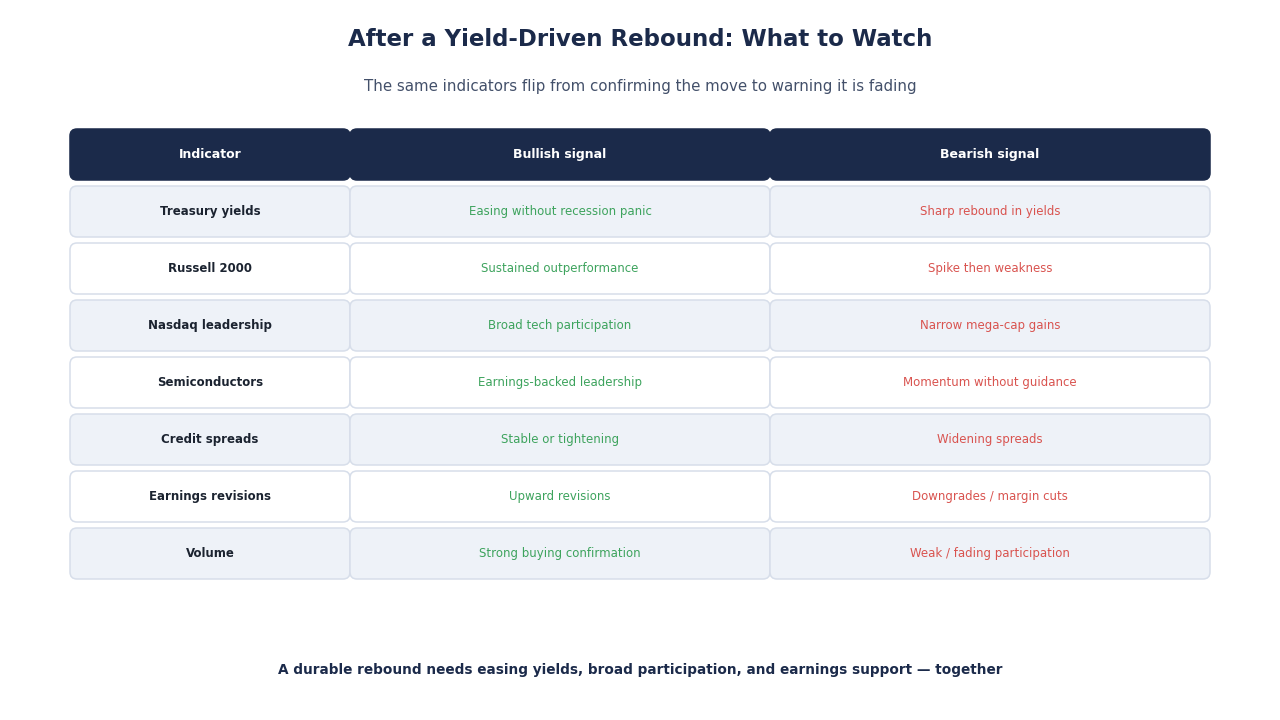
After a yield-driven rebound, investors should monitor whether the rally continues to broaden. The most useful indicators include market breadth, credit spreads, earnings revisions, sector leadership, and volume.
| Indicator | Bullish Signal | Bearish Signal |
|---|---|---|
| Treasury yields | Continued easing without recession panic | Sharp rebound in yields |
| Russell 2000 | Sustained outperformance | One-day spike followed by weakness |
| Nasdaq leadership | Broad participation across tech | Narrow gains in a few mega caps |
| Semiconductor stocks | Earnings-backed leadership | Momentum without guidance support |
| Credit spreads | Stable or tightening | Widening spreads |
| Earnings revisions | Upward estimate revisions | Downgrades or margin cuts |
| Volume | Strong buying confirmation | Weak or fading participation |
The goal is not to predict every market move. The goal is to identify whether the evidence is improving or deteriorating. When multiple indicators point in the same direction, investors can make more confident decisions.
How to Analyze Semiconductor Rebound Opportunities Step by Step
A disciplined investor can analyze semiconductor rebound opportunities using the following process:
Step 1: Identify the Driver
Determine whether the stock is moving because of:
- Lower yields.
- Strong earnings.
- AI demand.
- Analyst upgrades.
- Sector rotation.
- Short covering.
- Technical breakout.
Step 2: Check the Fundamentals
Look at revenue growth, margins, free cash flow, balance sheet strength, and guidance. A rebound supported by improving fundamentals is more reliable than one driven only by sentiment.
Step 3: Review Competitive Position
Ask whether the company has a durable edge. In semiconductors, competitive advantages may include advanced chip design, manufacturing scale, customer relationships, intellectual property, or ecosystem control.
Step 4: Evaluate Valuation
Compare valuation to growth. A premium valuation may be justified for a high-quality AI leader, but only if growth and margins can support it.
Step 5: Define the Risk
Every thesis needs an invalidation point. Investors should know what would make them change their view, such as a yield rebound, weaker guidance, margin compression, or technical breakdown.
FAQ About Small Caps Lead Tech and Semiconductor Rebound as Yields Ease
What does lower Treasury yield mean for small caps?
Lower Treasury yields can reduce financing pressure and improve risk appetite for smaller companies. Small caps often rely more on borrowing to fund growth, so they may react more strongly than large caps when yields fall.
How do I analyze a semiconductor stock rebound?
Start by separating macro relief from company fundamentals. Look at revenue guidance, AI exposure, margin trends, supply-chain risks, valuation, and whether earnings estimates are rising.
Why do tech stocks rebound when yields ease?
Tech stocks often depend on future cash flows, so lower yields reduce discount-rate pressure. This can make growth stocks more attractive, especially when earnings momentum remains strong.
Is the small-cap tech rally a buy signal?
Not automatically. A small-cap tech rally is more credible when it includes broad market participation, easing yields, improving earnings revisions, and strong volume confirmation.
What is the best AI tool for stock market analysis?
The best AI tool depends on the workflow, but investors should look for transparent reasoning, multi-source analysis, risk checks, and auditable outputs. SimianX AI is designed to support structured stock and market analysis, making it relevant for investors researching complex sector rotations.
Conclusion
Small Caps Lead Tech and Semiconductor Rebound as Yields Ease is a powerful market signal because it combines three important forces: lower bond-market pressure, broader risk appetite, and renewed confidence in AI-linked semiconductor demand. The move becomes more meaningful when small caps outperform, technology stocks regain leadership, and chip earnings support the narrative.
Still, investors should avoid chasing the headline without confirming the underlying drivers. The strongest approach is to track yields, earnings revisions, semiconductor demand, breadth, valuation, and risk factors together.
For a more structured way to evaluate fast-moving market rotations, explore SimianX AI and use its AI-assisted research approach to turn market noise into clearer, more defensible analysis.
Disclaimer: This article is for informational and educational purposes only and is not investment, legal, tax, or financial advice. Always do your own research and consult a licensed financial advisor before making investment decisions.
Related Reading
- AI Rally Stress Test: Nvidia Earnings vs 5% Yields 2026
- Russell 2000 Rotation in 2026: New Market Leaders Emerge
- AI Chip Stocks Stay Strong: AMD, Intel Drive Data Centers