
 By Muke
Viking Therapeutics After the Monthly VK2735 Data: Dose Math, Cash Runway and the $500M ATM
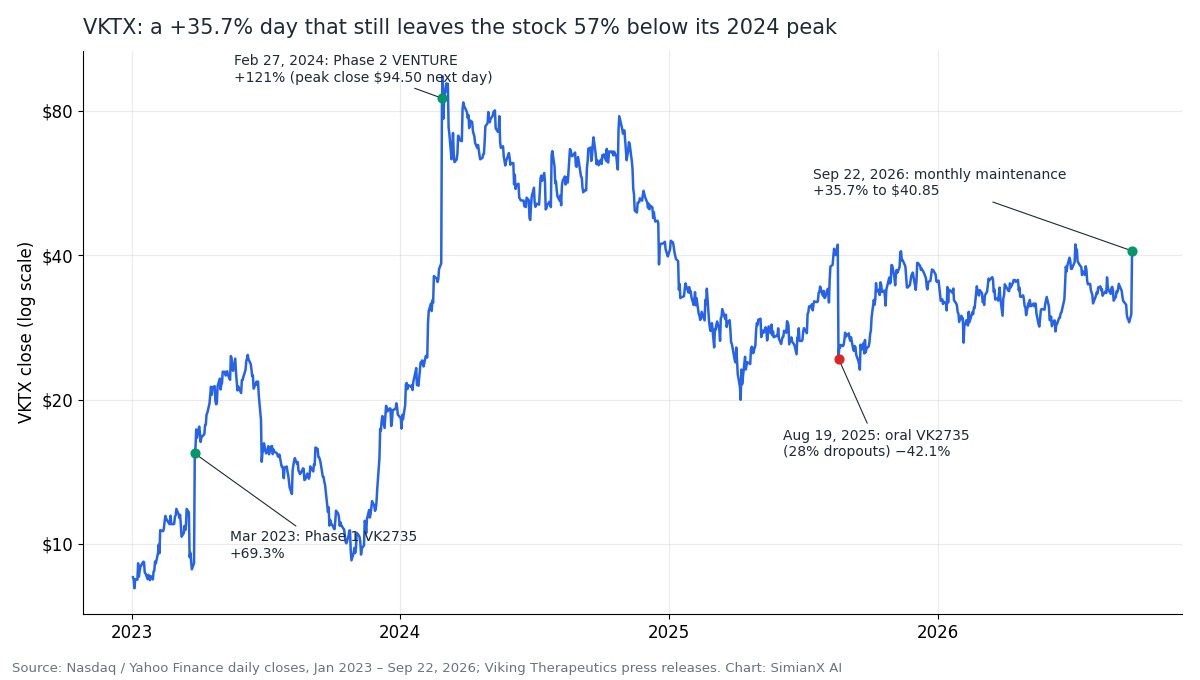
Viking Therapeutics (Nasdaq: VKTX) closed at $40.85 on September 22, 2026, up 35.7%. That was its biggest one-day gain since the February 2024 Phase 2 readout. Volume was 41.2 million shares, roughly 15 times a normal session. The catalyst was topline data from the VK2735-102 maintenance study. After 21 weeks of weekly injections, patients switched to shots every other week or once a month, and kept most of the weight they had lost.
Most coverage stopped at "up to 90% of weight loss maintained." The press release tables and Viking's SEC filings add three facts that change how the rally should be read:
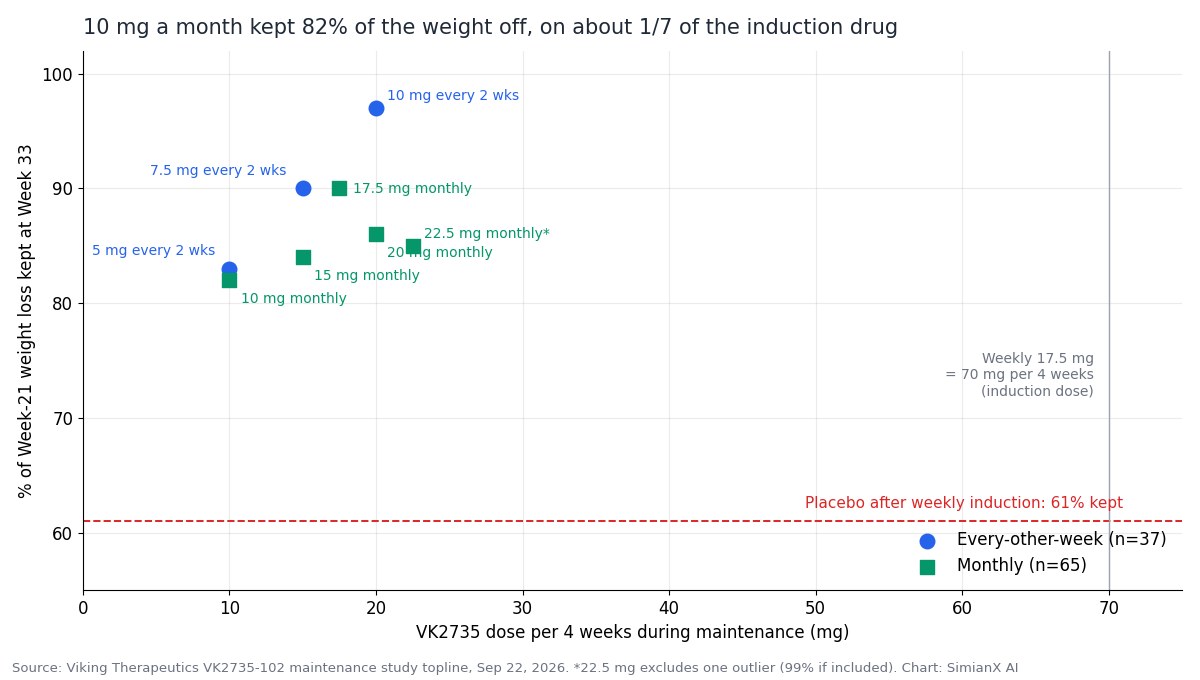
- Monthly maintenance used far less drug, not more. Each monthly shot was the same size as a single weekly shot (10–22.5 mg). The lowest arm, 10 mg a month, kept 82% of the weight off while using about one-seventh of the drug patients received during induction. For payers and manufacturing, that is the most important number in the release.
- The comparison is against a strong placebo. Patients switched to placebo still kept 61% of their weight loss after 12 weeks. The monthly arms beat that by 21–29 points. That is a clear signal, but it is a 12-week result in groups of 10–16 people.
- Viking has a $500 million share-sale program in place. It signed a new at-the-market (ATM) sales agreement on July 29, 2026. Cash and securities fell from $852 million to $502 million in five quarters, and the company's own runway guidance ("through at least September 30, 2027") ends right around the expected Phase 3 readout.
This analysis rebuilds the study from Viking's September 22 release, the Q2 2026 Form 10-Q, the July 30 shelf registration and the stock's trading history. It adds a dose-per-month analysis, a cash-runway timeline and a record of how VKTX has behaved after each of its big data days.
Prices are Nasdaq closes as of September 22, 2026. Company financials are from Viking's 10-K and 10-Q filings.
VKTX After the Maintenance Data: Key Numbers
| Metric | Value | Source |
|---|---|---|
| Close, Sep 22, 2026 | $40.85 | Nasdaq |
| One-day change | +35.7% | Nasdaq |
| Day range | $36.34 – $41.73 | Nasdaq |
| Volume | 41.2 million shares | Nasdaq |
| Shares outstanding (Jul 15, 2026) | 116.65 million | 10-Q cover |
| Market value at close | ~$4.77 billion | Calculated |
| Cash + marketable securities (Jun 30, 2026) | $501.7 million | 10-Q |
| Enterprise value (using Jun 30 cash) | ~$4.26 billion | Calculated |
| All-time closing high | $94.50 (Feb 28, 2024) | Nasdaq |
| Distance from all-time high | −56.8% | Calculated |
| Unused ATM capacity | Up to $500 million | S-3ASR |
The rally took Viking back to the top of its range of the past year (it last closed above $42 on July 7, 2026), but the stock is still worth less than half its early-2024 peak. At the time of this data, the market was valuing the whole VK2735 franchise at about $4.3 billion net of cash.
What the VK2735 Maintenance Study Tested
The study (VK2735-102) was randomized, double-blind and placebo-controlled, with about 180 adults with obesity (BMI ≥30) who were otherwise healthy. It had two phases:
- Induction (weeks 0–21): weekly subcutaneous VK2735, titrated every two weeks up to final doses of 15, 17.5, 20 or 22.5 mg, or placebo. Weight loss after 21 weeks was 16.3%–18.7% from baseline, compared with 0.1% on placebo.
- Maintenance (weeks 21–33): patients who had lost weight on weekly VK2735 were re-randomized to every-other-week doses, monthly doses, continued weekly dosing, or placebo for 12 weeks.
The endpoint that drove the stock was the share of the week-21 weight loss still kept at week 33. It is an exploratory endpoint; the study's formal objectives were safety, tolerability and pharmacokinetics.
A small weekly cohort that stayed on 17.5 mg (n=13) reached 21.7% weight loss from baseline at week 33. Viking described that as about 22% placebo-adjusted with "no plateau" in the weight-loss curve.
Monthly and Every-Other-Week Results, Arm by Arm
| Maintenance regimen (after weekly induction) | n | Drug per 4 weeks | % of weight loss kept | p vs placebo |
|---|---|---|---|---|
| Placebo | 27 | 0 mg | 61% | — |
| 5 mg every other week (from 17.5 mg weekly) | 12 | 10 mg | 83% | 0.004 |
| 7.5 mg every other week (from 15 mg weekly) | 13 | 15 mg | 90% | <0.0001 |
| 10 mg every other week (from 17.5 mg weekly) | 12 | 20 mg | 97% | <0.0001 |
| Every-other-week, combined | 37 | — | 90% | <0.0001 |
| 10 mg monthly (from 17.5 mg weekly) | 16 | 10 mg | 82% | 0.0016 |
| 15 mg monthly (from 17.5 mg weekly) | 14 | 15 mg | 84% | 0.0012 |
| 17.5 mg monthly (from 17.5 mg weekly) | 11 | 17.5 mg | 90% | 0.0002 |
| 20 mg monthly (from 20 mg weekly) | 14 | 20 mg | 86% | 0.0005 |
| 22.5 mg monthly (from 22.5 mg weekly) | 10 | 22.5 mg | 85%* | 0.0024 |
| Monthly, combined | 65 | — | 85% | — |
The 22.5 mg result excludes one participant whose response was more than 2.5 standard deviations from the cohort mean. Including that person lifts the cohort to 99%. The release does not give a p-value for the combined monthly group.
Three things stand out.
There is no clear dose response in the monthly arms. Moving from 10 mg to 22.5 mg a month changed retention only from 82% to 85–90%. With 10–16 people per arm, the differences between arms are within noise. What the data do show is that every monthly arm beat placebo.
Every-other-week dosing looked slightly better. At the same 20 mg per four weeks, 10 mg every other week kept 97% and 20 mg monthly kept 86%. That suggests steadier drug levels matter, which fits Viking's point about VK2735's long half-life.
Retention did not come with more side effects. In the monthly group, mild nausea affected 4.5% of patients, with no moderate or severe cases. Vomiting was 8% versus 7% on placebo. One of 66 monthly patients stopped treatment because of an adverse event.
The dose math most coverage missed
Induction at 17.5 mg weekly delivers about 70 mg of VK2735 every four weeks. The maintenance arms delivered 10–22.5 mg over the same period, 14%–32% as much drug:
- 10 mg monthly: about 86% less drug than induction, and 82% of the weight loss kept (versus 61% on placebo).
- 5 mg every other week: the same 10 mg per four weeks, and 83% kept.
This matters for three reasons:
- Cost of goods. Viking has already contracted dedicated capacity with CordenPharma for "multiple metric tons" of VK2735 active ingredient a year, 100 million autoinjectors and over a billion tablets. Maintenance at a fraction of the induction dose stretches that capacity much further.
- Pricing room. A maintenance regimen that uses a quarter or less of the drug could be priced below weekly treatment and still carry good margins. That matters in a market where Lilly's oral Foundayo self-pay starts at $149 a month for the lowest dose.
- Tolerability. Lower doses fit the near-placebo rate of gastrointestinal side effects seen in maintenance.
This also corrects a common assumption: a monthly shot here does not mean four weekly doses packed into one injection.
What the study does not show
- It is not monthly-from-day-one. Every patient first had 21 weeks of weekly induction. Viking says the tolerability data "raise the possibility" of testing less frequent dosing for induction too, but that has not been tested.
- It lasted 12 weeks. Obesity treatment runs for years, and there are no 12-month or longer durability data yet.
- It enrolled otherwise healthy adults. Patients with type 2 diabetes are in the VANQUISH-2 trial, not this one.
- There was no head-to-head comparison with tirzepatide (Zepbound) or semaglutide (Wegovy).
- The groups were small: 37 every-other-week and 65 monthly patients, with 10–16 per arm.
How VKTX Has Traded After Its Big Data Days
VK2735 has now produced four data releases that moved the stock by more than 35% in a day. The first move has rarely been the final verdict.
| Data release | Day move | Next 60 trading days | What followed |
|---|---|---|---|
| Mar 28, 2023 — Phase 1 VK2735 | +69.3% | +32.1% | Rally extended |
| Feb 27, 2024 — Phase 2 VENTURE (14.7% at 13 weeks) | +121.0% | −25.9% | All-time closing high $94.50 the next day, then a two-year decline |
| Aug 19, 2025 — oral VK2735 Phase 2 (28% discontinuation) | −42.1% | +67.4% | Selloff fully reversed |
| Sep 22, 2026 — monthly maintenance | +35.7% | ? | — |
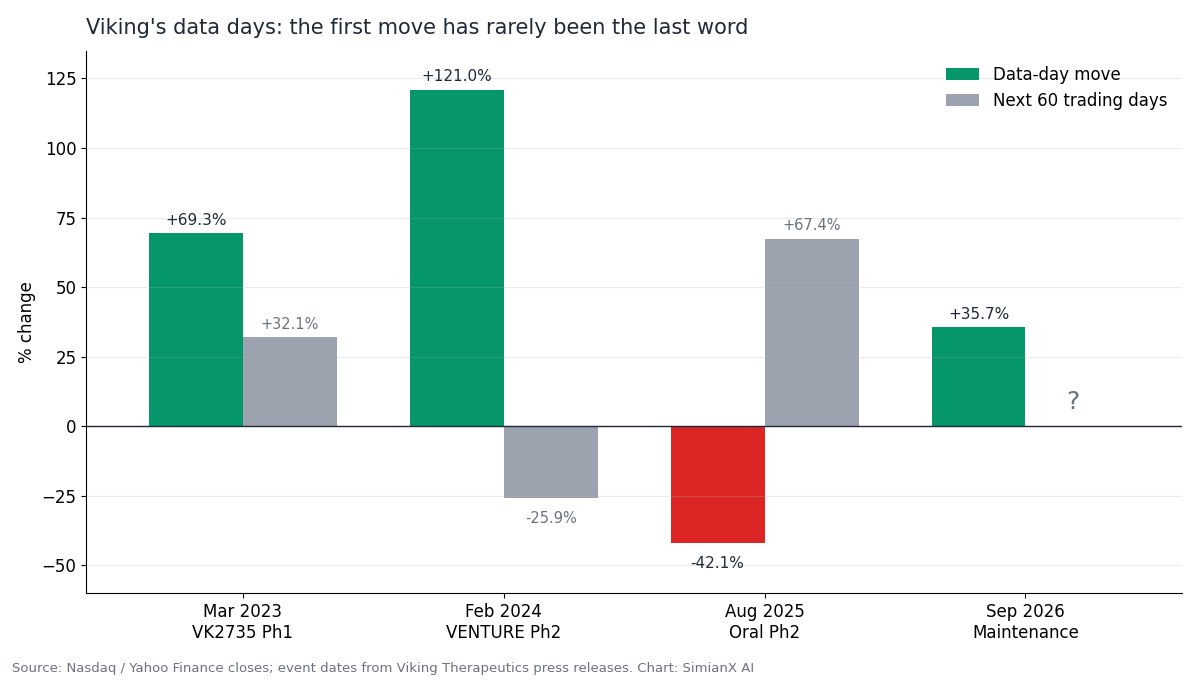
The August 2025 oral readout is the one to remember. The VENTURE-Oral Dosing results showed up to 12.2% weight loss at 13 weeks. However, 28% of VK2735 patients discontinued, versus 18% on placebo, and vomiting affected 26%. The stock lost 42% in a day. The new data answer that concern for the injectable in maintenance, but not for the tablet. Viking plans to test oral maintenance regimens in a second part of this study and to start oral Phase 3 in Q4 2026.
The $500 Million ATM and the Cash Runway
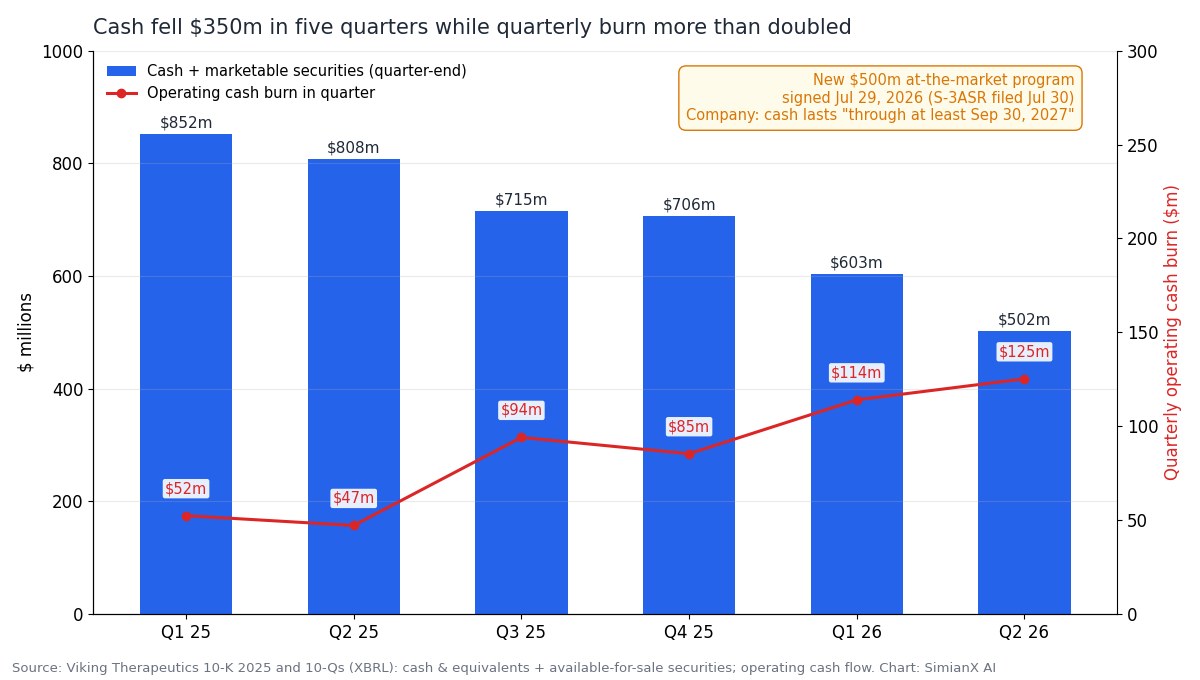
| Quarter | Cash + securities (end) | Operating cash burn | Net loss |
|---|---|---|---|
| Q1 2025 | $851.9m | $52.3m | $45.6m |
| Q2 2025 | $807.7m | $47.1m | $65.6m |
| Q3 2025 | $714.6m | $94.0m | $90.8m |
| Q4 2025 | $705.7m | $85.3m | $157.7m |
| Q1 2026 | $603.0m | $114.0m | $158.3m |
| Q2 2026 | $501.7m | $125.2m | $128.0m |
Full-year 2025 net loss was $359.6 million; H1 2026 was $286.3 million. Q2 2026 R&D was $115.8 million, versus $60.2 million a year earlier.
Three filings frame the financing question:
- Runway guidance. The Q2 10-Q says cash, equivalents and short-term investments of $501.9 million "will be sufficient to fund our operations through at least September 30, 2027."
- Phase 3 timing. VANQUISH-1 (about 4,500 adults with obesity) finished enrolling in November 2025, and VANQUISH-2 (about 1,000 adults with obesity and type 2 diabetes) in Q1 2026. Both treat patients weekly for 78 weeks, so the last patients reach the primary endpoint around mid-2027 for VANQUISH-1 and later in 2027 for VANQUISH-2. The cash guidance runs out close to when the pivotal data are expected.
- The ATM. Viking's old shelf expired on July 26, 2026. It had already sold 4,591,231 shares under the old program, including $34.2 million net in H1 2026. On July 29 it signed a new $500 million at-the-market agreement with Stifel, Piper Sandler, Cantor, Oppenheimer and Canaccord, filed as an automatically effective shelf registration on July 30.
At the new share price, the ATM's dilution looks like this:
| Average ATM sale price | Shares for $500m | Dilution vs 116.65m shares |
|---|---|---|
| $30 | 16.7m | 14.3% |
| $40.85 (Sep 22 close) | 12.2m | 10.5% |
| $50 | 10.0m | 8.6% |
An ATM lets Viking sell stock into rallies like this one without an announcement. Sales only show up in the next quarterly report. Raising money at $40 instead of $30 would mean about 4.5 million fewer new shares for the same $500 million. Seen that way, the rally has improved Viking's funding position as much as its clinical case. Investors should watch the Q3 10-Q, due around late October, for ATM sales made after September 22.
For how equity raises change per-share value, see our breakdown of Sysco's $1 billion stock sale. For a pre-revenue company whose deal cash covers about a year of spending, see our analysis of the newcleo listing.
VK2735 vs Zepbound, Wegovy and the Next Wave
VK2735 is a dual GLP-1/GIP receptor agonist, the same broad class as Lilly's tirzepatide. The market it would enter is moving quickly:
| VK2735 (Viking) | Eli Lilly | Novo Nordisk | |
|---|---|---|---|
| Approved obesity products | None; Phase 3 (VANQUISH-1/-2) | Zepbound (tirzepatide); Foundayo oral pill approved Apr 1, 2026 | Wegovy (semaglutide), injectable and oral |
| Late-stage pipeline | Oral VK2735 Phase 3 planned Q4 2026; VK3019 amylin agonist in Phase 1 | Retatrutide (triple agonist): TRIUMPH-1 showed up to 28.3% weight loss at 80 weeks | CagriSema (cagrilintide + semaglutide) |
| Lower-dose options | Every-other-week and monthly maintenance after weekly induction (this study) | Retatrutide's lowest 4 mg dose gave 19.0% weight loss in TRIUMPH-1 | Weekly dosing |
| Stock move, Sep 21–22 | +3.9%, then +35.7% | +1.0%, then +0.5% | −8.0% (Capital Markets Day), then −1.0% |
Two things happened to the incumbents in the same week. On September 21, Novo Nordisk fell 8% after its Capital Markets Day guided 2026–2030 revenue growth only "in line with" industry peers (Bloomberg). Lilly closed at $1,170, about 9% below its August 2026 record close.
Lilly's retatrutide still delivered 19.0% weight loss at its lowest 4 mg dose in TRIUMPH-1, so lower-dose strategies will not stay unique to Viking. Viking's edge is being first with randomized maintenance data at monthly intervals for an incretin already in Phase 3.
Is VKTX a Takeover Target? The Metsera Benchmark
The closest recent deal is Pfizer's purchase of Metsera, a developer of monthly GLP-1 injectables. Pfizer completed it on November 13, 2025 at $65.60 per share in cash, about $7.0 billion in enterprise value, plus a contingent value right (CVR) worth up to $20.65 per share. The CVR includes $7 per share on FDA approval of the monthly GLP-1 MET-097i, so Pfizer attached an explicit price to monthly dosing.
| Metsera (at acquisition) | Viking (Sep 22, 2026) | |
|---|---|---|
| Lead-asset stage | Phase 2 | Phase 3 fully enrolled |
| Monthly dosing evidence | Core design of the lead program | Randomized maintenance data |
| Upfront enterprise value | ~$7.0 billion (plus CVR) | ~$4.26 billion market EV |
| Bidding | Pfizer vs Novo Nordisk | None announced |
This is not a prediction of a deal. Viking has never announced a sale process, and Metsera was bought at the peak of the 2025 obesity-asset bidding. It does show that a large drugmaker has paid more for a less advanced monthly program than the market currently assigns to Viking's whole franchise, which is one reason takeover speculation follows VKTX. The same funding pressure that makes the ATM likely also makes a partnership a plausible alternative.
Risks That Remain After the Rally
- Phase 3 efficacy and tolerability. VANQUISH uses weekly doses of 7.5, 12.5 and 17.5 mg for 78 weeks. Its weight loss and discontinuation rates will determine VK2735's value far more than 12 weeks of maintenance data.
- Durability. A 61% placebo retention after 12 weeks shows how fast weight comes back. Whether monthly dosing still holds 80%+ at 12 or 24 months is unknown.
- Small-sample risk. Arms of 10–16 people, plus one excluded outlier, can move several points when a larger trial reruns them.
- Dilution. Up to $500 million of ATM capacity, rising quarterly burn, and runway guidance ending in September 2027.
- Oral tolerability. The 28% discontinuation rate in the oral Phase 2 has not yet been answered.
- Competition. Lilly's approved oral pill and higher-efficacy retatrutide; Novo's CagriSema; Pfizer's Metsera assets.
- Pricing and policy. US obesity-drug prices are falling through direct-to-consumer and government deals. Our look at how the 2026 midterms could move healthcare stocks covers the policy backdrop.
What to Watch Next
- Q3 2026 10-Q (late October): ATM shares sold after the rally, and updated cash and runway language.
- Full maintenance data: any medical-meeting presentation with individual patient data and results from the second part of the study, which tests oral maintenance.
- Oral Phase 3 start (Q4 2026): the trial design and whether it includes a lower-dose maintenance arm.
- VANQUISH-1 topline (expected around mid-to-late 2027): placebo-adjusted weight loss at 78 weeks and discontinuations due to adverse events.
- Partnership or strategic news: the alternative to equity funding.
- Peers: Lilly (retatrutide filings) and Novo (CagriSema) set the competitive bar.
SimianX AI tracks VKTX price action, SEC filings such as 10-Qs and 424B prospectus supplements, and news in one multi-agent research workflow. See VKTX stock fundamentals, or compare Eli Lilly (LLY) and Novo Nordisk (NVO).
FAQ
Why did Viking Therapeutics stock go up on September 22, 2026?
VKTX closed up 35.7% at $40.85 after Viking reported that patients switched from weekly VK2735 to monthly or every-other-week injections kept most of their weight loss over 12 weeks: 85% for the combined monthly group and 90% for every-other-week, versus 61% on placebo.
Does monthly VK2735 work as well as weekly?
In this study, the weekly cohort that stayed on 17.5 mg kept losing weight, reaching 21.7% from baseline at week 33. The monthly arms kept 82%–90% of the weight they had already lost. Monthly dosing maintains weight loss; it has not been tested for inducing it.
Is the monthly dose four times the weekly dose?
No. Each monthly injection was 10–22.5 mg, the same range as one weekly dose. Over four weeks, patients on monthly dosing received roughly 14%–32% of the drug they got during weekly induction.
Will Viking sell more stock?
It can. Viking signed a $500 million at-the-market sales agreement on July 29, 2026, and says its cash lasts through at least September 30, 2027. Sales under the program appear in its quarterly reports.
When will the VK2735 Phase 3 results come out?
VANQUISH-1 and VANQUISH-2 treat patients for 78 weeks. VANQUISH-1 finished enrolling in November 2025, which points to topline data around mid-to-late 2027. Viking has not given an exact date.
How does VK2735 compare with Zepbound and Wegovy?
There is no head-to-head trial. VK2735 is in the same GLP-1/GIP class as Zepbound (tirzepatide). Its possible edge is flexible maintenance dosing and an oral form. Zepbound and Wegovy are already approved, with years of real-world data.
Conclusion
The September 22 rally was a response to a real finding. After weekly induction, VK2735 kept 82%–97% of weight loss on as little as one-seventh of the induction dose, given monthly or every other week, with side-effect rates close to placebo. That strengthens Viking's case on convenience, cost and capacity, which the "90% maintained" headline alone does not show.
It also left three questions unanswered. First, the data cover 12 weeks in small groups of otherwise healthy adults. Second, the pivotal VANQUISH results are expected around mid-to-late 2027, about when the company's cash guidance runs out. Third, a $500 million ATM is available to close that gap at whatever price the market offers. At about $4.3 billion in enterprise value, VKTX is still below its 2024 peak and below the price Pfizer paid for an earlier-stage monthly program. The next quarterly filing will show how much stock Viking sold into the rally.
Related Reading
- Newcleo NWCL Debut: $8.145 Close vs $10 SPAC Price, Decoded
- Sysco $1B Stock Sale: Pro Forma EPS Falls 23% to $2.83
- Will the 2026 Midterms Move Healthcare Stocks UNH, HUM, CVS?
References
- Viking Therapeutics — VK2735 maintenance study topline results (Sep 22, 2026)
- Viking Therapeutics — Form 10-Q for Q2 2026
- Viking Therapeutics — Q2 2026 results release (Exhibit 99.1)
- Viking Therapeutics — Form S-3ASR with $500 million ATM prospectus (Jul 30, 2026)
- SEC EDGAR — Viking Therapeutics filings
- Viking Therapeutics — VENTURE-Oral Dosing Phase 2 results (Aug 19, 2025)
- ClinicalTrials.gov — VK2735 studies
- Eli Lilly — FDA approval of Foundayo (orforglipron)
- Eli Lilly — retatrutide TRIUMPH-1 Phase 3 results
- U.S. FDA — approval of Zepbound for chronic weight management
- Pfizer — completion of the Metsera acquisition
- Bloomberg — Novo Nordisk shares fall after Capital Markets Day
- CordenPharma — contract manufacturer
- Nasdaq — VKTX quote
- Investopedia — shelf offerings
- Investopedia — stock dilution
- Viking Therapeutics — company website