
Le short sur Micron (MU) : parier contre un gagnant de la mémoire IA
Le marché poursuit les actions de mémoire IA, donc pourquoi les investisseurs parient à la baisse sur l'action Micron semble presque irrationnel à première vue. Micron Technology (MU) est devenu l'un des bénéficiaires les plus clairs du boom de l'infrastructure IA : revenus records, marges records, demande HBM, accords stratégiques avec des clients, et des prévisions qui impliquent que le cycle de mémoire ne se comporte plus comme un cycle de mémoire normal. Pourtant, l'intérêt à découvert pour Micron a augmenté, et non disparu. Cette contradiction est exactement pourquoi ce trade est important.
Pour les lecteurs utilisant SimianX AI pour suivre les actions d'infrastructure IA, Micron est un test de résistance utile : le marché sous-estime-t-il toujours une pénurie structurelle de mémoire, ou les vendeurs à découvert avertissent-ils correctement que le trade de mémoire IA est déjà devenu vertical ?
Résumé exécutif : La thèse baissière sur Micron n'est pas une simple bearishness
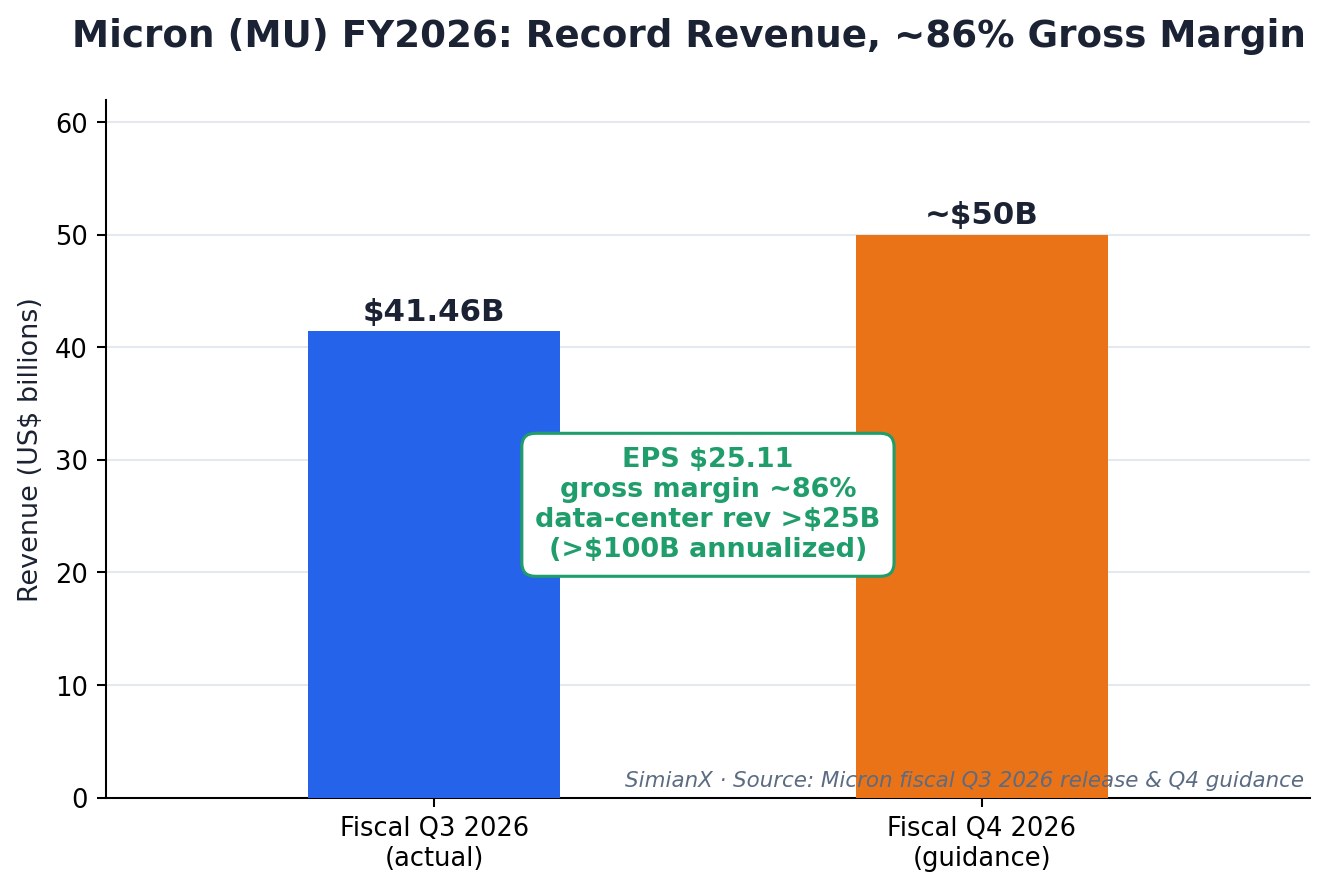
Le cas baissier contre Micron n'est pas que l'entreprise est faible. Au contraire, c'est vrai. Le dernier trimestre rapporté de Micron était exceptionnel : les revenus du T3 fiscal 2026 ont atteint 41,46 milliards de dollars, en forte hausse par rapport au trimestre précédent et à l'année précédente, tandis que le BPA non-GAAP s'est établi à 25,11 $. La direction a également prévu des revenus pour le T4 fiscal d'environ 50 milliards de dollars, avec une marge brute proche de 86 %.
Ce n'est pas une entreprise en difficulté. C'est une entreprise dans un cycle haussier alimenté par l'IA, avec des prix en forte hausse et une offre contrainte.
Alors pourquoi parier à la baisse ?
Parce que les vendeurs à découvert parient généralement contre l'une des quatre choses :
- Évaluation après un mouvement vertical
- Les bénéfices au pic du cycle étant confondus avec des bénéfices normaux
- Les attentes en matière de dépenses en capital pour l'IA devenant trop étendues
- L'offre de mémoire finissant par rattraper la demande
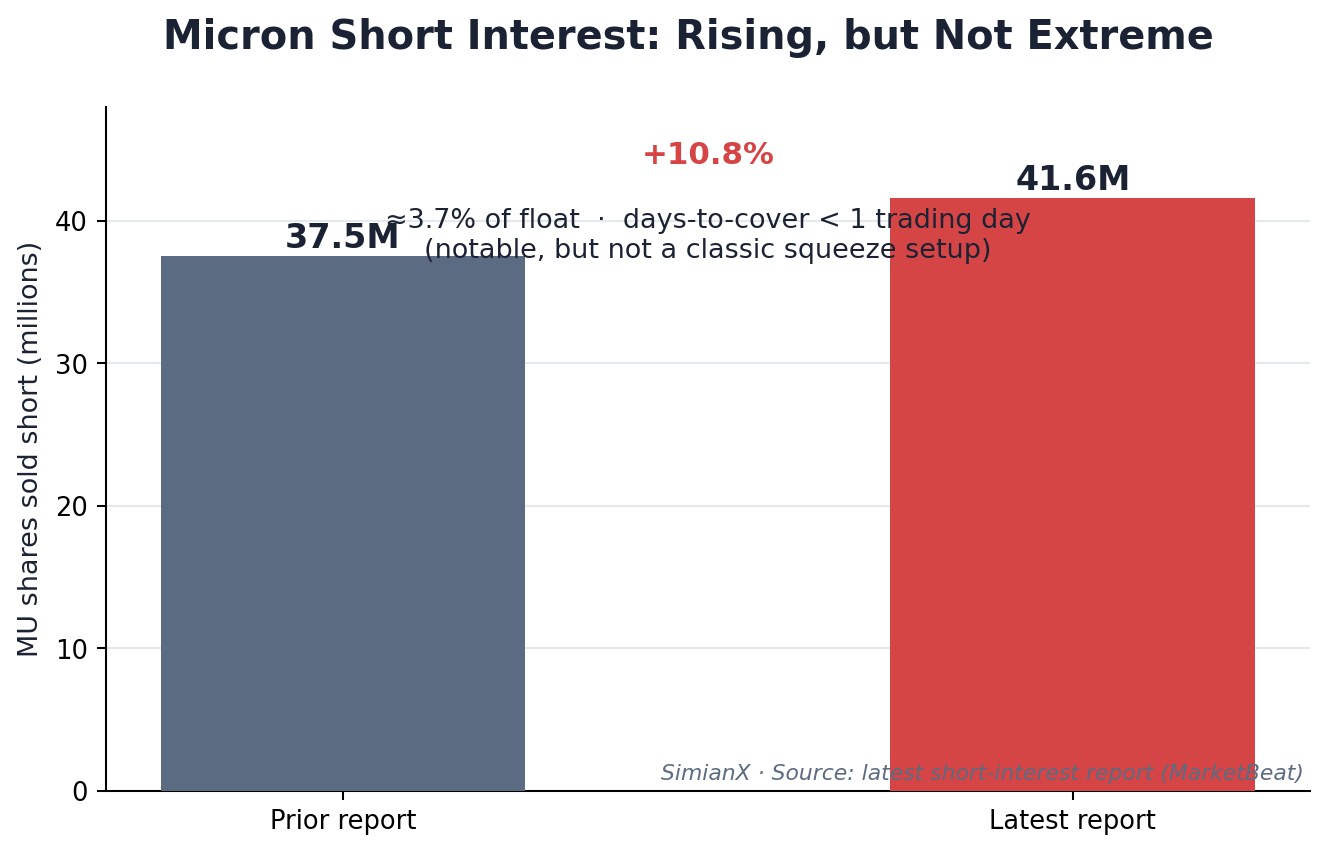
Ce qui est intéressant, c'est que l'intérêt à découvert de Micron n'est pas extrêmement élevé en pourcentage de l'offre. Selon le dernier rapport d'intérêt à découvert disponible, environ 41,6 millions d'actions MU ont été vendues à découvert, ce qui équivaut à environ 3,7 % de l'offre, avec un ratio de jours pour couvrir inférieur à un jour de négociation.
Point clé : Parier à la baisse sur Micron en 2026 est moins un pari sur l'échec de Micron, et plus un pari sur le fait que le marché extrapole les prix record de la mémoire AI trop loin dans le futur.
Pourquoi Micron est devenu l'action de mémoire AI que tout le monde poursuit
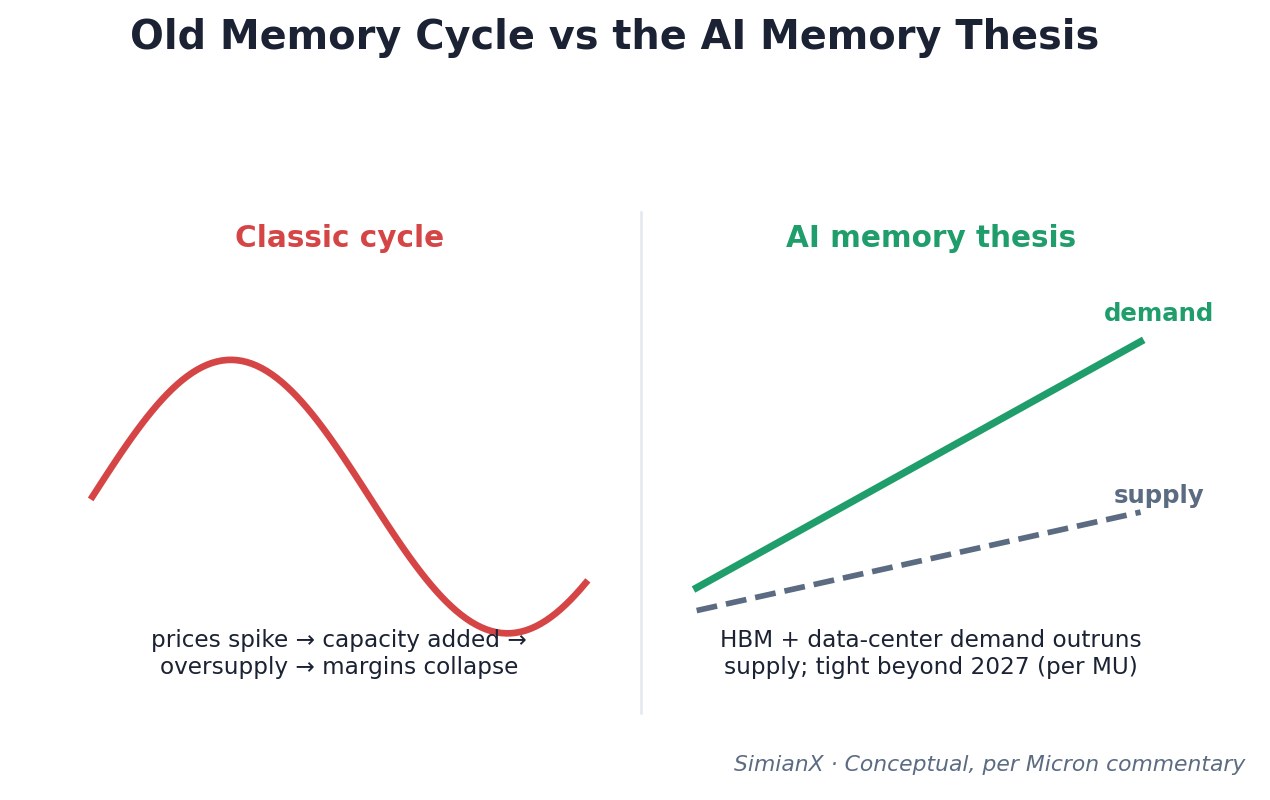
Micron était autrefois considéré comme une entreprise classique de mémoire cyclique. Lors des cycles passés, les prix de la DRAM et de la NAND augmentaient, les producteurs augmentaient leur capacité, l'offre finissait par dépasser la demande, et les marges s'effondraient. Les investisseurs ont appris à vendre des actions de mémoire lorsque les bénéfices semblaient les meilleurs.
L'IA a remis en question ce scénario.
Les accélérateurs modernes d'IA ont besoin de mémoire à large bande passante, de DRAM avancée et de stockage rapide. À mesure que les tailles de modèles augmentent et que les charges de travail d'inférence s'étendent, la mémoire n'est plus simplement un composant de base. Elle devient un goulot d'étranglement en matière de performance. La direction de Micron a soutenu que la mémoire a été élevée au rang d'actif stratégique à l'ère de l'IA, et les résultats récents soutiennent cette affirmation.
Le scénario haussier repose sur trois piliers :
- Les centres de données AI consomment de la mémoire plus rapidement que l'industrie ne peut ajouter d'offre.
- Les produits HBM et DRAM avancés offrent de meilleurs prix et avantages de mix.
- Les accords clients à long terme pourraient rendre Micron moins cyclique qu'auparavant.
Micron a également signé plusieurs accords stratégiques avec des clients, ou SCA, qui sont conçus pour fournir un approvisionnement engagé et une économie à long terme plus prévisible. La direction a déclaré que 16 accords signés représentaient environ 20 % du volume DRAM et un tiers du volume NAND pendant la période de l'accord, et que 14 de ces accords comportaient environ 100 milliards de dollars de revenus contractuels minimums pour le reste de leur durée.
Que dit l'intérêt à découvert de Micron en ce moment ?
L'intérêt à découvert de Micron raconte une histoire plus nuancée que ce que le titre suggère.
Un intérêt à découvert d'environ 3,7 % de flottant est significatif, mais pas extrême. Les dernières données rapportées ont montré que l'intérêt à découvert est passé d'environ 37,5 millions d'actions à environ 41,6 millions d'actions, soit une augmentation d'environ 10,8 % par rapport au rapport précédent.
Cela compte pour le sentiment, mais cela ne signifie pas automatiquement que « l'argent intelligent est baissier ». Dans un nom de semi-conducteur méga-cap à évolution rapide, les positions à découvert peuvent servir plusieurs objectifs :
| Type de position à découvert | Ce que cela signifie pour MU |
|---|---|
| Position à découvert directionnelle | Un trader pense que l'action MU va chuter |
| Trade pair | Long sur une autre action AI, short sur MU comme couverture de valeur relative |
| Couverture de valorisation | Un investisseur possède des gagnants en mémoire mais se couvre après un mouvement vertical |
| Couverture d'événement | Exposition à découvert avant ou après les bénéfices pour gérer la volatilité |
| Trade de facteur neutre au marché | Short sur MU dans le cadre d'un panier de semi-conducteurs plus large |
Cette distinction est importante. Le fait que des personnes vendent à découvert Micron ne signifie pas nécessairement qu'elles croient que la thèse de la mémoire AI est fausse. Cela peut signifier qu'elles pensent que l'action a évolué plus rapidement que même d'excellents fondamentaux ne peuvent le justifier.
Pourquoi les investisseurs vendent-ils à découvert l'action Micron malgré des résultats record ?
1. L'Action a Réajusté Plus Rapidement que le Cycle Économique Ne Peut Être Prouvé
Les derniers résultats financiers de Micron sont extraordinaires, mais les marchés évaluent l'avenir, pas le dernier trimestre. Lorsqu'une action monte fortement avec des bénéfices record, les vendeurs à découvert peuvent soutenir que les attentes sont devenues asymétriques : de bons résultats sont déjà intégrés, tandis que tout signe de ralentissement des augmentations de prix pourrait affecter le multiple.
Les propres prévisions de Micron montrent cette tension. La direction a prévu un autre record pour le T4 fiscal, mais a également noté que les perspectives de marge brute reflètent une modération du taux d'augmentation des prix. Cela ne signifie pas que les prix sont faibles. Cela signifie que le rythme d'amélioration pourrait ralentir par rapport à des niveaux extrêmes.
Pour une action qui a déjà été récompensée pour l'accélération des prix de la mémoire, "toujours forte mais moins accélérée" peut devenir un problème à court terme.
2. Les Investisseurs en Mémoire Se Souviennent de l'Ancien Cycle
Le marché a une longue mémoire. Dans les précédents cycles DRAM et NAND, les meilleurs bénéfices rapportés arrivaient souvent près du sommet. Cela crée un ancrage psychologique : lorsque Micron annonce des marges record, certains investisseurs se demandent instinctivement si le prochain mouvement est à la baisse.
La réponse des haussiers est que l'IA a changé la courbe de demande. La direction dit que les conditions de DRAM et NAND tendues pourraient persister au-delà de 2027, et que les clients reconnaissent que les pénuries de mémoire prendront un temps considérable à s'améliorer.
La réponse des baissiers est qu'aucune pénurie de mémoire ne dure éternellement. Les usines Greenfield sont lentes, mais elles finissent par être construites. Si les dépenses en capital pour l'IA ralentissent en même temps que l'offre commence à se normaliser, les bénéfices maximaux pourraient se comprimer plus rapidement que le récit actuel ne le suppose.
3. Les Accords Stratégiques avec les Clients Améliorent la Visibilité mais Peuvent Limiter le Potentiel
Les SCAs de Micron sont l'une des plus grandes raisons pour lesquelles les haussiers croient que le modèle commercial est en train de changer. Les structures take-or-pay, les engagements de volume, les planchers de prix et les dépôts des clients peuvent réduire la cyclicité et rendre les revenus plus prévisibles.
Mais les vendeurs à découvert peuvent retourner le même point en une préoccupation.
Si certains accords incluent des plafonds de prix ou des structures de prix fixes, alors une partie du potentiel de Micron pourrait être limitée si les prix au comptant continuent d'augmenter. Ce compromis peut néanmoins être excellent pour Micron car il améliore la protection contre les baisses et la visibilité. Mais pour les traders pariant sur un potentiel de prix illimité, les contrats peuvent introduire un plafond ainsi qu'un plancher.
C'est pourquoi la structure SCA est si importante. La question n'est pas simplement « Les contrats sont-ils bons ? » La question est :
Les accords à long terme de Micron transforment-ils les bénéfices en période de pointe en bénéfices durables, ou échangent-ils une partie du potentiel contre de la stabilité ?
4. Le risque d'exécution HBM reste réel
L'histoire HBM de Micron est devenue centrale pour sa revalorisation dans l'IA. L'entreprise a souligné les expéditions en volume élevé de HBM4 pour un client principal, le développement de HBM4E, et plus de 1 milliard de dollars de revenus HBM4 déjà expédiés.
C'est impressionnant, mais HBM est techniquement exigeant. Il dépend de nœuds DRAM avancés, de la capacité d'emballage, de l'apprentissage des rendements, des délais de qualification et des rampes de plateforme client. Si Micron manque une fenêtre de qualification, rencontre des problèmes de rendement ou fait face à une concurrence plus forte de SK Hynix ou Samsung, le récit premium de la mémoire AI pourrait s'affaiblir.
C'est un domaine clé où SimianX AI peut aider les investisseurs à suivre la thèse. Plutôt que de ne surveiller que le prix de l'action, les utilisateurs peuvent suivre le langage des transcriptions autour du rendement HBM, du calendrier des expéditions, de la qualification des clients et de la contribution aux marges.
Le cas haussier : Pourquoi vendre à découvert Micron pourrait être dangereux
L'argument le plus fort contre les vendeurs à découvert est que Micron pourrait ne plus être une action de cycle de mémoire normal.
La direction a déclaré que les revenus du centre de données ont dépassé 25 milliards de dollars au troisième trimestre fiscal, représentant un taux de croissance annualisé de plus de 100 milliards de dollars. L'entreprise a également décrit la demande de DRAM et de NAND comme dépassant significativement l'offre de l'industrie, avec des conditions tendues qui devraient persister au-delà de l'année civile 2027.
Cette combinaison modifie le profil de risque. Si la demande reste forte, l'offre reste contrainte et les clients continuent de signer des contrats à long terme, Micron pourrait maintenir des marges plus élevées plus longtemps que ce que les cycles passés pourraient suggérer.
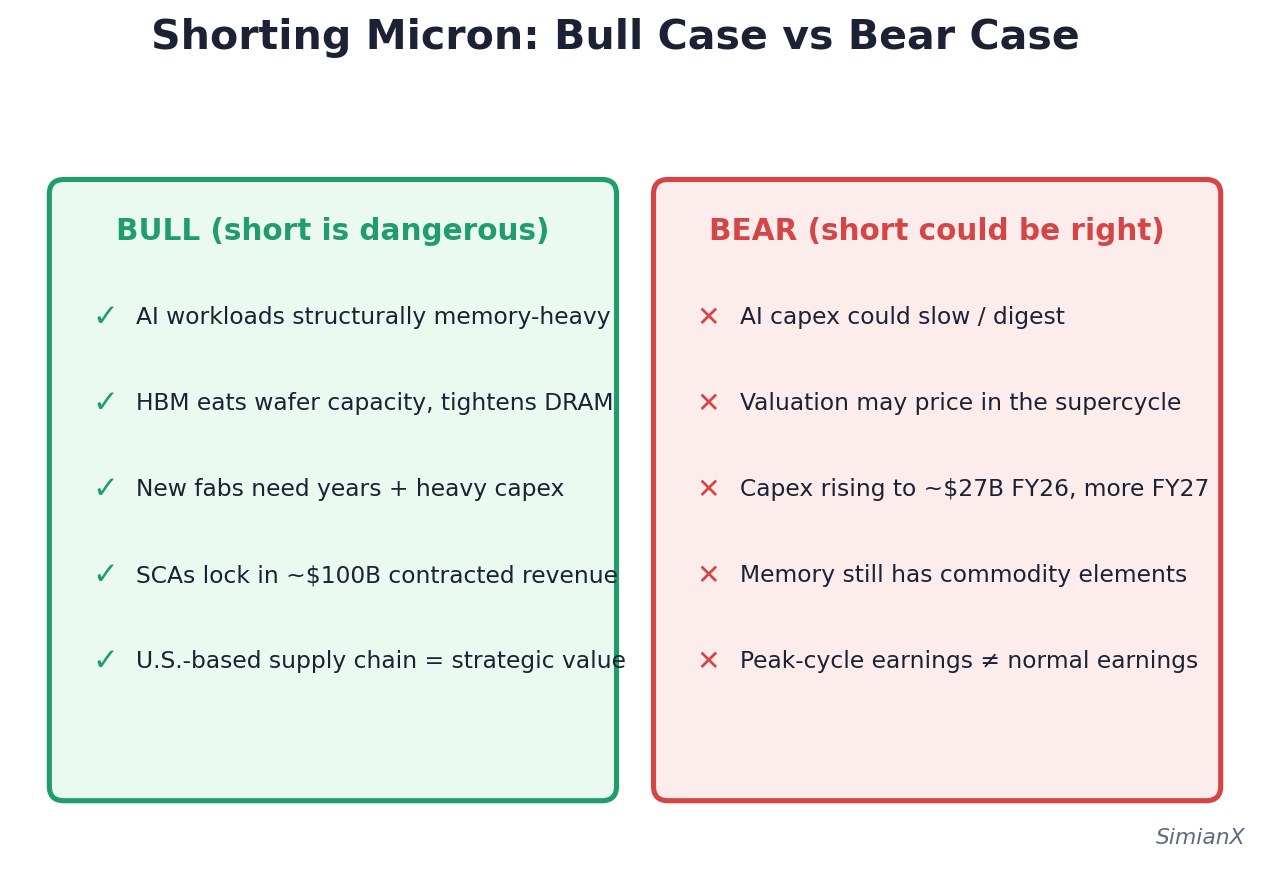
Le scénario optimiste repose sur cinq affirmations :
- Les charges de travail en IA sont structurellement intensives en mémoire
- Le HBM consomme plus de capacité de wafer et exerce une pression sur l'offre de DRAM non-HBM
- Les nouvelles usines nécessitent de longs délais de livraison et des investissements en capital majeurs
- Les accords clients rendent les bénéfices plus visibles
- La chaîne d'approvisionnement de Micron basée aux États-Unis a une valeur stratégique
C'est pourquoi vendre à découvert MU peut être douloureux. Si le marché commence à valoriser Micron moins comme un producteur de mémoire de commodité et plus comme un fournisseur d'infrastructure IA, le multiple peut s'élargir en même temps que les bénéfices augmentent.
C'est la configuration classique pour un réajustement.
Le scénario pessimiste : Qu'est-ce qui pourrait donner raison aux vendeurs à découvert ?
Les vendeurs à découvert n'ont pas automatiquement tort. Une note de recherche sérieuse sur Micron doit reconnaître les risques.
Risque 1 : Les dépenses en capital pour l'IA pourraient ralentir
La demande de Micron est de plus en plus liée à l'infrastructure IA. Si les hyperscalers ralentissent les dépenses en centres de données, retardent les achats d'accélérateurs ou déplacent davantage de charges de travail vers des silicons personnalisés avec des exigences de mémoire différentes, la demande de mémoire pourrait décevoir.
Le marché actuel suppose que l'infrastructure IA reste urgente. Tout signe de digestion pourrait exercer une pression sur l'ensemble de la pile matérielle IA.
Risque 2 : La valorisation pourrait déjà refléter le supercycle
Une grande entreprise peut toujours être une action risquée si le prix anticipe déjà la perfection. Le débat actuel sur la valorisation de Micron ne concerne pas la solidité de l'exercice 2026. Il s'agit de savoir à quoi ressemblent les bénéfices normalisés pour l'exercice 2027, 2028 et au-delà.
Si les investisseurs décident que les bénéfices d'aujourd'hui sont plus proches du pic que de la base, l'action pourrait se déprécier même si l'entreprise reste rentable.
Risque 3 : Les exigences en matière de capex augmentent
Micron investit agressivement pour répondre à la demande. La direction a guidé un capex pour le T4 fiscal d'environ 10 milliards de dollars, portant les dépenses en capital pour l'exercice 2026 à environ 27 milliards de dollars, et a déclaré que le capex trimestriel pour l'exercice 2027 devrait être supérieur aux niveaux du T4 fiscal.
Ce capex soutient la croissance à long terme, mais il augmente également la pression d'exécution. Les investisseurs doivent se demander si les rendements futurs sur ce capital resteront attrayants si les prix se normalisent.
Risque 4 : La mémoire a encore des éléments de commodité
HBM est différencié, mais Micron vend toujours de la DRAM et de la NAND sur des marchés qui peuvent devenir surapprovisionnés. Même si la mémoire AI reste tendue, la faiblesse dans les marchés mobiles, PC, consommateurs ou de stockage traditionnel peut avoir de l'importance.
C'est pourquoi une analyse complète de l'action MU devrait suivre à la fois les données spécifiques à HBM et les prix de la mémoire plus larges.
Un cadre pratique pour suivre l'intérêt à découvert sur Micron
Les investisseurs ne devraient pas regarder l'intérêt à découvert de Micron de manière isolée. Un nombre croissant de positions à découvert n'est utile que lorsqu'il est combiné avec des fondamentaux, l'action des prix et les révisions des bénéfices.
Voici un cadre pratique :
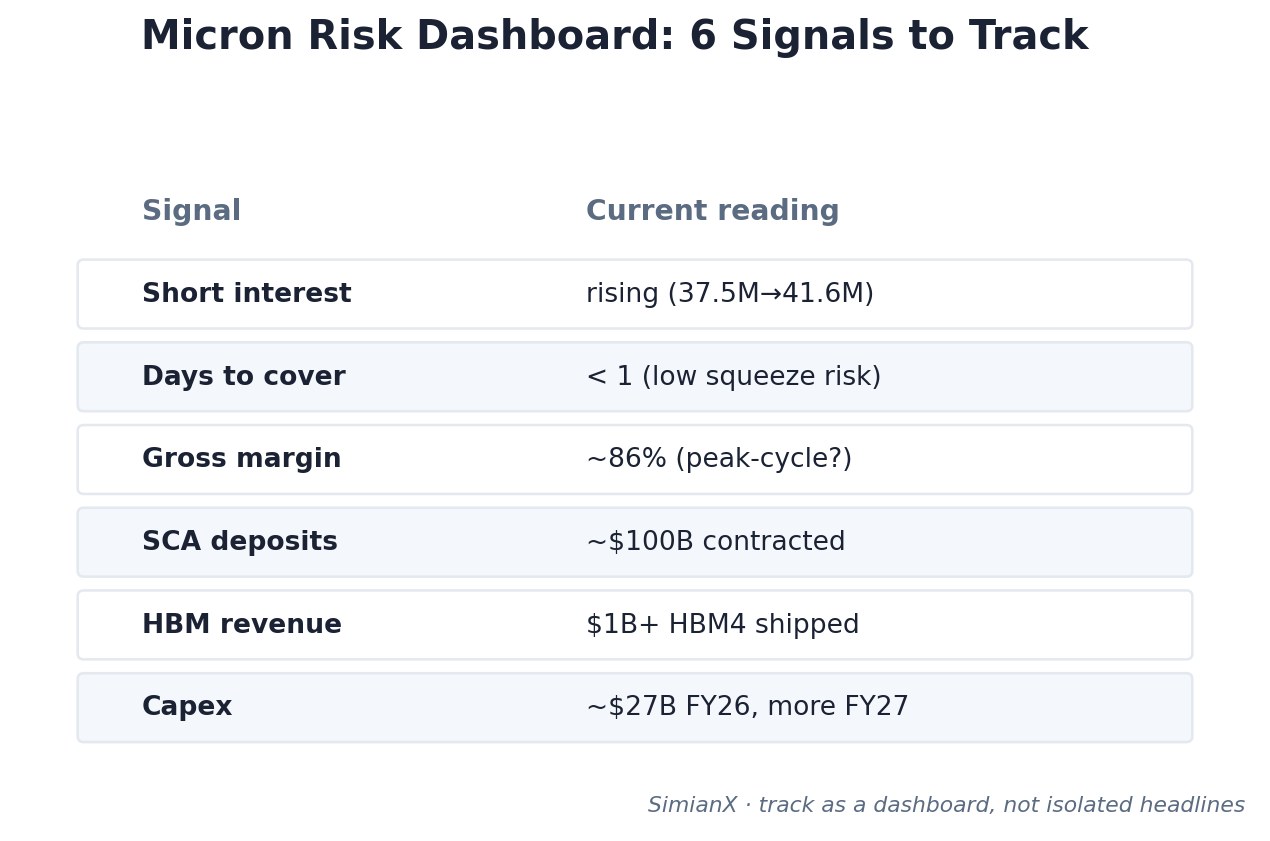
| Signal | Interprétation haussière | Interprétation baissière |
|---|---|---|
| Intérêt à découvert en hausse | Plus de carburant pour couvrir si les résultats continuent de battre | Plus de traders voient un risque de valorisation |
| Jours pour couvrir en dessous de 1 | Risque de squeeze faible ; les shorts peuvent sortir rapidement | La pression à découvert peut ne pas créer un grand squeeze |
| Marge brute en hausse | Le pouvoir de fixation des prix est toujours intact | Alerte de pic de cycle si la croissance ralentit |
| Dépôts SCA en hausse | Les clients verrouillent l'approvisionnement | Les contrats peuvent limiter certains avantages |
| Les revenus HBM augmentent | Le mélange AI se renforce | Les attentes d'exécution deviennent plus difficiles |
| L'augmentation des Capex | Micron investit dans la demande réelle | Risque de surapprovisionnement plus tard dans le cycle |
Pour les utilisateurs de SimianX AI, la meilleure approche est de suivre ces signaux comme un tableau de bord, et non comme des titres isolés. L'intérêt à découvert seul ne vous dit pas si MU est un achat, une vente ou une vente à découvert. Mais l'intérêt à découvert combiné avec les prévisions de revenus, les commentaires sur HBM et la direction de la marge brute peuvent révéler si le désaccord du marché s'élargit ou se résout.
Micron est-il un candidat pour un squeeze à découvert ?
Micron ne ressemble actuellement pas à un candidat classique pour un squeeze à découvert. Le flottant à découvert n'est pas exceptionnellement élevé, et le ratio jours à couvrir est bas.
Cela signifie qu'un rallye peut encore nuire aux vendeurs à découvert, mais les mécanismes sont différents de ceux des petites capitalisations fortement vendues à découvert. Avec MU, le moteur principal n'est pas la couverture forcée. C'est la réévaluation fondamentale.
Si les estimations de bénéfices augmentent, que les contrats stratégiques améliorent la visibilité, et que les investisseurs décident que Micron mérite un multiple plus élevé, les vendeurs à découvert peuvent perdre de l'argent sans un squeeze dramatique. Le danger n'est pas seulement que les vendeurs à découvert doivent racheter des actions. Le danger est que le marché continue d'augmenter ce qu'il est prêt à payer pour chaque dollar de bénéfices de Micron.
Qu'est-ce qui changerait la thèse de Micron ?
Un bon processus de recherche définit ce qui changerait la conclusion. Pour Micron, les indicateurs clés sont clairs.
Signaux qui renforcent le cas haussier
- Les revenus HBM continuent de croître plus rapidement que prévu.
- La marge brute reste élevée même si les augmentations de prix se modèrent.
- Plus de SCAs sont signés avec des dépôts ou des engagements d'achat significatifs.
- Les revenus des centres de données continuent de dominer le mélange.
- Les dépenses d'investissement sont absorbées sans détérioration significative du flux de trésorerie disponible.
Signaux Qui Renforcent le Cas Baissier
- Le langage de la direction passe de la pénurie à la normalisation.
- Les commentaires sur la qualification ou le rendement de HBM s'affaiblissent.
- Les dépôts des clients ralentissent ou les conditions de contrat deviennent moins favorables.
- Les commentaires sur les dépenses d'investissement en IA des hyperscalers deviennent prudents.
- Les prix de la DRAM ou de la NAND chutent plus rapidement que prévu.
La clé est d'éviter de traiter Micron comme un commerce de bénéfices sur un seul trimestre. Il s'agit maintenant d'un débat pluriannuel sur la question de savoir si la mémoire est devenue un goulot d'étranglement stratégique pour l'IA.
FAQ Sur Pourquoi Les Investisseurs Vendent À Découvert L'Action Micron
Pourquoi les investisseurs vendent-ils à découvert l'action Micron si la demande de mémoire pour l'IA est forte ?
Parce que la thèse de vente à découvert concerne principalement l'évaluation, la cyclicité et le risque de marge maximale, et non la demande actuelle faible. Les vendeurs à découvert peuvent croire que l'action a déjà intégré plusieurs années de croissance exceptionnelle de la mémoire pour l'IA.
Quel est l'intérêt à découvert actuel de Micron ?
Les dernières données disponibles sur l'intérêt à découvert montraient environ 41,6 millions d'actions MU vendues à découvert, soit environ 3,7 % du flottant, avec des jours pour couvrir en dessous d'un jour de négociation. C'est notable mais pas extrême.
L'action Micron est-elle une action d'IA ou une action de cycle de mémoire ?
C'est les deux. Micron est toujours une entreprise de mémoire, mais l'IA a changé le profil de demande pour HBM, DRAM avancé et stockage de centre de données. Le débat d'investissement est de savoir si la demande en IA augmente de manière permanente la structure de marge de Micron.
Les vendeurs à découvert de Micron pourraient-ils être contraints de couvrir ?
Ils pourraient couvrir si l'action continue de monter, mais les indicateurs d'intérêt à découvert actuels ne suggèrent pas une configuration classique de squeeze. Le plus grand risque pour les vendeurs à découvert est une revalorisation continue des bénéfices et des multiples.
Que devraient surveiller les investisseurs après les derniers bénéfices de Micron ?
Surveillez les revenus de HBM, la marge brute, les accords avec des clients stratégiques, les dépenses d'investissement, le flux de trésorerie disponible et les commentaires de la direction sur la tension entre l'offre et la demande au-delà de 2027. Ces variables détermineront si les vendeurs à découvert sont en avance, dans l'erreur ou finalement dans le vrai.
Conclusion : Vendre à découvert Micron est un pari contre l'extrapolation, pas contre l'IA
Tout le marché poursuit les actions de mémoire liées à l'IA, et Micron est l'un des gagnants les plus clairs. L'entreprise a des revenus record, une rentabilité record, une exposition croissante à l'HBM, des accords clients à long terme et des prévisions qui soutiennent l'idée d'une pénurie prolongée de mémoire.
Pourtant, les gens continuent de vendre à découvert Micron parce que le marché ne débat pas de la force du trimestre actuel. Il débat de la durabilité de ce niveau de rentabilité pour justifier la revalorisation de l'action.
Cela fait de MU l'une des actions d'infrastructure IA les plus importantes à surveiller. Le scénario haussier dit que Micron devient un fournisseur de mémoire IA stratégique, soutenu par des contrats. Le scénario baissier dit que les investisseurs paient encore une fois des prix de cycle de pointe pour des bénéfices de cycle de pointe.
La vérité apparaîtra dans les données : mix HBM, durabilité des marges, engagements des clients, retours sur capex et comportement de l'intérêt à découvert. Pour suivre ces signaux en continu, explorez SimianX AI et utilisez son flux de travail de recherche multi-agents pour surveiller MU, les pairs de mémoire IA et le cycle plus large des semi-conducteurs.
Notes sur la source des données
[1] Communiqué de presse officiel de Micron pour le T3 fiscal 2026 : revenus, BPA, marge brute et prévisions pour le T4 fiscal.
[2] Données sur l'intérêt à découvert de MarketBeat pour Micron Technology.
[3] Remarques préparées sur les résultats de Micron pour le T3 fiscal 2026 : revenus des centres de données, demande de DRAM/NAND et commentaires sur la tension de l'offre.
[4] Commentaires sur les accords clients stratégiques de Micron issus des remarques préparées pour le T3 fiscal 2026.
[5] Prévisions de capex de Micron issues des remarques préparées pour le T3 fiscal 2026.
[6] Commentaires sur Micron HBM4 et HBM4E issus du communiqué de presse officiel des résultats du T3 fiscal 2026.
Lecture Liée
- Boom des Actions IA : Nvidia Mène le Supercycle des Puces
- Actions Puces IA Solides : AMD, Intel Portent Data Centers
- Résultats Broadcom 2026 : ASIC IA et l'action AVGO
- Krach du KOSPI 2026 : le règlement de comptes des puces IA
- Action Cerebras 2026 : Boom des puces IA vs risque de marge
- Infrastructure IA KKR Helix : NVDA, VST et l'énergie IA