Inside the 2026 AI Chip Selloff: How a Record Q2 Rally Turned Into a Momentum Unwind
AI Momentum Unwind 2026: Why Semiconductor Stocks Are Falling After the Q2 Rally is the question traders are asking after one of the strongest AI-led semiconductor runs in years suddenly turned unstable. The selloff does not mean artificial intelligence demand has disappeared. It means the market is testing whether AI chip valuations, earnings expectations, and hyperscaler capex assumptions became too aggressive too quickly. For investors using SimianX AI, the key is not to label every dip as a bargain or every selloff as a bubble. The better approach is to separate fundamentals, positioning, technical momentum, and risk management into a structured research process.
What Happened to Semiconductor Stocks After the Q2 Rally?
The semiconductor trade entered Q3 2026 with a sharp reversal after a powerful second-quarter rally. The Philadelphia Semiconductor Index, or SOX, had already become one of the clearest symbols of the AI equity boom. After a dramatic Q2 surge, several chip names began to fall as investors questioned whether the rally had priced in too much good news.
That matters because chip stocks had been one of the main engines behind the broader AI trade. The rally was not limited to one company. It included GPUs, ASICs, memory, storage, semiconductor equipment, networking, optical components, power infrastructure, and data center supply-chain names.
Key takeaway: The semiconductor selloff is not simply about weak AI demand. It is a repricing of momentum, valuation, positioning, and the market’s confidence in future AI infrastructure returns.
The Q2 rally was built on several powerful forces:
- AI data center demand remained a core growth driver.
- High-bandwidth memory and storage demand pushed investors toward memory suppliers.
- Networking, power, cooling, and data center infrastructure became part of the broader AI trade.
- Momentum funds and trend-following strategies amplified upside.
- Retail and institutional investors crowded into the same AI hardware winners.
But when a trade becomes crowded, the same forces that accelerate gains can also accelerate declines. This is the essence of the AI momentum unwind 2026 setup.
Why Semiconductor Stocks Are Falling After the Q2 Rally
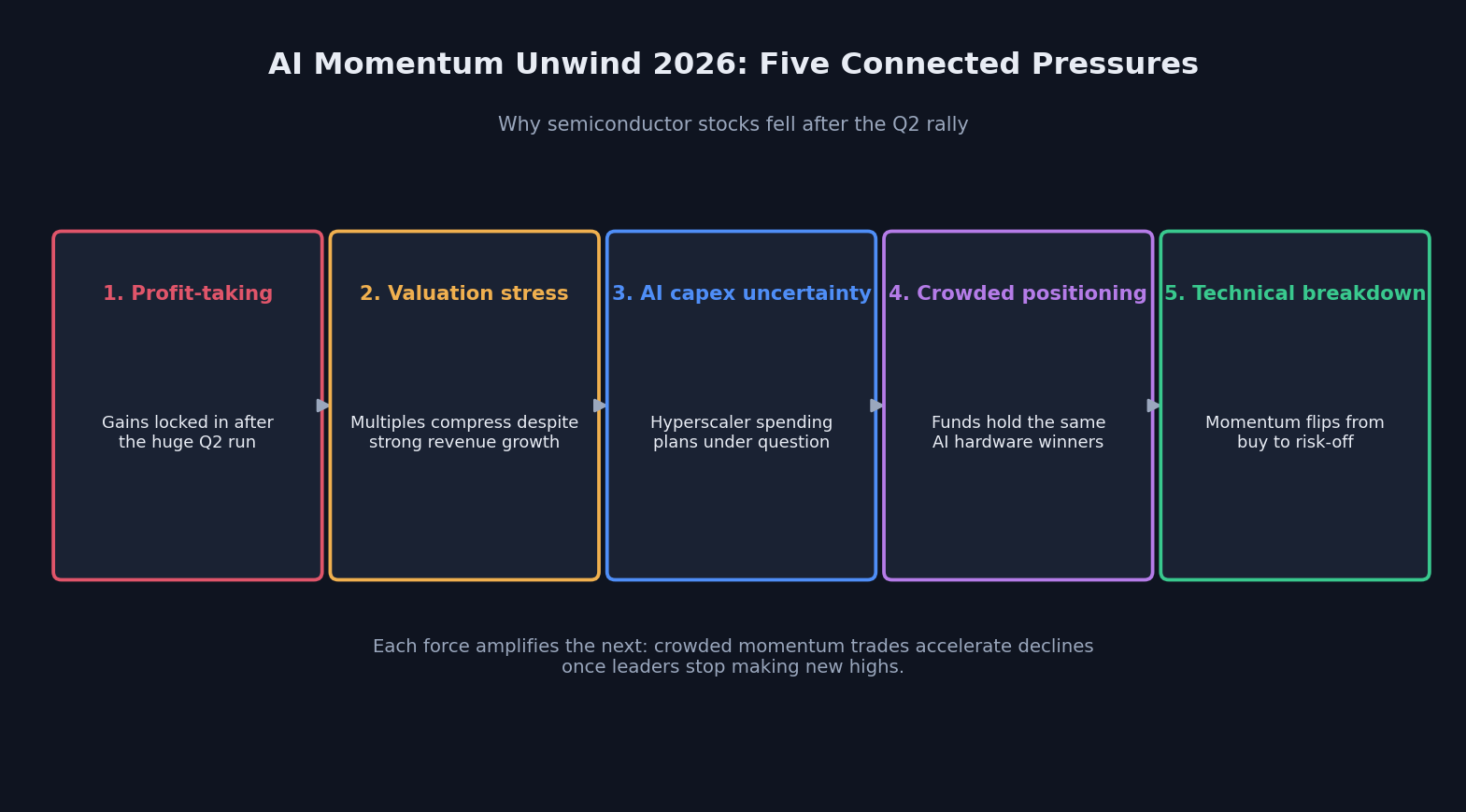
The semiconductor decline can be explained through five connected forces: profit-taking, valuation stress, hyperscaler capex uncertainty, market concentration, and technical momentum breakdown.
| Pressure Point | Why It Matters | Market Signal to Watch |
|---|---|---|
| Profit-taking | Investors lock in gains after a huge Q2 rally | Sharp reversals in leaders like MU, AMD, AVGO, NVDA |
| Valuation risk | Stocks may price in perfect execution | Multiple compression despite strong revenue growth |
| AI capex uncertainty | Chip demand depends on hyperscaler spending | Commentary from Microsoft, Meta, Amazon, Alphabet |
| Crowded positioning | Everyone owns similar AI hardware exposure | Fast ETF and factor rotation |
| Technical breakdown | Momentum signals flip from buy to risk-off | Broken moving averages, failed rebounds, rising volatility |
1. Profit-Taking After Extreme AI Hardware Gains
A strong business can still become a risky stock if price runs too far ahead of earnings. Semiconductor and memory stocks had already surged during the first half of 2026, with investors aggressively bidding up AI infrastructure exposure.
That kind of move creates a simple market problem: even bullish investors may reduce exposure because the risk-reward becomes less attractive after a huge run.
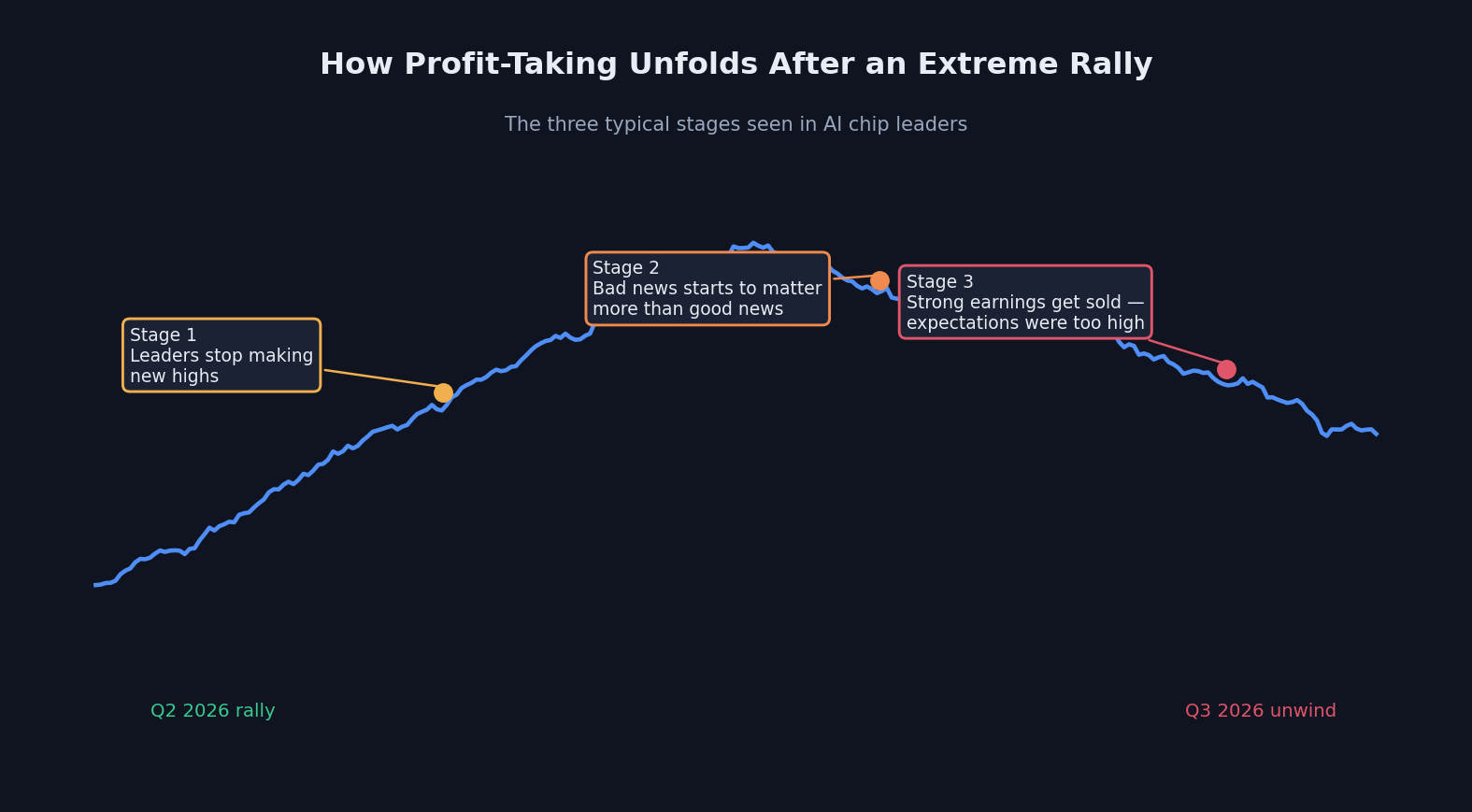
In practical terms, profit-taking usually appears in three stages:
- Leaders stop making new highs.
- Bad news starts to matter more than good news.
- The market sells strong earnings because expectations were already too high.
This is why “semiconductor stocks are falling after the Q2 rally” can be true even if AI infrastructure demand remains strong.
2. AI Capex Is Now the Core Debate
The AI chip trade depends on a huge spending chain. Hyperscalers buy GPUs, ASICs, HBM, networking equipment, storage, optical components, power systems, and data center capacity. If investors believe hyperscalers will keep spending aggressively, semiconductor stocks can justify high expectations. If investors believe spending slows, the entire AI hardware chain becomes vulnerable.
The concern is not just “Are companies spending?” The deeper question is:
Are AI users generating enough revenue, productivity, and margin improvement to justify the next wave of capex?
That is where the AI momentum unwind becomes more complicated. Chip suppliers may still report strong demand today, but investors are discounting what could happen if hyperscalers become more selective in 2027.
3. The Hardware-vs-Hyperscaler Divergence Looks Fragile
One reason the semiconductor selloff matters is that the AI trade has become divided. Hardware and memory stocks have surged, while many large AI spenders have lagged. This type of divergence can create tension inside the AI investment narrative.
The bullish interpretation is that the market is simply rotating toward “picks and shovels” winners. The bearish interpretation is that suppliers are benefiting from a capex cycle that may later be revised lower.
Both can be true at different timeframes.
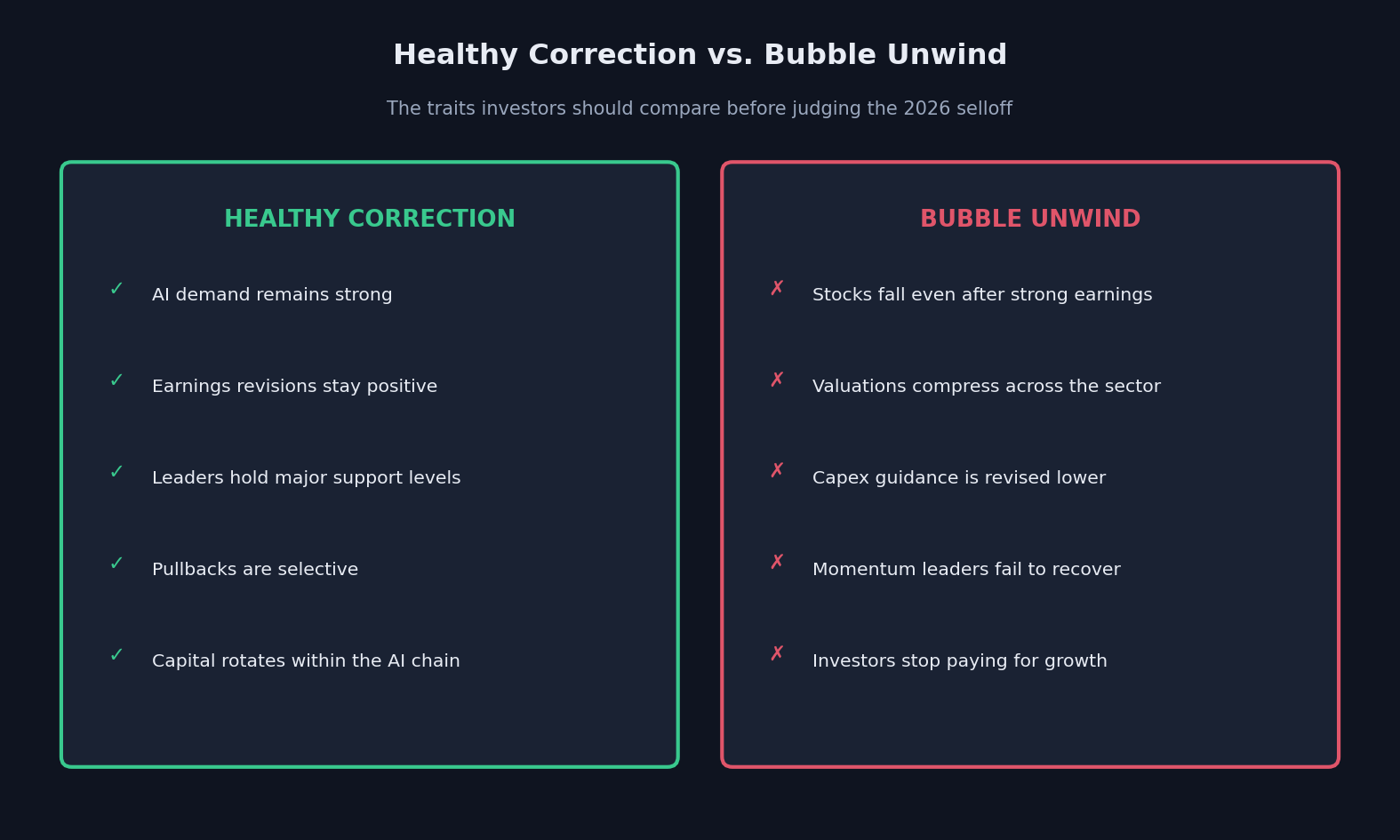
Is the AI Momentum Unwind 2026 a Bubble Signal or a Healthy Correction?
The best answer is: it depends on what happens next.
A healthy correction usually has these traits:
- AI demand remains strong.
- Earnings revisions stay positive.
- Leaders hold major support levels.
- Pullbacks are selective, not indiscriminate.
- Capital rotates within the AI supply chain instead of leaving the theme entirely.
A bubble unwind has different traits:
- Stocks fall even after strong earnings.
- Valuations compress across the full sector.
- Hyperscaler capex guidance is revised lower.
- Momentum leaders fail to recover.
- Investors stop paying for future growth.
That is the tension investors must understand: the fundamental AI demand story may remain intact, while the stock-market setup becomes more fragile.
How to Analyze Semiconductor Stocks After the Q2 Rally
After a fast AI chip selloff, the worst mistake is to rely on a single narrative. Investors need a repeatable framework that tests both the bull case and the bear case.
Here is a practical research workflow:
- Rebuild the rally
- Which stocks led Q2?
- Was the move driven by earnings, multiple expansion, or momentum?
- Did the rally broaden or become concentrated in a few names?
- Map the AI value chain
- GPUs: NVDA, AMD
- ASICs and networking: AVGO, MRVL
- Memory and storage: MU, WDC, STX, SK Hynix
- Foundry and equipment: TSM, ASML, AMAT, LRCX, KLAC
- Power and infrastructure: VRT, ETN, GLW, CAT
- Check earnings expectations
- Are analysts raising or cutting estimates?
- Are gross margins expanding or peaking?
- Is backlog converting into revenue?
- Compare price action with fundamentals
- If fundamentals improve but price weakens, positioning may be the issue.
- If fundamentals weaken and price breaks down, the selloff may be more serious.
- Define risk before entry
- Position size
- Stop-loss level
- Earnings-event exposure
- Maximum portfolio concentration
- Thesis invalidation trigger
SimianX AI can help investors structure this process by comparing technical signals, market news, fundamental drivers, and sentiment changes across multiple AI analyst perspectives. That matters because a semiconductor selloff is rarely caused by one variable alone.
What Investors Should Watch Next in AI Chip Stocks
The next stage of the AI momentum unwind 2026 will likely depend on six signals.
| Signal | Bullish Interpretation | Bearish Interpretation |
|---|---|---|
| Hyperscaler capex | Spending stays strong and supports chip orders | Spending slows or becomes more selective |
| Earnings revisions | Revenue and margins move higher | Estimates peak after Q2 strength |
| Memory pricing | HBM and DRAM remain tight | Supply improves and pricing power fades |
| Sector breadth | More chip names recover | Only a few mega-cap leaders hold up |
| Technical levels | Pullbacks hold support | Failed rebounds confirm distribution |
| Investor positioning | Rotation stays orderly | Crowded trades unwind rapidly |
Why Does AI Momentum Unwind 2026 Matter for Semiconductor Investors?
The phrase AI Momentum Unwind 2026 matters because it describes a market structure problem, not just a one-day selloff. Momentum trades often work until positioning becomes too crowded. Once a leading group starts to fall, investors who bought for performance reasons may exit faster than fundamental investors can absorb the supply.
For semiconductor investors, this means the real question is not:
“Is AI still important?”
The real question is:
“How much future AI growth is already priced into these stocks?”
That distinction is critical. AI can remain one of the most important technology shifts of the decade while semiconductor stocks still experience sharp drawdowns.
Bull Case: Why the AI Chip Trade May Recover
The bullish case is still meaningful. AI workloads continue to expand, enterprises are deploying more AI tools, model training and inference need huge compute capacity, and memory bandwidth remains a bottleneck.
The bull case for semiconductor stocks includes:
- AI compute demand remains undersupplied
- HBM and advanced memory stay tight
- ASIC adoption expands beyond GPUs
- Networking and optical demand rise
- Data center power constraints support infrastructure suppliers
- Earnings growth catches up with valuation
In this scenario, the Q3 pullback becomes a reset, not the end of the AI trade. Leaders with durable demand, strong margins, and real customer commitments may recover first.
Bear Case: Why the Semiconductor Selloff Could Deepen
The bearish case starts with valuation. If a stock rises too far too fast, even good news may not be enough. Investors may decide that the best-case scenario is already priced in.
The bear case includes:
- Hyperscalers slow AI capex growth
- Investors question AI monetization
- Memory pricing peaks
- Export restrictions pressure China-related revenue
- Rate expectations hurt long-duration growth stocks
- Momentum funds continue to unwind exposure
The most dangerous setup is not weak demand alone. It is strong demand plus impossible expectations. When investors expect perfection, small disappointments can create large price moves.
A Simple AI Semiconductor Risk Checklist
Before buying the dip in semiconductor stocks after the Q2 rally, investors should ask:
- Is the stock falling because fundamentals changed, or because positioning changed?
- Did the company raise guidance, maintain guidance, or avoid giving detail?
- Are customers expanding AI capex or becoming more disciplined?
- Is the company exposed to GPUs, ASICs, HBM, equipment, or infrastructure?
- Does the stock still trade above key support levels?
- Is portfolio exposure too concentrated in one AI theme?
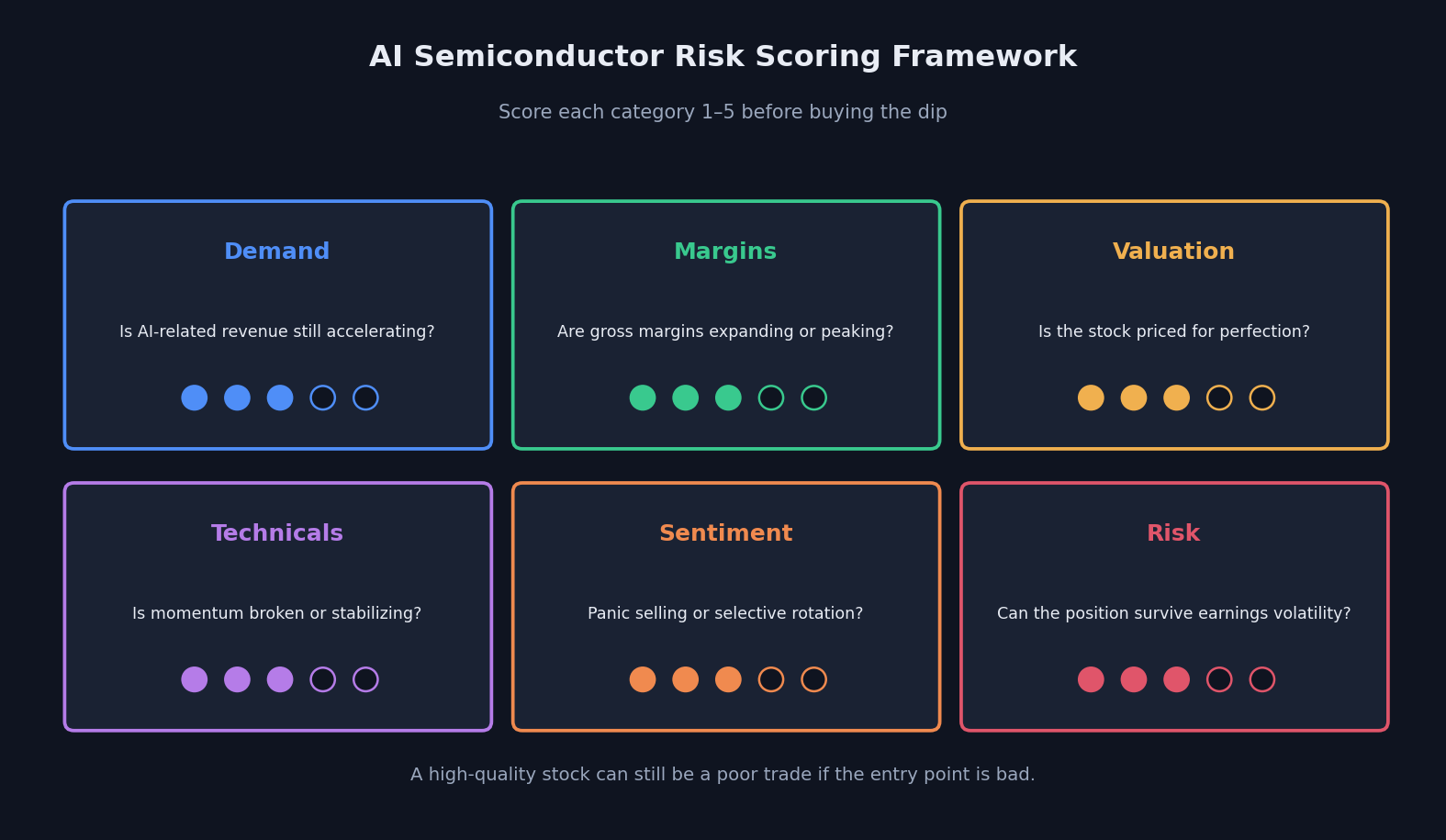
A simple scoring model can help:
| Category | Question | Score 1–5 |
|---|---|---|
| Demand | Is AI-related revenue still accelerating? | |
| Margins | Are gross margins expanding or peaking? | |
| Valuation | Is the stock priced for perfection? | |
| Technicals | Is momentum broken or stabilizing? | |
| Sentiment | Are investors panicking or rotating selectively? | |
| Risk | Can the position survive earnings volatility? |
A high-quality semiconductor stock can still be a poor trade if the entry point is bad. A volatile stock can still be attractive if expectations reset and fundamentals remain strong.
How SimianX AI Helps Research the Semiconductor Selloff
The semiconductor market is difficult because it combines macro, earnings, supply chains, technical signals, and sentiment. A single headline rarely explains the move.
SimianX AI is useful for this type of research because it can help organize the market into multiple decision layers:
- Indicator analysis for momentum, support, resistance, and volatility
- Fundamental analysis for revenue growth, margins, capex, and valuation
- Intelligence analysis for news flow, analyst commentary, and market sentiment
- Decision analysis for entry zones, stop-loss levels, and risk-reward planning
This multi-angle approach is especially helpful when the AI trade is split between bullish long-term demand and bearish short-term positioning. Investors do not need a magical prediction. They need a clearer process for deciding whether a pullback is a buyable reset, a crowded-trade unwind, or the beginning of a broader repricing.
FAQ About AI Momentum Unwind 2026
What caused semiconductor stocks to fall after the Q2 rally?
Semiconductor stocks fell because investors took profits after a powerful AI-led Q2 rally, while concerns grew around valuation, crowded positioning, and hyperscaler AI capex. The selloff also reflected technical momentum pressure, where prior winners became vulnerable once buyers stopped chasing upside.
Is the AI chip stock selloff a sign that AI demand is weakening?
Not necessarily. The selloff may reflect market expectations resetting rather than a collapse in AI demand. AI infrastructure demand can remain strong while stock prices fall because valuations already priced in years of growth.
How should investors analyze AI semiconductor stocks in 2026?
Investors should combine earnings revisions, AI revenue exposure, margin trends, capex signals, technical support levels, and sector positioning. A multi-factor approach is better than reacting to one headline or assuming every AI-related dip is automatically a buying opportunity.
Which semiconductor stocks are most exposed to the AI momentum unwind?
The most exposed stocks are usually the biggest winners from the AI infrastructure trade, including GPU, memory, ASIC, networking, equipment, and data center infrastructure names. Examples include NVDA, AMD, AVGO, MU, MRVL, AMAT, LRCX, KLAC, and related AI infrastructure suppliers.
What is the best way to manage risk after the AI chip selloff?
The best way is to define position size, stop-loss levels, earnings-event risk, and thesis invalidation points before entering a trade. Investors should also avoid overconcentration in one AI theme and compare each stock’s valuation against realistic earnings expectations.
Conclusion
AI Momentum Unwind 2026: Why Semiconductor Stocks Are Falling After the Q2 Rally is not a story about AI suddenly becoming irrelevant. It is a story about a powerful market theme becoming crowded, expensive, and vulnerable after a major Q2 advance. The core lesson is simple: AI demand can be real, and semiconductor stocks can still correct sharply.
Investors should focus on the evidence: hyperscaler capex, semiconductor earnings revisions, margin durability, memory pricing, technical support, sector breadth, and positioning risk. The winners of the next phase may not be the stocks that rallied the most in Q2, but the companies that can convert AI demand into durable earnings while surviving valuation pressure.
To research these fast-moving AI semiconductor setups with more structure, explore SimianX AI and use multi-agent market analysis to turn volatility, news flow, and technical signals into clearer investment decisions.
Related Reading
- Meta Compute 2026: Can Excess AI Capacity Drive Revenue?
- Comfort Systems Stock (FIX) 2026: AI Cooling Bottleneck
- NVIDIA-IREN 2026: The $2.1B 5GW AI Factory Power Trade
- Micron Anthropic Deal 2026: Claude AI Memory Explained
- ON Semiconductor Stock 2026: $7B Synaptics Physical AI Bet