Inside the Micron–Anthropic Pact: Memory as AI's New Bottleneck
The Micron Anthropic Deal 2026: Claude’s AI Memory Supply Chain Explained story is not just another semiconductor headline. It is a signal that frontier AI labs are no longer treating memory as a commodity component. They are locking down HBM, DRAM, SSDs, and storage architecture as strategic infrastructure for training and serving large models like Claude. For investors tracking this shift through SimianX AI, the deal offers a cleaner way to understand where the next AI bottleneck may be: not only GPUs, but the memory systems around them.

Executive Summary: Why the Micron Anthropic Deal Matters
Micron and Anthropic announced a strategic agreement covering four connected areas: memory and storage architecture design, supply and demand alignment, Claude adoption inside Micron, and Micron’s strategic investment in Anthropic’s Series H funding round.
That structure matters because it links a frontier AI model developer directly with a memory supplier. Instead of buying components through a traditional supply chain, Anthropic is working with Micron to understand how memory and storage subsystems affect Claude workloads across the full AI infrastructure stack.
Key takeaway: the Micron Anthropic deal turns memory from a back-end component into a front-line AI scaling variable.
For Claude, this means better visibility into the hardware layer that determines training efficiency, inference throughput, energy use, and token economics. For Micron, it means another proof point that memory is becoming a strategic AI infrastructure category rather than a purely cyclical semiconductor product.
The core idea is simple:
- Claude demand rises
- Anthropic needs more compute capacity
- Compute capacity requires memory bandwidth and storage performance
- Micron supplies and co-optimizes the memory layer
- Better memory architecture can improve cost, speed, and scalability
This is why the deal should be read as an AI supply chain agreement, not just a chip purchase order.
What Is the Micron Anthropic Deal 2026?
The Micron Anthropic Deal 2026 is a strategic AI infrastructure agreement between Micron Technology and Anthropic, the company behind Claude. The agreement covers the design and supply of memory and storage systems that support Claude’s long-term compute strategy.
Micron’s product portfolio includes:
- HBM: high-bandwidth memory used near AI accelerators
- DRAM: system memory used across servers and data center platforms
- SSDs: storage systems needed for datasets, checkpoints, retrieval, logs, and inference workflows
- Advanced data center memory products: capacity and bandwidth solutions built for AI infrastructure
Anthropic’s interest is clear. Claude is not just a chatbot running on generic servers. It is a frontier AI system that needs enormous infrastructure for training, fine-tuning, inference, safety testing, and enterprise deployment.
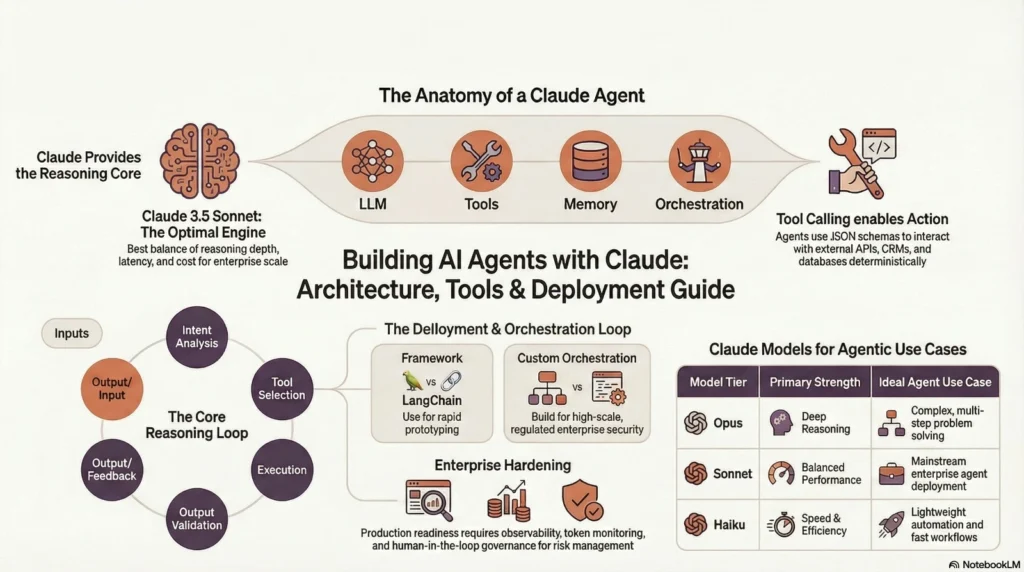
The agreement also includes Micron’s internal use of Claude across engineering, manufacturing, and enterprise functions. That creates a two-way relationship: Micron supplies memory to Anthropic, while Claude helps Micron improve software development, operations, and agentic AI workflows.
Why Is the Micron Anthropic Deal Important for Claude’s AI Memory Supply Chain?
The Micron Anthropic deal is important because Claude’s AI memory supply chain depends on more than raw GPU access. Large AI models need fast memory close to accelerators, large DRAM pools across servers, and high-performance storage to move data efficiently.
A simplified Claude infrastructure stack looks like this:
| Layer | Why It Matters for Claude | Memory / Storage Link |
|---|---|---|
| AI accelerators | Run training and inference math | Need HBM for bandwidth |
| Server memory | Supports model serving, batching, and orchestration | Needs DRAM capacity |
| Storage | Holds datasets, checkpoints, embeddings, logs, and retrieval systems | Needs SSD performance |
| Networking | Moves data across clusters | Interacts with memory pressure |
| Software scheduler | Allocates workloads efficiently | Depends on memory availability |
| Token economics | Determines cost per useful output | Improves when memory bottlenecks fall |
The most important point is that AI performance is not only about compute. If an accelerator is waiting for model weights, activations, or data movement, the system wastes expensive capacity. That is why HBM and memory bandwidth have become central to AI economics.
For Anthropic, memory supply can affect how quickly Claude can scale. For Micron, Anthropic becomes a high-profile customer and technical partner that validates memory as an AI infrastructure bottleneck.
Claude’s AI Memory Supply Chain Explained
To understand the deal, start with how a frontier AI model uses infrastructure.
Claude needs memory and storage in several different stages:
- Pretraining
- Massive datasets are processed across large accelerator clusters.
- Memory bandwidth helps keep accelerators fed with data.
- Storage throughput matters for data loading and checkpointing.
- Post-training and alignment
- Fine-tuning, reinforcement learning, and safety evaluation require repeated model runs.
- DRAM and storage performance can affect experiment velocity.
- Inference
- Every user prompt becomes a real-time compute event.
- Long context windows, enterprise workflows, and agentic tasks increase memory pressure.
- Serving costs are deeply tied to how efficiently tokens are generated.
- Enterprise deployment
- Businesses use Claude for coding, analysis, support, research, and automation.
- Enterprise demand can be bursty, which makes infrastructure planning harder.
- Agentic AI
- Claude increasingly handles multi-step tasks.
- More autonomy usually means more tool calls, longer context, and more persistent state.
- That increases pressure on memory, storage, retrieval, and orchestration.
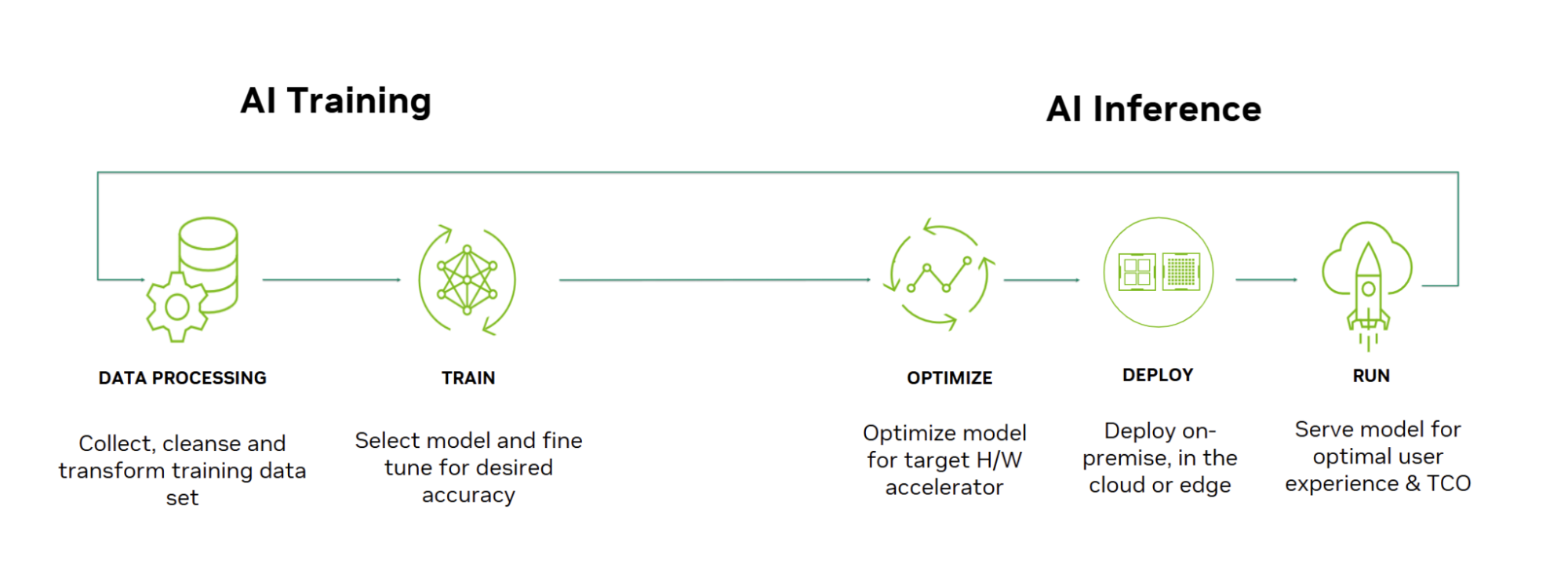
A common mistake is to think of memory as just a component attached to a GPU. In reality, memory defines how much work the AI system can keep active at once, how quickly the system can serve tokens, and how efficiently it can scale across users.
Claude’s memory supply chain is the invisible layer between model demand and model availability.
That is why the Micron Anthropic agreement matters: it gives Anthropic a closer relationship with a supplier that can influence performance, availability, and cost.
HBM, DRAM, and SSDs: The Three Memory Layers Behind Claude
The deal is best understood as a three-layer memory story.
1. HBM: The Bandwidth Layer
HBM, or high-bandwidth memory, is the premium memory used near AI accelerators. It is essential because large models need extremely fast access to weights and activations during training and inference.
For Claude, HBM helps determine:
- How efficiently accelerators are used
- How much model work can happen per unit of time
- Whether large models can run with acceptable latency
- How much cost is wasted on idle compute
HBM is the most visible part of the AI memory story because it is closely tied to GPUs and advanced accelerators.
2. DRAM: The System Capacity Layer
DRAM supports the broader server environment. It helps with model serving, batching, data movement, caching, orchestration, and general data center workloads.
For Anthropic, DRAM matters because Claude is not one model sitting on one chip. It is a distributed system serving many users, enterprises, and internal workloads at once.
3. SSDs: The Persistence and Throughput Layer
SSDs support the data-heavy parts of AI infrastructure: datasets, logs, embeddings, retrieval systems, checkpoints, monitoring, and large-scale storage workflows.
As AI models become more agentic and retrieval-heavy, SSD performance becomes more important. Claude does not only generate text; it interacts with documents, codebases, enterprise data, and tool outputs.
| Memory Layer | Primary Role | Why It Matters |
|---|---|---|
| HBM | High-speed accelerator memory | Keeps AI chips fed |
| DRAM | System memory | Supports serving and orchestration |
| SSD | Persistent storage | Enables data access and checkpointing |
Together, these layers define the Claude AI memory supply chain.
How the Micron Anthropic Deal Could Improve Token Economics
One of the most important phrases in the deal is token economics. Token economics refers to the cost and efficiency of generating model outputs.
For an AI company like Anthropic, token economics can improve when:
- More tokens are generated per dollar of infrastructure
- Latency falls without raising cost
- Hardware utilization improves
- Energy efficiency improves
- Memory bottlenecks are reduced
- Storage and retrieval systems become faster
If Claude can serve more users on the same infrastructure, Anthropic’s margins may improve. If Claude can handle longer context windows and agentic workflows more efficiently, enterprise customers may get better performance without runaway cost.
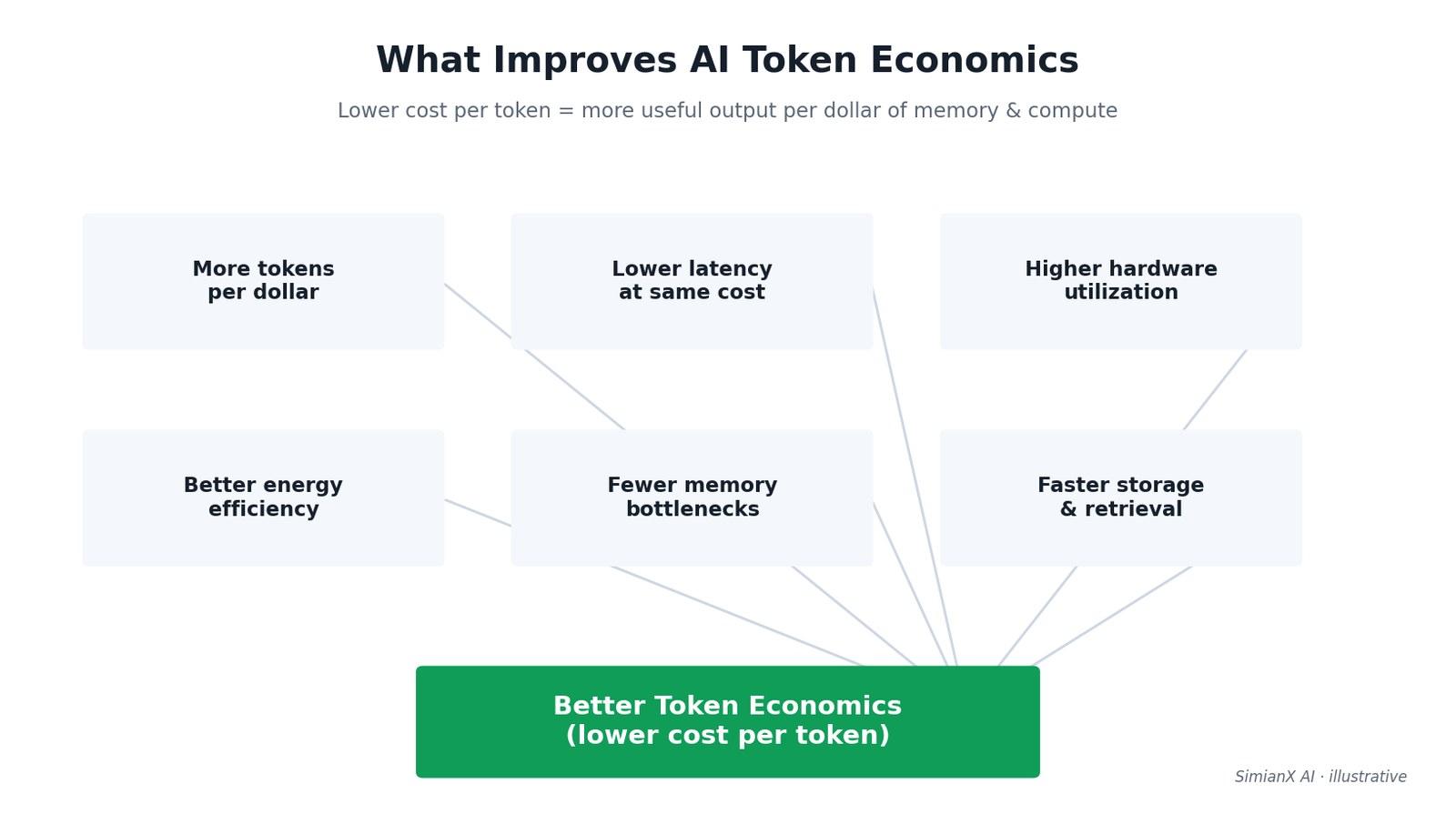
This is where memory becomes strategic. A small efficiency gain at the infrastructure level can matter when scaled across billions or trillions of tokens.
For investors, the implication is important: AI profitability may depend less on model intelligence alone and more on supply chain efficiency.
That is exactly the type of signal traders can track using platforms like SimianX AI, where stock analysis can combine company news, semiconductor supply data, earnings momentum, and multi-agent market interpretation.
Why Micron Benefits From the Anthropic Partnership
Micron benefits from the Anthropic partnership in three major ways.
First, it strengthens the narrative that Micron is no longer just a traditional memory-cycle company. The AI era has changed how customers view memory. HBM, advanced DRAM, and data center SSDs are now linked to strategic compute availability.
Second, the deal creates a high-profile AI customer relationship. Anthropic is one of the most important frontier model companies, and Claude demand gives Micron a strong customer use case for its data center portfolio.
Third, the agreement may support more durable demand. Memory companies have historically suffered from violent cycles: prices rise, supply expands, demand cools, and margins collapse. Strategic customer agreements can reduce some of that uncertainty by giving suppliers and customers clearer visibility.
Micron’s upside case:
- AI memory demand remains tight
- HBM supply stays constrained
- Data center customers sign longer-term agreements
- Gross margins remain higher than past cycles
- Investors re-rate Micron as an AI infrastructure company
Micron’s risk case:
- Memory supply eventually catches up
- AI customers optimize models to use less memory
- Pricing peaks before investors expect it
- Customer agreements fail to prevent a downcycle
- Valuation becomes too aggressive after a major rally
The deal does not eliminate memory-cycle risk. It simply shows why the current cycle is different enough to deserve serious analysis.
What the Deal Means for Anthropic and Claude
For Anthropic, the Micron deal is about scale.
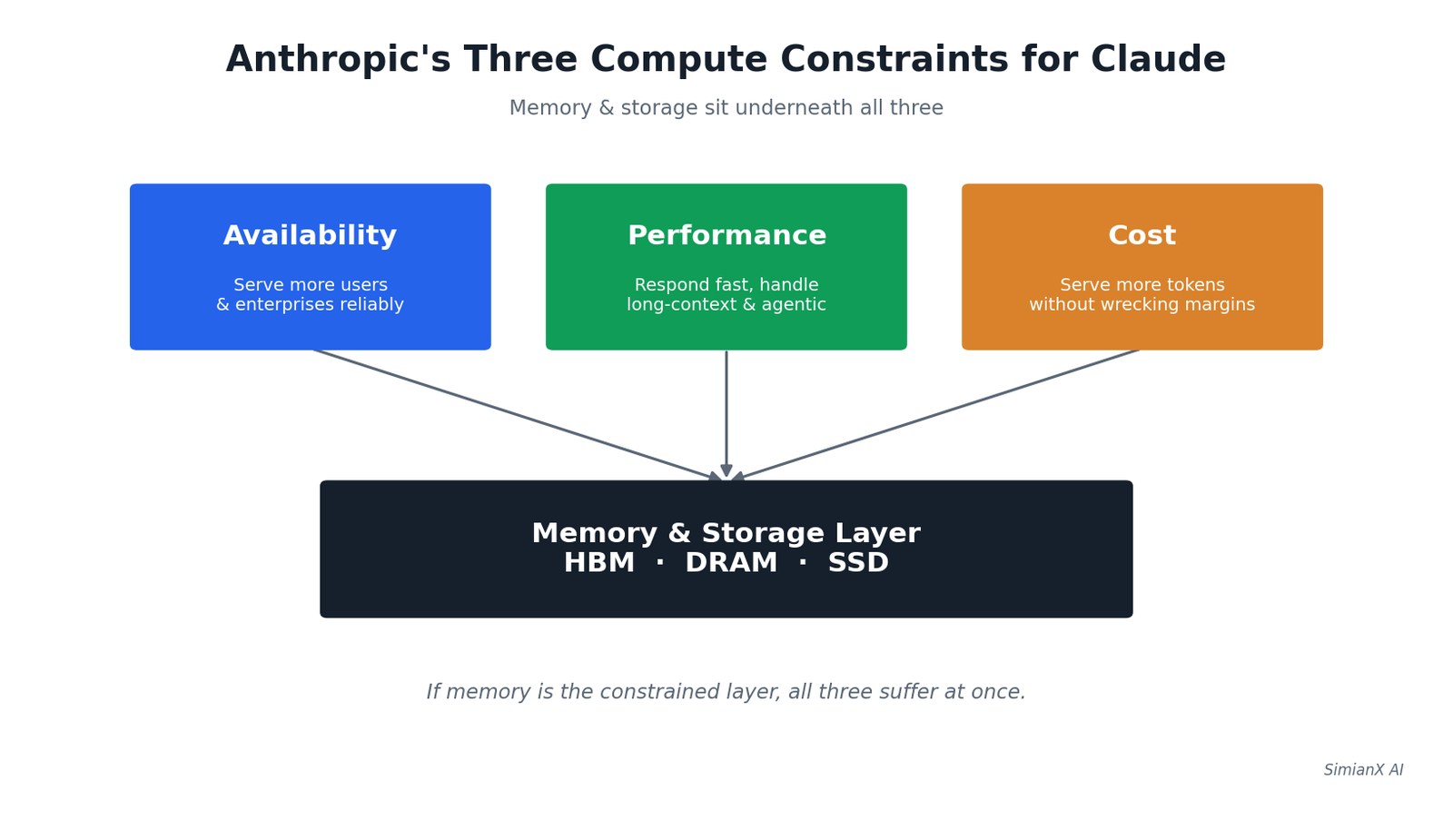
Claude demand is growing across consumer, enterprise, API, and agentic use cases. As usage grows, Anthropic needs to manage three constraints:
- Availability
- Can Claude serve more users and enterprises reliably?
- Performance
- Can Claude respond quickly and handle complex tasks?
- Cost
- Can Anthropic serve more tokens without destroying margins?
Memory and storage touch all three constraints.
A model can be brilliant, but if the infrastructure stack is inefficient, the product becomes expensive to serve. That is why Anthropic’s compute strategy must include supplier relationships, architecture optimization, and multi-year capacity planning.
The Micron agreement also suggests that frontier AI labs are moving closer to hardware-aware infrastructure planning. The next generation of AI winners may not only be the companies with the best models. They may be the companies with the best model-hardware-supply-chain alignment.
Investor Framework: How to Analyze MU Stock After the Micron Anthropic Deal
The Micron Anthropic deal gives investors a useful framework for analyzing MU stock in 2026.
Instead of asking only whether Micron had a strong quarter, investors should ask whether the AI memory cycle is becoming more durable.
Key Signals to Watch
| Signal | Bullish Interpretation | Bearish Interpretation |
|---|---|---|
| HBM demand | AI memory shortage persists | Demand growth slows |
| Gross margin | Structural improvement | Peak-cycle pricing |
| Customer agreements | Better revenue visibility | Temporary supply panic |
| Capex | Funds future AI capacity | Risks oversupply later |
| Claude demand | Supports long-term supply | Model efficiency reduces need |
| Competitors | Supply remains constrained | Samsung/SK Hynix add capacity faster |
| AI capex sentiment | Hyperscalers keep spending | AI budget discipline returns |
Practical Watchlist for SimianX Users
If you are tracking the Micron Anthropic deal through SimianX, focus on these market signals:
MUprice reaction after AI infrastructure news- HBM-related commentary in earnings calls
- Gross margin guidance
- Long-term customer agreement disclosures
- AI capex updates from hyperscalers
- Memory pricing trends
- Peer moves in
NVDA,AVGO,AMD,WDC,STX, Samsung, and SK Hynix
The goal is not to chase every headline. The goal is to decide whether the market is pricing Micron as a short-term memory winner or a long-term AI infrastructure supplier.
The Hidden Supply Chain: Why Claude Needs More Than GPUs
Most AI infrastructure discussions start with GPUs. That makes sense because GPUs are the most visible bottleneck. But the Claude supply chain extends beyond accelerators.
The hidden layers include:
- HBM supply
- DRAM pricing
- SSD availability
- Networking capacity
- Power and cooling
- Data center construction
- Software scheduling
- Model optimization
- Enterprise demand forecasting
Each layer can become a constraint. If any one layer breaks, Claude’s scaling path becomes harder.
The AI supply chain is only as strong as its most constrained layer.
That is why memory suppliers are gaining more bargaining power. If Claude demand keeps rising, Anthropic cannot simply rely on spot-market memory availability. It needs deeper supplier alignment.
Bull Case and Bear Case for the Micron Anthropic Deal
The deal is bullish, but it is not risk-free.
Bull Case
The bullish view is that AI has permanently changed memory demand. In this version of the story, Claude and other frontier models continue to require more HBM, more DRAM, and more high-performance storage. Micron benefits from structural demand, better pricing, and more predictable customer agreements.
Bullish investors may argue that:
- Memory has become strategic AI infrastructure
- Micron is gaining relevance with frontier AI labs
- Claude demand supports multi-year capacity needs
- HBM shortages may last longer than expected
- Micron deserves a higher valuation multiple
Bear Case
The bearish view is that memory remains cyclical, even if AI demand is strong today. In this version of the story, customers sign supply agreements during a shortage, suppliers increase capacity, and pricing eventually normalizes.
Bearish investors may argue that:
- Current margins are unsustainably high
- AI companies will optimize models to use less memory
- Competitors will add supply
- Customer contracts may not fully protect pricing
- Investors may be extrapolating peak-cycle earnings
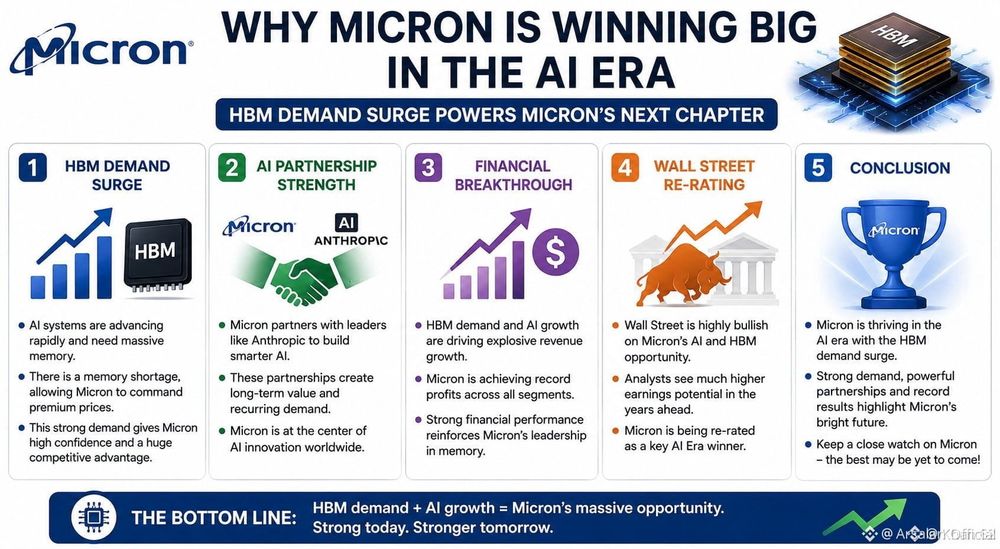
The best interpretation is balanced: the deal is strategically important, but investors still need to monitor margin durability, supply expansion, and AI efficiency improvements.
Step-by-Step Framework: How to Track the Claude AI Memory Supply Chain
Use this framework to monitor the story after the initial headline fades.
- Track Anthropic demand
- Watch enterprise Claude adoption, API growth, agentic AI use cases, and infrastructure partnerships.
- Track Micron supply signals
- Follow HBM shipments, DRAM pricing, SSD demand, capex plans, and customer agreements.
- Track token economics
- Look for signs that memory optimization is improving cost per token or latency.
- Track competitor response
- Watch Samsung, SK Hynix, and other memory suppliers for capacity increases.
- Track market expectations
- Compare stock price moves with earnings revisions and margin guidance.
- Track AI capex discipline
- If hyperscalers and AI labs reduce spending, memory demand assumptions can change quickly.
This process helps investors avoid treating the Micron Anthropic deal as a one-day stock catalyst. It is better understood as part of a broader AI infrastructure cycle.
FAQ About Micron Anthropic Deal 2026
What is the Micron Anthropic Deal 2026?
The Micron Anthropic Deal 2026 is a strategic agreement covering AI memory and storage architecture, supply alignment, Claude adoption inside Micron, and Micron’s investment in Anthropic’s Series H round. It connects Claude’s infrastructure needs with Micron’s HBM, DRAM, and SSD portfolio.
How does Claude use HBM memory?
Claude uses AI infrastructure that depends on high-bandwidth memory near accelerators. HBM helps move model data quickly enough to keep AI chips efficiently used during training and inference, which can improve speed, utilization, and cost per token.
Why does the Claude AI memory supply chain matter for investors?
The Claude AI memory supply chain matters because memory availability can affect AI infrastructure cost, performance, and scalability. If memory remains tight, companies like Micron may benefit from stronger pricing, strategic customer agreements, and higher visibility.
Is the Micron Anthropic supply agreement bullish for MU stock?
The agreement is strategically bullish because it supports the idea that Micron is becoming a key AI infrastructure supplier. However, investors still need to watch memory-cycle risk, valuation, competitor capacity, and whether current margins are sustainable.
What should investors track after the Micron Anthropic deal?
Investors should track HBM demand, DRAM pricing, SSD data center demand, Micron gross margin guidance, Anthropic infrastructure growth, AI capex trends, and customer agreement disclosures. These signals help separate a durable AI memory cycle from a temporary shortage.
Conclusion: Claude’s Memory Supply Chain Is Now an AI Market Signal
The Micron Anthropic Deal 2026: Claude’s AI Memory Supply Chain Explained story shows how AI infrastructure is becoming more integrated, strategic, and supply-constrained. Anthropic needs memory and storage systems that can support Claude’s long-term growth. Micron needs proof that its data center portfolio is central to the AI buildout. This agreement gives both sides a stronger position.
The bigger lesson is that AI investors should stop thinking only in terms of GPUs. The next phase of the AI trade may be shaped by HBM availability, DRAM capacity, SSD performance, energy efficiency, and token economics.
For readers trying to track this fast-moving AI infrastructure cycle, SimianX AI can help connect the dots across semiconductor news, stock momentum, company fundamentals, and market signals. Explore SimianX AI to monitor MU, Claude-related infrastructure themes, and the broader AI memory supply chain as it evolves.
Related Reading
- Why Investors Are Shorting Micron Stock in the AI Boom
- Cerebras Stock 2026: AI Chip Boom vs Gross Margin Risk
- KOSPI Crash 2026: Korea’s AI Chip Reckoning Explained
- Broadcom Earnings 2026: AI ASIC Backlog & AVGO Stock
- AI Chip Stocks Stay Strong: AMD, Intel Drive Data Centers
- AI Stock Boom: Nvidia Leads the Chip Supercycle Now
- KKR Helix AI Infrastructure: NVDA, VST Power Trade
- Caterpillar Stock 2026: AI Data Center Power Trade
- AKAM Stock: $11.6B Anthropic Deal Needs $4.8B Before Revenue