
The 20 Worst Days in S&P 500 History — and What Came Next
The worst single day in S&P 500 history was Monday, October 19, 1987 — "Black Monday" — when the index closed down 20.47% in a single session. No other day in nearly a century of market data comes close. But Black Monday is only the headline. Below it sits a roll call of panic sessions stretching from the Great Depression to the COVID crash, and the most useful thing about studying them is not the size of the drops. It is what happened in the days, weeks, and years immediately afterward.
This is the complete reference table of the 20 worst single-day percentage declines in the S&P 500 (and its pre-1957 predecessor, the S&P Composite), ranked by closing loss, with the trigger behind each one. It is deliberately a companion to two longer pieces on this site: Every S&P 500 Bear Market Since 1929, which measures the slow peak-to-trough declines, and How Long Every Bear Market Took to Recover, which measures the climb back. Those track the marathon. This one tracks the single most violent steps inside it.
What Counts as a "Crash Day" — the Methodology
A crash day is not the same thing as a bear market. A bear market is a peak-to-trough decline of 20% or more that can take months or years to play out. A crash day is a single trading session — one close-to-close move — that registers among the largest one-day losses ever recorded.
The table below ranks days by percentage change in the closing level of the S&P 500, using the modern index back to 1957 and the S&P Composite (its direct predecessor) before that. A few ground rules keep the list honest:
- Percentages, not points. A 500-point drop in 2026 is routine; a 50-point drop in 1929 was catastrophic. Only percentage moves are comparable across a century.
- Closing prices, not intraday. Intraday measures (like the May 2010 "flash crash," which briefly cratered then partly recovered before the close) shuffle the rankings. Close-to-close is the cleaner, more widely cited standard.
- Price only, not total return. Dividends are excluded, which is the convention for crash tables. On a total-return basis the recoveries that follow are all slightly faster than stated.
Different data vendors disagree by a few hundredths of a percent on the oldest sessions, so treat the decimals as accurate to roughly a tenth of a point. The structure of the table — which eras dominate, how the days cluster — is stable across every reputable source, including the Wikipedia compilation of largest daily S&P 500 changes.
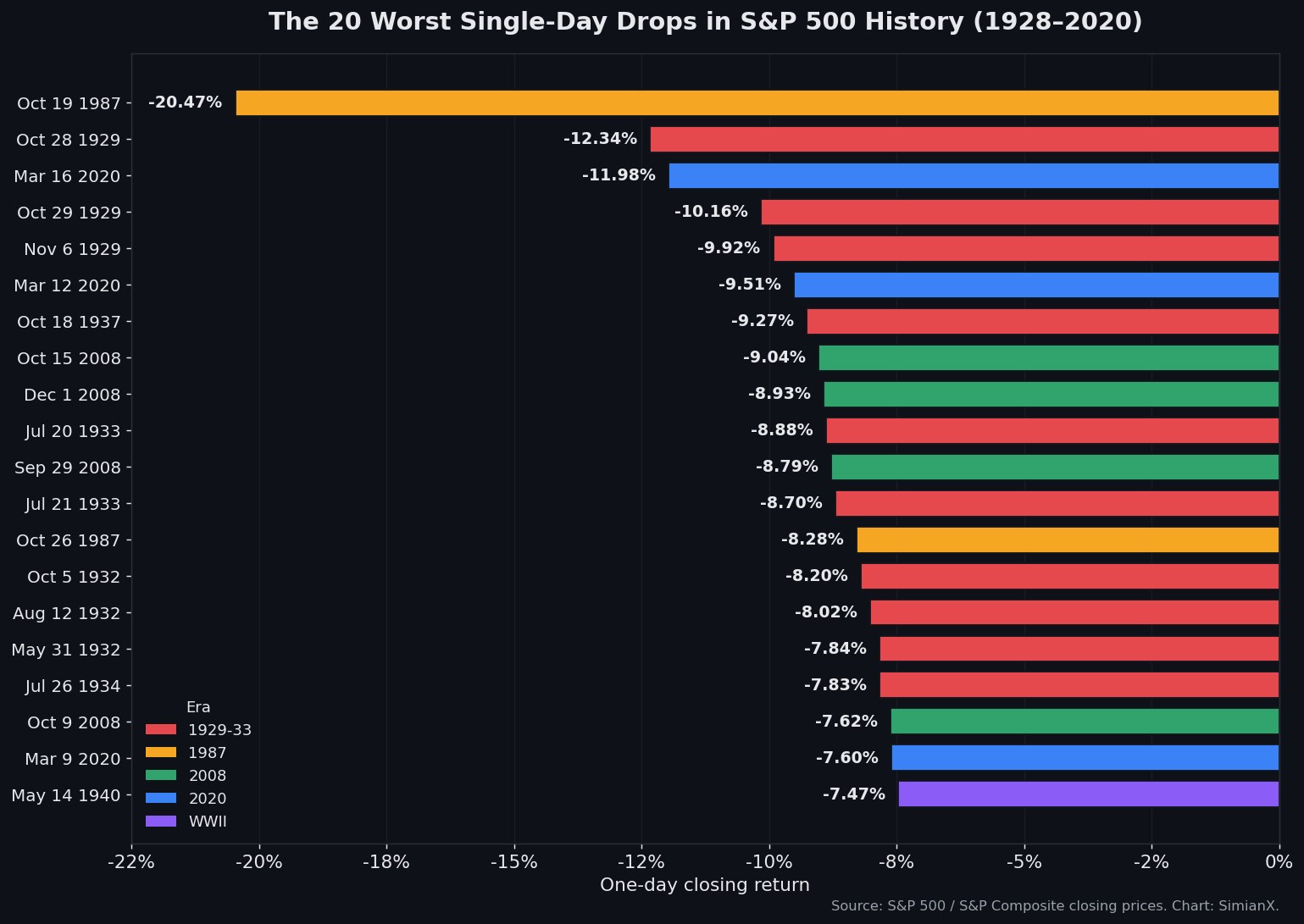
The 20 Worst Single-Day Crashes in S&P 500 History
Here is the full table, ranked from worst to least-worst. You can track the same index live on the S&P 500 ETF page.
| Rank | Date | One-Day Close | Trigger / Context |
|---|---|---|---|
| 1 | October 19, 1987 | −20.47% | Black Monday — portfolio insurance and program-trading cascade |
| 2 | October 28, 1929 | −12.34% | Wall Street Crash — the slide into the Great Depression |
| 3 | March 16, 2020 | −11.98% | COVID-19 — nationwide lockdowns begin |
| 4 | October 29, 1929 | −10.16% | "Black Tuesday" — record volume panic selling |
| 5 | November 6, 1929 | −9.92% | 1929 crash aftershock |
| 6 | March 12, 2020 | −9.51% | COVID-19 "Black Thursday" — WHO declares a pandemic |
| 7 | October 18, 1937 | −9.27% | The 1937–38 "Roosevelt Recession" |
| 8 | October 15, 2008 | −9.04% | Global Financial Crisis — credit markets seize |
| 9 | December 1, 2008 | −8.93% | Recession officially declared by the NBER |
| 10 | July 20, 1933 | −8.88% | Depression-era reversal after the spring rally |
| 11 | September 29, 2008 | −8.79% | House rejects the first TARP bailout vote |
| 12 | July 21, 1933 | −8.70% | Depression-era follow-through selling |
| 13 | October 26, 1987 | −8.28% | Black Monday aftershock |
| 14 | October 5, 1932 | −8.20% | Great Depression |
| 15 | August 12, 1932 | −8.02% | Great Depression |
| 16 | May 31, 1932 | −7.84% | Great Depression bottoming process |
| 17 | July 26, 1934 | −7.83% | Depression-era selloff |
| 18 | October 9, 2008 | −7.62% | Global Financial Crisis |
| 19 | March 9, 2020 | −7.60% | COVID-19 plus the Saudi–Russia oil price war |
| 20 | May 14, 1940 | −7.47% | World War II — Nazi forces break through into France |
The Four Clusters: Crash Days Travel in Packs
The single most important pattern in the table is that the 20 worst days are not scattered evenly across 95 years. They collapse into four clusters, and almost nothing else.
1929–1937: The Great Depression
Eleven of the 20 worst days fall in the Depression era (1929 through 1937). This was not one crash but a grinding, multi-year collapse in which the index lost roughly 86% from its 1929 peak to its 1932 trough — the deepest bear market in S&P 500 history. The worst days came in waves: the October 1929 panic, the 1932 capitulation, the false 1933 recovery, and the 1937 relapse. When an economy actually breaks, crash days multiply.
October 1987: Black Monday
Black Monday is the strangest entry because it had no accompanying recession. The economy kept growing; corporate earnings kept rising. The 20.47% one-day collapse was largely a mechanical event — "portfolio insurance" hedging programs sold futures automatically as prices fell, which pushed prices lower, which triggered more selling, in a feedback loop. The S&P 500 still finished 1987 with a small positive return. It is the purest example of a crash that the underlying economy did not justify.
2008: The Global Financial Crisis
Four of the 20 worst days belong to autumn 2008, when the failure of Lehman Brothers and the freezing of credit markets produced a string of −7% to −9% sessions. The September 29 drop came the day the U.S. House of Representatives voted down the first version of the TARP bank rescue — a rare case where you can point to a single roll-call vote and watch nearly 9% of market value evaporate by the close.
2020: The COVID Crash
The fastest cluster of all. Four of the 20 worst days happened in a single three-week window in March 2020, as the pandemic shut down the global economy. It produced the third-worst day ever (−11.98% on March 16) — and then it became the fastest major recovery on record, with the index reclaiming its old high within about six months.
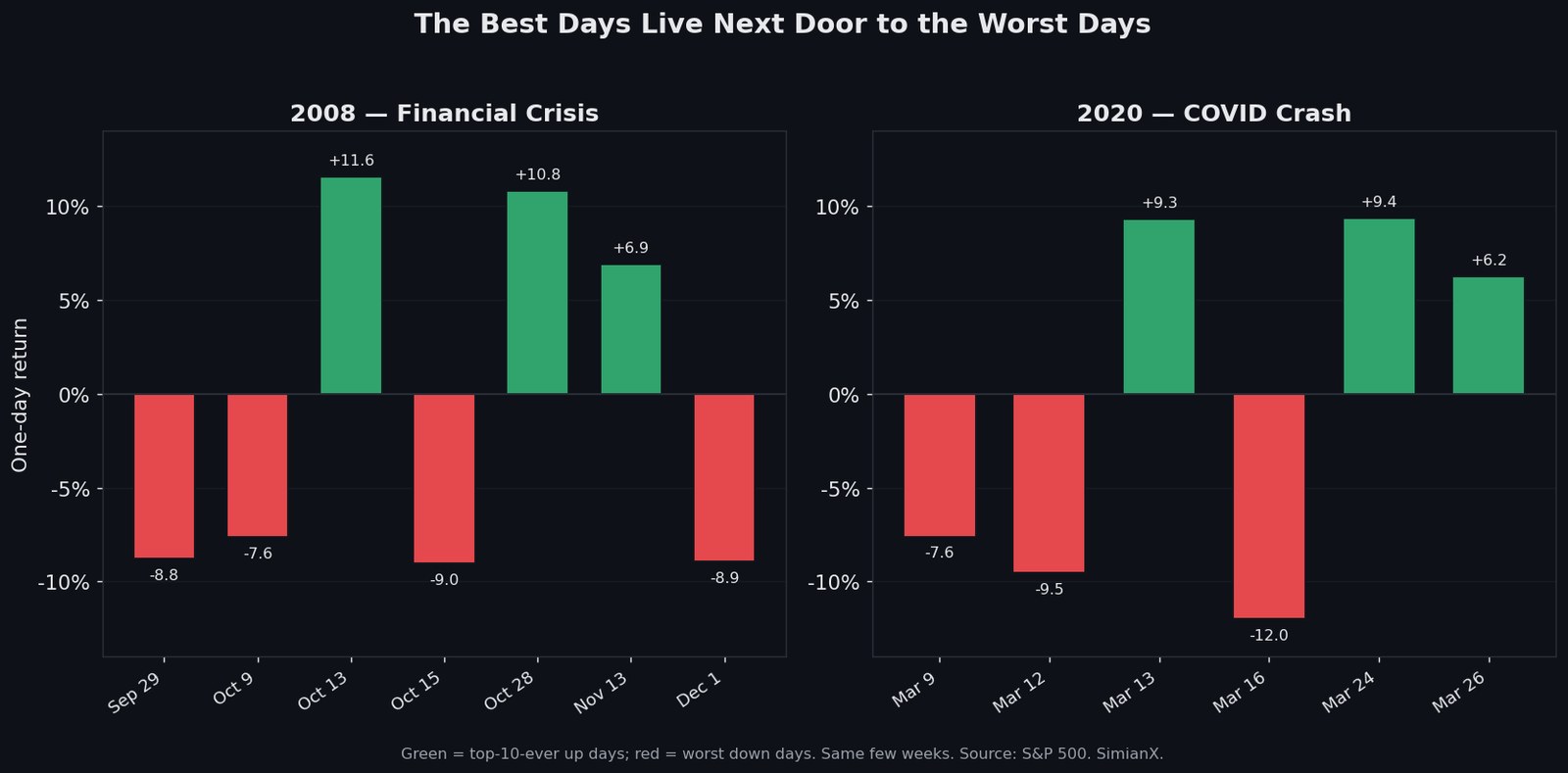
Why the Best Days Live Next Door to the Worst
Look closely at the 2008 and 2020 charts above and the single most actionable fact in this entire article jumps out: the biggest up days in market history happen in the middle of the biggest down days. They are not in calm bull markets. They are in the eye of the storm.
The evidence is overwhelming:
- The day after Black Monday's −20.47%, the S&P rebounded, and two sessions later (October 21, 1987) it rose +9.10% — itself one of the largest single-day gains ever recorded.
- In the depths of the 2008 crisis, October 13, 2008 rose +11.58% — the biggest one-day percentage gain since the 1930s — just days after a −7.62% rout. Two weeks later, October 28 added +10.79%.
- During the COVID crash, March 24, 2020 surged +9.38% (the best day since 1933) immediately after the −11.98% bottom on March 16, and March 13 had already jumped +9.29% the day after a −9.51% session.
This is not a coincidence. Extreme volatility is symmetric: the same fear, forced selling, and thin liquidity that produce a −9% day produce a +9% day a session or two later, as oversold conditions snap back and bargain-hunters and short-covering pile in. Volatility clusters. Crash days and melt-up days are two faces of the same disordered tape.
The Math of Selling the Panic
That symmetry is exactly why trying to "sell the crash and get back in once it's calm" is so dangerous. If the best days sit right beside the worst days, then an investor who flees after a crash day is overwhelmingly likely to be in cash for the rebound.
The arithmetic is brutal. According to J.P. Morgan Asset Management's *Guide to the Markets*, a $10,000 investment fully invested in the S&P 500 over the 20 years from 2003 to 2022 grew to roughly $64,844 — an annualized return near 9.8%. Miss just the 10 best days of those two decades and the same $10,000 ends at about $29,708. Miss the 20 best days and you are below $18,000. Miss the 30 best and you barely break even on a nominal basis. The firm's own data shows that seven of the ten best days occurred within about two weeks of the ten worst days.
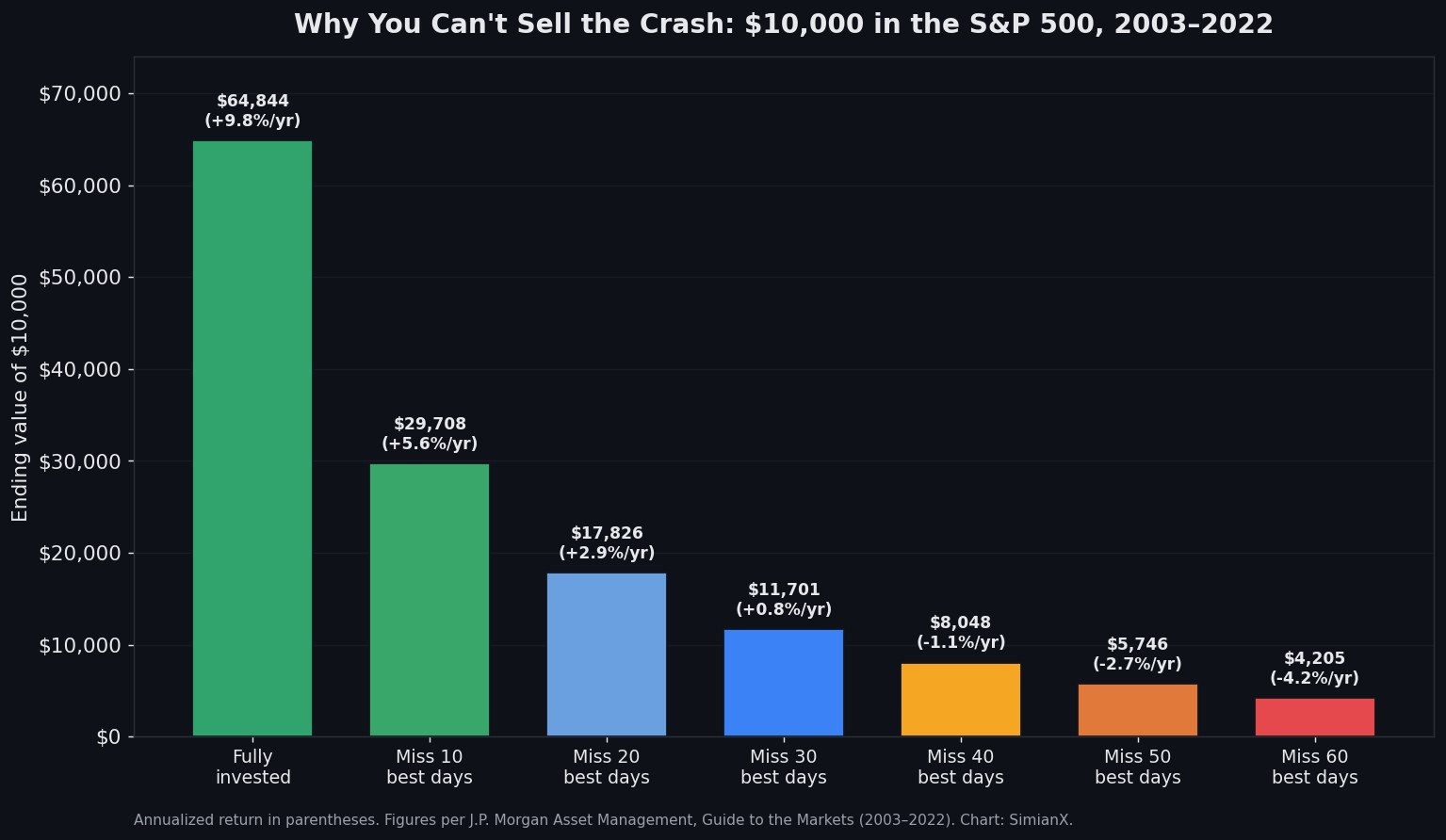
The lesson is not "crashes don't matter." They obviously do — the bear markets they belong to have taken anywhere from six months to 25 years to fully recover. The lesson is narrower and more precise: the crash day itself is almost never the right day to sell, because the rebound day is usually within arm's reach, and missing a handful of those rebounds does more long-term damage than sitting through the entire decline.
What the Worst Days Mean for How You Invest
Three durable takeaways fall out of the table:
- Single-day size is not single-day importance. Black Monday 1987 was the largest crash ever and was almost fully recovered within two years, with no recession. Many smaller Depression-era days were part of an 86% collapse that took a generation to undo. The context — recession or no recession, structural or mechanical — matters far more than the headline percentage.
- Crash days cluster with both recessions and rebounds. If you are seeing −7% sessions, you are statistically close to +7% sessions. Both belong to the same volatile regime.
- Time in the market beats timing the crash. The J.P. Morgan "missing the best days" math is the most repeated chart in professional finance for exactly one reason: it is true, and it is unintuitive.
Do AI Trading Models Panic on the Worst Days?
Human investors sell crash days; that is the entire problem the table exposes. So a natural question for 2026 is whether AI-driven trading systems are any more disciplined when the tape goes red.
SimianX runs dozens of frontier AI models against live markets and logs every decision, which makes it possible to actually measure this rather than guess. The companion study Do AI Models Panic-Sell in a Crash? breaks down how 31 different model bots behaved when prices fell hard — which ones froze, which ones bought, and which ones capitulated at exactly the wrong moment. You can watch models reason through live drawdowns in real time in the Live Command Room, compare their track records on the AI model leaderboard, and — if you want the discipline without the screen time — let an autopilot hold a rules-based line through the next −9% session. (For the parallel story in digital assets, see Every Bitcoin Crash Over 50% and How Long Recovery Took.)
Frequently Asked Questions
What was the worst single day in stock market history?
By percentage, the worst day in S&P 500 history was October 19, 1987 — "Black Monday" — a 20.47% close-to-close drop. The Dow Jones Industrial Average fell 22.6% that same day. By raw points the largest declines are all recent (March 2020), but points are not comparable across decades; percentage is the only fair measure.
Was the 1929 crash worse than 1987?
On any single day, no — October 28, 1929 (−12.34%) was smaller than Black Monday. But 1929 was the opening act of a multi-year collapse of about 86% that defined the Great Depression, whereas 1987 had no recession behind it and recovered within roughly two years. Worst day and worst crash are different questions.
How fast does the market usually bounce after a crash day?
Often within days. The largest one-day gains in history (October 13, 2008 at +11.58%; March 24, 2020 at +9.38%; October 21, 1987 at +9.10%) all occurred within a session or two of a record decline. Full recovery to a new high is a separate, slower process — see how long every bear market took to recover.
Should I sell after a big down day?
History argues strongly against it. Because the best days cluster next to the worst days, investors who sell the panic tend to miss the rebound, and J.P. Morgan's data shows that missing even the 10 best days over 20 years roughly halves your ending wealth. This is educational analysis, not personal financial advice.
Related Reading
- Every S&P 500 Bear Market Since 1929: Duration and Recovery
- How Long Every Bear Market Took to Recover: 1929–2022
- Do AI Models Panic-Sell in a Crash? What 31 Bots Reveal
- Every Bitcoin Crash Over 50%: Recovery Times Since 2011
- Live tools: the S&P 500 tracker, the AI model leaderboard, the Live Command Room, and autopilots.
Data sources: S&P 500 and S&P Composite closing prices as compiled by the Wikipedia list of largest daily S&P 500 changes; "missing the best days" figures from J.P. Morgan Asset Management, Guide to the Markets (2003–2022). All charts produced by SimianX. This article is for educational purposes and is not investment advice.