
How Long Bitcoin Takes to Recover After a 50%+ Crash
How long do Bitcoin crashes take to recover? If you have held BTC through even one cycle, you already know the answer is "longer than you'd like." But the precise history is more useful than the fear. Since it began trading in 2010, Bitcoin has suffered a handful of crashes exceeding 50% — and every single one eventually made a new all-time high. This reference catalogs each major Bitcoin crash since 2011: how deep it fell, how long it took to bottom, and how long it took to reclaim the previous peak.
The headline pattern is striking. Bitcoin's full cycle bear markets have bottomed at remarkably consistent depths — between roughly −77% and −93% — and have taken on average about 939 days (roughly 2.6 years) to set a new all-time high. Yet each successive cycle's drawdown has been shallower than the last, a signature of a maturing, deeper market. This article lays out the full table, the charts, a crash-by-crash breakdown, and what the pattern does — and does not — imply.
How we measured it (methodology)
A reference table is only credible if the rules are explicit, so here are ours:
- Prices are daily BTC/USD, drawn from public price history (CoinGecko / CoinMarketCap). Figures are approximate and rounded — exact tops and bottoms differ slightly across exchanges and between intraday and daily-close measurement.
- Drawdown is measured from the cycle peak to the subsequent trough (peak-to-trough).
- Days to bottom counts from the peak date to the trough date.
- Days to new ATH counts from the peak date to the day Bitcoin first closed above that prior peak — i.e. full recovery, not just "off the lows."
- We include both full cycle bears (the multi-year tops) and notable intra-cycle crashes (sharp >50% drops that occurred inside a larger uptrend), and label which is which, because they behave very differently.
A note on "recovery": reclaiming the old high is a high bar. Bitcoin is usually well off its lows long before it makes a new ATH, so these recovery times are the conservative measure — the time to fully heal, not the time to stop bleeding.
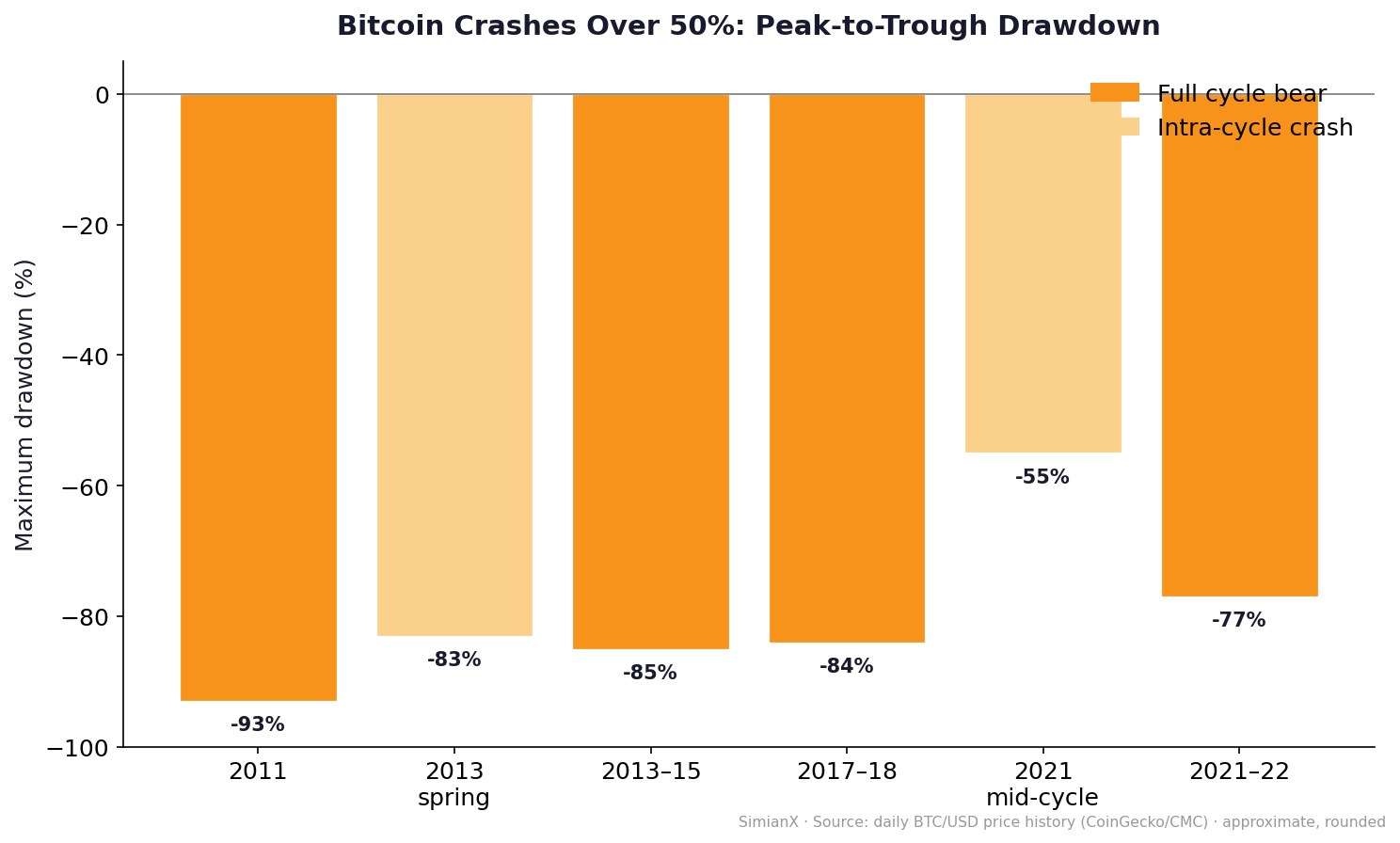
The reference table: every Bitcoin crash over 50% since 2011
| Crash | Window | Peak → Trough | Drawdown | Days to bottom | Days to new ATH | Catalyst |
|---|---|---|---|---|---|---|
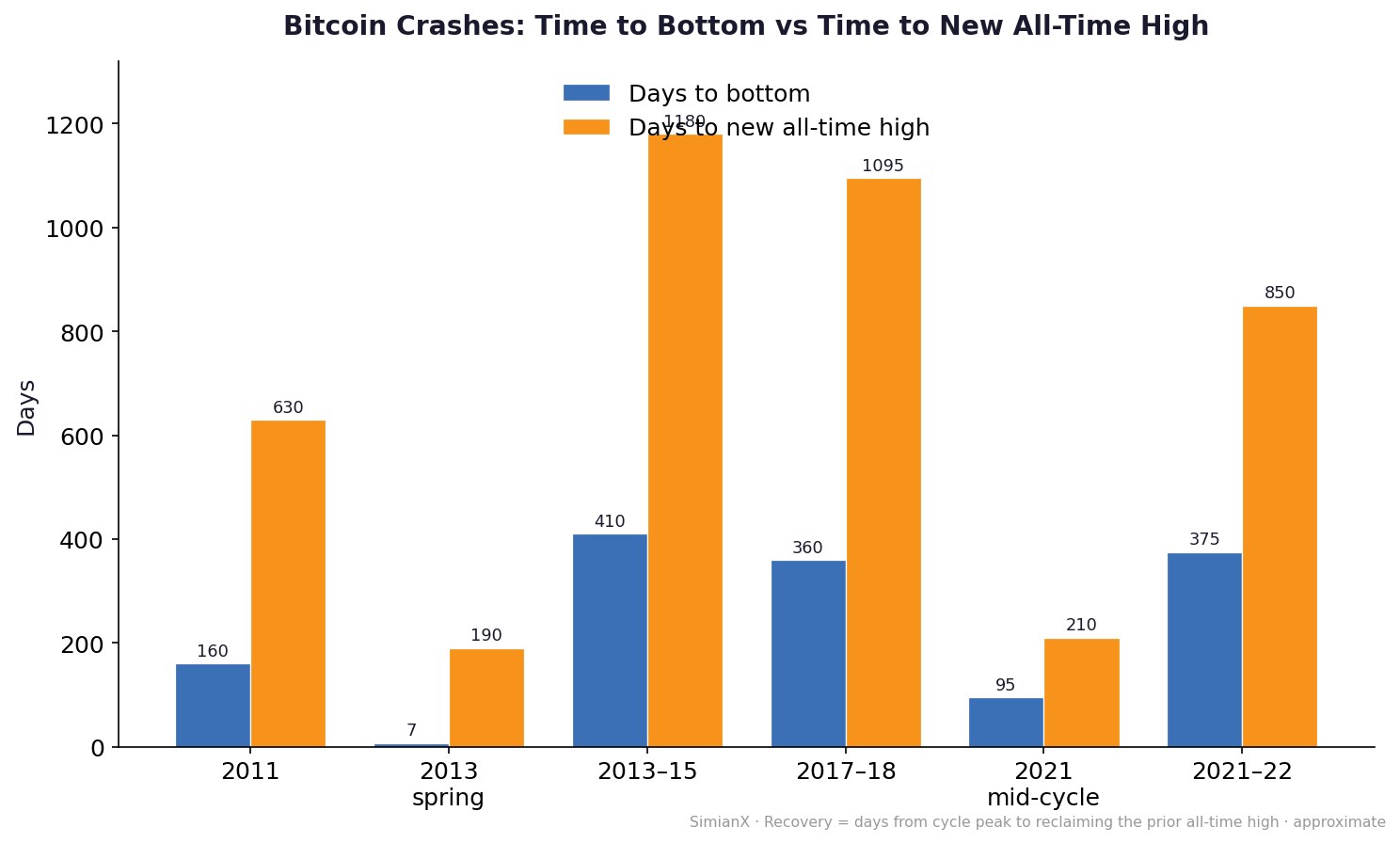
| 2011 | Jun 2011 – Nov 2011 | ~$32 → ~$2 | −93% | ~160 | ~630 | Mt. Gox breach, illiquid early market |
| 2013 spring | Apr 2013 (days) | ~$259 → ~$45 | −83% | ~7 | ~190 | Parabolic blow-off, exchange overload |
| 2013–15 | Dec 2013 – Jan 2015 | ~$1,150 → ~$170 | −85% | ~410 | ~1,180 | Mt. Gox collapse, long grinding bear |
| 2017–18 | Dec 2017 – Dec 2018 | ~$19,800 → ~$3,200 | −84% | ~360 | ~1,095 | ICO bubble burst, regulatory crackdown |
| 2021 mid-cycle | Apr 2021 – Jul 2021 | ~$64,800 → ~$29,000 | −55% | ~95 | ~210 | China mining ban, leverage flush |
| 2021–22 | Nov 2021 – Nov 2022 | ~$69,000 → ~$15,500 | −77% | ~375 | ~850 | Fed hikes, Terra/LUNA, Celsius, FTX |
The four full cycle bears (2011, 2013–15, 2017–18, 2021–22) averaged a −85% drawdown and took about 939 days — roughly two and a half years — to reclaim their prior peak. The two intra-cycle crashes (2013 spring, 2021 mid-cycle) were violent but recovered in well under a year because the broader uptrend was still intact. Every crash, without exception, was eventually followed by a new all-time high.
Crash by crash
2011: the −93% baptism
Bitcoin's first real crash was its deepest. After running from cents to about $32 by June 2011, BTC collapsed to roughly $2 by November — a −93% wipeout. The market was tiny and almost entirely routed through a single exchange, Mt. Gox, whose security breach that summer shattered confidence. Recovery to a new high took about 630 days. The lesson that would repeat for a decade was set here: Bitcoin falls further and faster than almost any liquid asset — and then comes back.
2013 spring: the seven-day flash crash
In April 2013, Bitcoin spiked toward $259 and then crashed about 83% to roughly $45 in a matter of days, as a parabolic rally met an overwhelmed exchange infrastructure. Unlike the cycle bears, this was an intra-cycle crash: the larger 2013 bull market was still underway, and Bitcoin made a new high within roughly 190 days, going on to break $1,000 by year-end. It is the clearest early example that not every 50%+ drop is a cycle top.
2013–15: the long grind
The late-2013 top near $1,150 began the most grinding bear in Bitcoin's history. The February 2014 collapse of Mt. Gox — then handling the majority of BTC trades — turned a correction into a 14-month slide to about $170, an −85% drawdown. Recovery was the slowest on record: roughly 1,180 days (over three years) to reclaim the old high in early 2017. For traders, this cycle is the cautionary tale about how long crypto winters can last.
2017–18: the ICO hangover
The famous 2017 retail mania peaked near $19,800 in December. The unwinding of the ICO bubble, combined with a wave of regulatory crackdowns, drove an −84% decline to about $3,200 by December 2018. Recovery took roughly 1,095 days — three years — with the new high arriving in December 2020 as institutional demand and macro liquidity ignited the next cycle.
2021 mid-cycle: the −55% head-fake
In spring 2021, Bitcoin hit about $64,800, then fell roughly 55% to $29,000 by July — driven by China's mining ban, a leverage flush, and a sentiment reversal. Many called it the top. It wasn't: this was an intra-cycle crash, and BTC made a new all-time high near $69,000 by November 2021, about 210 days after the spring peak. It is the textbook reminder that a 50% drop can happen inside a bull market.
2021–22: the contagion bear
The November 2021 top near $69,000 gave way to the most contagion-driven bear yet. Aggressive Fed rate hikes drained liquidity, then a cascade of blow-ups — the Terra/LUNA implosion, the Celsius freeze, and finally the FTX collapse — drove BTC to about $15,500 by November 2022, a −77% drawdown. Notably, this was the shallowest cycle-bear bottom yet, and recovery was the fastest of the cycle bears at roughly 850 days, with a new high in early 2024.
What the pattern reveals
Pull the table together and four durable patterns emerge:
- Cycle bottoms cluster around −77% to −85%. With the exception of the tiny 2011 market (−93%), Bitcoin's full bear markets have bottomed in a surprisingly tight band. A drawdown of "only" 50–60% has historically not marked a final cycle bottom — it has marked a mid-cycle shakeout.
- The drawdowns are getting shallower. −93% → −85% → −84% → −77%. As Bitcoin's market cap, liquidity, and holder base have grown, each cycle's maximum pain has eased. This is what a maturing asset looks like; it does not guarantee the trend continues, but it is the clearest structural signal in the data.
- Full recovery takes years, not months. The cycle bears took ~630, ~1,180, ~1,095, and ~850 days to make a new high — averaging about 2.6 years. Anyone using Bitcoin as a short-horizon "safe" asset is fighting the historical record.
- The catalysts rhyme. Every cycle bear paired a macro tightening or liquidity drain with a leverage flush and at least one exchange or protocol failure (Mt. Gox twice, ICO blowups, Terra/Celsius/FTX). The trigger differs; the structure — too much leverage meeting a liquidity withdrawal — repeats.
The current cycle
This reference deliberately stops at fully completed crashes, because writing precise peak-and-trough numbers for an unfinished cycle would be guesswork, and a reference asset has to be trustworthy. For the live picture of the most recent drawdown and where support sits, see our dated coverage in Bitcoin Near 2026 Lows and the analysis in the February 2026 crash piece. The table above is the historical lens to read any new drawdown against: is this a −50% mid-cycle shakeout, or are we heading for the −77%+ band that has marked true cycle bottoms?
Bitcoin crashes vs stock crashes
Bitcoin's drawdowns dwarf equities'. The worst S&P 500 bear since 1929 fell about 57% peak-to-trough; Bitcoin routinely falls 80%+. But the recovery dynamic is different too: where stocks have sometimes taken a decade-plus to recover in real terms, Bitcoin's cycle bears have recovered in two to three years — because each was followed by a new wave of adoption rather than a permanent re-rating. For the equity comparison, see how long every bear market took to recover, and for how a classic safe haven behaves when risk assets crash, see our gold-in-recession scorecard. Altcoins, for the record, fall harder still — ETH and smaller caps have routinely lost 90%+ in the same bears that took BTC down 77–85%.
What it means for investors
The table is not a prediction; it is a base rate. A few honest takeaways:
- Position-size for −80%. If you cannot hold an 80% drawdown without being forced to sell, you are over-allocated. The investors who captured Bitcoin's recoveries are the ones who could survive the crash.
- Distinguish mid-cycle from cycle-top. A −50% drop with the broader uptrend intact (2013 spring, 2021 mid-cycle) has historically been a shakeout, not the end. The −77%+ moves have been the cycle bottoms.
- Time, not timing. Every recovery took years and was invisible at the lows. The pattern rewards survival and patience over precision.
Reading where a drawdown sits in this framework — mid-cycle flush or full bear — is exactly the kind of regime question modern AI tooling is built for. SimianX runs a panel of frontier AI models that score market conditions continuously: watch them debate direction on the AI model leaderboard, follow BTC in live crypto sessions, and run credit-aware autopilots that monitor the setup around the clock. Pair this table with our companion references on Bitcoin halving cycles, Bitcoin after every Fed rate cut, and Bitcoin dominance cycles — see pricing to start, or browse more data references in the stories archive.
Frequently asked questions
How long does it take Bitcoin to recover from a crash? Historically, full cycle bears took about 2 to 3 years to make a new all-time high (≈630–1,180 days, averaging ~939). Intra-cycle crashes recovered in under a year.
What is the biggest Bitcoin crash ever? In percentage terms, the 2011 crash (about −93%) was the deepest. The largest dollar destruction came in the 2021–22 bear, from ~$69,000 to ~$15,500 (about −77%).
Does Bitcoin always recover? Every >50% crash in Bitcoin's history has so far been followed by a new all-time high. That is a powerful base rate — but it is history, not a guarantee. A non-zero risk of permanent loss always exists.
Is a 50% drop the bottom? Not necessarily. A −50% to −55% fall with the broader uptrend intact has historically been a mid-cycle shakeout (2013 spring, 2021 mid-cycle). True cycle bottoms have clustered around −77% to −85%.
Are Bitcoin's crashes getting smaller? Yes, so far: −93% → −85% → −84% → −77% across successive cycle bears, consistent with a deeper, more liquid market. Whether the trend persists is unknown.
How do Bitcoin crashes compare to stock crashes? Far deeper — Bitcoin routinely falls 80%+ versus the S&P 500's worst-ever ~57% — but historically with faster multi-year recoveries driven by new adoption.
The bottom line
Bitcoin's crash history is brutal and remarkably regular: cycle bears bottom in the −77% to −93% range, take two to three years to fully recover, and have each been shallower than the last. The crashes are inevitable; so far, so have been the recoveries. The reference table above is the cheat sheet — use it to judge whether the next drawdown is a mid-cycle flush or a full cycle bottom, and size your position so you can actually be there for the recovery. Bookmark it alongside our halving and rate-cut references to build a complete Bitcoin cycle playbook.
Disclosure: figures are approximate, rounded measurements compiled from public daily BTC/USD price history (CoinGecko / CoinMarketCap), presented for educational reference only. Past performance does not predict future results, and nothing here is investment advice.
Related Reading
- Bitcoin Halving Cycles: Complete Returns Reference 2012-2028
- Bitcoin Dominance Cycles: When Altseason Starts 2017-2026
- Bitcoin After Every Fed Rate Cut: 2019-2026 Reference
- Bitcoin Crash Feb 2026: $60K Bottom or More Pain Ahead?
- Bitcoin Near 2026 Lows: BTC Support & Rebound Signals
- How Long Every Bear Market Took to Recover: 1929-2022