
 By Muke
Bitcoin Crash in February 2026: Is the Bottom In?
The Bitcoin crash in February 2026 reignited the oldest question in crypto: is the bottom in, or is this just the first leg down? In the span of two sessions, Bitcoin swung from a sharp selloff into a violent rebound—classic “stress tape” behavior that can mark either capitulation or the start of a grinding bear continuation [1][2].
This research breaks down what actually happened, what bottoming looks like in liquid 24/7 markets, and how to turn noisy headlines into a repeatable decision framework. We’ll also show how traders can centralize the workflow using SimianX AI—especially its multi-timeframe “command room” design and multi-agent reasoning layer—so you can decide faster without losing discipline [3][4].
What happened during the February 2026 Bitcoin crash?
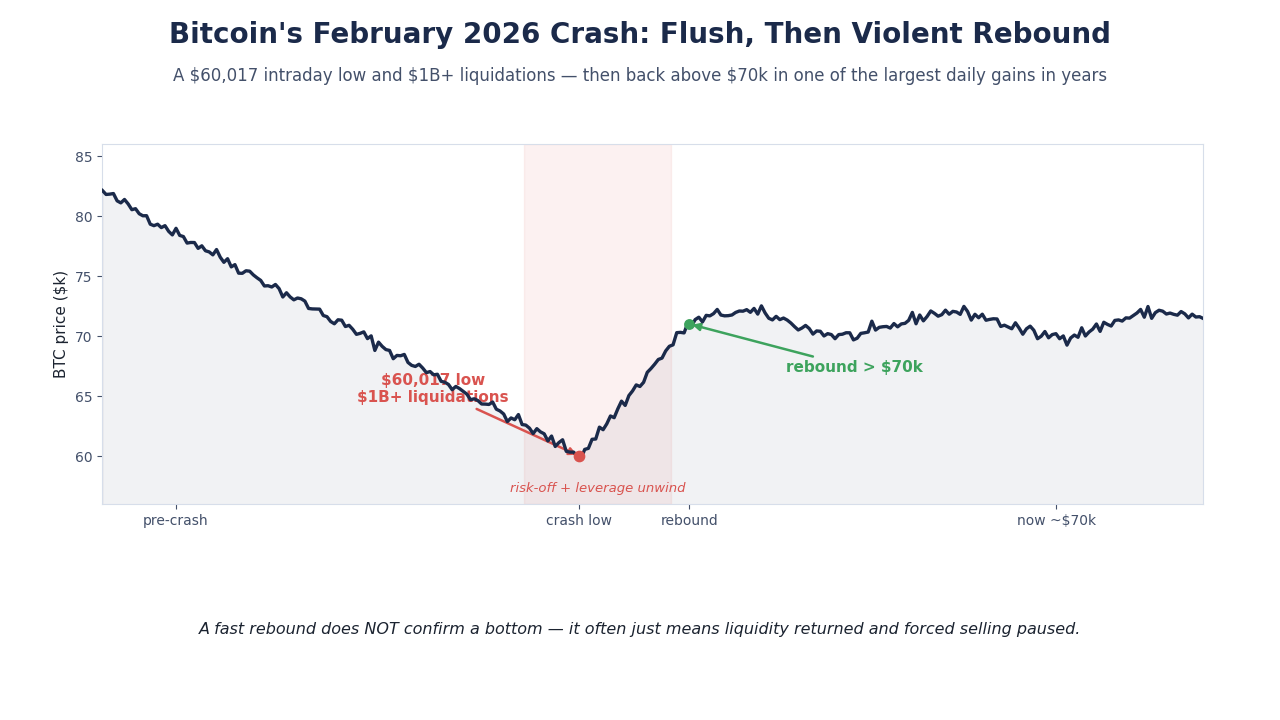
A bottom call only matters if you understand the mechanism of the drop. In early February 2026, Bitcoin’s selloff accelerated alongside a broader risk-off move hitting equities and even precious metals, with crypto’s own structure (leverage + liquidations) amplifying the downside [1][4]. Reuters reported Bitcoin falling to the low-$60k area with liquidations around $1B+ in a 24-hour window, and noted the broader crypto market had shed roughly $2T in value since an earlier peak [1]. The next day, Bitcoin printed an intraday low near $60,017 before rebounding back above $70k—one of the largest daily gains in years—while options markets still showed heavy demand for downside protection into late February expiries [2].
Key point: a fast rebound does not automatically mean “bottom confirmed.” It often means liquidity returned, shorts got squeezed, or forced selling paused. The “bottom” question is really: did the market finish transferring risk from weak hands to strong hands?
Why crypto falls faster than stocks in crashes
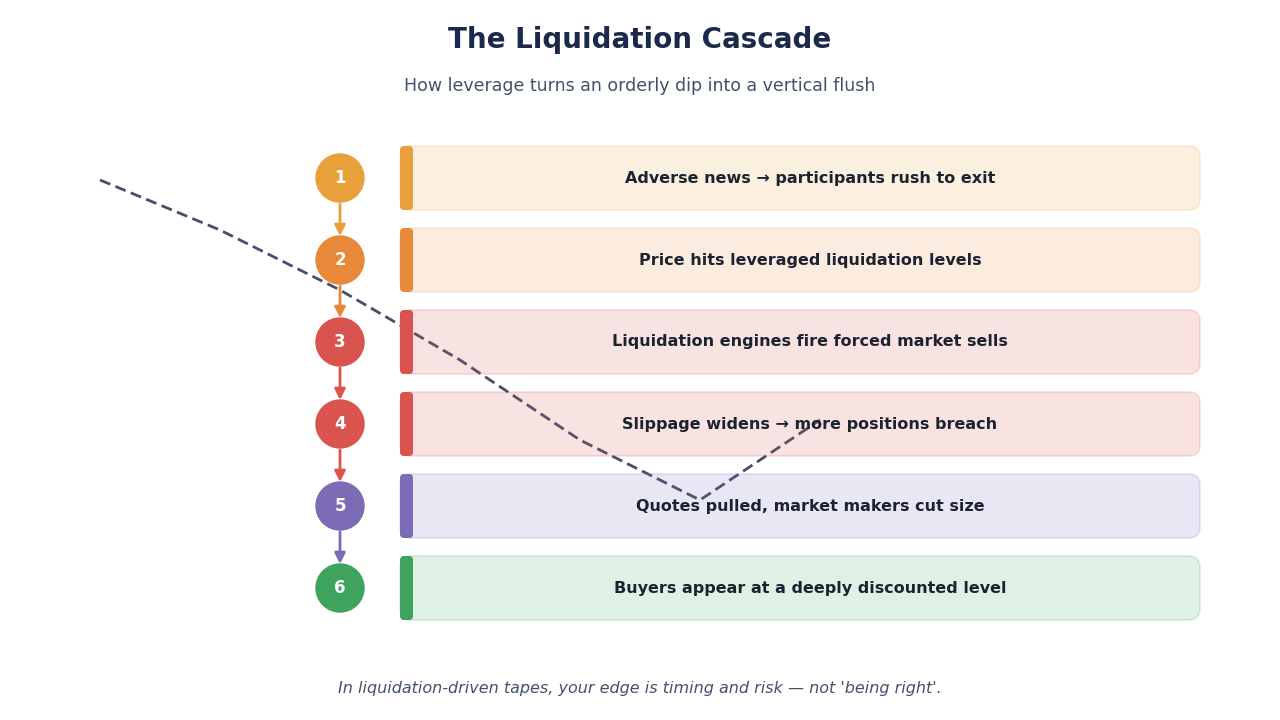
Crypto has built-in accelerators:
- Perpetual futures make leverage easy.
- Liquidation engines convert margin stress into market sells.
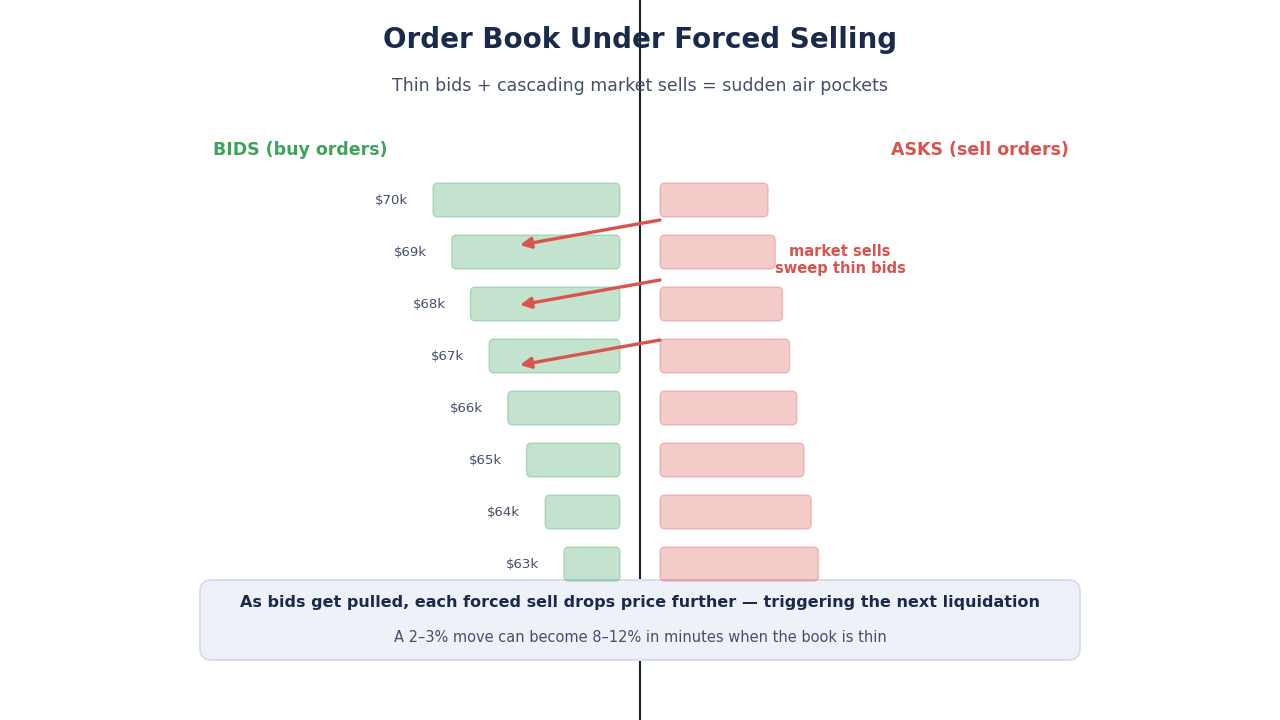
- Thin liquidity windows can turn a 2–3% move into 8–12% quickly [4].
In liquidation-driven tapes, your edge is often timing and risk, not “being right.” [4]
That’s why “Is the bottom in?” is best treated as a probability question with scenario branches—not a binary prediction.
What does “the bottom” actually mean?
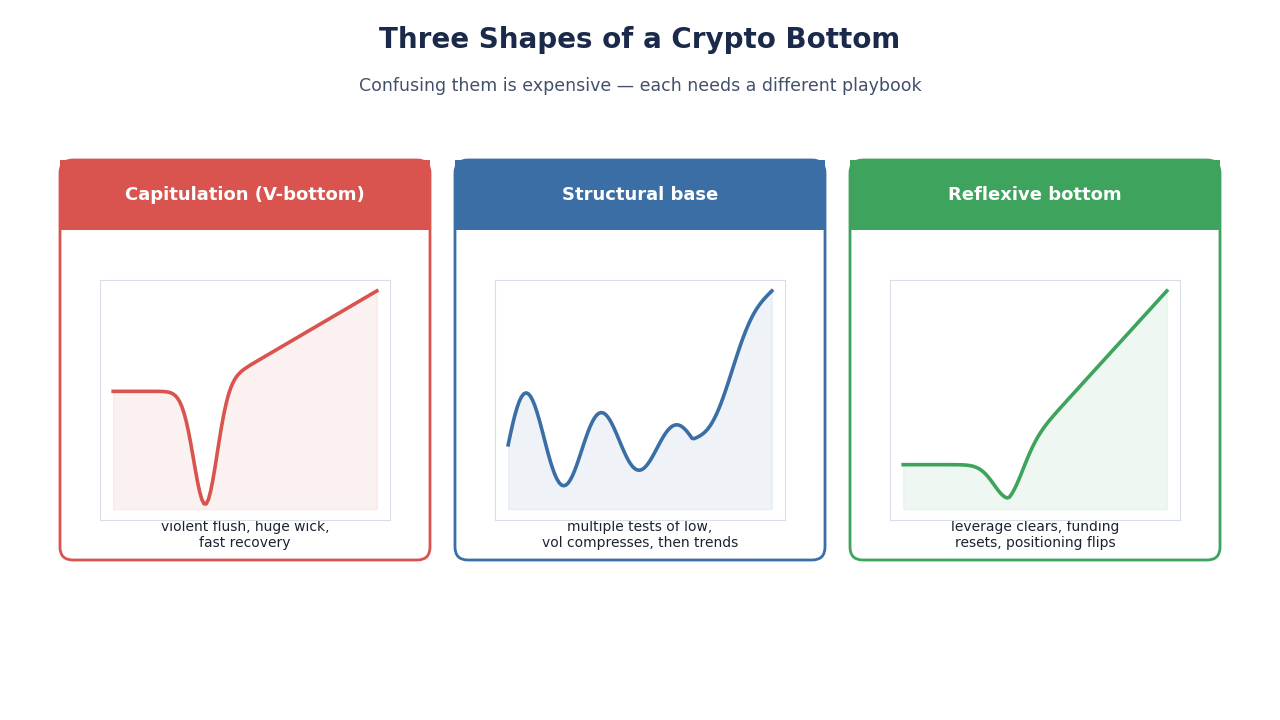
Crypto bottoms come in different shapes, and confusing them causes expensive mistakes:
- Capitulation bottom (V-bottom): a violent flush, huge wick, then fast recovery—often after forced selling peaks.
- Structural bottom (base): multiple tests of lows, volatility compresses, and the market builds acceptance before trending.
- Reflexive bottom: price stabilizes because leverage is cleared, funding resets, and positioning flips—often before fundamentals “feel” better.
In February 2026, we saw ingredients of (1) and (3), but (2) may still be pending depending on follow-through and macro conditions [1][2][4].
A practical definition
For traders, “bottom in” should mean:
- Downside liquidation risk has materially declined
- The market is holding higher timeframes (4h/1d) without constant breakdowns
- Rallies are supported by spot demand, not only short covering
- You have a risk plan that wins even if you’re wrong
That last bullet is non-negotiable.
Bitcoin crash in February 2026: is the bottom in?
This is the core question—and the right answer is: it depends on which confirmation layer you require.
Use a 3-layer framework:
Layer 1: Price/structure (what the chart is proving)
Look for:
- Reclaim of key breakdown levels (prior support becomes resistance → then flips back)
- Higher lows on 1h/4h after the low
- Reduced “air pockets” (fewer sudden 2–3k drops on thin books)
- Trend proxies improving (e.g., reclaiming a major moving average and holding above it for multiple sessions)
During the rebound, Bitcoin recovered above $70k after dipping near $60k [2], but the market still needs to prove it can hold reclaimed zones during the next volatility wave.
Layer 2: Positioning/flows (what leverage and hedging are saying)
Look for:
- Funding normalizing (not excessively negative for too long; not euphorically positive too soon)
- Open interest stabilizing after the flush (less “forced selling fuel”)
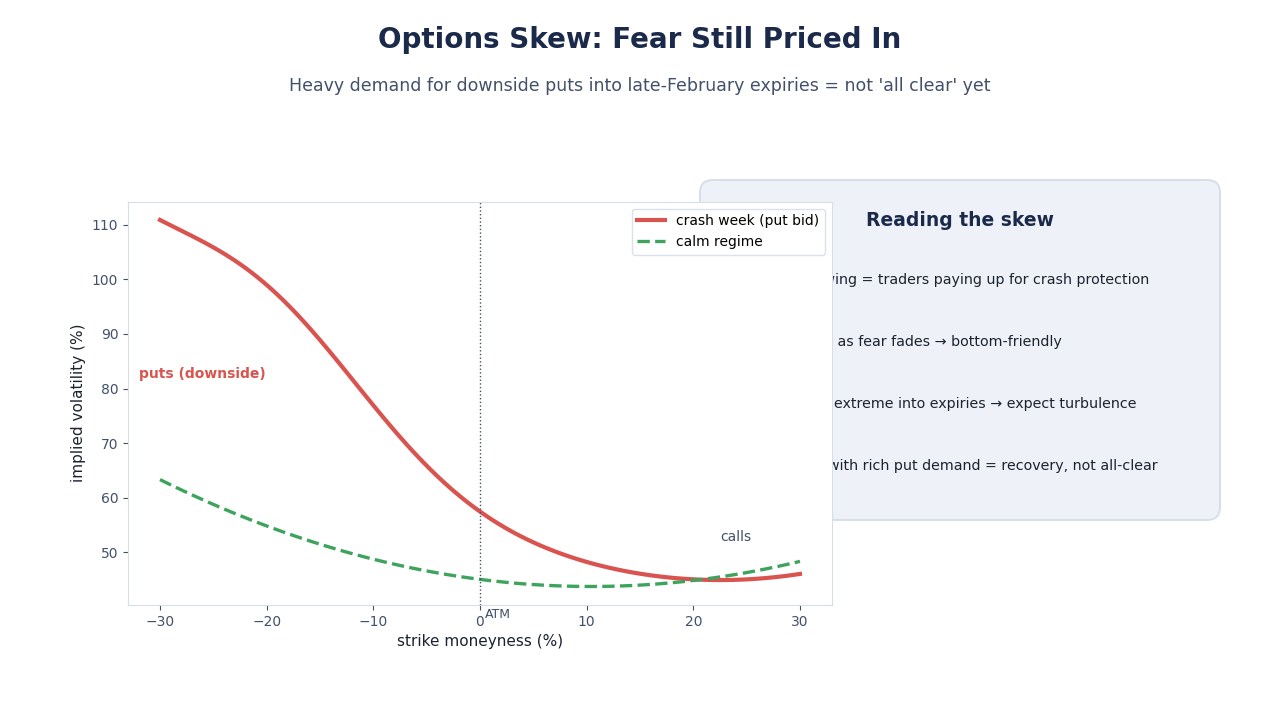
- Options skew easing: if traders are paying aggressively for puts, fear is still dominant
Reuters highlighted heavy demand for downside protection and focus on lower strikes into late-February expiry windows [2]. That suggests: market participants were not behaving like “all clear” yet.
Layer 3: Fundamentals/on-chain (what long-horizon holders are doing)
Even without perfect on-chain data, conceptually you want:
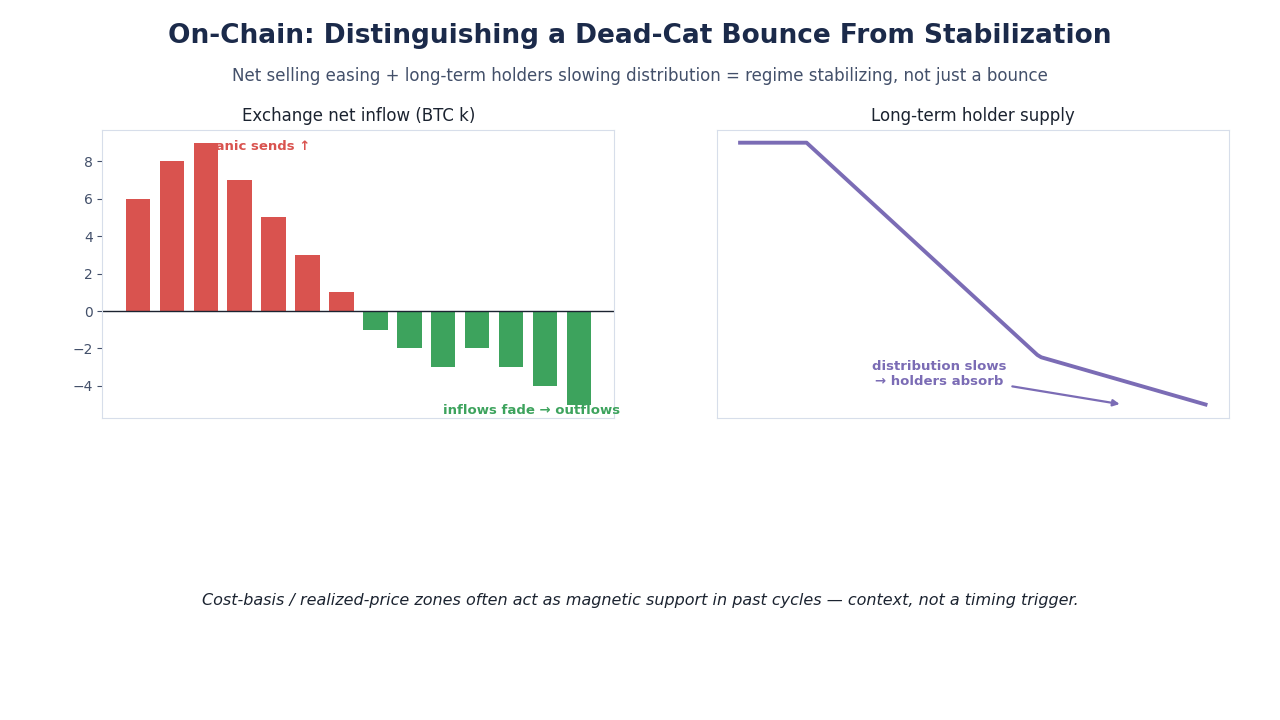
- Net selling pressure easing (fewer “panic sends” to exchanges)
- Long-term holders reducing distribution
- Realized price / cost-basis zones acting as “magnetic support” (in past cycles)
On-chain isn’t a timing tool by itself—but it’s valuable for distinguishing dead cat bounce vs regime stabilization.
The February 2026 crash checklist: what to watch next
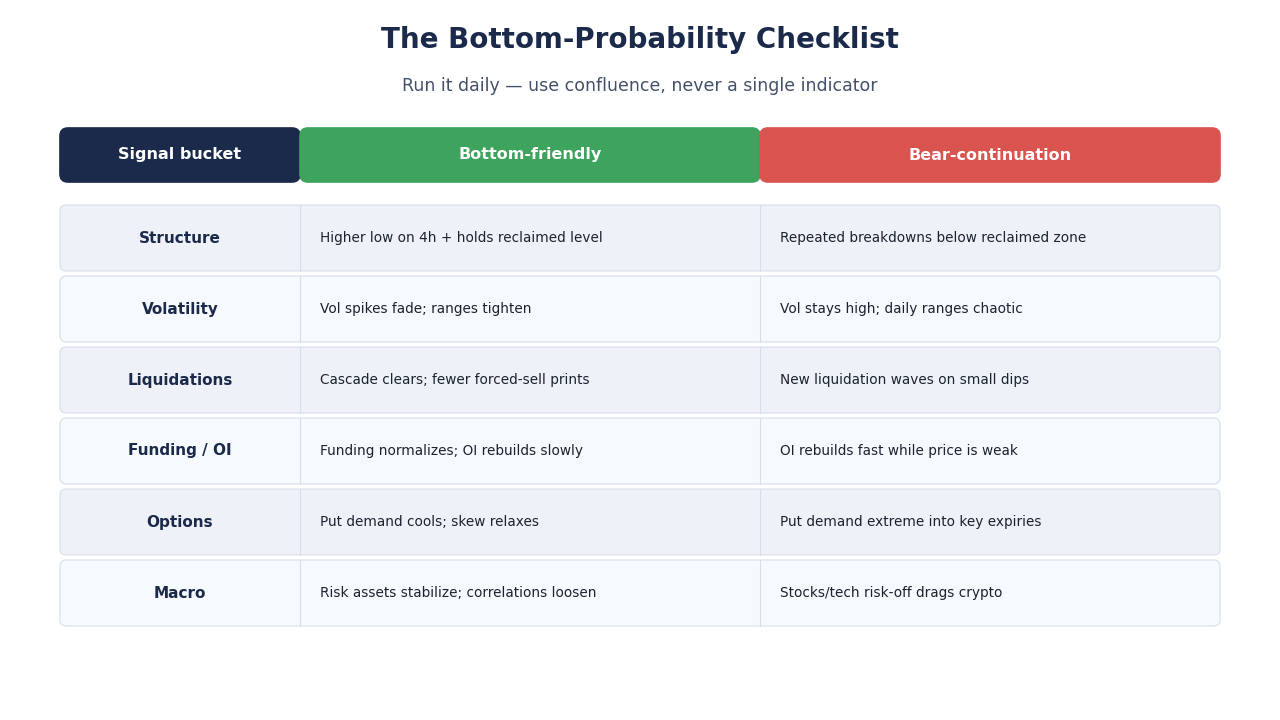
Below is a bottom-probability checklist you can run daily. Don’t treat any single indicator as decisive—use confluence.
| Signal bucket | Bottom-friendly behavior | Bear-continuation behavior |
|---|---|---|
| Structure | Higher low on 4h + holds reclaimed level | Repeated breakdowns below reclaimed zone |
| Volatility | Vol spikes fade; ranges tighten | Vol stays high; daily ranges remain chaotic |
| Liquidations | Cascade clears; fewer “forced sell” prints | New liquidation waves on small dips |
| Funding/OI | Funding normalizes; OI rebuilds slowly | OI rebuilds fast while price is weak |
| Options | Put demand cools; skew relaxes | Put demand stays extreme into key expiries [2] |
| Macro | Risk assets stabilize; correlations loosen | Stocks/tech risk-off drags crypto [1][4] |
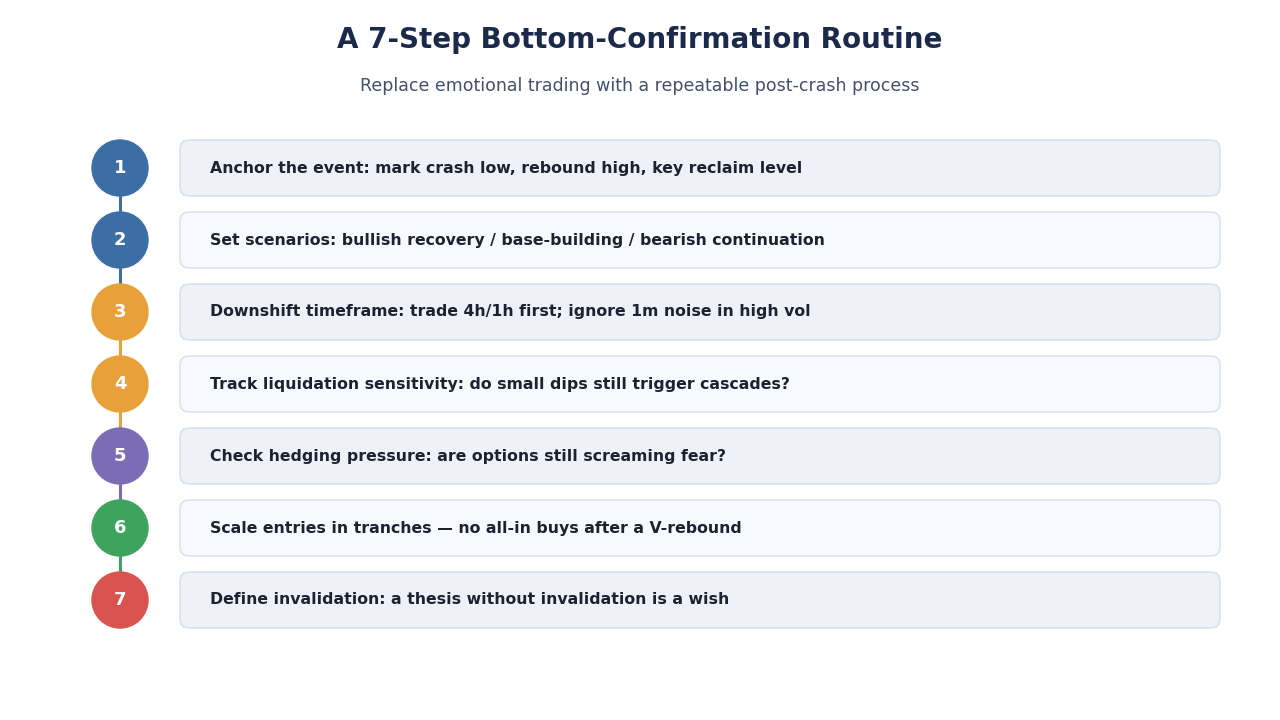
A 7-step “bottom confirmation” routine you can actually follow
Use this routine to avoid emotional trading after a crash:
- Anchor the event: mark the crash low, the rebound high, and the key reclaim level (the “line in the sand”).
- Set scenarios: bullish recovery, base-building, bearish continuation (define what price must do in each).
- Downshift timeframe: trade 4h/1h structure first; avoid overreacting to 1m noise during high vol.
- Track liquidation sensitivity: if small dips trigger big cascades, the tape is still fragile [4].
- Check hedging pressure: if options markets still scream fear, expect turbulence [2].
- Scale entries: use tranches; avoid all-in buys immediately after a V-rebound.
- Define invalidation: a bottom thesis without invalidation is not a thesis—it’s a wish.
Why this crash felt so violent: cross-asset risk and “shared risk budgets”
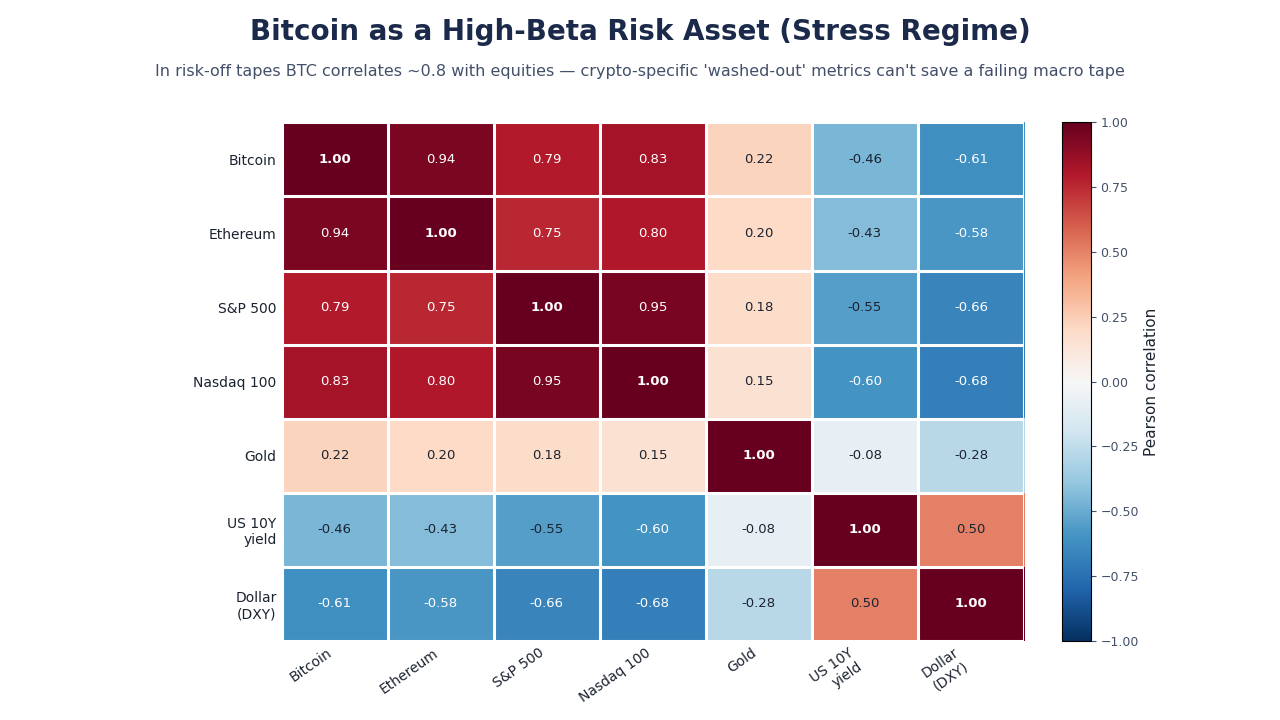
One underappreciated factor in 2026 is that Bitcoin has increasingly traded like a high-beta risk asset during stress regimes. When macro liquidity expectations tighten or equity leadership (especially AI/tech) wobbles, crypto can get sold as part of the same global “risk book” [1][4].
SimianX’s own cross-asset analysis emphasizes how rates, USD strength, volatility regimes, and forced deleveraging can synchronize drawdowns across stocks and crypto, turning multiple markets into one correlated unwind [4]. In practical terms, that means Bitcoin bottoms can fail if the macro tape keeps deteriorating—even if crypto-specific metrics look “washed out.”
Three scenarios from here (and how to trade each)
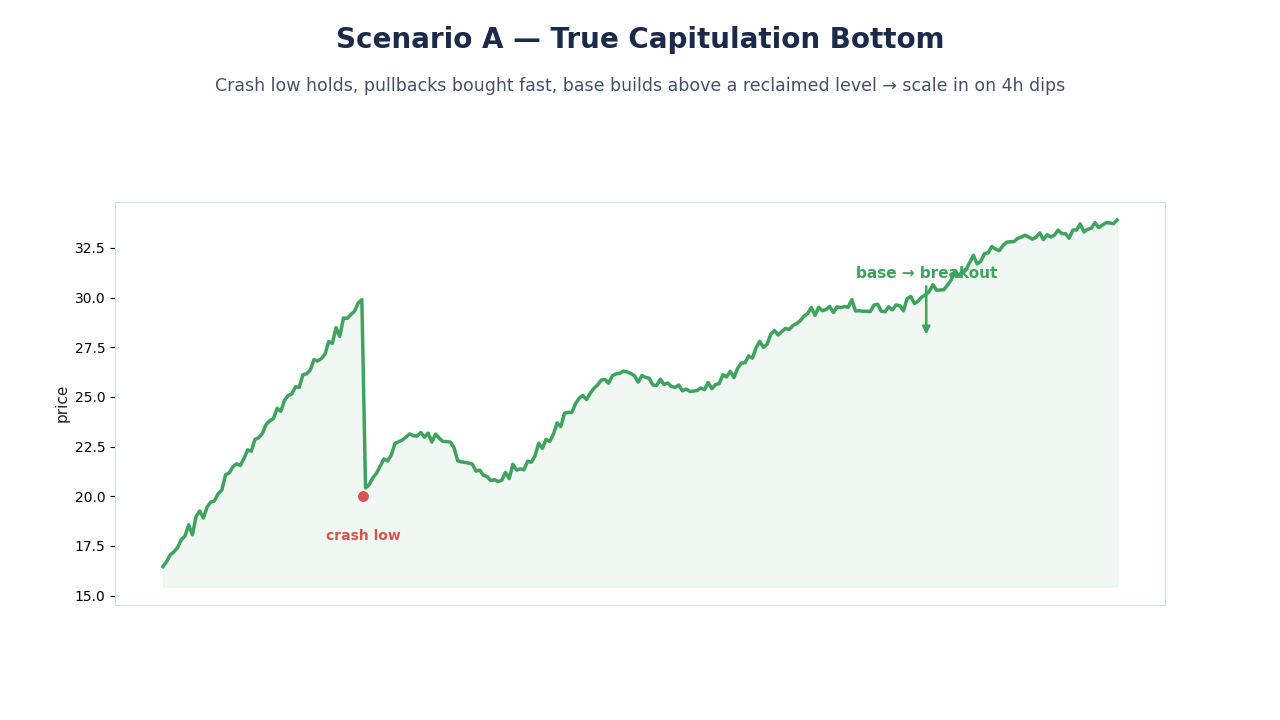
Scenario A: True capitulation bottom (fast recovery that sticks)
What you’ll see:
- The crash low holds.
- Pullbacks are bought quickly and don’t reopen liquidation cascades.
- Price builds a base above a reclaimed level.
How to trade it:
- Scale into spot or longer-horizon positions on 4h pullbacks.
- Use defined risk (stop below the base or hedge with options).
- Avoid chasing vertical candles.
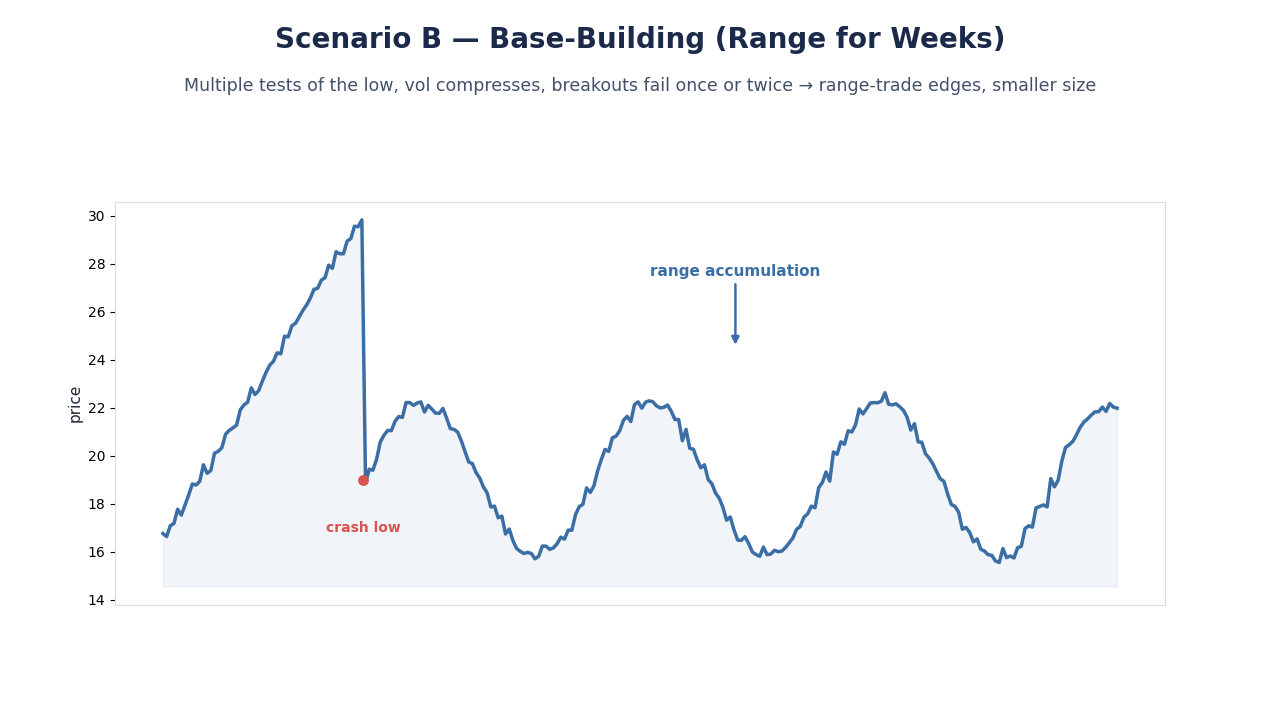
Scenario B: Base-building (range for weeks)
What you’ll see:
- Multiple tests of the low zone.
- Volatility compresses; range forms.
- Breakouts fail once or twice before succeeding.
How to trade it:
- Range trade edges with smaller size.
- Favor mean-reversion setups over trend-following.
- Keep capital ready for the eventual breakout.
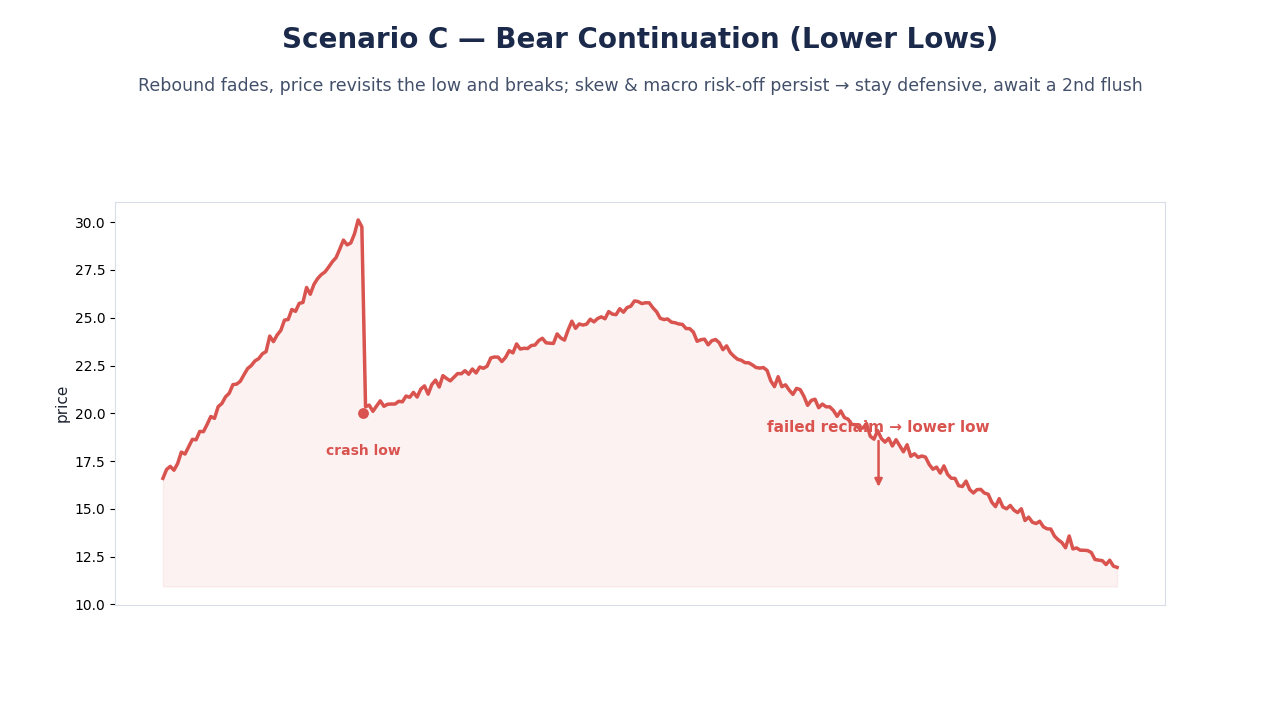
Scenario C: Bear continuation (lower lows ahead)
What you’ll see:
- Rebound fades; price revisits the low and breaks.
- Options skew and hedging demand remain elevated [2].
- Macro risk-off persists and correlations stay tight [1][4].
How to trade it:
- Stay defensive: smaller size, more cash, or hedges.
- Wait for a second capitulation.
- If trading, focus on short setups after failed reclaims.
How to use SimianX AI to answer “Is the bottom in?” without guessing
If you’re running this analysis across 10 tabs, you will get slower and more emotional precisely when speed and clarity matter most. This is where SimianX AI is directly useful.
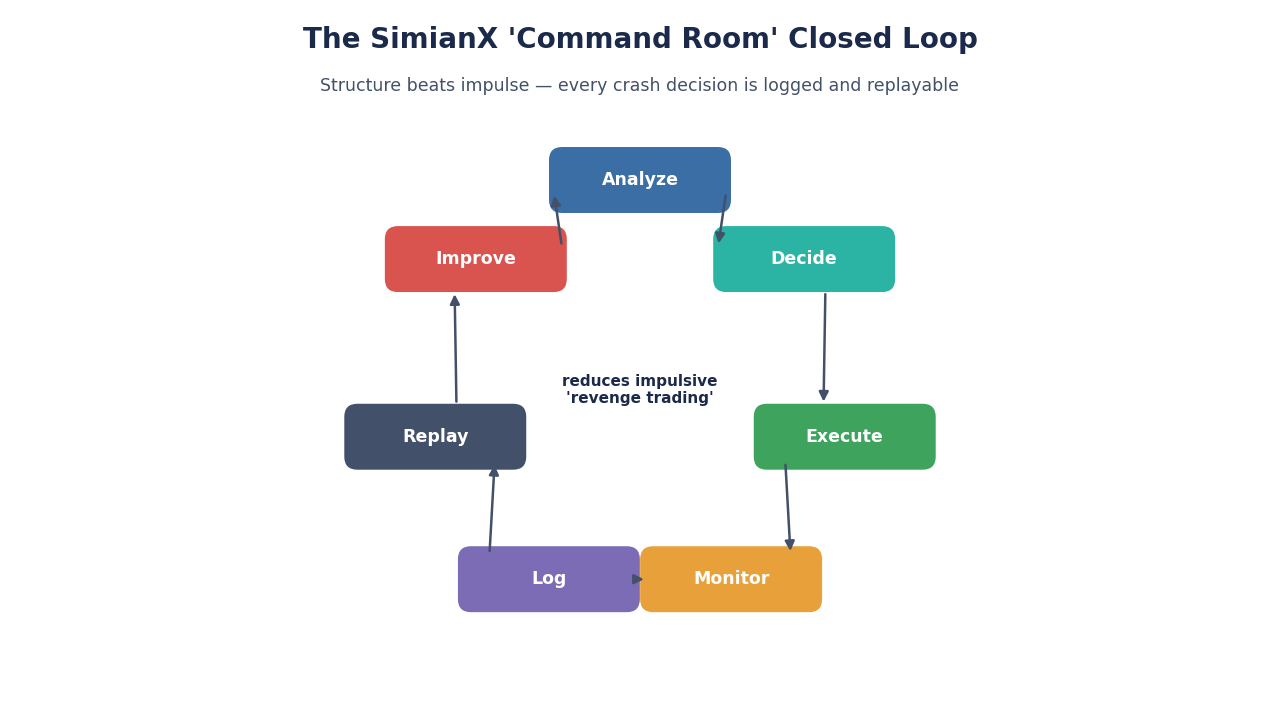
1) Use the “Command Room” workflow: analyze → decide → execute → monitor → log
SimianX’s Crypto Live Command Room is built as a unified decision space—multi-timeframe charts, a live signal stream, explainable AI reasoning, and an execution loop that logs decisions for review [3]. The platform explicitly frames trading as a closed-loop process:
Analyze → Decide → Execute → Monitor → Log → Replay → Improve [3]
That structure is ideal during crash regimes because it reduces impulsive “revenge trading.”
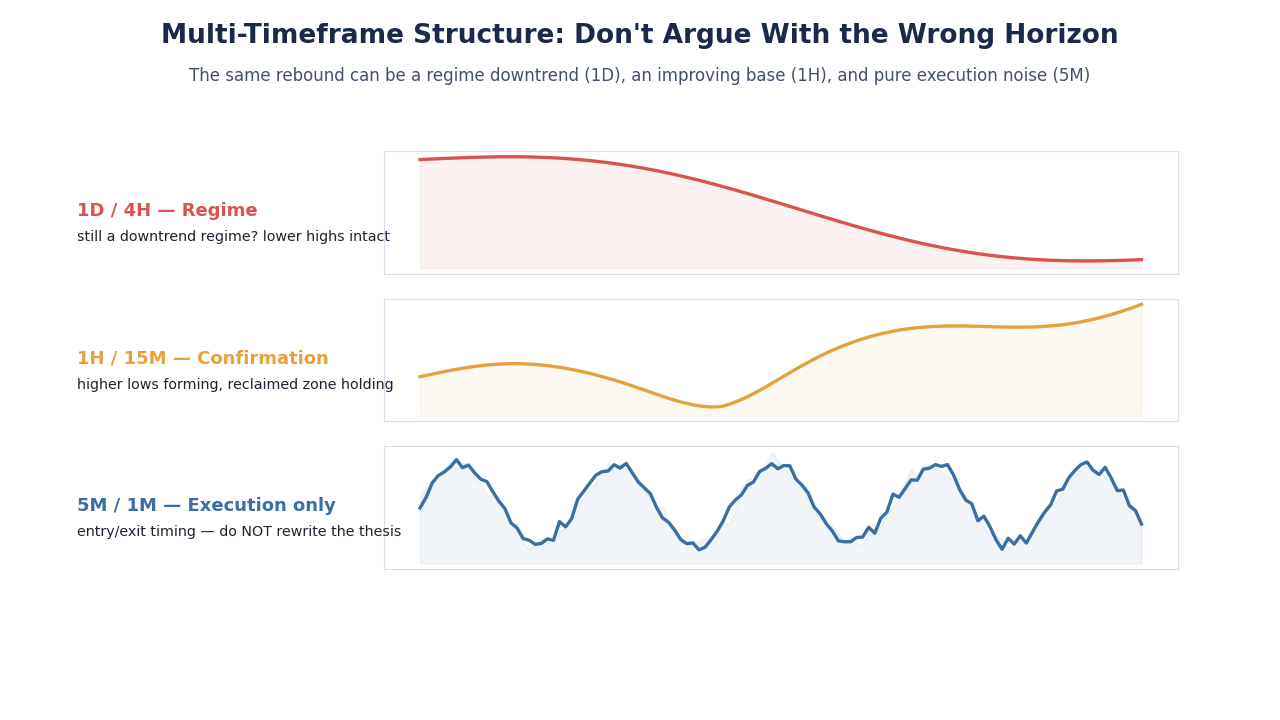
2) Multi-timeframe confirmation (stop arguing with the wrong horizon)
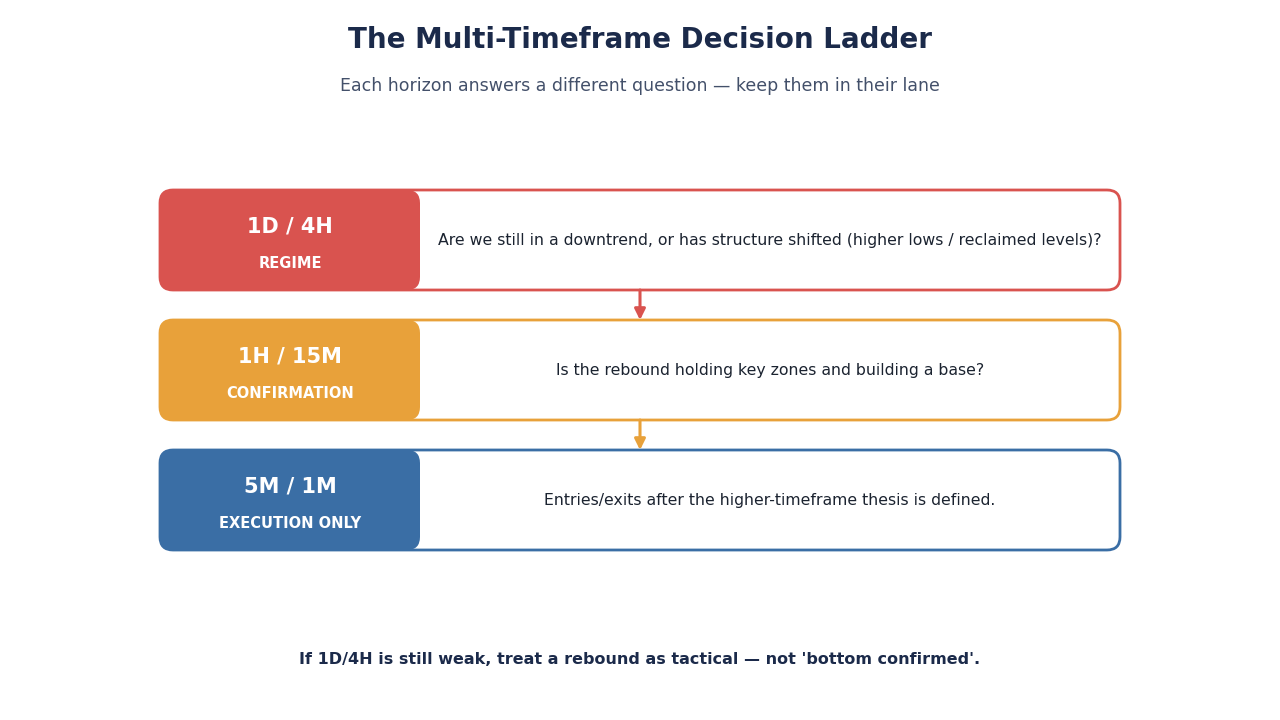
SimianX’s interface emphasizes instant switching across timeframes (1m/5m/15m/1h/4h/1d) to distinguish micro flushes from regime breaks [3]. During a post-crash rebound, that’s crucial:
- 4h/1d: is the market still in a downtrend regime?
- 15m/1h: is structure improving (higher lows, reclaimed zones)?
- 1m/5m: execution timing only—don’t let it rewrite your thesis.
3) Multi-agent synthesis (technical + market intelligence + decision layer)
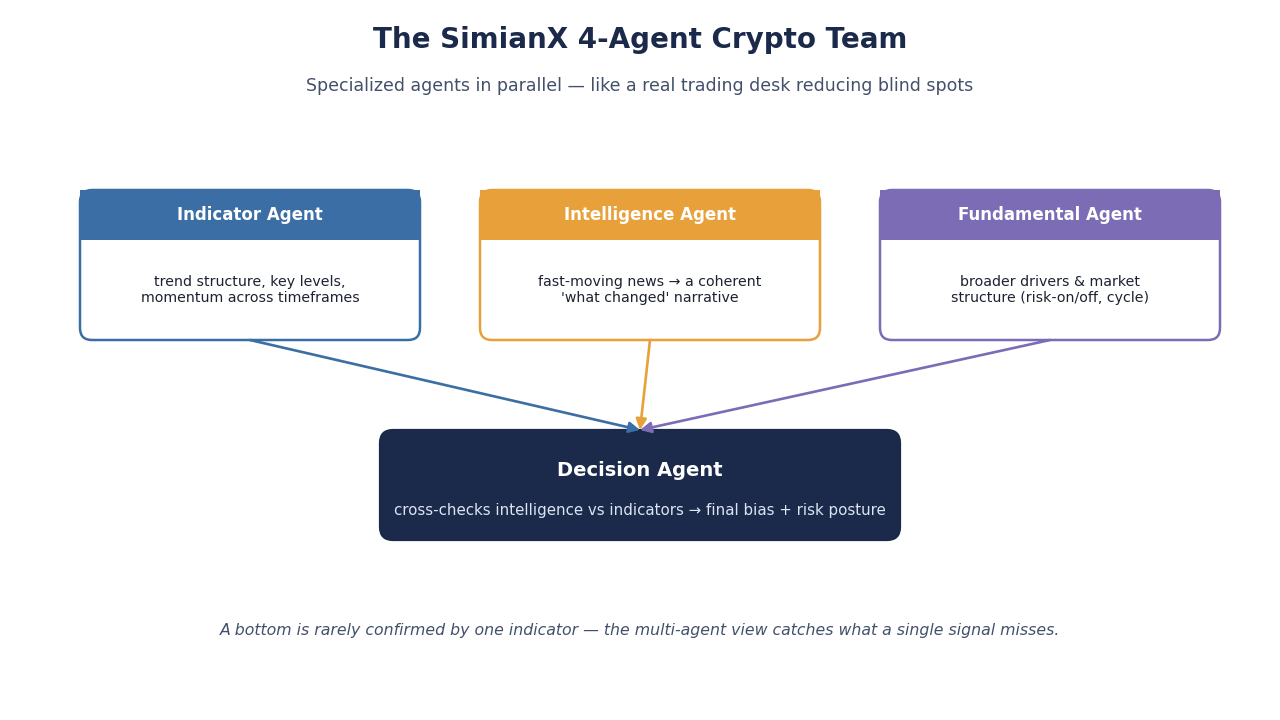
Instead of relying on one “signal,” SimianX describes a multi-agent architecture where specialized agents cover technical structure, market intelligence (news/narratives), and a decision agent that resolves conflicts into a final bias and risk posture [3]. This matters because February 2026 wasn’t just “a chart event”—it was a leverage-and-sentiment unwind inside a broader risk-off tape [1][4].
4) Model selection and benchmarking via the Crypto AI Model Leaderboard
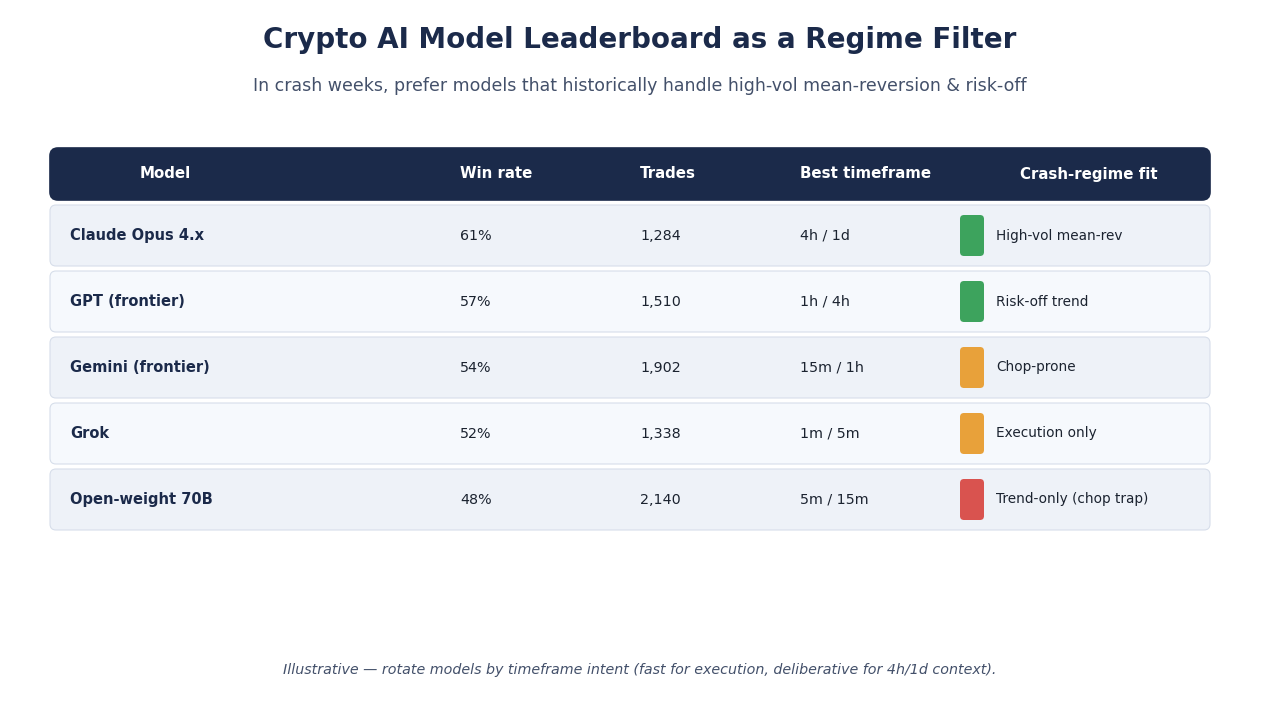
One unique element: SimianX publishes a Crypto AI Model Leaderboard with real-time performance rankings, including win rate, total trades, and the number of models/pairs tracked [5]. In volatile regimes, different models may perform better depending on whether the market is trending, mean-reverting, or chaotic.
Practical use:
- In crash weeks, prefer models that historically handle high-volatility mean-reversion or risk-off trend better (based on leaderboard stats and your own evaluation).
- Rotate models by timeframe (fast models for 1m/5m execution, more deliberative ones for 4h/1d context), consistent with the command-room thesis [3][5].
5) A simple “Bottom Probability Score” you can run in SimianX
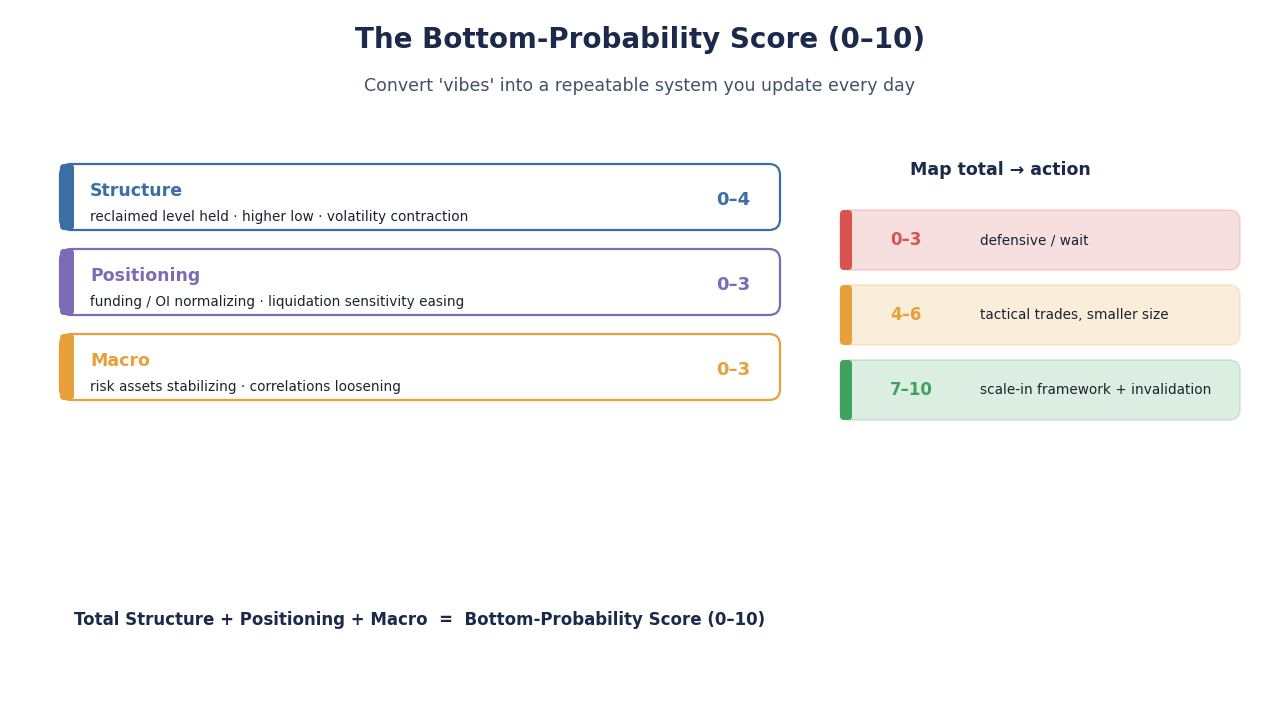
You can operationalize the 3-layer framework as a score:
- Structure score (0–4): reclaimed level hold, higher low, volatility contraction
- Positioning score (0–3): funding/OI normalization, liquidation sensitivity easing
- Macro score (0–3): risk assets stabilizing, correlations loosening
Then map the total (0–10) to actions:
- 0–3: defensive / wait
- 4–6: tactical trades only, smaller size
- 7–10: scale-in framework, still with invalidation
This converts “vibes” into a repeatable system—exactly what you need after a crash.
What the rebound does (and doesn’t) prove
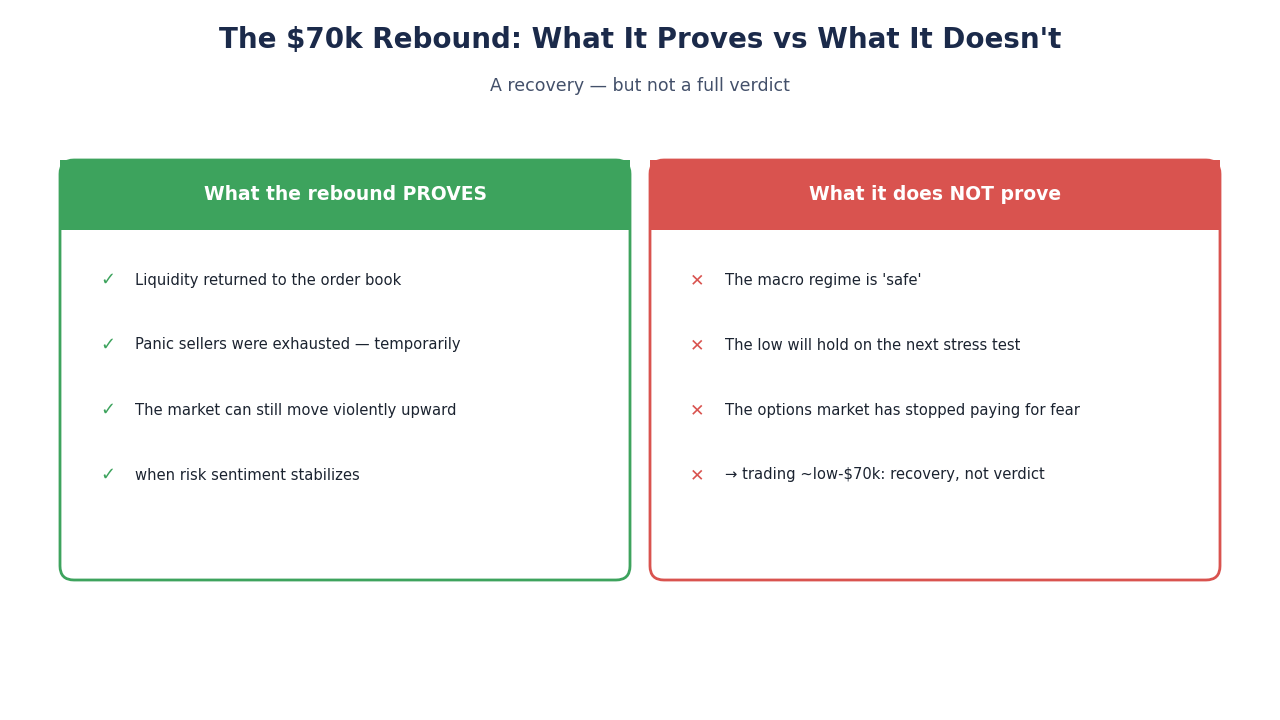
After the flush to roughly $60k, Bitcoin rebounded above $70k [2]. That proves:
- Liquidity returned
- Panic sellers exhausted temporarily
- The market can still move violently upward when risk sentiment stabilizes
But it does not prove:
- The macro regime is “safe”
- The low will hold on the next stress test
- The options market has stopped paying for fear [2]
As of the latest snapshot, Bitcoin is trading around the low-$70k area again [6]. That’s a recovery—but not a full verdict.
FAQ About Bitcoin Crash in February 2026
Is the Bitcoin bottom in after the February 2026 crash?
Not definitively. The fast rebound is consistent with capitulation behavior, but markets often revisit lows. Confirmation usually requires reclaimed levels holding on higher timeframes and reduced liquidation sensitivity [2][4].
What are the best capitulation signals to watch in Bitcoin?
Look for liquidation cascades, extreme volatility spikes, long wicks, and then stability—smaller ranges and higher lows. If options hedging demand stays extreme, expect more turbulence [2].
How do liquidations affect Bitcoin price during crashes?
Liquidations turn leverage stress into forced market selling, which can trigger slippage and more liquidations—a feedback loop. Crypto’s structure makes it especially prone to cascades [4].
How should I buy Bitcoin after a big crash without getting trapped?
Use a tranche-based plan (scale in), define invalidation, and avoid chasing vertical rebounds. Treat “bottom in” as probability, not certainty, and size positions so you can survive a retest.
How can SimianX AI help me time entries after a Bitcoin crash?
SimianX AI centralizes multi-timeframe structure, multi-agent reasoning, and a live signal workflow so you can separate regime context from execution timing and maintain a logged, replayable decision process [3][5].
Conclusion: a bottom is a process, not a moment
The Bitcoin crash in February 2026 delivered a familiar combo: risk-off macro pressure + crypto leverage unwind + liquidation acceleration [1][4]. The rebound above $70k is meaningful, but the market still needs to prove stability—especially with options traders still paying aggressively for downside protection into late-February windows [2].
If you take one thing from this research, make it this: stop trying to “call” the bottom and start managing the bottoming process—with scenarios, levels, scaling, and clear invalidation.
And if you want a cleaner workflow in chaotic regimes, explore how SimianX AI can help unify multi-timeframe structure, market intelligence, and disciplined execution into one closed-loop system: SimianX AI [3].
1) Start with the right workspace: Crypto Live Command Room
Open the Crypto Live Command Room for your target pair (e.g., BTC-USDT perpetual or spot). This environment is designed to unify:
interactive chart + indicators
live news flow
a dedicated multi-agent AI team
continuous analysis updates
Your goal is to keep everything needed for a bottom call in one loop: Analyze → Decide → Monitor → Review.
2) Use the 4-agent team to separate “noise” from “signal”
SimianX’s Crypto AI Team runs four specialized agents in parallel. Use them like a real trading desk:
Indicator Agent: confirms trend structure, key levels, momentum shifts across timeframes.
Intelligence Agent: converts fast-moving news into a coherent “what changed” narrative for BTC.
Fundamental Agent: frames broader drivers and market structure behaviors (risk-on/off, cycle context).
Decision Agent: cross-checks intelligence vs indicators, then synthesizes a final view of “what matters now” (and why).
How this helps the “bottom” question:
A “bottom” is rarely confirmed by a single indicator. The multi-agent approach reduces blind spots—e.g., bullish chart structure might be invalidated by a fresh macro shock, or bearish headlines might not matter if technical structure has already stabilized.
3) Run a bottom-detection routine with multi-timeframe confirmation
A bottom is a process, not a moment. In SimianX, switch timeframes intentionally:
1D / 4H (Regime): Are we still in a downtrend regime, or has structure shifted (higher lows / reclaimed levels)?
1H / 15M (Confirmation): Is the rebound holding key zones and forming a base?
5M / 1M (Execution only): Use for entries/exits after your higher-timeframe thesis is defined.
Rule of thumb:
If 1D/4H structure is still weak, treat a rebound as tactical (tradeable bounce) rather than “bottom confirmed.”
4) Turn “Is the bottom in?” into a score (so you’re not trading feelings)
Inside your SimianX workflow, create a simple scorecard you update every day:
Bottom Probability Score (0–10)
Structure (0–4): reclaimed level held, higher-low formation, volatility contraction
Market Stress (0–3): fewer liquidation-like impulses, more stable candles, less “air pocket” behavior
Narrative/News (0–3): negative news flow cooling, fewer new shocks, improving tone
Then map it to actions:
0–3: defensive / wait
4–6: tactical trades only, reduced size
7–10: scale-in framework (still with invalidation)
This pairs perfectly with SimianX’s “continuous updates + reviewable history” approach, because you can compare your score changes to what the agents were seeing at the time.
5) Use the News Pipeline to avoid headline whiplash
During crashes, news is constant—but most of it is low signal. SimianX runs a structured pipeline:
Collection + first-pass scoring: low-confidence items can be dropped to reduce noise
Intelligence synthesis: the Intelligence agent produces a holistic “what the latest flow implies” view
Decision grounding: the Decision agent cross-checks news implications against indicators and context, and can reference inputs that influenced the conclusion
How to use this for bottom calls:
You’re looking for the shift from “new bad news accelerates downside” to “bad news no longer pushes price lower.” When price becomes less sensitive to negative flow, it’s often an early stabilization clue.
6) Choose your operating mode: Manual first, then CoPilot
SimianX supports Manual mode (monitoring/advisory) and an optional CoPilot mode for users who want more automation.
For bottom detection specifically:
Start in Manual mode so you validate the signals, levels, and agent logic during high volatility.
If your workflow proves reliable, you can later explore CoPilot-style automation depending on your setup.
7) Review “Analysis History” like a post-trade lab
The most underrated edge after a crash is learning faster than the market.
SimianX is designed to be traceable and reviewable—you can revisit analysis history for backtesting and post-trade learning.
A strong review habit:
Snapshot what each agent said near the low
Compare it to what happened during the rebound and any retests
Extract your “top 3 signals” that were most predictive
Update your bottom score framework accordingly
Over time, this builds a personalized playbook for “crash → stabilization → recovery” phases.
8) (Optional) Use the Crypto AI Model Leaderboard as a regime filter
SimianX also provides a Crypto AI Model Leaderboard tracking performance metrics like trades, win rate, average duration, and timeframe behavior.
In crash regimes:
prefer models/behaviors that historically handle high volatility and mean-reversion (or risk-off trends) better
align model choice with timeframe intent (execution vs regime)
This is especially useful when market conditions shift quickly and yesterday’s “trend model” becomes tomorrow’s “chop trap.”
Practical “Bottom Watch” Setup (Quick Template)
Use this checklist inside SimianX each day:
1D/4H: key levels + trend regime
1H/15M: base-building vs failing rebound
Intelligence Agent: what changed in the last 24h
Decision Agent: current bias + what would invalidate it
Score update: bottom probability (0–10)
Plan: scale-in rules, stop/invalidation level, hedge rules (if any)
Log: record the decision so you can replay and improve
Related Reading
- How to Trade a Crypto Bear Market: 2026 Survival Playbook
- Crypto Leverage Radar: Funding, OI, Liquidation AI Signals
- Crypto Open Interest Spike: What It Really Signals
- Why US Stocks & Crypto Plummeted This Week: The Causes
- SimianX Crypto Live Command Room: AI Copilot for Trading
- 30+ AI Models Ranked Live: Crypto Trade Leaderboard
- BTC 20/60/200-Day Moving Averages: Bull vs Bear Map