
 By Muke
Crypto Leverage Radar: AI Signals from Funding Rates, Open Interest & Liquidation Heatmaps
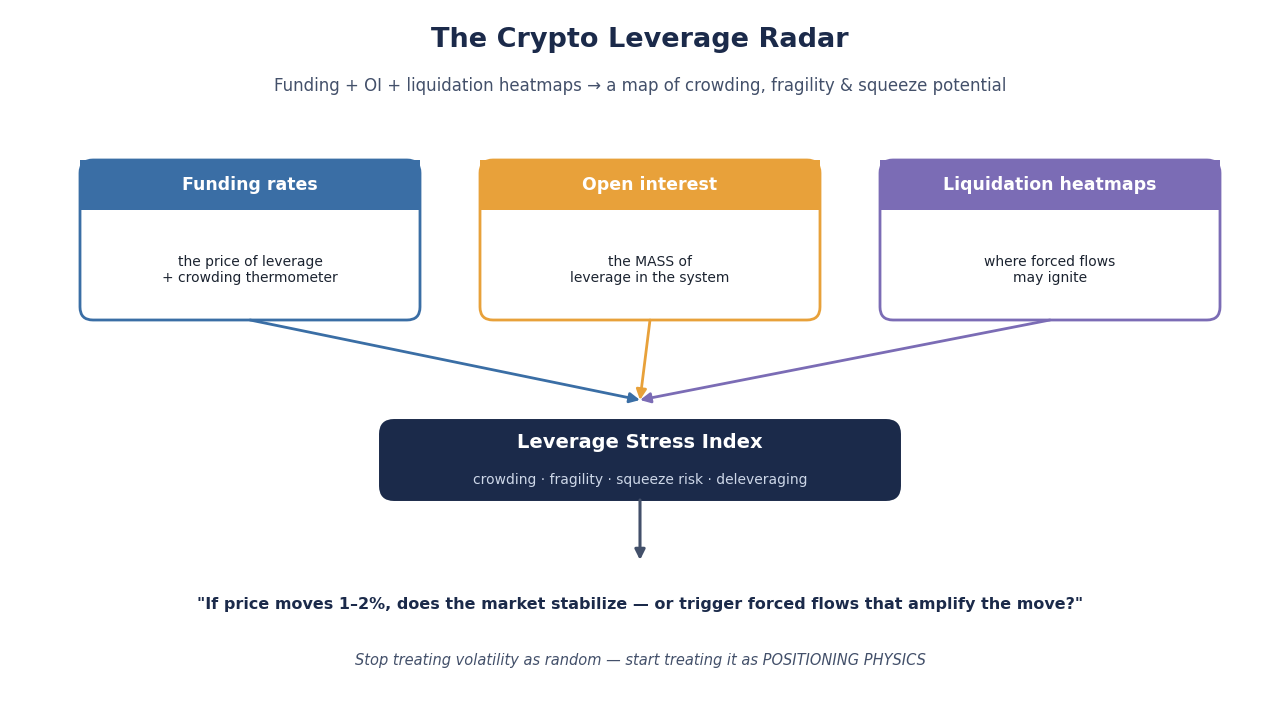
Leverage is the hidden engine of crypto volatility. A Crypto Leverage Radar turns derivatives data—funding rates, open interest (OI), and liquidation heatmaps—into a readable map of crowding, fragility, and squeeze potential. Instead of guessing whether a move is “real” or “leveraged,” you can quantify how positioning is building, where forced liquidations may cascade, and when the market is primed for a violent unwind.
Platforms like SimianX AI can help structure this workflow so you’re not juggling ten dashboards: you want one lens that explains what leverage is doing, where it’s trapped, and how risk changes if price moves a small distance—then turns that into a repeatable decision process.
Why a “Leverage Radar” matters in crypto derivatives
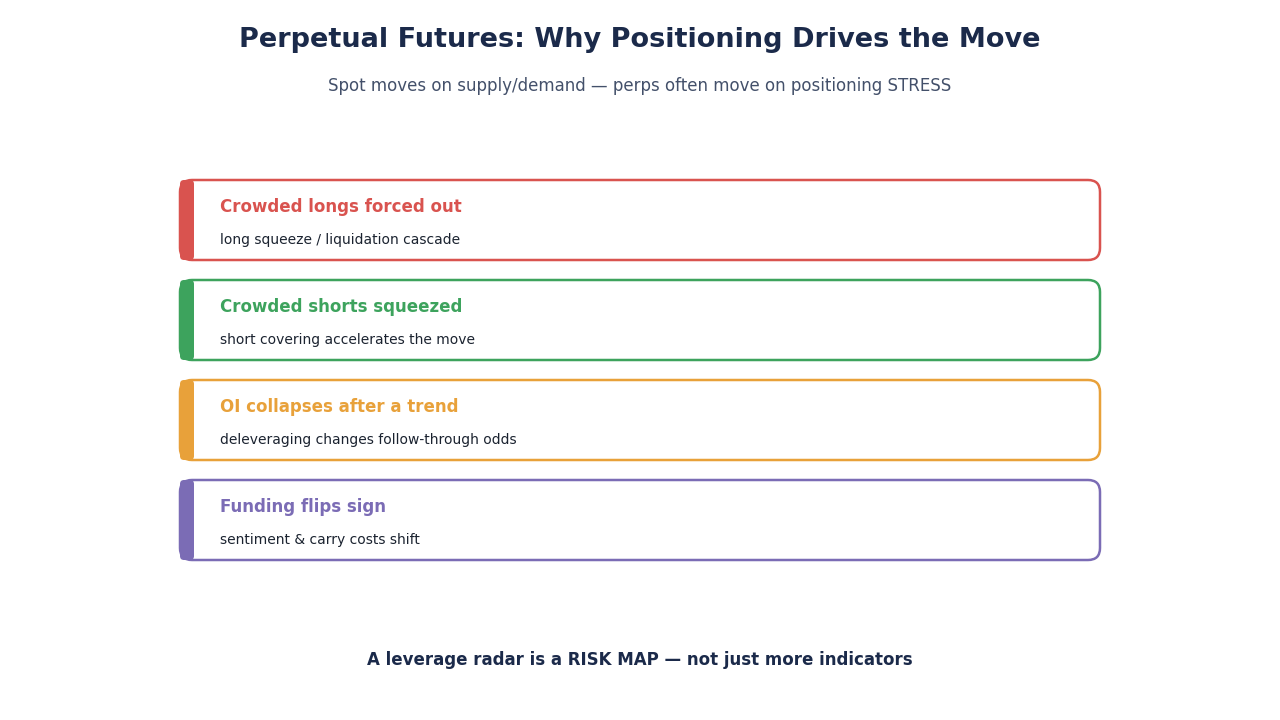
Spot markets move on supply/demand, but perpetual futures often move on positioning stress. The largest intraday swings frequently happen when leverage becomes unstable:
- Crowded longs get forced out (a “long squeeze” / liquidation cascade).
- Crowded shorts get squeezed (short covering accelerates the move).
- OI collapses after a trend (deleveraging), changing follow-through odds.
- Funding flips sign as sentiment and carry costs shift.
A leverage radar is not just “more indicators.” It is a risk map—a way to answer:
“If price moves 1–2%, does the market become more stable… or does it trigger forced flows that amplify the move?”
Key benefit: You stop treating volatility as random and start treating it as positioning physics.
The three core inputs: funding rates, open interest, liquidation heatmaps
1) Funding rates: the price of leverage (and a crowding thermometer)
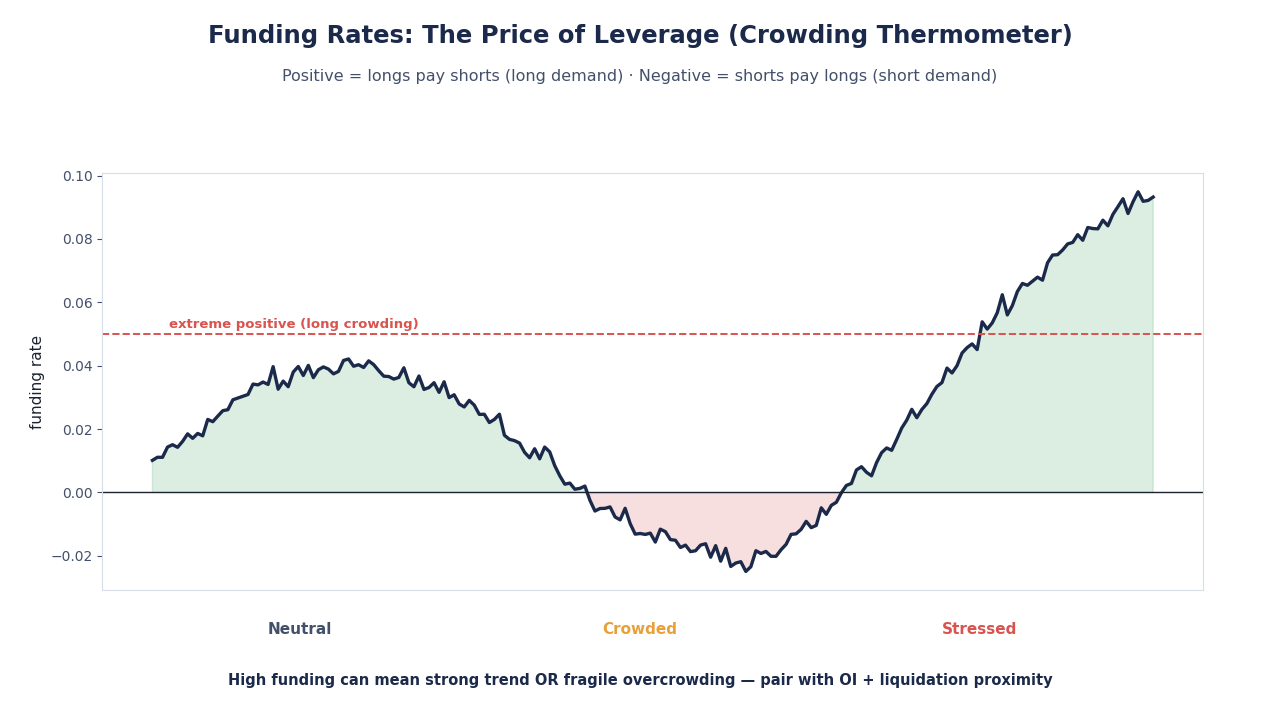
In perpetual futures, funding is a periodic payment that helps keep perp prices anchored to spot. Practically, funding rate is also a crowding proxy:
- Positive funding often implies longs are paying shorts → long demand is dominant.
- Negative funding often implies shorts are paying longs → short demand is dominant.
But funding is only useful when you interpret it in context:
- Funding can be high because the trend is strong (healthy momentum)
- Funding can be high because leverage is overcrowded (fragile)
- Funding can be neutral while leverage quietly accumulates (stealth crowding)
Actionable lens: treat funding as a cost-of-carry + sentiment indicator, not a “sell when positive” meme.
Funding rate pitfalls (and how AI helps)
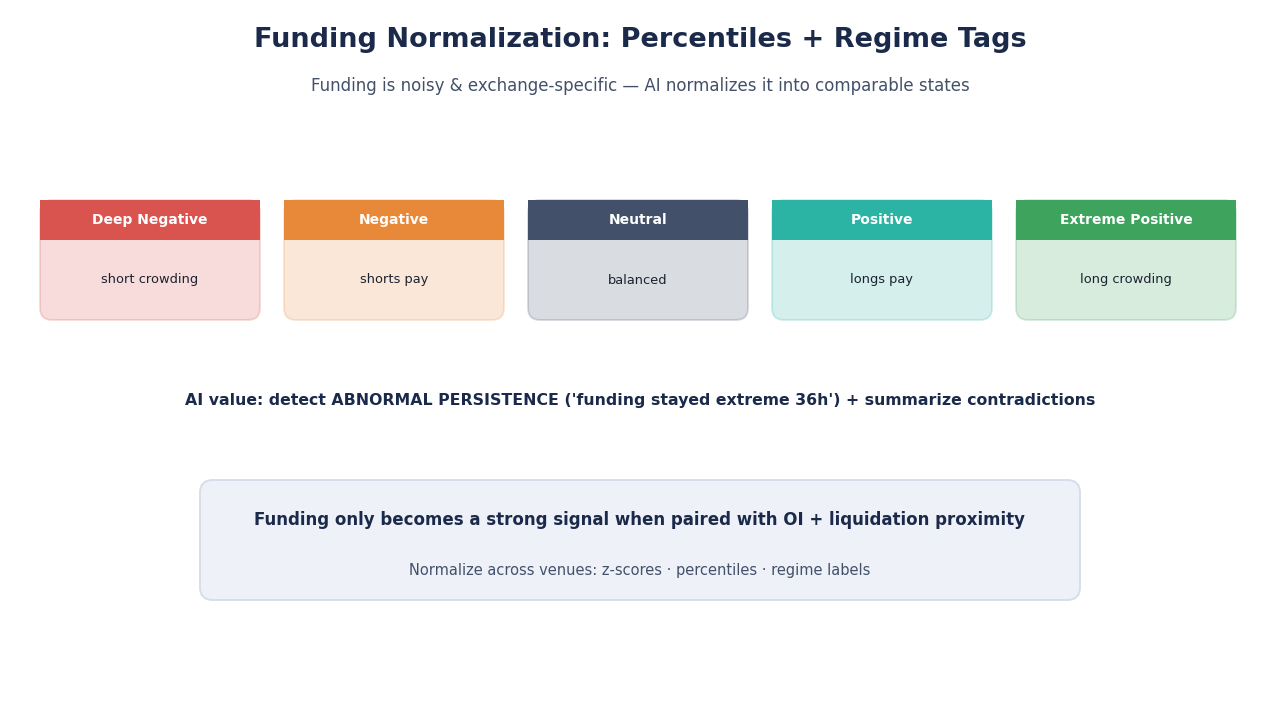
Funding is noisy and exchange-specific. AI helps by:
- Normalizing funding across venues (z-scores, percentiles, regime labels)
- Detecting abnormal persistence (e.g., “funding stayed extreme for 36 hours”)
- Summarizing contradictions (e.g., “funding rising but OI falling”)
Bold takeaway: Funding only becomes a strong signal when paired with OI and liquidation proximity.
2) Open interest (OI): the “mass” of leverage
Open interest is the number of outstanding derivative contracts. It’s best understood as the mass of leverage sitting in the system. When OI rises, the market is accumulating positions. When it falls, the market is deleveraging.
But OI alone is not directional. You need the price + OI interaction.
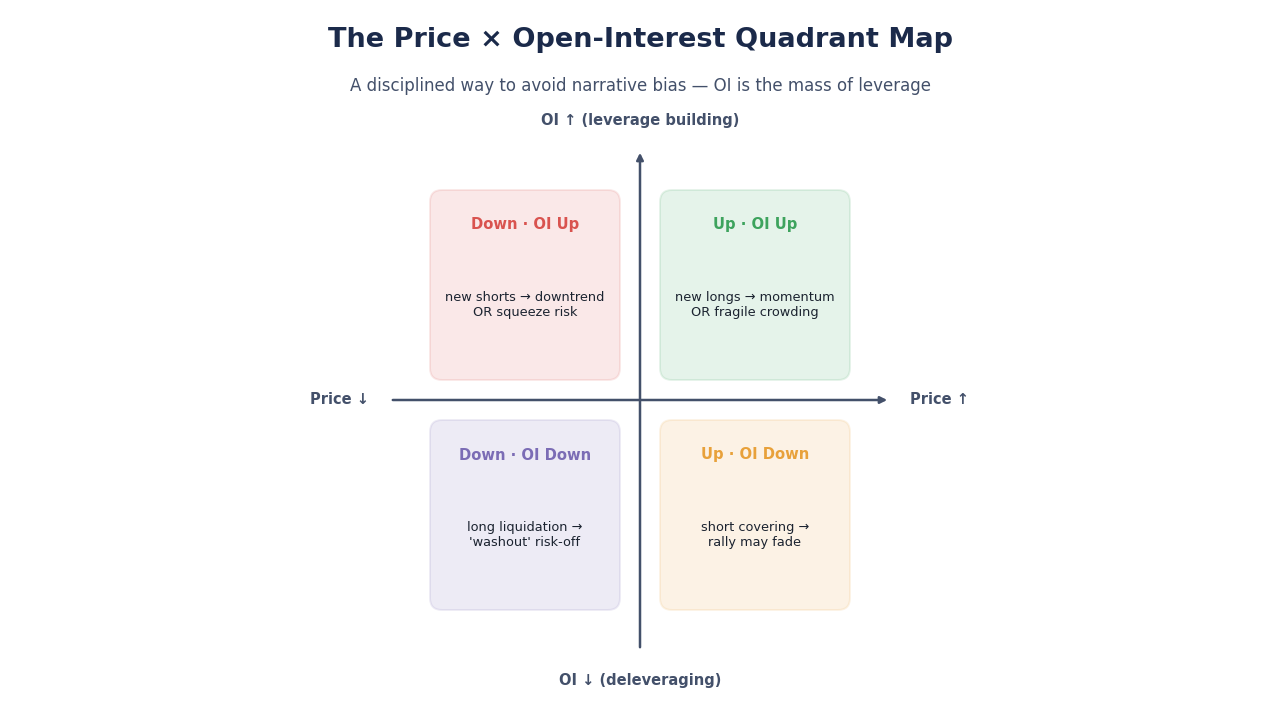
A simple, powerful framework is the 4-quadrant OI map:
| Price Change | OI Change | Likely Positioning Interpretation | Typical Market Behavior |
|---|---|---|---|
| Up | Up | New longs / leverage building | Momentum… or fragile crowding |
| Down | Up | New shorts / leverage building | Downtrend pressure… or squeeze risk |
| Up | Down | Short covering / deleveraging | Rally may fade if spot demand weak |
| Down | Down | Long liquidation / deleveraging | “Washout” risk-off move |
This table is not “truth,” but it’s a disciplined way to avoid narrative bias.
OI pitfalls
- OI can rise from market makers hedging, not just speculators
- OI can migrate between exchanges
- OI can rise while risk actually falls if leverage becomes better hedged
So your leverage radar should include:
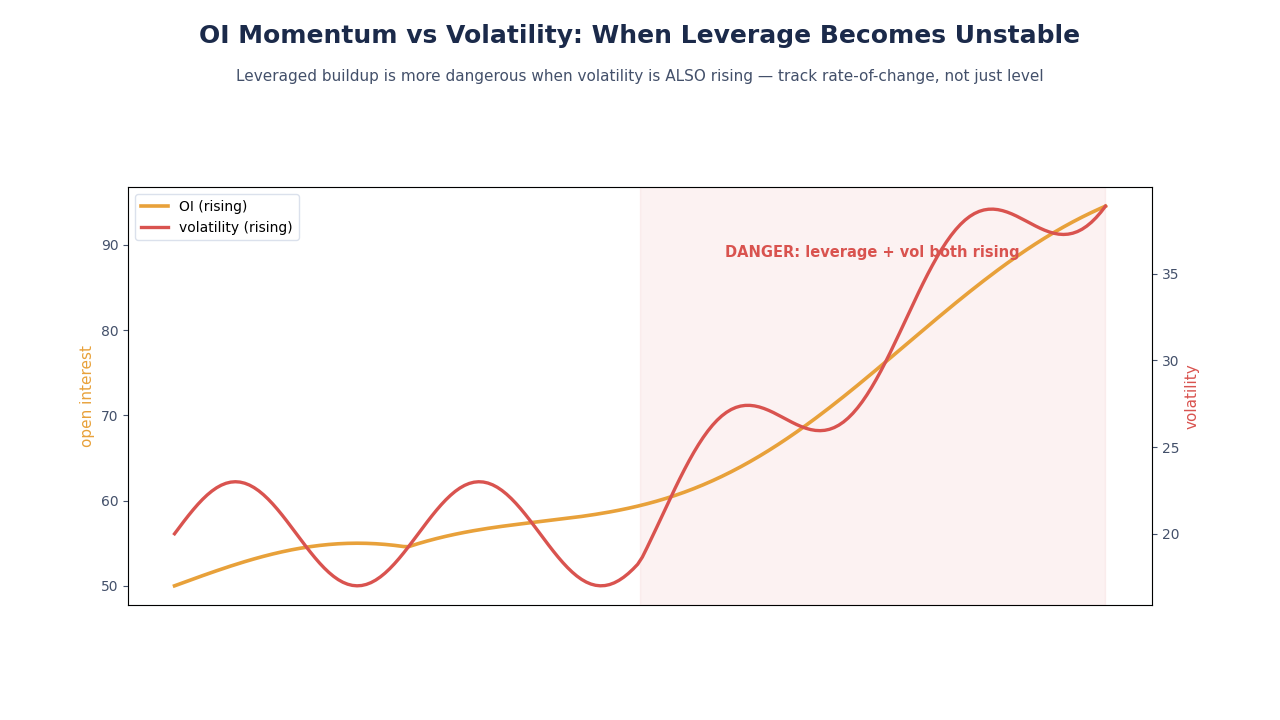
- OI rate-of-change (momentum), not just the level
- OI vs volatility (leveraged buildup is more dangerous when vol is rising)
- OI concentration by venue if available
3) Liquidation heatmaps: where forced flows may ignite
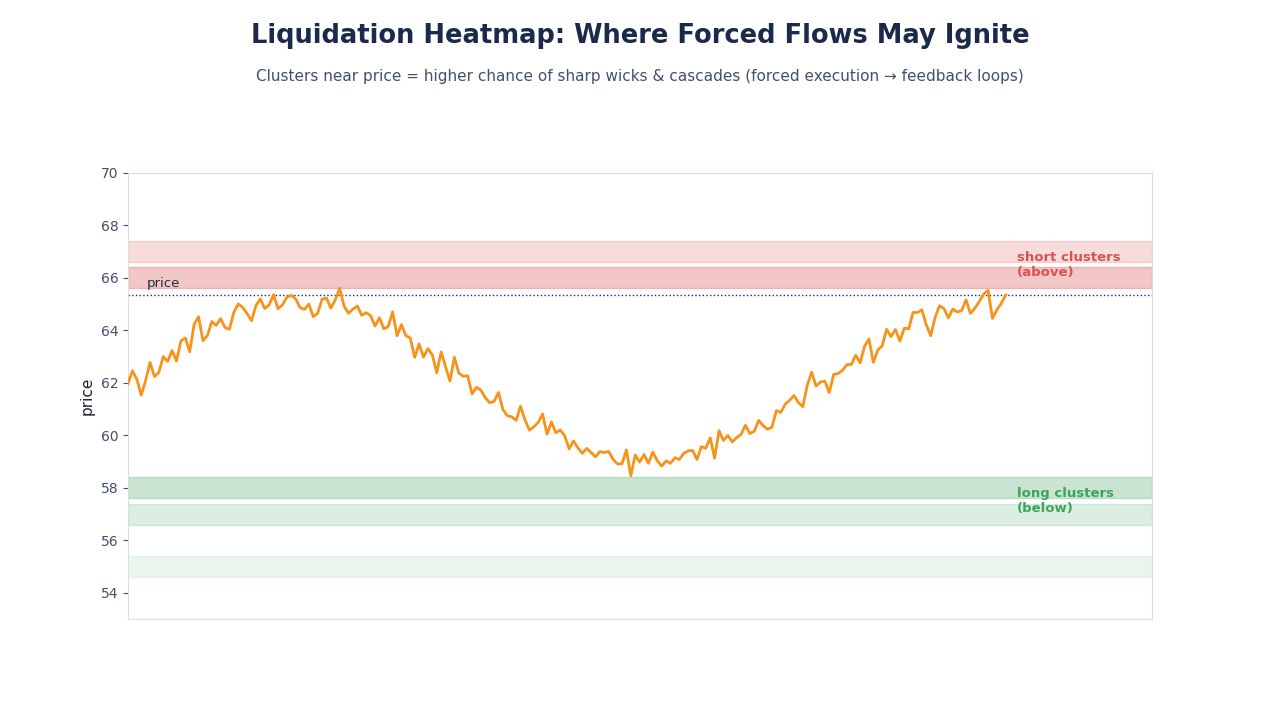
A liquidation heatmap is a visualization of potential liquidation clusters—price zones where many leveraged positions would be forced to close (typically via market orders) if price reaches those levels.
Think of it as a map of where the market might become non-linear.
Why it matters:
- Liquidations are not just “people losing money.”
- Liquidations are forced execution → they can create feedback loops.
- Clusters near price increase the chance of sharp wicks and cascades.
Interpretation rule: the closer and denser the cluster, the more the market can accelerate once triggered.
Heatmap pitfalls (what to watch)
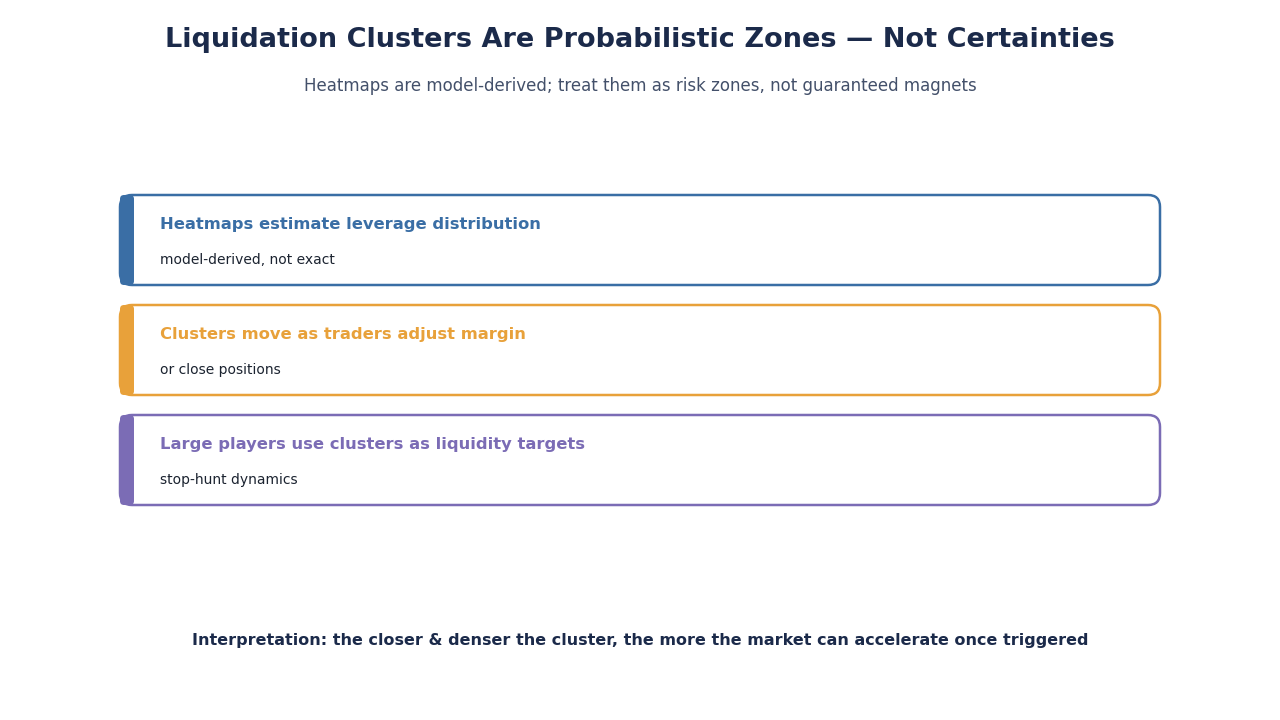
- Heatmaps are model-derived (estimated leverage distribution)
- Clusters can “move” as traders adjust margin or close positions
- Large players can use clusters as liquidity targets
So treat heatmaps probabilistically:
- “High-likelihood cascade zone” not “guaranteed magnet”
Building a Crypto Leverage Radar: a practical AI framework
A useful radar needs signals, not dashboards. Here’s a structured approach you can implement manually—or automate with AI.
Step 1: Define your radar outputs (what decisions it should drive)
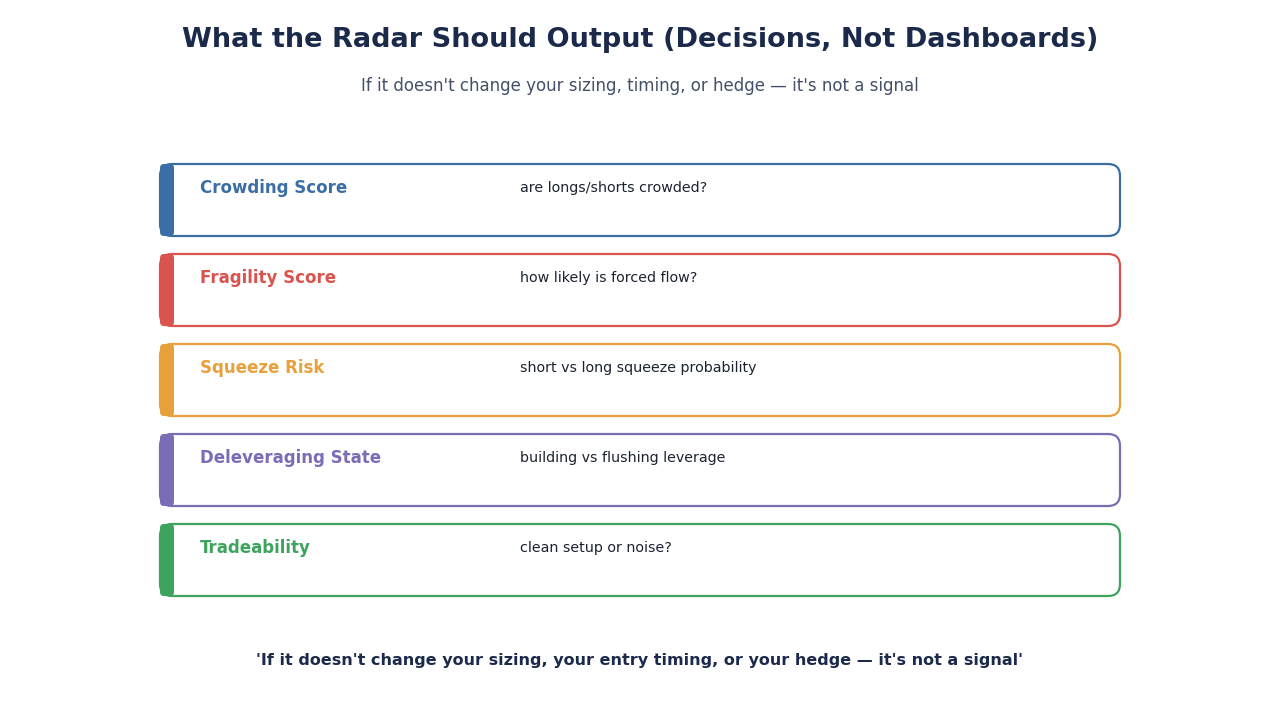
Your radar should produce outputs like:
- Crowding Score (are longs/shorts crowded?)
- Fragility Score (how likely is forced flow?)
- Squeeze Risk (short squeeze vs long squeeze probability)
- Deleveraging State (building leverage vs flushing leverage)
- Tradeability (is this a clean setup or noise?)
If it doesn’t change your sizing, your entry timing, or your hedge—it's not a signal.
Step 2: Normalize each input into comparable “regimes”
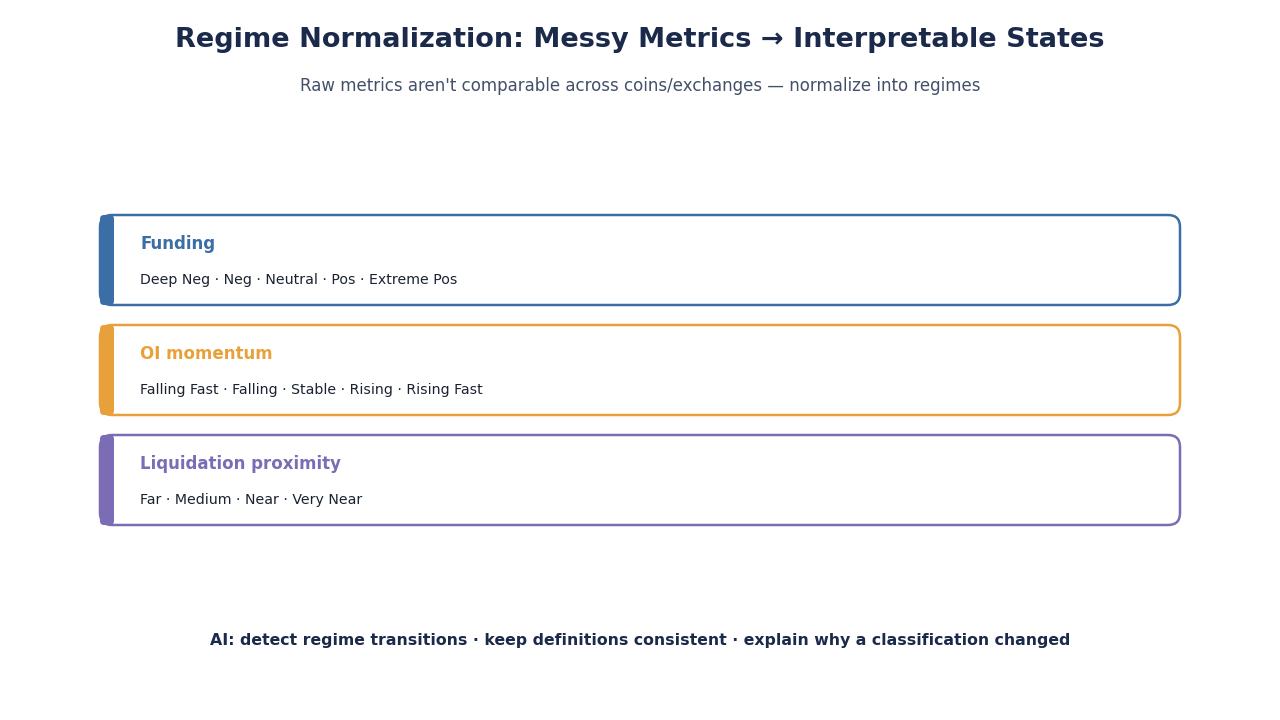
Raw metrics are not comparable across coins, exchanges, and market conditions. Normalize them into:
- Percentiles (e.g., funding at 95th percentile vs past 90 days)
- Z-scores (distance from mean in standard deviations)
- Regime labels (neutral / elevated / extreme)
Example regime labels:
- Funding:
Deep Negative,Negative,Neutral,Positive,Extreme Positive - OI momentum:
Falling Fast,Falling,Stable,Rising,Rising Fast - Liquidation proximity:
Far,Medium,Near,Very Near
AI is valuable here because it can:
- detect regime transitions,
- keep the regime definitions consistent,
- and explain why a classification changed.
Step 3: Combine signals into a single “Leverage Stress Index”
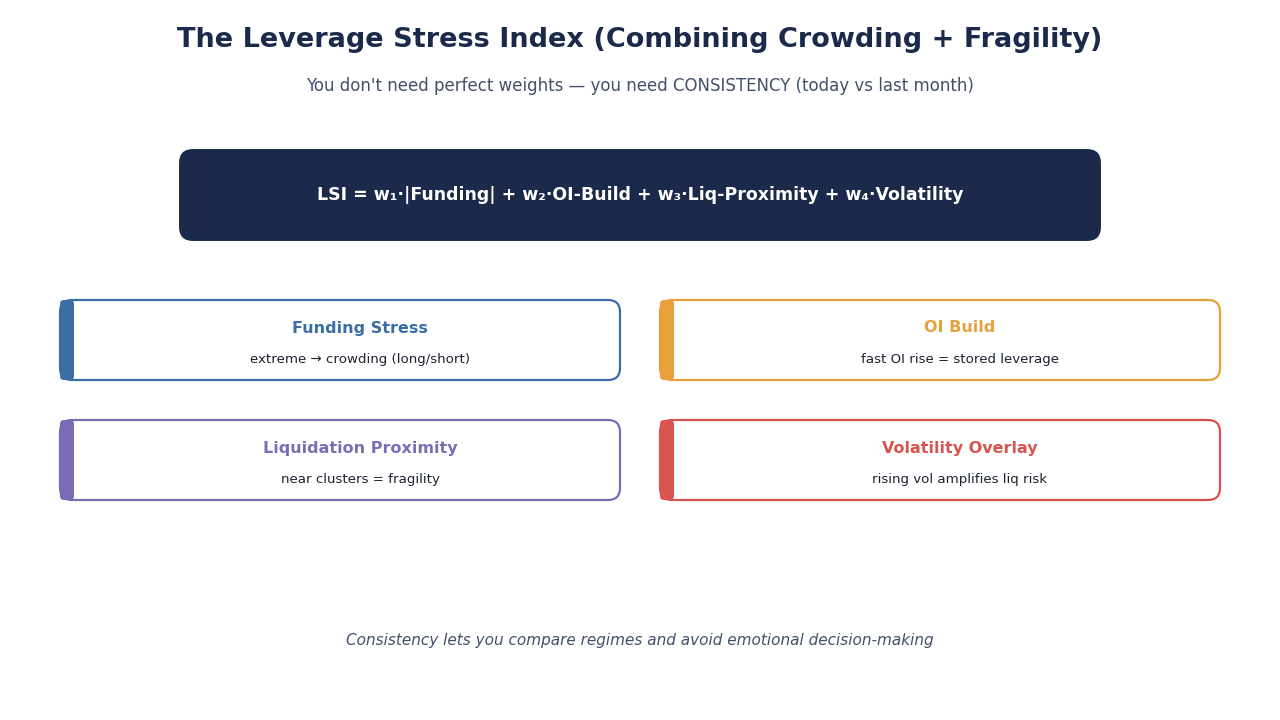
One robust approach is a weighted index:
- Funding Stress (FS): extreme positive → long crowding; extreme negative → short crowding
- OI Build (OIB): fast OI rise increases stored leverage
- Liquidation Proximity (LP): near clusters increase fragility
- Volatility Overlay (VO): rising volatility amplifies liquidation risk
A simplified formula (conceptually):
Leverage Stress Index = w1*|FS| + w2*OIB + w3*LP + w4*VO
You don’t need perfect weights. What you need is consistency—so you can compare “today vs last month” and avoid emotional decision-making.
Step 4: Add an AI “contradiction detector”
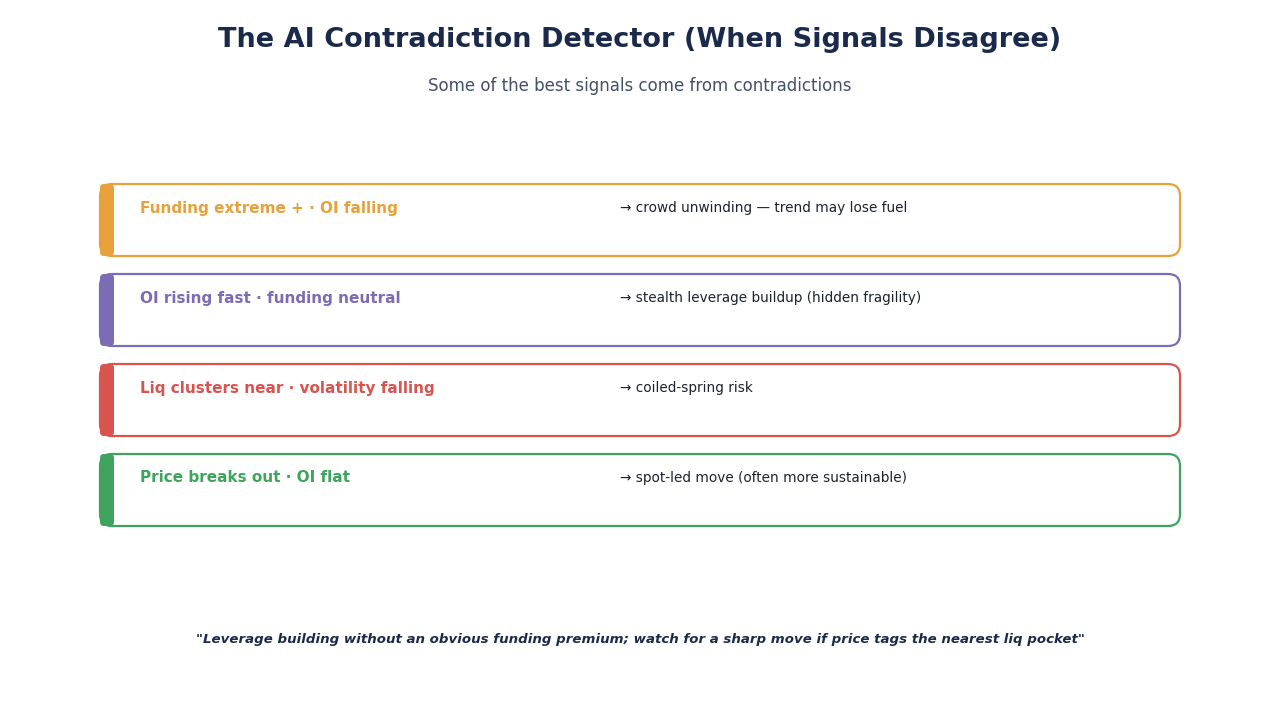
Some of the best signals come from contradictions:
- Funding extreme positive but OI falling → crowd unwinding (trend may lose fuel)
- OI rising fast but funding neutral → stealth leverage buildup (hidden fragility)
- Liquidation clusters near price but volatility falling → coiled spring risk
- Price breaks out but OI flat → spot-led move (often more sustainable)
AI can monitor these combinations and output a clean sentence like:
“Leverage is building without an obvious funding premium; watch for a sharp move if price tags the nearest liquidation pocket.”
That’s the difference between data and decisions.
How to read the classic leverage setups (with actionable playbooks)
Below are the most common patterns that a Crypto Leverage Radar should catch.
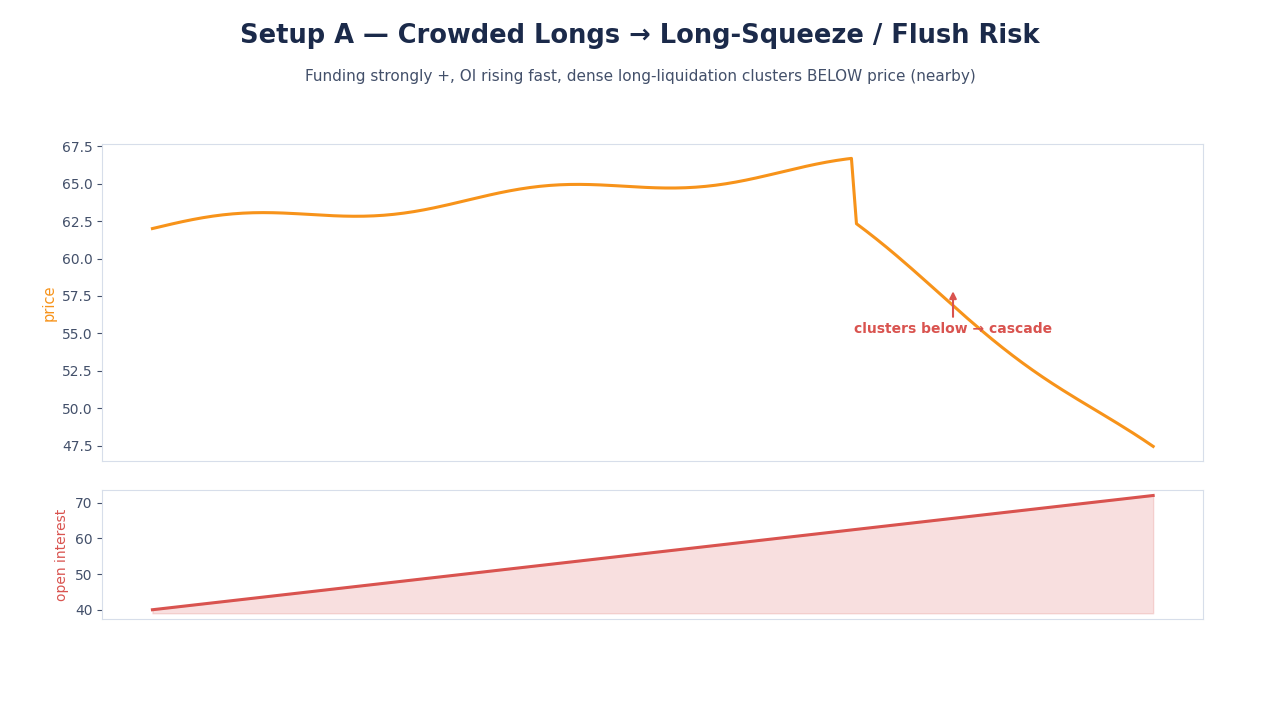
Setup A: Crowded longs → long squeeze / liquidation flush risk
Signature:
- Funding: strongly positive and persistent
- OI: rising fast
- Heatmap: dense long liquidation clusters below price (nearby)
Interpretation: longs are paying up to stay in; leverage mass is increasing; downside pockets can cascade.
Trading playbook (risk-first):
- Avoid late longs without a clear invalidation level
- Prefer waiting for a flush and reclaim (post-liquidation mean reversion)
- If shorting, size smaller than usual (because squeezes can still happen)
Bold rule: when funding + OI both scream crowding, you trade the liquidation path, not your opinion.
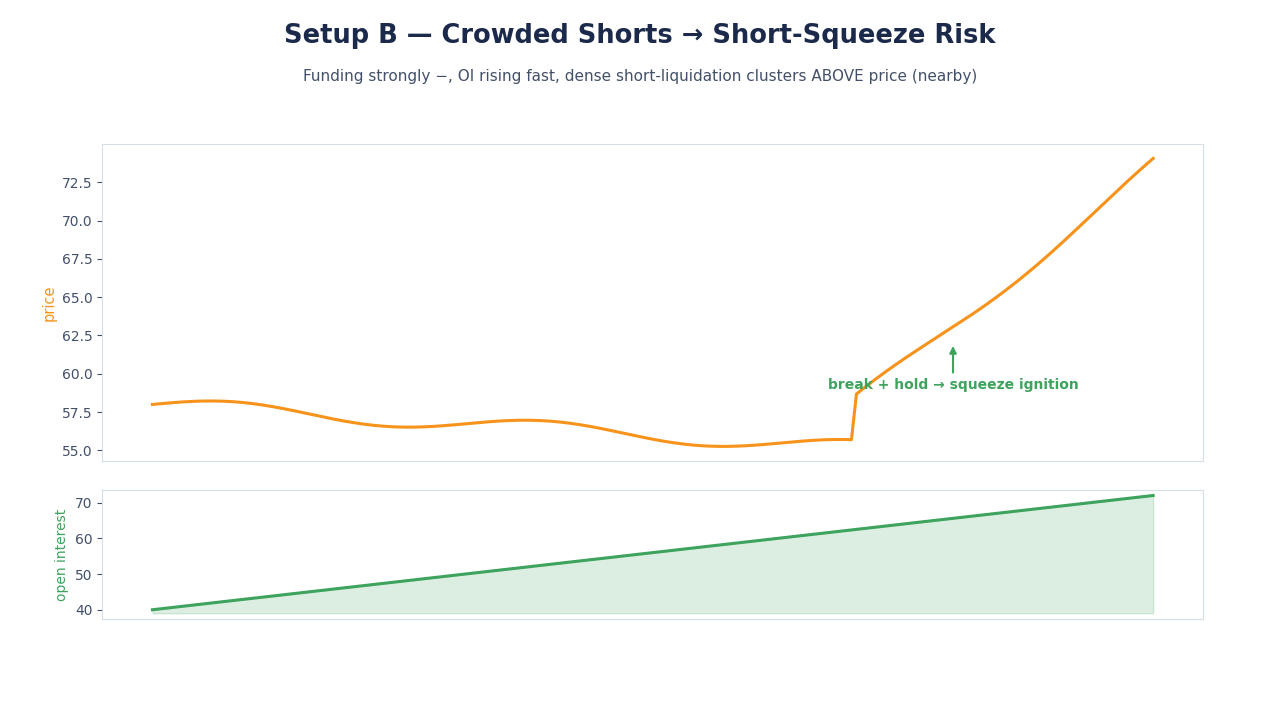
Setup B: Crowded shorts → short squeeze risk
Signature:
- Funding: strongly negative
- OI: rising fast
- Heatmap: dense short liquidation clusters above price (nearby)
Interpretation: shorts are paying carry; leverage mass is increasing; a small pump can trigger forced buybacks.
Trading playbook:
- If trend is down, do not chase breakdowns into nearby short clusters
- Look for “break + hold” above a key level (squeeze ignition)
- Use tight invalidations (squeezes move fast—don’t overstay)
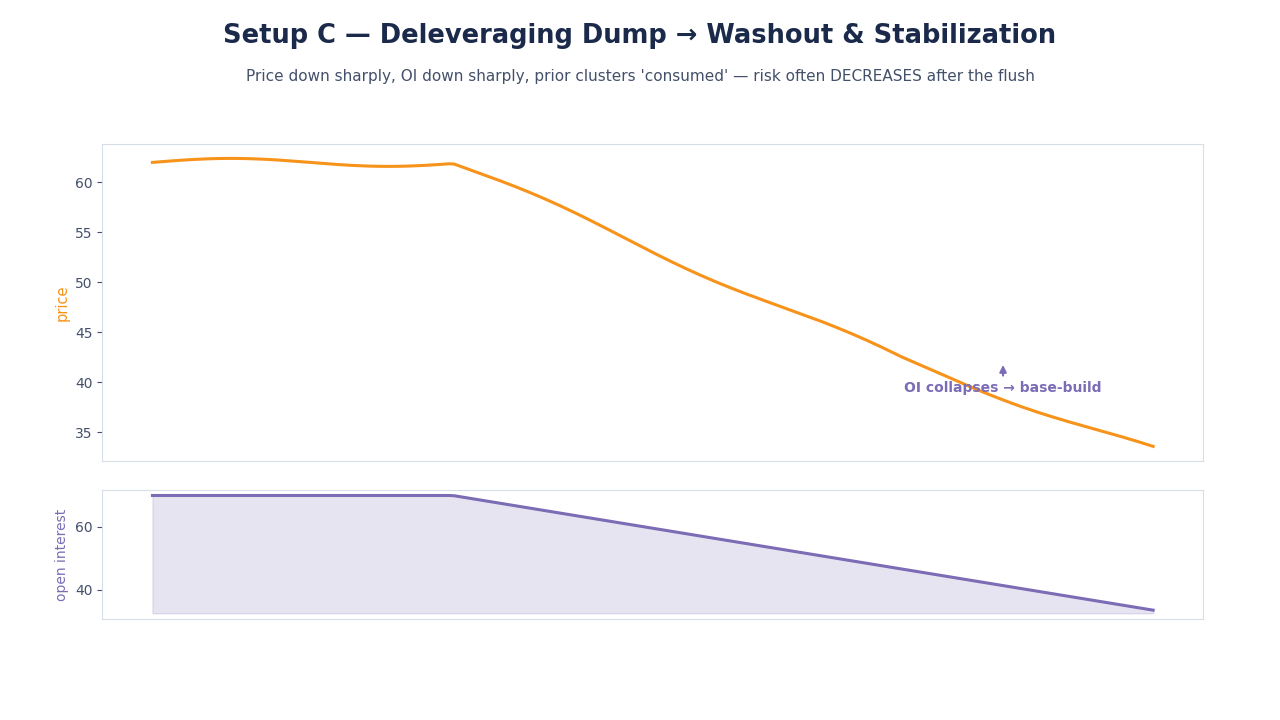
Setup C: Deleveraging dump → potential washout and stabilization
Signature:
- Price: down sharply
- OI: down sharply
- Heatmap: previous clusters get “consumed” (liquidations triggered)
Interpretation: leveraged longs got flushed; risk often decreases after the flush, even if sentiment is awful.
Trading playbook:
- Look for volatility compression after the flush
- Prefer “base-building” entries over knife-catching
- Watch funding normalization (from extreme to neutral)
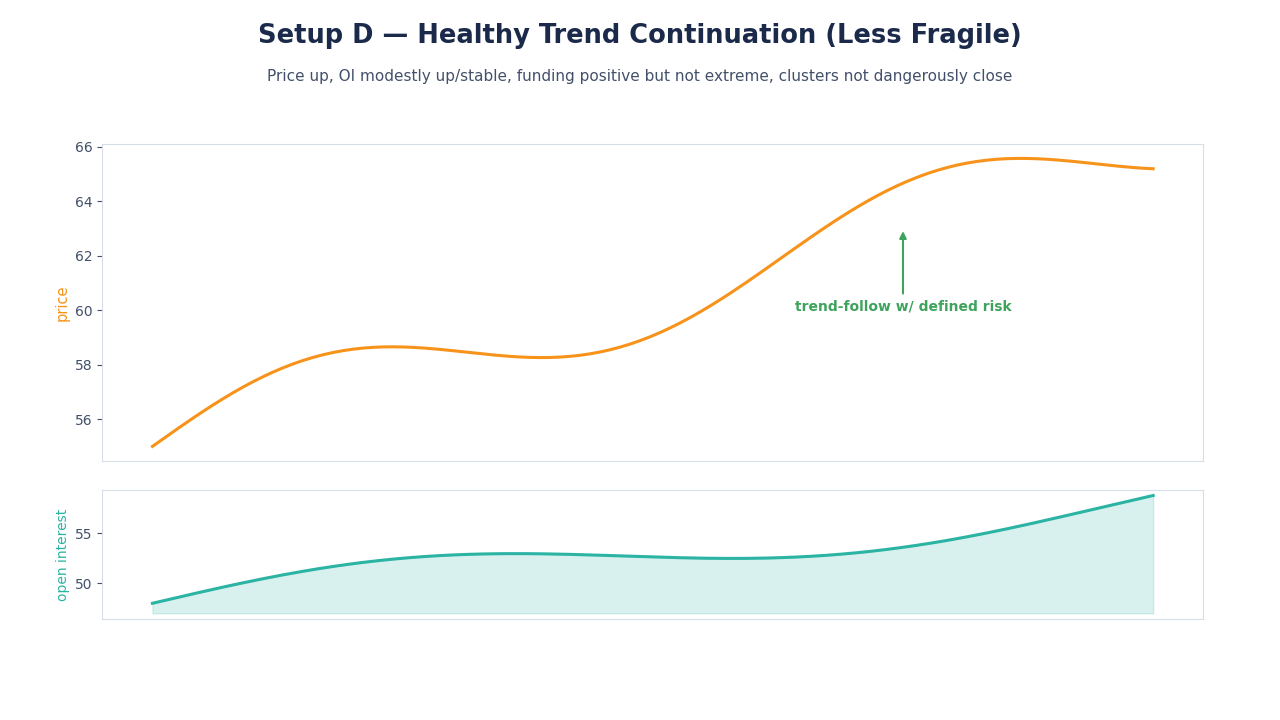
Setup D: Healthy trend continuation (less fragile)
Signature:
- Price: up
- OI: modestly up or stable
- Funding: positive but not extreme
- Heatmap: clusters not dangerously close
Interpretation: demand exists, but leverage is not overly stressed. This is often the environment where trend-following works best.
Trading playbook:
- Trend-follow with defined invalidations
- Scale risk up only if radar stays “stable”
- Reduce risk when funding/heatmap proximity begins to flash “fragile”
A step-by-step workflow: using the radar to plan a trade
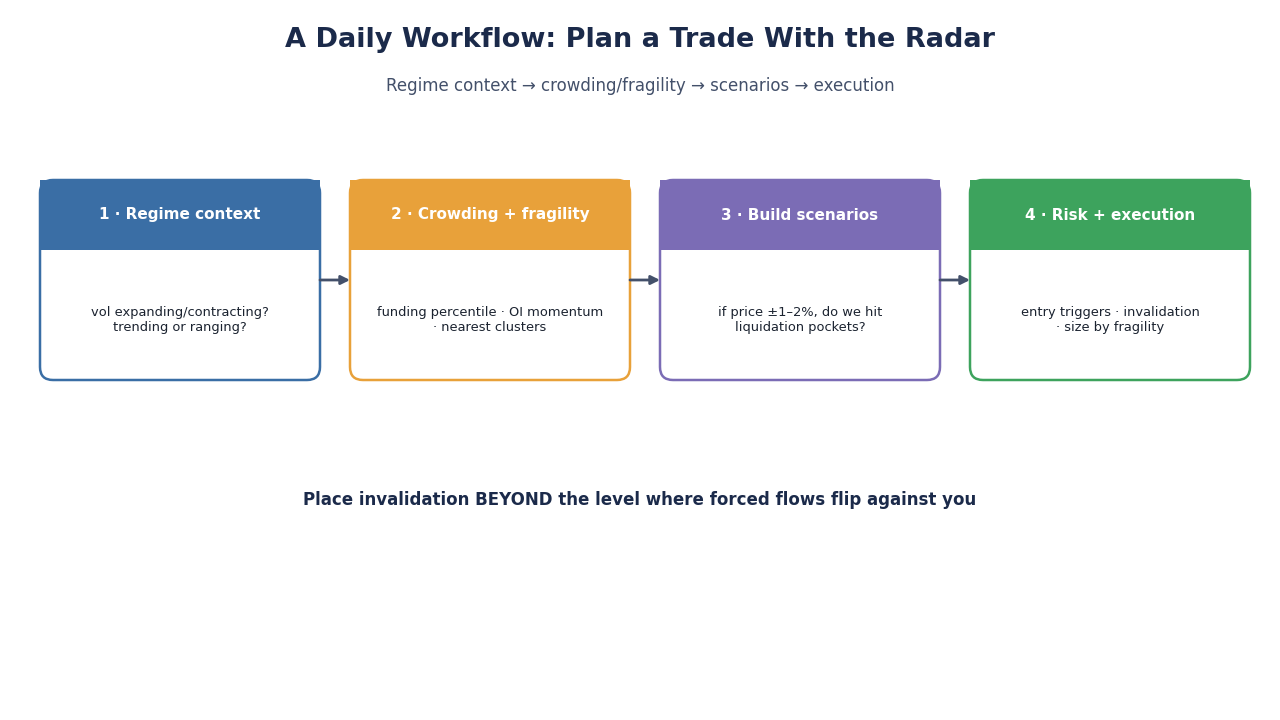
Here’s a repeatable decision process you can run daily.
1) Start with regime context (higher timeframe)
- Is volatility expanding or contracting?
- Is the market trending or ranging?
- Are we near major structure levels?
2) Check crowding + fragility
- Funding percentile: extreme or normal?
- OI momentum: building or flushing?
- Heatmap: where are the nearest clusters (above and below)?
3) Build scenarios (what happens if price moves 1–2%?)
- If price dips 1%: do we hit long liquidation pockets?
- If price pumps 1%: do we ignite short clusters?
4) Define risk and execution
- Entry triggers (break & hold, reclaim, wick + close)
- Invalidation point (where your thesis is wrong)
- Position size based on fragility score
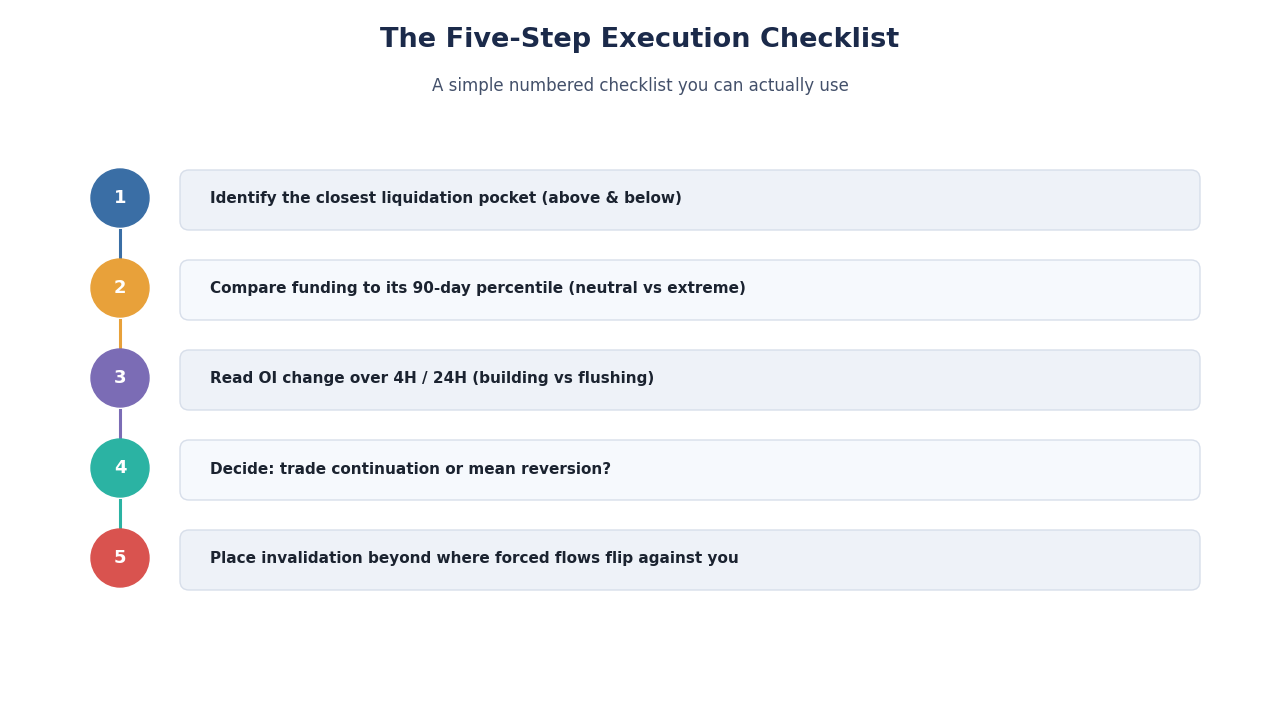
A simple numbered checklist you can actually use:
- Identify the closest liquidation pocket (above and below).
- Compare funding to its 90-day percentile (neutral vs extreme).
- Read OI change over 4H/24H (building vs flushing).
- Decide whether you want to trade continuation or mean reversion.
- Place invalidation beyond the level where forced flows flip against you.
How do you build a Crypto Leverage Radar with AI?
A human can run the framework, but AI makes it scalable across coins and timeframes.
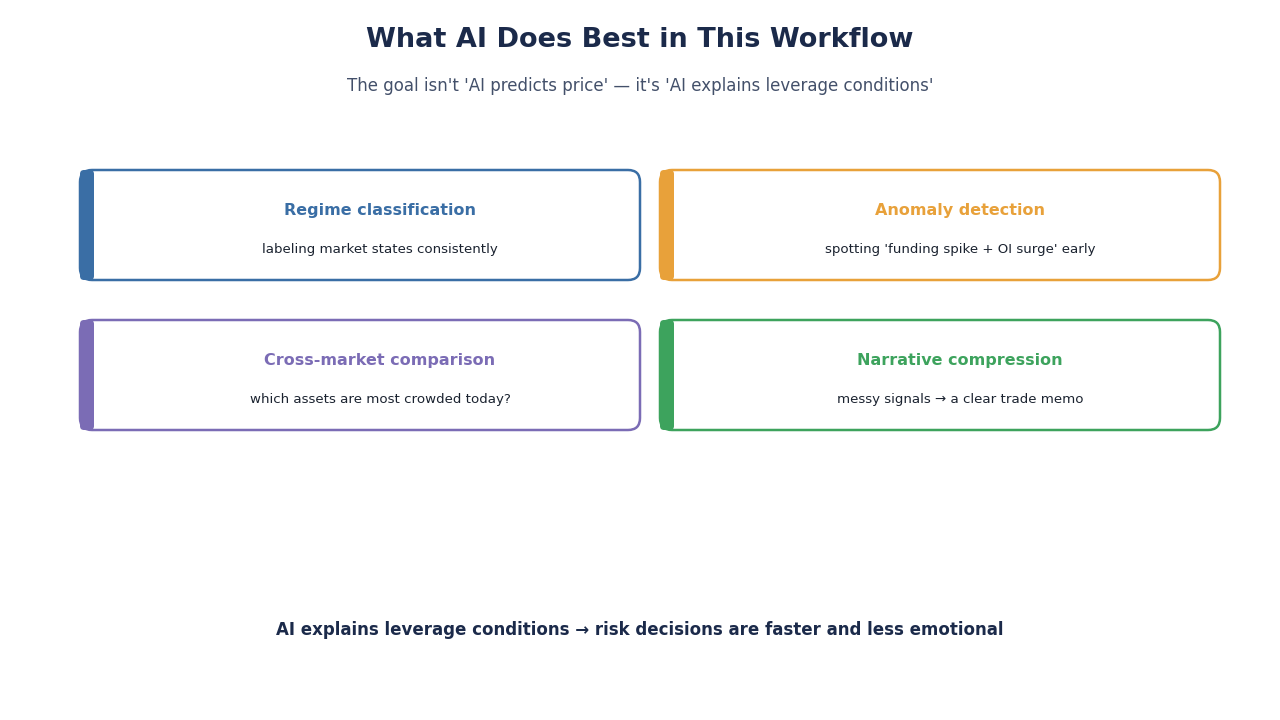
What AI does best in this workflow
- Regime classification: labeling market states consistently
- Anomaly detection: spotting “funding spike + OI surge” moments early
- Cross-market comparison: which assets are most crowded today?
- Narrative compression: turning messy signals into a clear trade memo
The goal isn’t “AI predicts price.” The goal is AI explains leverage conditions so your risk decisions are faster and less emotional.
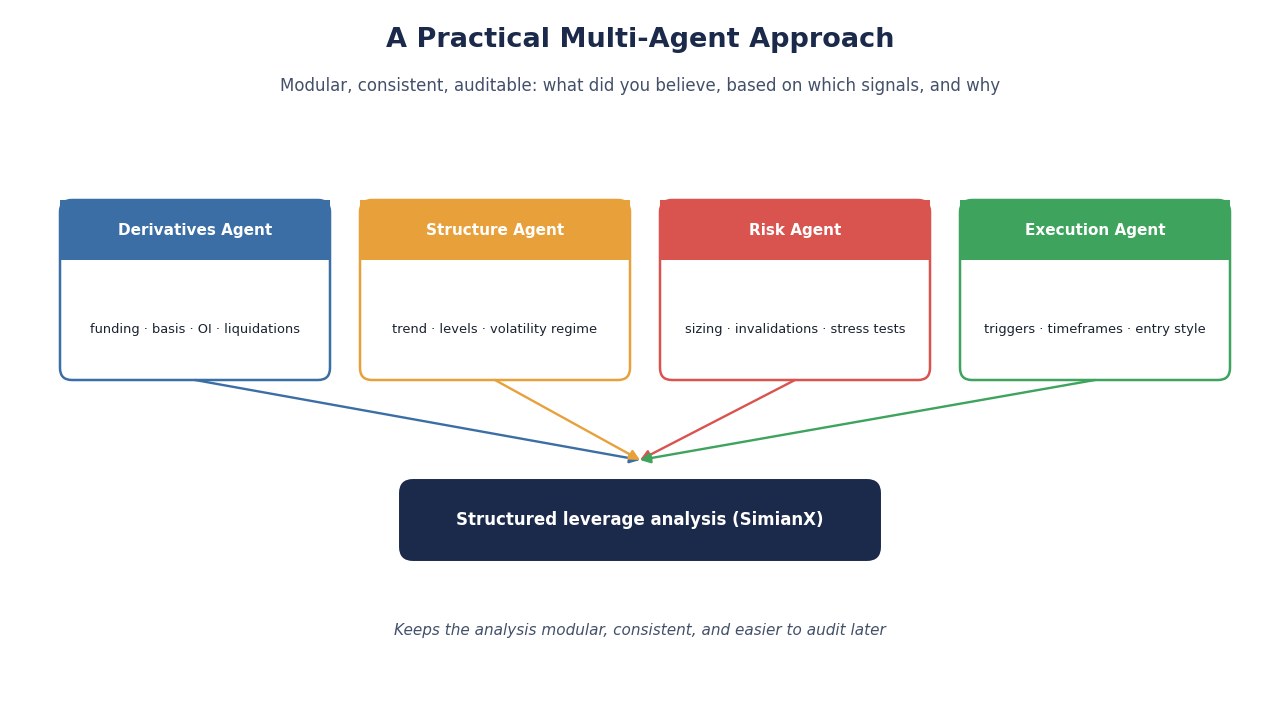
A practical multi-agent approach (simple but powerful)
You can split the work into specialized “agents” (human or AI):
- Derivatives Agent: funding, basis, OI, liquidations
- Structure Agent: trend, levels, volatility regime
- Risk Agent: sizing, invalidations, scenario stress tests
- Execution Agent: triggers, timeframes, entry style (breakout vs mean reversion)
This is exactly how a structured platform like SimianX AI can be useful: it keeps the analysis modular, consistent, and easier to audit later (what did you believe, based on which signals, and why).
Practical implementation notes (so your radar doesn’t lie to you)
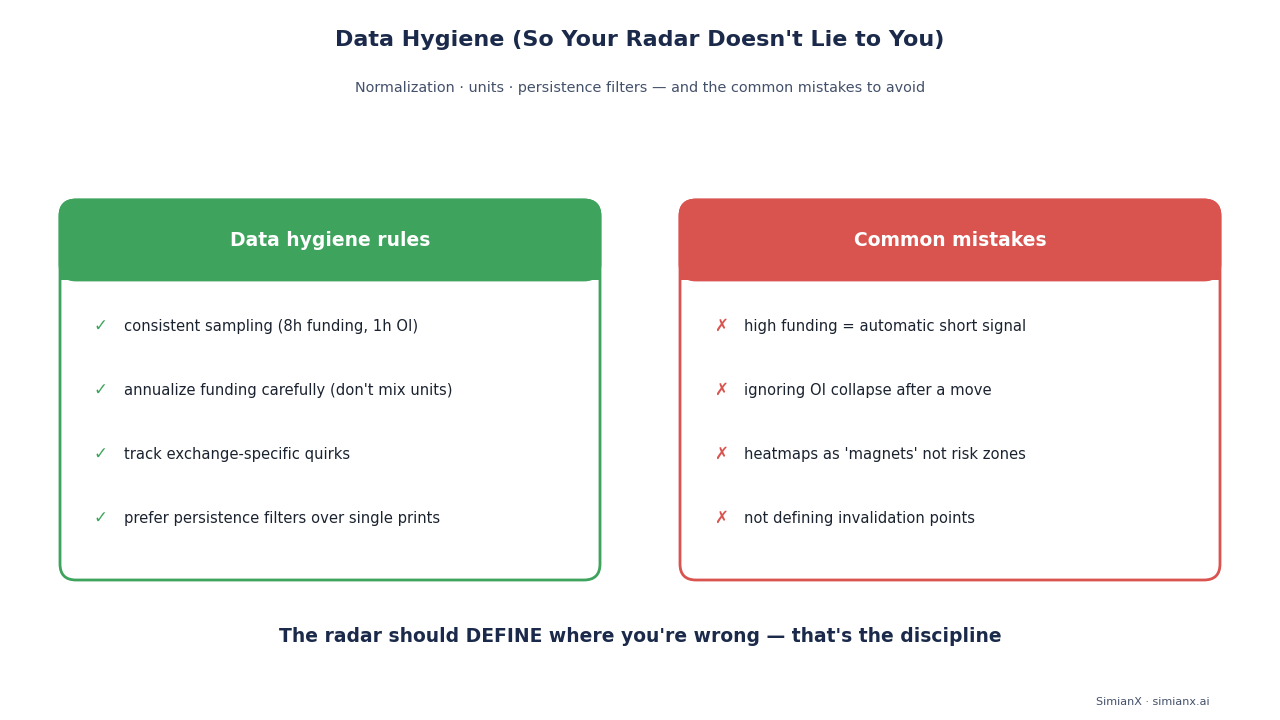
Data hygiene rules
- Use consistent sampling intervals (e.g., 8h funding, 1h OI)
- Annualize funding carefully (don’t mix units)
- Track exchange-specific quirks (some venues have different funding schedules)
- Avoid overreacting to single prints; prefer persistence filters
Common mistakes
- Treating high funding as an automatic short signal
- Ignoring OI collapse after a move (trend fuel changed)
- Using heatmaps as “price magnets” instead of risk zones
- Not defining invalidation points (the radar should define where you’re wrong)
A lightweight pseudo-formula you can use today
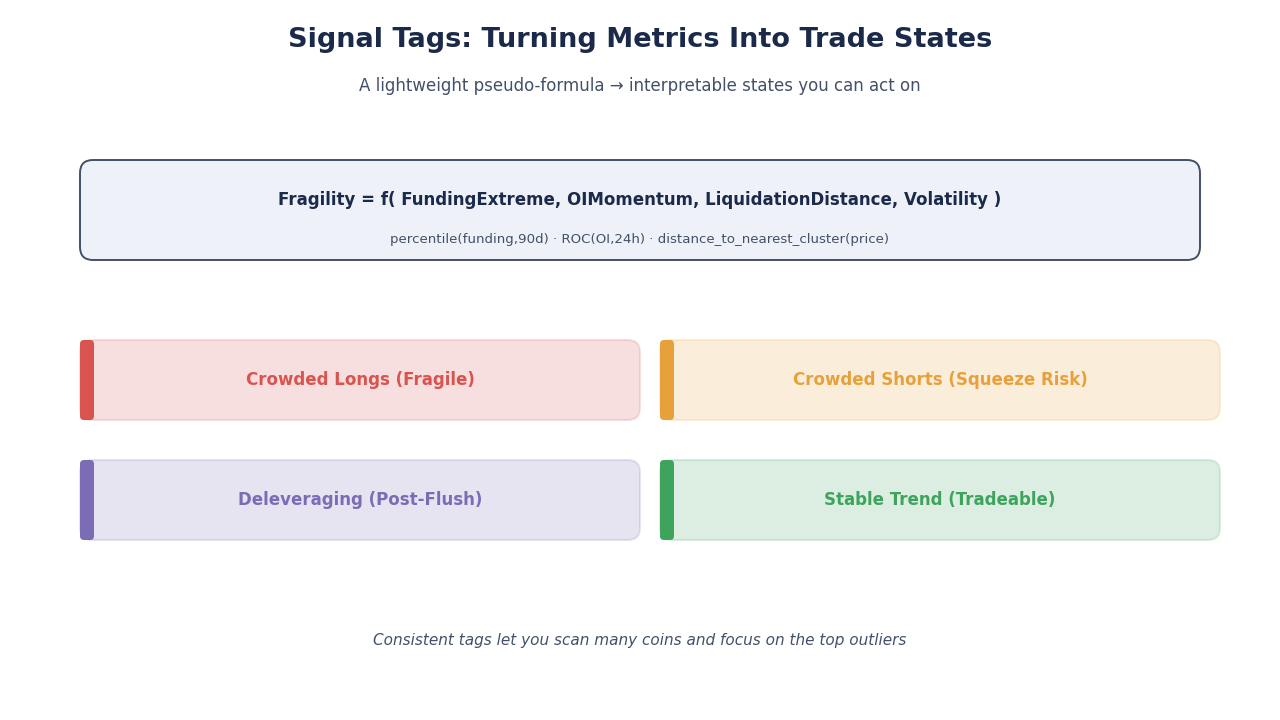
FundingExtreme = percentile(funding, 90d)OIMomentum = ROC(OI, 24h)LiquidationDistance = distance_to_nearest_cluster(price, clusters)Fragility = f(FundingExtreme, OIMomentum, LiquidationDistance, Volatility)
Then tag states like:
Crowded Longs (Fragile)Crowded Shorts (Squeeze Risk)Deleveraging (Post-Flush)Stable Trend (Tradeable)
How SimianX AI fits this Crypto Leverage Radar workflow
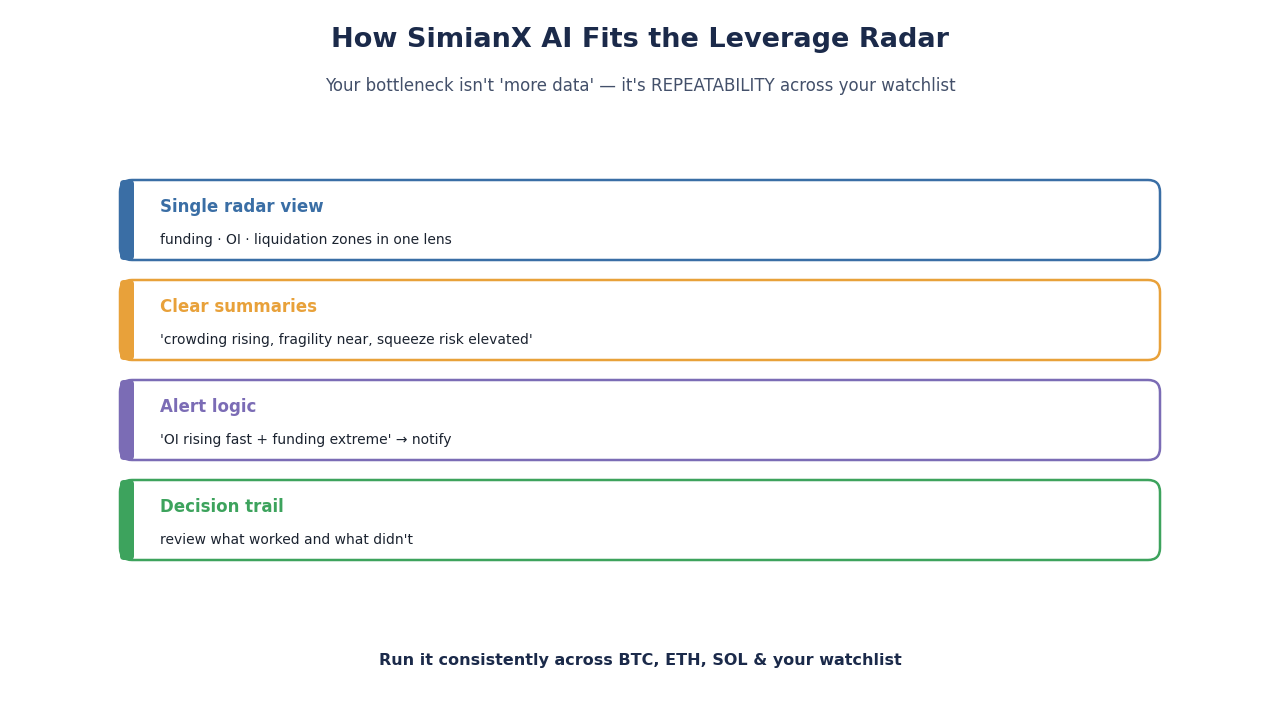
If you want to run this consistently—across BTC, ETH, SOL, and your watchlist—your bottleneck is not “more data.” It’s repeatability.
A structured workflow with SimianX AI can help you:
- Keep a single “radar view” of funding, OI, and liquidation zones
- Generate clear summaries like “crowding rising, fragility near, squeeze risk elevated”
- Set alert logic around regime shifts (e.g., “OI rising fast + funding extreme”)
- Maintain a decision trail so you can review what worked and what didn’t
You can explore the platform here: SimianX AI
Example scenarios (what the radar would say)
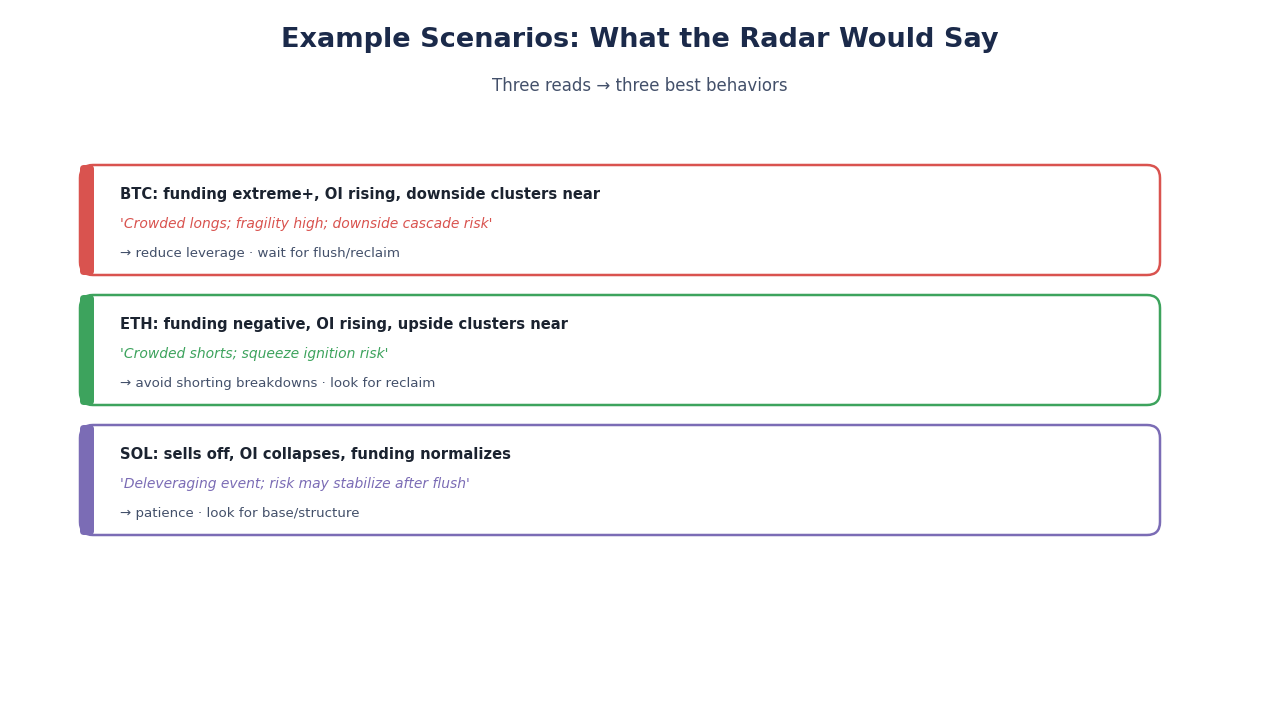
Scenario 1: BTC funding extreme positive, OI rising, downside clusters near
Radar read: “Crowded longs; fragility high; downside cascade risk elevated.”
Best behavior: reduce leverage, avoid chasing, wait for flush/reclaim setups.
Scenario 2: ETH funding negative, OI rising, upside clusters near
Radar read: “Crowded shorts; squeeze ignition risk; upside acceleration possible.”
Best behavior: avoid shorting breakdowns; look for reclaim triggers.
Scenario 3: SOL sells off, OI collapses, funding normalizes
Radar read: “Deleveraging event; risk may stabilize after flush.”
Best behavior: patience; look for base/structure, not immediate reversal calls.
FAQ About Crypto Leverage Radar: AI Signals from Funding Rates, Open Interest & Liquidation Heatmaps
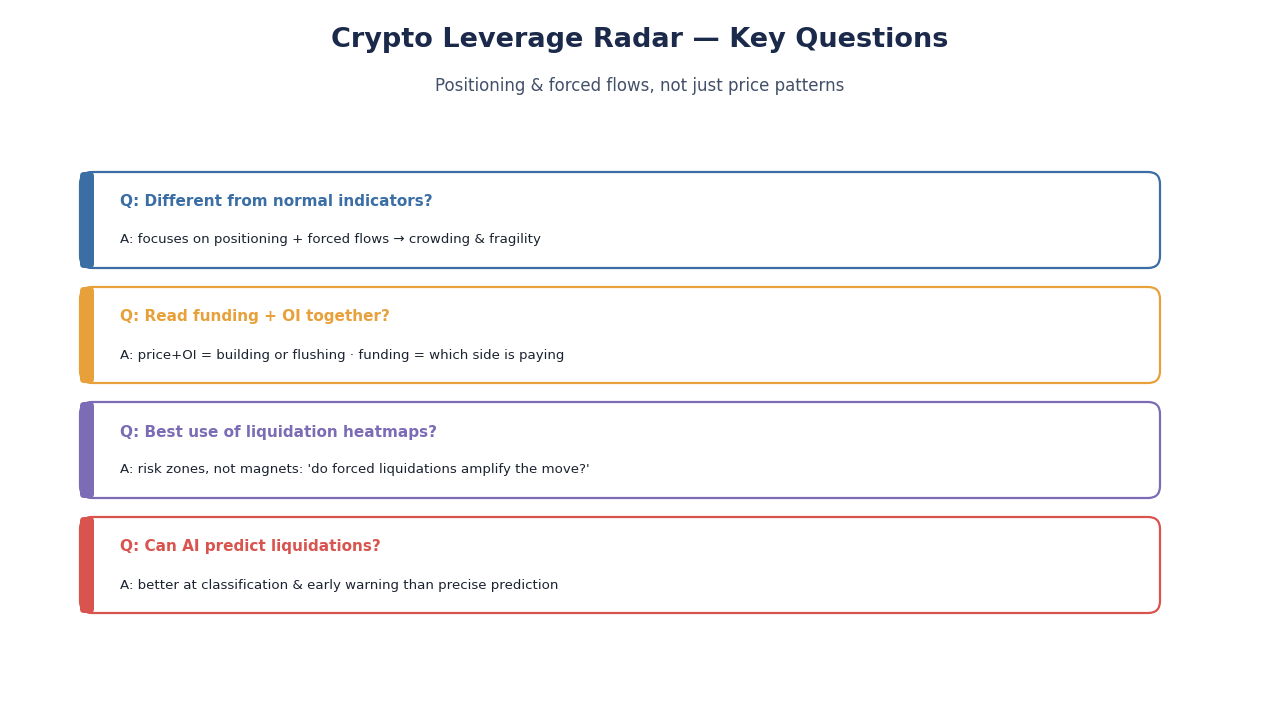
What is a Crypto Leverage Radar and how is it different from normal indicators?
A Crypto Leverage Radar focuses on positioning and forced flows, not just price patterns. It integrates funding, OI, and liquidation zones to estimate crowding and fragility, which often explains why moves accelerate or fail.
How to read funding rates and open interest together?
Start with the quadrant logic: price + OI tells you whether leverage is building or flushing, while funding tells you which side is paying. Extreme funding with rising OI often signals crowding; neutral funding with rising OI can signal stealth buildup.
What is the best way to use liquidation heatmaps in trading?
Treat liquidation heatmaps as risk zones, not guaranteed magnets. The most useful question is: “If price reaches this level, do forced liquidations amplify the move?” Use them to plan invalidations and scenario paths.
Can AI predict liquidations using funding, OI, and heatmaps?
AI is better at classification and early warning than precise prediction. It can flag unusual combinations (e.g., extreme funding + rapid OI build + clusters near price) that historically precede squeezes or cascades.
How do I apply a leverage radar on multiple coins without getting overwhelmed?
Use a standardized scoring system (percentiles/regimes) and focus on the top outliers: the most crowded, most fragile, and highest squeeze-risk assets. Tools like SimianX AI can help centralize this workflow so your decision process stays consistent.
Conclusion
A Crypto Leverage Radar turns derivatives data into a real risk framework: funding rates reveal who’s paying to stay positioned, open interest measures how much leverage mass is in the system, and liquidation heatmaps show where forced flows can ignite. Combined—and interpreted through regimes, contradictions, and scenario paths—these signals help you avoid crowded trades, anticipate squeezes, and time entries with clearer invalidations.
If you want to run this process consistently across your watchlist, explore how SimianX AI can support a structured, repeatable leverage workflow with clear summaries, alerts, and decision tracking: SimianX AI
Related Reading
- Crypto Open Interest Spike: What It Really Signals
- AI Early-Warning for DeFi Liquidity and Depeg Risks 2026
- How to Trade a Crypto Bear Market: 2026 Survival Playbook
- Bitcoin Crash Feb 2026: $60K Bottom or More Pain Ahead?
- BTC 20/60/200-Day Moving Averages: Bull vs Bear Map
- US CPI vs Crypto: 5%-Day Swings & Rate-Bet Playbook