
From 1929 to 2022: How Long the Climb Back Really Took
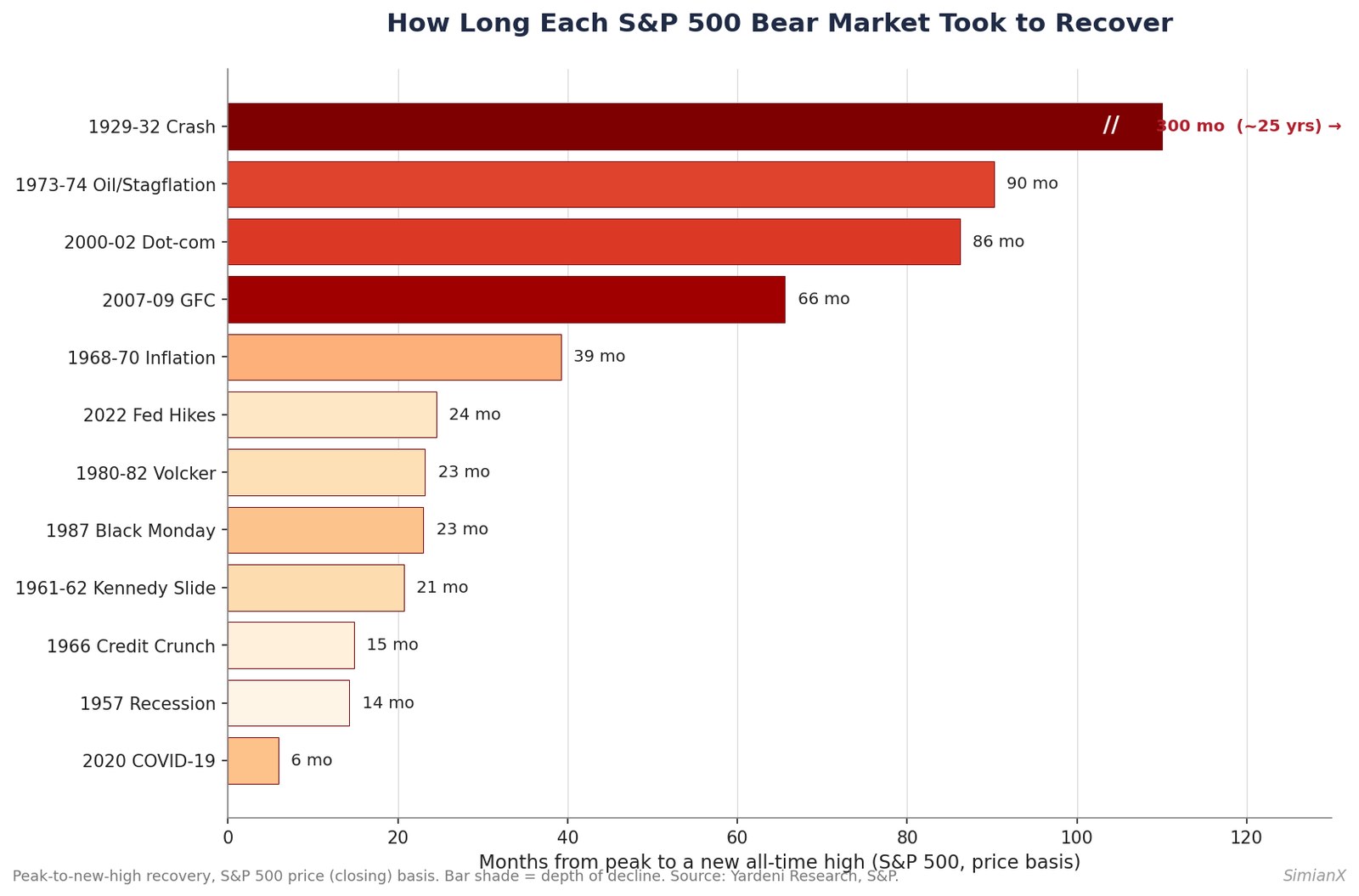
Every S&P 500 bear market in history has eventually been erased by a new all-time high. The only thing that changed was how long investors had to wait — anywhere from about six months after the 2020 COVID crash to roughly 25 years after the 1929 collapse. This is the complete reference table of how long every S&P 500 bear market took to recover, the data behind the averages, and the pattern that explains the gap between a quick rebound and a lost decade.
We use the standard convention throughout: a bear market is a peak-to-trough decline of 20% or more on a closing basis, measured on the S&P 500 (and its predecessor S&P Composite before 1957). "Recovery" means the index closing back at a new all-time high — the moment a buy-and-hold investor who bought at the previous top is finally back to even. All figures are price-only (no dividends reinvested); on a total-return basis, every recovery below is meaningfully faster.
How Long Do Bear Markets Take to Recover? The Short Answer
Strip out the Great Depression, which is a genuine outlier, and the eleven bear markets since 1945 took on average about three years (roughly 37 months) to recover to a new high, with a median closer to two years (about 23 months). The fastest modern recovery was the 2020 pandemic crash at under six months; the slowest were the deep, structural bears of 1973–74 and 2000–02, each of which took more than seven years to fully reclaim its old peak.
The decline itself is usually much shorter than the recovery. Bear markets have historically taken roughly 9 to 11 months on average to fall from peak to trough, then far longer to climb back. The pain comes fast; the healing is slow. That asymmetry — quick drop, grinding recovery — is the single most important thing to internalize, and it has a precise mathematical cause we will get to below.
The Complete Reference Table: Every S&P 500 Bear Market Since 1929
The table below lists each peak-to-trough bear market of 20% or more, the depth of the decline, how long the decline lasted, and how long it took the index to close at a new all-time high measured from the prior peak. Sources are Yardeni Research bull-and-bear tables and Standard & Poor's index history, cross-checked against Hartford Funds / Ned Davis Research.
| Bear market | Decline (peak → trough) | Length of decline | Time to recover (peak → new high) | Main trigger |
|---|---|---|---|---|
| 1929–1932 | −83% to −86% | ~33 months | ~25 years (Sept 1954) | Great Crash / Depression |
| 1957 | −20.7% | ~3 months | ~14 months | 1957–58 recession |
| 1961–1962 | −28.0% | ~6 months | ~21 months | "Kennedy Slide" |
| 1966 | −22.2% | ~8 months | ~15 months | Credit crunch, Fed tightening |
| 1968–1970 | −36.1% | ~18 months | ~39 months | Inflation, Vietnam, tight money |
| 1973–1974 | −48.2% | ~21 months | ~90 months (7.5 yrs) | Oil embargo, stagflation |
| 1980–1982 | −27.1% | ~20 months | ~23 months | Volcker rate shock |
| 1987 | −33.5% | ~3 months | ~23 months | Black Monday |
| 2000–2002 | −49.1% | ~31 months | ~86 months (7.2 yrs) | Dot-com bust, 9/11 |
| 2007–2009 | −56.8% | ~17 months | ~66 months (5.5 yrs) | Global Financial Crisis |
| 2020 | −33.9% | ~1 month | ~6 months | COVID-19 pandemic |
| 2022 | −25.4% | ~9 months | ~25 months | Inflation, Fed hiking cycle |
A note on counting: under the strict single-peak-to-trough, closing-basis convention used by Yardeni and S&P, there have been 22 distinct bear markets since 1929. Some widely cited sources (Ned Davis Research, by way of Hartford Funds) count 27, because they split the 1929–1932 collapse into five separate 20%-plus legs and break 2000–02 and 2007–09 into two legs each. Both methods are internally consistent — the important thing when you cite any "number of bear markets" statistic is to know which convention is being used. The table above groups each episode as one continuous decline, which is the cleaner reference frame.
The 1929 Outlier: Why It Took 25 Years
The 1929 crash deserves its own paragraph because it distorts every average and is the most misquoted figure in market history. From its September 1929 peak, the S&P Composite fell roughly 83% to 86% into its June 1932 trough — by far the deepest decline on record. But the headline number people repeat — "it took 25 years to recover" — needs care.
On a price basis, the S&P Composite did not close at a new high above its 1929 peak until September 1954 — about a quarter century. The reason it took so long is that the 1930s and 1940s were not one bear and one recovery; they were a stack of them. The index had to climb back through the brutal 1937–38 bear (a further −54%), the WWII-era declines of 1939–1942, and the 1946–1949 bear before it finally cleared the old high in 1954. Note also that the often-quoted "25 years to November 1954" milestone usually refers to the Dow Jones Industrial Average, not the S&P — the two indices recovered within months of each other but are not the same series.
One more caveat worth stating plainly because it changes the conclusion: on a total-return basis — dividends reinvested, which is how a real investor experiences the market — the 1929 break-even arrived far sooner, in the mid-1930s to mid-1940s depending on the deflation assumptions, not 1954. Dividend yields were high in that era, and reinvested income did enormous work. Every recovery figure in this article is price-only for consistency, but the gap between price and total return is widest exactly here.
Why Deeper Bear Markets Take So Long: The Recovery Math
There is a hard mathematical reason a −50% bear takes years while a −20% correction is forgotten in months, and it has nothing to do with sentiment. A percentage loss and the percentage gain needed to undo it are not symmetric. Lose 20% and you need +25% to get back to even. Lose 33% and you need +50%. Lose 50% and you need a full +100% — the market has to literally double. Lose 57% as it did in 2008, and you need +133%. And the 1929 crash's −83% to −86% required a gain of roughly +490% to +610% just to break even.
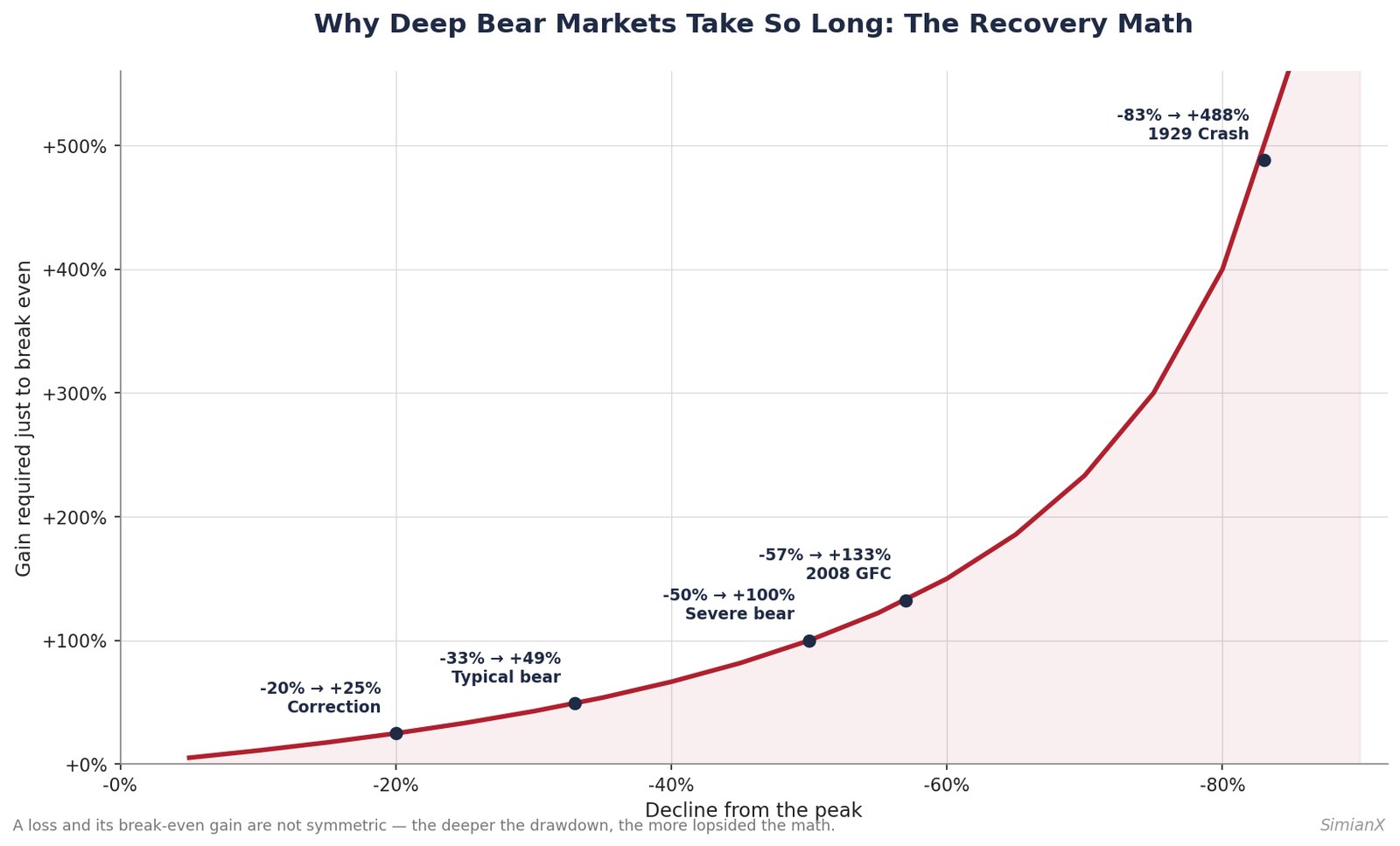
This convex relationship is why the recovery column in the table grows so much faster than the decline column. A market that compounds at, say, 8% a year needs about three years to deliver a +25% gain but closer to nine years to deliver a +100% gain. The depth of the hole sets a floor on the recovery time that no amount of optimism can shorten. It is also the strongest argument for why avoiding the deepest part of a drawdown matters more than catching the exact bottom — the math punishes deep losses disproportionately.
What the Data Actually Shows: Five Patterns
1. Recoveries are getting faster. The three most recent bears — 2020, 2022, and the recovery underway after each — were resolved in 6 and 25 months respectively. Deeper liquidity, faster policy response, and a more concentrated, higher-margin index have compressed recovery times relative to the 1970s, when a single bear could swallow most of a decade.
2. Depth predicts duration — loosely. The four longest recoveries (1929, 1973–74, 2000–02, 2007–09) were also among the deepest declines. But depth is not destiny: the 1987 crash was a −33.5% plunge yet recovered in about 23 months, while the shallower 1968–70 bear took 39 months. What lengthens a recovery is not just how far the market fell but whether the underlying economy was also broken — a balance-sheet recession (2008) or a structural inflation regime (1970s) drags out the climb.
3. Fast crashes recover fast; slow grinds recover slow. The 2020 and 1987 declines were violent and brief — and both healed relatively quickly. The 2000–02 and 1973–74 bears bled lower for two to three years, and their recoveries dragged for seven-plus. A drawn-out decline tends to signal a deeper economic problem, and the recovery inherits that weight.
4. The decline is short; the wait is long. Across history the average bear takes under a year to bottom but multiple years to recover. Investors consistently underestimate the waiting, not the falling.
5. Every single one recovered. Twenty-two bear markets, twenty-two new all-time highs. The S&P 500 has a 100% historical track record of eventually making investors who held (or kept buying) whole again. That is the entire bull case for long-horizon investing compressed into one sentence — though "eventually" has, on one occasion, meant 25 years.
What About the 1990 "Bear"?
You will see some lists include a 1990 bear market tied to the Gulf War oil spike. On a closing basis the S&P 500 fell 19.9% from its July 1990 peak to its October 1990 low — just shy of the 20% threshold — so the strict convention classifies it as a deep correction, not a bear. Intraday it briefly crossed 20%. We exclude it from the numbered table for consistency, but it is worth knowing about: the recovery from that low to a new high took only about four months, one of the quickest on record, because the underlying economy was far healthier than the headlines suggested. It is a useful reminder that the definition you use changes the count.
How AI Models Read Bear-Market Recoveries
The reason this reference table matters for a trader today is that recoveries are not random — they carry repeatable structure, and structure is exactly what modern AI models are built to detect. At SimianX, large language models from OpenAI, Anthropic, Google, and xAI analyze live market conditions and place simulated trades, so you can watch how different models reason about drawdowns and recoveries in real time on the AI model leaderboard.
A few of the historically reliable recovery signals an AI model can weigh:
- Breadth thrusts — the share of stocks advancing surging off a bottom, which has preceded every durable recovery in the table.
- The decline's character — a fast, liquidity-driven crash (2020) versus a slow, fundamentals-driven grind (2000–02), which the recovery math above shows lead to very different timelines.
- Policy inflection — the pivot from monetary tightening to easing, which front-ran the 1982, 2009, and 2020 recoveries.
- Leadership rotation — which names lead the new bull. After 2009 it was megacaps like Apple and Amazon; after 2020 it was Nvidia and Microsoft that carried the index back to highs.
You can put that to work without watching screens all day. SimianX stock autopilots let an AI model monitor your watchlist and surface signals continuously, and the same engine powers the crypto leaderboard for digital assets, which have their own — far shorter and far more violent — bear-and-recovery cycles. See pricing for how the autopilots are gated.
Lessons for Investors From a Century of Recoveries
- Time in the market beats timing the bottom. Because the recovery math punishes deep losses, the investors who did best were rarely the ones who called the exact low — they were the ones who kept buying through it and let the inevitable new high arrive.
- Your time horizon decides whether a bear is survivable. A 25-year recovery is catastrophic if you retire in year three and fine if you are 30. Match your equity exposure to the horizon you actually have.
- Deep is the enemy of fast. A shallow bear is a speed bump; a −50% bear is a multi-year detour. Risk management is mostly about not participating in the deepest part of the decline.
- The decline will feel longer than the data says, and the recovery will feel longer still. Plan for the wait, not just the drop.
FAQ: S&P 500 Bear Markets and Recovery Times
How long does it take the stock market to recover from a bear market?
Historically, the S&P 500 has taken on average about three years to recover to a new all-time high from a bear-market low, with a median closer to two years if you exclude the 1929 crash. The range is wide: as little as six months (2020) to about 25 years (1929, price basis).
What was the longest bear market recovery in history?
The 1929 crash, on a price basis, which did not set a new all-time high until September 1954 — roughly 25 years, because the index had to climb back through several additional bear markets in the 1930s and 1940s along the way. On a dividends-reinvested (total-return) basis the recovery was much faster.
What was the fastest bear market recovery?
The 2020 COVID-19 crash. The S&P 500 fell about 34% in roughly a month, then made a new all-time high in about six months — the quickest full recovery in the dataset.
How many bear markets has the S&P 500 had?
Twenty-two distinct peak-to-trough bear markets since 1929 under the standard closing-basis convention, or 27 if you use Ned Davis Research's method of splitting the deepest crashes into separate legs.
Do all bear markets eventually recover?
Every S&P 500 bear market in recorded history has eventually been followed by a new all-time high — a 100% recovery rate so far. The variable has always been how long, not whether.
Why does a 50% loss need a 100% gain to recover?
Because losses and gains are not symmetric. If $100 falls 50% to $50, it must double (+100%) to get back to $100. The deeper the loss, the more lopsided this math becomes, which is the core reason deep bear markets take so much longer to recover.
Conclusion
A century of data delivers a blunt, two-part message. First, the S&P 500 has never failed to recover from a bear market — twenty-two declines, twenty-two new highs. Second, the wait is governed by depth and by the health of the underlying economy, and it has ranged from half a year to a quarter century. The recovery math is the through-line: the deeper the hole, the more disproportionate the climb out. For a long-horizon investor that argues for staying invested and managing the depth of drawdowns rather than trying to time the precise bottom. To see how today's leading AI models read the current market against this exact historical backdrop, explore the SimianX AI model leaderboard and the stock autopilots.
Related Reading
- Buy the Invasion Pattern: Iraq 2003 S&P 500 +15% Rally
- Every S&P 500 Bear Market Since 1929: Duration and Recovery
- How the S&P 500 Performs During Oil Shocks: 1973–2026
- Gold in Every US Recession Since 1973: Safe-Haven Scorecard
- Every Fed Rate-Cut Cycle Since 1980: Stocks, Bonds & Gold
- SimianX AI Model Leaderboard
- Stock Autopilots
- Crypto Leaderboard
- All Stories