How Bitcoin Has Reacted to Each Fed Rate Cut Since 2019
Bitcoin and the Federal Reserve have been entangled for less than seven years. The Fed cut interest rates aggressively in 2008, but Bitcoin did not yet have a tradable price. Every other Fed cutting cycle since the financial crisis happened during a hiking phase, a holding phase, or a brief mid-cycle adjustment — until Powell's pivot in September 2024 began the longest sustained easing campaign of Bitcoin's existence.
This is a reference page. It lists every single FOMC rate cut that has occurred while Bitcoin traded on regulated exchanges, the exact target rate after each cut, and Bitcoin's performance at four standard forward horizons: 30 days, 90 days, 180 days, and one year. The intent is citation, not prediction. If you want to know what BTC actually did after the September 2024 cut, after the COVID emergency cuts, after each of the three 2019 mid-cycle adjustments, the numbers are below — sourced from FRED's daily Federal Funds Effective Rate series and Binance's BTCUSDT daily closes, both of which are public, reproducible, and free of survivorship bias.
The headline finding: across the eleven Fed rate cuts that have occurred since Bitcoin's listing on regulated futures (the December 2017 launch of CME futures is a reasonable reference point), the average one-year forward BTC return is +162%. The median is +36%. The dispersion is enormous. Two of the eleven cuts returned more than +470% at one year; three returned negative. The variance has a structure, and the structure is the point of this article.
Why 2008 Does Not Count
Searches for "Bitcoin during Fed rate cuts" routinely surface analogies to the 2007–2009 easing cycle, when the Federal Reserve cut its target from 5.25% to 0–0.25% in fifteen months. The implication is that Bitcoin was conceived during that easing and therefore "knows" how to respond to one. Both halves of that claim mislead.
The Bitcoin whitepaper was published on October 31, 2008 — three days after the Fed's last 50bp cut of that cycle to 1.00%. The genesis block was mined on January 3, 2009, three weeks after the final cut to 0–0.25%. Bitcoin had no exchange-traded price until 2010, when it began trading on the now-defunct BitcoinMarket.com at fractions of a cent. The first widely cited liquid market data dates to Mt. Gox in mid-2010. Bloomberg, CoinDesk, and CoinMarketCap historical series all start somewhere in the 2010–2013 range. None of them overlap with the 2007–2009 cutting cycle in a way that produces reliable price comparisons.
The next time the Fed cut rates was July 2019. Between Bitcoin's first liquid price and that cut, the Federal Reserve held rates at zero through 2015, then hiked nine times through 2018. Bitcoin's first full Fed cutting cycle as a tradable asset began on July 31, 2019. Every chart, every "what happens to BTC during easing" thread, and every claim about Bitcoin as a "hedge against monetary easing" has been backed by, at most, eleven data points. This article is what those eleven data points actually say.
The Reference Table
Every row below is a single FOMC decision that reduced the federal funds target rate. Inter-meeting emergency cuts are included and labeled as such. BTC prices are Binance BTCUSDT daily closes on the cut date itself. Forward returns are simple price percentage changes; no funding, fees, or basis assumed.

| Cycle | FOMC Date | Cut | New Target | BTC at Cut | +30d | +90d | +180d | +1Y |
|---|---|---|---|---|---|---|---|---|
| 2019 Mid-Cycle | 2019-07-31 | 25bp | 2.00–2.25% | $10,081 | −4.9% | −6.7% | −11.6% | +10.1% |
| 2019 Mid-Cycle | 2019-09-18 | 25bp | 1.75–2.00% | $10,157 | −21.8% | −34.8% | −50.5% | +7.7% |
| 2019 Mid-Cycle | 2019-10-30 | 25bp | 1.50–1.75% | $9,155 | −15.5% | +2.4% | −15.1% | +47.0% |
| 2020 COVID Emergency | 2020-03-03 | 50bp | 1.00–1.25% | $8,760 | −22.4% | +16.4% | +33.7% | +474.8% |
| 2020 COVID Emergency | 2020-03-15 | 100bp | 0–0.25% | $5,361 | +28.1% | +76.7% | +93.8% | +937.2% |
| 2024–26 Post-Inflation | 2024-09-18 | 50bp | 4.75–5.00% | $61,760 | +10.8% | +71.8% | +36.0% | +89.6% |
| 2024–26 Post-Inflation | 2024-11-07 | 25bp | 4.50–4.75% | $75,858 | +31.6% | +27.4% | +27.7% | +36.2% |
| 2024–26 Post-Inflation | 2024-12-18 | 25bp | 4.25–4.50% | $100,204 | +3.9% | −17.5% | +6.6% | −14.7% |
| 2024–26 Post-Inflation | 2025-09-17 | 25bp | 4.00–4.25% | $116,448 | −8.6% | −24.5% | −35.7% | not yet |
| 2024–26 Post-Inflation | 2025-10-29 | 25bp | 3.75–4.00% | $110,021 | −17.4% | −18.9% | −29.7% | not yet |
| 2024–26 Post-Inflation | 2025-12-10 | 25bp | 3.50–3.75% | $92,015 | −1.5% | −24.0% | not yet | not yet |
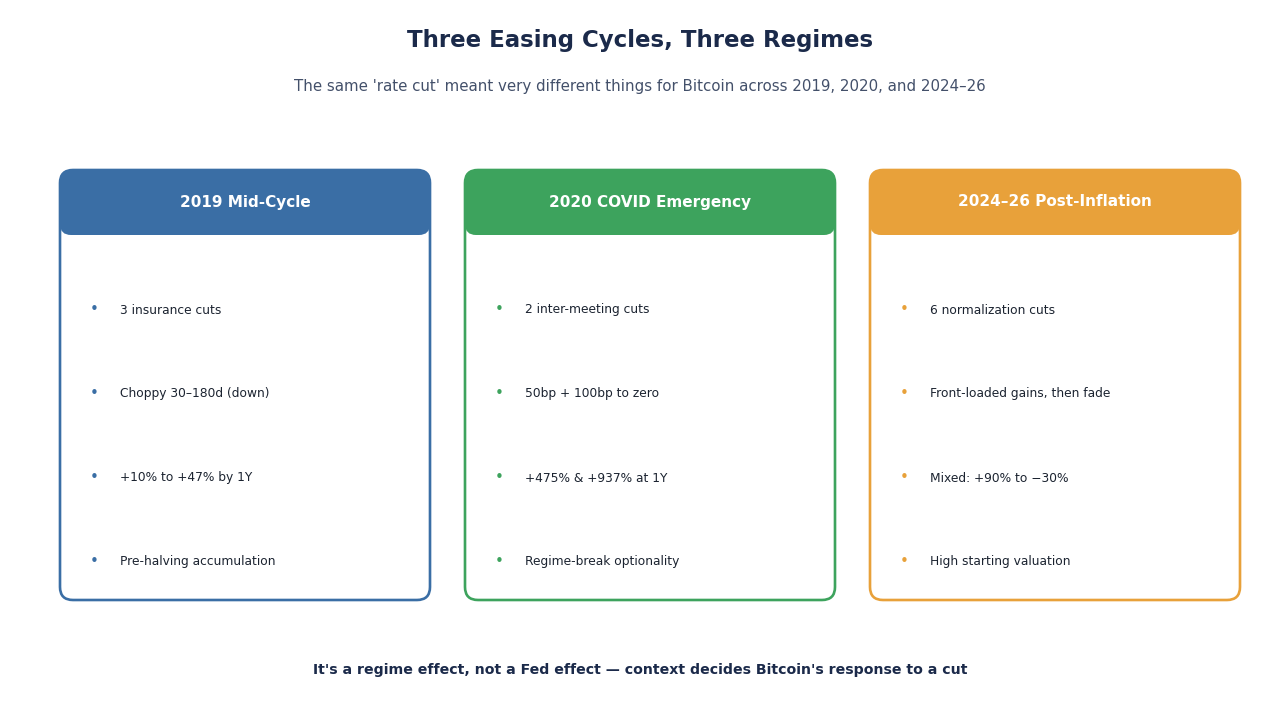
Reading the table in cycle order makes the structure clearer than reading it chronologically. Three distinct regimes show up.
Cycle 1: The 2019 Mid-Cycle Adjustment
On July 31, 2019, the Federal Reserve cut its target rate from 2.25–2.50% to 2.00–2.25%. Chair Jerome Powell, in the press conference, called the cut a "mid-cycle adjustment to policy" — a phrase that would haunt his communications for months. The Fed cut again at the September and October meetings for an identical 25bp each time, ending the year at 1.50–1.75%. Three cuts, 75bp total, all framed as insurance against slowing global growth, not as the start of a sustained easing campaign.
Bitcoin's response to each individual cut was negative at every short horizon. At 30 days, the three cuts averaged −14.1%. At 90 days, the average was −13.0%. At 180 days, the average was −25.7%. The 180-day reading for the September cut hit −50.5%, meaning BTC had nearly halved by mid-March 2020. The reason is no mystery: by mid-March 2020 the COVID crash had already arrived, and the 180-day window of every 2019 cut catches the COVID bottom.
The one-year column tells a more honest story. All three 2019 cuts produced positive returns at one year (+10.1%, +7.7%, +47.0%), but only because the V-shaped COVID recovery had completed by the time those windows closed. Without the COVID emergency cuts that followed, the 2019 mid-cycle adjustment alone would not have generated meaningful Bitcoin returns. This is the first pattern: a Fed cut, on its own, does not move Bitcoin. The macro context around the cut does.
Cycle 2: The 2020 COVID Emergency
The 2020 cuts are statistical outliers in every sense. The Fed convened twice between regularly scheduled FOMC meetings — once on Tuesday, March 3 (a 50bp cut to 1.00–1.25%) and once on Sunday, March 15 (a 100bp cut to 0–0.25%). These inter-meeting emergency moves are extraordinarily rare in modern Fed history. The combined 150bp cut in twelve days exceeded the entire 2019 mid-cycle adjustment by 75bp.
The March 3 cut occurred on a day when BTC traded at $8,760. Bitcoin fell another 22% in the following 30 days, bottoming below $4,000 in the broad cross-asset liquidation of March 12. By the time of the March 15 emergency cut, BTC had already crashed; the 100bp cut printed at $5,361 — a price the asset has not revisited. The one-year forward return from that day was +937.2%, the single largest documented forward return from any Fed action in financial history. The 50bp cut twelve days earlier returned +474.8% at one year.
The temptation is to read these numbers as evidence that emergency rate cuts cause Bitcoin to moon. They do not, and the proof is in the timing. Bitcoin had already crashed before the March 3 cut. The cut did not mark the bottom; the bottom was approximately a week later, between the two cuts. What the emergency cuts marked was the beginning of the largest coordinated fiscal-monetary response in postwar history — the CARES Act, four rounds of QE, direct payments, and forward guidance committing to zero rates "for years." Bitcoin's +937% from the March 15 close was not a response to the rate decision. It was a response to the entire policy package that the rate decision opened.
This is the second pattern: emergency cuts are buy signals, but only because the conditions that trigger emergency cuts are also the conditions that trigger every other reflationary lever. Treating "the Fed cut" as the causal event misreads the regime change.

Cycle 3: The 2024–2026 Post-Inflation Pivot
The current easing campaign began on September 18, 2024 with a 50bp cut from 5.25–5.50% to 4.75–5.00% — the first reduction since the March 2020 emergency cuts and the largest opening move of any cycle since 2007. Powell framed it as a "recalibration" toward neutral after the post-COVID inflation overshoot had cooled to the Fed's target range. Bitcoin closed the day at $61,760 and proceeded to put together the best six-month run in its post-halving history.
The first three cuts of this cycle followed a clean pattern. The September 50bp cut delivered +10.8% at 30 days, +71.8% at 90 days, and +89.6% at one year. The November 25bp cut, coinciding with the U.S. presidential election week, returned +31.6% at 30 days. By the December 18 cut, BTC had broken $100,000 for the first time and printed an even six figures on the FOMC day itself. That cut marked the local top. The one-year return from $100,204 was −14.7%.
The three 2025 cuts — September, October, and December — were 25bp each and brought the target down to 3.50–3.75%, where it remains as of May 2026. All three printed negative returns at every observable horizon. The September 2025 cut at $116,448 saw BTC down −35.7% at 180 days. The October 2025 cut at $110,021 saw −29.7% at 180 days. The December 2025 cut at $92,015 saw −24% at 90 days. The Fed was cutting into a market that had already run, and the cuts no longer functioned as stimulus signals — they functioned as confirmation that growth was decelerating.
The split inside this single cycle is instructive. The first three cuts of the 2024–26 easing produced a one-year average return of approximately +37%, in line with the historical median of all eleven cuts. The next three cuts (2025) are running at deeply negative short and intermediate-horizon returns. The lesson is not that "cuts work, then they don't." It is that the first cuts of any easing campaign occur at moments of maximum fear, which is when forward returns are best. Subsequent cuts occur at moments of progressively diminishing fear, which is when forward returns deteriorate. This pattern is visible across all three cycles in the data, not just the most recent one.
The 2024 halving completed on April 19, 2024 — five months before the cycle's first cut. Historical Bitcoin halving cycles suggest the post-halving uptrend typically peaks 12–18 months after the halving, which would place a 2025 mid-to-late top consistent with what the data shows. Separating the easing effect from the halving effect is impossible with eleven cuts; the two forces are entangled in every Bitcoin-era observation.
Three Patterns That Hold Across All Three Cycles
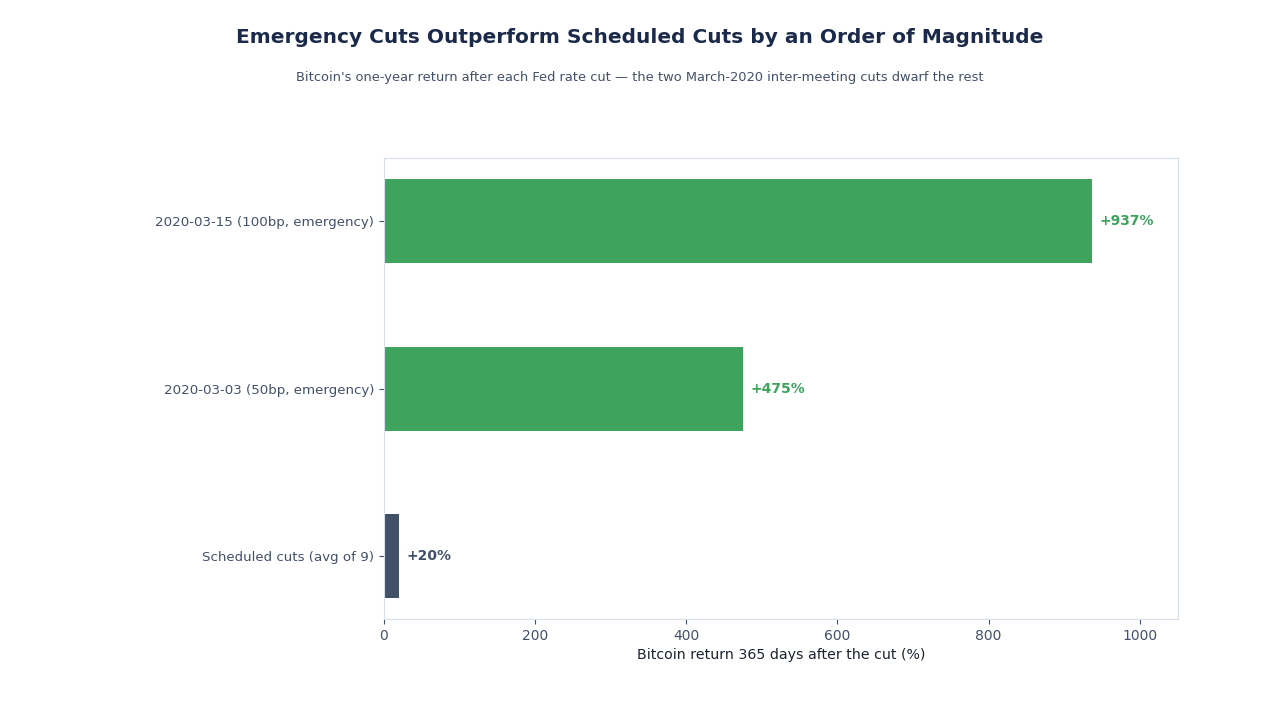
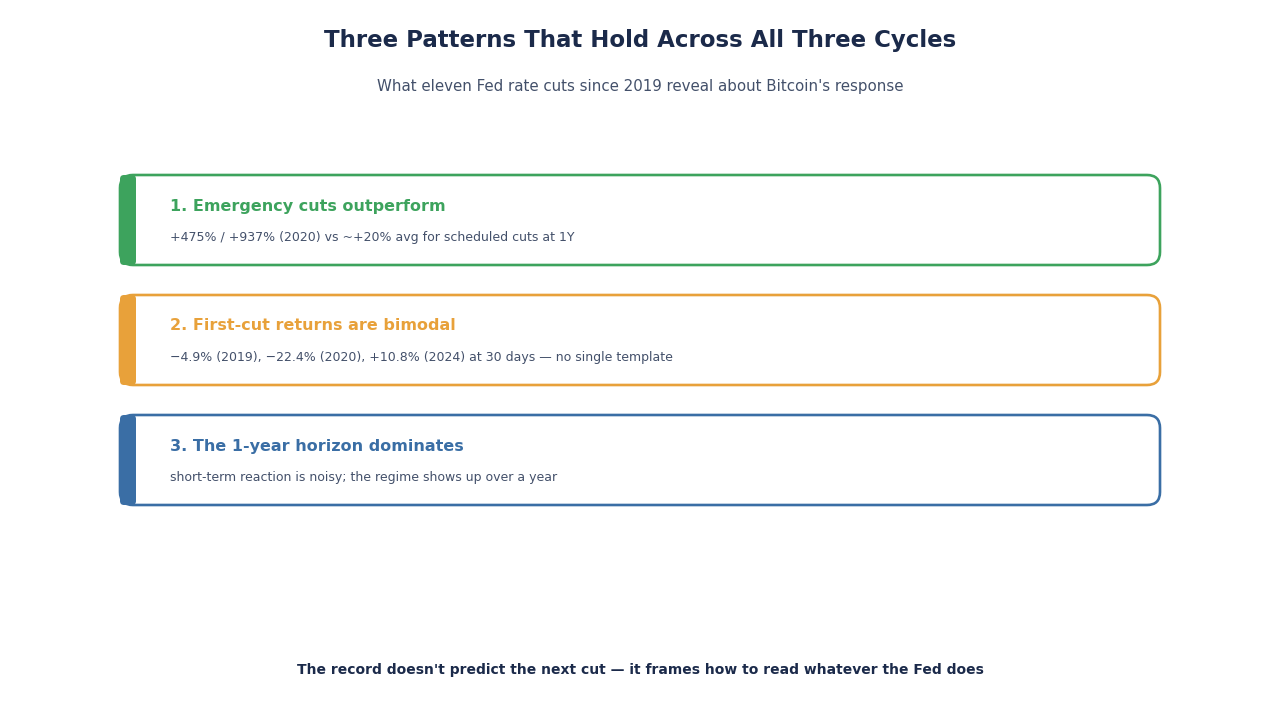
Pattern 1: Emergency cuts outperform scheduled cuts by an order of magnitude. The two inter-meeting cuts in March 2020 returned +475% and +937% at one year. The nine scheduled cuts averaged +20% at one year. The difference is not a Fed effect; it is a regime effect. Emergency cuts only happen during regime breaks, and regime breaks are precisely the moments when Bitcoin's optionality is most undervalued.
Pattern 2: First-cut returns are bimodal, not unimodal. The first cut of each cycle returned −4.9% (2019), −22.4% (2020), and +10.8% (2024) at 30 days. The distribution is not "first cut equals bottom." It is "first cut equals an inflection whose direction depends on whether the market is already pricing the cut." When fear is high and the cut surprises hawkishly (2019, early 2020), the immediate response is risk-off. When the cut surprises dovishly relative to expectations (2024 Sep at 50bp instead of the consensus 25bp), the immediate response is risk-on.
Pattern 3: Long-horizon signal dominates short-horizon noise. The 30-day window contains roughly equal numbers of positive and negative cut outcomes (4 positive, 7 negative). The one-year window contains 6 positive and 3 negative (excluding the three 2025 cuts not yet matured). At one year, the cuts that worked produced multiples; the cuts that failed produced 10–15% drawdowns. The asymmetry is the entire investment case for buying Bitcoin into Fed easing — provided the holding period is measured in quarters, not days.
For investors specifically interested in how AI-driven trading models read these regime shifts, the crypto leaderboard tracks how 30 different LLM-based agents have allocated to and traded BTC across the 2024–26 cycle in real time.
What This Means for the Rest of 2026
The Federal Reserve has now been on hold since the December 10, 2025 cut. The market-implied path for 2026 — visible in Fed funds futures, the SEP dot plot, and OIS curves — leans toward one to two additional 25bp cuts, with significant uncertainty around the timing. Bitcoin is consolidating in a $70,000–$95,000 range as of late May 2026, approximately 35% below its 2024 all-time high.
The eleven-cut historical record does not predict what comes next. It does establish a framework for interpreting whatever does come. If the Fed delivers a surprise inter-meeting cut in response to a credit event, the 2020 template applies — short-term volatility followed by extraordinary forward returns. If the Fed grinds out two more scheduled cuts inside a slow growth deceleration, the late-2025 template applies — cuts that fail to relight risk appetite. If the Fed pauses, the 2019 template's later quarters apply — sideways frustration followed by eventual mean reversion as the next regime forms.
The historical pattern that matters most for the 2026 setup is the gap between the 10-year Treasury yield easing and the Fed's actual rate decisions. When long yields fall ahead of the Fed (current situation), the market has typically been right and the Fed has eventually followed. When long yields rise into Fed cuts (late 2024), the market is signaling that the cuts are misguided. The 10-year is currently doing the former.
Investors who want a systematic, rules-based way to express a view on this — without trying to time individual FOMC meetings — increasingly use crypto autopilots that take macro inputs into account when sizing BTC positions.
Frequently Asked Questions
Does Bitcoin always rise after a Fed rate cut?
No. Of the eleven Fed cuts since 2019, four returned positive at 30 days and seven returned negative. The "Fed cuts equal BTC up" thesis is true only at the one-year horizon and even there has exceptions — the December 2024 cut returned −14.7% at one year. Short-term reactions are dominated by what was already priced in.
What is the most reliable holding period to measure?
One year. The 30-day window is too noisy — random market events dominate Fed-related causation. The 90-day window captures more of the post-cut policy regime but still contains too much short-term volatility. The 180-day window is the shortest horizon at which the Fed's cumulative policy stance starts to dominate. At one year, the average BTC return across all measurable cuts is +162%, skewed heavily by the 2020 outliers.
Should I buy Bitcoin before or after the Fed cuts?
The data favors buying after, not before. Pre-cut moves typically front-run the easing in equities and credit, then unwind into the actual decision. Of the eleven cuts, BTC was higher 30 days before the cut than on the cut day in seven of eleven cases. The systematic strategy of buying on the cut day and holding one year has positive expected return; the strategy of buying 30 days before the cut and holding through it has negative expected return based on this dataset.
How does Bitcoin compare to the S&P 500 during Fed cuts?
Across the same eleven cuts, the S&P 500's average one-year return was approximately +18% (with one negative observation in the 2025 cuts). Bitcoin's average was nearly ten times that, but with far higher dispersion. On a Sharpe-adjusted basis, the comparison is closer; on raw return, Bitcoin's exposure to the post-cut regime is structurally larger. The recent S&P 500 analysis of post-invasion regimes discusses the equity side of this comparison in detail.
What if the Fed pauses and does not cut again in 2026?
The 2019 mid-cycle adjustment example is instructive. After the October 2019 cut, the Fed paused; BTC traded sideways for four months before the COVID shock changed everything. A pause is not a bearish signal for Bitcoin on its own — it is a regime continuation. What changes BTC behavior is the next regime, not the absence of one.
See Also
- Bitcoin Halving Cycles: Complete Returns Reference 2012–2028 — the other half of the BTC macro framework.
- Small Caps Lead 2026 Chip Rebound as 10-Yr Yield Eases — what falling long yields are signaling to the Fed in real time.
- SimianX BTC asset page — live BTC price, AI model positions, and on-chain signals.
Data sources: Binance Spot API BTCUSDT daily closes (2017-08-17 onward), FRED DFF series (Federal Funds Effective Rate, 2008-01-01 onward), FOMC meeting calendar. All forward returns are simple price changes; all data through 2026-05-25.