
How Stocks, Bonds and Gold Behave After the First Fed Cut
When the Federal Reserve cuts interest rates, the first question every investor asks is the same: is this good or bad for my portfolio? The honest answer is that a Fed rate cut, on its own, tells you almost nothing — what matters is why the Fed is cutting. This is a complete reference table of every Fed rate-cut cycle since 1980, with how the S&P 500, U.S. Treasuries, and gold actually performed in the 12 months after each first cut. Bookmark it; it is the context that turns a scary headline into a usable signal.
The pattern that emerges across more than four decades is clear. When the Fed cuts to fine-tune a still-healthy economy — a so-called insurance or soft-landing cut — stocks have historically done very well. When the Fed cuts because the economy is already breaking — a recession cut — stocks have often fallen for another year while bonds and gold quietly outperformed. Same action, opposite outcome. The rest of this article shows you exactly how to tell the two apart.
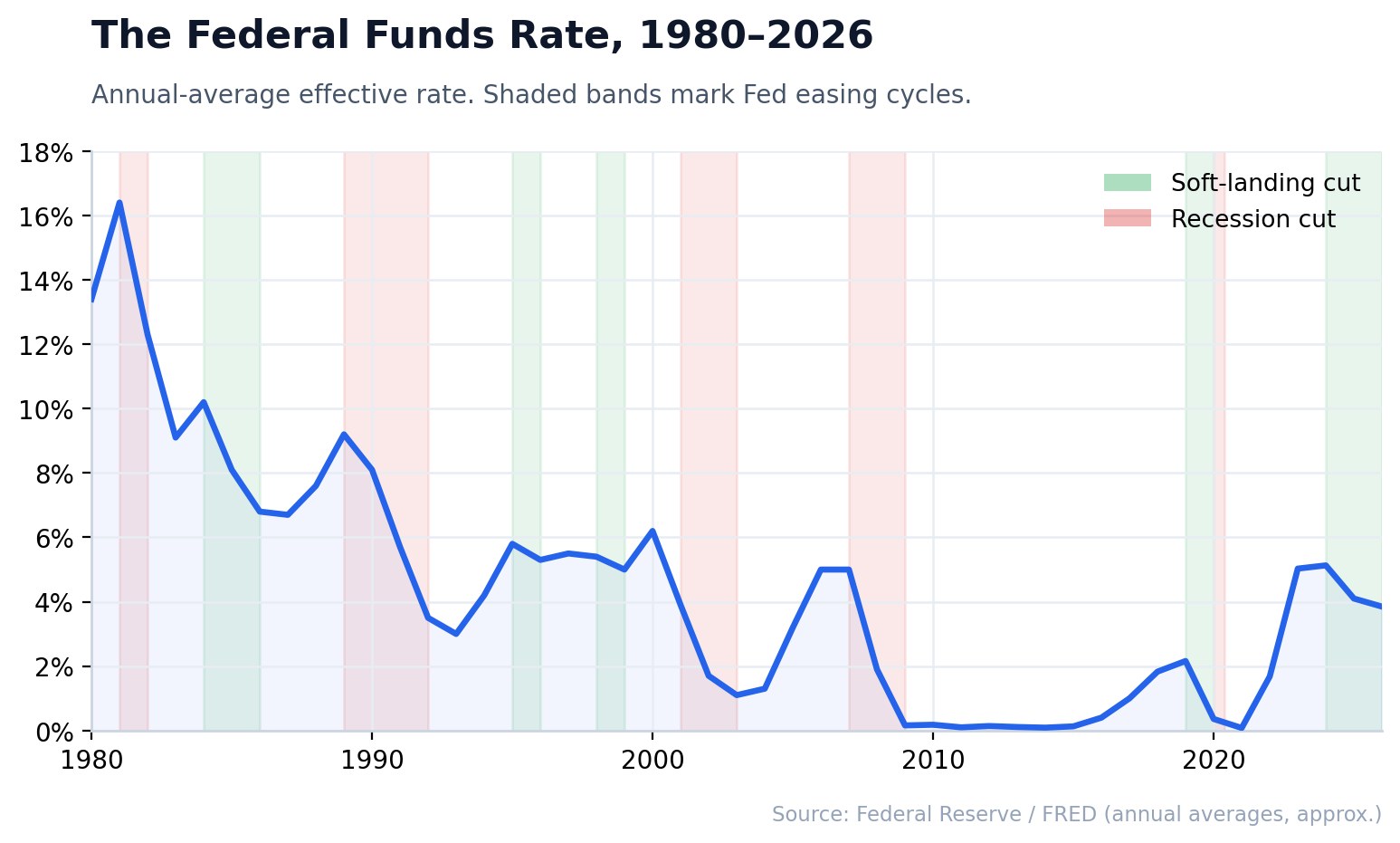
Why the first cut matters more than the last
Markets are discounting machines. By the time the Fed delivers its final cut of a cycle, the easing is old news and largely priced in. The first cut is different: it marks a regime change in the cost of money, and it forces every model — equity valuations, bond yields, the dollar, the price of gold — to re-rate at once.
That is why analysts obsess over the date of the first cut and the 12 months that follow it. It is the cleanest natural experiment finance offers: a known catalyst on a known date, repeated roughly once a business cycle. Since 1970, the S&P 500 has delivered a median price return of about +11.9% in the 12 months after the first cut of an easing cycle, according to RBC Wealth Management. But that median hides two completely different worlds, and lumping them together is the single most common mistake investors make with rate-cut data.
If you want the macro backdrop for the current decision, our companion piece on the June 2026 FOMC decision breaks down the dot plot and what it implies for AI stocks and Bitcoin.
The complete reference table: every Fed easing cycle since 1980
The table below lists every federal-funds easing cycle since 1980 — the date of the first cut, where the target rate started and where it bottomed, the economic backdrop, whether it was a soft-landing or recession cut, and the S&P 500 price return in the 12 months that followed.
| First cut | Starting rate | Trough | Backdrop | Cut type | S&P 500, next 12 mo |
|---|---|---|---|---|---|
| Jun 1981 \* | ~19–20% (peak) | ~8.5% | Volcker disinflation; 1981–82 double-dip recession | Recession | ≈ −16% \* |
| Nov 1984 | ~11.5% | ~5.85% (1986) | Mid-cycle slowdown, no recession | Soft landing | +20.4% |
| Jun 1989 | 9.75% | 3.00% (Sep 1992) | 1990–91 recession + S&L crisis | Recession † | +11.4% † |
| Jul 1995 | 6.00% | 5.25% (Jan 1996) | Classic soft landing | Soft landing | +21.4% |
| Sep 1998 | 5.50% | 4.75% (Nov 1998) | LTCM blow-up; Asian & Russian crises | Soft landing | +24.0% |
| Jan 2001 | 6.50% | 1.00% (Jun 2003) | Dot-com bust; 2001 recession | Recession | −13.0% |
| Sep 2007 | 5.25% | 0–0.25% (Dec 2008) | Global Financial Crisis | Recession | −17.6% |
| Jul 2019 | 2.50% | 1.75% (Oct 2019) | Trade-war "insurance" cuts | Soft landing | +8.7% |
| Mar 2020 | 1.75% | 0–0.25% (Mar 2020) | COVID-19 crash, emergency cuts | Recession ‡ | ≈ +45% ‡ |
| Sep 2024 | 5.25–5.50% | high-3% / low-4% (ongoing) | Post-inflation normalization | Soft landing (so far) | cycle ongoing |
\* The Volcker-era funds rate was extraordinarily volatile, swinging between roughly 9% and 20% across 1980–81; the S&P 500 ground into a bear market that did not bottom until August 1982. Treat the 1981 figure as illustrative of a recession cut rather than a clean print.
† The 12-month window after the June 1989 first cut was positive because the 1990–91 recession did not begin until July 1990 — month 13. It is a recession cut whose first year still looked benign, a useful warning that the clock matters.
‡ March 2020 was an emergency recession cut, yet the 12-month forward return was strongly positive — a reminder that starting valuation and the scale of liquidity can override the usual recession-cut script.
Rate levels are drawn from the Federal Reserve and Bankrate's federal-funds history; S&P 500 returns are price returns rounded from Bloomberg, CFRA, and Ned Davis Research data as reproduced in mainstream coverage. See Data & sources at the end for the full list.
Insurance cuts vs. recession cuts: the only distinction that matters
Read the table again and one split jumps out. Strip away the dates and the only variable that reliably predicts the next year of equity returns is whether a recession showed up.
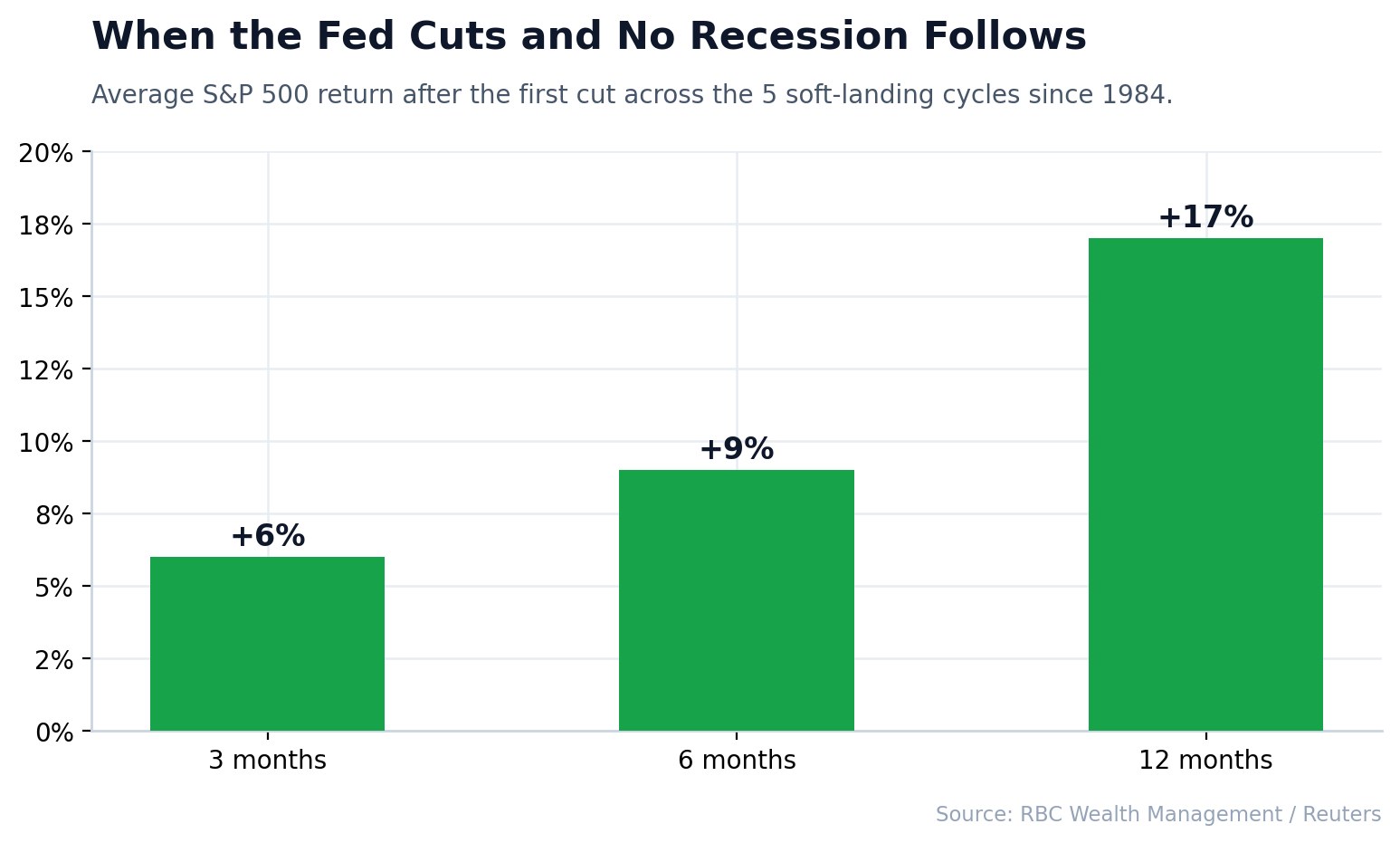
When the Fed eases into a still-expanding economy to extend the cycle — 1984, 1995, 1998, 2019 — the S&P 500 has typically returned roughly +6% three months later, +9% after six months, and +17% after twelve, per RBC Wealth Management and Reuters. Lower rates plus a healthy economy is the most bullish backdrop equities ever get.
When the Fed is instead cutting because growth is collapsing — 2001, 2007, and the long Volcker recession — the cuts are a symptom, not a cure. Corporate earnings fall faster than the discount rate, and equities keep dropping even as the Fed eases aggressively. The 2001 and 2007 cycles each delivered double-digit S&P losses in the year after the first cut, and both coincided with full-blown bear markets. (For the full catalogue of those drawdowns, see Every S&P 500 Bear Market Since 1929.)
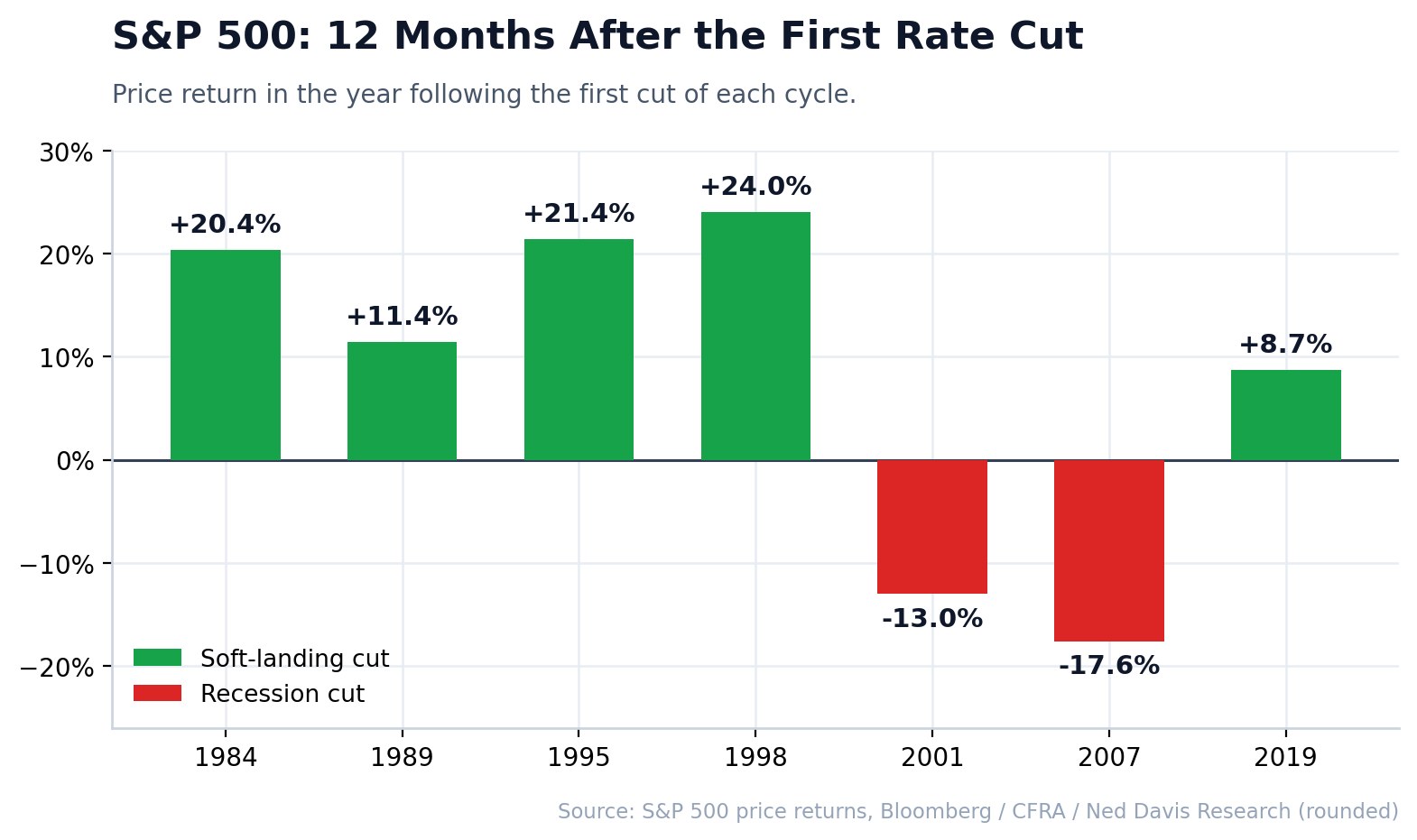
The contrast is stark enough that it should reframe how you read any rate-cut headline: "the Fed is cutting" is not the signal — "the Fed is cutting and the economy is still growing" is. The hard part, of course, is knowing in real time which regime you are in. That is where the leading indicators come in.
How to tell which regime you are in
You cannot know for certain until after the fact, but the historical tells are consistent:
- The yield curve. A deeply inverted 2s/10s curve that re-steepens as the Fed starts cutting has preceded every modern recession. When the curve is flat-to-normal and steepening gently, cuts have skewed toward the soft-landing outcome. Our yield-curve inversions reference table maps every inversion since the 1970s to the recession that did — or did not — follow.
- The unemployment rate. When the unemployment rate is rising into the first cut (the Sahm-rule dynamic), recession-cut outcomes dominate. When it is low and stable, insurance-cut outcomes dominate.
- Credit spreads. Widening high-yield spreads into the first cut signal stress that rate cuts often cannot arrest in time. Tight spreads signal a market that still believes in the soft landing.
- The pace of cuts. Slow, 25-basis-point "fine-tuning" cuts (1995, 2019) read very differently from 50bp emergency moves (2007, 2020). The Fed cuts fast when it is scared.
None of these is a crystal ball, and the 1989 cycle proves the timing can be cruel — the first year looked fine, then the recession arrived in month 13. That is precisely why a single dashboard that tracks rates, the curve, earnings revisions, and price action together beats reacting to one headline at a time.
Cycle by cycle: what actually happened
1981–82 — the Volcker recession. Paul Volcker pushed the funds rate to a record ~20% to break double-digit inflation, then eased as the economy buckled into a double-dip recession. Stocks were dead money until the great bull market began in August 1982. Lesson: cutting from a punitively high rate does not save equities if a recession is already underway.
1984–86 — the textbook insurance cut. The Fed trimmed rates from ~11.5% to under 6% to nurse a mid-cycle slowdown without a recession. The S&P 500 returned +20.4% over the following year. This is the soft-landing template.
1989–92 — the slow-motion recession cut. Easing began in June 1989 from 9.75%, and the first 12 months were positive (+11.4%). But the 1990–91 recession and the savings-and-loan crisis eventually dragged the funds rate all the way to 3%. The lesson is about timing, not direction.
1995–96 — Greenspan's soft landing. The cleanest insurance cut on record: a few cuts from 6.00% to 5.25%, no recession, and a +21.4% year for the S&P that set up the late-1990s melt-up.
1998 — the LTCM rescue cuts. Three rapid cuts as Long-Term Capital Management imploded and the Asian and Russian crises rattled markets. The economy never recessed, and the S&P returned roughly +24% in the following year — the dot-com bubble's final, vertical leg.
2001–03 — the dot-com bust. The Fed cut from 6.50% all the way to 1.00%, and it did not matter: the tech bubble unwound, a recession hit, and the S&P fell −13% in the year after the first cut on its way to a ~49% peak-to-trough bear market.
2007–08 — the Global Financial Crisis. The archetypal recession cut. Easing started in September 2007 with the S&P near an all-time high; twelve months later the index was down −17.6%, and the funds rate was on its way to zero as the financial system seized.
2019 — trade-war insurance. Three "mid-cycle adjustment" cuts from 2.50% to 1.75%. The S&P added +8.7% over the next year before the COVID shock — another soft-landing cut that worked, right up until an exogenous shock no one was modeling.
2020 — the pandemic emergency. The Fed slashed to zero in days. It was a recession cut by any definition, yet unprecedented fiscal and monetary liquidity, plus a crash that started from a deep oversold low, produced one of the fastest recoveries ever — the S&P was up roughly +45% a year after the cut. The outlier that proves liquidity and starting point matter.
2024–26 — the current normalization. The Fed began cutting in September 2024 from 5.25–5.50% as inflation cooled and the labor market stayed resilient — the profile of a soft-landing cut. Whether it stays that way depends on the data the June 2026 FOMC and its successors confirm. The concentration risk in this particular rally — see The Magnificent 7 in 2026 — is the wrinkle that makes this cycle hard to map onto any single historical analogue.
What about bonds and gold?
Equities get the headlines, but the rate-cut playbook is incomplete without the other two major asset classes — and they are exactly where the recession-cut regime pays off.
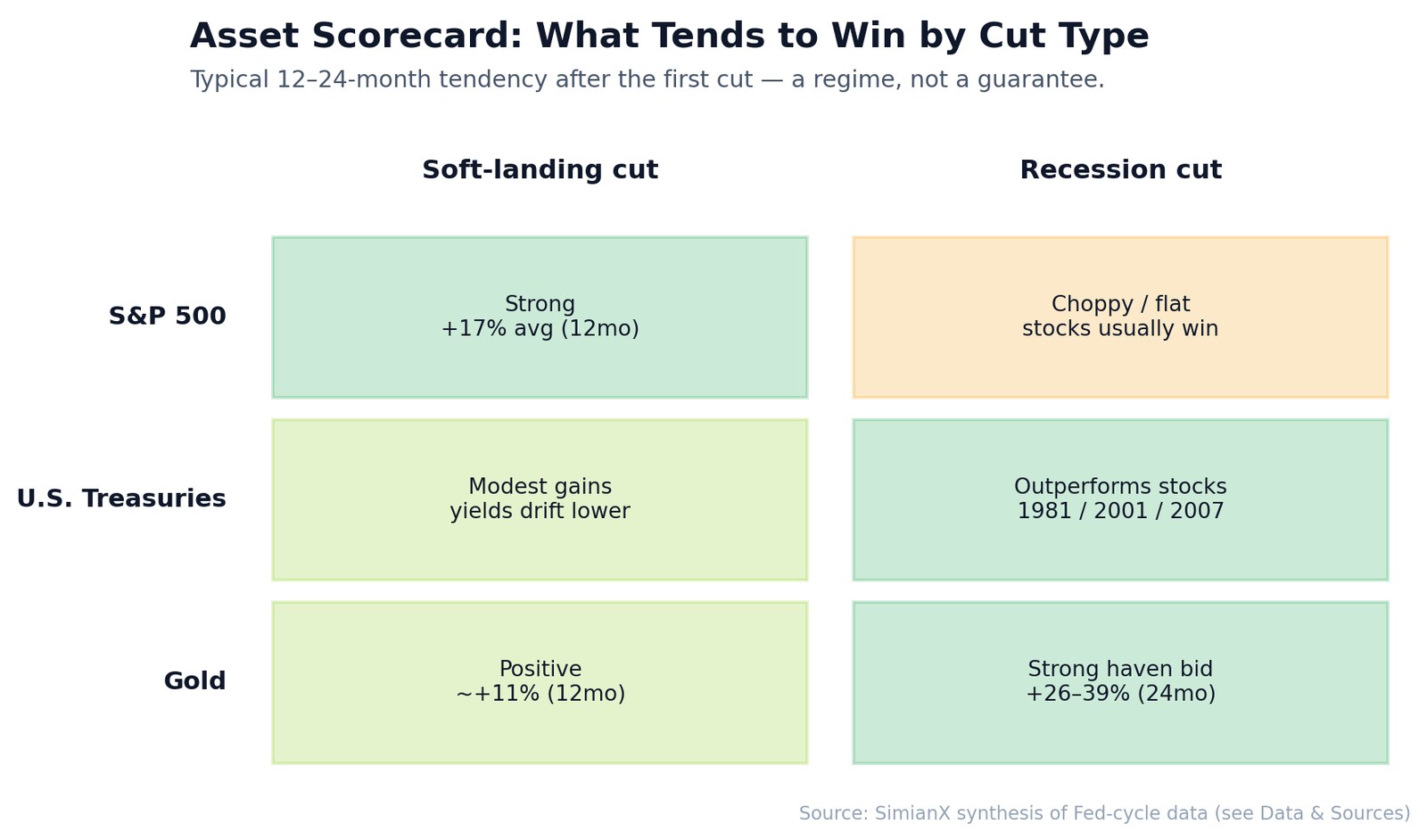
U.S. Treasuries. Falling rates lift bond prices, so Treasuries gain in almost every easing cycle. The crucial point is relative performance: bonds outperformed stocks in three of the modern cycles — 1981, 2001, and 2007 — and all three were recessions, according to Seeking Alpha's review of the data. When the cut is a recession cut, duration is the trade.
Gold. Lower rates reduce the opportunity cost of holding a non-yielding asset, and recession fear adds a haven bid. Gold has risen in the 12 months after the first cut in six of the last seven cycles, and over a 24-month horizon it has posted standout gains — roughly +31% after the 2000 cuts, +39% after 2007, and +26% after 2019, per Julius Baer and World Gold Council data.
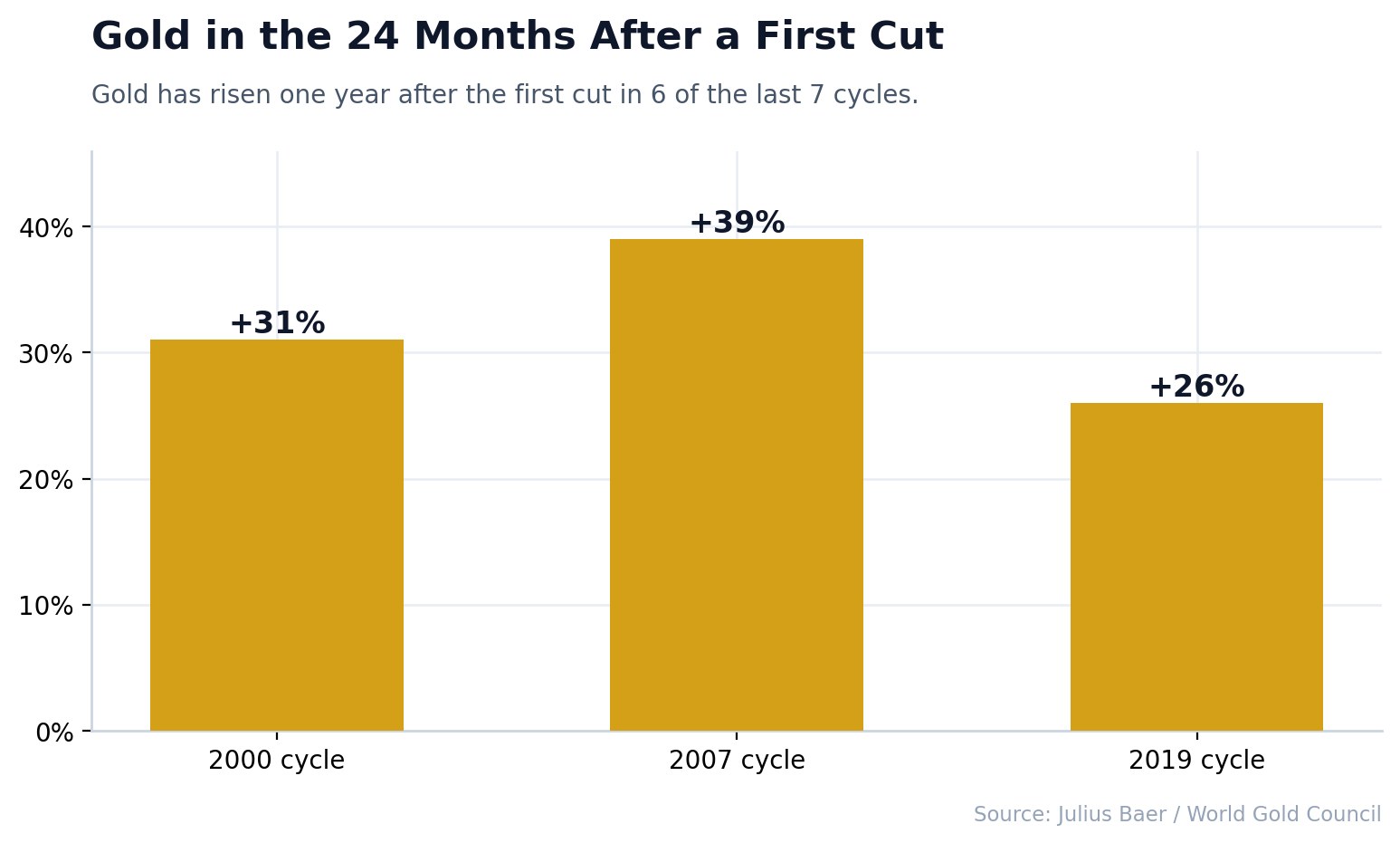
Put the three asset classes side by side and the regime framework becomes a simple scorecard. In a soft-landing cut, stocks lead and bonds and gold tag along. In a recession cut, stocks struggle while Treasuries and gold do the heavy lifting — which is the entire case for owning more than one asset class through a turning point.
The second-order effects: sectors and the dollar
The index-level numbers above hide a lot of rotation underneath. Rate cuts do not lift all boats equally, and knowing which parts of the market lead can matter more than the headline return.
Rate-sensitive and long-duration equities lead — when the cut is an insurance cut. Technology, growth, and other long-duration sectors are valued on cash flows far in the future, so a lower discount rate helps them most. That is why soft-landing cuts have so often coincided with growth-led melt-ups (1998, 2019, and the 2024–26 AI rally). The catch is that this only holds when earnings keep growing; in a recession cut, the same high-multiple names fall hardest as the "E" in the P/E collapses.
Small caps and cyclicals need the soft landing. Smaller companies carry more floating-rate debt and are more economically sensitive, so they theoretically benefit most from cheaper money. But they also get hit hardest if the cut fails to prevent a recession. Small-cap leadership after a first cut is therefore one of the market's cleaner real-time votes for the soft-landing outcome.
The dollar usually softens. Lower U.S. rates tend to narrow the yield advantage of holding dollars, so the dollar has generally weakened during easing cycles. A softer dollar is part of why gold and many commodities firm up after cuts, and it is a tailwind for U.S. multinationals' overseas earnings and for emerging-market assets.
Crypto trades the liquidity story. Bitcoin and the broader crypto market have become among the most rate-sensitive assets of all, because they trade almost purely on liquidity and risk appetite. When the market expects easier policy, long-duration risk assets — including Bitcoin — tend to lead the move, and they can also fall fastest when a recession cut reveals that the easing is a response to stress rather than a gift to risk-takers.
The throughline: the regime determines not just the index return but what leads. Soft-landing cuts reward duration, cyclicality, and risk; recession cuts reward quality, duration in bonds, and havens like gold.
How to use this table in 2026
History rhymes, it does not repeat, and the worst thing you can do with a reference table is treat it as a prophecy. The right use is as a base rate — a starting probability that you then update with live data. Here is the workflow this article is built to support:
- Classify the cut. Soft-landing or recession? Check the curve, unemployment, and credit spreads before you decide what the cut "means."
- Set the base rate. Soft-landing cut → equities have historically returned mid-teens over the next year, with bonds and gold as steady complements. Recession cut → expect another year of equity pressure and lean on duration and gold.
- Update continuously. The 1989 and 2020 cycles show the regime can flip in either direction after the first cut. Monitor, don't set-and-forget.
That last step is where modern tooling earns its keep. SimianX runs the same market data through multiple AI models in parallel, so you see where they agree and where they diverge instead of betting on one lens. You can track macro-sensitive names through a cut with SimianX Autopilots, watch how different models read risk appetite on the AI model leaderboard, and follow liquidity-sensitive crypto like Bitcoin on the crypto leaderboard — Bitcoin, as a long-duration liquidity asset, often trades the rate-cut narrative even harder than equities do. For the seasonal overlay on all of this, pair the rate-cut map with our S&P 500 seasonality guide.
Frequently asked questions
Does the stock market go up when the Fed cuts rates?
Usually, but not always — and the exceptions are the ones that hurt. Since 1970 the S&P 500's median return is about +11.9% in the 12 months after the first cut, and it has been positive most of the time. The losses cluster entirely in recession cuts (2001, 2007, 1981), where stocks fell double digits despite aggressive easing.
What is the difference between an insurance cut and a recession cut?
An insurance (or soft-landing) cut is preventive: the Fed trims rates to extend a healthy expansion, as in 1995, 1998, and 2019. A recession cut is reactive: the Fed is responding to an economy that is already contracting, as in 2001, 2007, and 2020. Insurance cuts have averaged roughly +17% for the S&P over the next year; recession cuts have averaged losses.
How long do Fed rate-cut cycles last?
It varies enormously. The 1998 cycle was over in about seven weeks; the 2001–03 and 1989–92 cycles ran more than two years and took rates down by hundreds of basis points. Recession cuts tend to be deeper and longer because the Fed keeps easing until the economy stabilizes.
Is gold a good investment when the Fed cuts rates?
Historically yes. Gold has risen in the year after the first cut in six of the last seven cycles, and lower real rates plus haven demand have produced 24-month gains of +26% to +39% in recent recession-linked cycles. It is one of the most reliable beneficiaries of an easing regime.
Where is the Fed in its cycle right now?
The Fed began easing in September 2024 from 5.25–5.50% and has been normalizing policy as inflation cooled — the profile of a soft-landing cut so far. As always, the classification can change with the data; track the latest in our June 2026 FOMC breakdown.
Related Reading
- June 2026 FOMC Decision: Dot Plot, AI Stocks & Bitcoin
- Yield Curve Inversions and US Recessions: A Reference Table
- Every S&P 500 Bear Market Since 1929: Duration and Recovery
- The Magnificent 7 in 2026: Weights & Concentration Risk
- S&P 500 Seasonality: The Best & Worst Months 1950–2026
Data & sources
This reference table synthesizes publicly available data. Rate levels and cycle dates are from the Federal Reserve and Bankrate's federal-funds history. S&P 500 figures are price returns (not total returns) in the ~12 months after each first cut, rounded from Bloomberg, CFRA, and Ned Davis Research data as reproduced in mainstream financial coverage; small differences across sources reflect price-vs-total-return and exact-date conventions. The insurance-cut averages (+6% / +9% / +17%) are from RBC Wealth Management and Reuters. The relative bond-vs-stock outcomes are from Seeking Alpha's review of cycles since 1970. Gold figures are from Julius Baer and the World Gold Council.
- Federal Reserve — Open Market Operations: https://www.federalreserve.gov/monetarypolicy/openmarket.htm
- Bankrate — History of the federal funds rate: https://www.bankrate.com/banking/federal-reserve/history-of-federal-funds-rate/
- RBC Wealth Management — Fed rate cuts on the horizon: https://www.rbcwealthmanagement.com/en-us/insights/fed-rate-cuts-on-the-horizon
- Seeking Alpha — Average S&P 500 return after an interest-rate cut since 1970: https://seekingalpha.com/article/4825189-since-1970-this-is-the-average-return-of-the-s-and-p-500-after-an-interest-rate-cut
- Julius Baer — What Fed rate cuts mean for gold, equities, and emerging markets: https://www.juliusbaer.com/en/insights/market-insights/market-outlook/us-fed-cuts-rates-what-does-this-mean-for-gold-equities-and-emerging-markets/
- Bloomberg — S&P 500 price-return market data: https://www.bloomberg.com
- Reuters — Fed rate-cut market coverage: https://www.reuters.com
- World Gold Council — gold demand and price data: https://www.gold.org
This article is for educational purposes only and is not investment advice. Past performance does not guarantee future results.