
 By Marcus Reeve
How the Stock Market's Calendar Really Works: 76 Years of Monthly Data
Updated October 2026. Data through October 15, 2026.
Short answer: Since 1950 the S&P 500's best months have been November (+1.9% on average), April (+1.4%) and December (+1.4%, higher in 72% of years). September is the worst (−0.6%, higher in 45%). In 2026, September fell 0.4% and April rose 10.4%.
Every year, traders ask the same two questions: what are the best months for the stock market, and which months should they fear? S&P 500 seasonality — the tendency of the index to perform differently in different calendar months — is one of the oldest and most studied patterns in finance. This reference compiles the approximate average monthly returns of the S&P 500 from 1950 through 2025, explains the famous anomalies behind them — the September effect, "Sell in May and go away," the Santa Claus rally, and the presidential cycle — and shows what the data implies for the rest of 2026, a midterm election year that historically sits in the weakest seat of the four-year cycle.
One warning before the tables: seasonality describes averages across 76 years, not guarantees about any single year. Treat it as context that tilts probabilities, never as a standalone signal. We will come back to how systematic traders actually combine it with live data at the end.
The Complete Monthly Seasonality Table (1950–2025)
The table below summarizes the approximate average price return and the share of positive months for the S&P 500 in each calendar month since 1950. Figures are averages of monthly price changes from month-end closes in Yahoo Finance's S&P 500 history (December 1949 base), cross-checked against CNBC's index data, which agree to within about 0.1 point per month. The 2026 column shows this year's result for each month. The table is part of our market history reference hub.
| Month | Avg. return | % of years positive | Rank | 2026 | Seasonal note |
|---|---|---|---|---|---|
| January | +1.1% | 61% | 5 | +1.4% | "January effect" + new-year inflows |
| February | 0.0% | 54% | 11 | −0.9% | Mid-quarter lull |
| March | +1.0% | 64% | 6 | −5.1% | Quarter-end rebalancing |
| April | +1.4% | 70% | 2 | +10.4% | Strongest spring month |
| May | +0.4% | 62% | 8 | +5.2% | Start of the "weak half" |
| June | +0.2% | 55% | 9 | −1.1% | Often flat, low conviction |
| July | +1.3% | 61% | 4 | −0.1% | Best summer month |
| August | 0.0% | 55% | 10 | +2.6% | Thin liquidity, vacation tape |
| September | −0.6% | 45% | 12 | −0.4% | The September effect — worst month |
| October | +0.9% | 59% | 7 | +1.2% (to Oct 15) | Most volatile month, but a "bear killer" |
| November | +1.9% | 70% | 1 | — | Best month on average |
| December | +1.4% | 72% | 3 | — | Highest hit rate of any month |
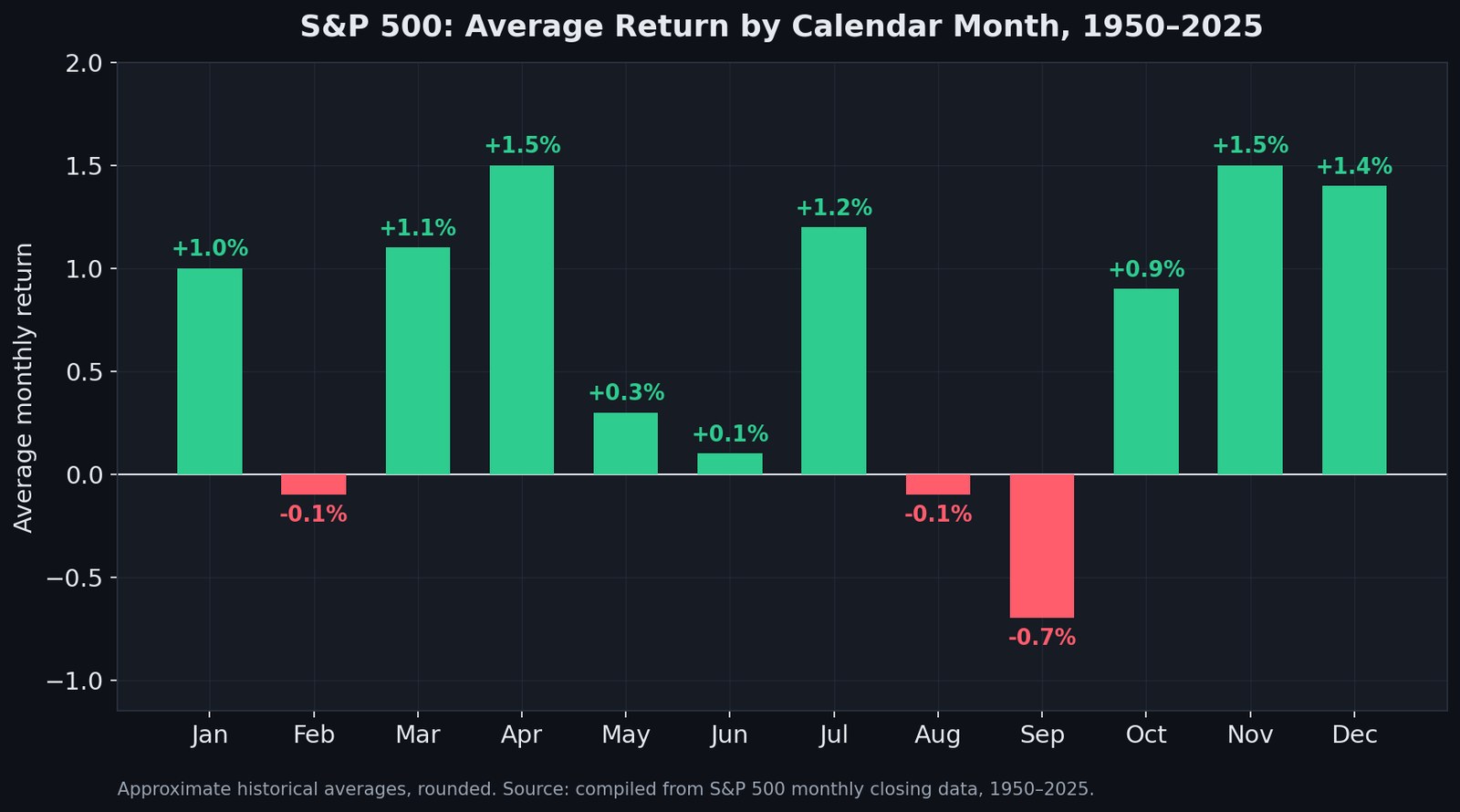
Three facts jump out of seven decades of data:
- November, April and December are the strongest months. They combine the highest average returns (+1.4% to +1.9%) with high hit rates (70–72% positive). The November–April window contains five of the six strongest months.
- September is the only month that is reliably bad. It is the only month with a clearly negative average (−0.6%) and a hit rate below 50% (45%). Every other "weak" month (February, June, August) is closer to a coin flip around zero.
- The summer is not a disaster — it is a dead zone. May, June and August average roughly zero. The problem with the weak half of the year is not large losses on average; it is that you historically collected very little reward for the risk you carried.
The September Effect: Why the Worst Month Keeps Underperforming
The September effect is the most persistent calendar anomaly in US equities. Since 1950, September is the worst month for the S&P 500, the Dow and the Nasdaq alike, and the pattern has been documented in markets outside the US as well.
Why does it persist when most known anomalies get arbitraged away? Researchers offer overlapping explanations rather than one clean answer:
- Mutual fund fiscal year-ends. Many US funds close their fiscal year on October 31 and harvest losses in September, creating mechanical selling pressure.
- Post-vacation repositioning. Institutional desks return from August holidays and execute deferred risk reductions at the same time.
- Bond issuance calendar. September is historically a heavy month for new debt supply, pulling liquidity from equities.
- Self-fulfilling caution. Enough market participants now expect a weak September that they de-risk in advance, front-loading the weakness.
Whatever the mix of causes, the practical takeaway is modest: September is a poor month to add leverage and a historically rewarding month to hold hedges — not a reason to liquidate a portfolio. If you want to watch the conditions that actually turn a seasonal dip into a real drawdown, the breadth, revision and credit-spread signals tracked in our Wall Street drawdown watch matter far more than the calendar. In 2026 the month followed the pattern only mildly: the S&P 500 fell 0.4% in September.
"Sell in May and Go Away": What 76 Years of Data Actually Show
The most famous seasonal rule of all splits the year into two halves: the "strong half" from November through April and the "weak half" from May through October. The slogan predates the modern S&P 500 — it originated with London brokers leaving for the summer — but the data behind it is real.
Since 1950, the S&P 500 has averaged +7.0% in November–April versus +2.1% in May–October, with the winter half higher in 76% of years and the summer half in 66%. Compounded over 76 years, the gap is large: $10,000 invested only during the winter halves grows to about $1.17 million, while the same $10,000 invested only during the summer halves grows to roughly $34,000. In 2026, the index gained about 7.4% from the end of April to October 15, already above the long-run May–October average.
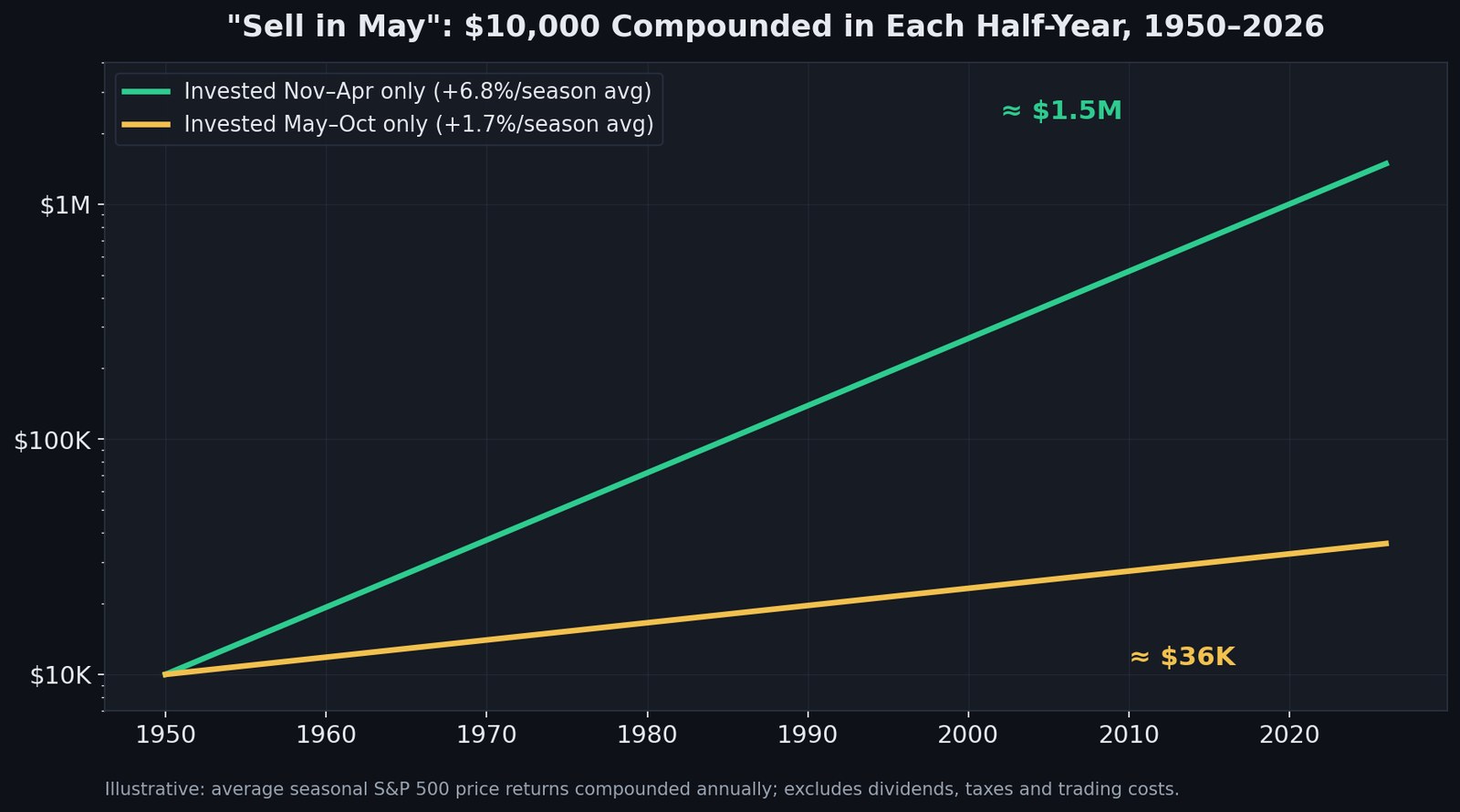
So should you actually sell in May? For most investors, no — and the reasons are worth spelling out:
- Both halves are positive on average. Exiting May–October historically reduced total returns versus simply staying invested; it just improved risk-adjusted returns.
- Taxes and costs eat the edge. Realizing gains every May converts long-term compounding into short-term tax events. After friction, the naive version of the strategy loses to buy-and-hold in most studies, including the long-run evidence summarized by Investopedia.
- The dispersion is wide. May–October 2025 gained 22.8%, the best summer half since 1950. May–October 2008 lost 30.1%. The average hides everything that matters in any given year.
The sophisticated reading of "Sell in May" is not exit in May; it is expect less from the summer tape and size accordingly. That is also how it interacts with the bear-market evidence: as our reference on every S&P 500 bear market since 1929 shows, the deepest damage in history has clustered in the May–October window — including 1987, 2002 and 2008.
October: The Crash Month That Is Secretly a Bear Killer
October owns the scariest reputation on the calendar because the 1929, 1987 and 2008 crashes all detonated in it, and October's realized volatility is the highest of any month: its average daily move since 1950 is about 0.79%, against 0.60–0.71% in the other months. Yet its average return since 1950 is positive (+0.9%), and it carries a nickname professionals use more often than "crash month": the bear killer. Many post-war declines — including 1957, 1960, 1966, 1974, 1990, 2002, 2011 and 2022 — made their final closing lows in October.
The lesson is that October is a month of resolution, not of reliable direction. Volatility clusters there, and historically that volatility has marked endings more often than beginnings. Panic-selling an October air pocket has been one of the most expensive habits in market history.
The Santa Claus Rally, the January Effect, and the Turn of the Month
Three smaller anomalies round out the seasonal map:
- Santa Claus rally. The last five trading days of December plus the first two of January have averaged roughly +1.3% since 1950, positive in close to four out of five years. Its inventor, Yale Hirsch of the Stock Trader's Almanac, attached the famous warning: "If Santa Claus should fail to call, bears may come to Broad and Wall" — a missed rally has often preceded weak Januaries.
- The January effect. Small-cap stocks historically outperformed large caps in January as tax-loss selling reversed. This is the clearest case of an anomaly fading after publication: since the 1990s the edge has shrunk dramatically as investors front-ran it.
- Turn-of-the-month effect. A disproportionate share of all equity returns accrues in the window from the last trading day of a month through the first three or four of the next, driven by salary flows, 401(k) contributions and systematic rebalancing.
The January-effect story is the essential cautionary tale for this whole topic: calendar edges are weak, public, and capable of decaying. Anyone trading them mechanically without confirming data is volunteering to be the liquidity for those who do confirm.
The Presidential Cycle: Why 2026 Sits in the Weak Seat
Beyond the monthly map, the four-year presidential election cycle is the strongest medium-term seasonal pattern in US equities — and 2026 is a midterm year, historically the weakest of the four.
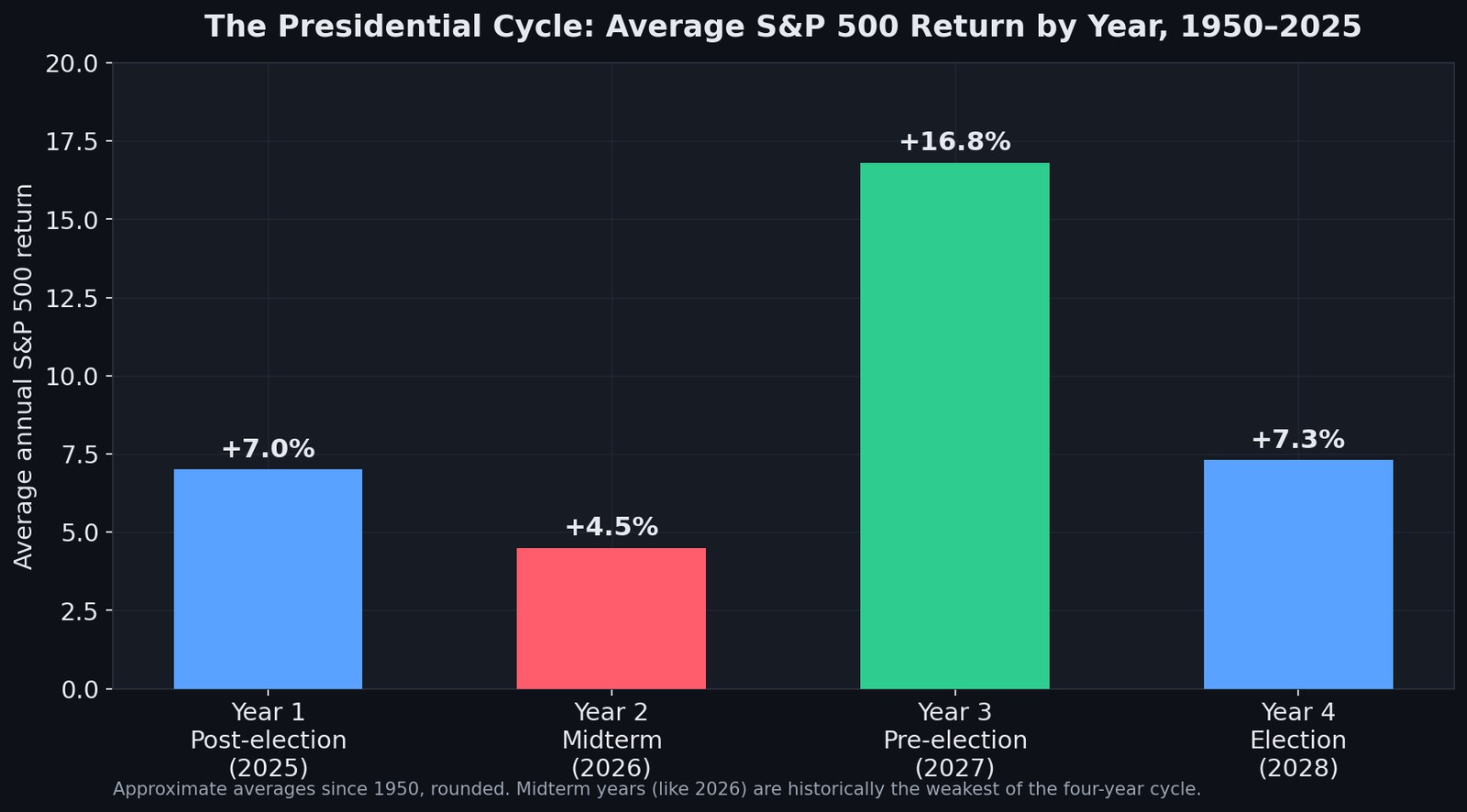
Since 1950 (calendar-year price returns, 1950–2025), the average S&P 500 return by cycle year:
| Cycle year | Average return | Character |
|---|---|---|
| Year 1 — post-election (2025) | +8.4% | New-administration agenda priced in |
| Year 2 — midterm (2026) | +4.6% | Weakest year; largest average drawdown |
| Year 3 — pre-election (2027) | +17.2% | Strongest year by a wide margin |
| Year 4 — election (2028) | +8.1% | Positive but choppy into the vote |
Midterm years carry two signature features. First, the largest average intra-year drawdown of the cycle — about 17.5% on average since 1950, against 11–13% in the other three years — often bottoming in the August–October window as election uncertainty peaks. Second, a consistent resolution: the S&P 500 has been higher 12 months after every midterm election since 1950 (19 of 19), with an average gain of about 15%, as policy uncertainty clears regardless of which party wins. The full year-by-year record is in our presidential cycle reference and our midterm election years table.
For 2026 specifically, the historical script says: respect the possibility of a rough late summer and early autumn, and treat any September–October midterm-year weakness as historically fertile ground rather than a reason to capitulate. That script interacts with the live macro picture — Fed policy expectations in particular — which we track in real time in our 2026 Fed rate-cut pricing map. And if the S&P's longer-term path toward new highs is your focus, the momentum and liquidity framework in S&P 500 to 7000 is the companion read.
So far 2026 has not followed the midterm script. Through October 15 the S&P 500 was up 13.1% for the year, its deepest decline was 9.1% (January 27 to March 30), about half the midterm-year average, and it closed at a record 7,818.93 on October 6. The midterm election is on November 3, 2026.
Does Seasonality Exist in Crypto Too?
Calendar patterns are not unique to equities. Bitcoin has its own well-documented rhythms — historically strong Octobers ("Uptober"), weak Septembers, and the four-year halving cycle that dominates everything else. The mechanics differ (halvings and liquidity cycles rather than fiscal year-ends), but the analytical rule is identical: averages tilt probabilities, single years routinely defy them. Our reference on Bitcoin's halving cycles and the data on how BTC trades after Fed rate cuts cover the crypto side of the seasonal map in depth.
How Traders Actually Use Seasonality (and How They Shouldn't)
Used badly, seasonality is astrology with a spreadsheet. Used well, it is a prior — a base rate you update with live evidence. Three practical rules separate the two:
- Never trade the calendar alone. A weak-September prior plus deteriorating breadth, widening credit spreads and falling earnings revisions is a real signal. A weak-September prior by itself is trivia. The multi-agent systems on the SimianX AI leaderboard are explicitly built around this idea: 39 ranked AI models from eight providers (as of October 16, 2026) analyze live market data, news and technicals — and their real profit-and-loss is published, so you can see which models actually convert context like seasonality into returns. Our breakdown of which AI model is the best trader summarizes the standings.
- Use seasonality for sizing and timing, not direction. The historical edge of November–April is an argument for carrying fuller risk in the strong half and tighter risk in the weak half — not for binary in/out switches that incur taxes and miss outlier summers.
- Automate the discipline. The hardest part of any seasonal plan is following it in October when screens are red. Systematic execution — for example through AI autopilots that apply consistent rules around position sizing and risk-off conditions around the clock — removes the emotional override that destroys most calendar-based plans. You can compare plans on the pricing page or browse the rest of our research in the stories library.
Individual names dance to their own seasonal calendars too — semiconductor leaders like NVDA cluster around earnings and product cycles, mega-caps like AAPL around product launches — which is another reason index-level averages should only ever be the starting layer of an analysis.
FAQ: S&P 500 Seasonality
What is the best month for the stock market?
By average price return from 1950 to 2025, November leads at +1.9%, followed by April (+1.4%) and December (+1.4%). December has the highest hit rate, with the S&P 500 higher in 72% of years. November and April were each higher in 70% of years.
What is the worst month for stocks?
September. From 1950 to 2025 it averaged −0.6%, and the S&P 500 rose in only 45% of Septembers — the only month below 50%. In 2026 the index fell 0.4% in September.
Does "Sell in May and go away" actually work?
The gap is real: since 1950 the S&P 500 averaged +7.0% from November to April and +2.1% from May to October. But the summer half is still positive on average, and exiting every May has historically lowered total returns after taxes and costs. Many professionals read it as "expect less from the summer", not "go to cash".
Is October a bad month for stocks?
Not on average. October returned +0.9% on average from 1950 to 2025 and was higher in 59% of years. It is the most volatile month, with an average daily move of about 0.79%, and the 1929, 1987 and 2008 crashes happened in it, but many bear markets also ended in October, including 1974, 1990, 2002 and 2022.
Is 2026 a good year for stocks historically?
2026 is a midterm year, historically the weakest of the four-year cycle: +4.6% on average since 1950, with the largest average intra-year drawdown (about 17.5%). This year has run ahead of that pattern: the S&P 500 was up 13.1% through October 15, with a deepest decline of 9.1%.
What happens to stocks after the midterm elections?
Since 1950 the S&P 500 has been higher 12 months after all 19 midterm elections, by about 15% on average. The smallest gain was about 1% (after 1986) and the largest about 33% (after 1954). The 2026 midterm election is on November 3.
Should I trade based on seasonality alone?
No. Seasonal averages hide wide year-to-year dispersion — May–October ranged from −30.1% (2008) to +22.8% (2025) — and well-known calendar patterns can fade once publicized. Use seasonality as a prior for position sizing and confirm it with live breadth, credit, earnings-revision and volatility data.
The Bottom Line
The 76-year seasonal map of the S&P 500 is stable in shape: a strong November–April stretch, a flat and accident-prone summer, one genuinely dangerous month in September, and an October that ends more bear markets than it starts. Layer on the presidential cycle and 2026 reads as a year to stay invested but stay humble — with the historically weakest stretch of the cycle directly ahead in late summer, and the historically strongest 12-month window of the entire cycle beginning right after the midterms.
Calendars set the stage; data decides the play. Combine the two, and seasonality stops being a slogan and becomes what it always should have been — a base rate in a bigger, live-updating model of the market.
Related Reading
- Does Mercury Retrograde Affect the Stock Market? 1950–2026
- Every S&P 500 Bear Market Since 1929: Duration and Recovery
- Wall Street Drawdown Watch: 10% Warnings, 40% Tail Risk
- 2026 Fed Rate Cut Expectations: Live Market Pricing Map
- S&P 500 to 7000: Momentum, Liquidity & Valuation Signals
- The Magnificent 7 in 2026: Weights & Concentration Risk
- Bitcoin Dominance Cycles: When Altseason Starts 2017-2026
- Bitcoin After Every Fed Rate Cut: 2019-2026 Reference
- Which AI Model Is the Best Trader? Ranked by Average R
- The Presidential Cycle: S&P 500 Returns by Year, 1928-2025
- Stock Market After Midterm Elections: Every Cycle 1950–2026
- The 20 Worst Days in S&P 500 History and What Came Next
- Market history reference hub
- SimianX AI — AI multi-agent S&P 500 & stock analysis
References
- Official S&P 500 index methodology & data — S&P Dow Jones Indices
- The September effect explained — Investopedia
- Sell in May and go away — long-run evidence — Investopedia
- Presidential election cycle theory — Investopedia
- Seasonal patterns & the Santa Claus rally — Stock Trader's Almanac
- S&P 500 historical chart data 1928–present — Macrotrends
- S&P 500 (^GSPC) daily and monthly history — Yahoo Finance
- S&P 500 index (.SPX) data — CNBC