
Reading the June 2026 Dot Plot: A Trader's Map for AI Stocks and Bitcoin
The June 2026 FOMC Decision: Dot Plot Impact on AI Stocks & Bitcoin is one of the most important macro events for investors tracking high-duration technology, semiconductor leaders, and crypto risk appetite. While the headline decision often focuses on whether the Federal Reserve holds, cuts, or hikes rates, the deeper market-moving signal usually comes from the dot plot, inflation language, and the projected policy path.
For traders and analysts using SimianX AI, this event is a perfect example of why market research needs more than one lens. AI stocks react to discount rates, capex expectations, earnings multiples, and narrative momentum. Bitcoin reacts to liquidity expectations, real yields, ETF flows, risk appetite, and leverage conditions. The dot plot sits at the center of all of those forces.

Why the June 2026 FOMC Decision Matters for AI Stocks and Bitcoin
The Federal Open Market Committee, or FOMC, sets the target range for the federal funds rate. That rate influences Treasury yields, equity valuation models, dollar liquidity, lending conditions, and risk-taking behavior across global markets.
For AI stocks, the June 2026 FOMC decision matters because the AI trade is highly sensitive to the cost of capital. Many AI leaders are valued on future cash flows, long-term infrastructure demand, and aggressive expectations for data center, chip, cloud, and software growth. When expected rates rise, the present value of those future cash flows can fall. When expected rates fall, investors often become more willing to pay higher multiples for growth.
For Bitcoin, the connection is different but equally powerful. Bitcoin does not have earnings, free cash flow, or traditional valuation multiples. Instead, it often trades as a liquidity-sensitive macro asset. When investors expect easier policy, lower real rates, or a softer dollar, Bitcoin can attract more speculative and institutional demand. When the Fed sounds hawkish, Bitcoin may face pressure from higher yields, stronger cash returns, and reduced appetite for leverage.
Key insight: the market may care less about the rate decision itself and more about whether the dot plot changes the expected path of money.
The June 2026 FOMC decision is especially relevant because investors are not only asking, “What will the Fed do today?” They are asking:
- Will the Fed keep rates higher for longer?
- Will the dot plot show fewer future cuts?
- Will inflation projections rise again?
- Will growth expectations weaken?
- Will liquidity-sensitive assets like Bitcoin recover or roll over?
- Will AI stocks regain leadership or remain under valuation pressure?
That is why traders should treat the event as a macro repricing catalyst, not just a one-day headline.
What Is the Fed Dot Plot, and Why Does It Move Markets?
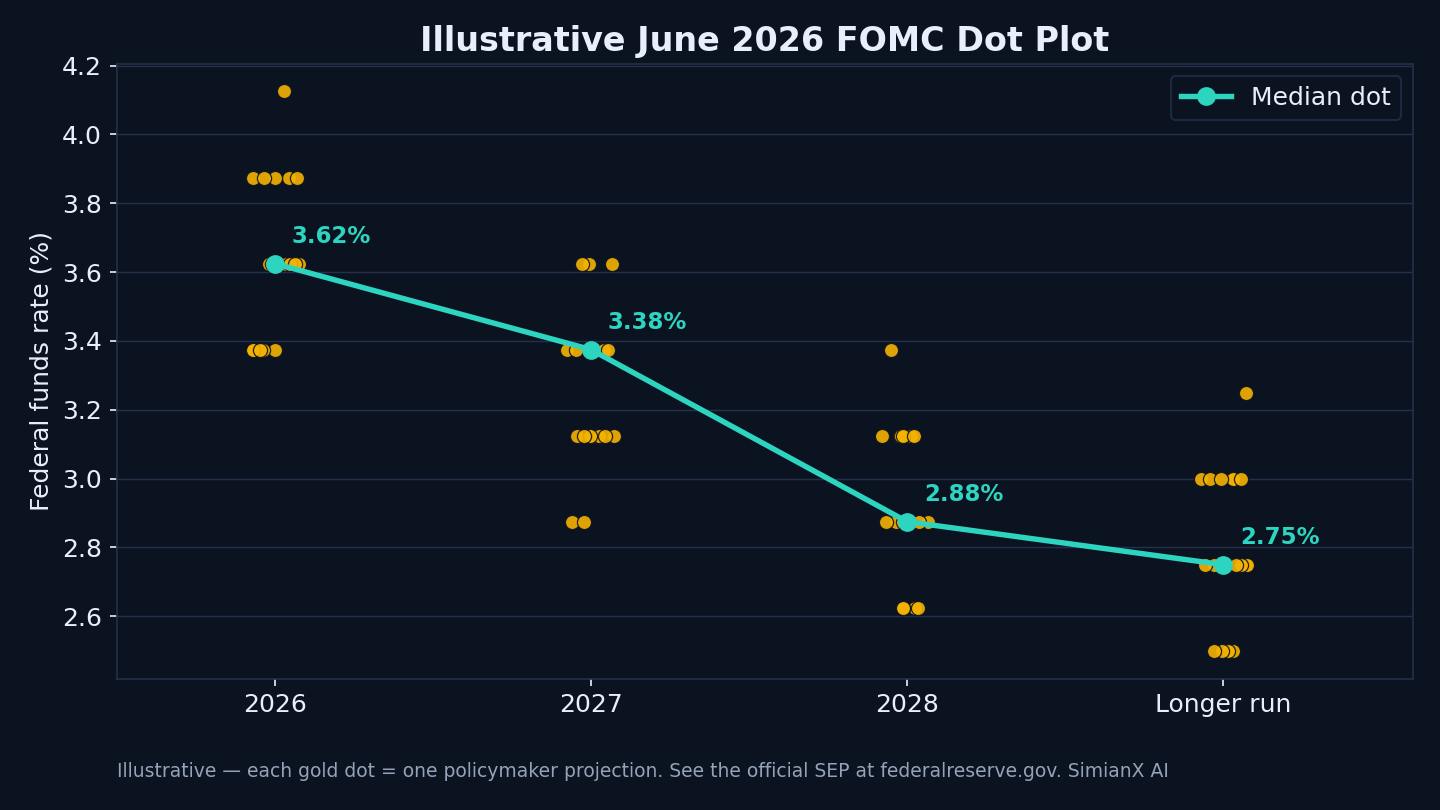
The Fed dot plot is part of the Summary of Economic Projections. It shows where individual Federal Reserve officials think the federal funds rate should be at the end of future calendar years and over the longer run. Each “dot” represents one policymaker’s view, though the dots are anonymous.
The market typically focuses on the median dot, but that can be misleading. The distribution matters. A small shift in only a few dots can change the median, while a wide dispersion of dots can signal disagreement inside the committee.
For investors in AI stocks and Bitcoin, the dot plot matters because it affects expectations for:
| Dot Plot Signal | Market Interpretation | Potential Impact |
|---|---|---|
| Lower median rate path | More dovish policy outlook | Bullish for growth stocks and Bitcoin |
| Higher median rate path | Higher-for-longer policy | Bearish for long-duration assets |
| Wider dot dispersion | More uncertainty | Higher volatility across risk assets |
| Higher inflation projection | Fed may stay restrictive | Pressure on AI multiples and crypto |
| Lower growth projection | Slower economy risk | Mixed: lower yields but weaker earnings outlook |
The dot plot is not a promise. It is a snapshot of policy assumptions. But because markets are forward-looking, even a modest change in the projected path can cause large moves in NVDA, AMD, AVGO, MSFT, QQQ, Bitcoin, Ethereum, and crypto-linked equities.
How Could the June 2026 FOMC Decision Impact AI Stocks?
AI stocks are not one single trade. The market often groups them together, but each part of the AI ecosystem reacts differently to rates and macro expectations.
1. Semiconductor Leaders
Semiconductor names such as NVDA, AMD, and other chip-related companies are highly exposed to AI infrastructure demand. Their valuations can expand when investors believe AI capex will remain strong and financing conditions will not become more restrictive.
A dovish dot plot could support semiconductor stocks by reducing discount-rate pressure. A hawkish dot plot could do the opposite, especially if investors start questioning whether hyperscalers can keep spending aggressively on GPUs, networking, memory, and data centers.
2. Cloud and Hyperscaler Platforms
Companies building large-scale AI infrastructure may be affected through both valuation and capital spending expectations. Higher rates can raise the hurdle rate for long-term projects. Lower expected rates can make future cash flows more valuable and support long-cycle growth narratives.
3. AI Software and Automation Stocks
AI software companies may be more sensitive to revenue durability and enterprise spending. If the Fed sounds hawkish because inflation is sticky, investors may worry about tighter financial conditions. If the Fed sounds dovish because growth is slowing, software stocks may still struggle if customers reduce budgets.
4. Speculative AI Equities
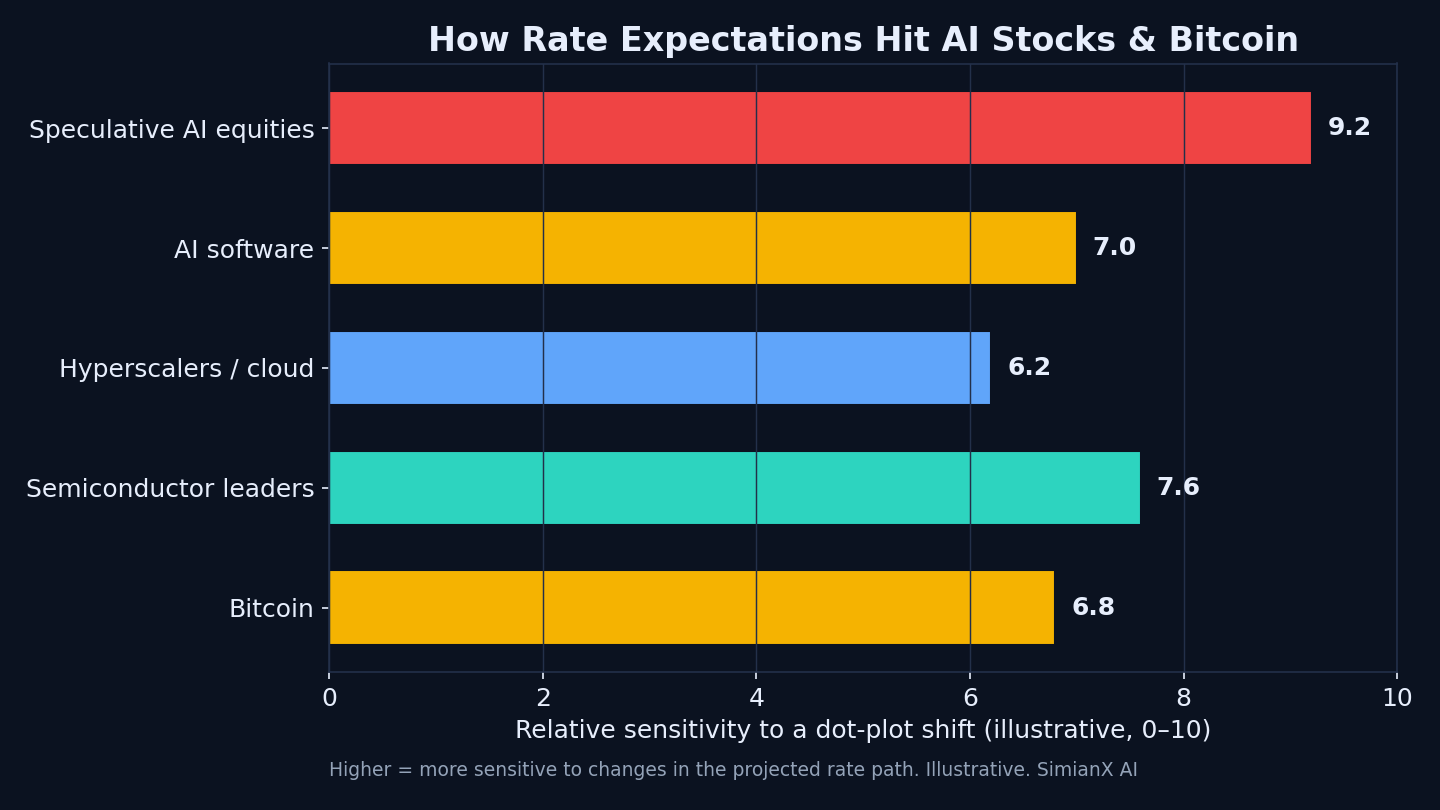
Smaller AI stocks, pre-profit AI names, and highly valued thematic trades are often the most volatile around FOMC events. They may rally hard on lower-rate expectations, but they can also fall sharply when yields rise.
A practical rule: the more a stock depends on future growth rather than current free cash flow, the more sensitive it may be to changes in the dot plot.
How Could the June 2026 FOMC Decision Impact Bitcoin?
Bitcoin’s reaction to the FOMC decision usually depends on three overlapping forces: liquidity, real yields, and risk appetite.
When the Fed signals a more accommodative path, traders may anticipate easier liquidity conditions. That can support Bitcoin, especially if the U.S. dollar softens and real yields move lower. When the Fed signals a tighter path, Bitcoin can face selling pressure as investors reduce leverage and rotate toward yield-bearing assets.
However, Bitcoin’s response is rarely mechanical. It also depends on:
- ETF inflows or outflows
- Stablecoin liquidity
- Exchange reserves
- Futures funding rates
- Options positioning
- Dollar strength
- Geopolitical risk
- Equity market correlation
For example, a dovish dot plot could be bullish for Bitcoin, but if it comes with a sharp downgrade to growth expectations, risk assets may initially sell off. Similarly, a hawkish hold could hurt Bitcoin, but if traders were already positioned for a hawkish outcome, the selloff may be limited.
Bitcoin often reacts less to what the Fed says and more to how the Fed changes liquidity expectations versus what the market already priced in.
June 2026 FOMC Decision Dot Plot Scenarios for AI Stocks and Bitcoin
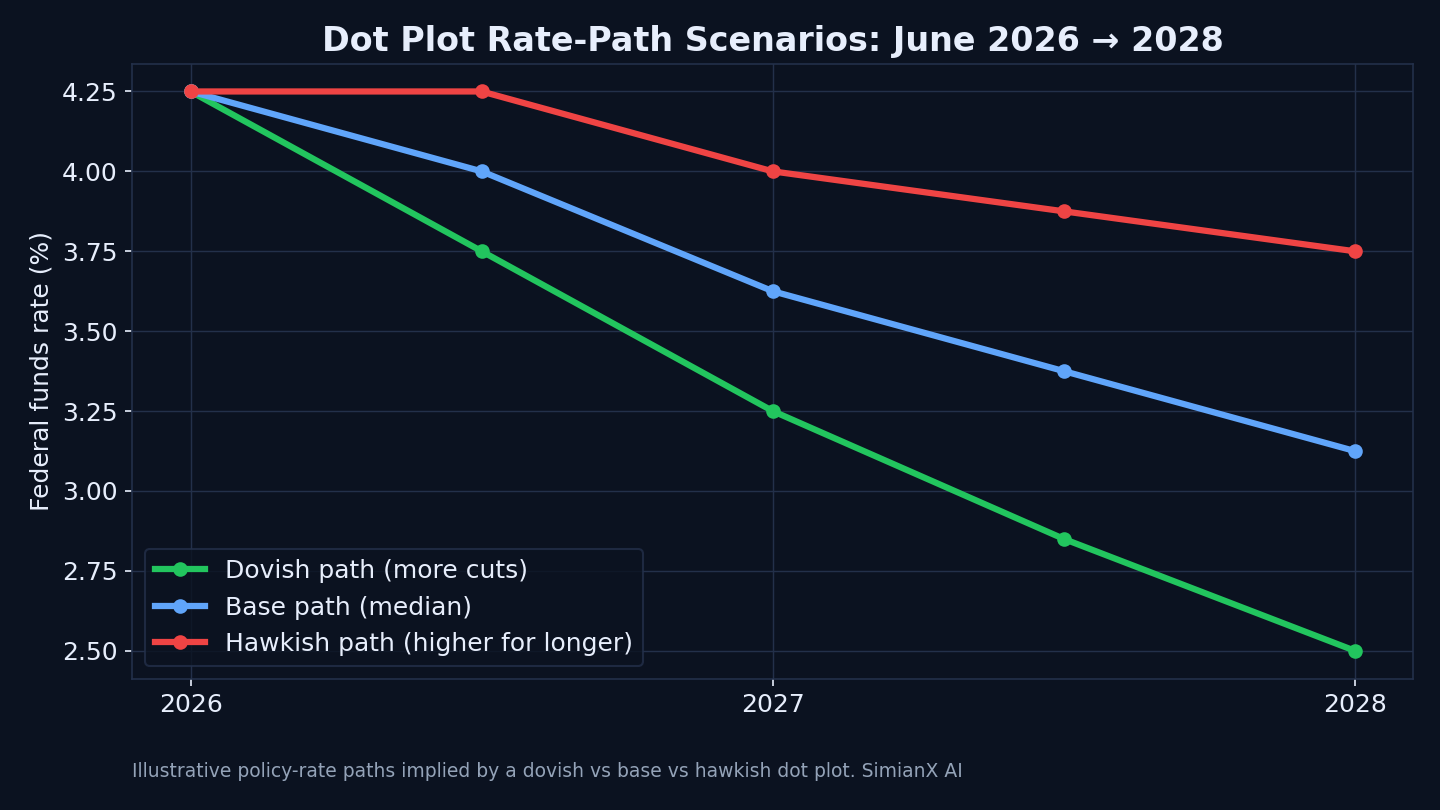
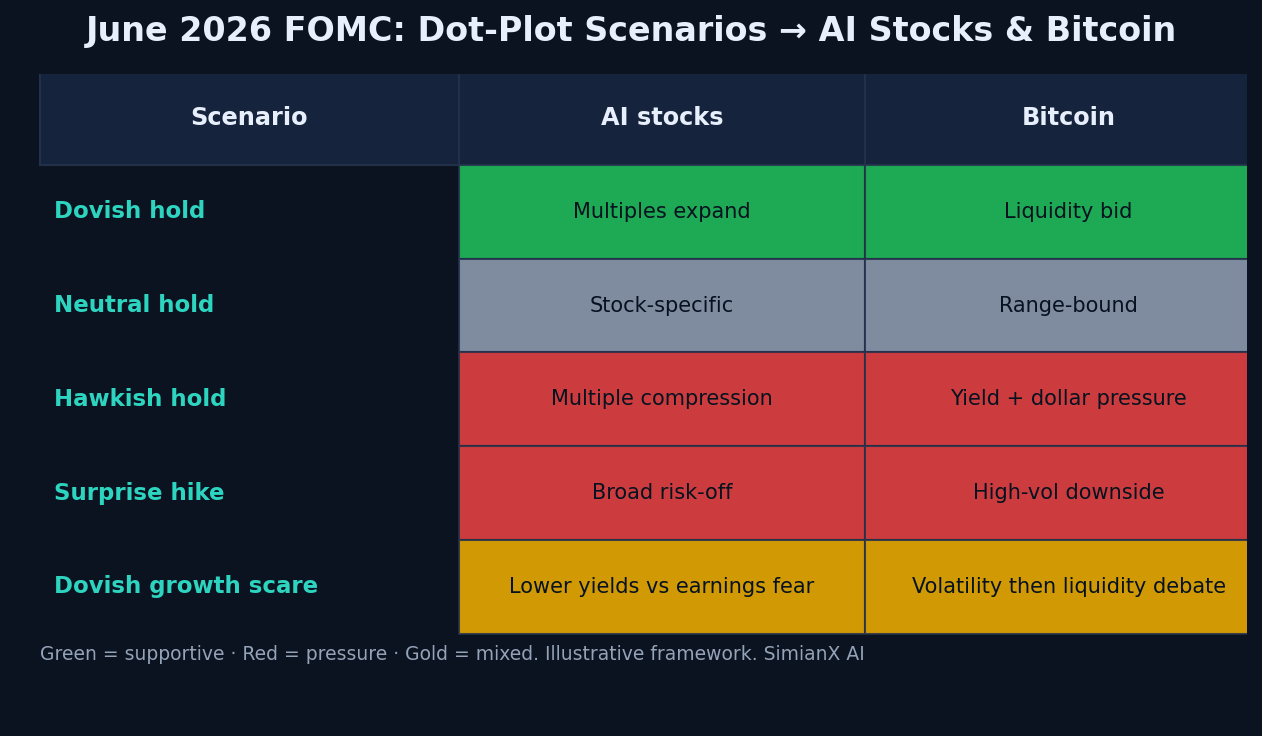
Because the outcome is uncertain, investors should think in scenarios rather than single-point forecasts. Below is a practical framework.
| Scenario | Dot Plot Message | AI Stocks Reaction | Bitcoin Reaction | Trading Takeaway |
|---|---|---|---|---|
| Dovish hold | Median dots shift lower or inflation confidence improves | Growth multiples may expand | Liquidity-sensitive bid possible | Watch breakouts in AI leaders and BTC |
| Neutral hold | Dots mostly unchanged | Stock-specific reactions dominate | Range-bound or choppy | Focus on technical levels and positioning |
| Hawkish hold | Dots move higher or cuts delayed | Multiple compression risk | Pressure from yields and dollar | Reduce leverage and wait for confirmation |
| Surprise hike | Policy shock | Broad risk-off likely | High volatility downside risk | Prioritize risk control over prediction |
| Dovish growth scare | Lower dots but weaker growth outlook | Mixed: lower yields, weaker earnings fear | Initial volatility, then liquidity debate | Separate “bad news” from “easy money” |
The most important distinction is between a dovish hold and a dovish growth scare. Both may involve lower expected rates, but the market interpretation can be very different. AI stocks prefer lower rates with resilient growth. Bitcoin may tolerate weaker growth better if liquidity expectations improve, but only if leverage is not already excessive.
What Should Traders Watch Immediately After the FOMC Statement?
The first reaction after the FOMC statement can be misleading. Algorithmic traders may respond to keywords in milliseconds, but the durable move often develops after the press conference, Treasury yield reaction, and market digestion of the dot plot.
A disciplined post-FOMC workflow should include:
- Compare the new median dot to the prior dot plot.
Did the expected policy rate move up, down, or stay unchanged?
- Check inflation and growth projections.
A higher inflation forecast can be hawkish even if the current rate is unchanged.
- Watch the 2-year Treasury yield.
The 2-year yield is often highly sensitive to Fed expectations.
- Track the U.S. dollar.
A stronger dollar can pressure Bitcoin and global risk appetite.
- Monitor AI leadership breadth.
Are only one or two mega-cap AI names holding up, or is the rally broadening?
- Study Bitcoin funding and open interest.
A price move driven by excessive leverage may reverse quickly.
- Avoid overreacting to the first candle.
FOMC days often produce head fakes before the real trend appears.
This is where SimianX AI can be useful for active investors. Instead of manually checking price action, news sentiment, technical indicators, and macro headlines one by one, traders can use SimianX AI to compare multiple agent perspectives across stocks and crypto in real time.
How to Use SimianX AI for FOMC-Driven Market Research
The June 2026 FOMC decision is exactly the type of event where single-model analysis can miss context. A single analyst may focus only on the Fed statement. A technical trader may focus only on chart levels. A crypto trader may focus only on Bitcoin funding. But macro events affect multiple layers at once.
SimianX AI is designed for multi-agent stock and crypto analysis. A practical FOMC workflow could look like this:
Step 1: Build a Watchlist
Create a focused watchlist instead of trying to analyze everything.
AI stock examples:
NVDAAMDAVGOMSFTGOOGLAMZNTSLA- AI infrastructure ETFs
- Semiconductor ETFs
Crypto examples:
BTCETHSOL- Crypto exchange equities
- Bitcoin miners
- Treasury-heavy Bitcoin proxies
Step 2: Separate Macro, Technicals, and Fundamentals
For each asset, separate the research into three layers:
| Research Layer | Key Question | Example |
|---|---|---|
| Macro | Did the dot plot change liquidity expectations? | Dovish vs hawkish rate path |
| Technical | Is price confirming the macro move? | Breakout, failed breakout, support test |
| Fundamental | Does the business or network support the move? | AI revenue growth or Bitcoin on-chain demand |
Step 3: Score the Outcome
Use a simple scoring model after the FOMC announcement:
| Signal | Bullish | Neutral | Bearish |
|---|---|---|---|
| Dot plot | Lower path | Unchanged | Higher path |
| Inflation language | Confidence improving | Mixed | Sticky inflation |
| 2-year yield | Falling | Flat | Rising |
| Dollar | Falling | Flat | Rising |
| AI breadth | Broad rally | Mega-cap only | Broad weakness |
| BTC structure | Spot-led rally | Choppy | Leverage-led selloff |
A high-quality trade setup occurs when multiple signals align. For example, a lower dot plot, falling 2-year yield, softer dollar, broad AI stock participation, and spot-led Bitcoin strength would create a cleaner bullish setup than any single signal alone.
Step 4: Define Risk Before Entry
FOMC events can create sharp reversals. Before entering a trade, define:
- Entry trigger
- Invalidation level
- Position size
- Maximum loss
- Time horizon
- Whether the trade is event-driven or trend-following
The best way to trade FOMC volatility is not to predict every word from the Fed. It is to prepare scenarios, wait for confirmation, and avoid oversized positions during the most chaotic part of the event window.
What Does the June 2026 FOMC Decision Mean for Long-Term AI Investors?
Long-term AI investors should avoid treating one FOMC meeting as the entire thesis. The AI investment cycle is driven by compute demand, enterprise adoption, model efficiency, infrastructure buildout, and software monetization. Rates matter, but they are not the only factor.
Still, the dot plot can affect entry points and valuation discipline. If the Fed signals higher-for-longer rates, investors may demand stronger earnings visibility before paying premium multiples. If the Fed signals a more accommodative path, the market may reward growth stories more aggressively.
Long-term investors should ask:
- Is the company generating real AI revenue or only AI narrative value?
- Are margins improving or deteriorating?
- Is capex creating durable competitive advantage?
- Does the balance sheet handle higher rates?
- Is valuation supported by realistic growth assumptions?
- Does the stock still work if multiples compress?
AI stocks with strong cash flow, pricing power, and durable demand may handle a hawkish Fed better than speculative AI names with weak fundamentals.
What Does the June 2026 FOMC Decision Mean for Long-Term Bitcoin Investors?
For long-term Bitcoin investors, the dot plot should be viewed as part of the liquidity cycle rather than a direct valuation tool. Bitcoin’s long-term thesis often includes scarcity, decentralization, institutional adoption, and monetary debasement concerns. The Fed’s policy path can accelerate or delay market cycles, but it does not define the entire asset.
A hawkish dot plot may pressure Bitcoin in the short term by lifting yields and reducing speculative appetite. A dovish dot plot may support Bitcoin by improving liquidity expectations. But long-term investors should also monitor:
- ETF adoption
- Custody infrastructure
- Regulatory clarity
- Stablecoin liquidity
- Miner economics
- Exchange supply
- Long-term holder behavior
- Global currency and sovereign debt concerns
The key is to distinguish short-term FOMC volatility from long-term Bitcoin allocation logic.
Risk Management Checklist for FOMC Volatility
FOMC events can produce fast, emotional, and misleading price action. Before trading AI stocks or Bitcoin around the June 2026 FOMC decision, use this checklist:
- Do not trade without a scenario plan.
- Avoid using maximum leverage into the announcement.
- Wait for bond yields and the dollar to confirm the equity or crypto move.
- Separate first reaction from sustained trend.
- Avoid chasing the first breakout without volume confirmation.
- Use stop losses based on structure, not emotion.
- Reduce position size if volatility expands sharply.
- Track correlations between AI stocks, Nasdaq, and Bitcoin.
- Review whether the move is spot-driven or derivatives-driven.
- Document the trade thesis before entering.
A simple rule can help: if you cannot explain why the dot plot supports your trade in one paragraph, the setup may not be clear enough.
FAQ About the June 2026 FOMC Decision and Dot Plot Impact
How does the Fed dot plot affect Bitcoin prices?
The Fed dot plot affects Bitcoin by changing expectations for future interest rates, liquidity, real yields, and risk appetite. A lower projected rate path can support Bitcoin if traders interpret it as easier liquidity, while a higher projected path can pressure Bitcoin through stronger yields and reduced speculative demand.
What happens to AI stocks after a hawkish FOMC decision?
After a hawkish FOMC decision, AI stocks can face valuation pressure because higher expected rates reduce the present value of future growth. The most speculative AI names usually react more sharply, while profitable AI leaders with strong cash flow may hold up better.
Is the June 2026 FOMC decision bullish or bearish for Bitcoin?
The June 2026 FOMC decision can be bullish or bearish depending on the dot plot, inflation language, Treasury yield reaction, and market positioning. A dovish surprise may support Bitcoin, but a hawkish hold or higher-for-longer message may create downside pressure.
What is the best way to trade AI stocks around FOMC volatility?
The best way to trade AI stocks around FOMC volatility is to prepare scenarios before the announcement, wait for confirmation from yields and price action, and control position size. Traders should focus on high-liquidity names and avoid chasing the first move without confirmation.
Why should investors use multi-agent analysis for FOMC market research?
Multi-agent analysis is useful because FOMC decisions affect macro conditions, technical price action, sentiment, fundamentals, and risk management at the same time. A platform like SimianX AI can help investors compare these perspectives instead of relying on a single viewpoint.
Conclusion
The June 2026 FOMC Decision: Dot Plot Impact on AI Stocks & Bitcoin is not just a central bank headline. It is a test of how markets price liquidity, inflation risk, valuation multiples, and speculative appetite.
For AI stocks, the dot plot can influence whether investors are willing to keep paying premium multiples for long-term growth. For Bitcoin, the same dot plot can shift expectations for liquidity, real yields, the dollar, and leverage. The most important market reaction will likely come from the gap between what the Fed signals and what traders already expected.
The right approach is not to guess blindly. Build scenarios, track the dot plot, watch yields, compare AI stock breadth, analyze Bitcoin market structure, and manage risk before the volatility arrives.
To turn this kind of macro event into a structured research workflow, explore SimianX AI. SimianX AI can help traders and investors analyze stocks and crypto through multiple specialist perspectives, making it easier to navigate FOMC-driven volatility with discipline instead of emotion.
Related Reading
- Bitcoin After Every Fed Rate Cut: 2019-2026 Reference
- US CPI vs Crypto: 5%-Day Swings & Rate-Bet Playbook
- Why US Stocks & Crypto Plummeted This Week: The Causes
- The Magnificent 7 in 2026: Weights & Concentration Risk
- Bitcoin Halving Cycles: Complete Returns Reference 2012-2028
- BTC vs ETH vs SOL: Best Buy Zones in the 2026 Crypto Dip
- 30+ AI Models, 6 Providers Live: Crypto Trade Leaderboard